
THE PESSIMIST COMPLAINS ABOUT THE WIND THE OPTIMIST

“THE PESSIMIST COMPLAINS ABOUT THE WIND; THE OPTIMIST EXPECTS IT TO CHANGE; THE REALIST ADJUSTS THE SAILS. ” WILLIAM A. WARD
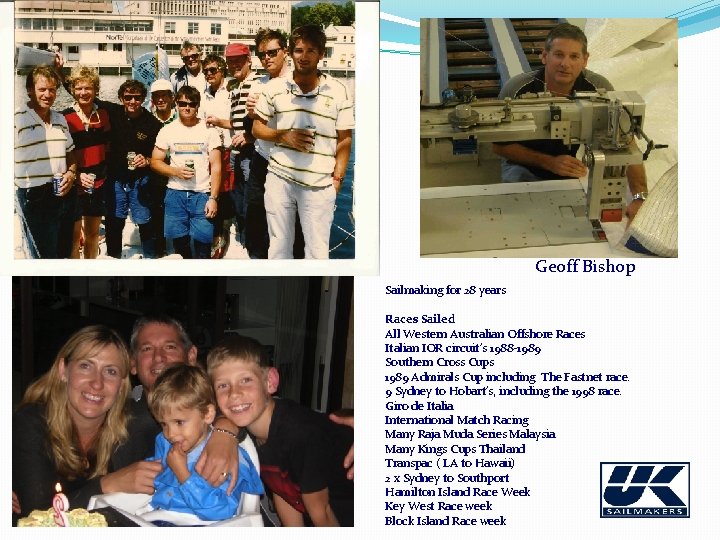
Geoff Bishop Sailmaking for 28 years Races Sailed All Western Australian Offshore Races Italian IOR circuit’s 1988 -1989 Southern Cross Cups 1989 Admirals Cup including The Fastnet race. 9 Sydney to Hobart’s, including the 1998 race. Giro de Italia International Match Racing Many Raja Muda Series Malaysia Many Kings Cups Thailand Transpac ( LA to Hawaii) 2 x Sydney to Southport Hamilton Island Race Week Key West Race week Block Island Race week
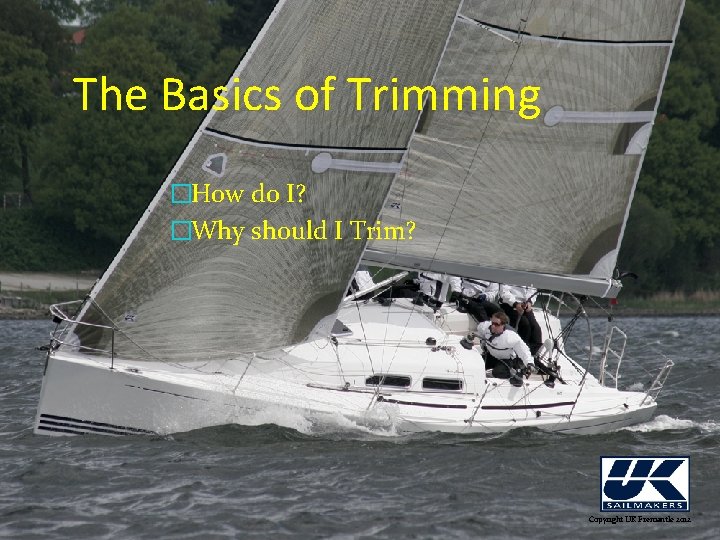
The Basics of Trimming �How do I? �Why should I Trim? Copyright UK Fremantle 2012
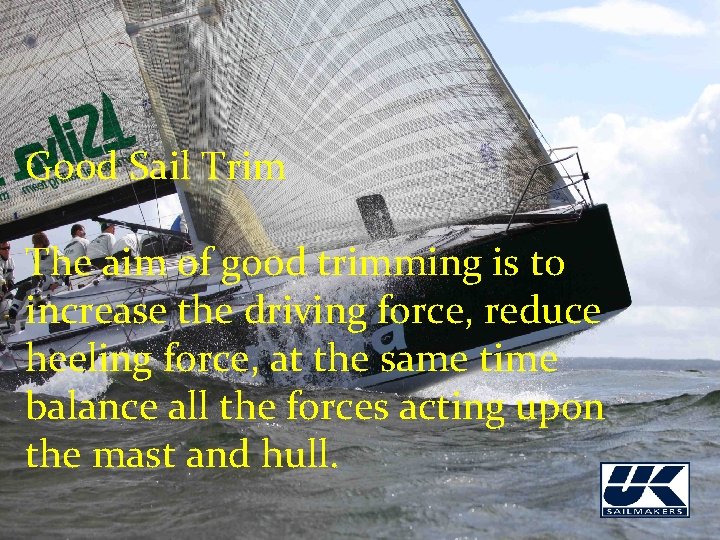
Good Sail Trim The aim of good trimming is to increase the driving force, reduce heeling force, at the same time balance all the forces acting upon the mast and hull.
Why? �Wind speed angle is always varying �Waves or current varies �It may be different from tack to tack �Because we want to sail fast and comfortably Copyright UK Fremantle 2012
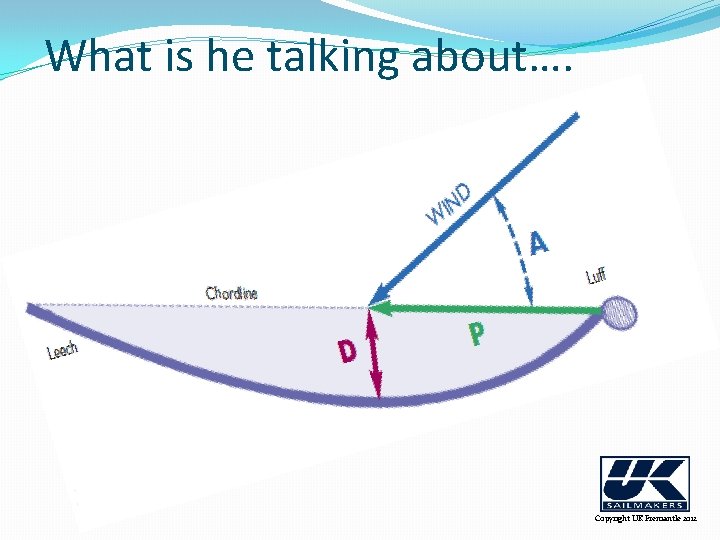
What is he talking about…. Copyright UK Fremantle 2012
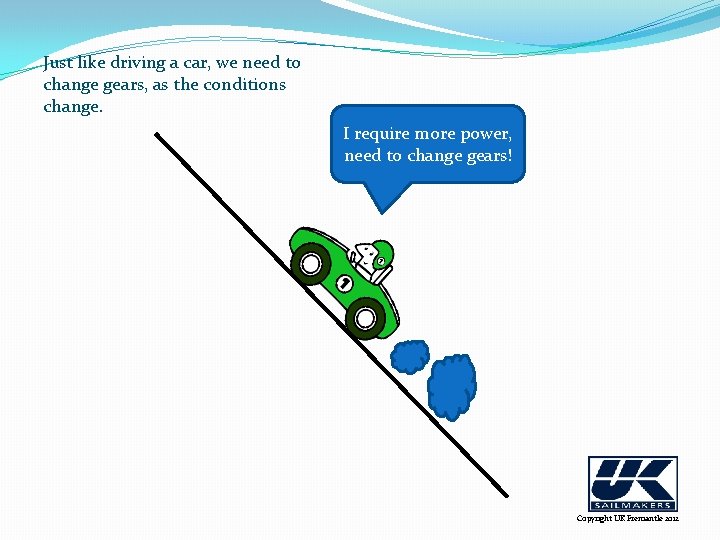
Just like driving a car, we need to change gears, as the conditions change. I require more power, need to change gears! Copyright UK Fremantle 2012
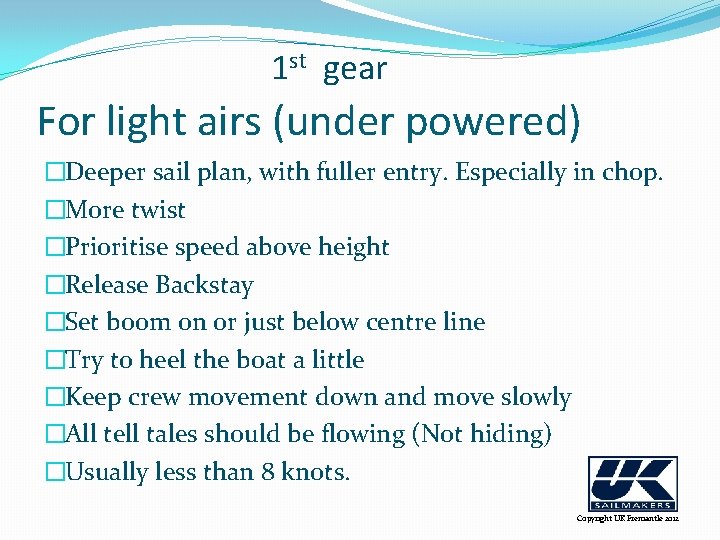
1 st gear For light airs (under powered) �Deeper sail plan, with fuller entry. Especially in chop. �More twist �Prioritise speed above height �Release Backstay �Set boom on or just below centre line �Try to heel the boat a little �Keep crew movement down and move slowly �All tell tales should be flowing (Not hiding) �Usually less than 8 knots. Copyright UK Fremantle 2012
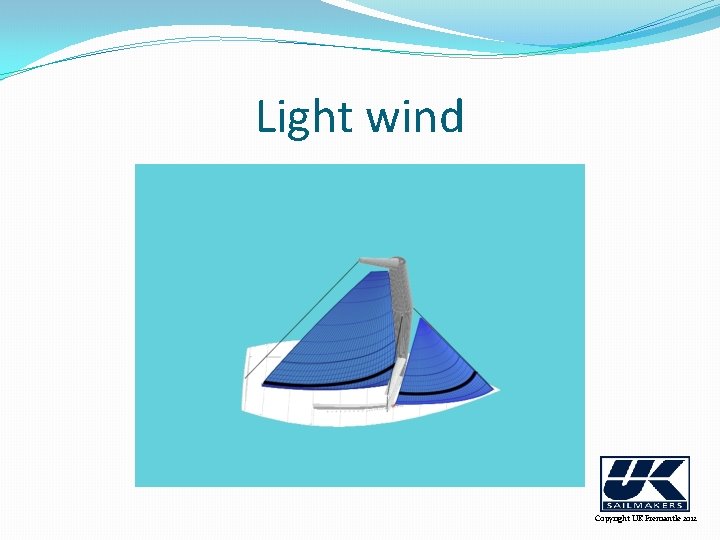
Light wind Copyright UK Fremantle 2012
2 nd gear Moderate wind (full power) �Keep Boat flat, crew weight. �Tight leech �Boom in Middle �Top leech tell tales, hiding half the time �Max Speed, with height trim (tell tales 45 degrees up) �Flatter sail plan �Wind speed between 8 to 15 Knots. Copyright UK Fremantle 2012
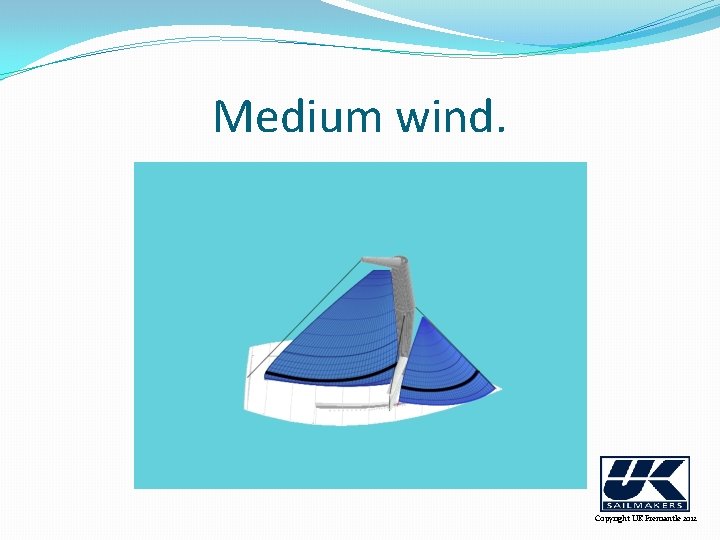
Medium wind. Copyright UK Fremantle 2012
3 rd gear Heavy wind (over powered) �Reduce heel �Flatten Sails ( backstay, sheet tension, car position) �Twist sails �Sail to the conditions, keep helm balanced � Helmsman sail to telltales & keep constant heel angle �Trim to what feels fast. �Sail to a slightly larger wind angle �Wind speed above 15 knots. Copyright UK Fremantle 2012
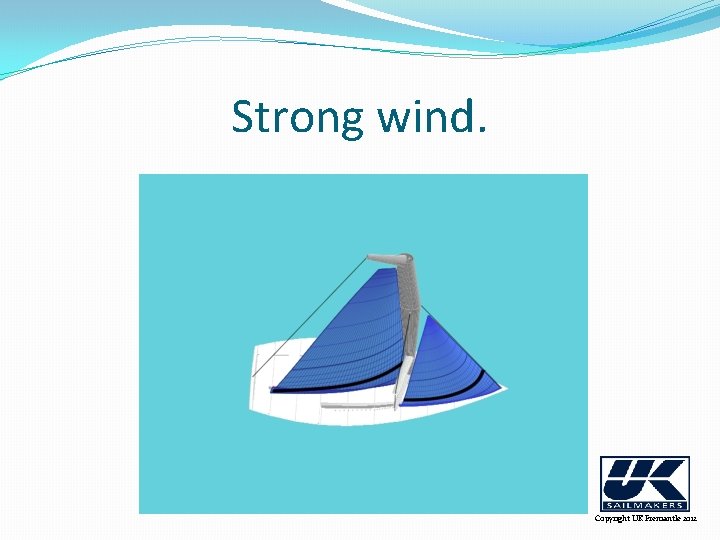
Strong wind. Copyright UK Fremantle 2012
Mainsail trim What are our telltales, telling us? Copyright UK Fremantle 2012
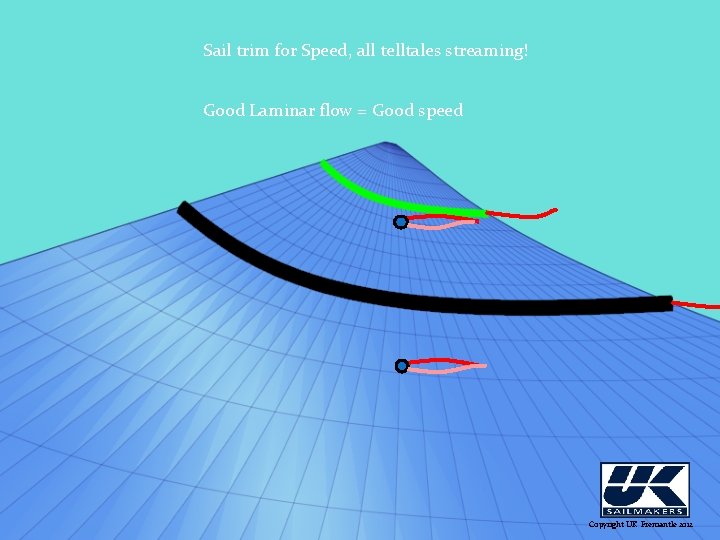
Sail trim for Speed, all telltales streaming! Rätt skotat! Good Laminar flow = Good speed Copyright UK Fremantle 2012
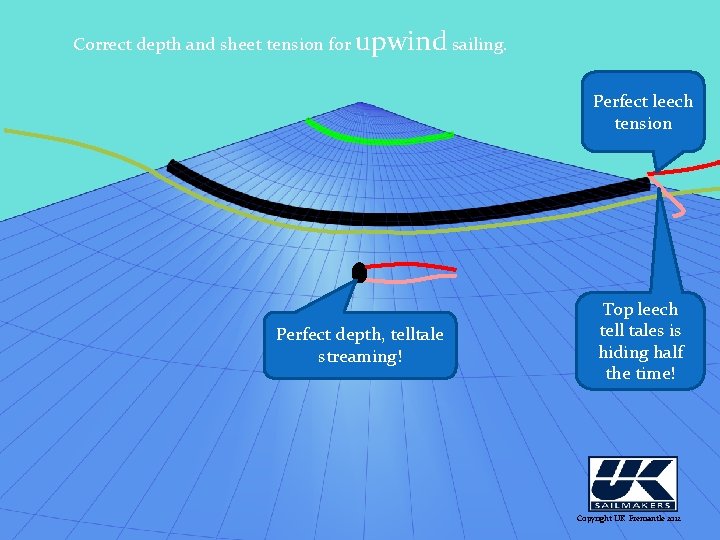
Correct depth and sheet tension for upwind sailing. Perfect leech tension Perfect depth, telltale streaming! Top leech tell tales is hiding half the time! Copyright UK Fremantle 2012
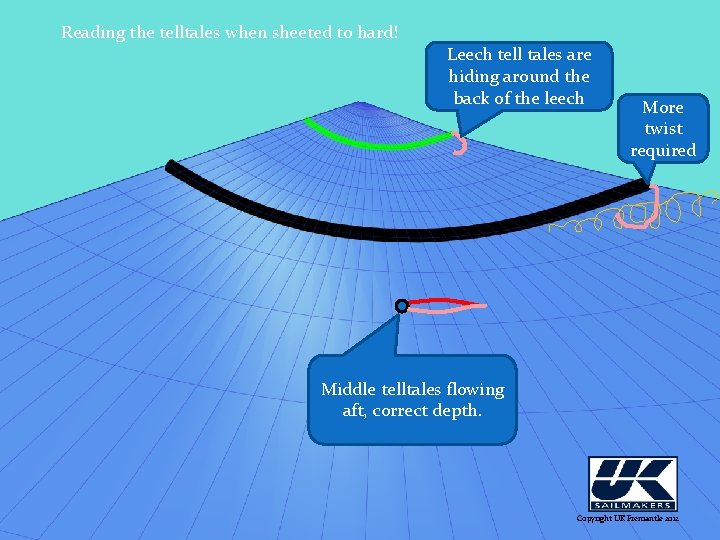
Reading the telltales when sheeted to hard! Leech tell tales are hiding around the back of the leech More twist required Middle telltales flowing aft, correct depth. Copyright UK Fremantle 2012
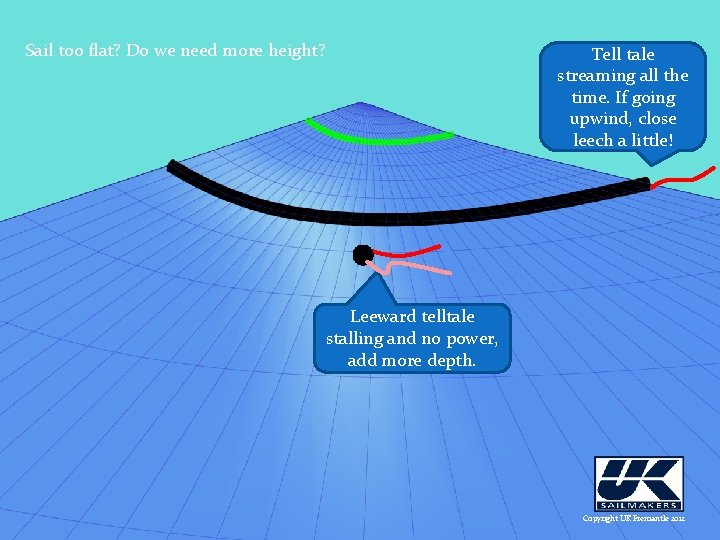
Sail too flat? Do we need more height? Tell tale streaming all the time. If going upwind, close leech a little! Leeward telltale stalling and no power, add more depth. Copyright UK Fremantle 2012
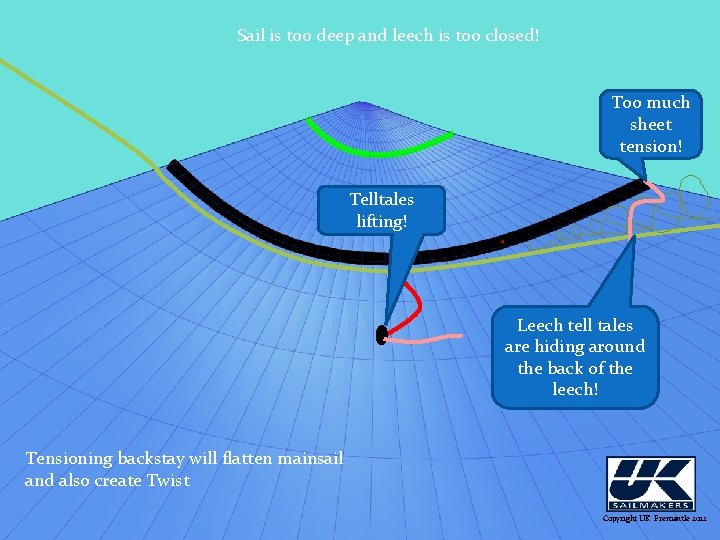
Sail is too deep and leech is too closed! Too much sheet tension! Telltales lifting! Leech tell tales are hiding around the back of the leech! Tensioning backstay will flatten mainsail and also create Twist Copyright UK Fremantle 2012
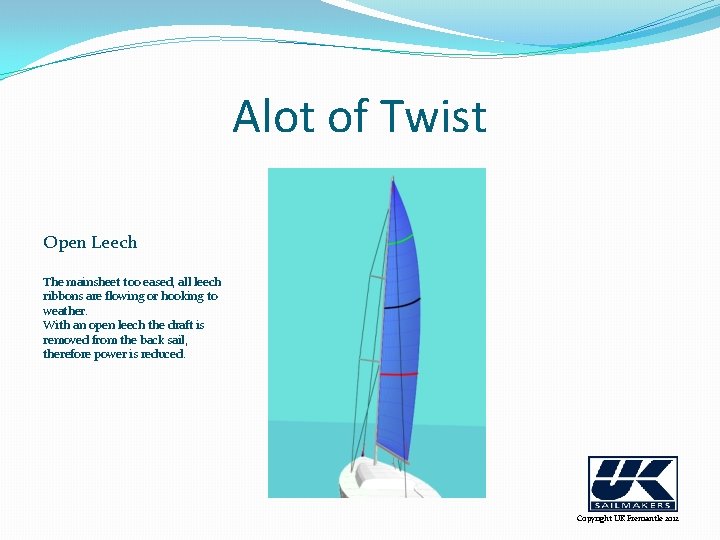
Alot of Twist Open Leech The mainsheet too eased, all leech ribbons are flowing or hooking to weather. With an open leech the draft is removed from the back sail, therefore power is reduced. Copyright UK Fremantle 2012
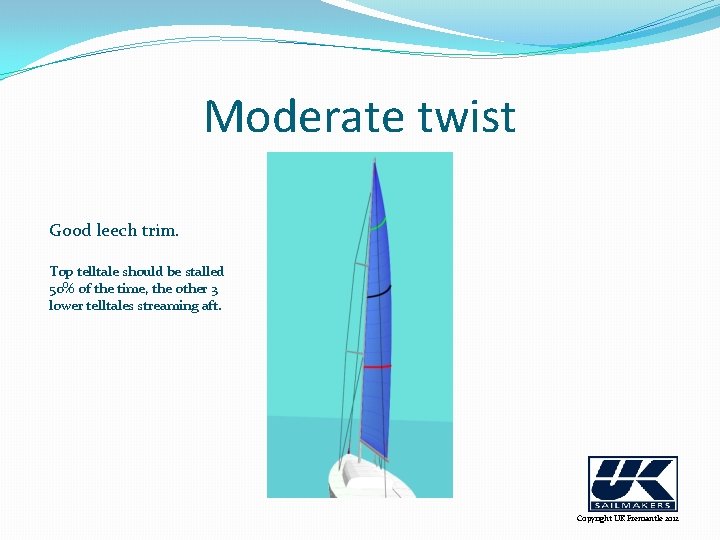
Moderate twist Good leech trim. Top telltale should be stalled 50% of the time, the other 3 lower telltales streaming aft. Copyright UK Fremantle 2012
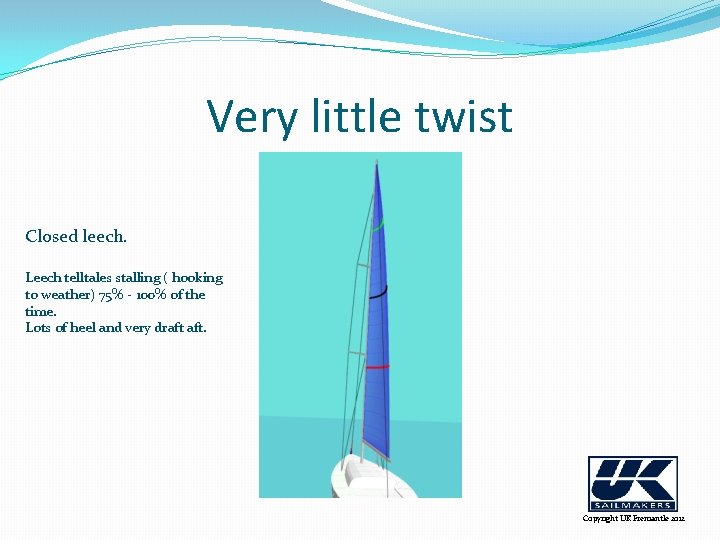
Very little twist Closed leech. Leech telltales stalling ( hooking to weather) 75% - 100% of the time. Lots of heel and very draft aft. Copyright UK Fremantle 2012
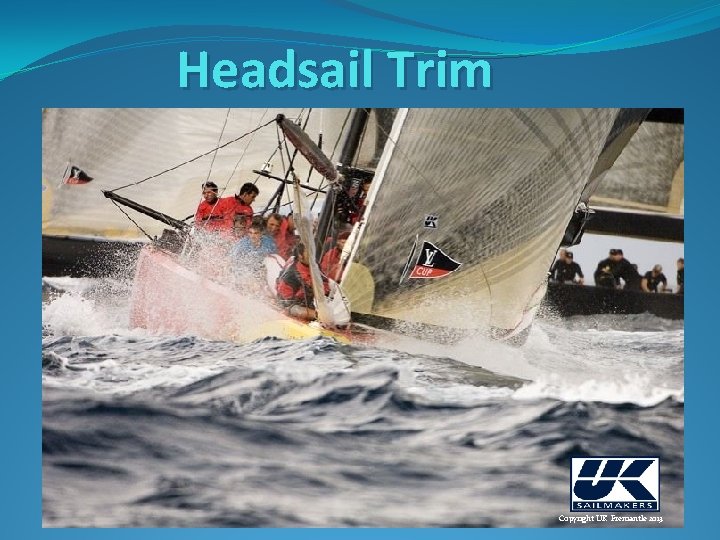
Headsail Trim Copyright UK Fremantle 2013
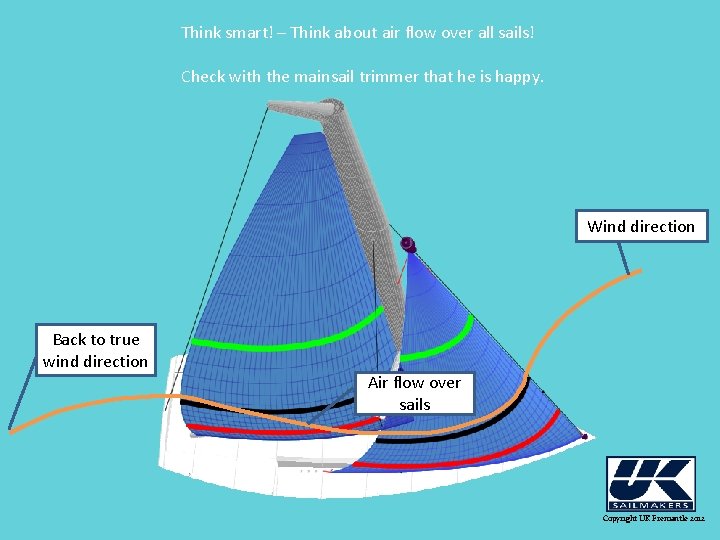
Think smart! – Think about air flow over all sails! Check with the mainsail trimmer that he is happy. Wind direction Back to true wind direction Air flow over sails Copyright UK Fremantle 2012
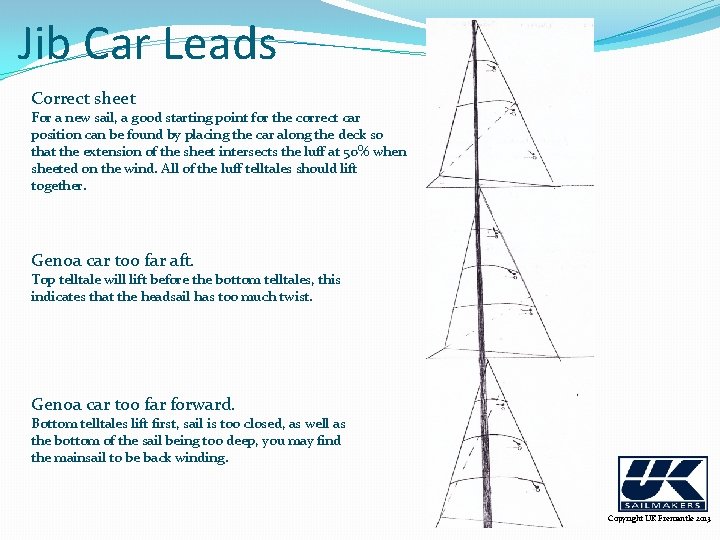
Jib Car Leads Correct sheet For a new sail, a good starting point for the correct car position can be found by placing the car along the deck so that the extension of the sheet intersects the luff at 50% when sheeted on the wind. All of the luff telltales should lift together. Genoa car too far aft. Top telltale will lift before the bottom telltales, this indicates that the headsail has too much twist. Genoa car too far forward. Bottom telltales lift first, sail is too closed, as well as the bottom of the sail being too deep, you may find the mainsail to be back winding. Copyright UK Fremantle 2013
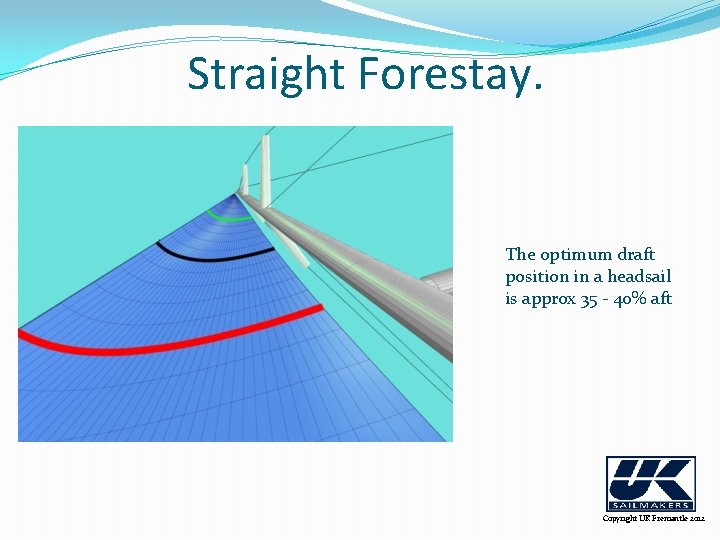
Straight Forestay. The optimum draft position in a headsail is approx 35 - 40% aft Copyright UK Fremantle 2012
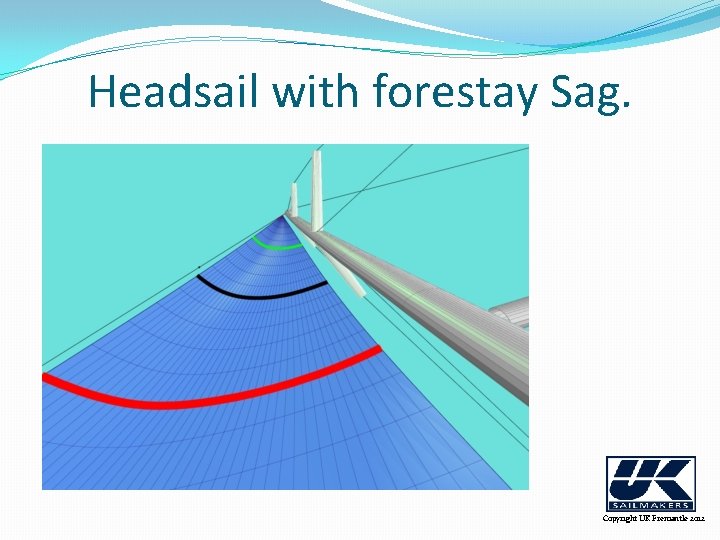
Headsail with forestay Sag. Copyright UK Fremantle 2012
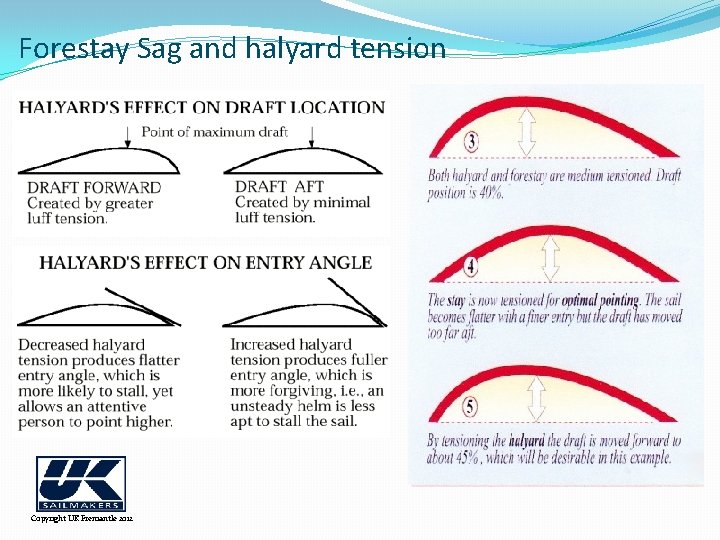
Forestay Sag and halyard tension Copyright UK Fremantle 2012
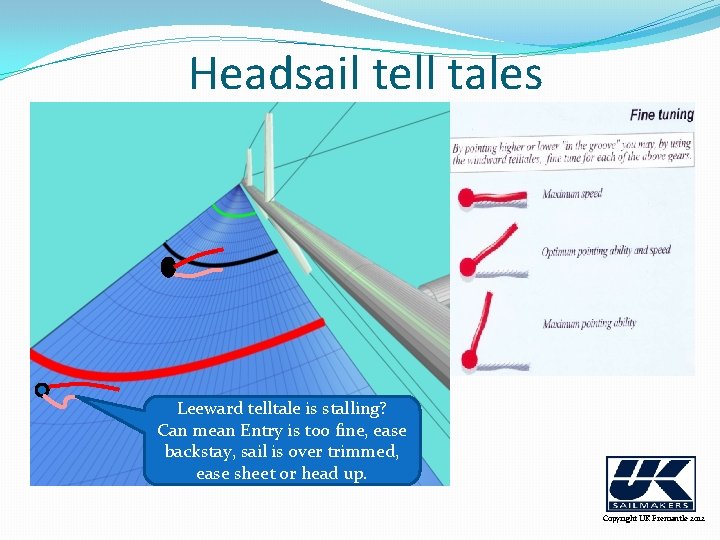
Headsail tell tales Leeward telltale is stalling? Can mean Entry is too fine, ease backstay, sail is over trimmed, ease sheet or head up. Copyright UK Fremantle 2012
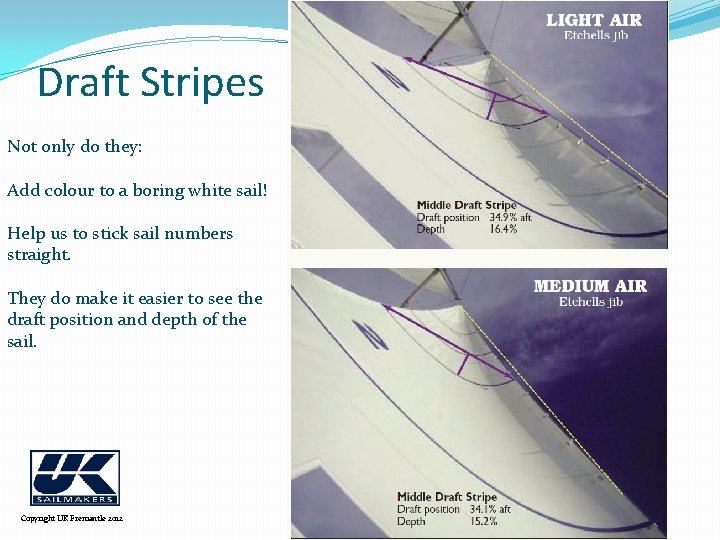
Draft Stripes Not only do they: Add colour to a boring white sail! Help us to stick sail numbers straight. They do make it easier to see the draft position and depth of the sail. Copyright UK Fremantle 2012
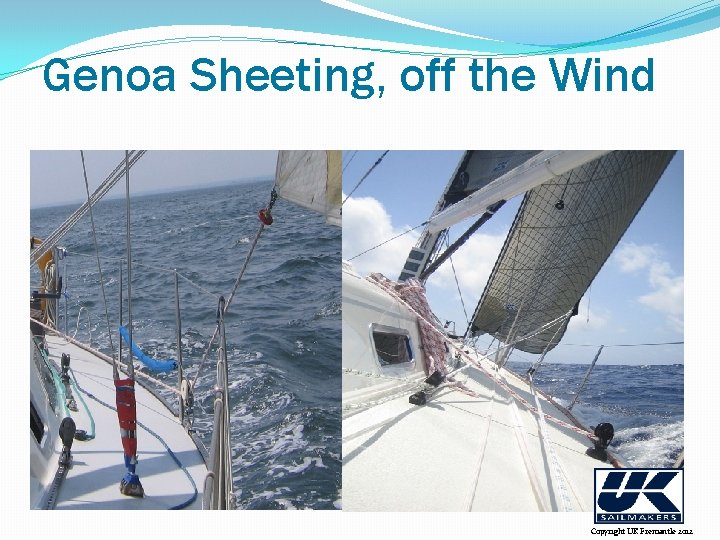
Genoa Sheeting, off the Wind Copyright UK Fremantle 2012
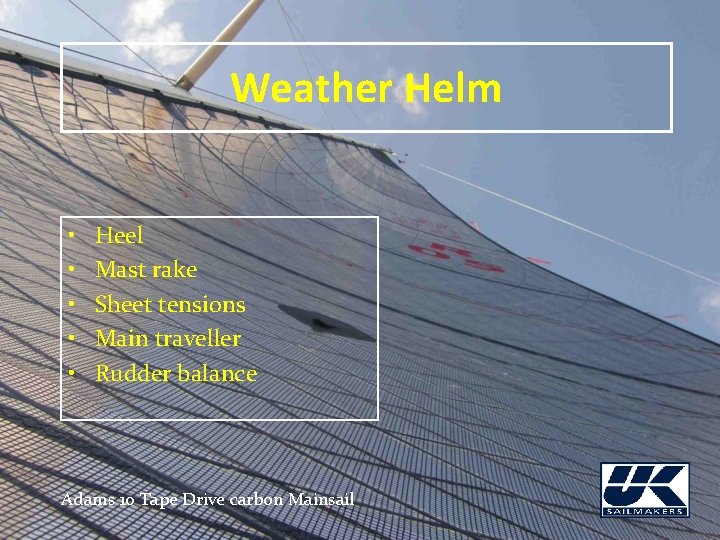
Weather Helm • • • Heel Mast rake Sheet tensions Main traveller Rudder balance Adams 10 Tape Drive carbon Mainsail
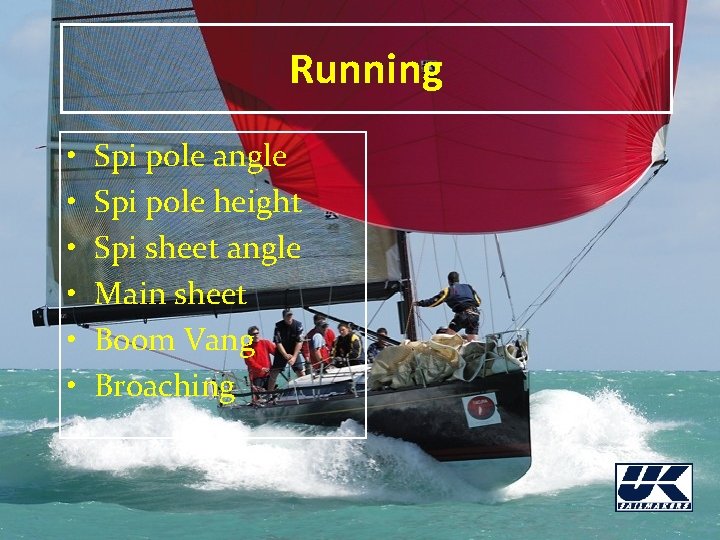
Running • • • Spi pole angle Spi pole height Spi sheet angle Main sheet Boom Vang Broaching
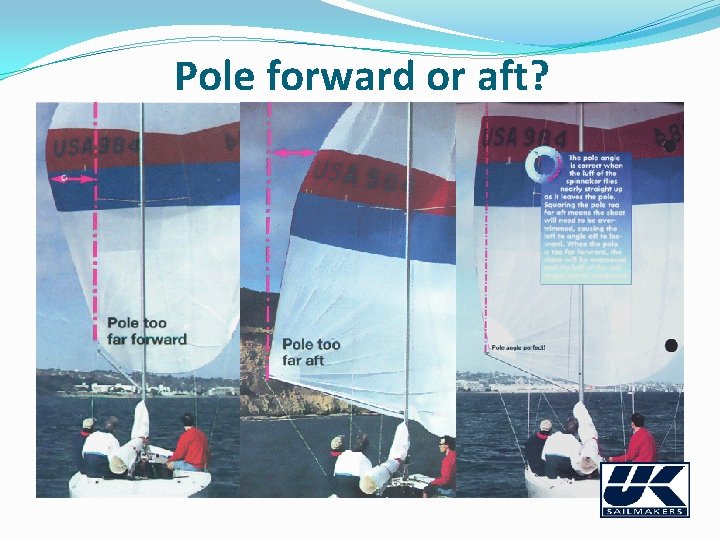
Pole forward or aft?
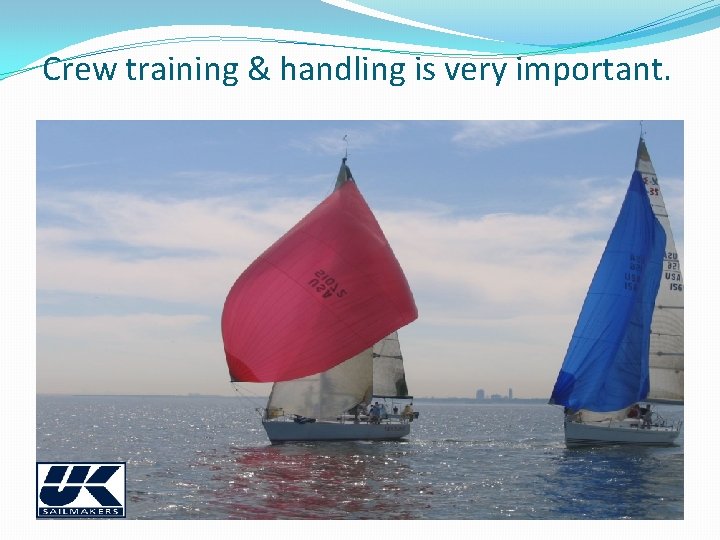
Crew training & handling is very important.

What are the major changes in the Sailmaking industry? In the last 10 years! Copyright UK Fremantle 2012
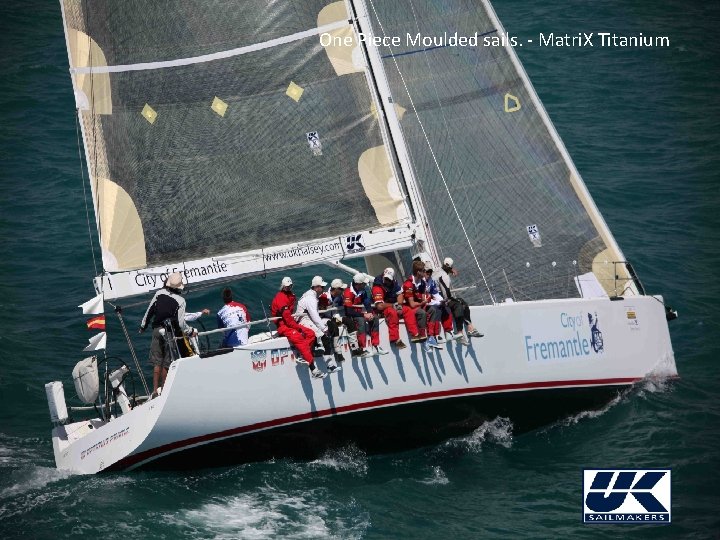
One Piece Moulded sails. - Matri. X Titanium
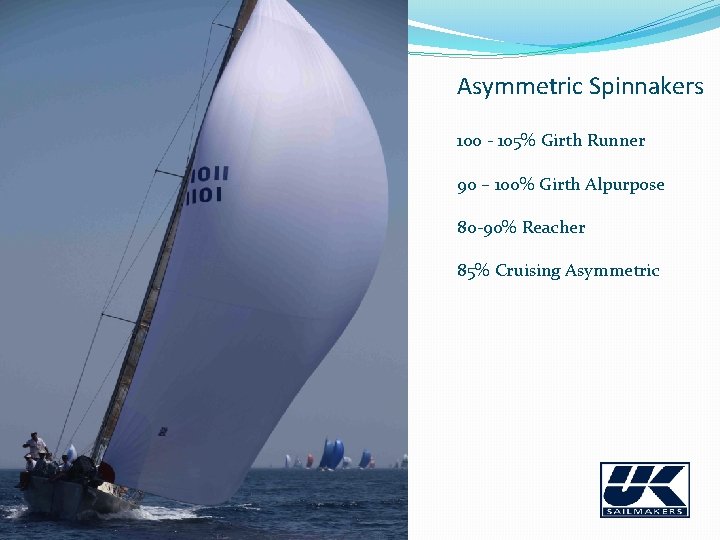
Asymmetric Spinnakers 100 - 105% Girth Runner 90 – 100% Girth Alpurpose 80 -90% Reacher 85% Cruising Asymmetric
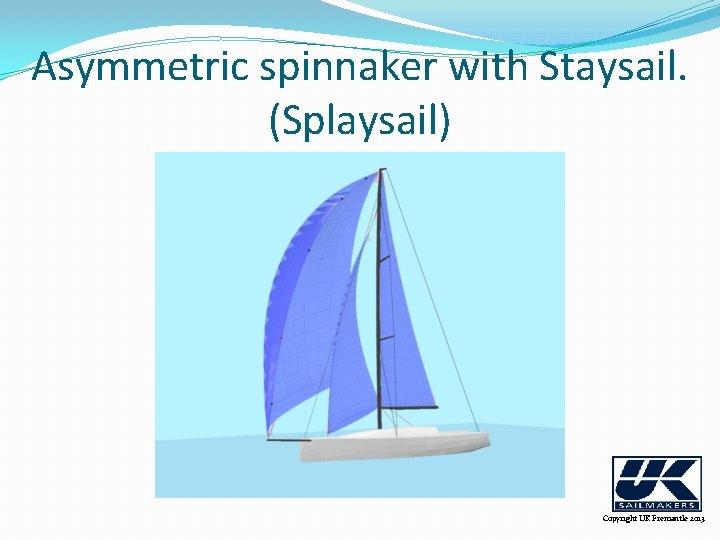
Asymmetric spinnaker with Staysail. (Splaysail) Copyright UK Fremantle 2013
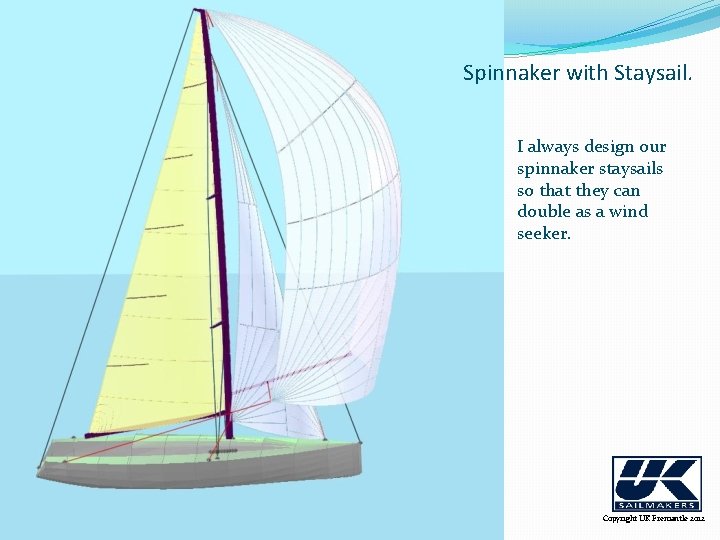
Spinnaker with Staysail. I always design our spinnaker staysails so that they can double as a wind seeker. Copyright UK Fremantle 2012
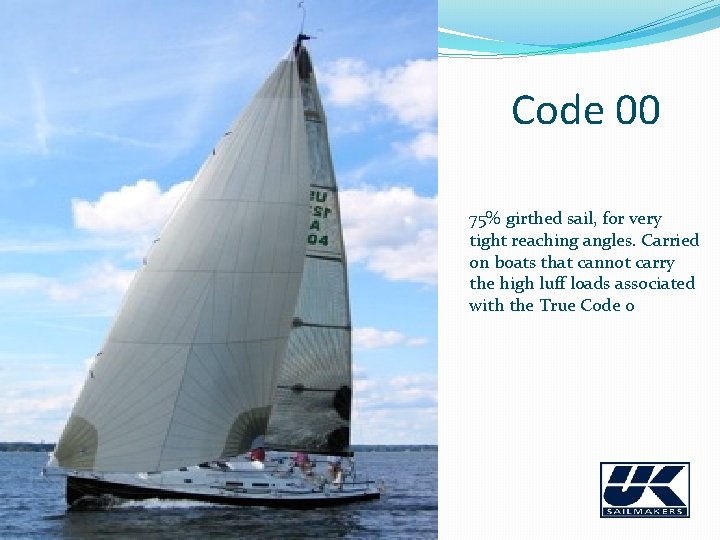
Code 00 75% girthed sail, for very tight reaching angles. Carried on boats that cannot carry the high luff loads associated with the True Code 0
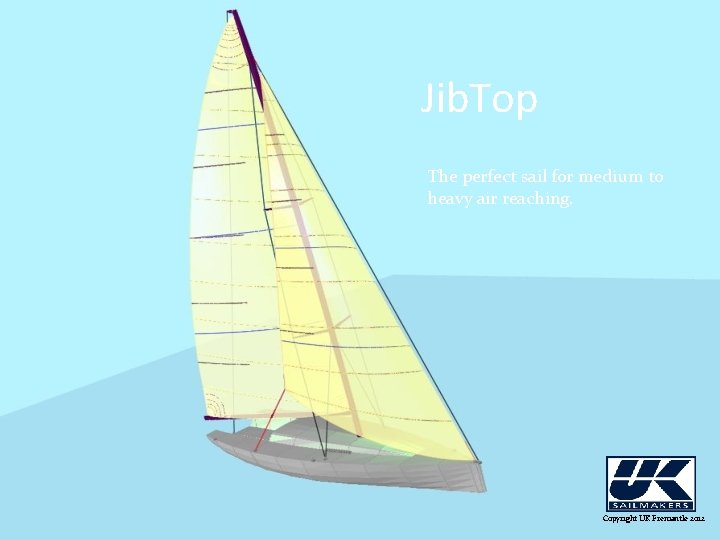
Jib. Top The perfect sail for medium to heavy air reaching. Copyright UK Fremantle 2012
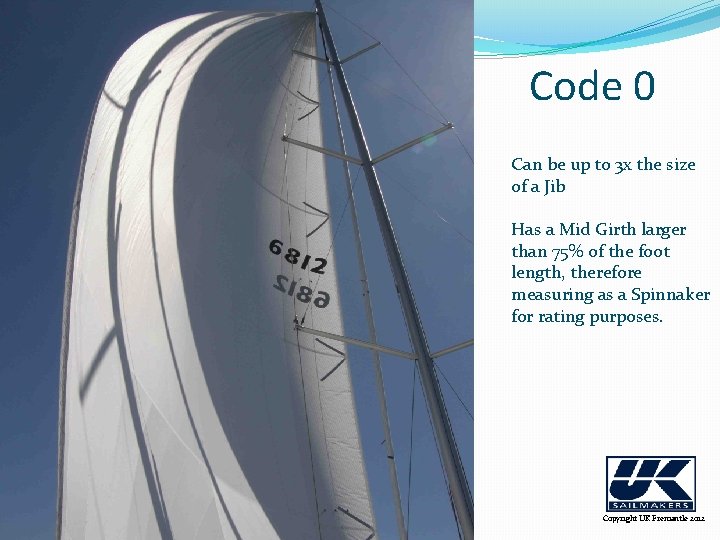
Code 0 Can be up to 3 x the size of a Jib Has a Mid Girth larger than 75% of the foot length, therefore measuring as a Spinnaker for rating purposes. Copyright UK Fremantle 2012
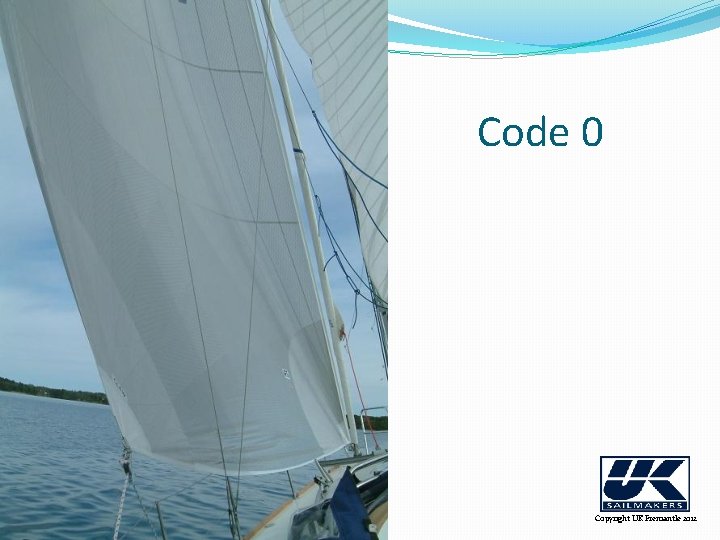
Code 0 Copyright UK Fremantle 2012
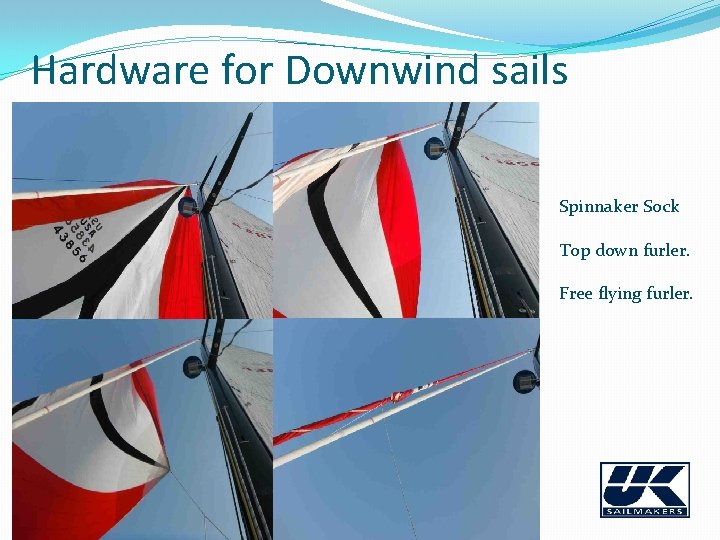
Hardware for Downwind sails Spinnaker Sock Top down furler. Free flying furler.
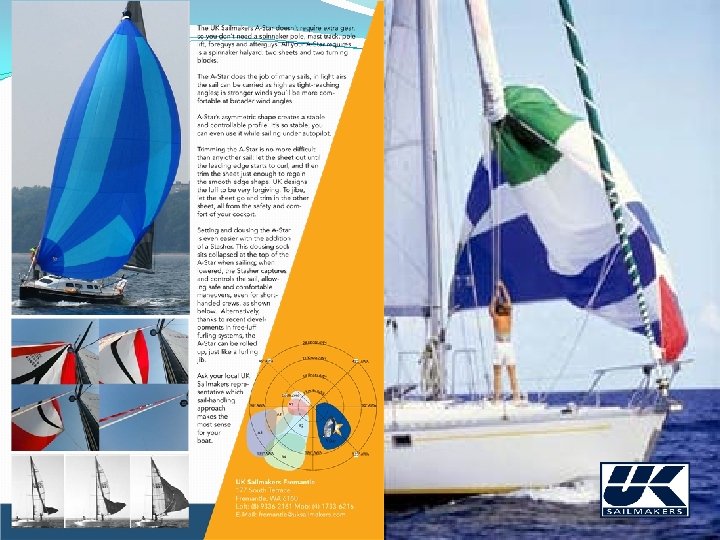
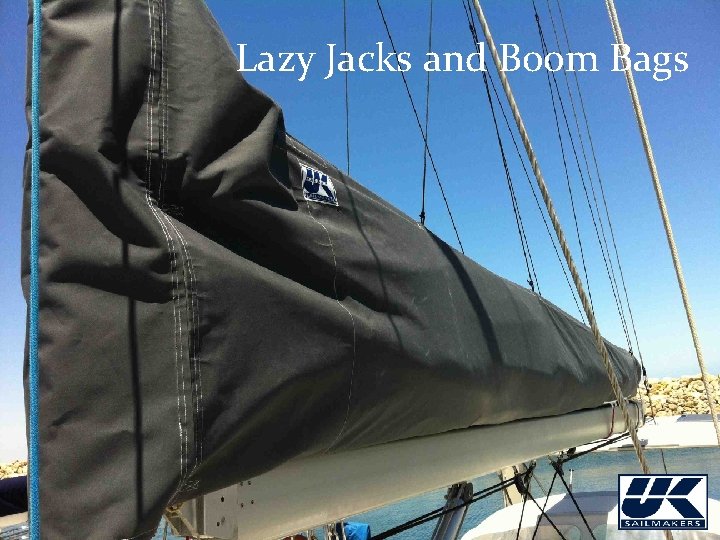
Lazy Jacks and Boom Bags
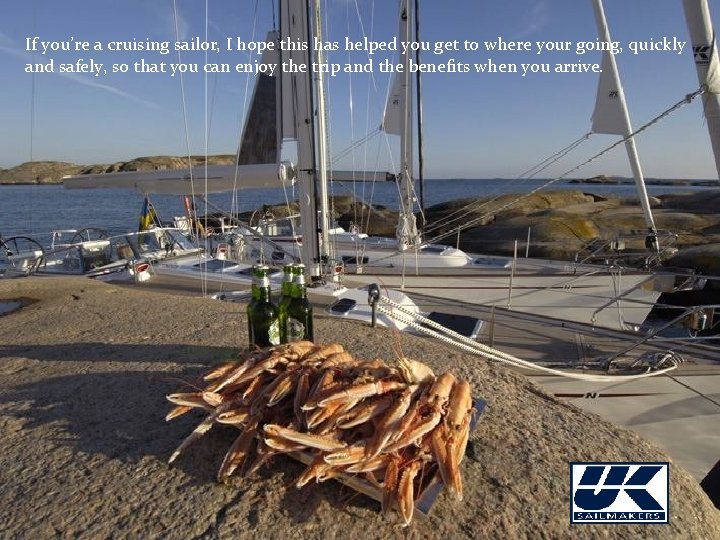
If you’re a cruising sailor, I hope this has helped you get to where your going, quickly and safely, so that you can enjoy the trip and the benefits when you arrive.
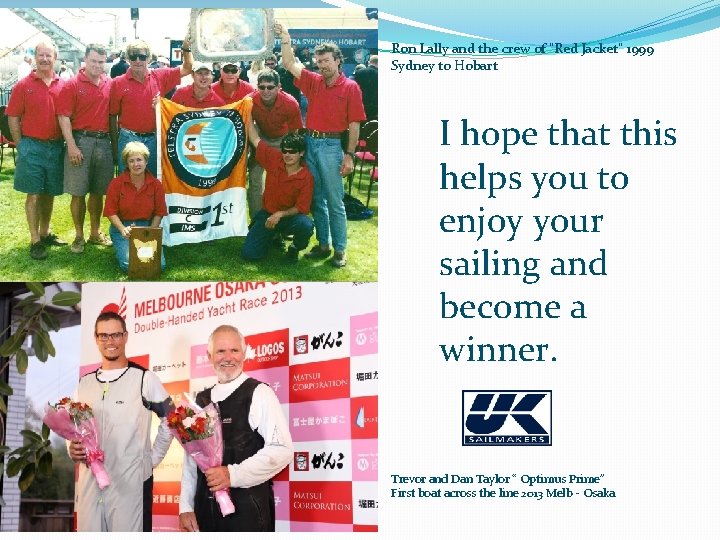
Ron Lally and the crew of “Red Jacket” 1999 Sydney to Hobart I hope that this helps you to enjoy your sailing and become a winner. Trevor and Dan Taylor “ Optimus Prime” First boat across the line 2013 Melb - Osaka
Questions? Geoff Bishop 177 South Terrace, Fremantle. 6160. Ph: 9336 2161 E-mail: ukhalsey@iinet. au Copyright UK Fremantle 2012

Website
Join us on facebook- UK Sailmakers Fremantle
- Slides: 52