
The Personal Statement Strategies for Supporting Students UC

![Focus on Academic Preparation (#1) Question: Ø [Freshman Applicants] How have you taken advantage](https://slidetodoc.com/presentation_image_h2/22d3a12201e6ae5ad4f26eccf22925fa/image-11.jpg "Focus on Academic Preparation (#1) Question: Ø [Freshman Applicants] How have you taken advantage")
- Slides: 37
The Personal Statement: Strategies for Supporting Students UC Counselor Conference 2006 1
Overview • Purpose of statement in UC admissions • Understanding the task • Preparing students to write • Necessary information and skills for a strong personal statement • Providing useful feedback 2
Purpose of the Personal Statement 3
Purpose of the Personal Statement • Part of UC’s comprehensive review process • Opportunity to provide information that supports and augments the review process • Enables applicant to make the best case possible for admission 4
Purpose of the Personal Statement • Adds clarity, depth and meaning to information collected in other parts of the UC application • Completes the application for admission • An admission decision will never be based on the content of a personal statement alone 5
A Message from UC Faculty • While it is acceptable to receive feedback or helpful suggestions, applicants’ personal statements should reflect their own ideas and be written by them alone 6
Understanding the Task 7
The Instructions • Three rationale statements and questions (prompts) Ø Academic preparation Ø Potential to contribute Ø Open-ended • Word limits Ø Two 200 -word responses Ø One 600 -word extended response • Choice of extended response 8
The Prompts • Rationale statement: provides context for the response • Question: provides direction for the response 9
Focus on Academic Preparation (#1) Rationale: • The University seeks to enroll students who take initiative in pursuing their education (for example, developing a special interest in science, language or the performing arts, or becoming involved in special programs such as EAOP, MESA, Puente, or COSMOS). This question seeks to understand a student’s motivation and dedication to learning. 10
Focus on Academic Preparation (#1) Question: Ø [Freshman Applicants] How have you taken advantage of the educational opportunities you have had to prepare for college? Ø [Transfer Applicants] What is your intended major? Discuss how your interest in the field developed and describe any experience you have had in the field — such as volunteer work, internships and employment, participation in student organizations and activities — and what you have gained from your involvement. 11
Potential to Contribute (#2) Rationale: • The University welcomes the contributions each student brings to the campus learning community. This question seeks to determine an applicant’s academic or creative interests and potential to contribute to the vitality of the University. 12
Potential to Contribute (#2) Question: Ø Tell us about a talent, experience, contribution or personal quality you will bring to the University of California. 13
Open-Ended (#3) Rationale: • This question seeks to give students the opportunity to share important aspects of their schooling or their lives — such as their personal circumstances, family experiences and opportunities that were or were not available at their school or college — which may not have been sufficiently addressed elsewhere in the application. 14
Open-Ended (#3) Question: Ø Is there anything you would like us to know about you or your academic record that you have not had the opportunity to describe elsewhere in this application? 15
Preparing Students to Write 16
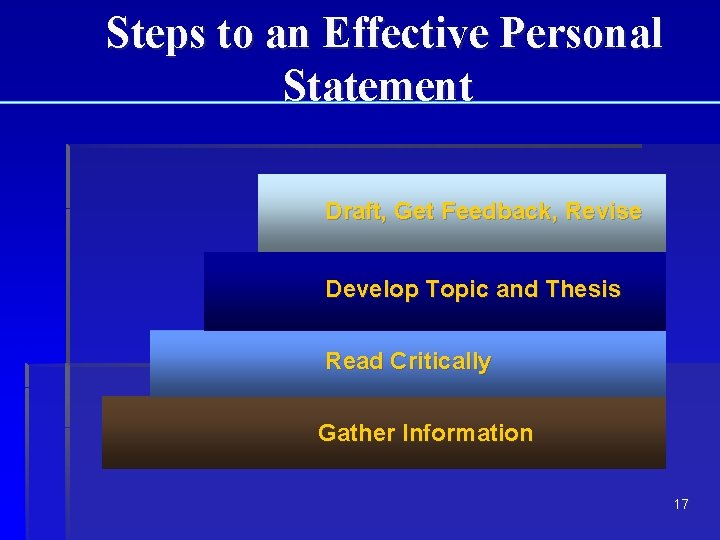
Steps to an Effective Personal Statement Draft, Get Feedback, Revise Develop Topic and Thesis Read Critically Gather Information 17
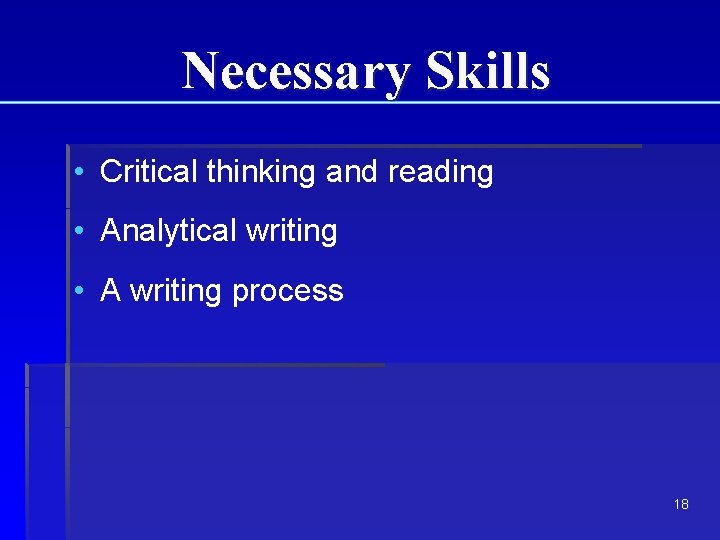
Necessary Skills • Critical thinking and reading • Analytical writing • A writing process 18
Important Strategies • Think like an admissions reader • Choose the extended prompt strategically • Know the difference between a shortanswer response and an extended response 19
You Can Help Students… • Understand the role of the personal statement in the admissions process • Recognize the relationship between reader and writer • Understand the reading and writing tasks of the personal statement • Use a writing process • Obtain appropriate feedback 20
Reader/Writer Pact • All readers have expectations of writers, revealed in readers’ questions, observations and interpretations of the application • Writers can anticipate these expectations by critically reading their applications prior to writing a personal statement • Writers fulfill readers’ expectations by addressing these questions, observations and interpretations in the personal statement 21
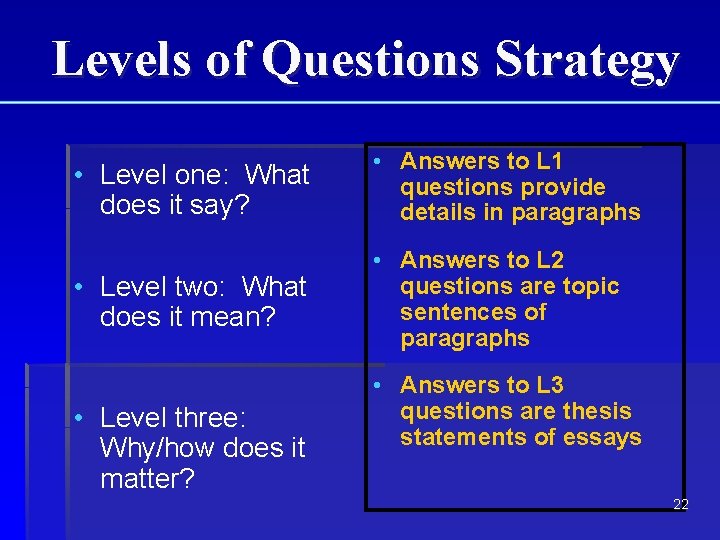
Levels of Questions Strategy • Level one: What does it say? • Answers to L 1 questions provide details in paragraphs • Level two: What does it mean? • Answers to L 2 questions are topic sentences of paragraphs • Level three: Why/how does it matter? • Answers to L 3 questions are thesis statements of essays 22
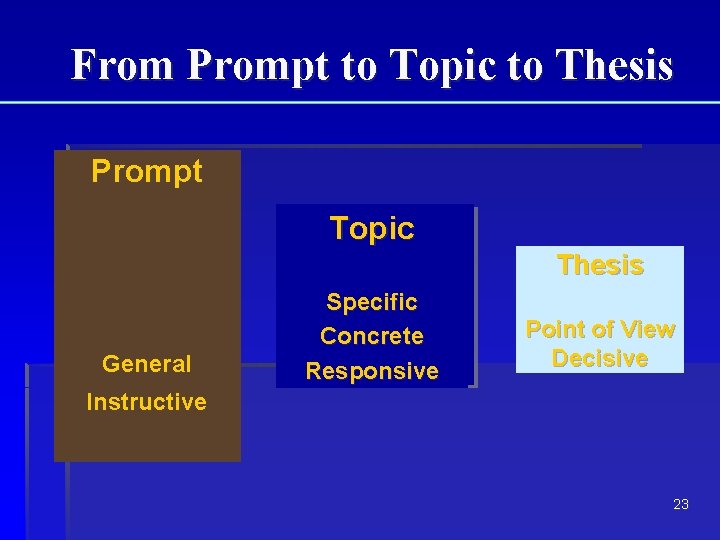
From Prompt to Topic to Thesis Prompt Topic Thesis General Specific Concrete Responsive Point of View Decisive Instructive 23
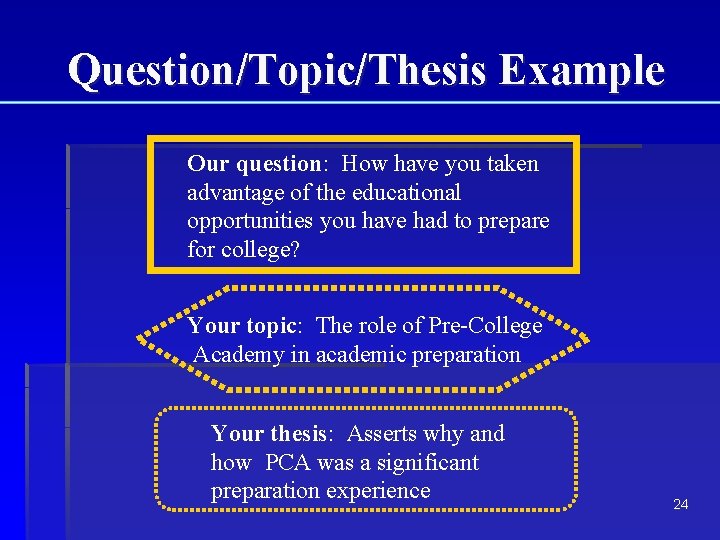
Question/Topic/Thesis Example Our question: How have you taken advantage of the educational opportunities you have had to prepare for college? Your topic: The role of Pre-College Academy in academic preparation Your thesis: Asserts why and how PCA was a significant preparation experience 24
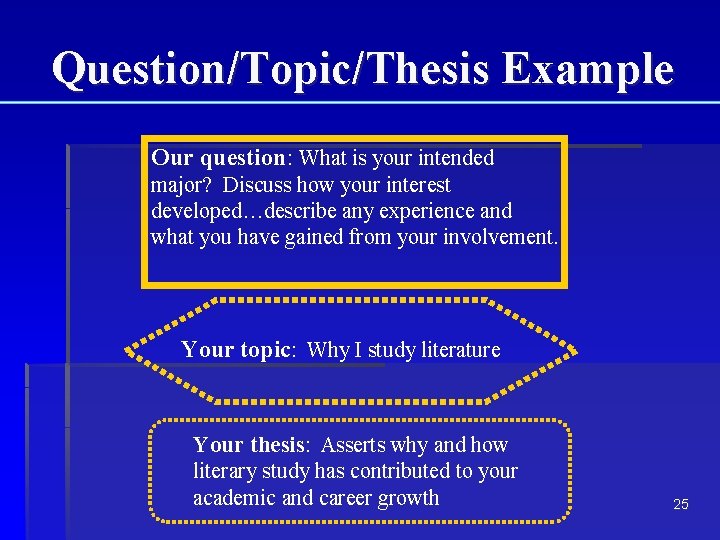
Question/Topic/Thesis Example Our question: What is your intended major? Discuss how your interest developed…describe any experience and what you have gained from your involvement. Your topic: Why I study literature Your thesis: Asserts why and how literary study has contributed to your academic and career growth 25
Short-Answer Strategies 26
Tips for Short-Answer Reponses • Avoid irrelevant background information • Make sure each sentence advances the argument • Understand meaning of key words • Avoid a collection of facts or examples • Ensure that response addresses what the prompt asks for • Use concrete details and make them clear, rich and meaningful 27
Extended-Response Strategies 28
Readers Want… • Organization and clarity provided by a persuasive thesis, analytical topic sentences, well-chosen examples • A response that supports and completes — by clarifying and contextualizing — the information in the application 29
Special Circumstances • Students are encouraged to write about special circumstances that have influenced their educational experience Ø Re-entry Ø Small or alternative learning environments Ø Learning and/or physical challenges Ø Veterans 30
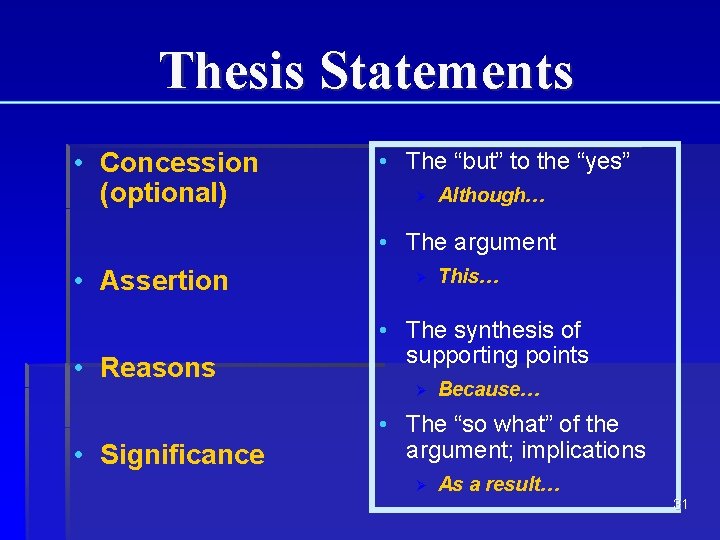
Thesis Statements • Concession (optional) • The “but” to the “yes” Ø Although… • The argument • Assertion • Reasons • Significance Ø This… • The synthesis of supporting points Ø Because… • The “so what” of the argument; implications Ø As a result… 31
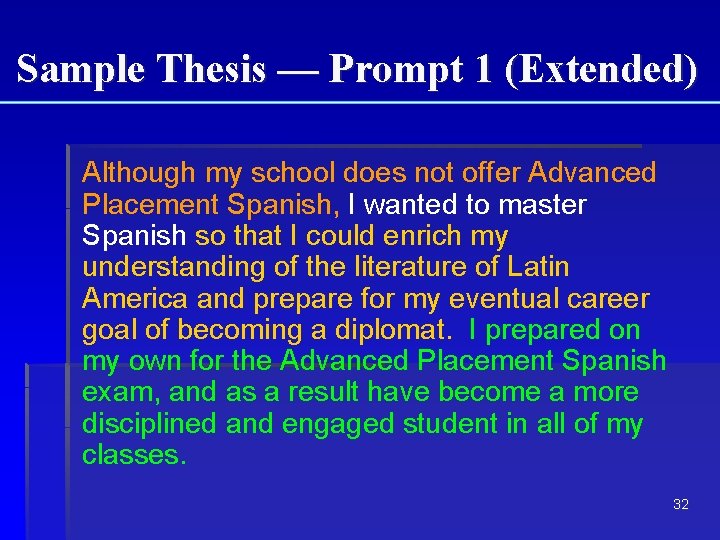
Sample Thesis — Prompt 1 (Extended) Although my school does not offer Advanced Placement Spanish, I wanted to master Spanish so that I could enrich my understanding of the literature of Latin America and prepare for my eventual career goal of becoming a diplomat. I prepared on my own for the Advanced Placement Spanish exam, and as a result have become a more disciplined and engaged student in all of my classes. 32
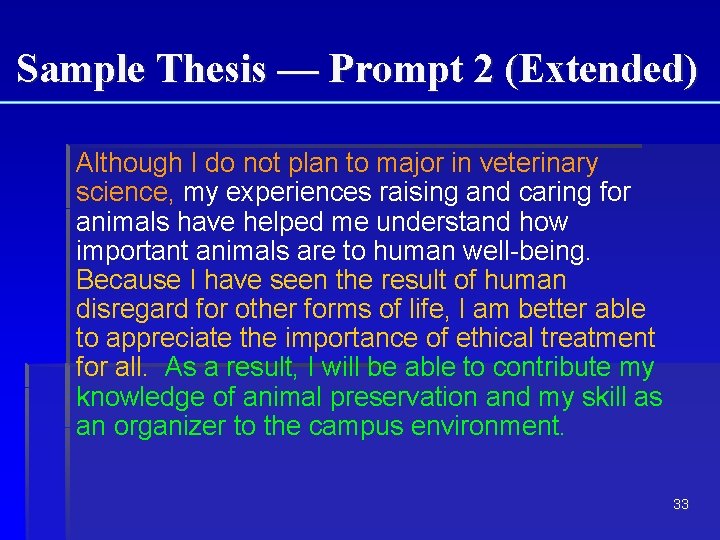
Sample Thesis — Prompt 2 (Extended) Although I do not plan to major in veterinary science, my experiences raising and caring for animals have helped me understand how important animals are to human well-being. Because I have seen the result of human disregard for other forms of life, I am better able to appreciate the importance of ethical treatment for all. As a result, I will be able to contribute my knowledge of animal preservation and my skill as an organizer to the campus environment. 33
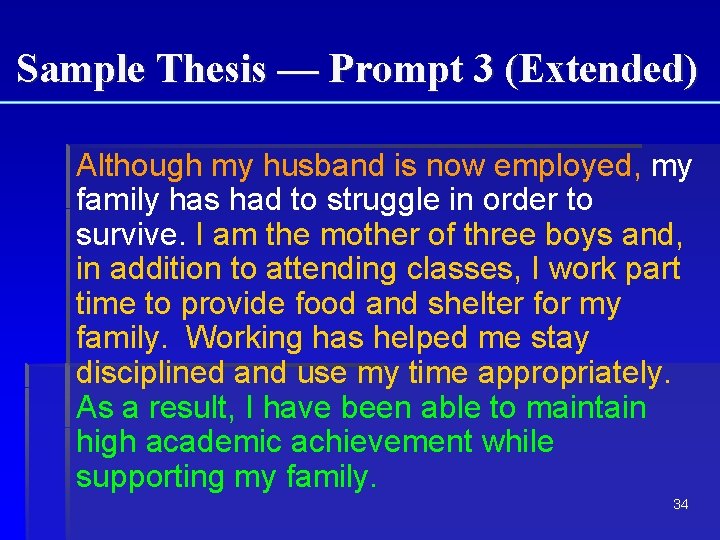
Sample Thesis — Prompt 3 (Extended) Although my husband is now employed, my family has had to struggle in order to survive. I am the mother of three boys and, in addition to attending classes, I work part time to provide food and shelter for my family. Working has helped me stay disciplined and use my time appropriately. As a result, I have been able to maintain high academic achievement while supporting my family. 34
Writing Process • Brainstorm using levels of questions • Draft • Get feedback — give readers at least a week to respond • Revise for organization, clarity & meaning • Proofread 35
How to Give Feedback to Students • Request the application and the personal statement, not just the statement • Ask students to provide you with a list of questions they would like you to answer • Comment on ideas and the level of persuasiveness, not grammar • Help students find readers who resemble their target audience 36
Additional Resources for Students • Online UC Personal Statement Tutorial for Students at www. ucgateways. org Ø Click the “Help with your UC personal statement” link in the News Center on UC Gateways Ø No need to create an account Ø Six activities to help students start early and stay on task Ø Developed by EAOP admissions preparation specialists 37