
THE PERSONAL NARRATIVE SPEECH The Personal Narrative Speech
- Slides: 13
THE PERSONAL NARRATIVE SPEECH The Personal Narrative Speech is all about you!
THE PERSONAL NARRATIVE SPEECH The main point is that you are talking about yourself, your thoughts, your feelings, your ideas, your views, your opinions, and your events. All of these ideas are the main components of this special speech writing process.
THE PERSONAL NARRATIVE SPEECH To create a personal narrative, explore each of these personal ideas, and then choose one to narrow down so you can build a speech. The goal of the personal narrative is also to make a point about: a personal past or present experience event knowledge a moral lesson
THE FOLLOWING IS A LIST OF NARRATIVE SPEECH TOPIC IDEAS: ABOUT EVENTS – An accident or positive event that changed my life. The birth of my brother, sister, or other relative. My first day at high school. The decision I regret most. My day of graduation. My first serious date.
More events… A significant family event. A memorable vacation. A historical event that impressed me. The day I moved. A milestone that seemed bad but turned out to be good. My heroic sports moment.
ABOUT YOUR LIFE LESSONS— The influence of a special person on my behavior. How I have dealt with a difficult situation. What lessons I have learned through studying the genealogy of my family. A prejudice that involved me. A Eureka moment: I suddenly understood how something works in life that I had been struggling with. How I helped someone else and what I learned from her or him, and from the situation.
ABOUT YOUR EXPERIENCES – My most frustrating moment. How I handled an emergency situation. How I broke up with a person I loved. A narrow escape. A moment I did something that took a lot of courage.
More personal experience ideas… A time I chose to go my own way and did not follow the crowd. How I stood up for my beliefs. The day I rebelled with a decision concerning me. How I have coped with my nerves recently. What happened when I had a disagreement with my parent/teacher/employer.
ABOUT YOUR RITUALS— How I usually prepare for a test. My ritual before a sports game. My ritual before going out with friends. The routines I always follow under certain circumstances.
ABOUT YOUR IDENTITY— My act of heroism. How curiosity brings me where I am now. My pet resembles my personal habits. A vivid childhood memory in which I can see how I would develop myself.
ONCE YOU HAVE CHOSEN AN IDEA, YOU WILL NEED TO NARROW THE SPEECH TOPIC APPROPRIATELY. Here are some suggestions: Pick out one significant story about yourself. Don’t try to tell your life story—narrow your topic down. Then, think about the point you want to make and the response you want to get from your audience. What do you want them to remember? What is the purpose, point, goal, lesson, or plot of your story? Why might your audience think your presentation is valuable or important? Think about your narrative just like a short story and include all of the story elements: the main event, the characters, the relevant details, the steps and/or dialogue. Organize the text of the speech in a time ordered format. The chronological order also helps you to remember your key ideas better.
More suggestions for narrowing your topic: Avoid starting your speech with an explanation of what you learned from this event; use the chronological order strategy to build up to the resolution where you can explain the life lesson this experience taught you. Add transitions words like then, after that, next, at this moment. Rehearse!!! Rehearse your narrative in front of a friend ask opinions. Then practice again!!! Avoid memorizing or reading your speech. Your audience will enjoy your narrative so much better if you sound like you are just talking to them. Be sure to try and make eye contact with your listeners.
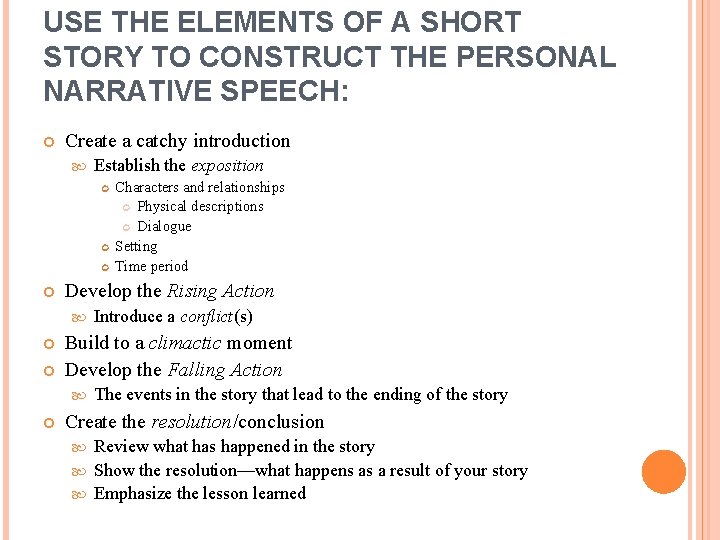
USE THE ELEMENTS OF A SHORT STORY TO CONSTRUCT THE PERSONAL NARRATIVE SPEECH: Create a catchy introduction Establish the exposition Develop the Rising Action Introduce a conflict(s) Build to a climactic moment Develop the Falling Action Characters and relationships Physical descriptions Dialogue Setting Time period The events in the story that lead to the ending of the story Create the resolution/conclusion Review what has happened in the story Show the resolution—what happens as a result of your story Emphasize the lesson learned