
The Periodic Table The how and why History
The Periodic Table The how and why
History u Russian scientist Dmitri Mendeleev taught chemistry in terms of properties u Mid 1800 – atomic masses of elements were known u Wrote down the elements in order of increasing mass u Found a pattern of repeating properties
Mendeleev’s Table u Grouped elements in columns by similar properties in order of increasing atomic mass u Found some inconsistencies - felt that the properties were more important than the mass, so switched order. u Found some gaps u Must be undiscovered elements u Predicted their properties before they were found
The Modern Table u Elements are still grouped by properties u Similar properties are in the same column u Order is in increasing atomic number u Added a column of elements Mendeleev didn’t know about. u The noble gases weren’t found because they didn’t react with anything.
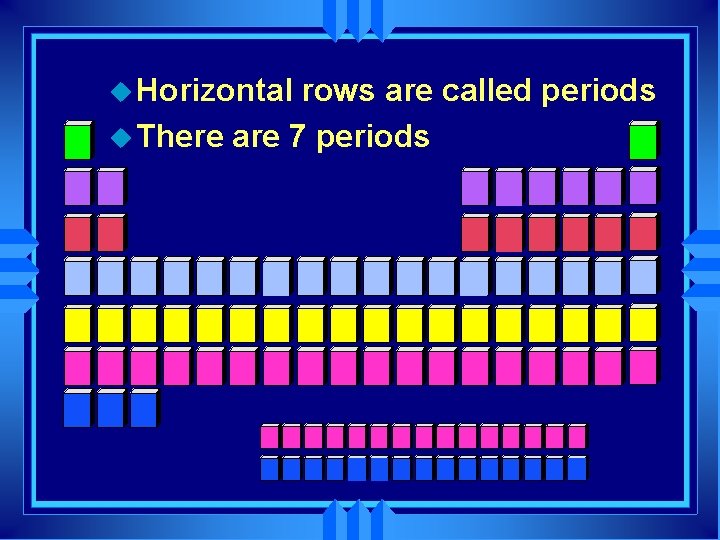
u Horizontal rows are called periods u There are 7 periods
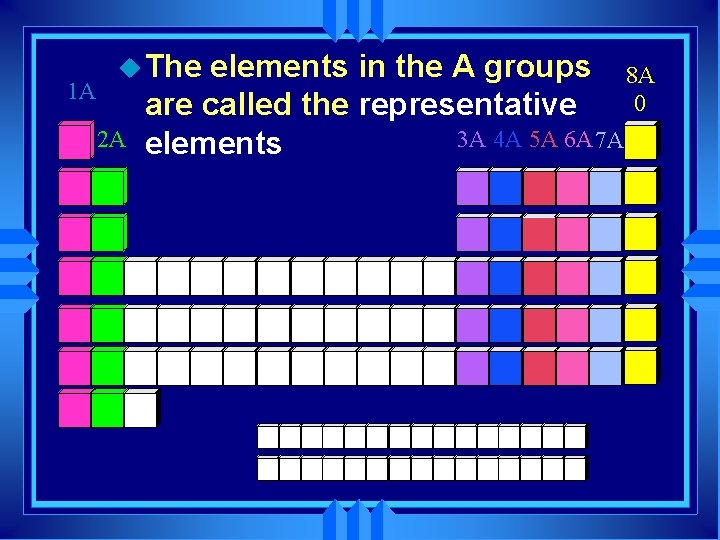
1 A u The 2 A elements in the A groups 8 A 0 are called the representative 3 A 4 A 5 A 6 A 7 A elements
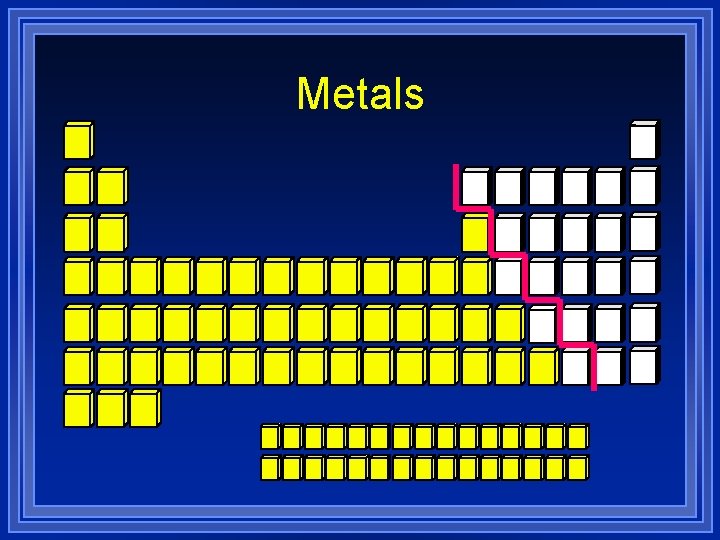
Metals
Metals Luster – shiny. l Ductile – drawn into wires. l Malleable – hammered into sheets. l Conductors of heat and electricity. l
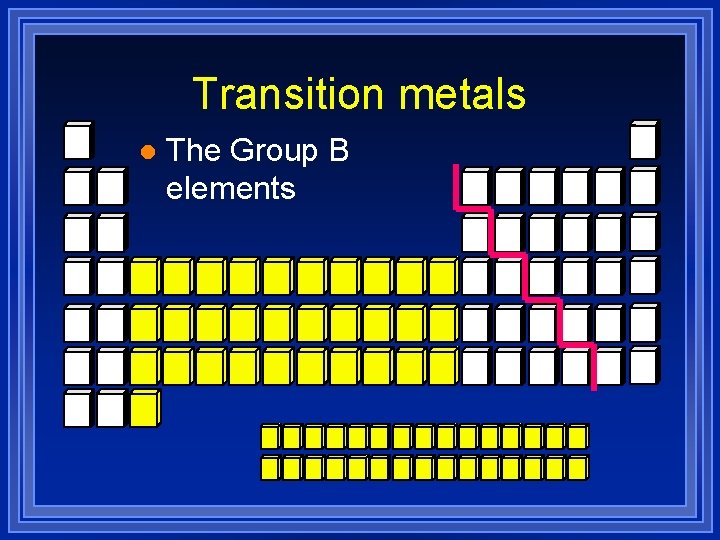
Transition metals l The Group B elements
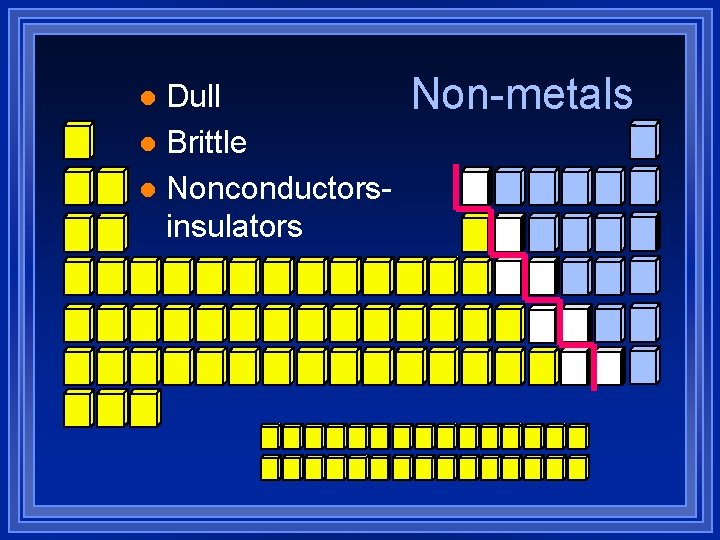
Dull l Brittle l Nonconductorsinsulators l Non-metals
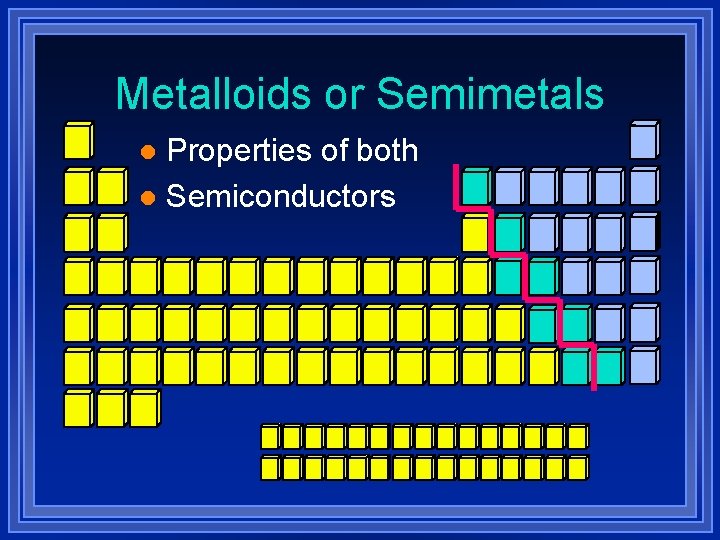
Metalloids or Semimetals Properties of both l Semiconductors l
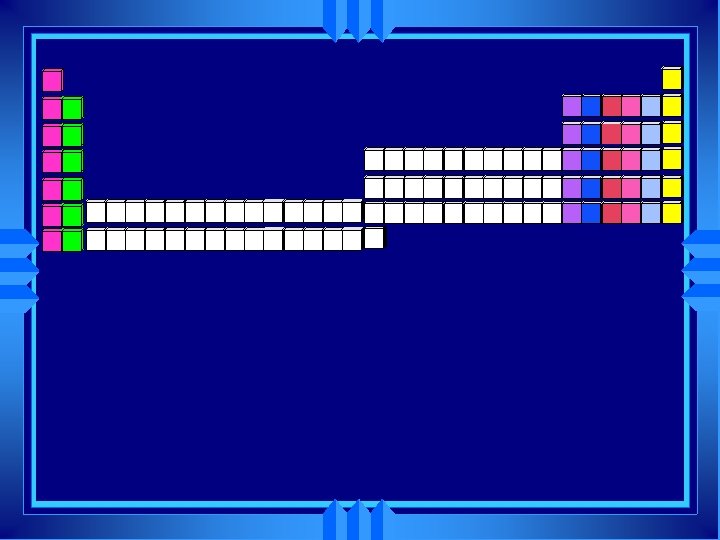
Why? u The part of the atom another atom sees is the electron cloud. u More importantly the outside orbitals u The orbitals fill up in a regular pattern u The outside orbital electron configuration repeats u So. . the properties of atoms repeat.
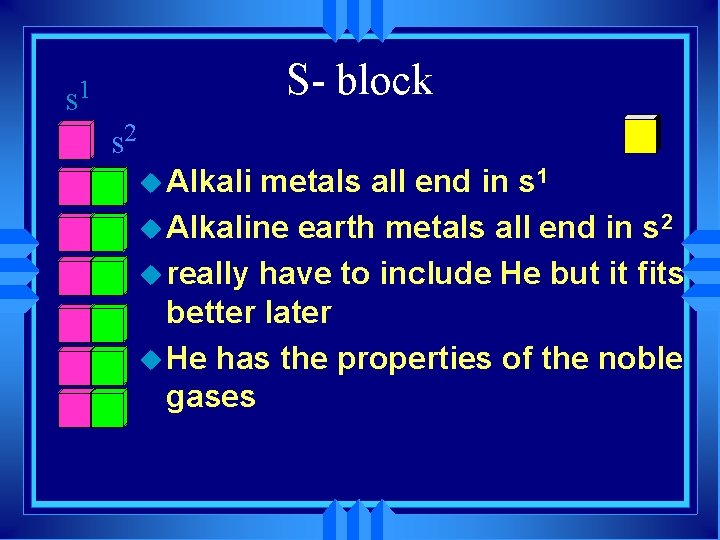
s 1 S- block s 2 u Alkali metals all end in s 1 u Alkaline earth metals all end in s 2 u really have to include He but it fits better later u He has the properties of the noble gases
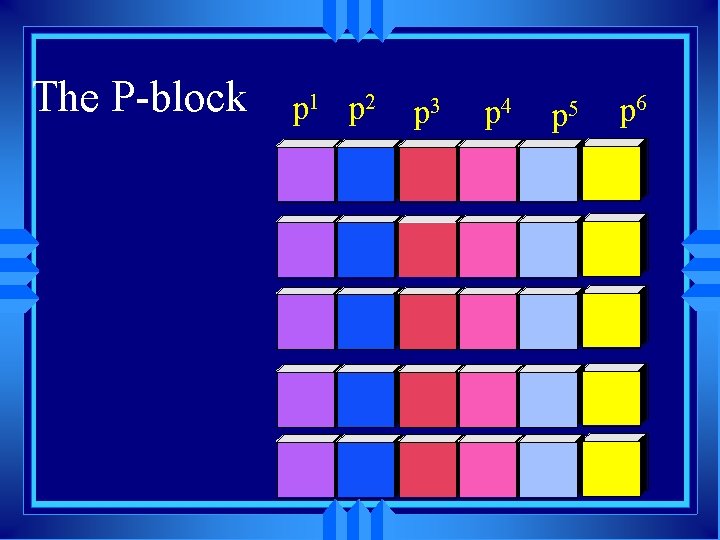
The P-block p 1 p 2 p 3 p 4 p 5 p 6
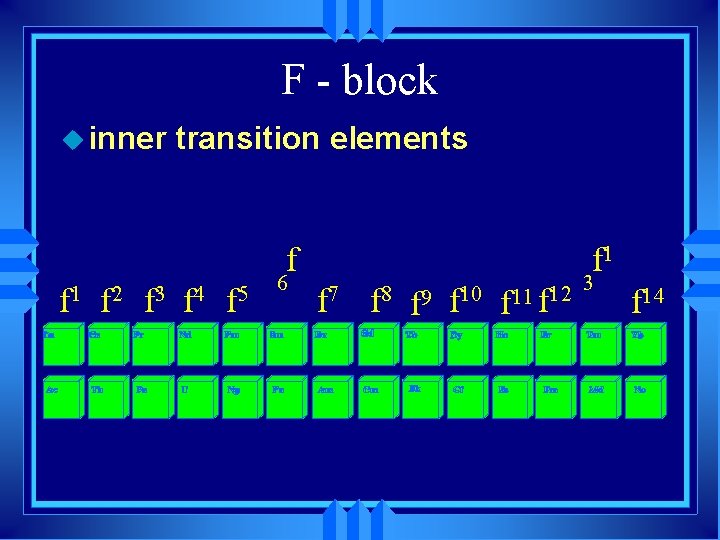
F - block u inner transition elements f f 1 f 2 f 3 f 4 f 5 6 f 1 f 7 f 8 f 9 f 10 f 11 f 12 3 f 14
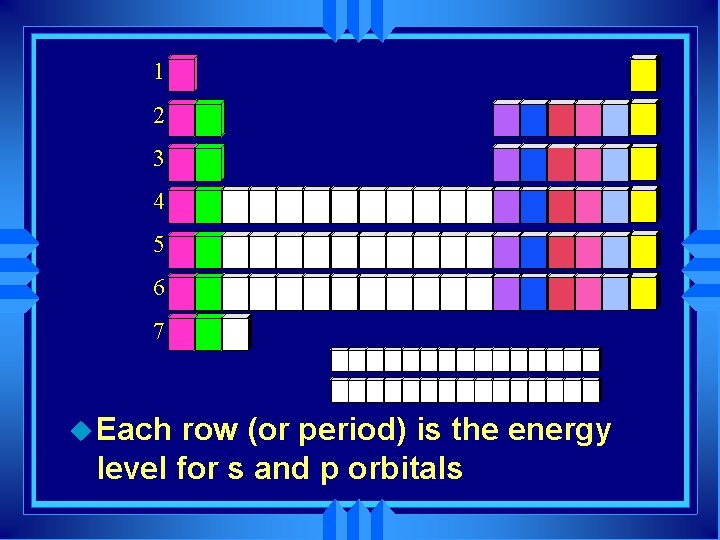
1 2 3 4 5 6 7 u Each row (or period) is the energy level for s and p orbitals
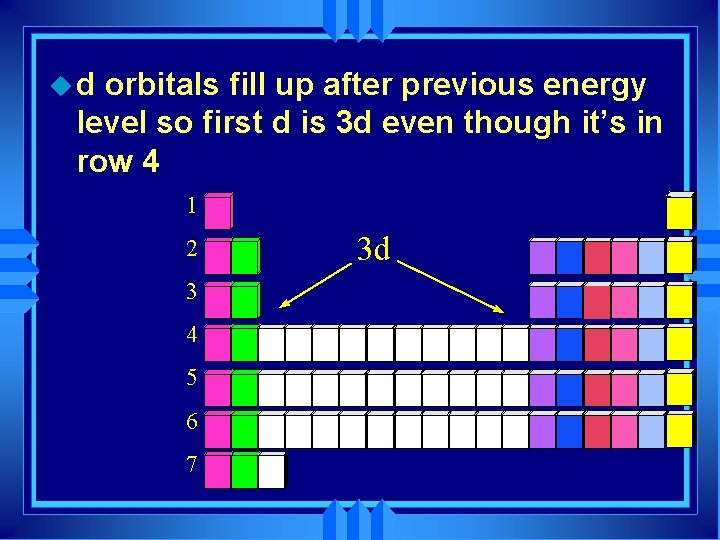
ud orbitals fill up after previous energy level so first d is 3 d even though it’s in row 4 1 2 3 4 5 6 7 3 d
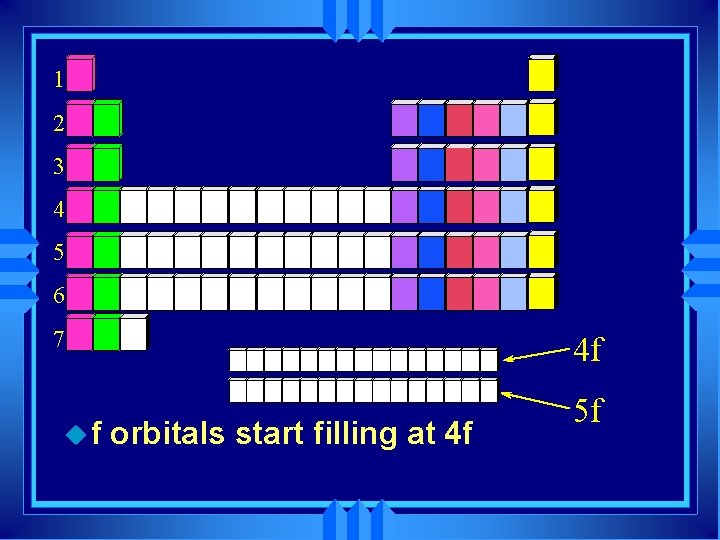
1 2 3 4 5 6 7 uf 4 f orbitals start filling at 4 f 5 f
Writing Electron configurations the easy way Yes there is a shorthand
Electron Configurations repeat u The shape of the periodic table is a representation of this repetition. u When we get to the end of the row the outermost energy level is full. u This is the basis for our shorthand
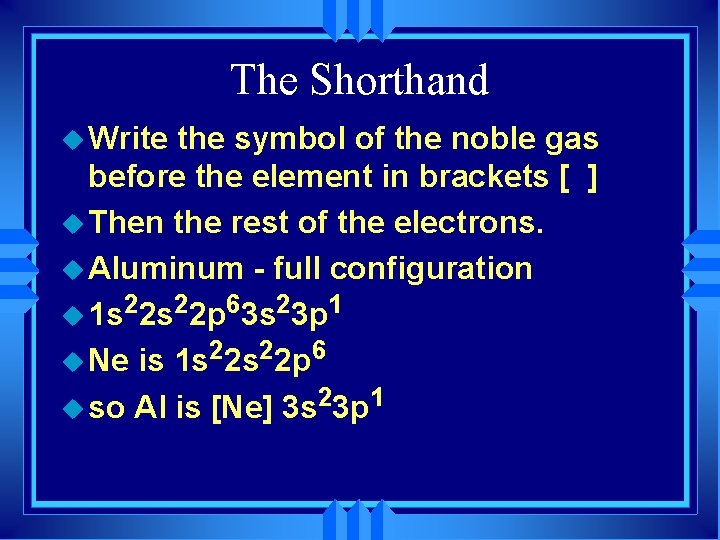
The Shorthand u Write the symbol of the noble gas before the element in brackets [ ] u Then the rest of the electrons. u Aluminum - full configuration u 1 s 22 p 63 s 23 p 1 u Ne is 1 s 22 p 6 u so Al is [Ne] 3 s 23 p 1
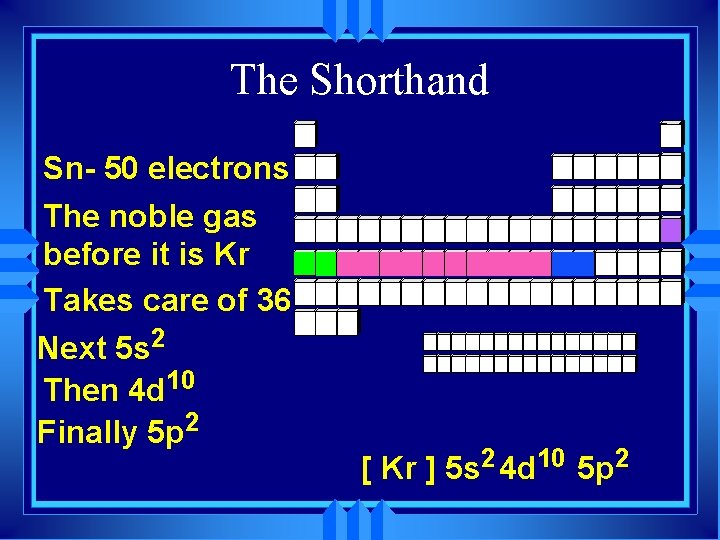
The Shorthand Sn- 50 electrons The noble gas before it is Kr Takes care of 36 Next 5 s 2 Then 4 d 10 Finally 5 p 2 [ Kr ] 5 s 2 4 d 10 5 p 2
Part 3 Periodic trends Identifying the patterns
What we will investigate u Atomic size • how big the atoms are u Ionization energy • How much energy to remove an electron u Electronegativity • The attraction for the electron in a compound u Ionic size • How big ions are
What we will look for u Periodic trends • How those 4 things vary as you go across a period u Group trends • How those 4 things vary as you go down a group u Why? • Explain why they vary
The why first u The positive nucleus pulls on electrons u Periodic trends – as you go across a period • The charge on the nucleus gets bigger • The outermost electrons are in the same energy level • So the outermost electrons are pulled stronger
The why first u The positive nucleus pulls on electrons u Group Trends • As you go down a group – You add energy levels – Outermost electrons not as attracted by the nucleus
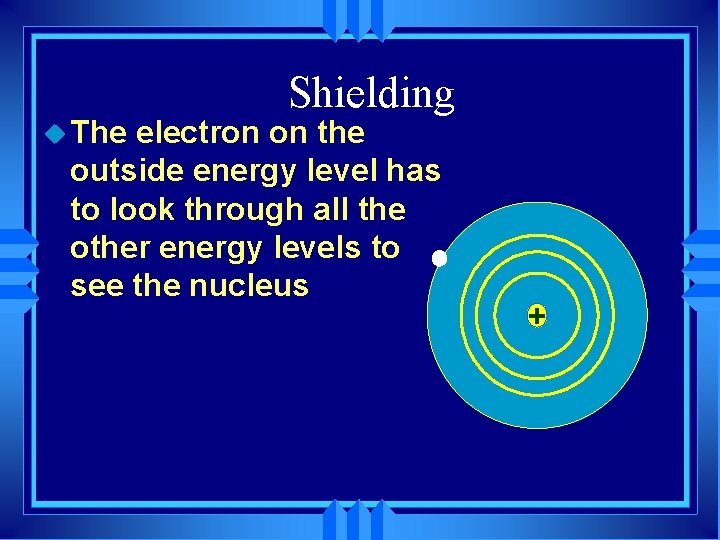
u The Shielding electron on the outside energy level has to look through all the other energy levels to see the nucleus +
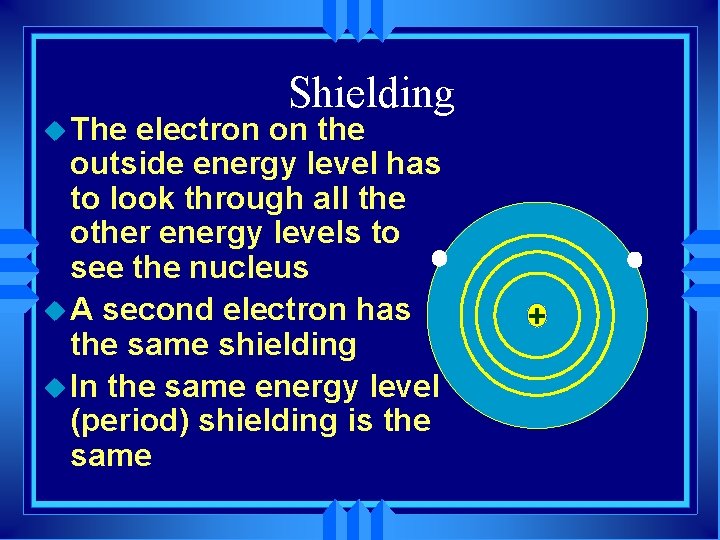
u The Shielding electron on the outside energy level has to look through all the other energy levels to see the nucleus u A second electron has the same shielding u In the same energy level (period) shielding is the same +
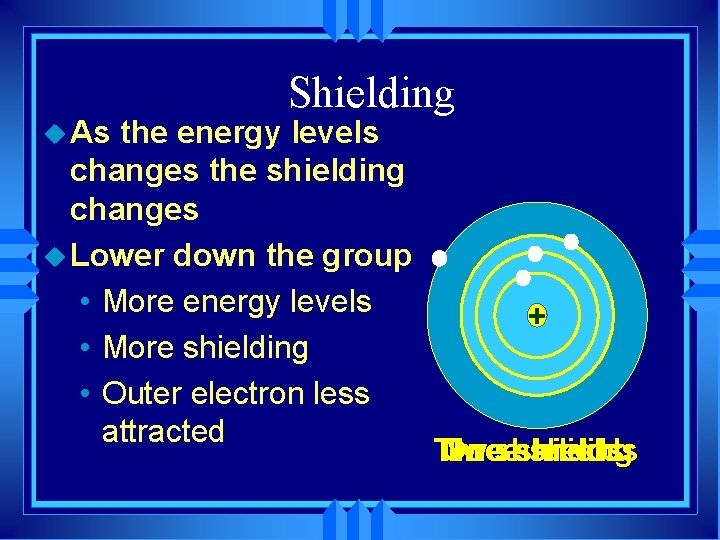
u As Shielding the energy levels changes the shielding changes u Lower down the group • More energy levels • More shielding • Outer electron less attracted + Three No shielding One Two shields
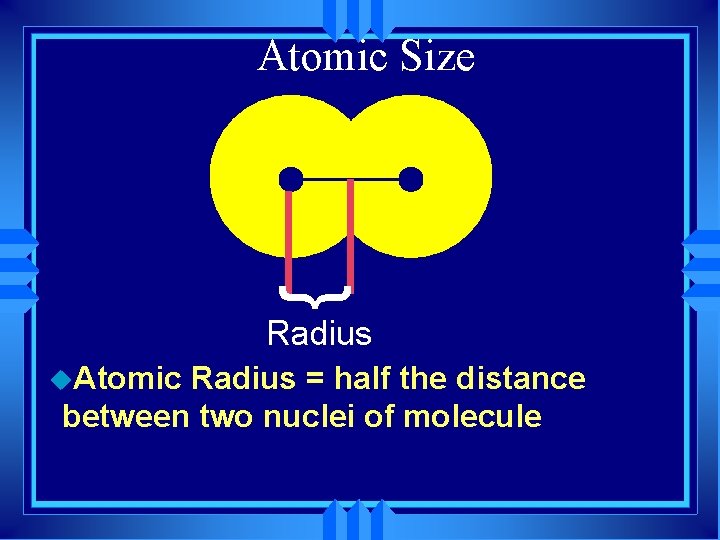
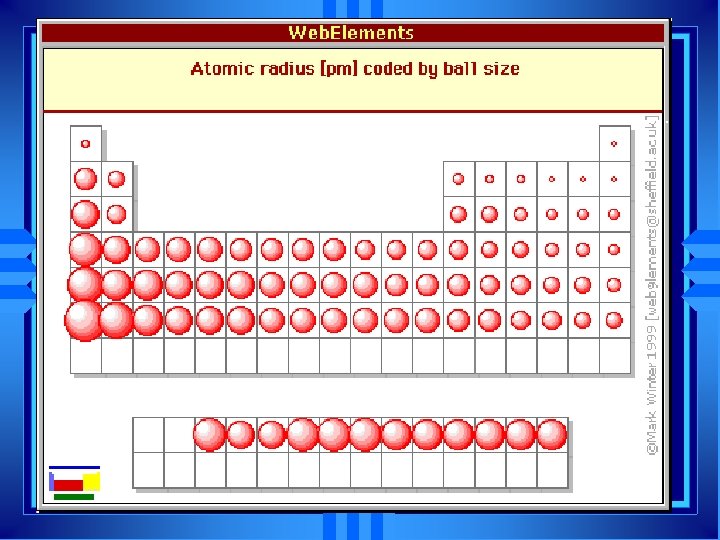
Atomic Size } Radius u. Atomic Radius = half the distance between two nuclei of molecule
Trends in Atomic Size u. Influenced by two factors u. Energy Level u. Higher energy level is further away u. Charge on nucleus u. More charge pulls electrons in closer
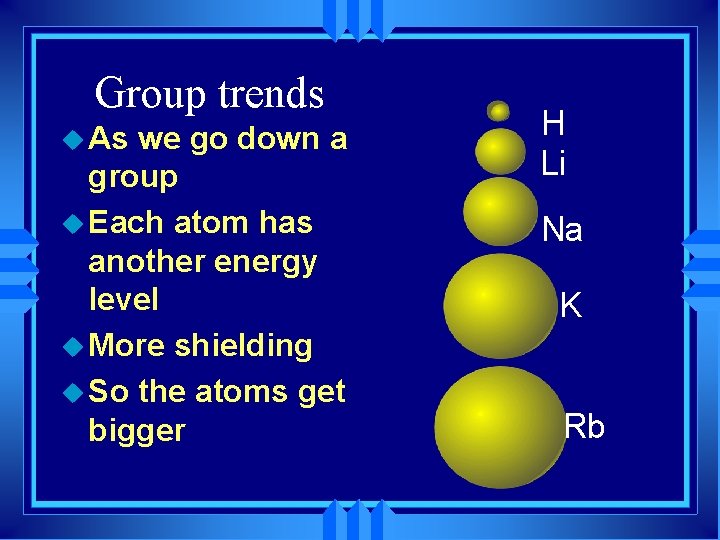
Group trends u As we go down a group u Each atom has another energy level u More shielding u So the atoms get bigger H Li Na K Rb
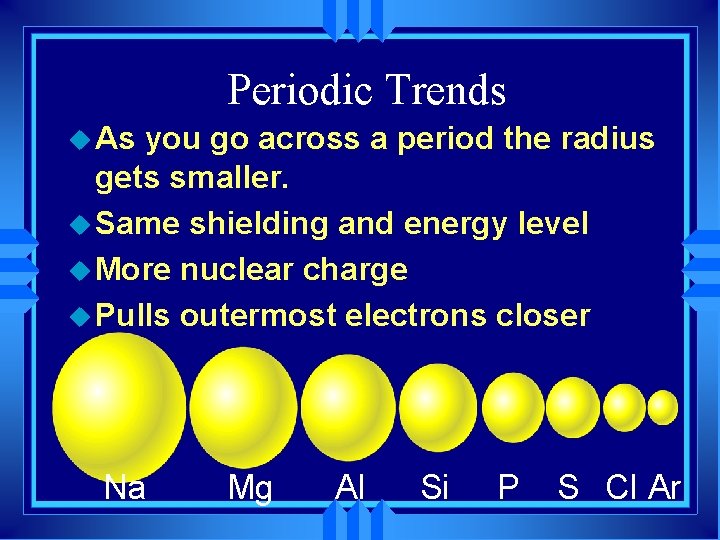
Periodic Trends u As you go across a period the radius gets smaller. u Same shielding and energy level u More nuclear charge u Pulls outermost electrons closer Na Mg Al Si P S Cl Ar
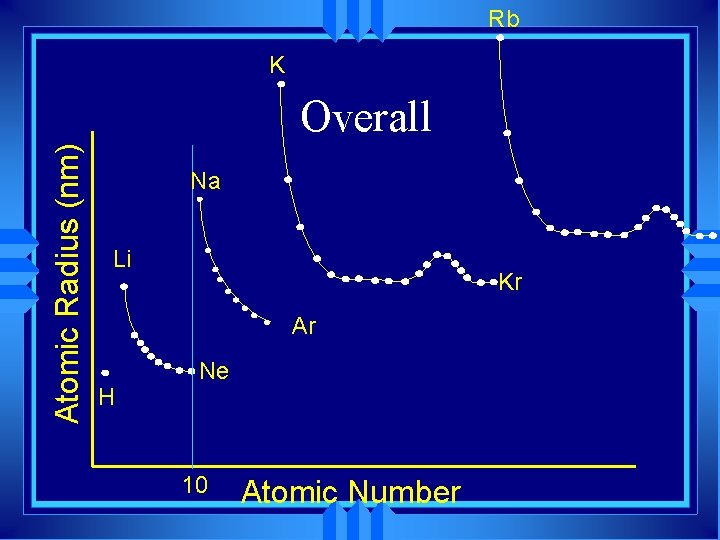
Rb K Atomic Radius (nm) Overall Na Li Kr Ar H Ne 10 Atomic Number
Ionization Energy u The amount of energy required to completely remove an electron from a gaseous atom. u Removing one electron makes a +1 ion u The energy required is called the first ionization energy
Ionization Energy u The second ionization energy is the energy required to remove the second electron u Always greater than first IE u The third IE is the energy required to remove a third electron u Greater than 1 st or 2 nd IE
What determines IE u The greater the nuclear charge the greater IE. u Increased shielding decreases IE u Filled and half filled orbitals have lower energy, so achieving them is easier, lower IE
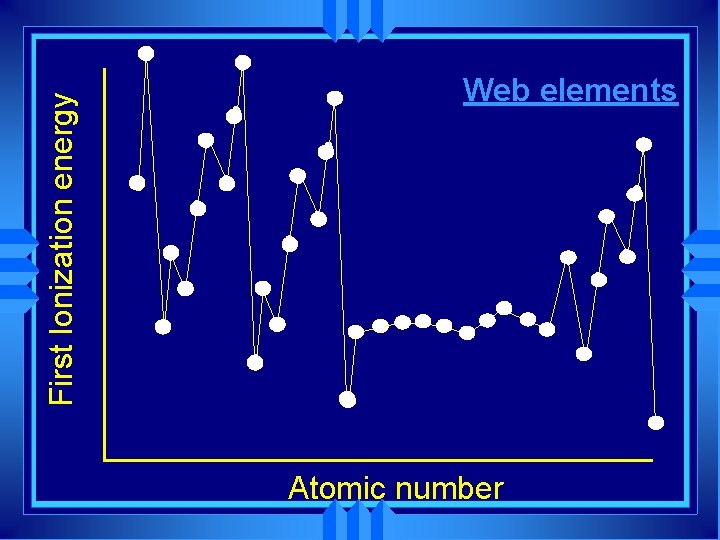
Group trends u. As you go down a group first IE decreases because of u. More shielding u. So outer electron less attracted
Periodic trends u All the atoms in the same period • Same shielding. • Increasing nuclear charge u So IE generally increases from left to right. u Exceptions at full and 1/2 full orbitals
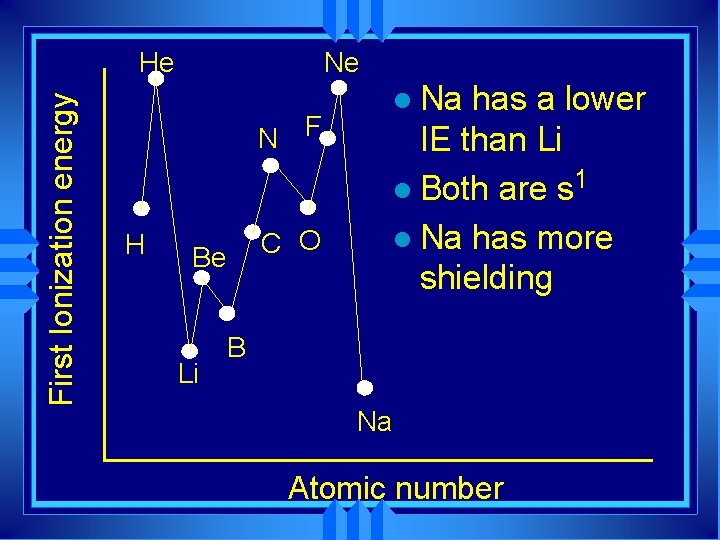
Ne First Ionization energy He N F H C O Be Li l Na has a lower IE than Li l Both are s 1 l Na has more shielding B Na Atomic number
First Ionization energy Web elements Atomic number
Driving Force u Full Energy Levels are very low energy u Noble Gases have full orbitals u Atoms behave in ways to achieve noble gas configuration
2 nd Ionization Energy u For elements that reach a filled or half-full orbital by removing 2 electrons 2 nd IE is lower than expected u True for s 2 u Alkali earth metals form 2+ ions
3 rd IE the same logic s 2 p 1 atoms have an low 3 rd IE u Atoms in the boron family form 3+ ions u 2 nd IE and 3 rd IE are always higher than 1 st IE!!! u Using
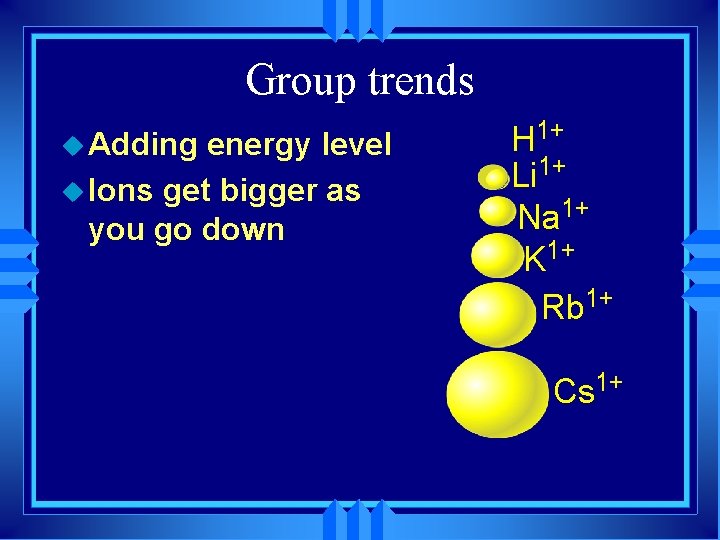
Group trends u Adding energy level u Ions get bigger as you go down H 1+ Li 1+ Na 1+ K 1+ Rb 1+ Cs 1+
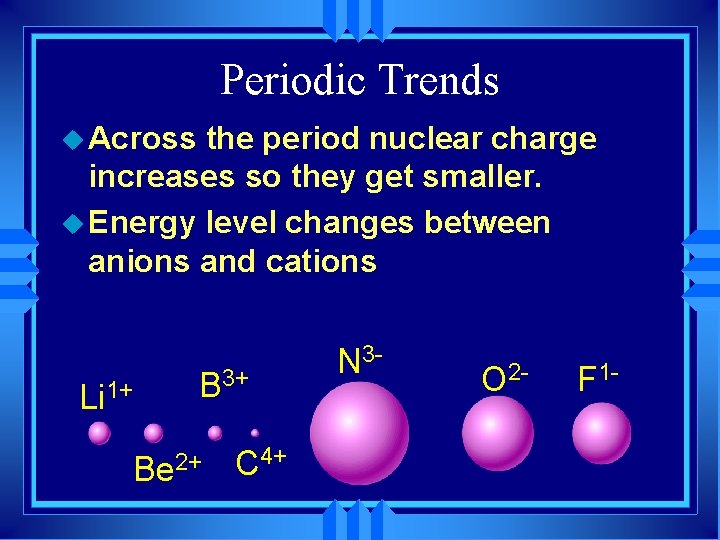
Periodic Trends u Across the period nuclear charge increases so they get smaller. u Energy level changes between anions and cations Li 1+ B 3+ Be 2+ C 4+ N 3 - O 2 - F 1 -
Electronegativity
Electronegativity u The tendency for an atom to attract electrons to itself when it is chemically combined with another element. u How “greedy” u Big electronegativity means it pulls the electron toward it.
Group Trend u The further down a group • More shielding • more electrons an atom has. u Less attraction for electrons u Low electronegativity.
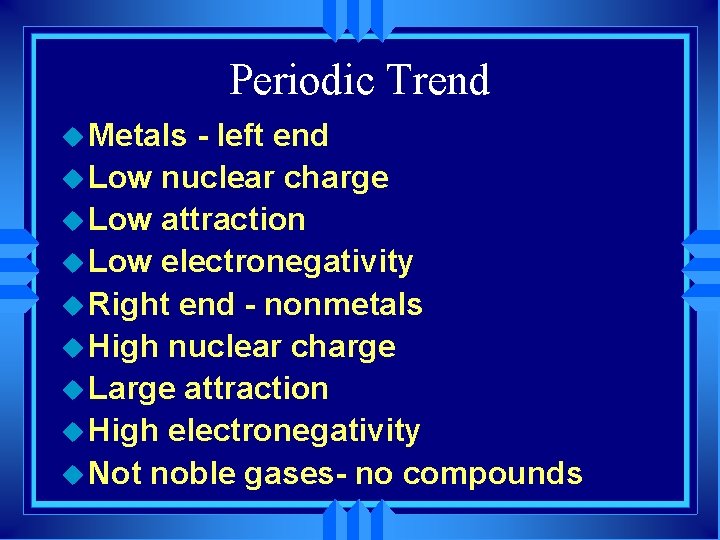
Periodic Trend u Metals - left end u Low nuclear charge u Low attraction u Low electronegativity u Right end - nonmetals u High nuclear charge u Large attraction u High electronegativity u Not noble gases- no compounds
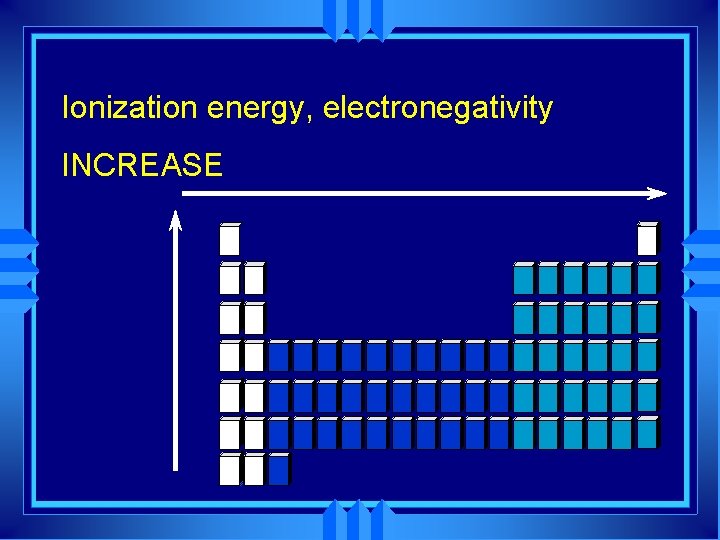
Ionization energy, electronegativity INCREASE
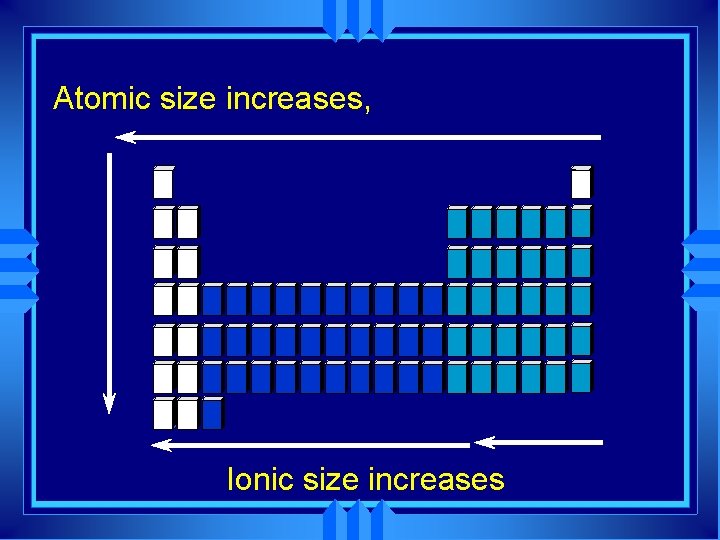
Atomic size increases, Ionic size increases
- Slides: 55