
The Periodic Table Project By Stephanie Saenz Sandy

The Periodic Table Project By: Stephanie Saenz, Sandy Sanchez, Juan Alanis, Quran Brown, and Gio Barrios
The Halogens are located in Group 17, of the Periodic table. They include: fluorine, bromine, chlorine, iodine, and astatine. Group 17 is the only group in the Periodic Table, that consists of all, of the 3 most common states of matter: solid, liquid, and gas at room temperature. The Halogens are all non-metallic elements, and more reactive than others, because of their 7 valence electrons. The Halogens can form an ionic, or covalent bond with any of the Alkali metals, in order to become stable. Halogens are toxic, and are always seen combined with other elements, in nature.
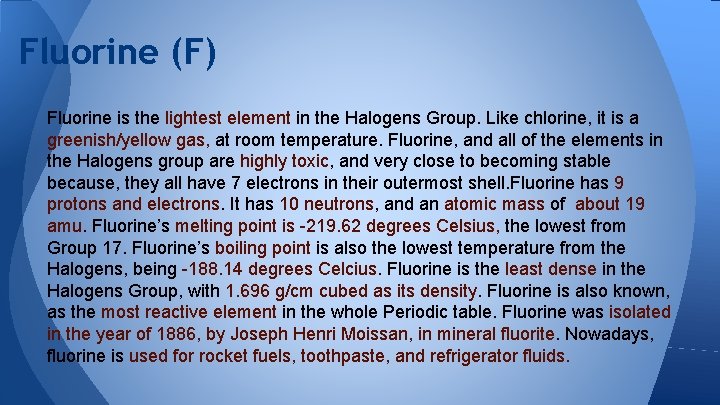
Fluorine (F) Fluorine is the lightest element in the Halogens Group. Like chlorine, it is a greenish/yellow gas, at room temperature. Fluorine, and all of the elements in the Halogens group are highly toxic, and very close to becoming stable because, they all have 7 electrons in their outermost shell. Fluorine has 9 protons and electrons. It has 10 neutrons, and an atomic mass of about 19 amu. Fluorine’s melting point is -219. 62 degrees Celsius, the lowest from Group 17. Fluorine’s boiling point is also the lowest temperature from the Halogens, being -188. 14 degrees Celcius. Fluorine is the least dense in the Halogens Group, with 1. 696 g/cm cubed as its density. Fluorine is also known, as the most reactive element in the whole Periodic table. Fluorine was isolated in the year of 1886, by Joseph Henri Moissan, in mineral fluorite. Nowadays, fluorine is used for rocket fuels, toothpaste, and refrigerator fluids.
Gas Solid

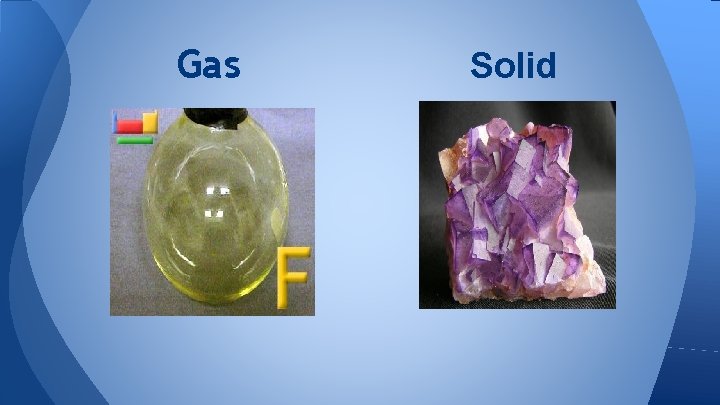
Bromine (Br) Bromine is the only liquid at room temperature, in the Halogens group. It has an atomic mass of about 80 amu, and 35 protons/electrons. That means it has 45 neutrons. Bromine’s melting point is -7. 2 degrees Celsius, while its boiling point is 58. 78 degrees Celsius. Bromine has a density of, 3. 119 g/cm cubed. Like every other Halogen, it is toxic. Bromine can burn the skin, if put in contact with. A cool fact: Bromine is needed in tissue development of mammals. It was isolated in 1826, by two scientists, Carl J. Lowig, and Antoine J. Balard in sea water. To this day, Bromine is used for pesticides, flame resistant plastics, the purification of water, medicine, and even photography.
Liquid Solid

Chlorine (CI) The element Chlorine was produced by Carl Scheele in the late 1700’s, and made as an element by Humphry Davey in 1810. Chlorine was obtained from salt. It has an atomic mass of about 35 amu, and consists of 17 protons, and electrons. Chlorine is a Gas, and has a greenish-yellow color to it, at room temperature. Chlorine’s melting point is -100. 98 degrees Celsius, the second coldest in the Halogens. Its boiling point is 34. 6 degrees Celsius. Chlorine is also a very toxic gas, and is dangerous if inhaled. When Chlorine is a liquid and gets into the skin, it can burn the skin. Chlorine’s density is 3. 214 g/cm cubed. Chlorine is a popular element, and is mostly known as, the most important chemical ingredient in bleach. Chlorine is also used for disinfecting swimming pools, making copy paper into the color white, table salt, and water purification.
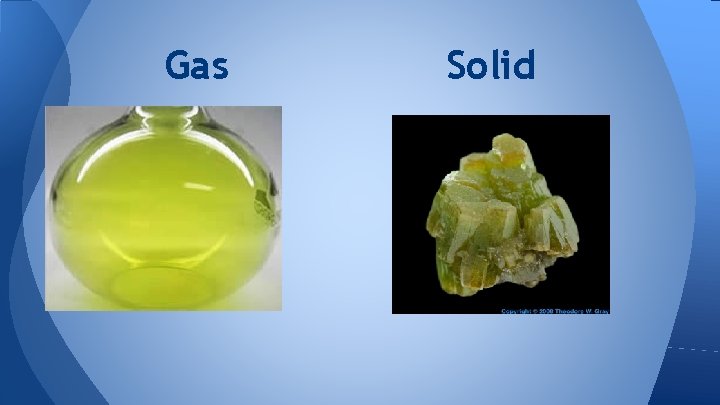
Gas Solid
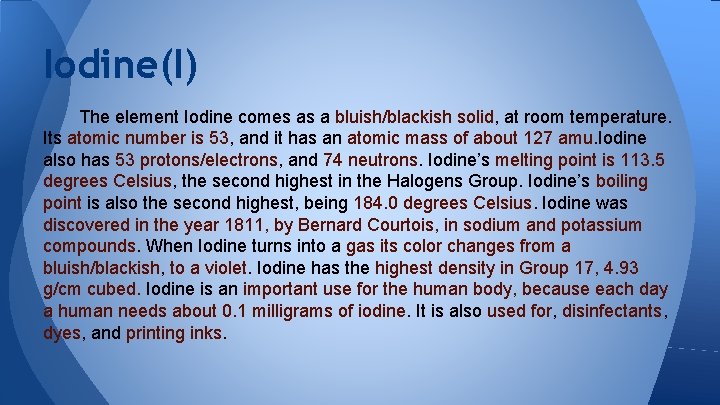
Iodine(I) The element Iodine comes as a bluish/blackish solid, at room temperature. Its atomic number is 53, and it has an atomic mass of about 127 amu. Iodine also has 53 protons/electrons, and 74 neutrons. Iodine’s melting point is 113. 5 degrees Celsius, the second highest in the Halogens Group. Iodine’s boiling point is also the second highest, being 184. 0 degrees Celsius. Iodine was discovered in the year 1811, by Bernard Courtois, in sodium and potassium compounds. When Iodine turns into a gas its color changes from a bluish/blackish, to a violet. Iodine has the highest density in Group 17, 4. 93 g/cm cubed. Iodine is an important use for the human body, because each day a human needs about 0. 1 milligrams of iodine. It is also used for, disinfectants, dyes, and printing inks.

Solid hhghghg Gas
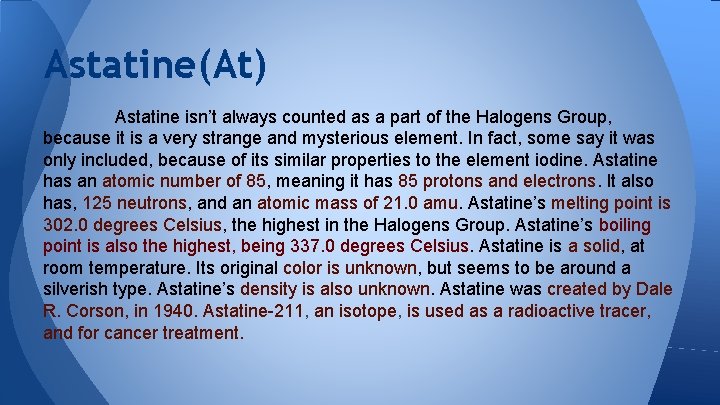
Astatine(At) Astatine isn’t always counted as a part of the Halogens Group, because it is a very strange and mysterious element. In fact, some say it was only included, because of its similar properties to the element iodine. Astatine has an atomic number of 85, meaning it has 85 protons and electrons. It also has, 125 neutrons, and an atomic mass of 21. 0 amu. Astatine’s melting point is 302. 0 degrees Celsius, the highest in the Halogens Group. Astatine’s boiling point is also the highest, being 337. 0 degrees Celsius. Astatine is a solid, at room temperature. Its original color is unknown, but seems to be around a silverish type. Astatine’s density is also unknown. Astatine was created by Dale R. Corson, in 1940. Astatine-211, an isotope, is used as a radioactive tracer, and for cancer treatment.
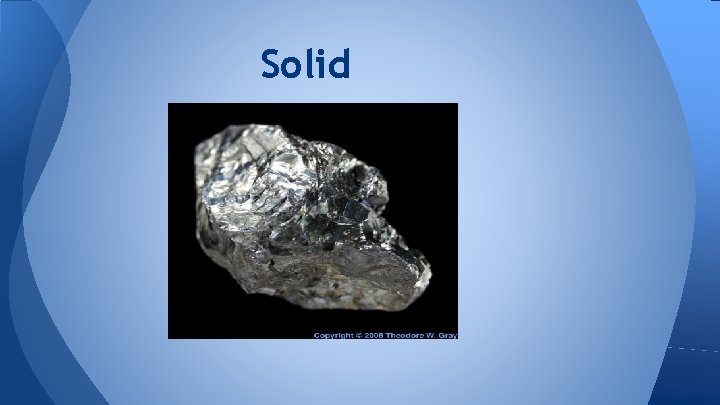
Solid mm
Similarities ● All of the elements in the Halogens Group are: nonmetallic elements, toxic, and very reactive. ● The Halogens, also tend to be seen combined with other elements in nature, quite often. ● The Halogens are disinfectants. ● All of the Halogens have seven electrons in their outermost shell, and can form bonds with the Alkali metals.
Questions 1. What is a similarity between all elements in the Halogens Group? 2. Which element do you think is the most productive, for the human race? 3. How can elements from the Halogens Group turn stable? 4. What is something you notice about the melting points, of the elements in Group 17? 5. Why do you think, that Iodine turns violet when it becomes a gas?
- Slides: 14