
The Periodic Table of Elements Lets start with
The Periodic Table of Elements
Let’s start with the basics. . . � All matter is made up of particles called atoms � Elements are pure substances that cannot be broken down or separated into other substances ◦ Atoms are the smallest particles of an element that still possess that element’s qualities! ◦ Each element is made of only ONE kind of atom! But you already knew that!

So where can I find elements? As Bill Nye would say, “Elements are EVERYWHERE!” Just think of your headphones. . . �Gold on the tips of the wires helps the transmission of electric signals �Copper wires carry the signal �Carbon and hydrogen make up the plastic that insulates the copper wire No matter where you look you can always find elements!
Chemical Symbols There are more than 115 elements! Because they have different names in different languages, chemists (like us) use a set of international symbols for them Chemical Symbol: 1 -2 letters that represent an element ◦ If there are 2 letters, only the first is capitalized! �Helium He �Oxygen O �Calcium Ca
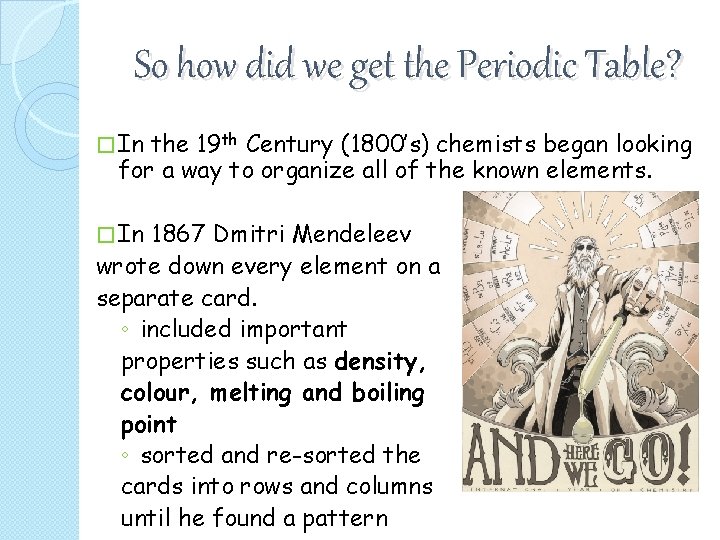
So how did we get the Periodic Table? � In the 19 th Century (1800’s) chemists began looking for a way to organize all of the known elements. � In 1867 Dmitri Mendeleev wrote down every element on a separate card. ◦ included important properties such as density, colour, melting and boiling point ◦ sorted and re-sorted the cards into rows and columns until he found a pattern
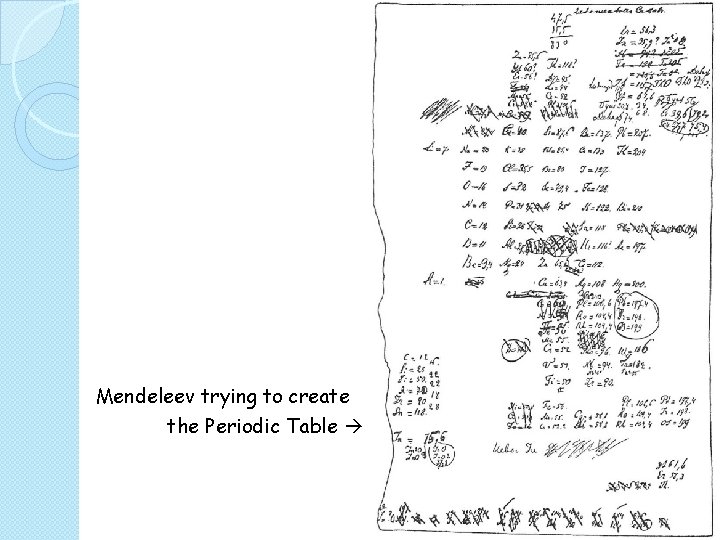
Mendeleev trying to create the Periodic Table
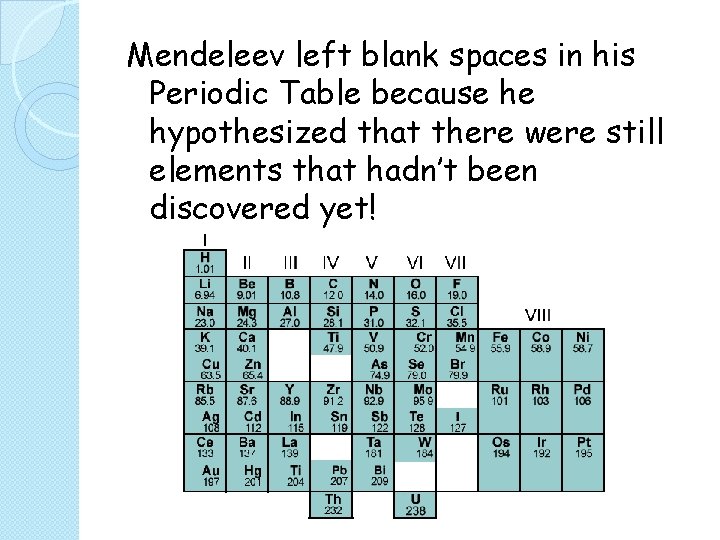
Mendeleev left blank spaces in his Periodic Table because he hypothesized that there were still elements that hadn’t been discovered yet!
Mendeleev was even able to predict the properties of undiscovered elements based on his knowledge of the blank spaces on the table and the properties of the surrounding elements!
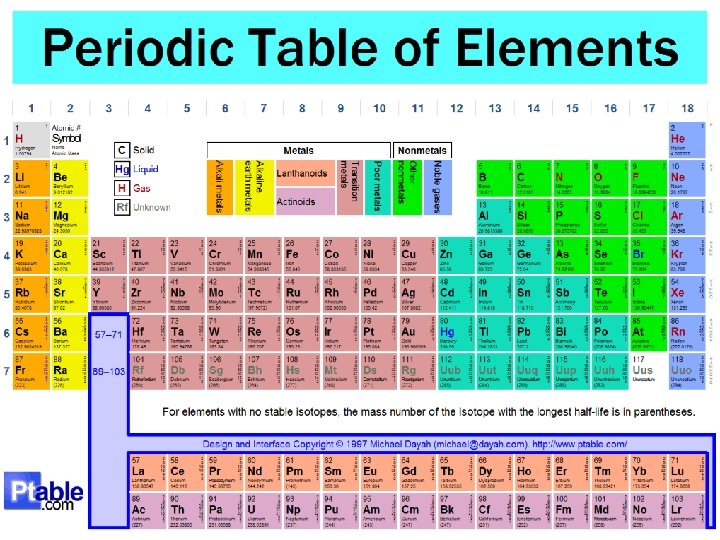
The Periodic Table Okay, we’ve heard the history but what does this table actually do? �It organizes the elements according to their physical and chemical properties �It gives each element’s name, symbol, atomic number, atomic mass, and ion charge(s)
The Atomic Number What is the Atomic Number? �The number of protons in the nucleus of each atom of an element �ALWAYS a whole number (no decimals)! Are there any patterns? �The atomic numbers increase 1 by 1 through the table, starting at #1 at the top left ◦ H = 1, He = 2, Li = 3, and so on. . .
The Atomic Mass What is it? �The mass of an average atom of an element �ALWAYS written as a decimal # and is measured in the atomic mass unit (amu) Patterns? �Tends to increase along with the atomic number with some exceptions (ex. between Cobalt and Nickel)
The Ion Charge What is it? �The electric charge that forms on an atom when it gains or loses electrons �Ion: any electrically charged atom ◦ Negative ion: an ion that has gained electrons ◦ Positive ion: an ion that has lost electrons �Multiple Ion Charge: when an element can form an ion in more than 1 way
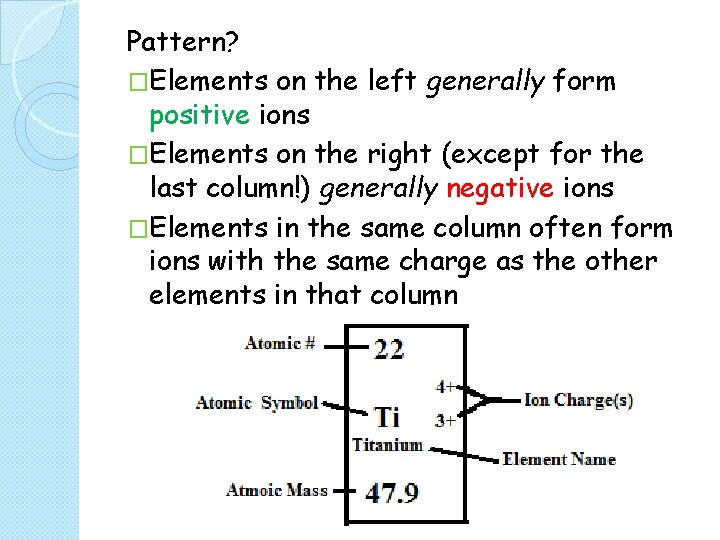
Pattern? �Elements on the left generally form positive ions �Elements on the right (except for the last column!) generally negative ions �Elements in the same column often form ions with the same charge as the other elements in that column
- Slides: 14