
THE PERIODIC TABLE OF ELEMENTS Devised by Dimitri
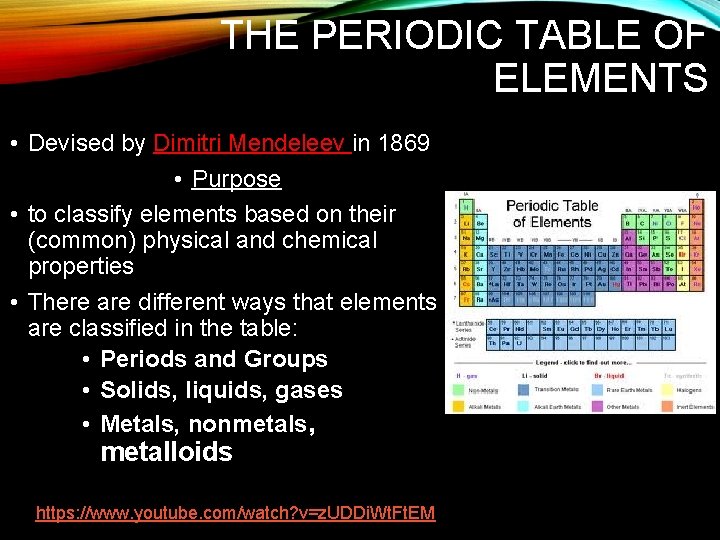
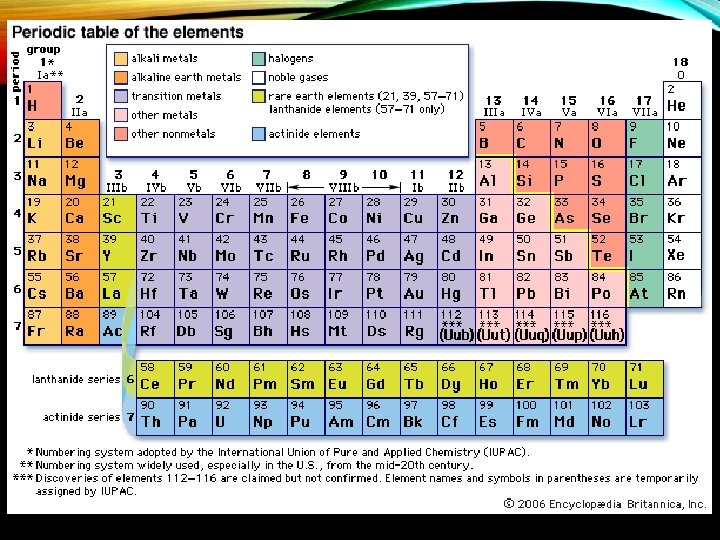
THE PERIODIC TABLE OF ELEMENTS • Devised by Dimitri Mendeleev in 1869 • Purpose • to classify elements based on their (common) physical and chemical properties • There are different ways that elements are classified in the table: • Periods and Groups • Solids, liquids, gases • Metals, nonmetals, metalloids https: //www. youtube. com/watch? v=z. UDDi. Wt. Ft. EM

DIMITRI MENDELEEV • Russian chemist! – Father of the periodic table
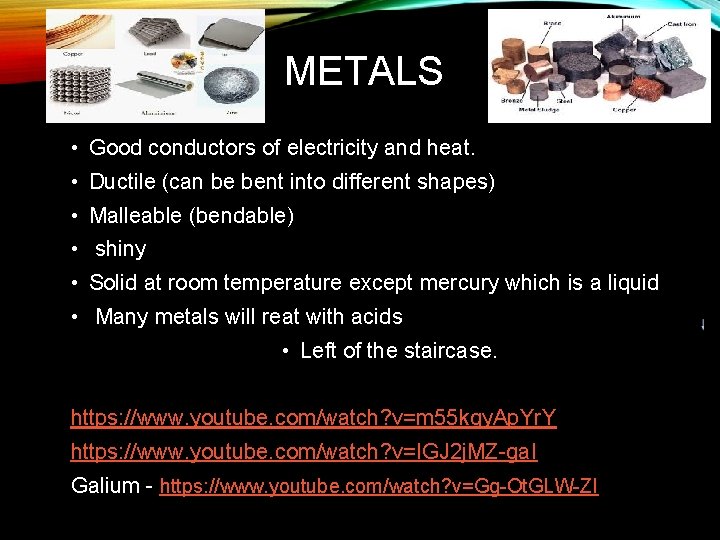
METALS • Good conductors of electricity and heat. • Ductile (can be bent into different shapes) • Malleable (bendable) • shiny • Solid at room temperature except mercury which is a liquid • Many metals will reat with acids • Left of the staircase. https: //www. youtube. com/watch? v=m 55 kgy. Ap. Yr. Y https: //www. youtube. com/watch? v=IGJ 2 j. MZ-ga. I Galium - https: //www. youtube. com/watch? v=Gg-Ot. GLW-ZI
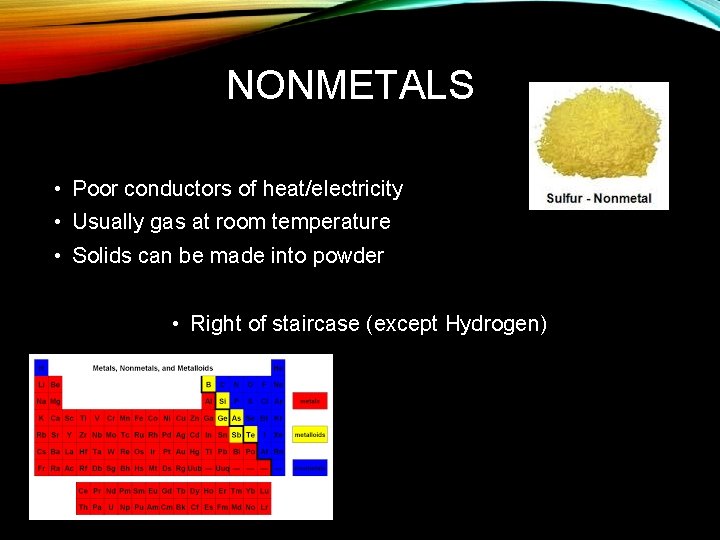
NONMETALS • Poor conductors of heat/electricity • Usually gas at room temperature • Solids can be made into powder • Right of staircase (except Hydrogen)

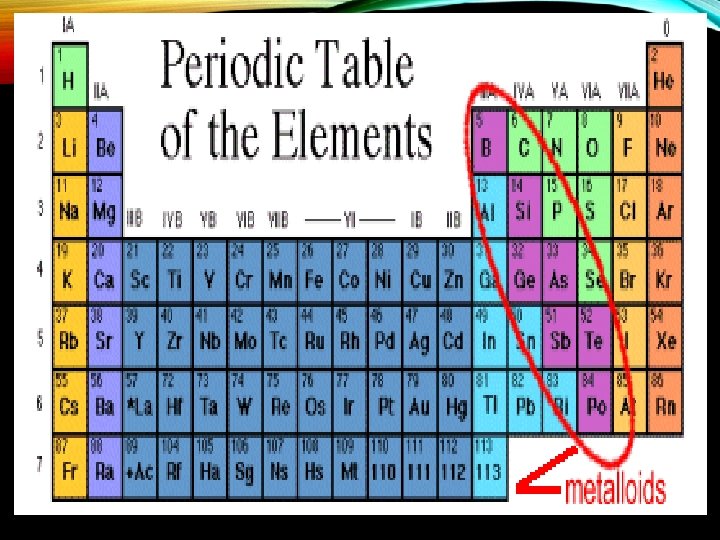
METALLOIDS • Also called semimetals • Seven elements with properties of both metals and nonmetals • Each has specific properties so they are used to make semiconductors, important materials for transitors, circuits and laser • found along both sides of the staircase.
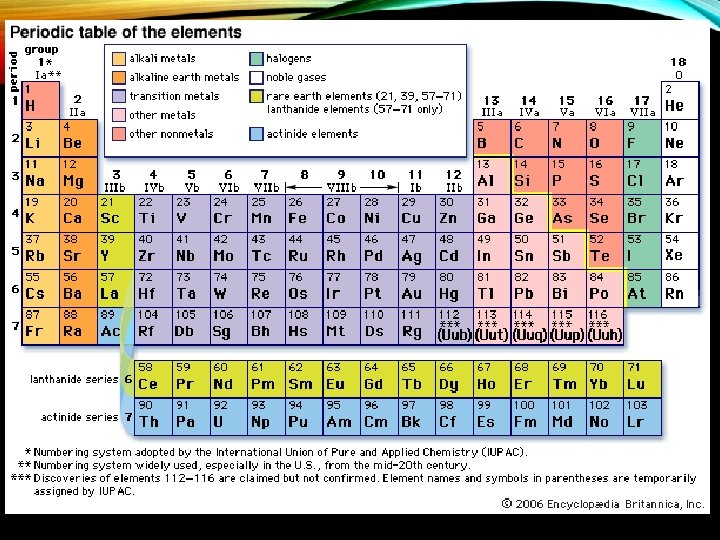
CLASSIFICATION : PERIODS & GROUPS • Columns (also called families) • Elements in a group have similar chemical properties • Group number indicates the number of electrons that exist in the outermost shell of the atoms (IA = 1 electron in its outer shell, IIA = 2 electrons in its outer shell, etc. ) • The electrons in the outermost shells are called valence electrons
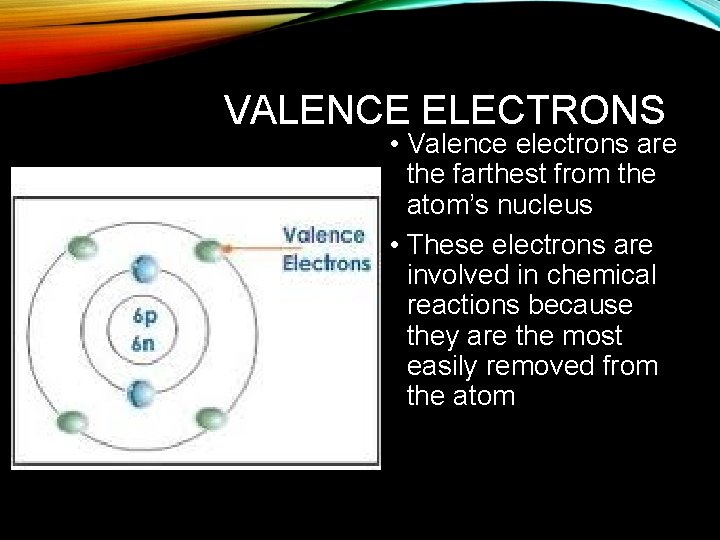
VALENCE ELECTRONS • Valence electrons are the farthest from the atom’s nucleus • These electrons are involved in chemical reactions because they are the most easily removed from the atom
CLASSIFICATION : PERIODS & GROUPS • GROUPS
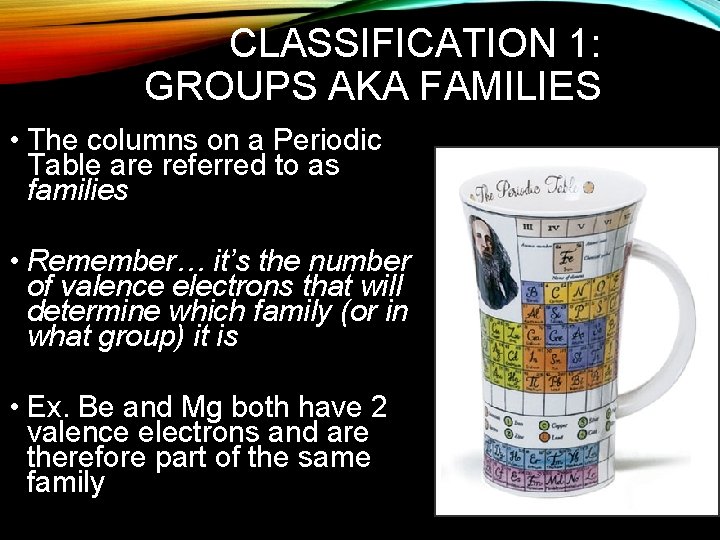
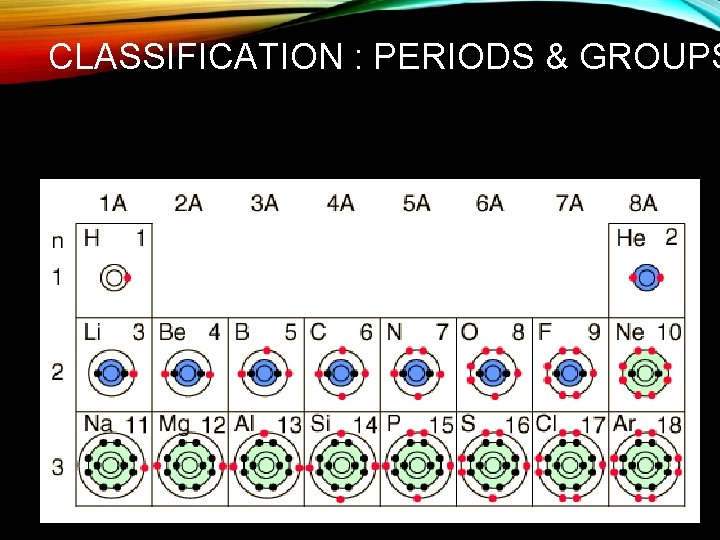
CLASSIFICATION 1: GROUPS AKA FAMILIES • The columns on a Periodic Table are referred to as families • Remember… it’s the number of valence electrons that will determine which family (or in what group) it is • Ex. Be and Mg both have 2 valence electrons and are therefore part of the same family

FAMILIES GROUP # # VALENCE ELECTRONS CHEMICAL FAMILY IA IIIA IVA VA VIIA VIIIA 1 2 3 4 5 6 7 8 Alkali metals Alkaline earth metals Boron group Carbon group Nitrogen group Oxygen group Halogens Inert/Noble gases
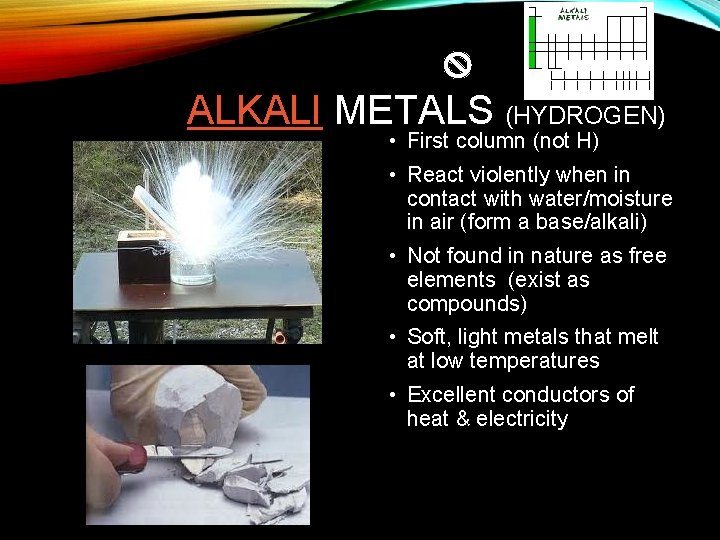
ALKALI METALS (HYDROGEN) • First column (not H) • React violently when in contact with water/moisture in air (form a base/alkali) • Not found in nature as free elements (exist as compounds) • Soft, light metals that melt at low temperatures • Excellent conductors of heat & electricity
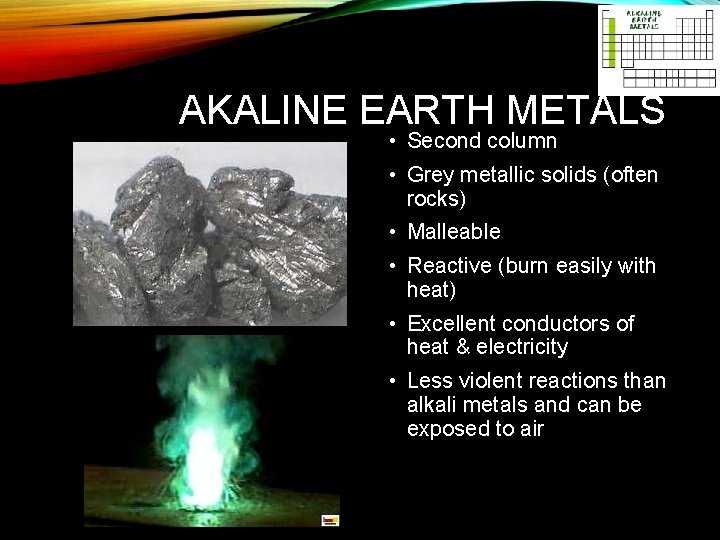
AKALINE EARTH METALS • Second column • Grey metallic solids (often rocks) • Malleable • Reactive (burn easily with heat) • Excellent conductors of heat & electricity • Less violent reactions than alkali metals and can be exposed to air
HALOGENS • MOST reactive/toxic non-metal (therefore only exist as compounds) • Found as either solids, liquids or gases • Combine with alkali metals to form salts (Na. Cl) • Powerful desinfectants: chlorine • Form strong acids when combined with H (ex. HCl)
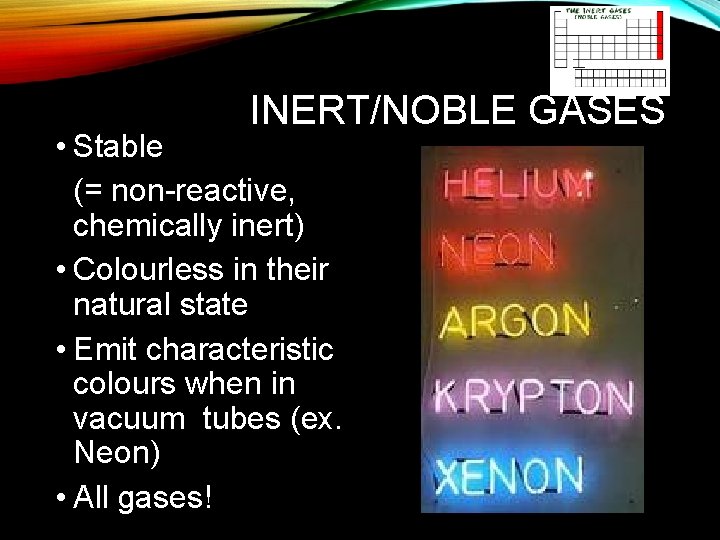
INERT/NOBLE GASES • Stable (= non-reactive, chemically inert) • Colourless in their natural state • Emit characteristic colours when in vacuum tubes (ex. Neon) • All gases!
CLASSIFICATION : PERIODS & GROUPS PERIODS • Rows • The period number indicates the number of orbits/shells an atom has. ex. Na and Cl are both situated in the 3 rd period therefore, their atoms contain 3 orbits
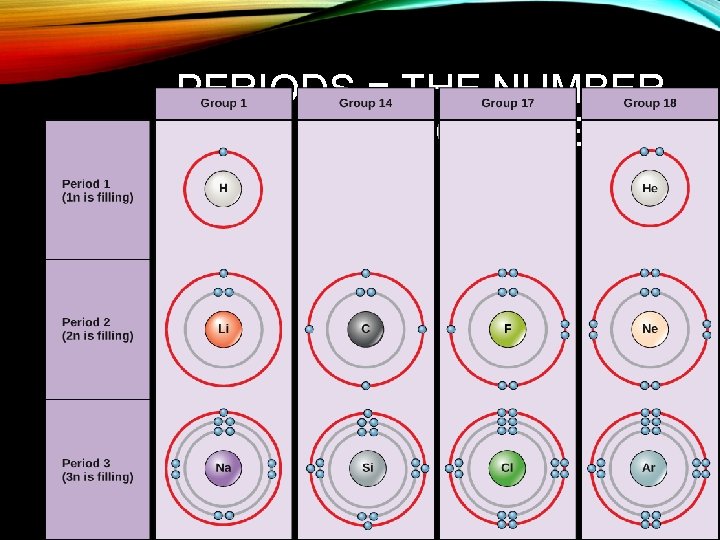
PERIODS = THE NUMBER OF SHELLS!
TEST YOUR KNOWLEDGE!!! • What element has • 3 shells and 4 valence electrons? • 4 shells and 7 valence electrons? • 2 shells and 1 valence electron? • 1 shell and 1 valence electron?
- Slides: 21