
The Periodic Table Lesson 9 Review 1 Science
The Periodic Table Lesson 9 - Review 1 Science Chemistry - Key Stage 3 Miss Willett 1

2
What have you learnt already? 1. What is an element? 3 1. How many electrons fit on the first shell of an atom? 1. What does the mass number tell you about an atom?
What makes a good flash card? What’s the problem? ! Example 1: Example 2: Example 3: 4
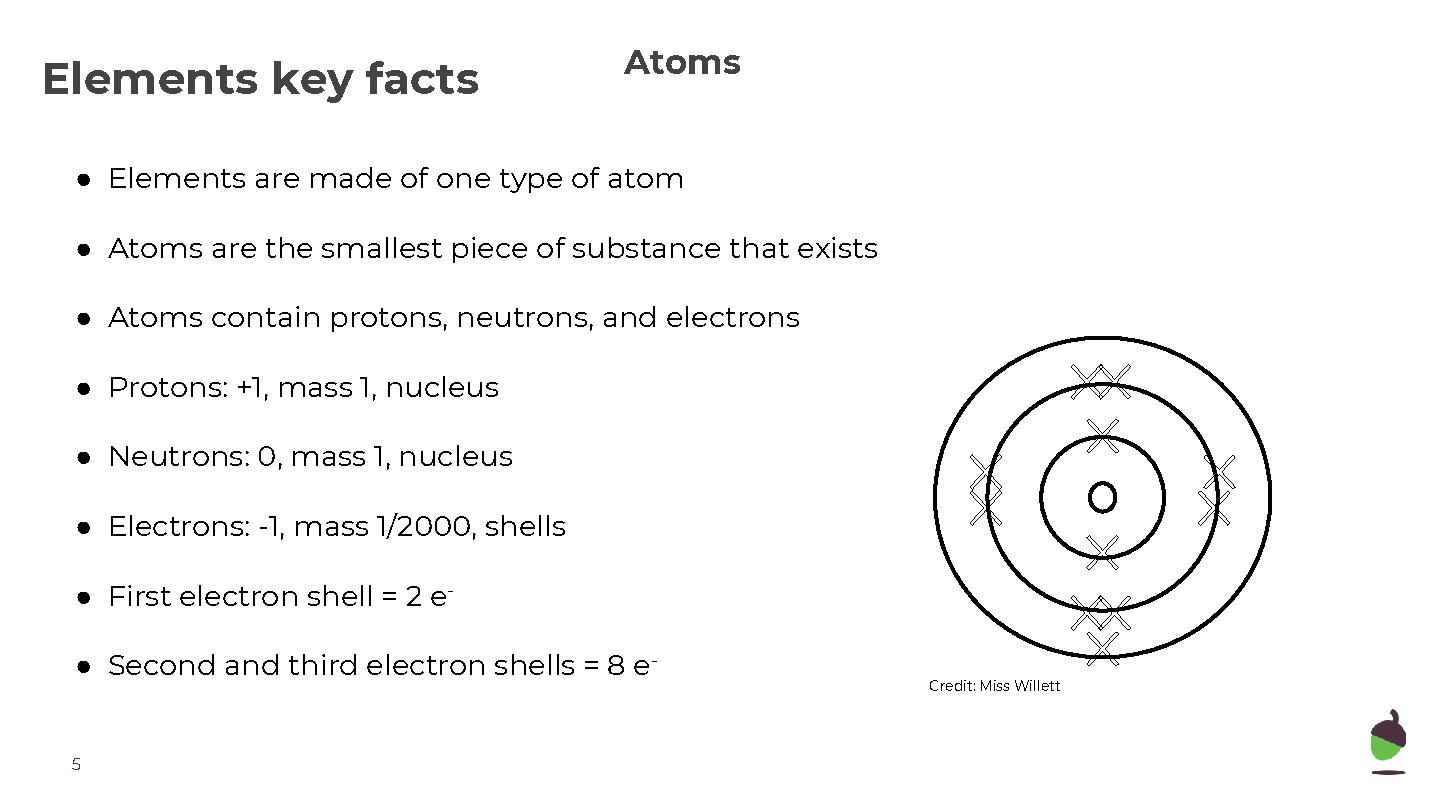
Elements key facts Atoms ● Elements are made of one type of atom ● Atoms are the smallest piece of substance that exists ● Atoms contain protons, neutrons, and electrons ● Protons: +1, mass 1, nucleus ● Neutrons: 0, mass 1, nucleus ● Electrons: -1, mass 1/2000, shells ● First electron shell = 2 e● Second and third electron shells = 8 e 5 Credit: Miss Willett
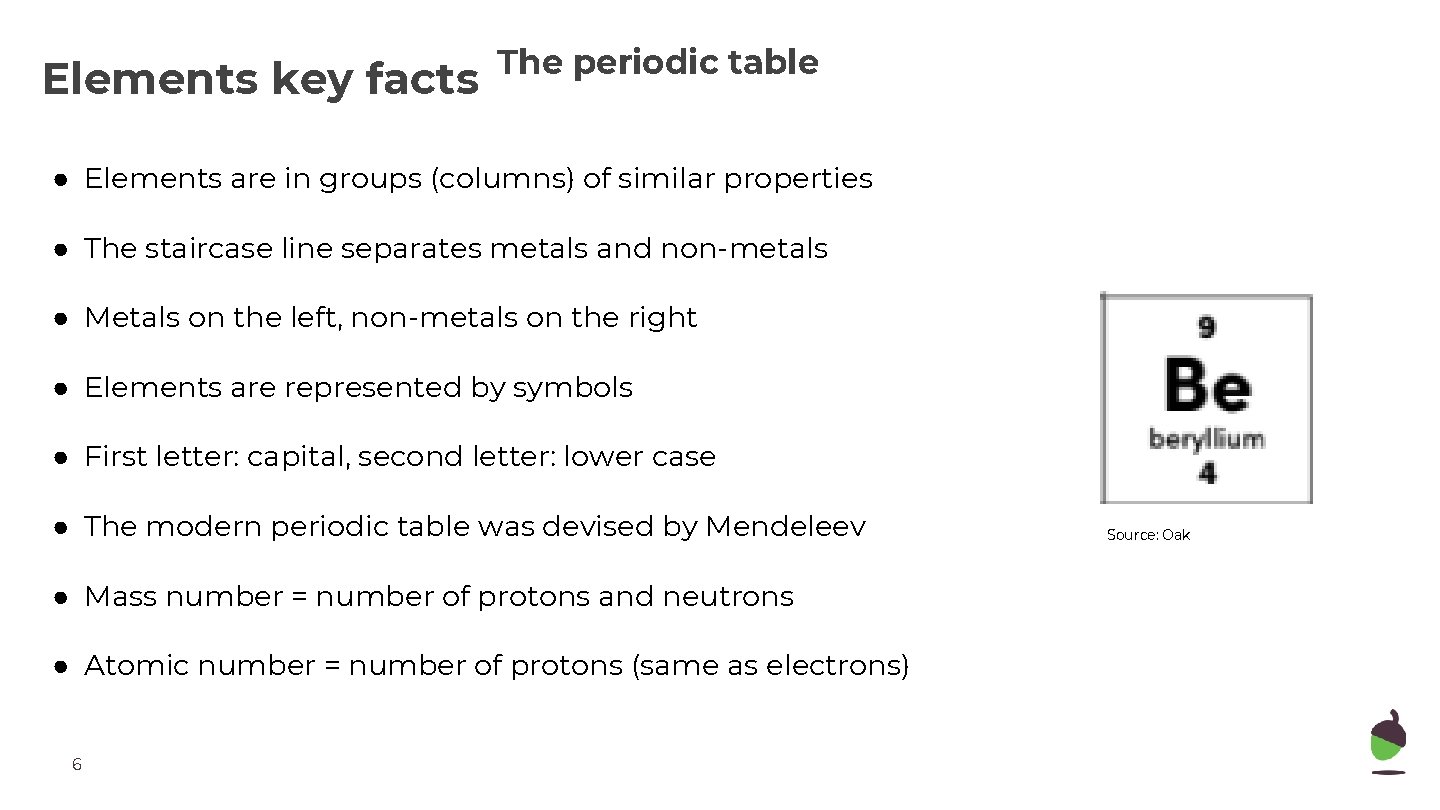
Elements key facts The periodic table ● Elements are in groups (columns) of similar properties ● The staircase line separates metals and non-metals ● Metals on the left, non-metals on the right ● Elements are represented by symbols ● First letter: capital, second letter: lower case ● The modern periodic table was devised by Mendeleev ● Mass number = number of protons and neutrons ● Atomic number = number of protons (same as electrons) 6 Source: Oak
Elements! True or false? Electrons have a negative charge and are found on shells The modern periodic table was designed by Newlands Atoms have the same number of protons and electrons (the mass number) 7
Revision 1: Elements Make at least 3 flashcards to summarise your learning about ELEMENTS Some ideas about what you could include: ● What are elements? ● What are the charge and location of the three subatomic particles? ● What is the periodic table? How is it organised? ● Who developed the periodic table? ● How are elements represented? 8
What makes a good mind map? Put the stages in order: A: Write a sentence along the line to show they’re linked B: Add definitions of the words, where needed C: Write keywords for the topic, scattered about D: Draw lines between linked words E: Choose a topic area 9 ANSWER: E,
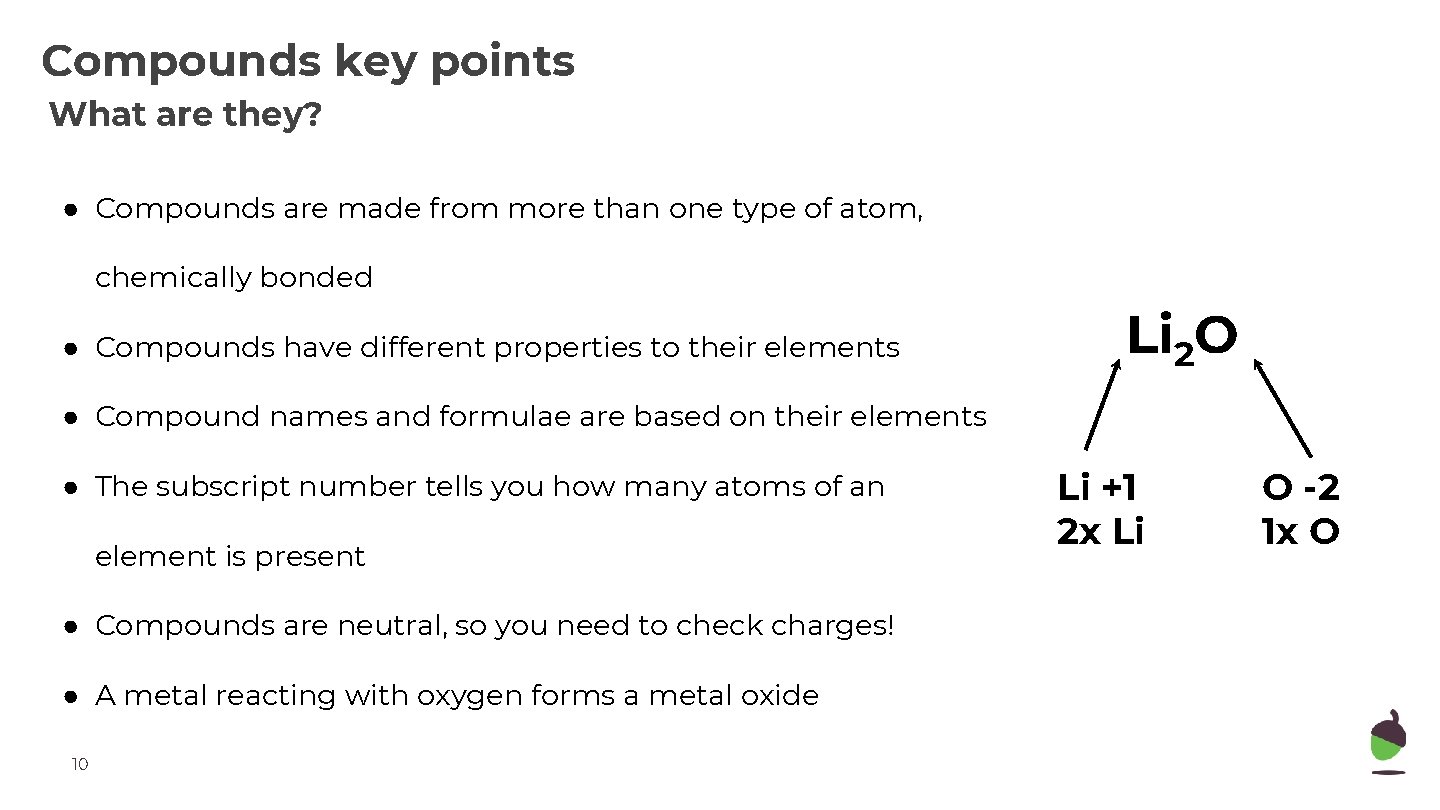
Compounds key points What are they? ● Compounds are made from more than one type of atom, chemically bonded ● Compounds have different properties to their elements Li 2 O ● Compound names and formulae are based on their elements ● The subscript number tells you how many atoms of an element is present ● Compounds are neutral, so you need to check charges! ● A metal reacting with oxygen forms a metal oxide 10 Li +1 2 x Li O -2 1 x O
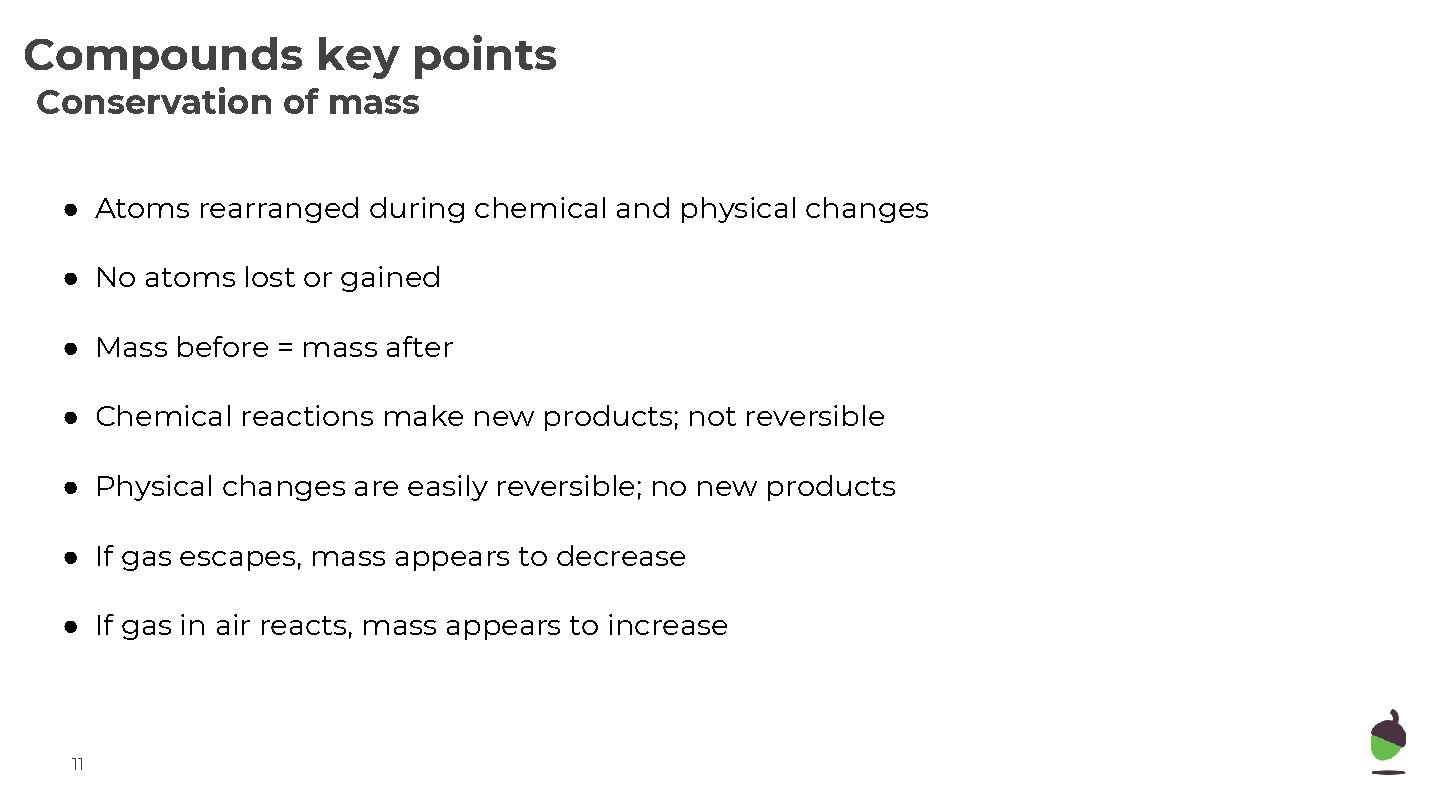
Compounds key points Conservation of mass ● Atoms rearranged during chemical and physical changes ● No atoms lost or gained ● Mass before = mass after ● Chemical reactions make new products; not reversible ● Physical changes are easily reversible; no new products ● If gas escapes, mass appears to decrease ● If gas in air reacts, mass appears to increase 11
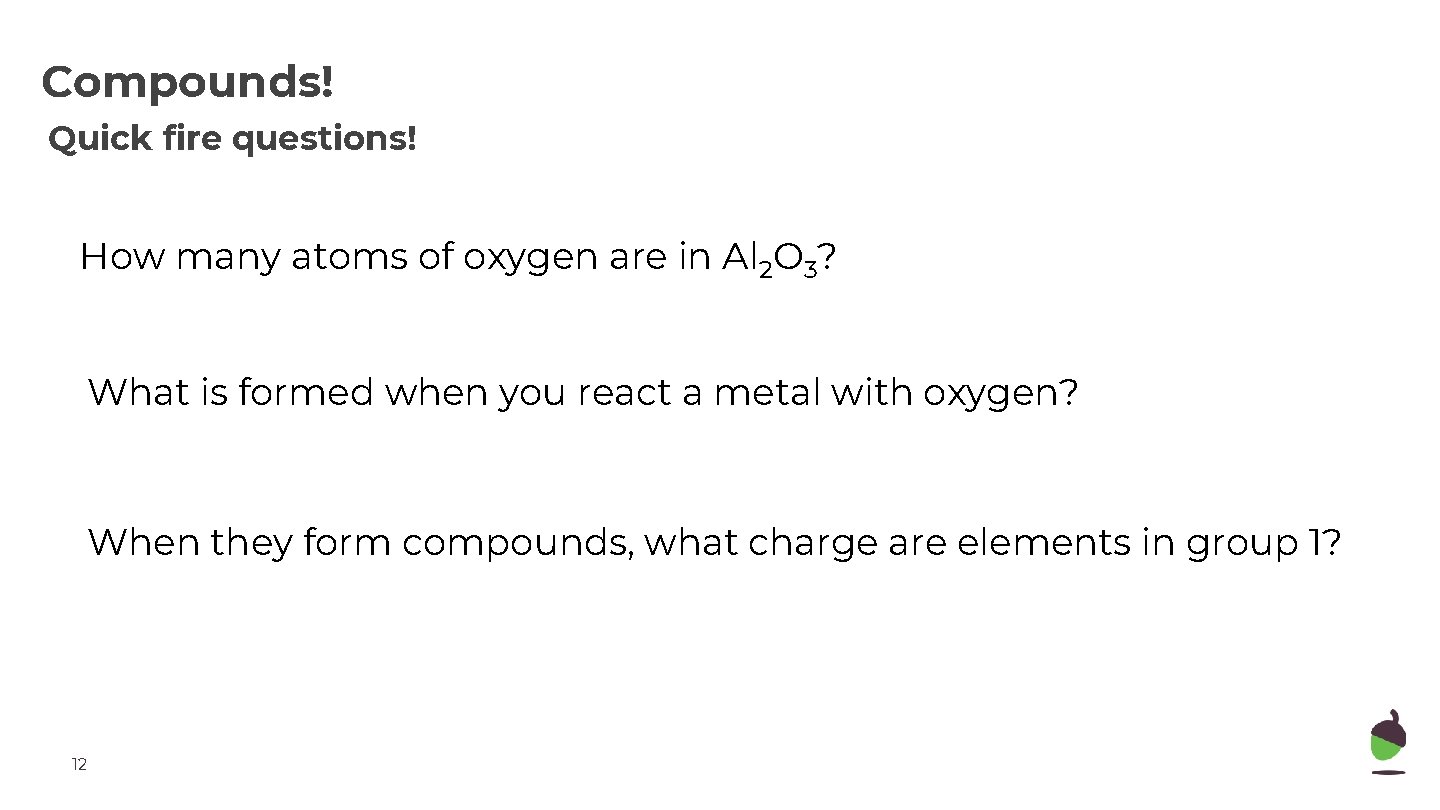
Compounds! Quick fire questions! How many atoms of oxygen are in Al 2 O 3? What is formed when you react a metal with oxygen? When they form compounds, what charge are elements in group 1? 12
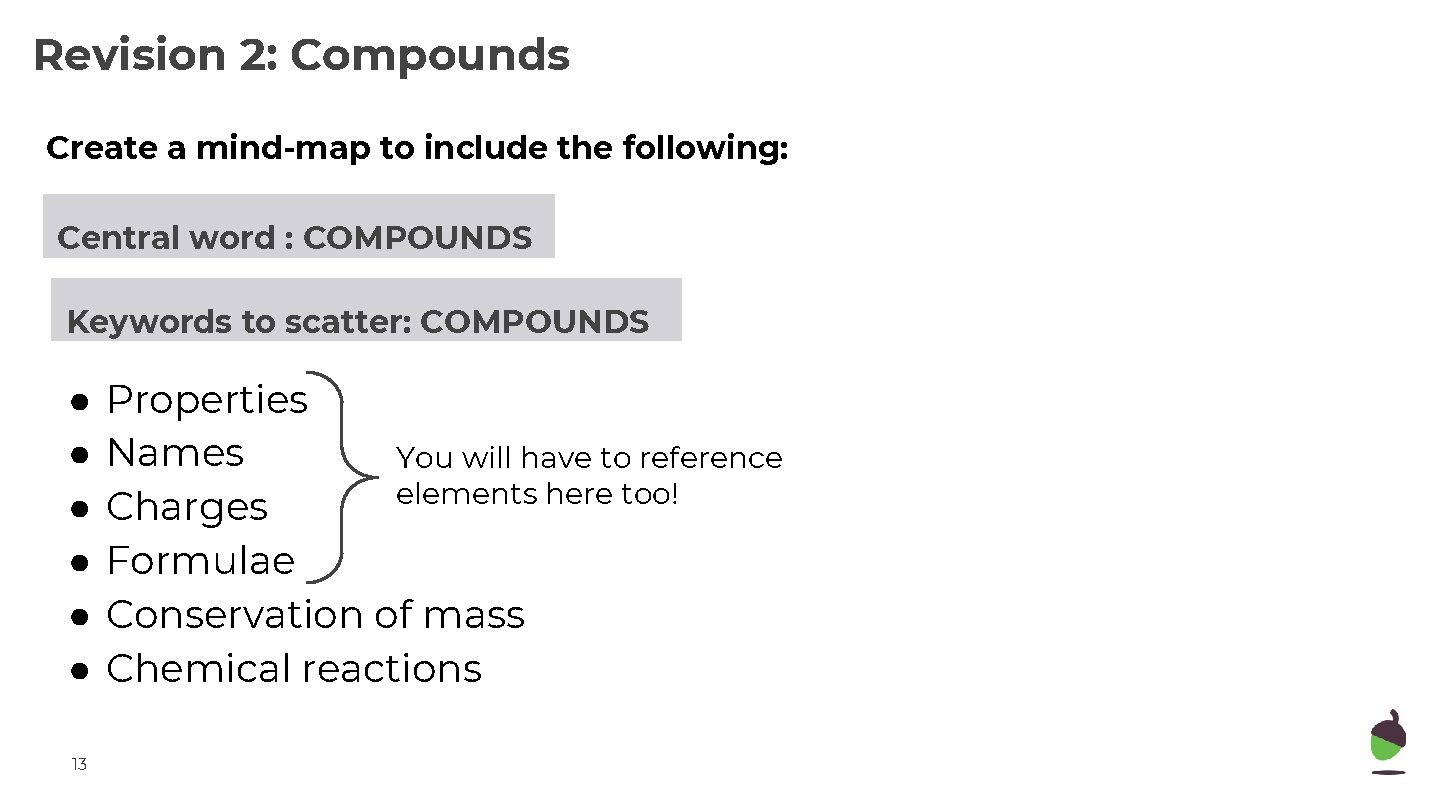
Revision 2: Compounds Create a mind-map to include the following: Central word : COMPOUNDS Keywords to scatter: COMPOUNDS ● ● ● 13 Properties Names You will have to reference elements here too! Charges Formulae Conservation of mass Chemical reactions
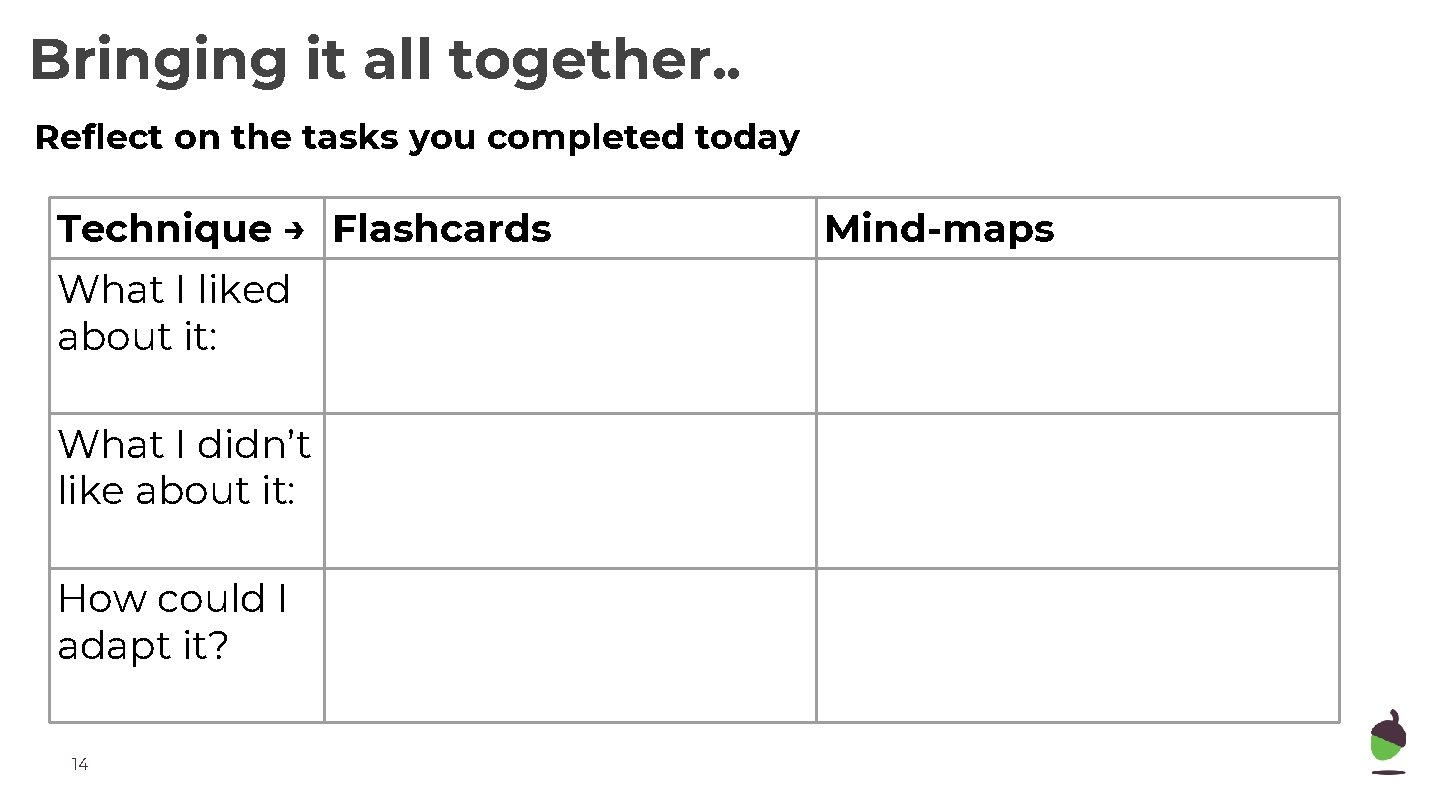
Bringing it all together. . Reflect on the tasks you completed today Technique → Flashcards What I liked about it: What I didn’t like about it: How could I adapt it? 14 Mind-maps
- Slides: 14