
The Periodic Table independently by Mendeleev and Meyer
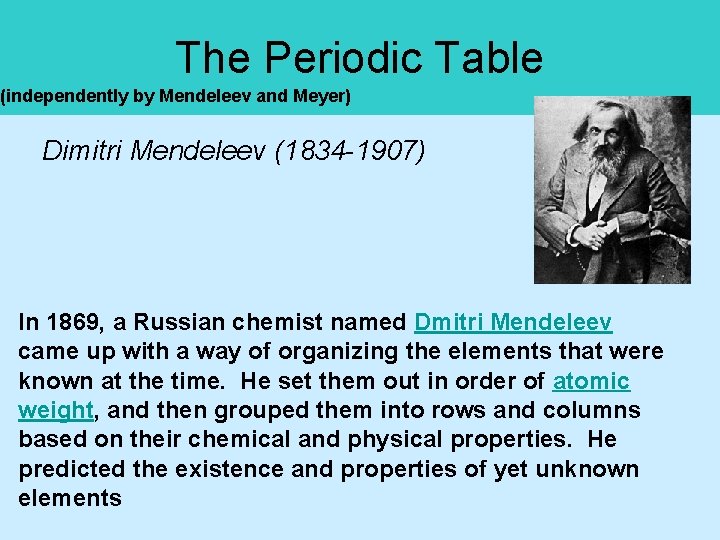
The Periodic Table (independently by Mendeleev and Meyer) Dimitri Mendeleev (1834 -1907) In 1869, a Russian chemist named Dmitri Mendeleev came up with a way of organizing the elements that were known at the time. He set them out in order of atomic weight, and then grouped them into rows and columns based on their chemical and physical properties. He predicted the existence and properties of yet unknown elements
• Mendeleev had no idea what atoms were made of or why they behaved as they did. Nevertheless, he was able to put together the periodic table almost as we know it today--except that some elements were missing, because they were unknown in 1869. Also the current Table is arranged in order of atomic numbers • Based on the gaps in his table, Mendeleev even succeeded in predicting the existence and properties of several new elements. • His basic rule was the following: the elements in any column, or group, of the table are similar to their columnmates. For example, look at the first column on the left, underneath hydrogen (H). The elements in this group are called the alkali metals; they're all soft metals that react violently with water to make hydrogen gas.
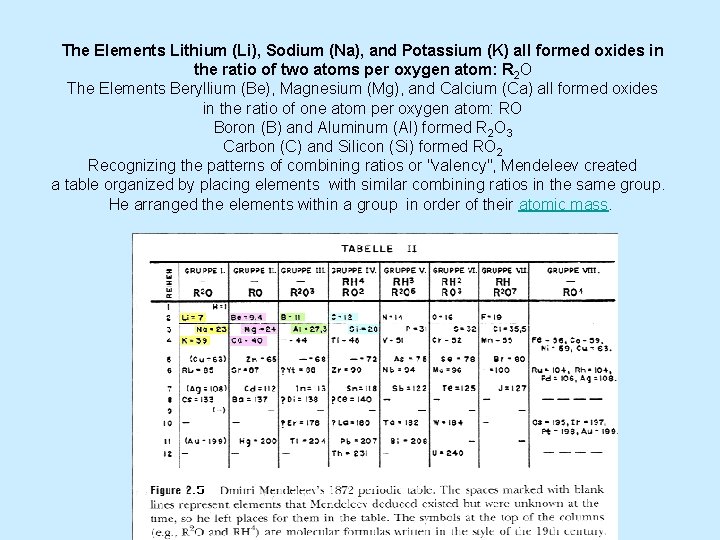
The Elements Lithium (Li), Sodium (Na), and Potassium (K) all formed oxides in the ratio of two atoms per oxygen atom: R 2 O The Elements Beryllium (Be), Magnesium (Mg), and Calcium (Ca) all formed oxides in the ratio of one atom per oxygen atom: RO Boron (B) and Aluminum (Al) formed R 2 O 3 Carbon (C) and Silicon (Si) formed RO 2 Recognizing the patterns of combining ratios or "valency", Mendeleev created a table organized by placing elements with similar combining ratios in the same group. He arranged the elements within a group in order of their atomic mass.
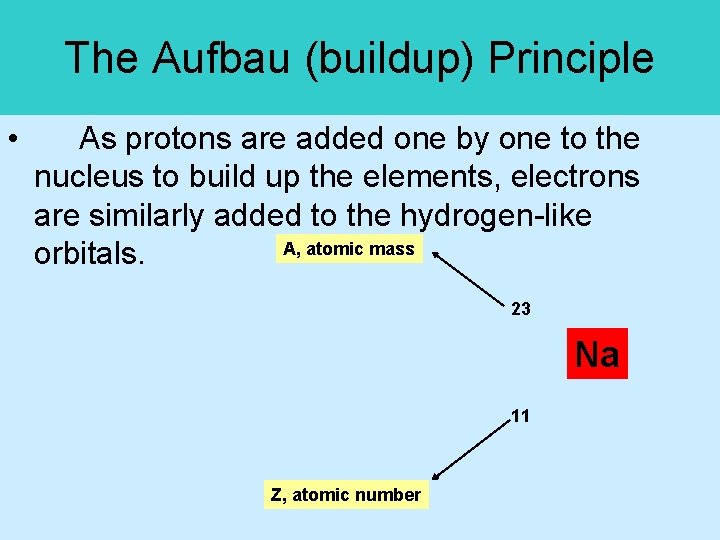
The Aufbau (buildup) Principle • As protons are added one by one to the nucleus to build up the elements, electrons are similarly added to the hydrogen-like A, atomic mass orbitals. 23 Na 11 Z, atomic number
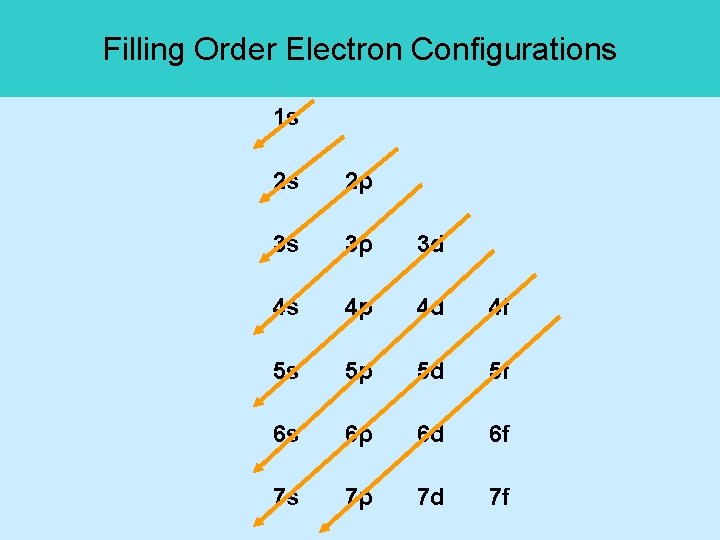
Filling Order Electron Configurations 1 s 2 s 2 p 3 s 3 p 3 d 4 s 4 p 4 d 4 f 5 s 5 p 5 d 5 f 6 s 6 p 6 d 6 f 7 s 7 p 7 d 7 f
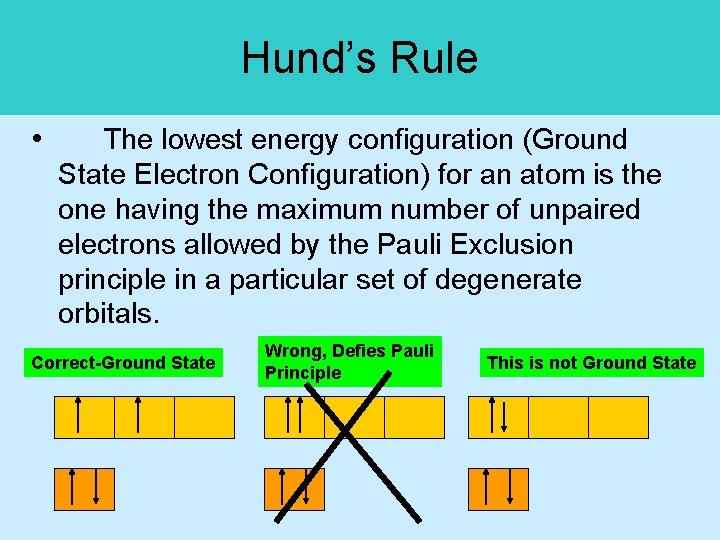
Hund’s Rule • The lowest energy configuration (Ground State Electron Configuration) for an atom is the one having the maximum number of unpaired electrons allowed by the Pauli Exclusion principle in a particular set of degenerate orbitals. Correct-Ground State Wrong, Defies Pauli Principle This is not Ground State
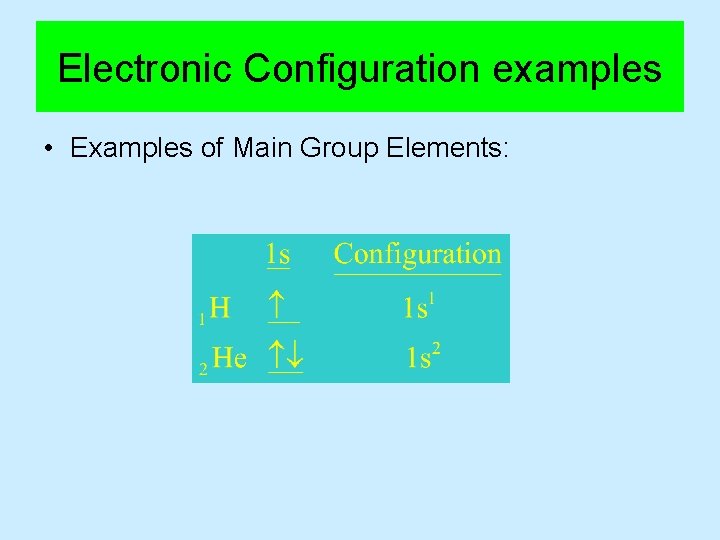
Electronic Configuration examples • Examples of Main Group Elements:


Note: elements to 104 to 111 have been named
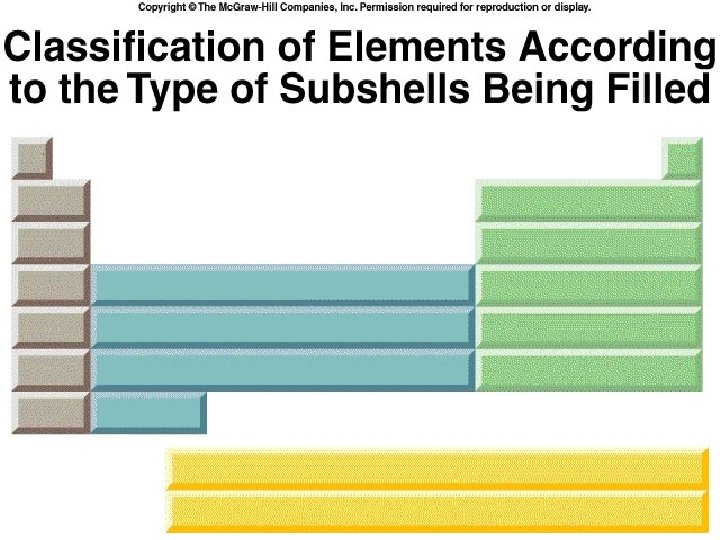
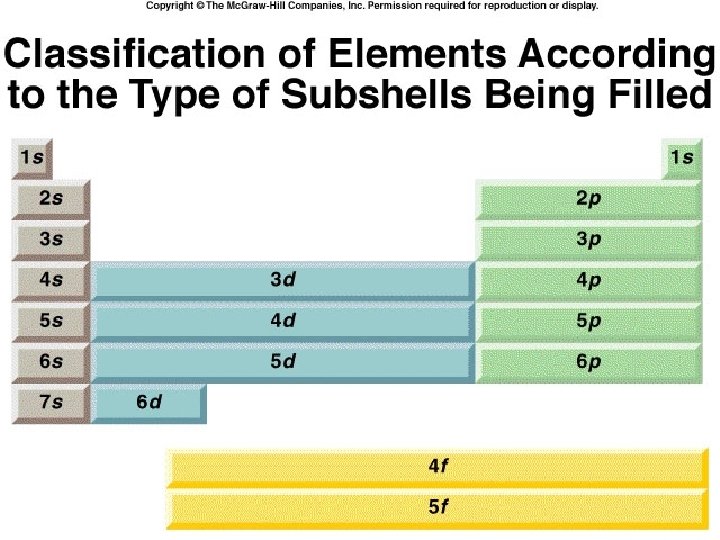
Broad Periodic Table Classifications • • • Representative Elements (main group): filling s and p orbitals (Na, Al, Ne, O) Transition Elements: filling d orbitals (Fe, Co, Ni) Lanthanide and Actinide Series (inner transition elements): filling 4 f and 5 f orbitals (Eu, Am, Es)
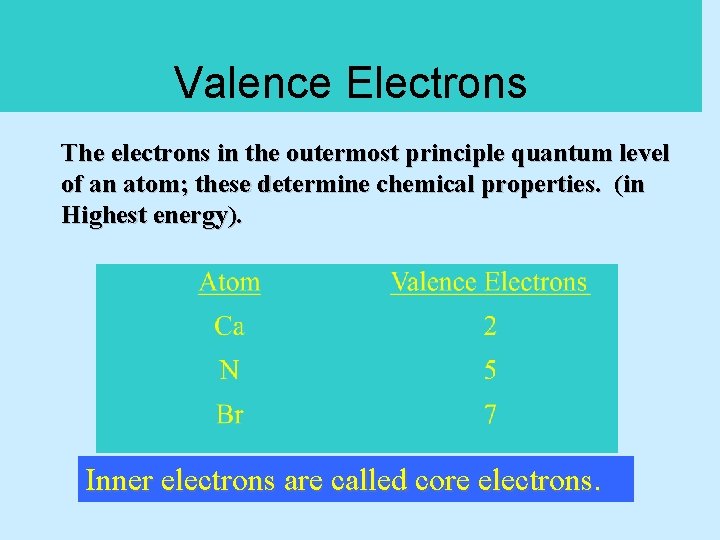
Valence Electrons The electrons in the outermost principle quantum level of an atom; these determine chemical properties. (in Highest energy). Inner electrons are called core electrons.

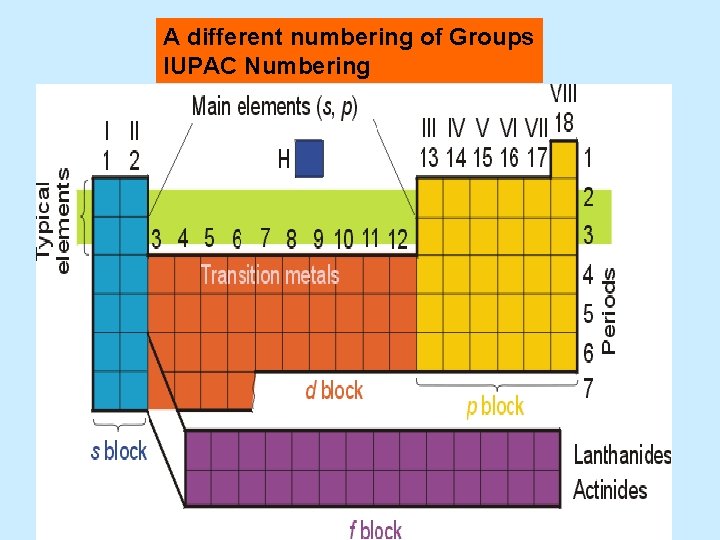
A different numbering of Groups IUPAC Numbering
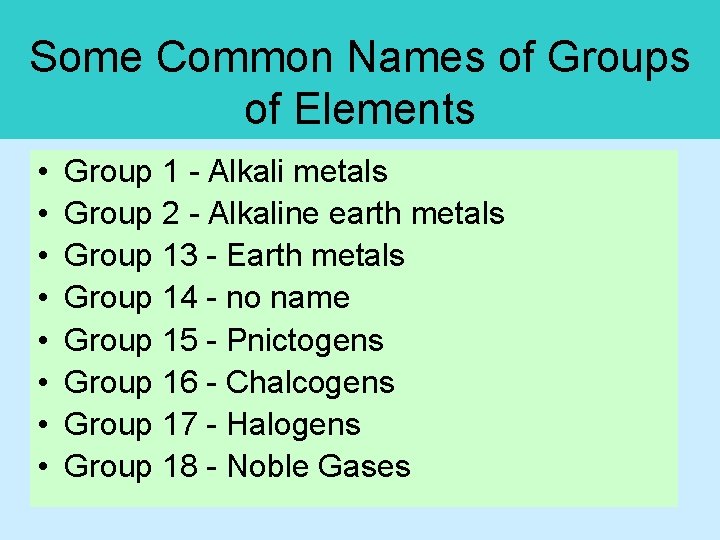
Some Common Names of Groups of Elements • • Group 1 - Alkali metals Group 2 - Alkaline earth metals Group 13 - Earth metals Group 14 - no name Group 15 - Pnictogens Group 16 - Chalcogens Group 17 - Halogens Group 18 - Noble Gases
Electronic Configuration: Using the Periodic Table
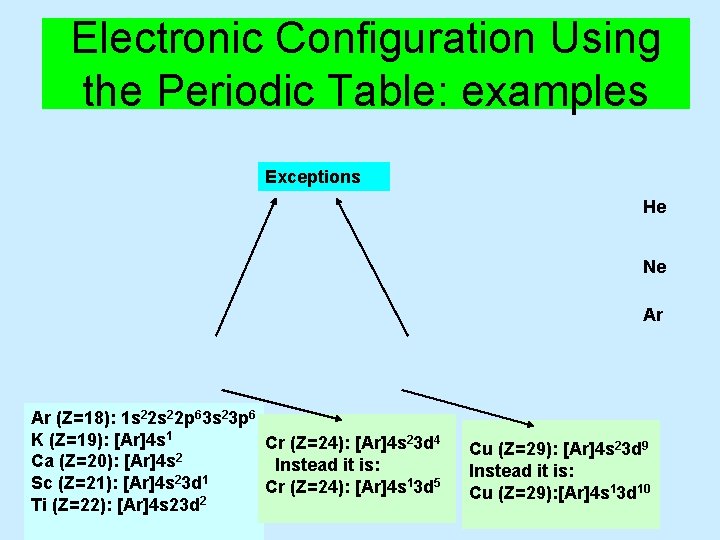
Electronic Configuration Using the Periodic Table: examples Exceptions He Ne Ar Ar (Z=18): 1 s 22 p 63 s 23 p 6 K (Z=19): [Ar]4 s 1 Cr (Z=24): [Ar]4 s 23 d 4 Ca (Z=20): [Ar]4 s 2 Instead it is: 2 1 Sc (Z=21): [Ar]4 s 3 d Cr (Z=24): [Ar]4 s 13 d 5 Ti (Z=22): [Ar]4 s 23 d 2 Cu (Z=29): [Ar]4 s 23 d 9 Instead it is: Cu (Z=29): [Ar]4 s 13 d 10
Levels become closely spaced as n increases Therefore exceptions are many for transition elements and more so for the lanthanides and actinides

General Rules • The (n+1) s fills before the nd orbitals • After Lanthanum [Xe]6 s 25 d 1, a group of 14 elements called the lanthanides occurs, corresponding the filling of 4 f. (exceptions occur) • After Actinium [Rn]7 s 26 d 1, a group of 14 elements called the actinides occurs, corresponding the filling of 5 f. (exceptions occur) • The group labels 1 A, 2 A, 3 A…indicate the total number of valence electrons in these groups. • By IUPAC: group number indicates the number of s, p, d electrons added since the last noble gas
- Slides: 22