
The Periodic Table I History II Arrangement of
The Periodic Table I. History II. Arrangement of Elements III. Electron Configuration Trends IV. Periodic Trends V. Reactivity
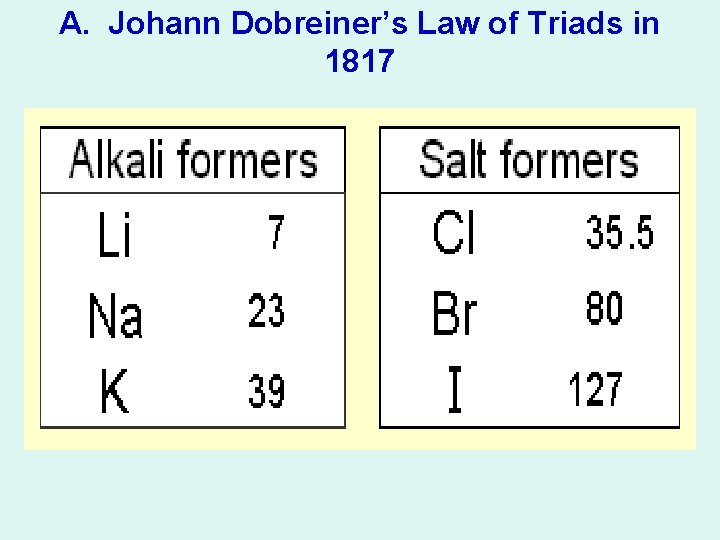
A. Johann Dobreiner’s Law of Triads in 1817

B. John Newlands – Law of Octaves
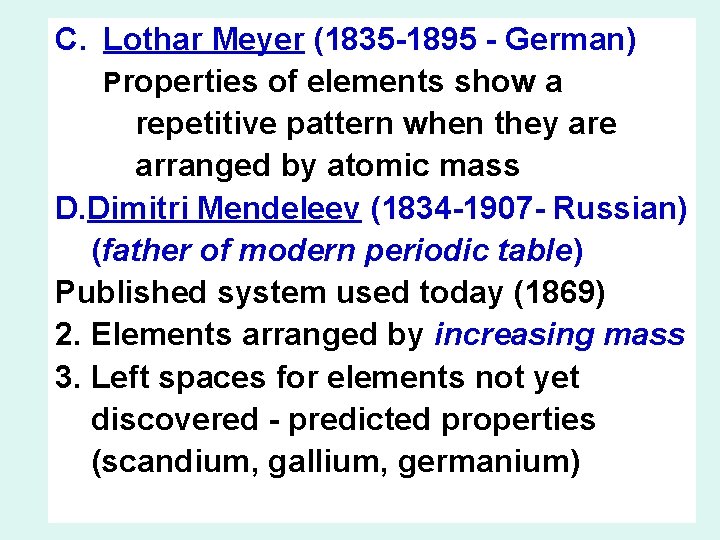
C. Lothar Meyer (1835 -1895 - German) Properties of elements show a repetitive pattern when they are arranged by atomic mass D. Dimitri Mendeleev (1834 -1907 - Russian) (father of modern periodic table) Published system used today (1869) 2. Elements arranged by increasing mass 3. Left spaces for elements not yet discovered - predicted properties (scandium, gallium, germanium)

Dimitri Mendelev
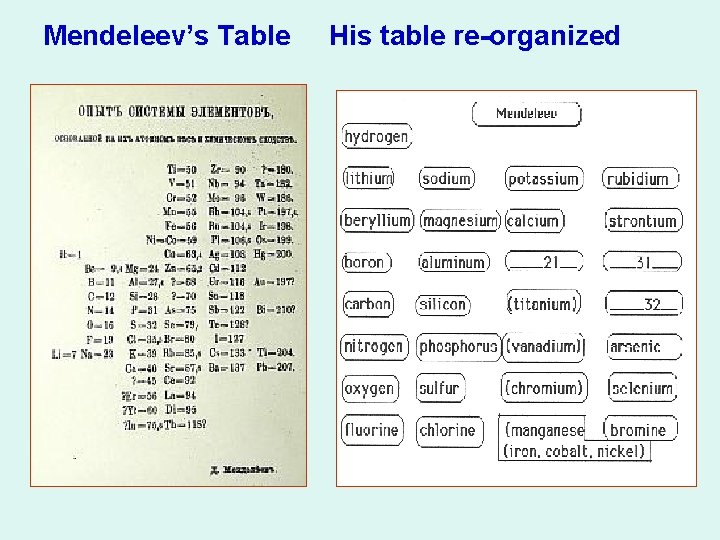
Mendeleev’s Table His table re-organized
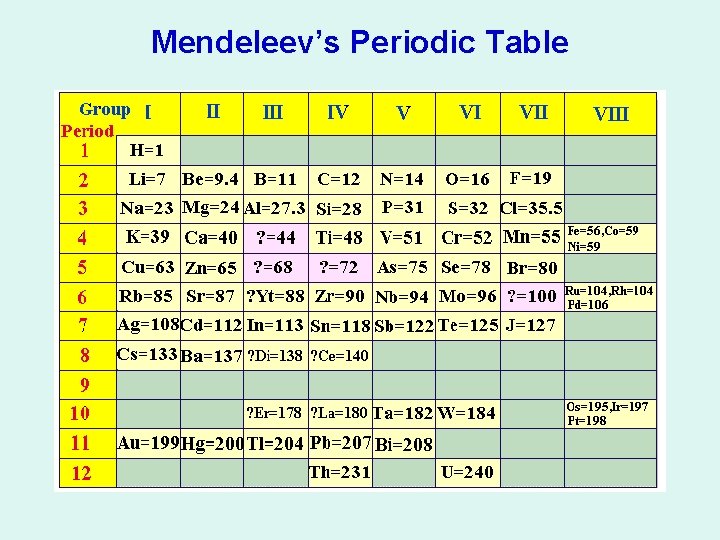
Mendeleev’s Periodic Table
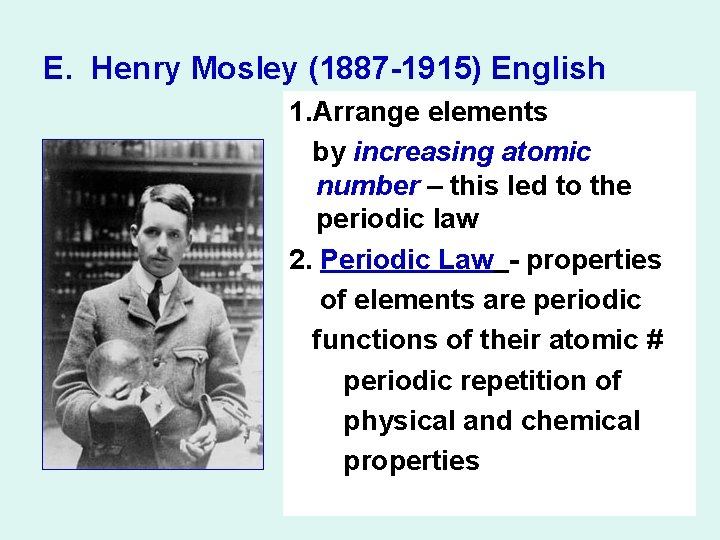
E. Henry Mosley (1887 -1915) English 1. Arrange elements by increasing atomic number – this led to the periodic law 2. Periodic Law - properties of elements are periodic functions of their atomic # periodic repetition of physical and chemical properties
II. Arrangement of Elements A. Periodic Table – arrangement of elements in order of increasing atomic number so that elements with similar properties are in the same column period – horizontal row (7) group(family)- vertical columns (1 -18) periodicity – reoccurrence of similar properties of elements in groups
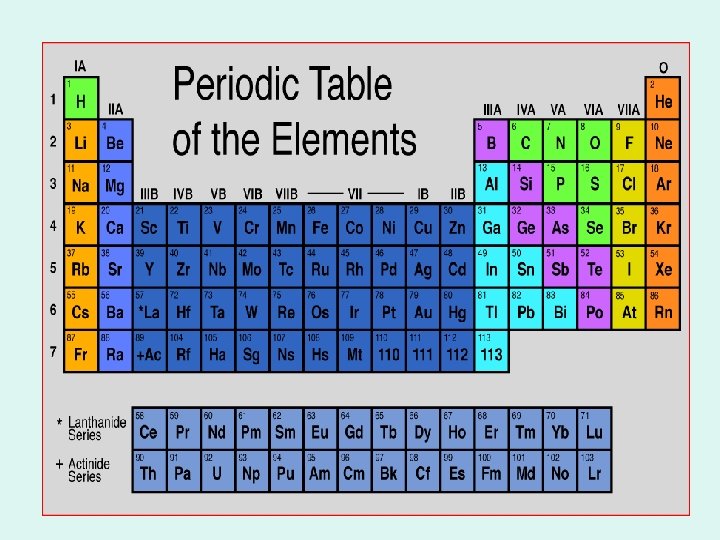
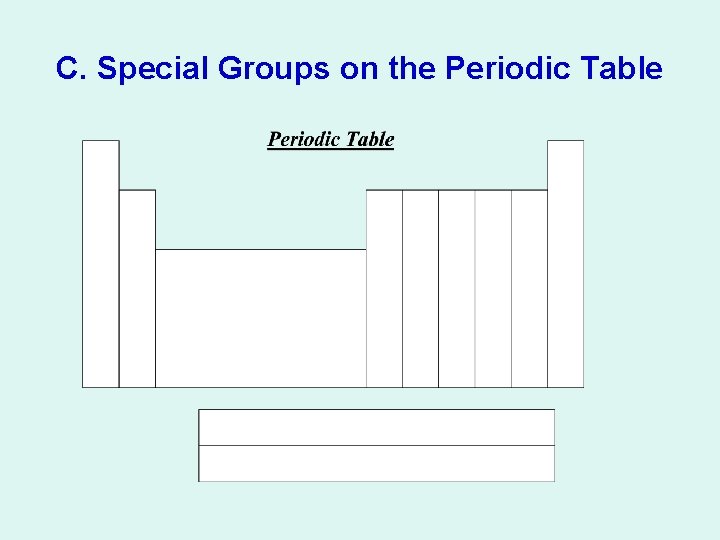
C. Special Groups on the Periodic Table

D. Periodic Table Showing s, p, d, f Blocks
E. Metals – Metalloids - Nonmetals 1. Metals are on the left side – all are solids except mercury (Hg) a. elements near the left of a period are more metallic than those near the right b. elements near the top of a group are more metallic than those near the bottom 2. Metalloids – group of elements between metals and nonmetals(B, Si, Ge, As, Sb, Te) 3. Nonmetals are on the right side – all are solids or gases except bromine(Br) liquid
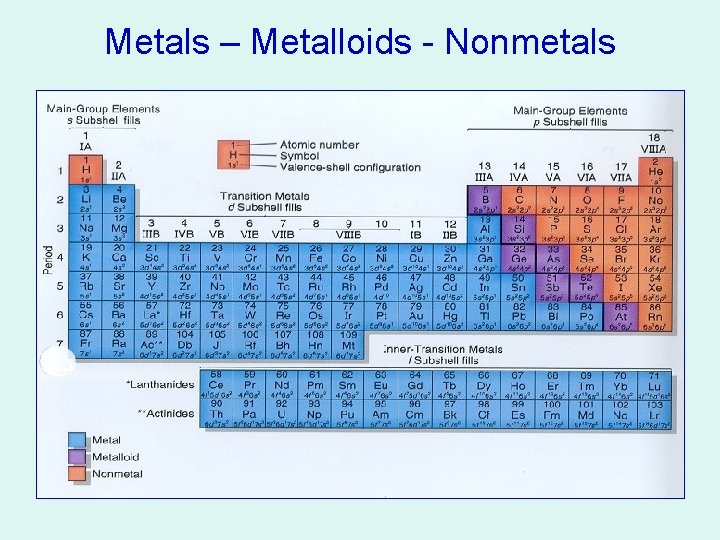
Metals – Metalloids - Nonmetals
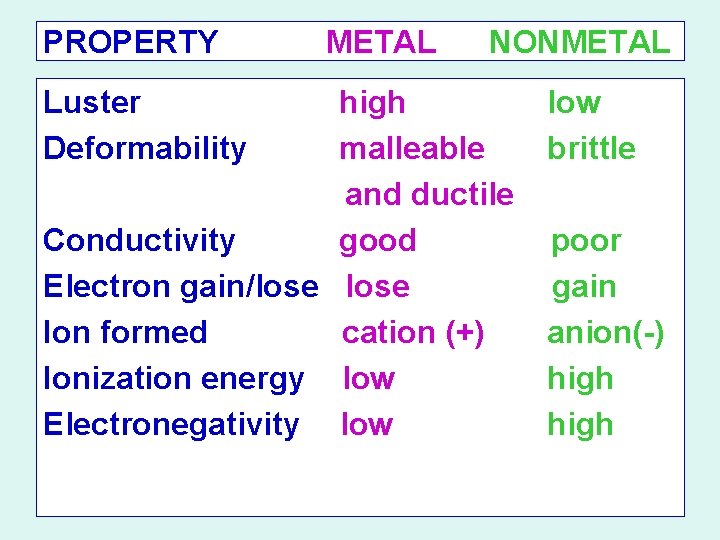
PROPERTY Luster Deformability METAL NONMETAL high malleable and ductile Conductivity good Electron gain/lose Ion formed cation (+) Ionization energy low Electronegativity low brittle poor gain anion(-) high
IV. Periodic Trends(Main Group Elements) A. Atomic Radii 1. atomic radius is ½ the distance between nuclei of identical atoms joined in a molecule 2. decreases across periods (left-right) a. caused by increasing attraction between protons and electrons 3. increases from top to bottom a. caused by adding electrons to new shells
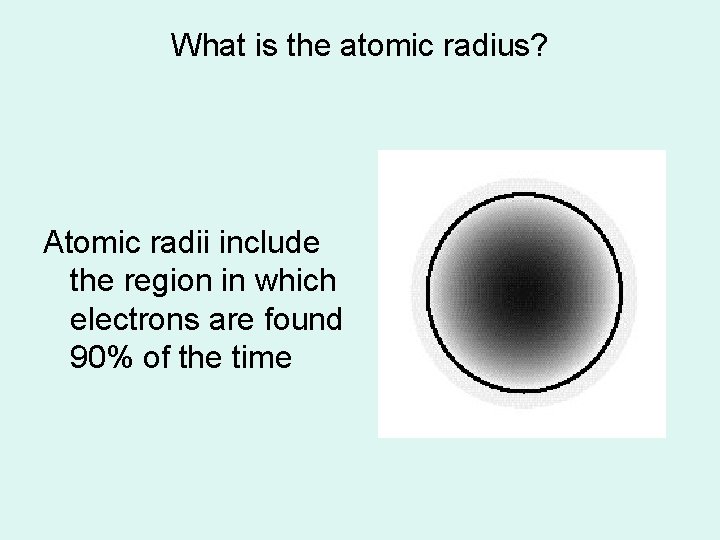
What is the atomic radius? Atomic radii include the region in which electrons are found 90% of the time
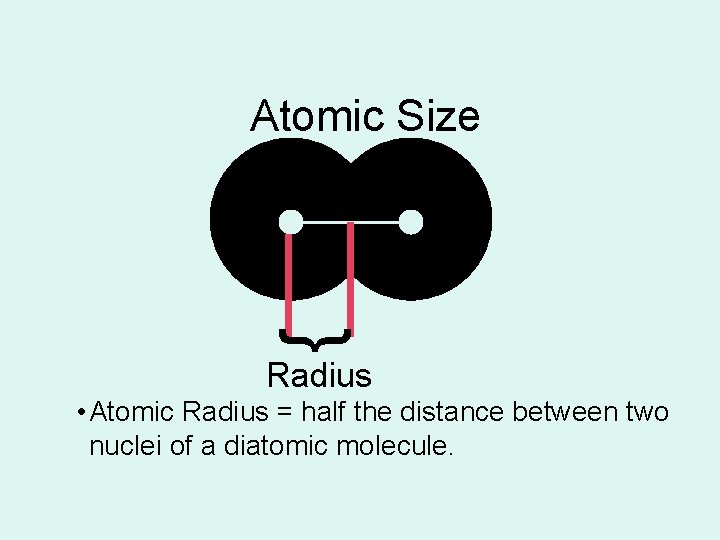
Atomic Size } Radius • Atomic Radius = half the distance between two nuclei of a diatomic molecule.
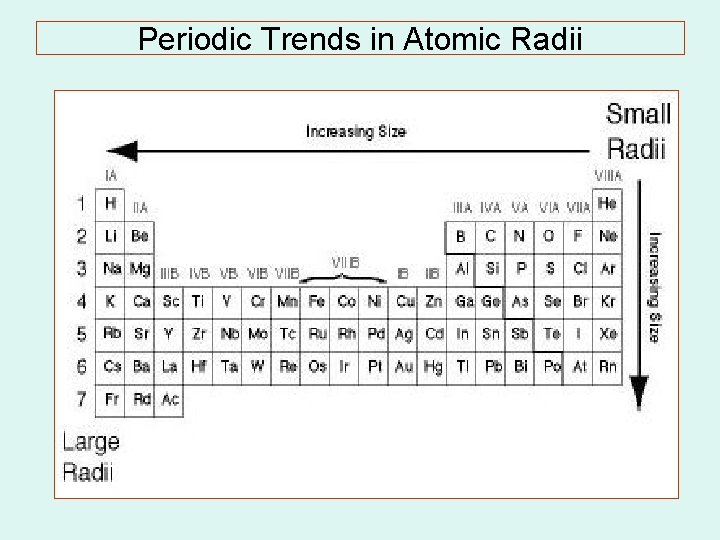
Periodic Trends in Atomic Radii
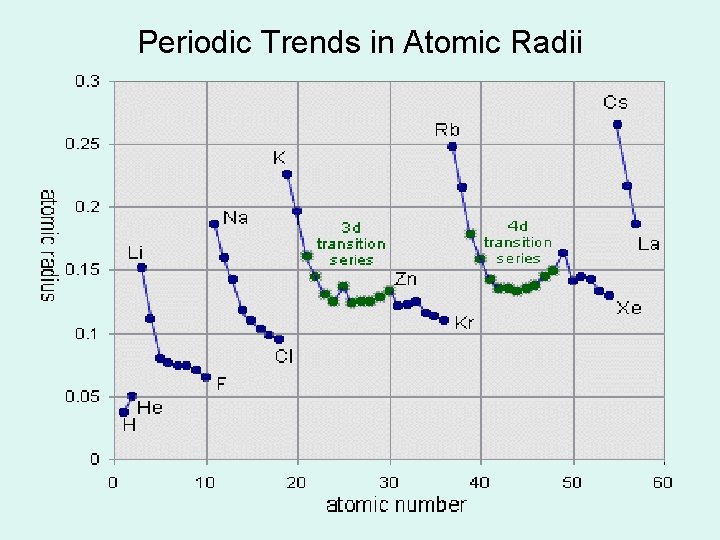
Periodic Trends in Atomic Radii
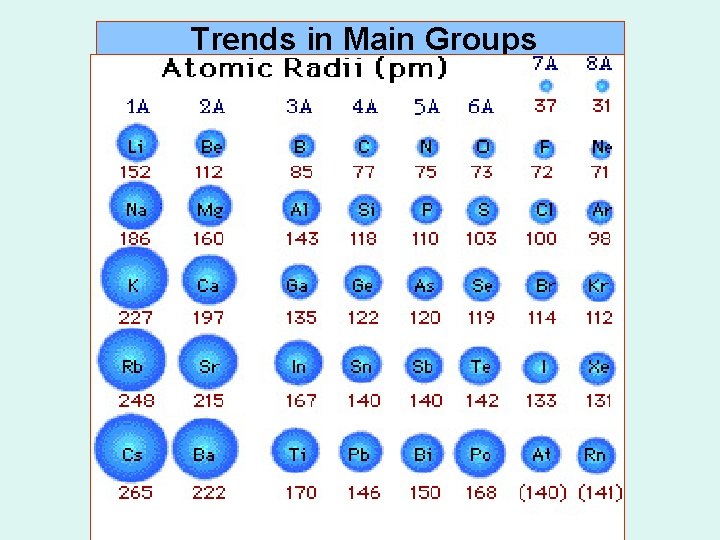
Trends in Main Groups
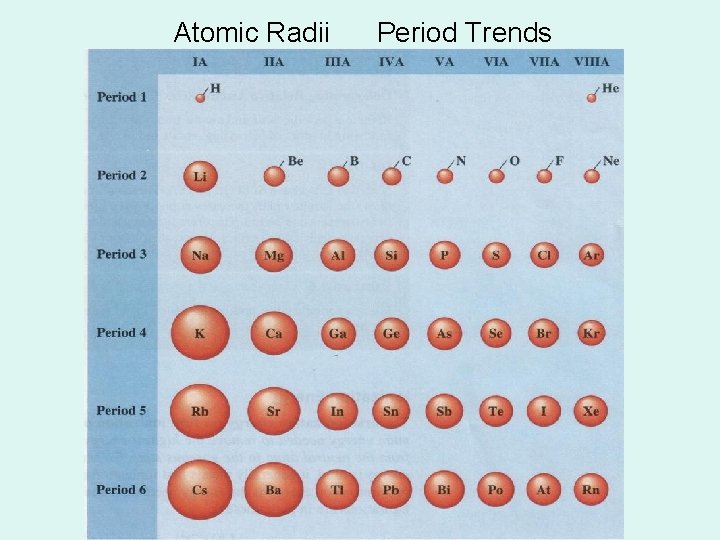
Atomic Radii Period Trends
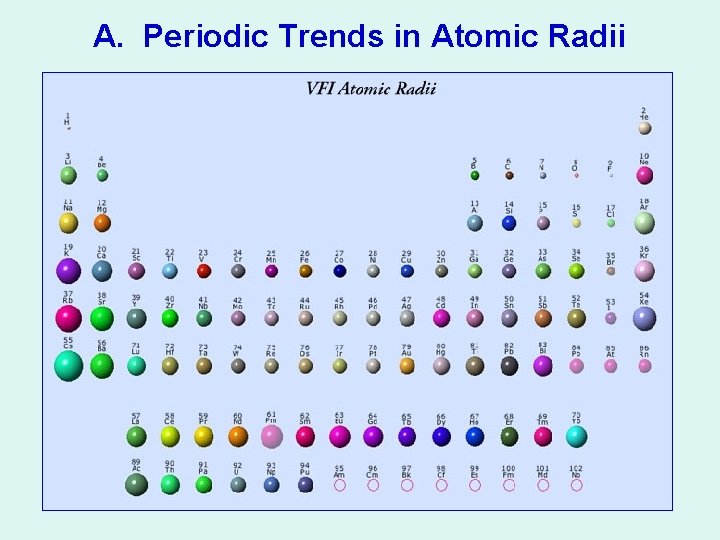
A. Periodic Trends in Atomic Radii
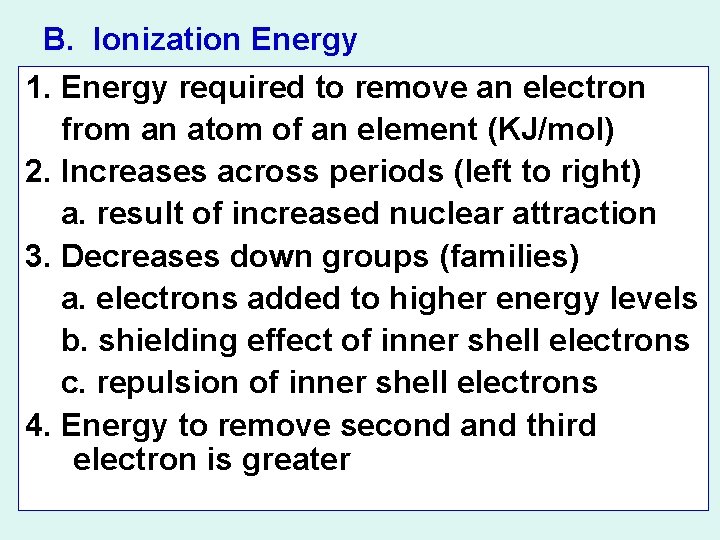
B. Ionization Energy 1. Energy required to remove an electron from an atom of an element (KJ/mol) 2. Increases across periods (left to right) a. result of increased nuclear attraction 3. Decreases down groups (families) a. electrons added to higher energy levels b. shielding effect of inner shell electrons c. repulsion of inner shell electrons 4. Energy to remove second and third electron is greater
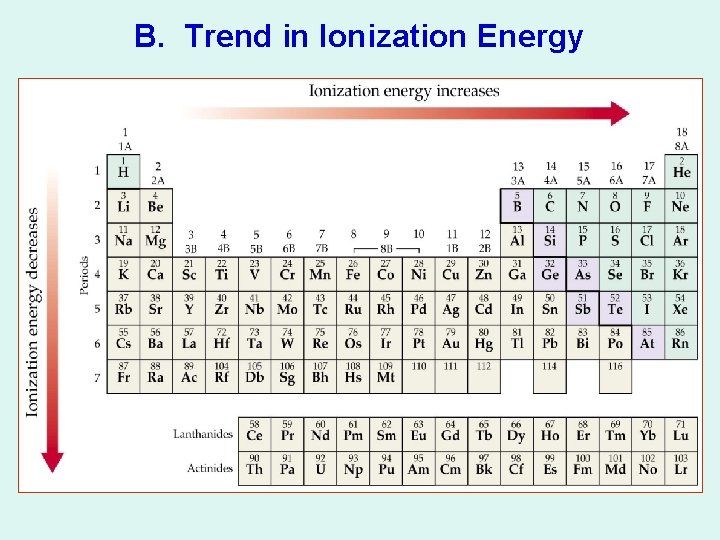
B. Trend in Ionization Energy
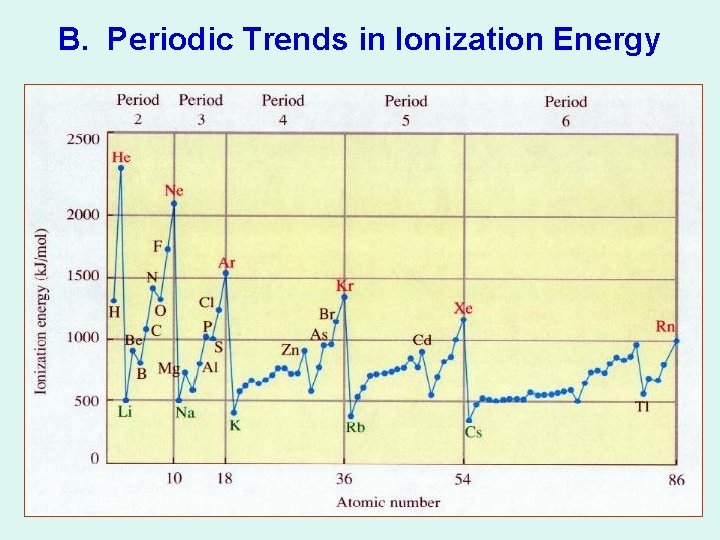
B. Periodic Trends in Ionization Energy
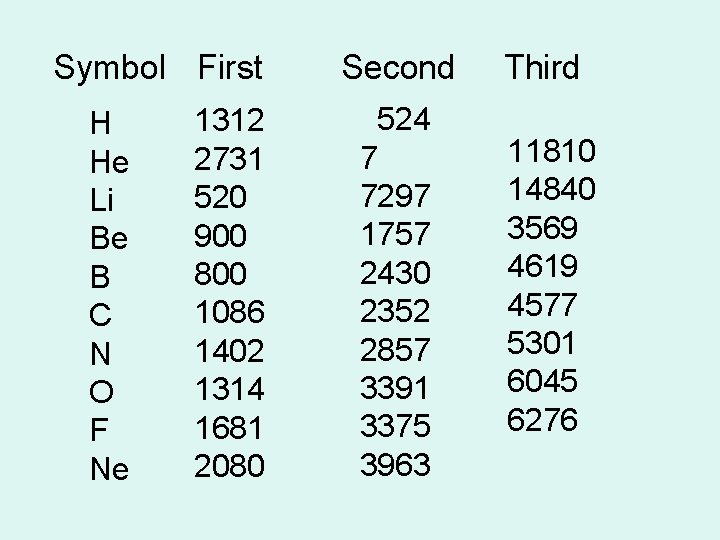
Symbol First H He Li Be B C N O F Ne 1312 2731 520 900 800 1086 1402 1314 1681 2080 Second Third 524 7 7297 1757 2430 2352 2857 3391 3375 3963 11810 14840 3569 4619 4577 5301 6045 6276
C. Electronegativity 1. Measures how strongly one atom attracts the electrons of another atom when they form a compound 2. Increases across periods (left to right) a. Fluorine has greatest value of 4 3. Decreases down groups a. electrons far from the nucleus in larger atoms have less attraction b. Cesium and Francium with large radii have the smallest electronegativity
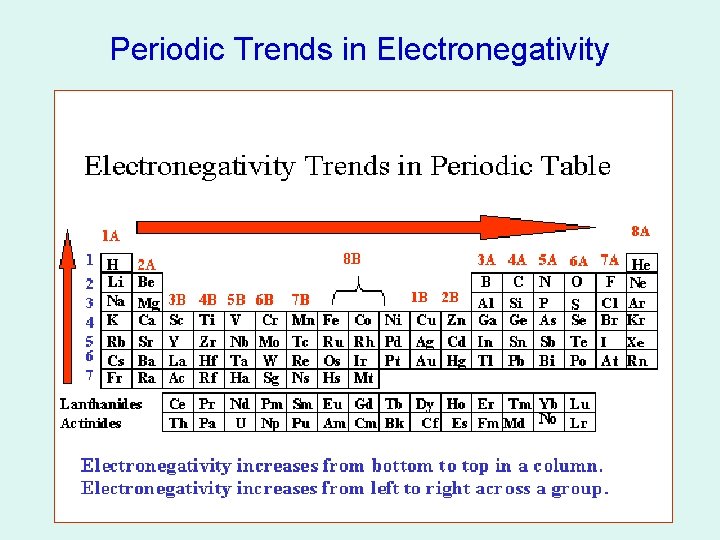
Periodic Trends in Electronegativity
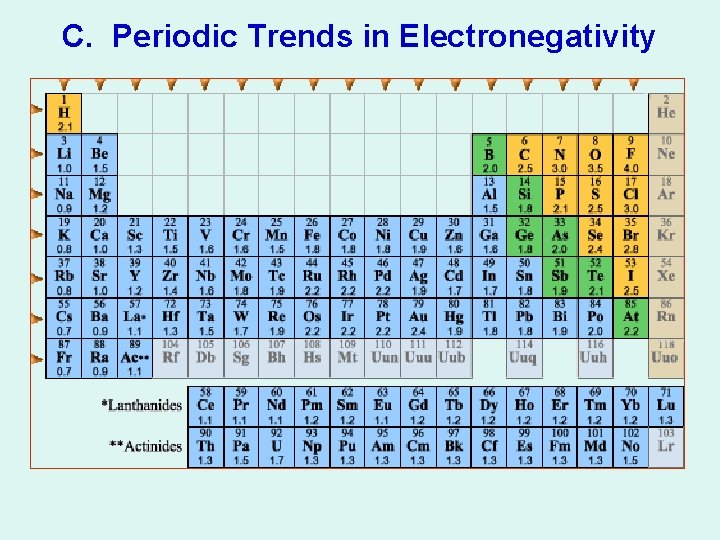
C. Periodic Trends in Electronegativity
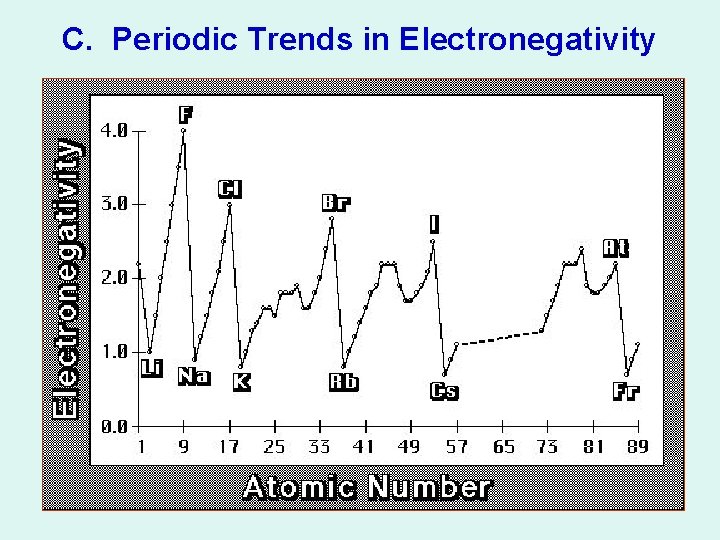
C. Periodic Trends in Electronegativity
D. Ionic Radii 1. Ion – atom that acquires a charge by gaining or losing electrons a. cation (+) ion anion (-) ion 2. Period trends a. cation radii decrease across periods b. anion radii increase across periods 3. Group trends a. increase in cation and anion radii down groups
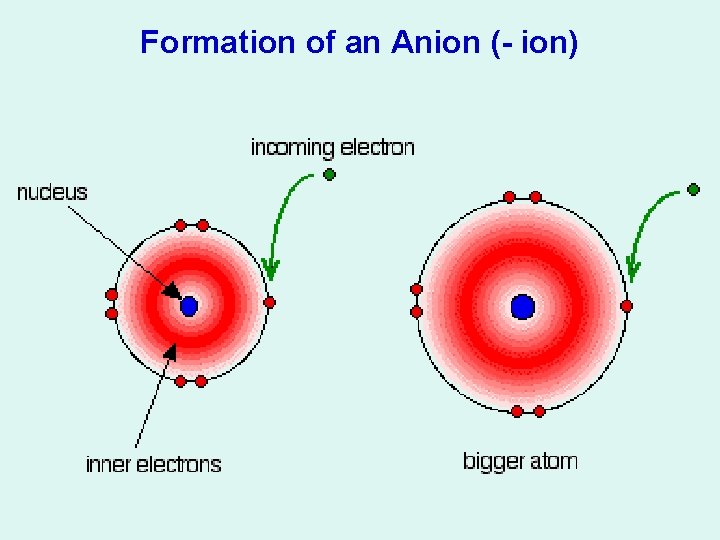
Formation of an Anion (- ion)
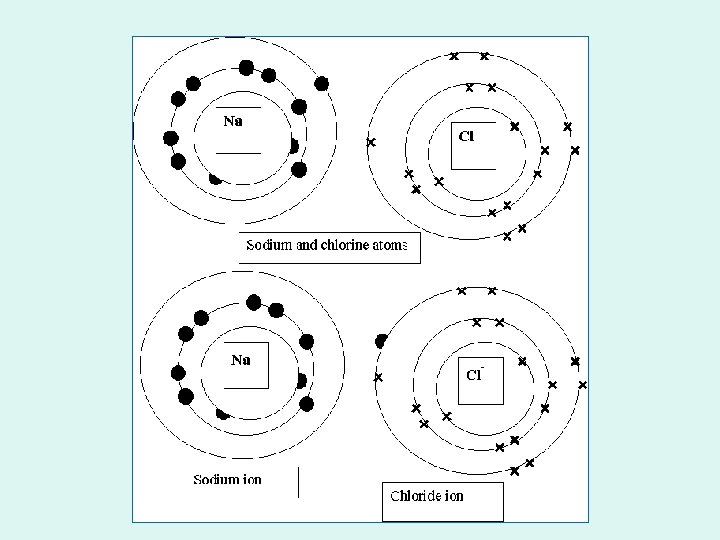
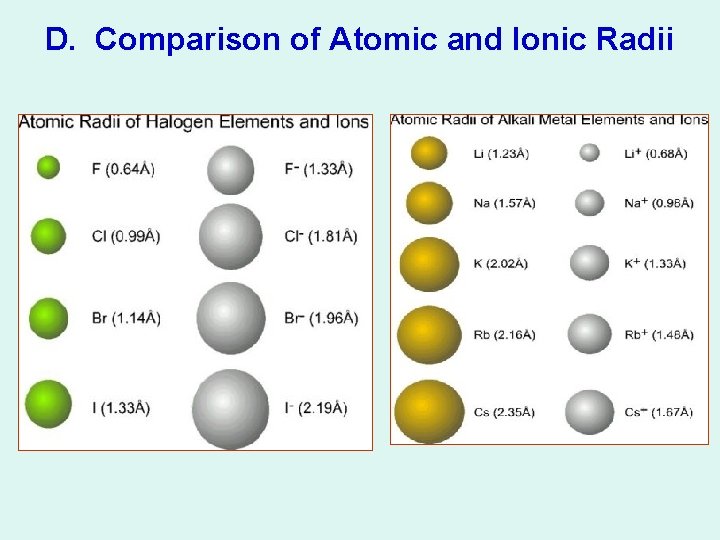
D. Comparison of Atomic and Ionic Radii
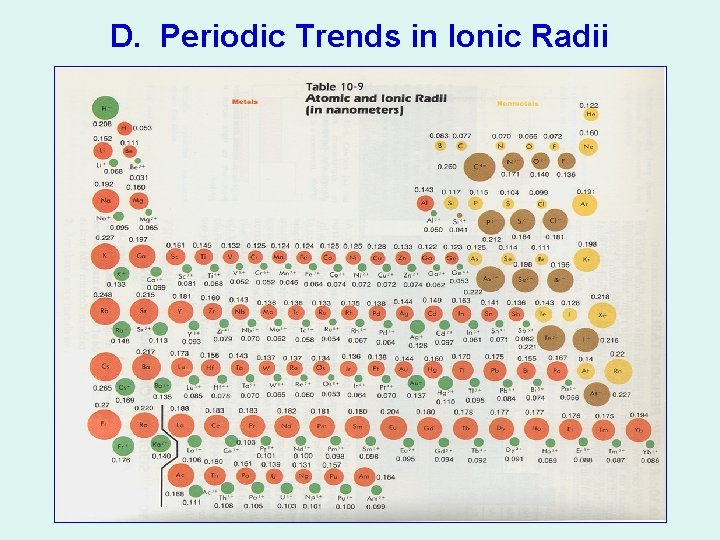
D. Periodic Trends in Ionic Radii
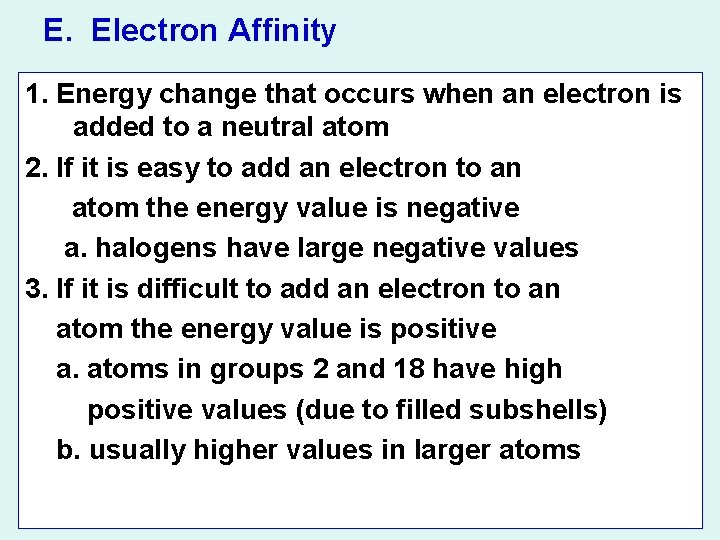
E. Electron Affinity 1. Energy change that occurs when an electron is added to a neutral atom 2. If it is easy to add an electron to an atom the energy value is negative a. halogens have large negative values 3. If it is difficult to add an electron to an atom the energy value is positive a. atoms in groups 2 and 18 have high positive values (due to filled subshells) b. usually higher values in larger atoms
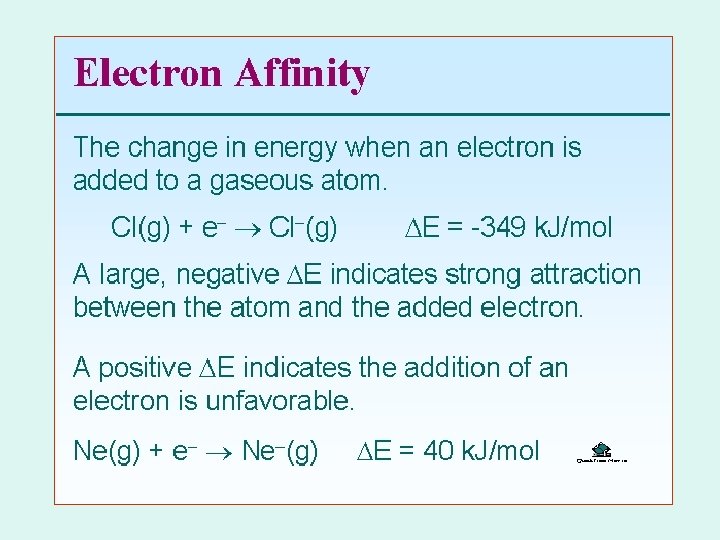
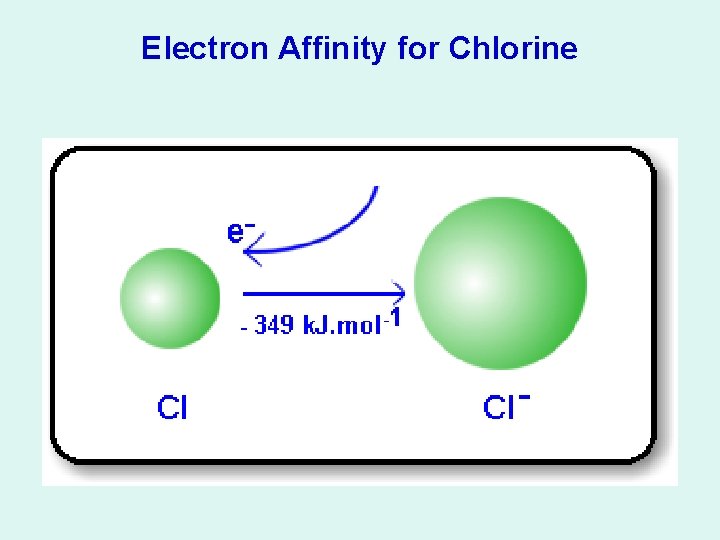
Electron Affinity for Chlorine
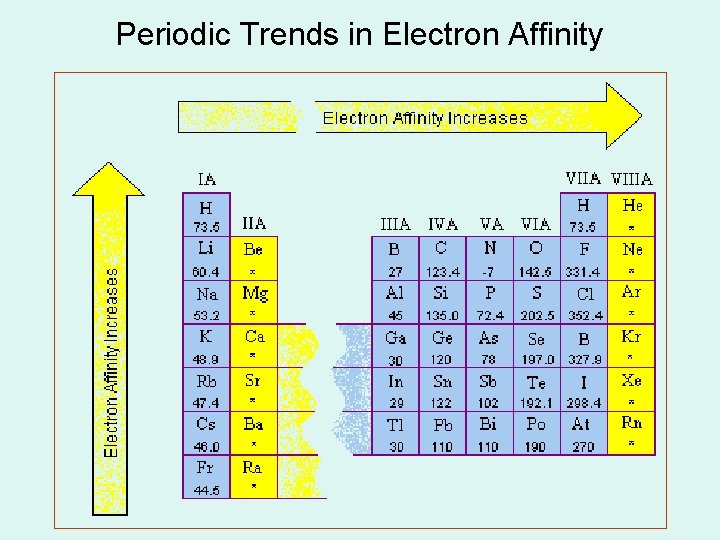
Periodic Trends in Electron Affinity
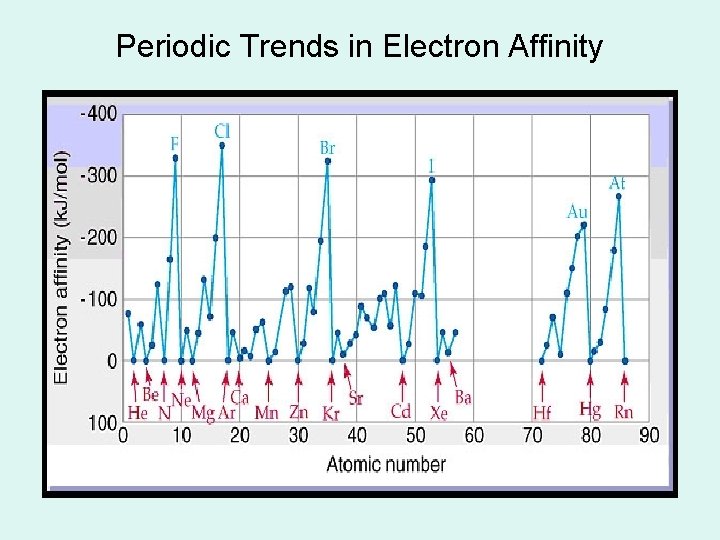
Periodic Trends in Electron Affinity
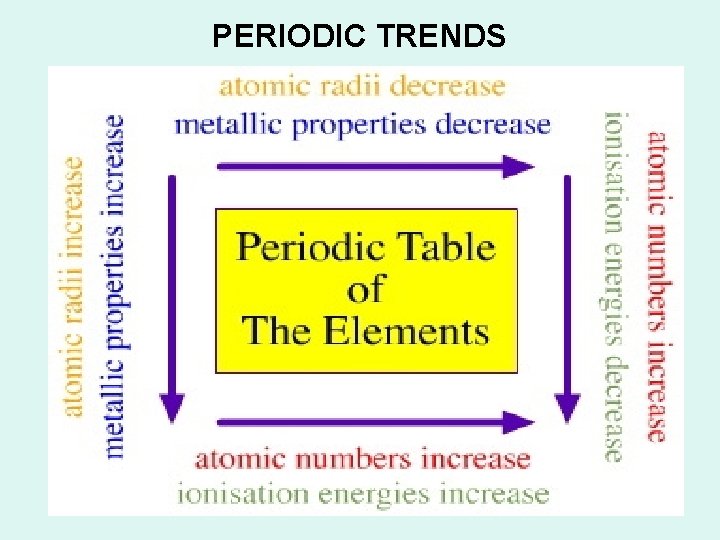
PERIODIC TRENDS
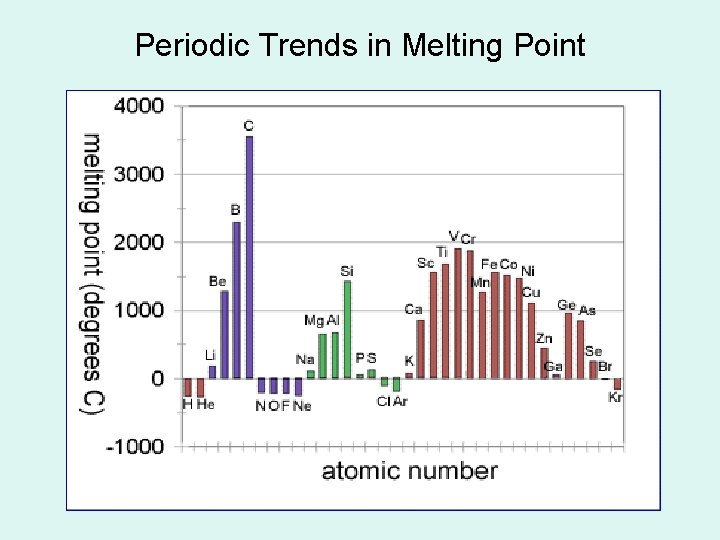
Periodic Trends in Melting Point
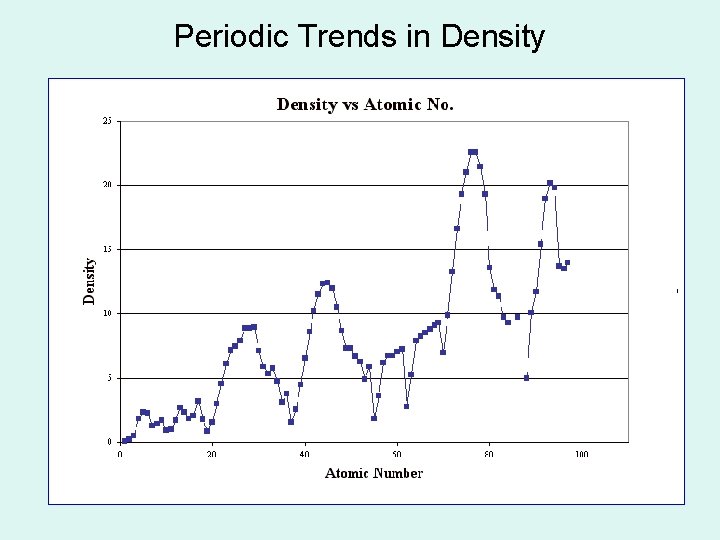
Periodic Trends in Density
V. Reactivity A. Reactivity – measure of the tendency of an element to engage in chemical reactions by losing, gaining or sharing electrons 1. atoms of reactive elements are very likely to gain, lose or share electrons 2. atoms of reactive elements are likely to form chemical bonds with other elements
B. Reactivity and the Periodic Table 1. alkali metals (group 1) most reactive metals 2. alkaline earth metals (group 2) second most reactive group of metals 3. halogens (group 17) most reactive nonmetals 4. noble gases (group 18) least reactive C. Ionization Energy and Electronegativity 1. elements with very high and very low values are very reactive
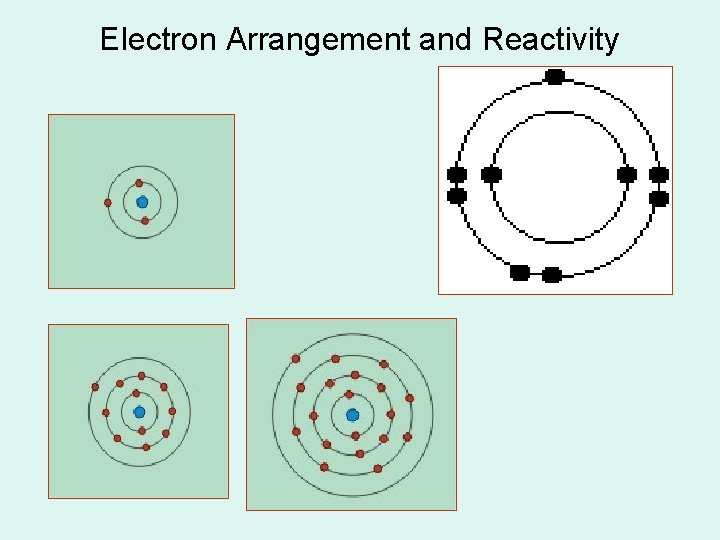
Electron Arrangement and Reactivity
![Electron Configuration • S block [groups 1 and 2] • P block [groups 13,](http://slidetodoc.com/presentation_image_h/18508833ffaa29196e7d26d844ffb026/image-48.jpg "Electron Configuration • S block [groups 1 and 2] • P block [groups 13,")
Electron Configuration • S block [groups 1 and 2] • P block [groups 13, 14, 15, 16, 17, 18] • D block [groups 3, 4, 5, 6, 7, 8, 9, 10, 11, 12] • F block (lanthanide and actinide series)
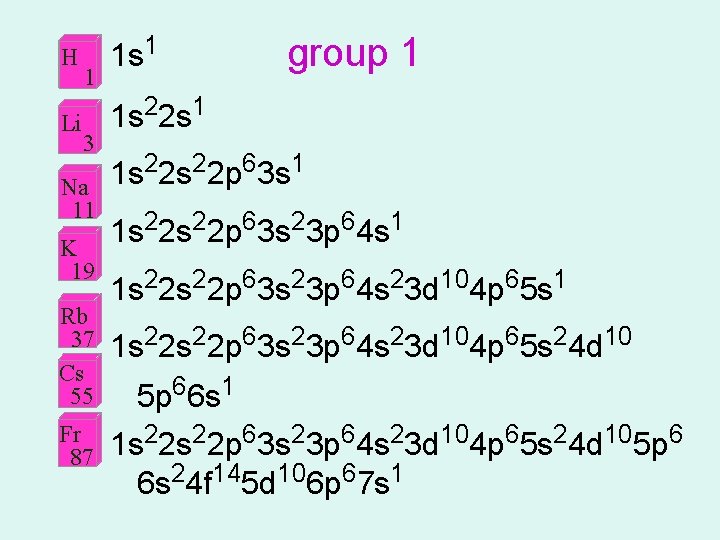
H Li 1 3 Na 11 K 19 Rb 37 Cs 55 Fr 87 1 s 1 group 1 1 s 22 s 22 p 63 s 23 p 64 s 23 d 104 p 65 s 1 1 s 22 p 63 s 23 p 64 s 23 d 104 p 65 s 24 d 10 5 p 66 s 1 1 s 22 p 63 s 23 p 64 s 23 d 104 p 65 s 24 d 105 p 6 6 s 24 f 145 d 106 p 67 s 1
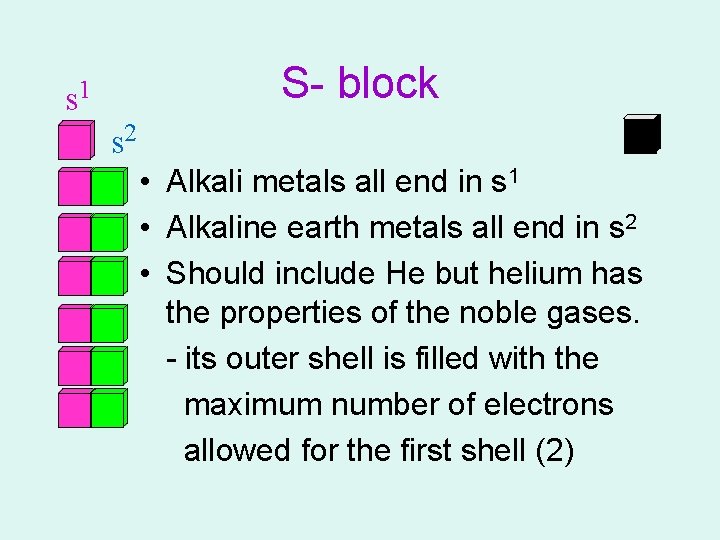
s 1 S- block s 2 • Alkali metals all end in s 1 • Alkaline earth metals all end in s 2 • Should include He but helium has the properties of the noble gases. - its outer shell is filled with the maximum number of electrons allowed for the first shell (2)
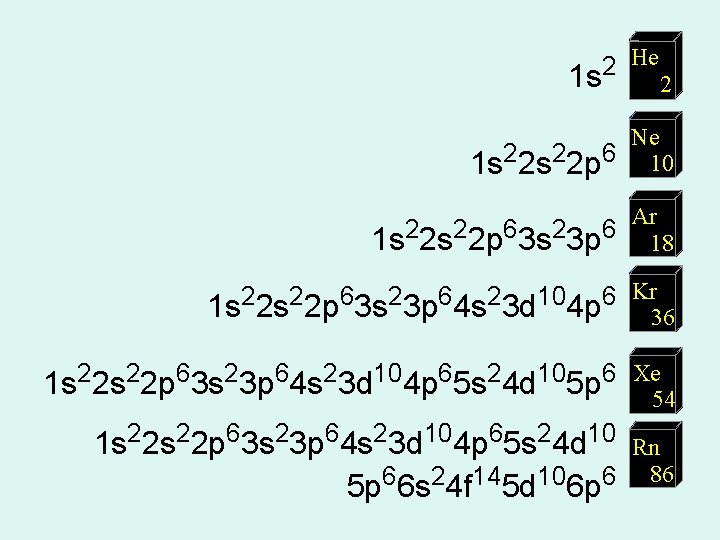
He 2 1 s 2 Ne 1 s 22 p 6 10 1 s 22 p 63 s 23 p 6 Ar 18 Kr 2 2 6 2 10 6 1 s 2 s 2 p 3 s 3 p 4 s 3 d 4 p 36 1 s 22 p 63 s 23 p 64 s 23 d 104 p 65 s 24 d 105 p 6 Xe 54 1 s 22 p 63 s 23 p 64 s 23 d 104 p 65 s 24 d 10 5 p 66 s 24 f 145 d 106 p 6 Rn 86
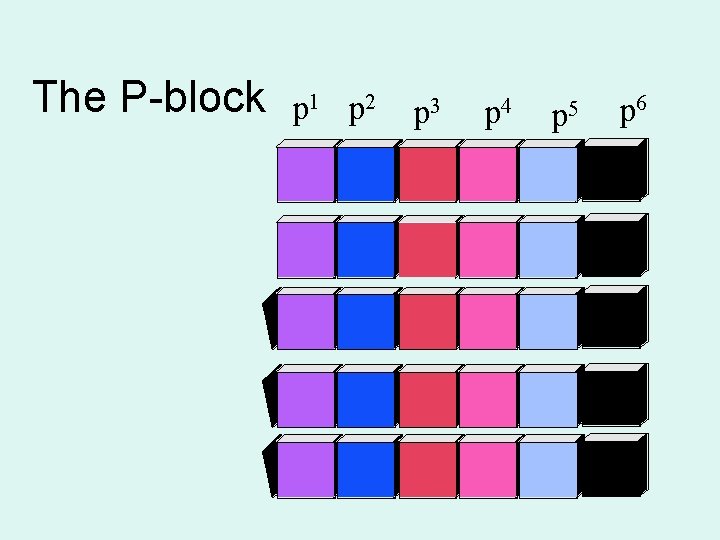
The P-block p 1 p 2 p 3 p 4 p 5 p 6
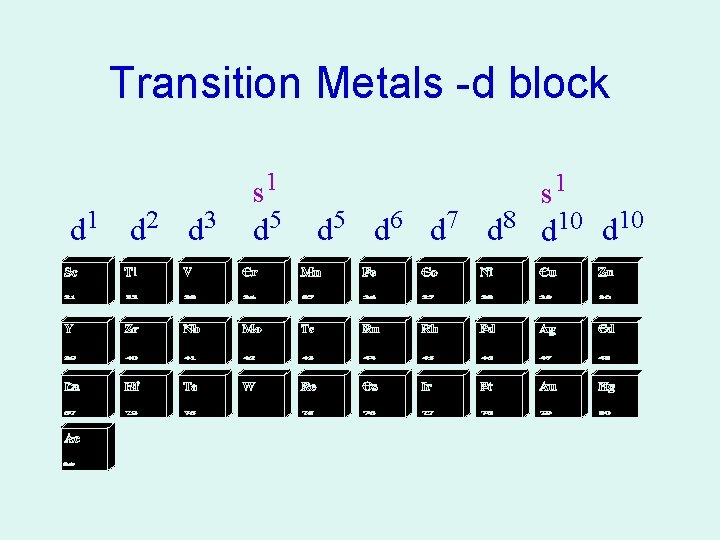
Transition Metals -d block d 1 d 2 d 3 s 1 d 5 d 6 d 7 d 8 d 10
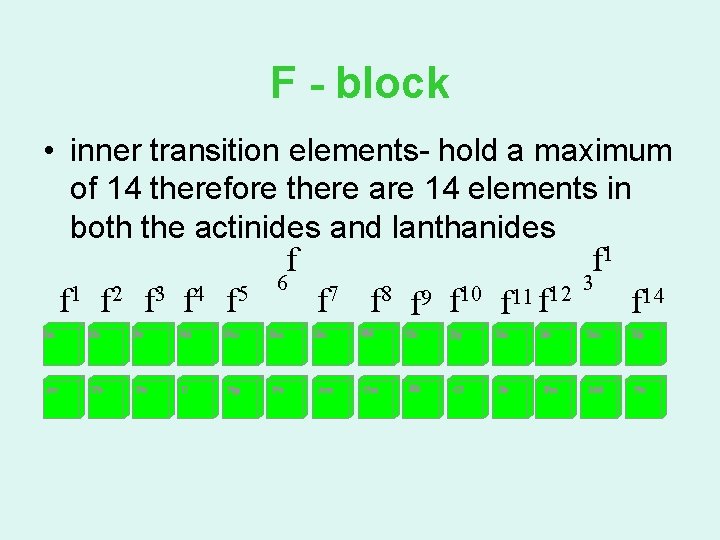
F - block • inner transition elements- hold a maximum of 14 therefore there are 14 elements in both the actinides and lanthanides f f 1 6 3 1 2 3 4 5 7 8 10 12 11 f f f f 9 f f 14
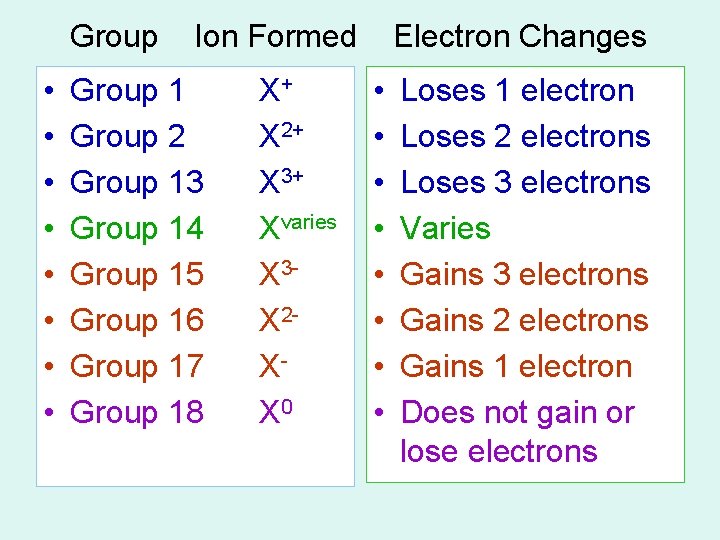
Group • • Ion Formed Group 1 Group 2 Group 13 Group 14 Group 15 Group 16 Group 17 Group 18 X+ X 2+ X 3+ Xvaries X 3 X 2 XX 0 Electron Changes • • Loses 1 electron Loses 2 electrons Loses 3 electrons Varies Gains 3 electrons Gains 2 electrons Gains 1 electron Does not gain or lose electrons
- Slides: 55