
THE PERIODIC TABLE http www dayah comperiodicImagesperiodic table
THE PERIODIC TABLE http: //www. dayah. com/periodic/Images/periodic table. png • Mendeleev’s Periodic Table (Figure 6. 3) • Arranged elements into rows and columns • Elements ordered by atomic mass.
THE PERIODIC TABLE • Modern periodic tables (Figure 6. 5) • Also arrange elements into rows and columns. • Elements are ordered by increasing atomic number
PERIODIC LAW • There are 7 periods (rows) in the periodic table. • Period 1 = 2 elements • Period 2 = 8 elements • Period 3 = 8 elements • Period 4 = 18 elements • Period 5 =18 elements • Period 6 = 32 elements • Period 7 = 24 elements • Each period = principal energy level.

PERIODIC LAW • Elements within a Group (column) have similar properties. • The properties of elements within a period change as you move across a period from left to right. • PERIODIC LAW STATES: when elements are arranged in order of increasing atomic number, there is a periodic repetition of their physical and chemical properties.
Metals, Nonmetals, Metalloids • Metals • 80% of elements • Good conductors of heat and electric current • All are solids at room temperature (EXCEPT: mercury!) • Ductile (drawn into wires) • Most are malleable
Metals, Nonmetals, Metalloids • Nonmetals • Found in the upper right hand corner of the periodic table • Most are gases at room temperature (i. e. oxygen and nitrogen) • Poor conductors of heat and electric current (except carbon) • Solid nonmetals tend to be brittle
Metals, Nonmetals, Metalloids • Properties similar to both metals and nonmetals • Depending on the conditions a metalloid may behave like a metal or a non metal.
Checkpoint • Which of these sets of elements have similar physical and chemical properties? • a. oxygen, nitrogen, carbon, boron • b. strontium, magnesium, calcium, beryllium • c. nitrogen, neon, nickel, niobium • Identify each element as a metal, metalloid, or nonmetal. • a. gold metal c. sulfur non metal • b. silicon metalloid d. barium metal

Classifying Elements • For helium, label the element symbol, element name, atomic number and the atomic mass. • Label all groups and periods • Color code (entire box) with key • Metals • Non metals • Metalloids • Gas • Liquid • Solid • Indicate where to find: • Alkali metals, alkaline earth metals, halogens, noble gases • *** Put your name and date at the top!
The Representative Elements • Groups IA through 7 A. • The valence electrons (electrons in the highest occupied energy level)= group number!
Transitional Elements • • Columns 3 -12 (or Groups IB-VIIIB) Transition metals and inner transition metals Transition metals have e- in d orbitals (main body) Inner transition metals have e- in f orbitals (formerly known as rare earth metals)

Practice Problems • Use figure 6. 9 and Figure 6. 12 (or the s, p, d, f handout) to write the electron configurations of the following elements. • • • A. Carbon 1 s 2 2 p 2 B. Strontium 1 s 2 2 p 63 s 23 p 63 d 104 s 24 p 65 s 2 C. Vanadium 1 s 2 2 p 63 s 23 p 63 d 34 s 2

PERIODIC TRENDS • Atomic Radius • 1/2 the distance between the nuclei of two atoms of the same element when the atoms are joined. • Measured in picometers(pm) – there are one trillion (1012 pm in one meter) • Decreases because # of protons increases therefore attractive forces are pulling in the e-’s. • Increases because you are adding more
IONS • Ions-charged atoms due to the gain/loss of electrons • Anion- ion with a negative (-) charge (nonmetals) • Cation-ion with a positive (+) charge (metals) • When compounds form, elements gain or lose e’s to form ions in order to attain a stable noble gas configuration.
Ionization Energy • Ionization Energy (IE) • The amount of energy needed or absorbed to remove an electron from an atom. • The further away an ethe less IE needed to remove the e-. ( but also consider protons and electrons are increasing)
IONIC SIZE • Anions (-) are larger than cations (+) due to taking e-’s away which reduces the radius. • Among the anions and cations the trend is the same as atomic radius • Decreases • Increases
ELECTRONEGATIVITY • Electronegativity (EN) • The ability of an atom to attract itself the electrons when in a compound (bonded). • Electrons shift toward the more EN atom
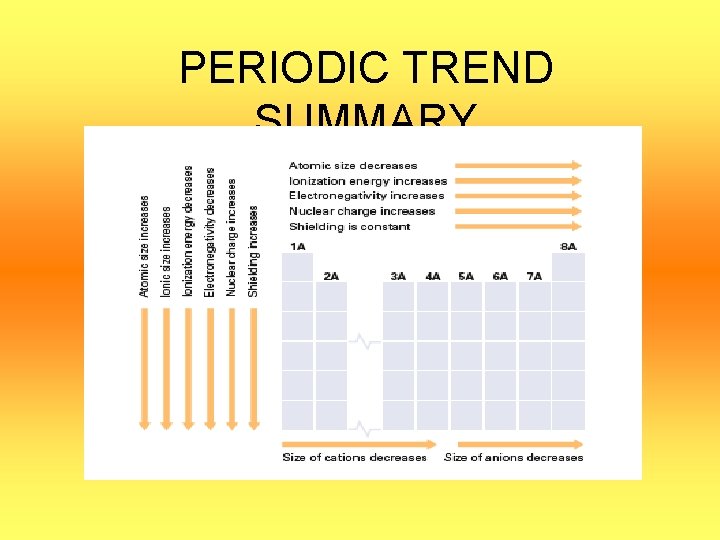
PERIODIC TREND SUMMARY
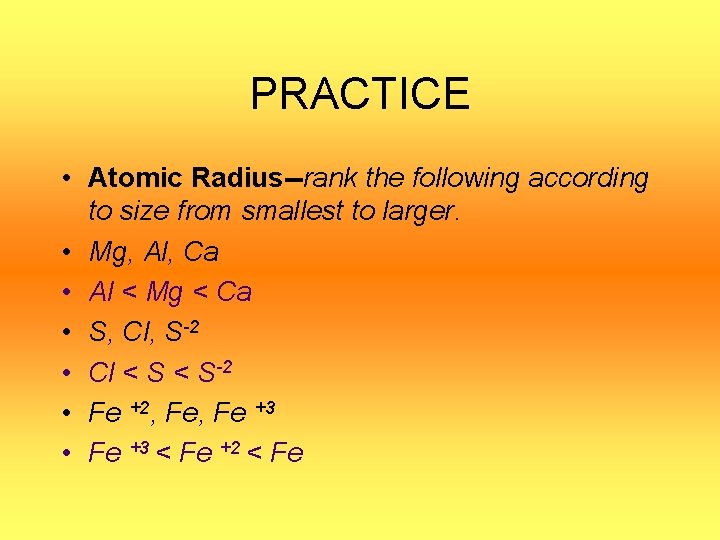
PRACTICE • Atomic Radius--rank the following according to size from smallest to larger. • Mg, Al, Ca • Al < Mg < Ca • S, Cl, S-2 • Cl < S-2 • Fe +2, Fe +3 • Fe +3 < Fe +2 < Fe

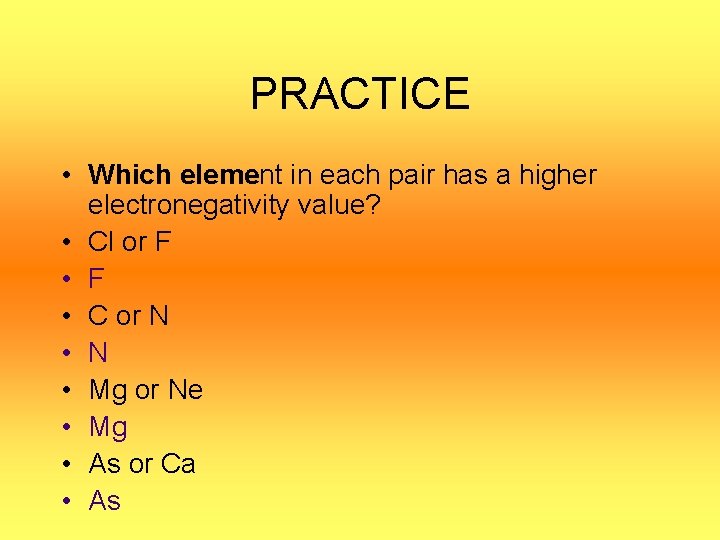
PRACTICE • Which element in each pair has a higher electronegativity value? • Cl or F • C or N • Mg or Ne • Mg • As or Ca • As
- Slides: 23