
The Periodic Table GroupsHeres Where the Periodic Table
The Periodic Table
Groups…Here’s Where the Periodic Table Gets Useful!! • Elements in the same group have similar chemical and physical properties!! • (did that on purpose. ) Why? ? • They have the same number of valence electrons. • They will form the same kinds of ions.
Families on the Periodic Table • Columns are also grouped into families. • Families may be one column, or several columns put together. • Families have names rather than numbers. (Just like your family has a common last name. )
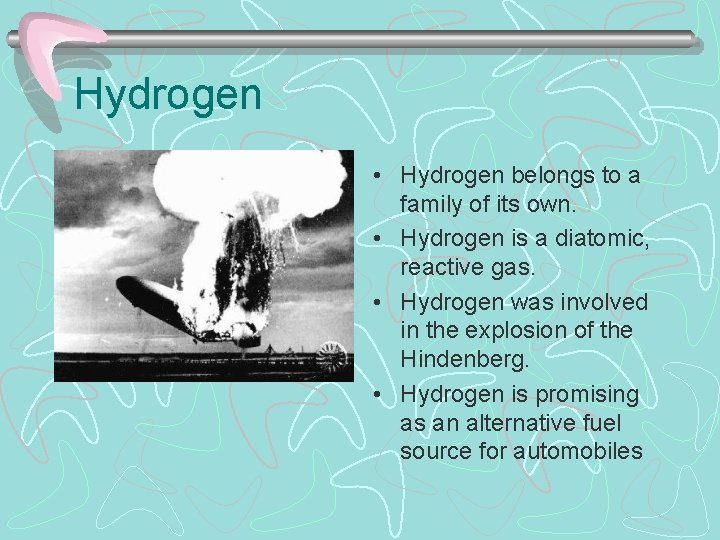
Hydrogen • Hydrogen belongs to a family of its own. • Hydrogen is a diatomic, reactive gas. • Hydrogen was involved in the explosion of the Hindenberg. • Hydrogen is promising as an alternative fuel source for automobiles
Alkali Metals • 1 st column on the periodic table (Group 1) not including hydrogen. • Very reactive metals, always combined with something else in nature (like in salt). • Soft enough to cut with a butter knife
Alkaline Earth Metals • Second column on the periodic table. (Group 2) • Reactive metals that are always combined with nonmetals in nature. • Several of these elements are important mineral nutrients (such as
Transition Metals • Elements in groups 3 -12 • Less reactive harder metals • Includes metals used in jewelry and construction. • Metals used “as metal. ”
Boron Family • Elements in group 13 • Aluminum metal was once rare and expensive, not a “disposable metal. ”
Carbon Family • Elements in group 14 • Contains elements important to life and computers. • Carbon is the basis for an entire branch of chemistry. • Silicon and Germanium are important semiconductors.
Nitrogen Family • Elements in group 15 • Nitrogen makes up over ¾ of the atmosphere. • Nitrogen and phosphorus are both important in living things. • Most of the world’s nitrogen is not available to living things.
Oxygen Family or Chalcogens • Elements in group 16 • Oxygen is necessary for respiration. • Many things that stink, contain sulfur (rotten eggs, garlic, skunks, etc. )
Halogens • Elements in group 17 • Very reactive, volatile, diatomic, nonmetals • Always found combined with other element in nature. • Used as disinfectants and to
The Noble Gases
The Noble Gases • Elements in group 18 • VERY unreactive, monatomic gases • Used in lighted “neon” signs • Used in blimps to fix the Hindenburg problem. • Have a full valence
Homework p. 305 Review Questions #13 -20
- Slides: 15