
The Periodic Table Chemistry Subatomic particles Charge Proton
The Periodic Table Chemistry
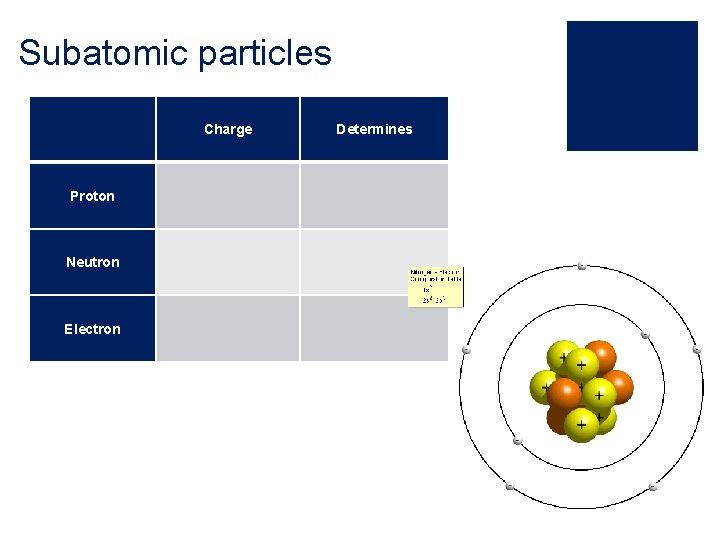
Subatomic particles Charge Proton Neutron Electron Determines
Isotopes ¡Meaning “same place” ¡Refers to location on ¡ Elements have same protons, but different ¡Usually expressed as a ¡ the sum of ¡Ex Carbon-14 is used in dating artifacts and very old samples. How many neutrons does carbon 14 have?
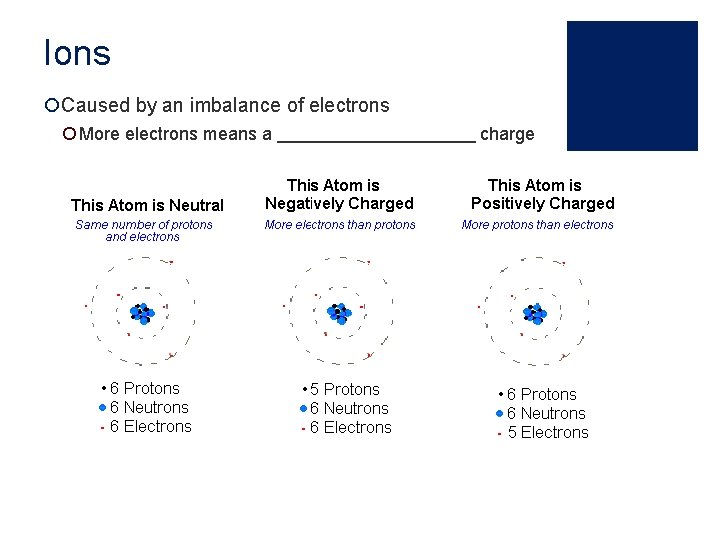
Ions ¡Caused by an imbalance of electrons ¡ More electrons means a charge

Complete the table Symbol Atomic Number Mass Number Protons Neutrons O 8 18 8 10 1 3 Mg 2+ 1 26 66 30 19 S 252 Cr 3+ Electrons 28 20 18 20
Periods ¡These indicate a row of increasing electrons ¡Elements in a row do not have similar properties, but they increase in size (more _________) ¡Within a period, each successive element has one more ____________________ ¡ these are the electrons involved in bonding ¡Ex Na Draw the Bohr model of each. Be Al C N
Groups (Families) ¡These indicate a column of similar elements ¡Since electrons determine how atoms _______ ¡All elements in the same family have the same bonding pattern ¡Ex. Give two elements with characteristics similar to the given element. ¡a)Ar b) Rb c) Al d) Si
Compounds ¡We can predict new compounds based on families ¡Ex Aluminum oxide has the formula Al 2 O 3. What are two other possible aluminum compounds? ¡Ex Given the following compounds, give eight other possible compounds based on the families. a) KCl b) Mg. Cl 2 c) H 2 O
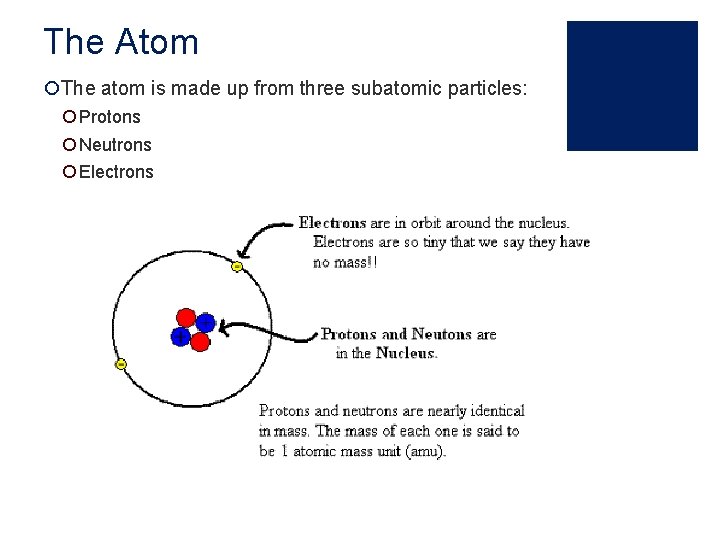
The Atom ¡The atom is made up from three subatomic particles: ¡ Protons ¡ Neutrons ¡ Electrons
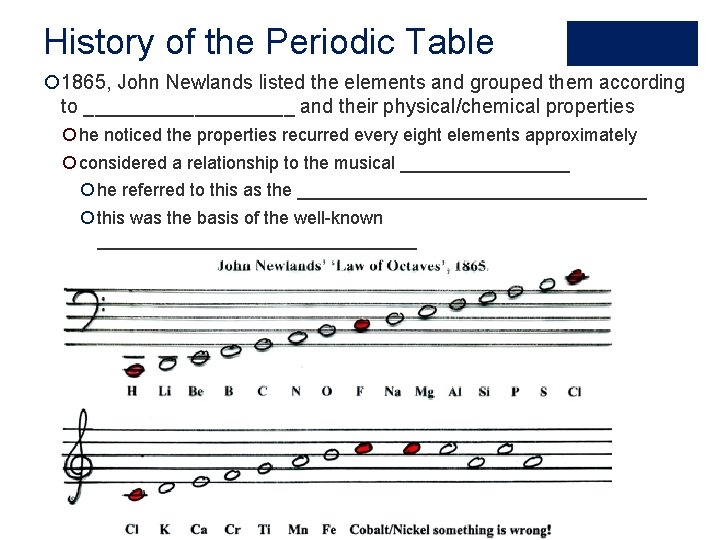
History of the Periodic Table ¡ 1865, John Newlands listed the elements and grouped them according to __________ and their physical/chemical properties ¡ he noticed the properties recurred every eight elements approximately ¡ considered a relationship to the musical _________ ¡ he referred to this as the __________________ ¡ this was the basis of the well-known ________________
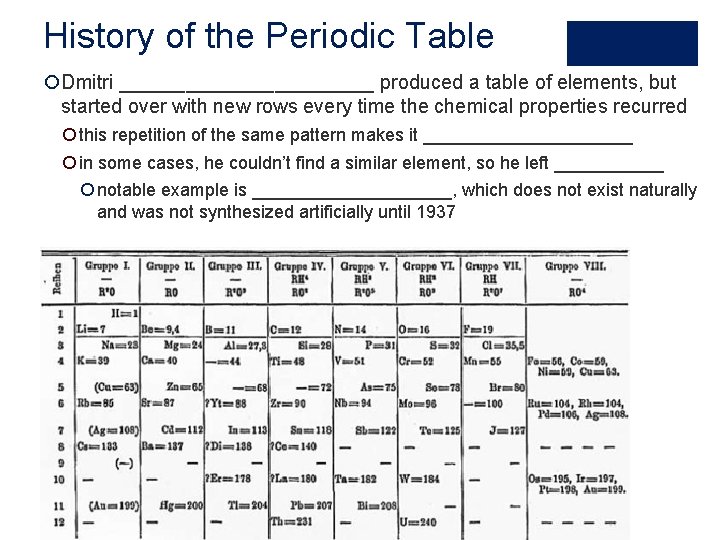
History of the Periodic Table ¡Dmitri ____________ produced a table of elements, but started over with new rows every time the chemical properties recurred ¡ this repetition of the same pattern makes it ___________ ¡ in some cases, he couldn’t find a similar element, so he left ______ ¡ notable example is __________, which does not exist naturally and was not synthesized artificially until 1937
The Periodic Table ¡The periodic table represents all known __________ ¡ they are grouped in: _________ (columns) and ________ (rows) ¡each element is given a unique _________ ¡most element names are just the first one or two letters, and tend to be intuitive ¡Ex Write the element symbols. a) C = b) Li = ¡Ex Write the element symbols. a) Nitrogen = b) Zinc = Nickel = Zirconium = c) U = c) Helium = Hydrogen =
Latin names ¡Others are taken from Latin names, and aren’t as intuitive ¡Ex a)Na = c)Iron = Write the element name, and the original Latin name. b) Pb = d) Tin =
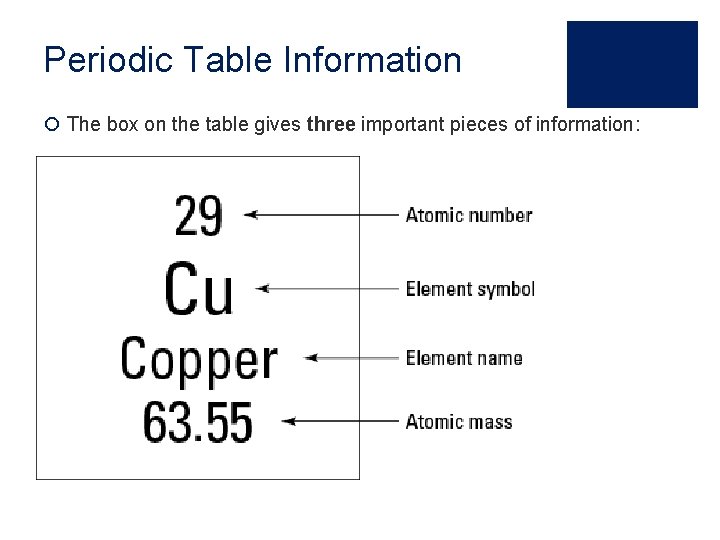
Periodic Table Information ¡ The box on the table gives three important pieces of information:
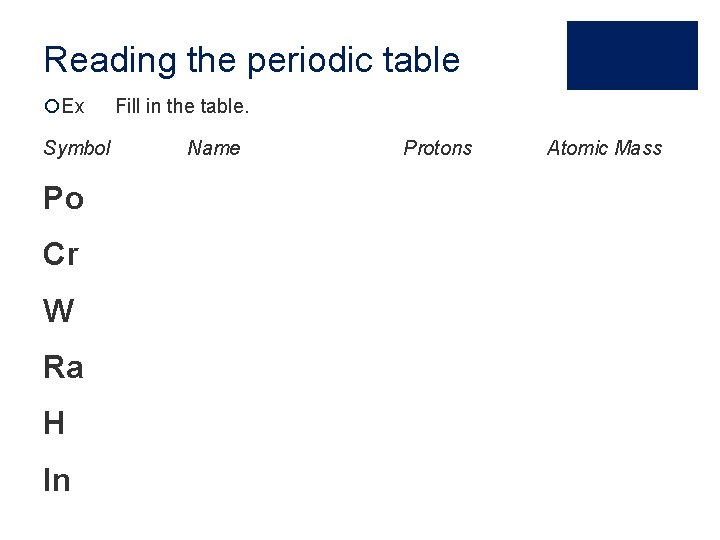
Reading the periodic table ¡Ex Symbol Po Cr W Ra H In Fill in the table. Name Protons Atomic Mass
- Slides: 15