
The Periodic Table Chapter 8 Copyright The Mc
The Periodic Table Chapter 8 Copyright © The Mc. Graw-Hill Companies, Inc. Permission required for reproduction or display.
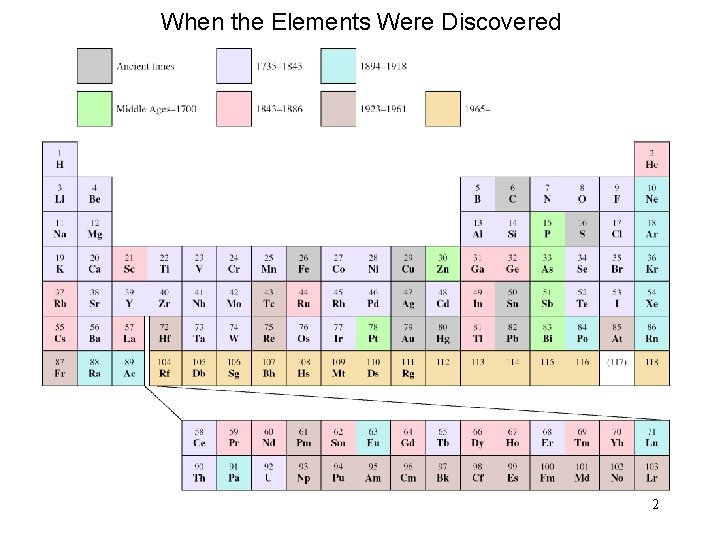
When the Elements Were Discovered 2
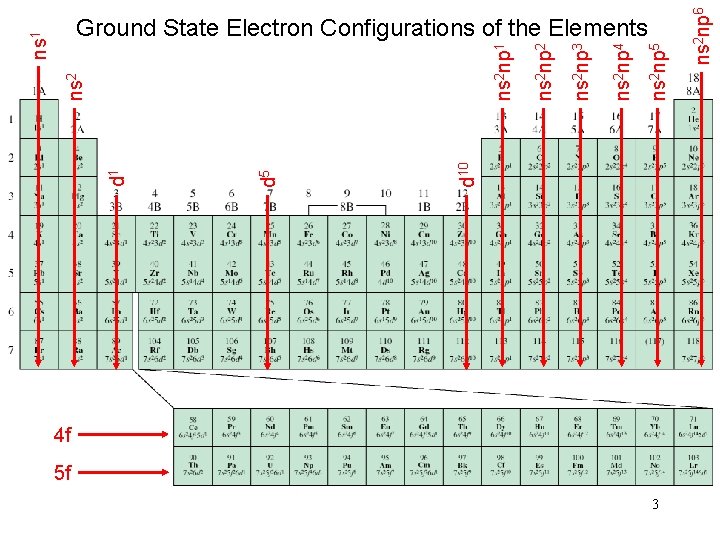
4 f 5 f 3 ns 2 np 6 ns 2 np 5 ns 2 np 4 ns 2 np 3 ns 2 np 2 ns 2 np 1 d 10 d 5 d 1 ns 2 ns 1 Ground State Electron Configurations of the Elements
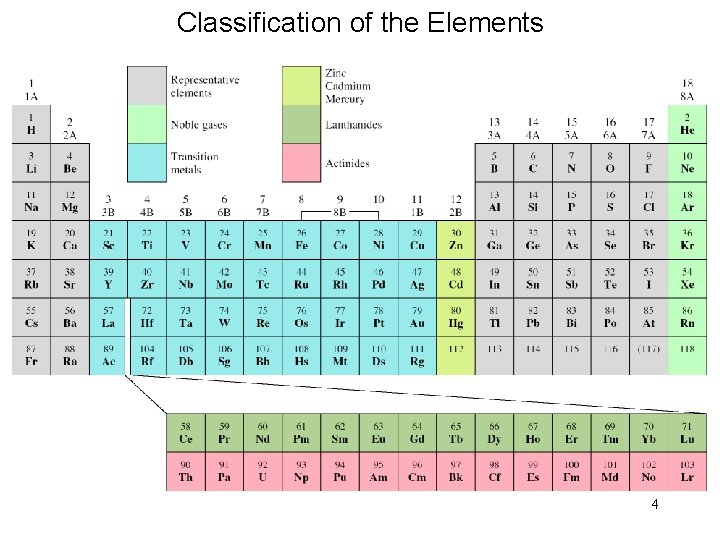
Classification of the Elements 4
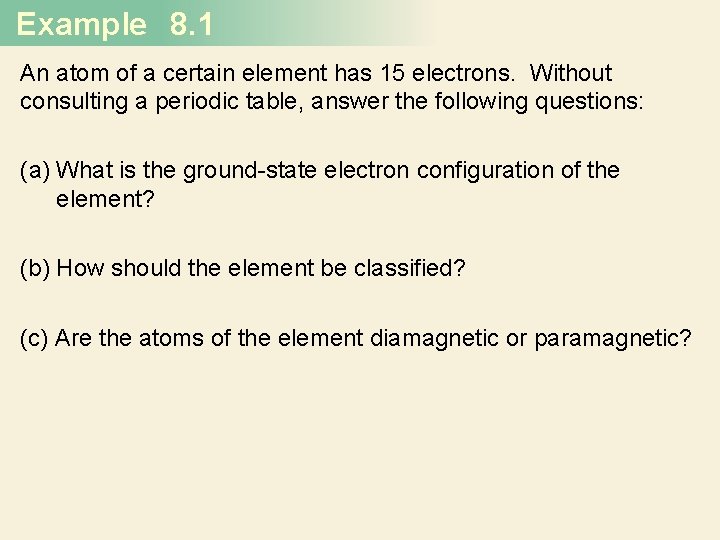
Example 8. 1 An atom of a certain element has 15 electrons. Without consulting a periodic table, answer the following questions: (a) What is the ground-state electron configuration of the element? (b) How should the element be classified? (c) Are the atoms of the element diamagnetic or paramagnetic?
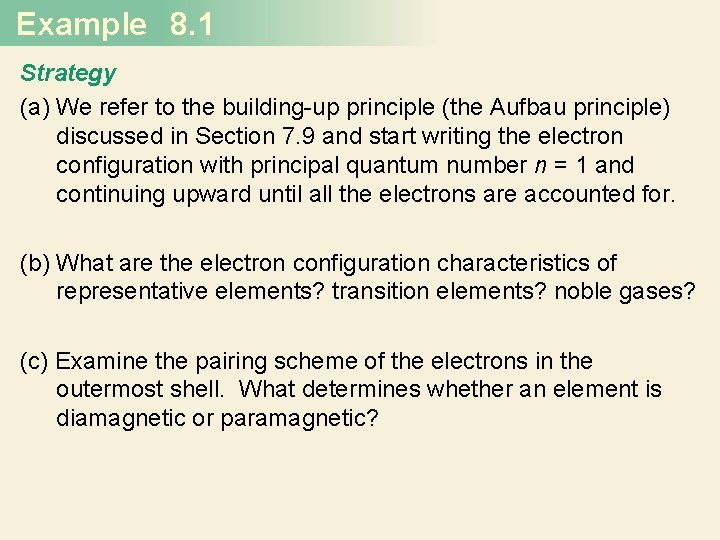
Example 8. 1 Strategy (a) We refer to the building-up principle (the Aufbau principle) discussed in Section 7. 9 and start writing the electron configuration with principal quantum number n = 1 and continuing upward until all the electrons are accounted for. (b) What are the electron configuration characteristics of representative elements? transition elements? noble gases? (c) Examine the pairing scheme of the electrons in the outermost shell. What determines whether an element is diamagnetic or paramagnetic?
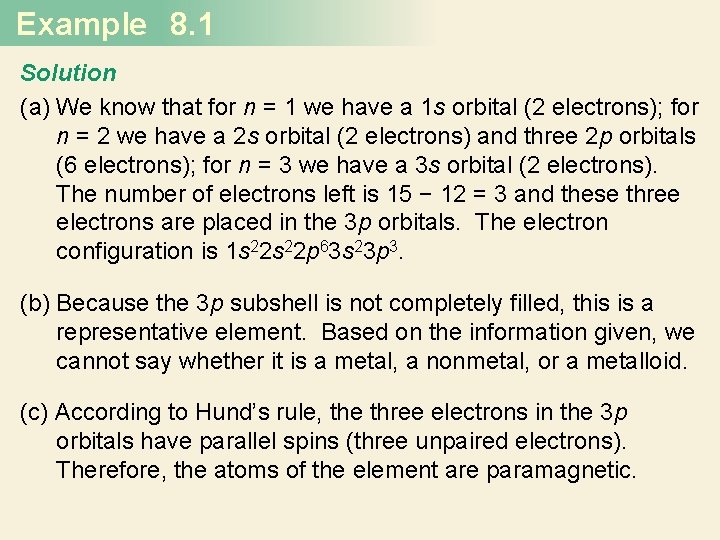
Example 8. 1 Solution (a) We know that for n = 1 we have a 1 s orbital (2 electrons); for n = 2 we have a 2 s orbital (2 electrons) and three 2 p orbitals (6 electrons); for n = 3 we have a 3 s orbital (2 electrons). The number of electrons left is 15 − 12 = 3 and these three electrons are placed in the 3 p orbitals. The electron configuration is 1 s 22 p 63 s 23 p 3. (b) Because the 3 p subshell is not completely filled, this is a representative element. Based on the information given, we cannot say whether it is a metal, a nonmetal, or a metalloid. (c) According to Hund’s rule, the three electrons in the 3 p orbitals have parallel spins (three unpaired electrons). Therefore, the atoms of the element are paramagnetic.
![Electron Configurations of Cations and Anions Of Representative Elements Na [Ne]3 s 1 Na+](http://slidetodoc.com/presentation_image_h2/f4680b29c6d2f4b166ff908c32dc82ec/image-8.jpg "Electron Configurations of Cations and Anions Of Representative Elements Na [Ne]3 s 1 Na+")
Electron Configurations of Cations and Anions Of Representative Elements Na [Ne]3 s 1 Na+ [Ne] Ca [Ar]4 s 2 Ca 2+ [Ar] Al [Ne]3 s 23 p 1 Al 3+ [Ne] Atoms gain electrons so that anion has a noblegas outer electron configuration. Atoms lose electrons so that cation has a noble-gas outer electron configuration. H 1 s 1 H− 1 s 2 or [He] F 1 s 22 p 5 F− 1 s 22 p 6 or [Ne] O 1 s 22 p 4 O 2− 1 s 22 p 6 or [Ne] N 1 s 22 p 3 N 3− 1 s 22 p 6 or [Ne] 8
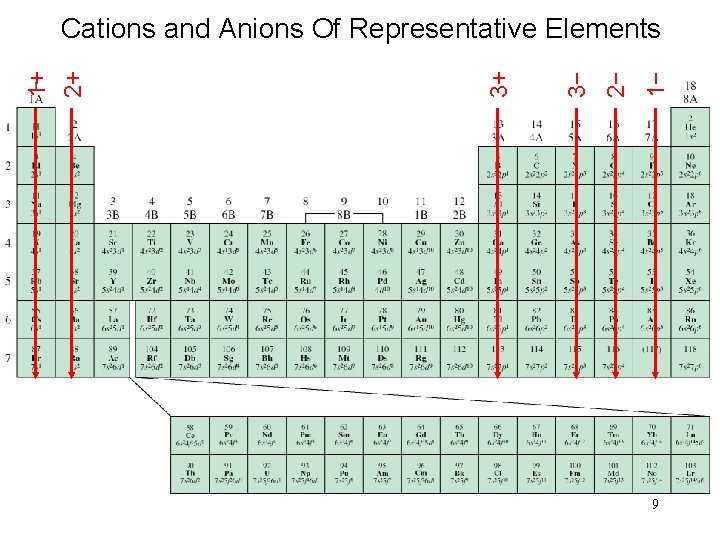
1− 2− 3− 3+ 2+ 1+ Cations and Anions Of Representative Elements 9
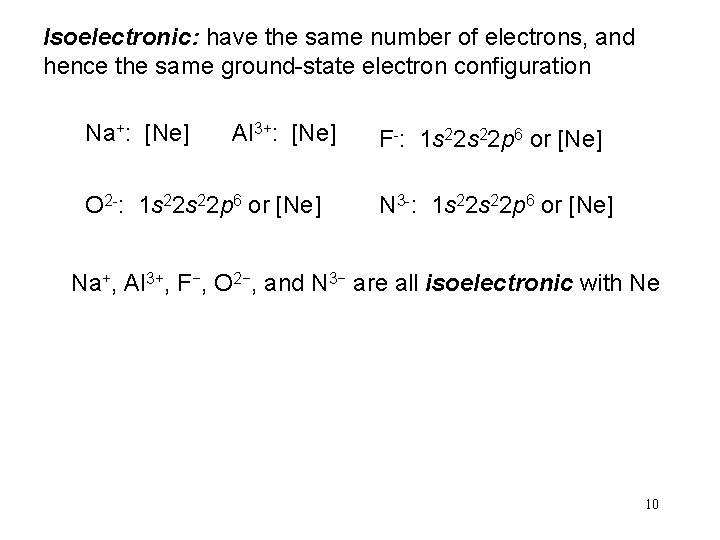
Isoelectronic: have the same number of electrons, and hence the same ground-state electron configuration Na+: [Ne] Al 3+: [Ne] O 2 -: 1 s 22 p 6 or [Ne] F-: 1 s 22 p 6 or [Ne] N 3 -: 1 s 22 p 6 or [Ne] Na+, Al 3+, F−, O 2−, and N 3− are all isoelectronic with Ne 10
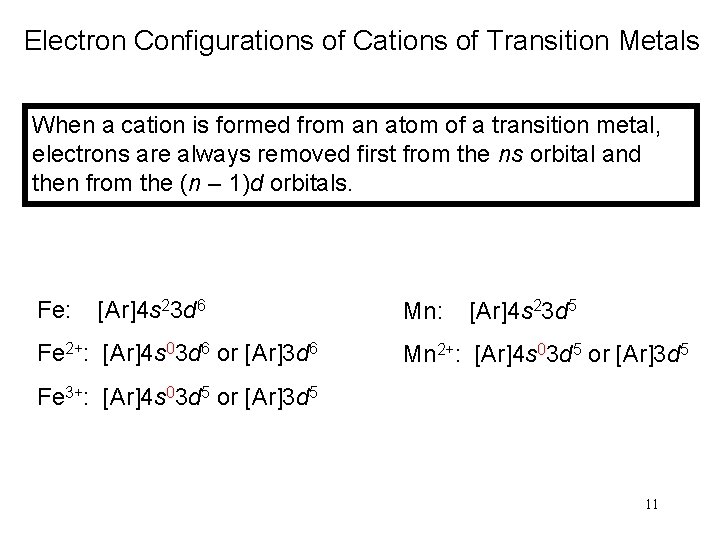
Electron Configurations of Cations of Transition Metals When a cation is formed from an atom of a transition metal, electrons are always removed first from the ns orbital and then from the (n – 1)d orbitals. Fe: [Ar]4 s 23 d 6 Fe 2+: [Ar]4 s 03 d 6 or [Ar]3 d 6 Mn: [Ar]4 s 23 d 5 Mn 2+: [Ar]4 s 03 d 5 or [Ar]3 d 5 Fe 3+: [Ar]4 s 03 d 5 or [Ar]3 d 5 11
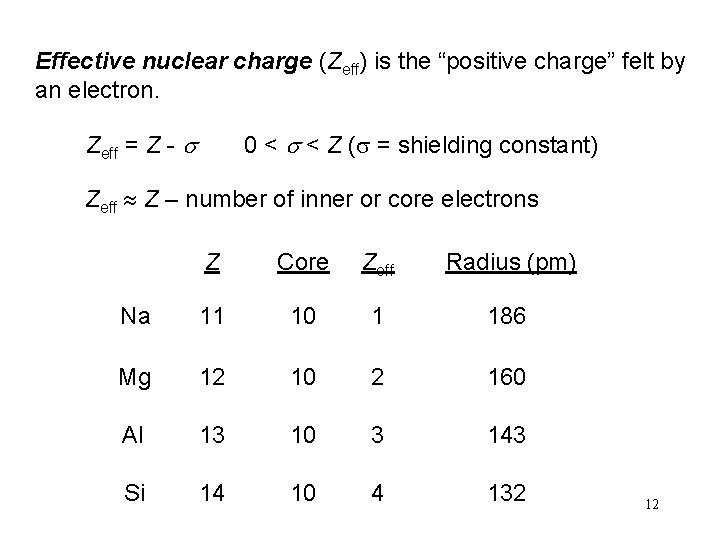
Effective nuclear charge (Zeff) is the “positive charge” felt by an electron. Zeff = Z - s 0 < s < Z (s = shielding constant) Zeff Z – number of inner or core electrons Z Core Zeff Radius (pm) Na 11 10 1 186 Mg 12 10 2 160 Al 13 10 3 143 Si 14 10 4 132 12
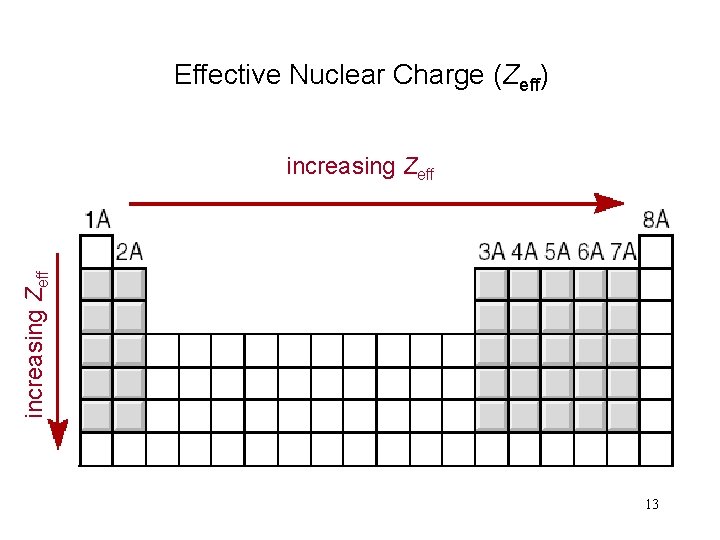
Effective Nuclear Charge (Zeff) increasing Zeff 13
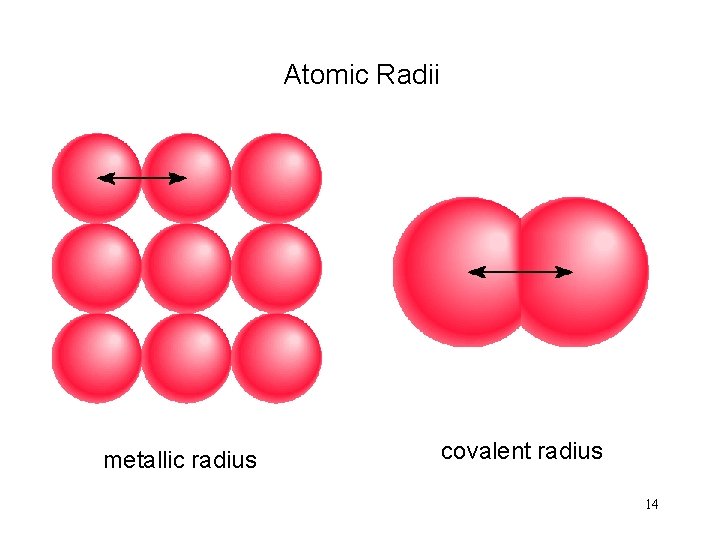
Atomic Radii metallic radius covalent radius 14
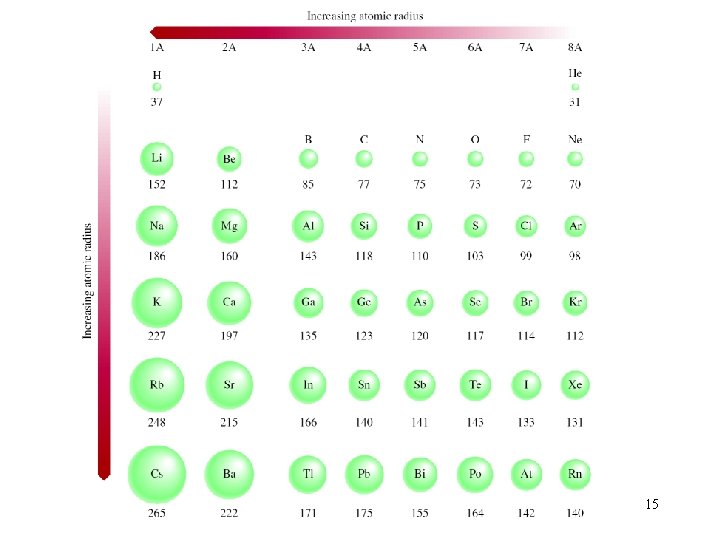
15
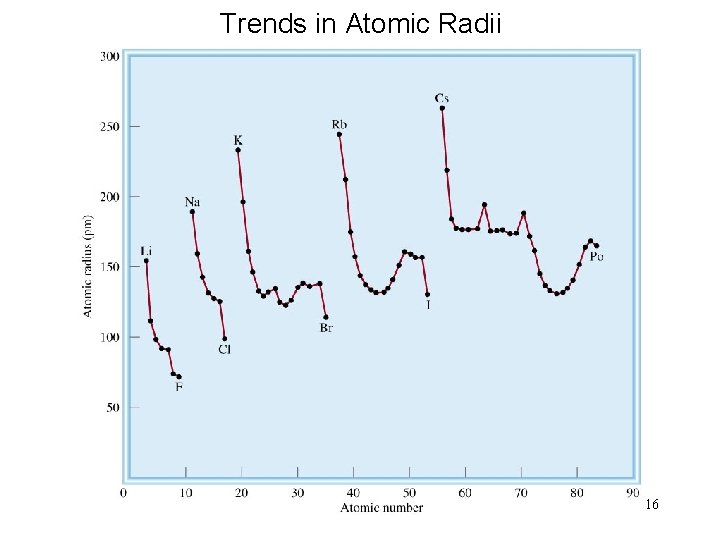
Trends in Atomic Radii 16
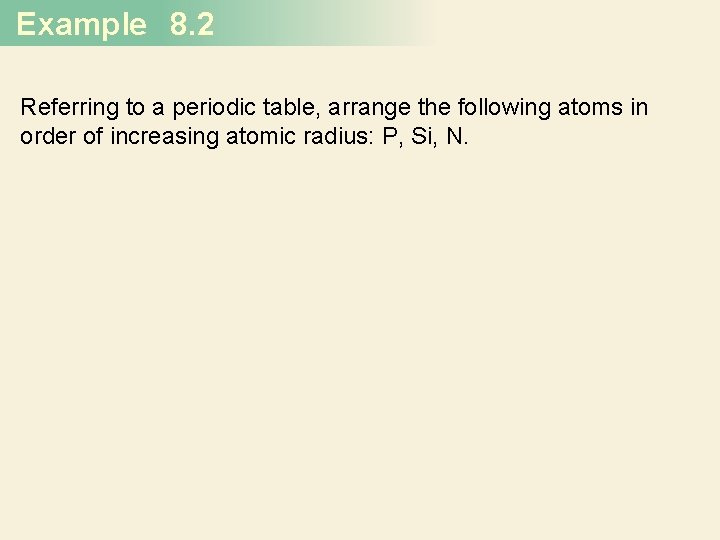
Example 8. 2 Referring to a periodic table, arrange the following atoms in order of increasing atomic radius: P, Si, N.
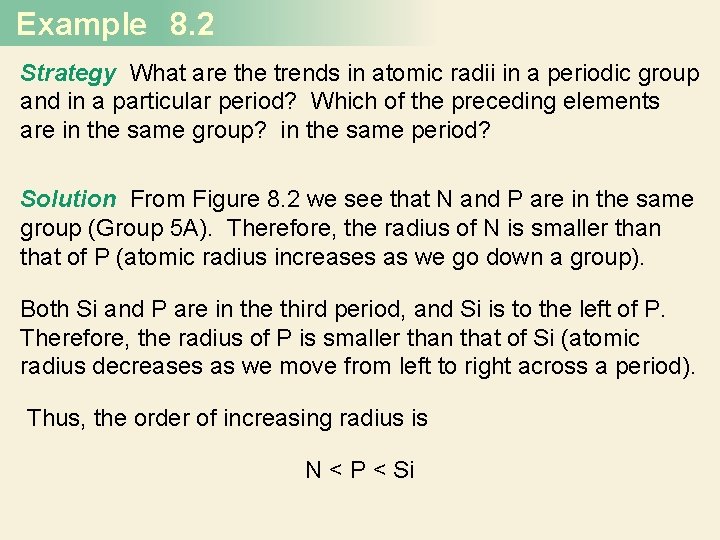
Example 8. 2 Strategy What are the trends in atomic radii in a periodic group and in a particular period? Which of the preceding elements are in the same group? in the same period? Solution From Figure 8. 2 we see that N and P are in the same group (Group 5 A). Therefore, the radius of N is smaller than that of P (atomic radius increases as we go down a group). Both Si and P are in the third period, and Si is to the left of P. Therefore, the radius of P is smaller than that of Si (atomic radius decreases as we move from left to right across a period). Thus, the order of increasing radius is N < P < Si
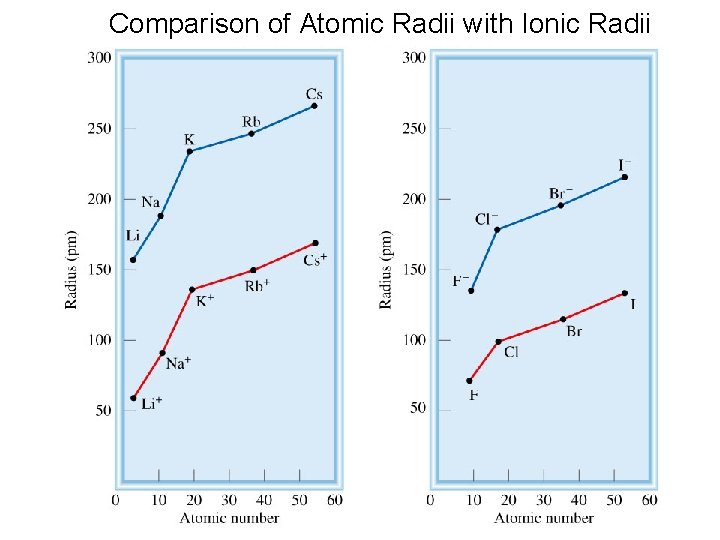
Comparison of Atomic Radii with Ionic Radii 19
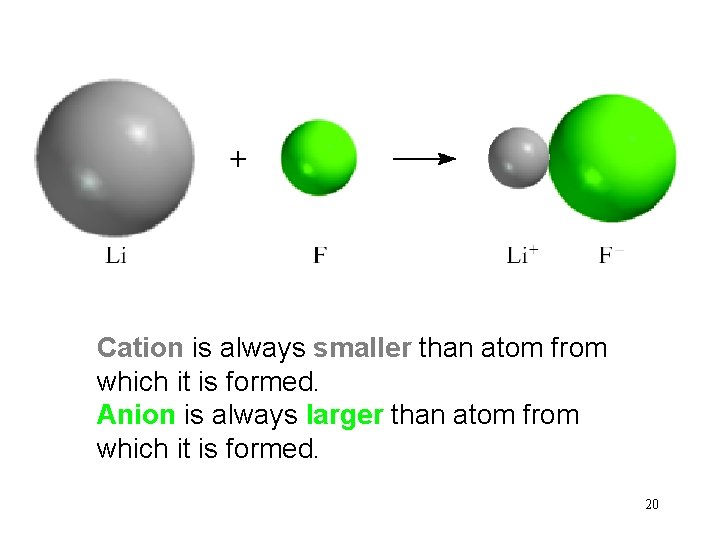
Cation is always smaller than atom from which it is formed. Anion is always larger than atom from which it is formed. 20

The Radii (in pm) of Ions of Familiar Elements 21
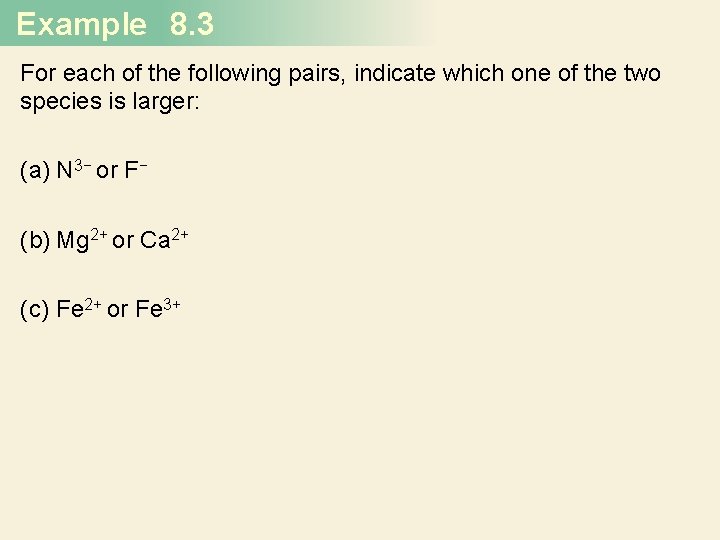
Example 8. 3 For each of the following pairs, indicate which one of the two species is larger: (a) N 3− or F− (b) Mg 2+ or Ca 2+ (c) Fe 2+ or Fe 3+
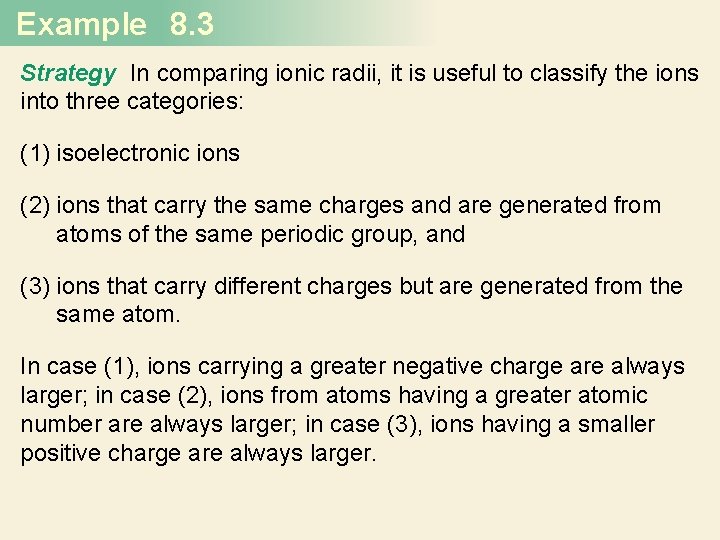
Example 8. 3 Strategy In comparing ionic radii, it is useful to classify the ions into three categories: (1) isoelectronic ions (2) ions that carry the same charges and are generated from atoms of the same periodic group, and (3) ions that carry different charges but are generated from the same atom. In case (1), ions carrying a greater negative charge are always larger; in case (2), ions from atoms having a greater atomic number are always larger; in case (3), ions having a smaller positive charge are always larger.
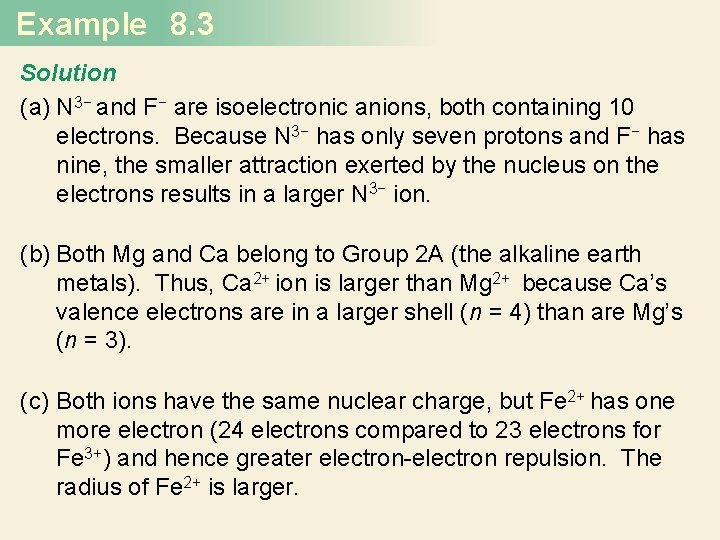
Example 8. 3 Solution (a) N 3− and F− are isoelectronic anions, both containing 10 electrons. Because N 3− has only seven protons and F− has nine, the smaller attraction exerted by the nucleus on the electrons results in a larger N 3− ion. (b) Both Mg and Ca belong to Group 2 A (the alkaline earth metals). Thus, Ca 2+ ion is larger than Mg 2+ because Ca’s valence electrons are in a larger shell (n = 4) than are Mg’s (n = 3). (c) Both ions have the same nuclear charge, but Fe 2+ has one more electron (24 electrons compared to 23 electrons for Fe 3+) and hence greater electron-electron repulsion. The radius of Fe 2+ is larger.
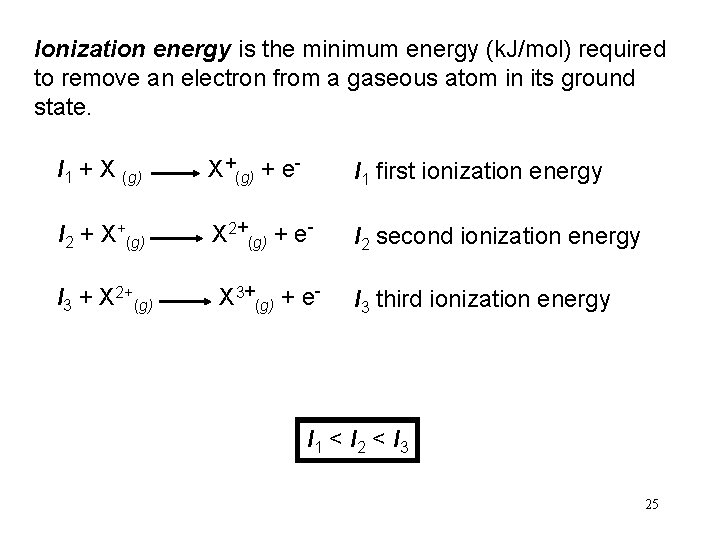
Ionization energy is the minimum energy (k. J/mol) required to remove an electron from a gaseous atom in its ground state. I 1 + X (g) X+(g) + e- I 1 first ionization energy I 2 + X+(g) X 2+(g) + e- I 2 second ionization energy I 3 + X 2+(g) X 3+(g) + e- I 3 third ionization energy I 1 < I 2 < I 3 25
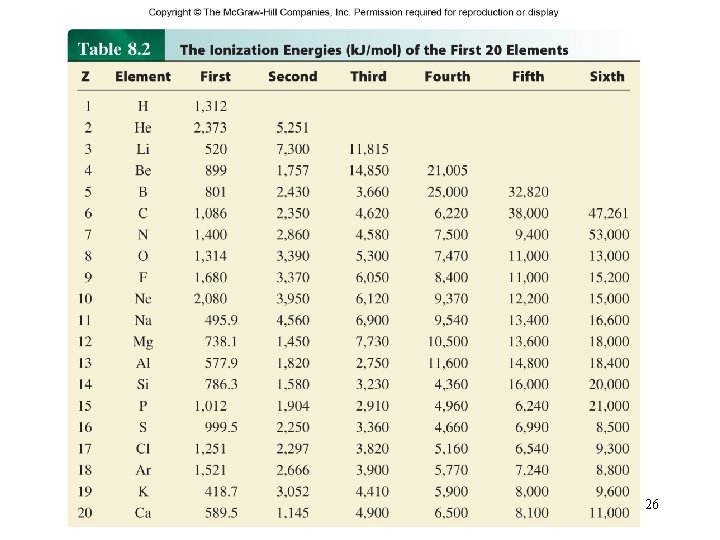
26
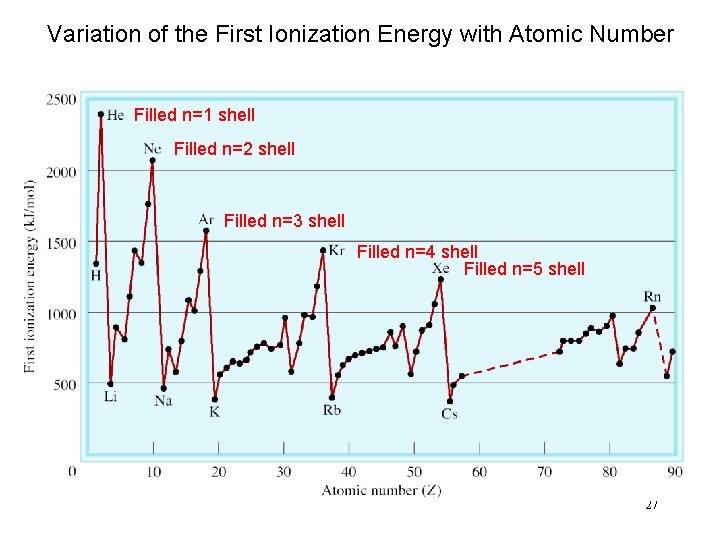
Variation of the First Ionization Energy with Atomic Number Filled n=1 shell Filled n=2 shell Filled n=3 shell Filled n=4 shell Filled n=5 shell 27
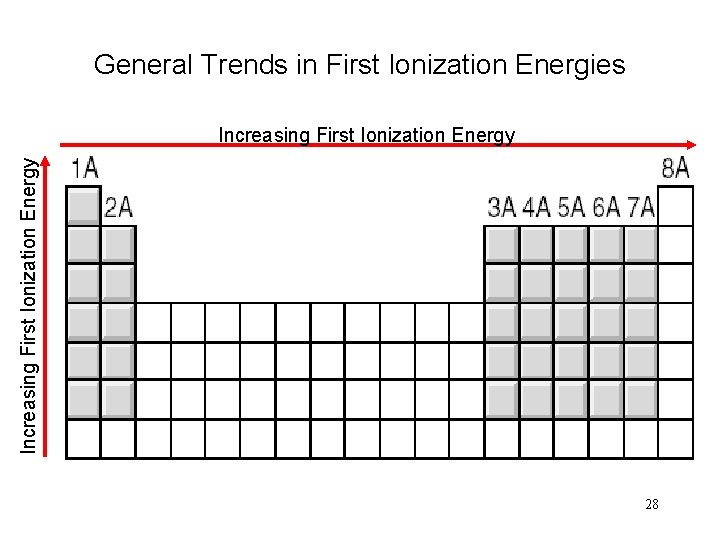
General Trends in First Ionization Energies Increasing First Ionization Energy 28
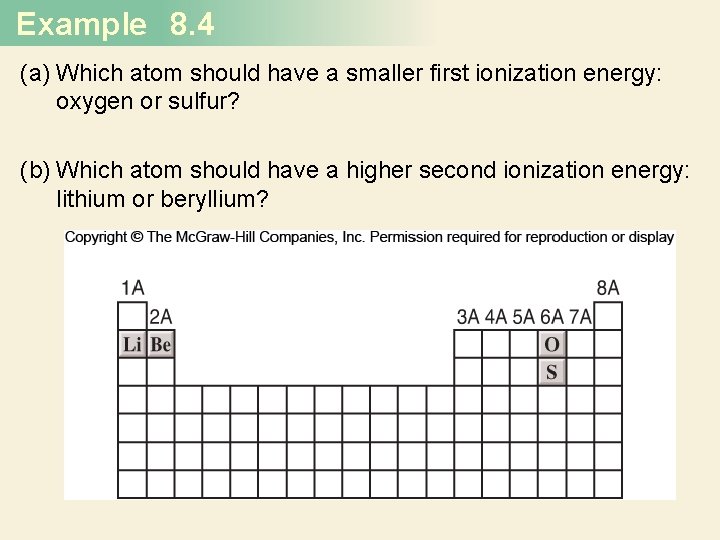
Example 8. 4 (a) Which atom should have a smaller first ionization energy: oxygen or sulfur? (b) Which atom should have a higher second ionization energy: lithium or beryllium?
Example 8. 4 Strategy (a) First ionization energy decreases as we go down a group because the outermost electron is farther away from the nucleus and feels less attraction. (b) Removal of the outermost electron requires less energy if it is shielded by a filled inner shell. Solution (a) Oxygen and sulfur are members of Group 6 A. They have the same valence electron configuration (ns 2 np 4), but the 3 p electron in sulfur is farther from the nucleus and experiences less nuclear attraction than the 2 p electron in oxygen. Thus, we predict that sulfur should have a smaller first ionization energy.
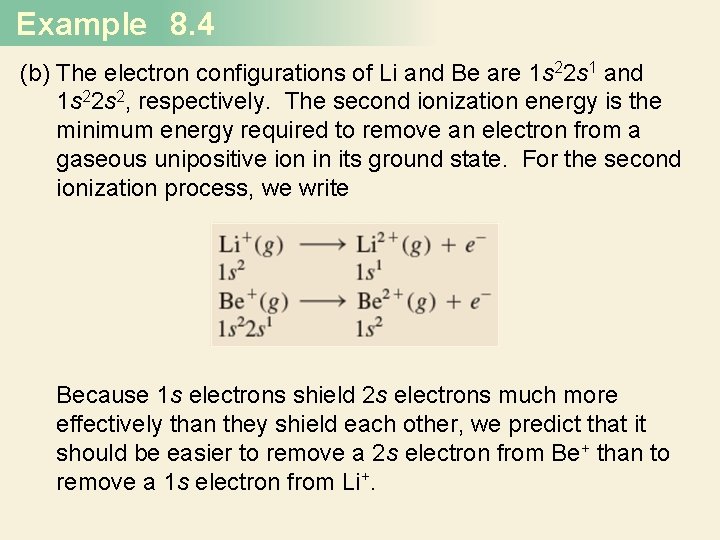
Example 8. 4 (b) The electron configurations of Li and Be are 1 s 22 s 1 and 1 s 22 s 2, respectively. The second ionization energy is the minimum energy required to remove an electron from a gaseous unipositive ion in its ground state. For the second ionization process, we write Because 1 s electrons shield 2 s electrons much more effectively than they shield each other, we predict that it should be easier to remove a 2 s electron from Be+ than to remove a 1 s electron from Li+.
Example 8. 4 Check Compare your result with the data shown in Table 8. 2. In (a), is your prediction consistent with the fact that the metallic character of the elements increases as we move down a periodic group? In (b), does your prediction account for the fact that alkali metals form +1 ions while alkaline earth metals form +2 ions?
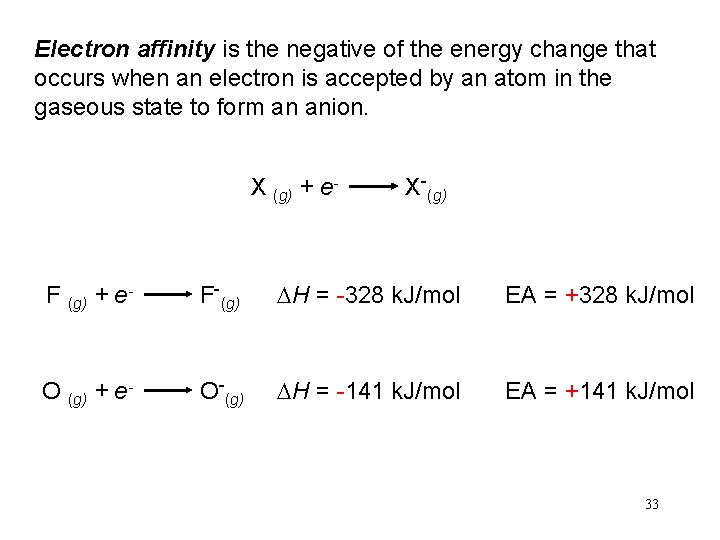
Electron affinity is the negative of the energy change that occurs when an electron is accepted by an atom in the gaseous state to form an anion. X (g) + e- X-(g) F (g) + e- F-(g) DH = -328 k. J/mol EA = +328 k. J/mol O (g) + e- O-(g) DH = -141 k. J/mol EA = +141 k. J/mol 33
34
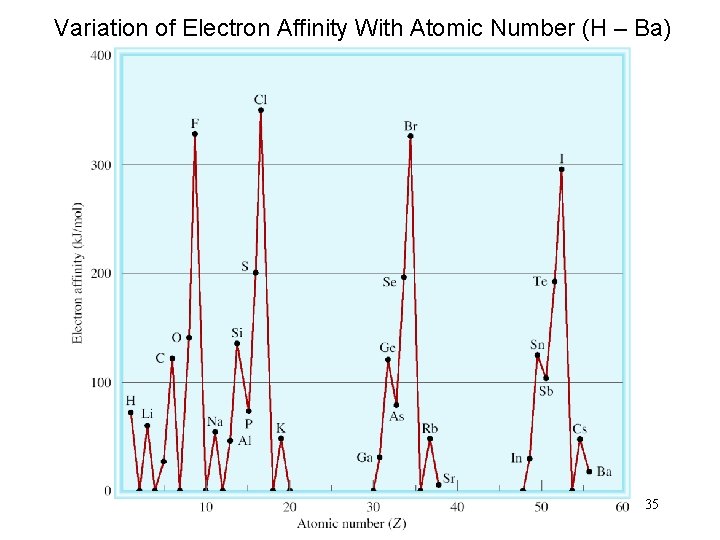
Variation of Electron Affinity With Atomic Number (H – Ba) 35
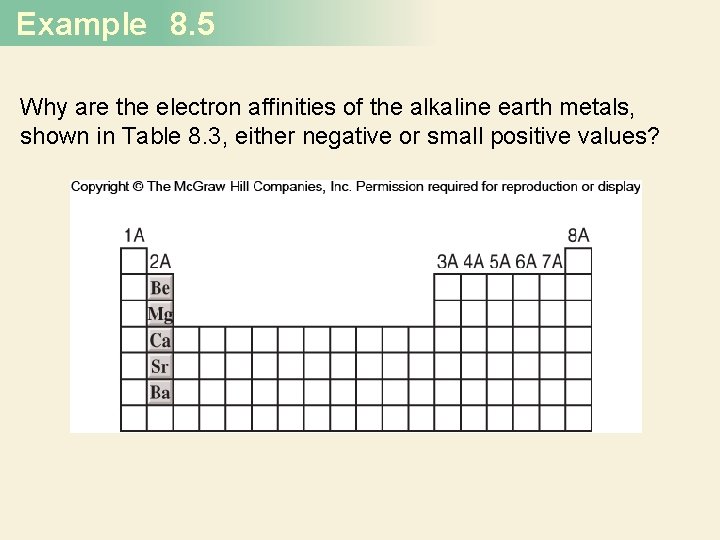
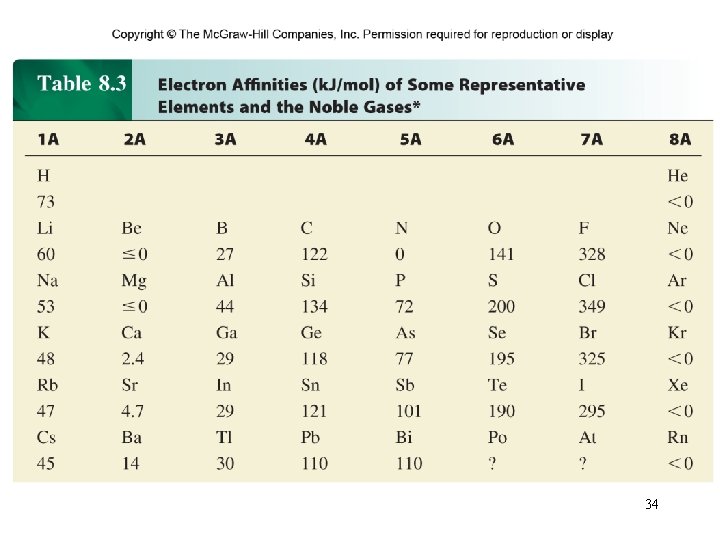
Example 8. 5 Why are the electron affinities of the alkaline earth metals, shown in Table 8. 3, either negative or small positive values?
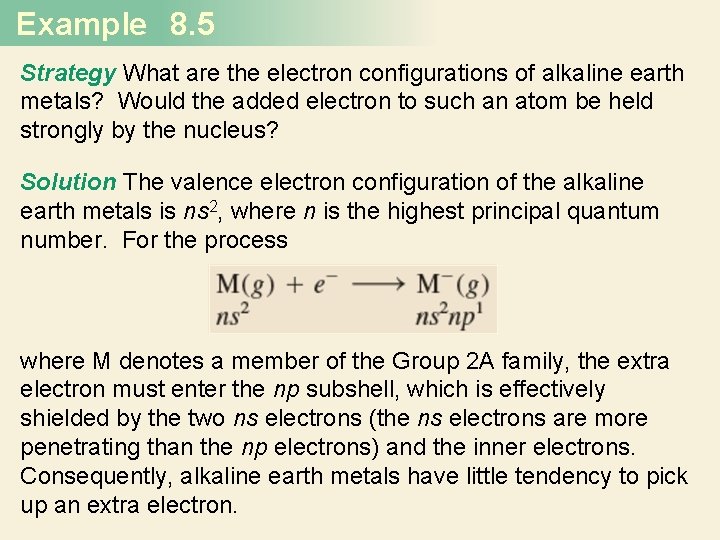
Example 8. 5 Strategy What are the electron configurations of alkaline earth metals? Would the added electron to such an atom be held strongly by the nucleus? Solution The valence electron configuration of the alkaline earth metals is ns 2, where n is the highest principal quantum number. For the process where M denotes a member of the Group 2 A family, the extra electron must enter the np subshell, which is effectively shielded by the two ns electrons (the ns electrons are more penetrating than the np electrons) and the inner electrons. Consequently, alkaline earth metals have little tendency to pick up an extra electron.
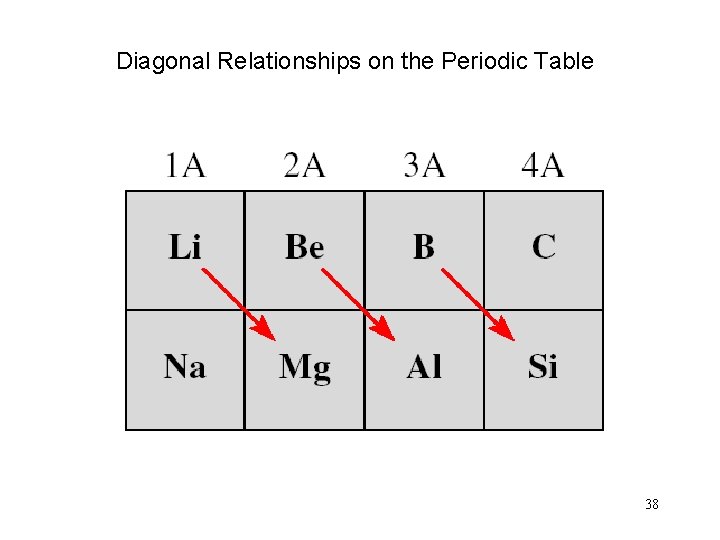
Diagonal Relationships on the Periodic Table 38
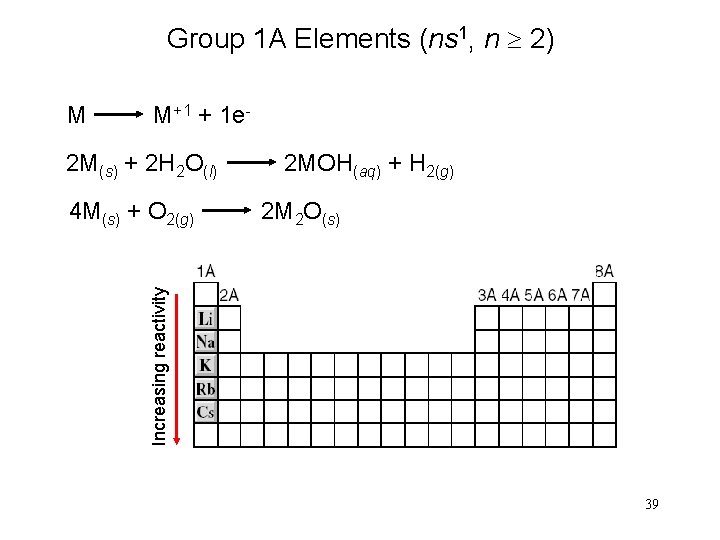
Group 1 A Elements (ns 1, n 2) M M+1 + 1 e- 2 M(s) + 2 H 2 O(l) 2 M 2 O(s) Increasing reactivity 4 M(s) + O 2(g) 2 MOH(aq) + H 2(g) 39
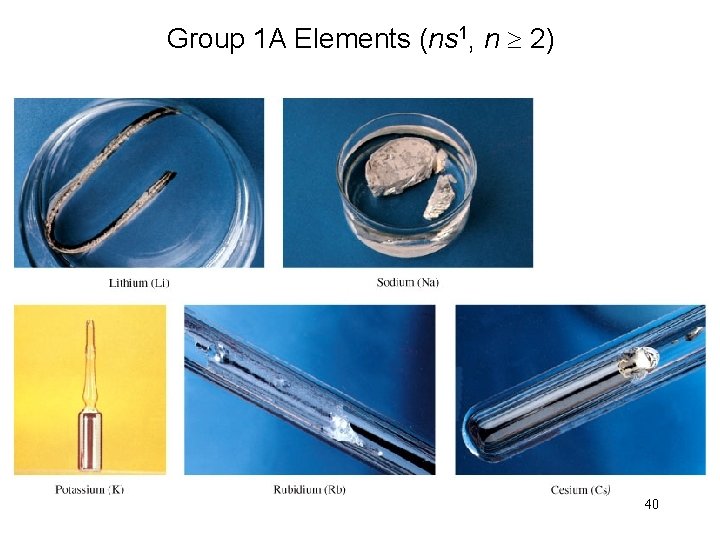
Group 1 A Elements (ns 1, n 2) 40
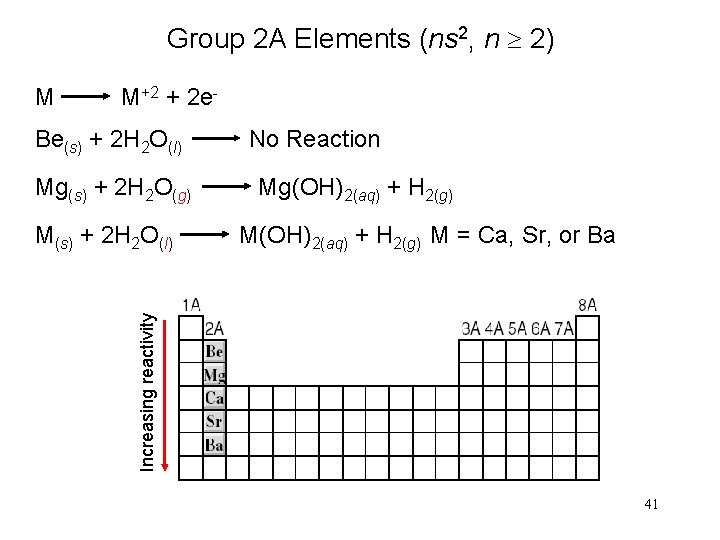
Group 2 A Elements (ns 2, n 2) M M+2 + 2 e- Be(s) + 2 H 2 O(l) Mg(s) + 2 H 2 O(g) Mg(OH)2(aq) + H 2(g) M = Ca, Sr, or Ba Increasing reactivity M(s) + 2 H 2 O(l) No Reaction 41
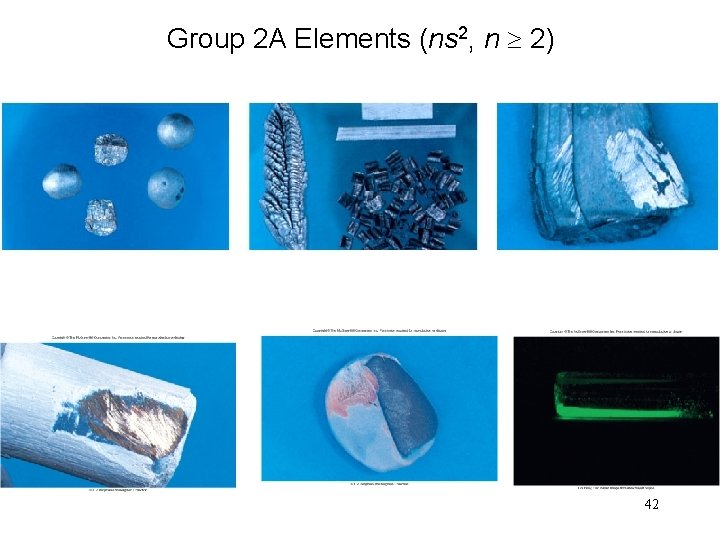
Group 2 A Elements (ns 2, n 2) 42
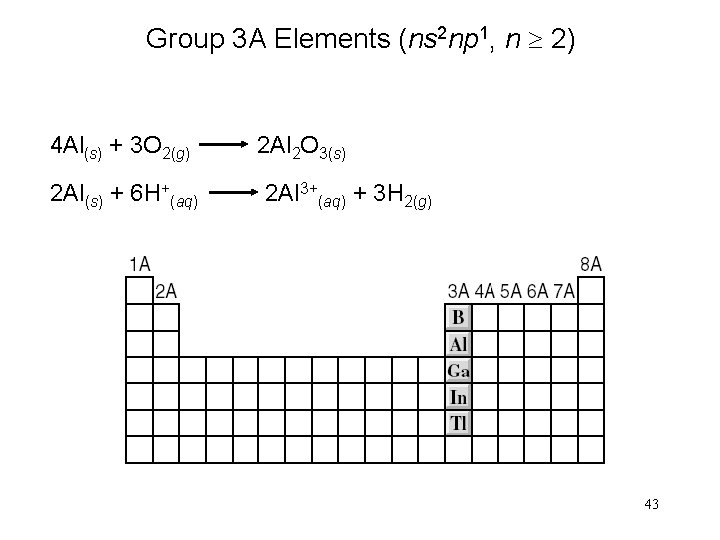
Group 3 A Elements (ns 2 np 1, n 2) 4 Al(s) + 3 O 2(g) 2 Al(s) + 6 H+(aq) 2 Al 2 O 3(s) 2 Al 3+(aq) + 3 H 2(g) 43
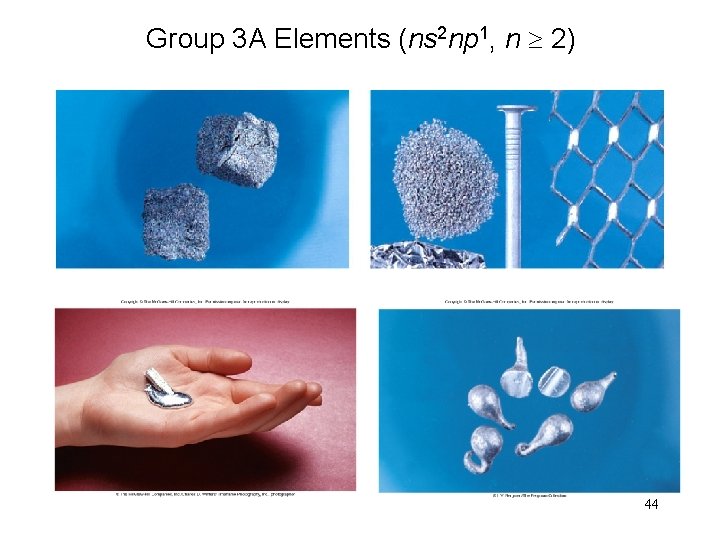
Group 3 A Elements (ns 2 np 1, n 2) 44
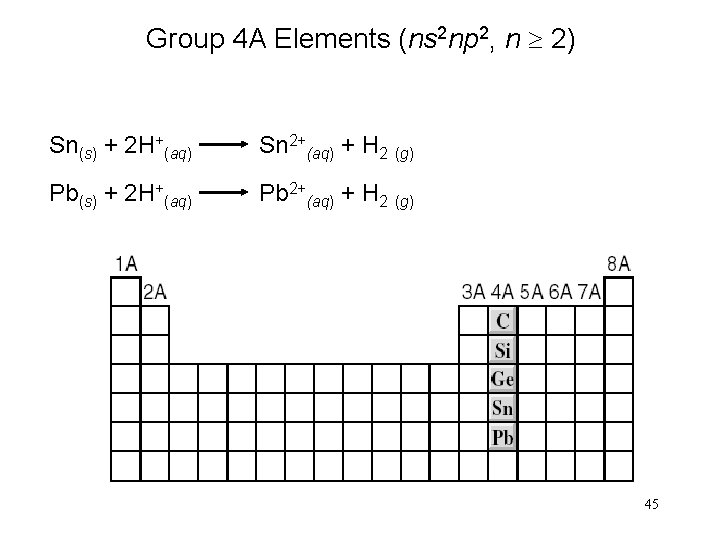
Group 4 A Elements (ns 2 np 2, n 2) Sn(s) + 2 H+(aq) Sn 2+(aq) + H 2 (g) Pb(s) + 2 H+(aq) Pb 2+(aq) + H 2 (g) 45
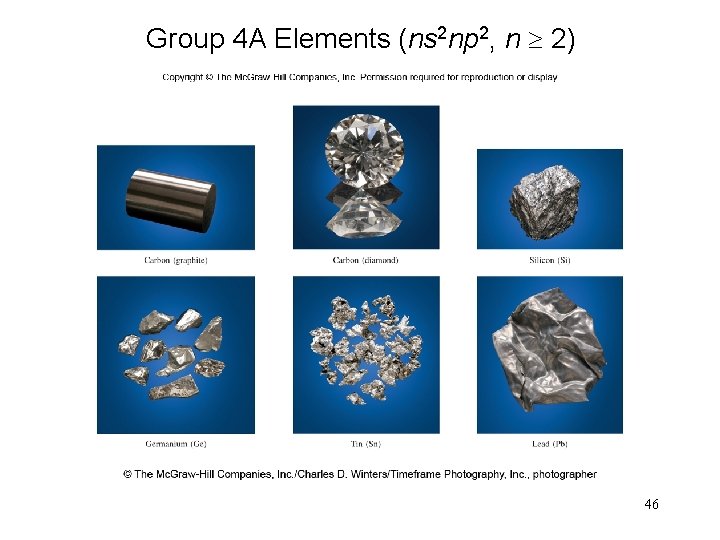
Group 4 A Elements (ns 2 np 2, n 2) 46
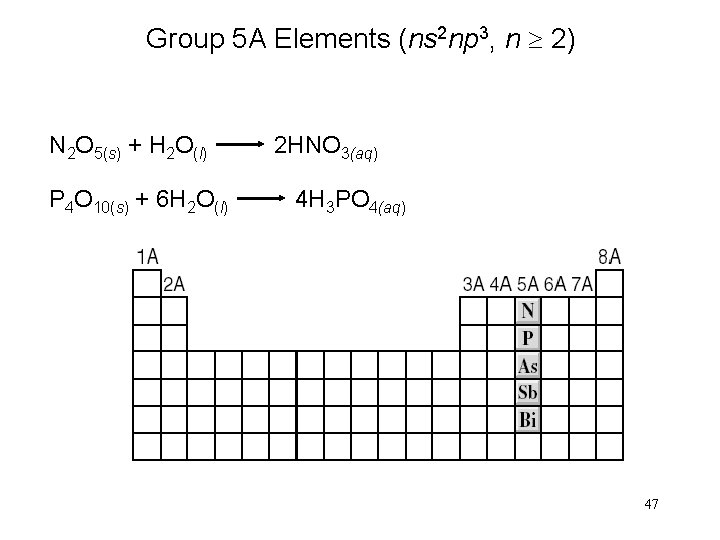
Group 5 A Elements (ns 2 np 3, n 2) N 2 O 5(s) + H 2 O(l) P 4 O 10(s) + 6 H 2 O(l) 2 HNO 3(aq) 4 H 3 PO 4(aq) 47
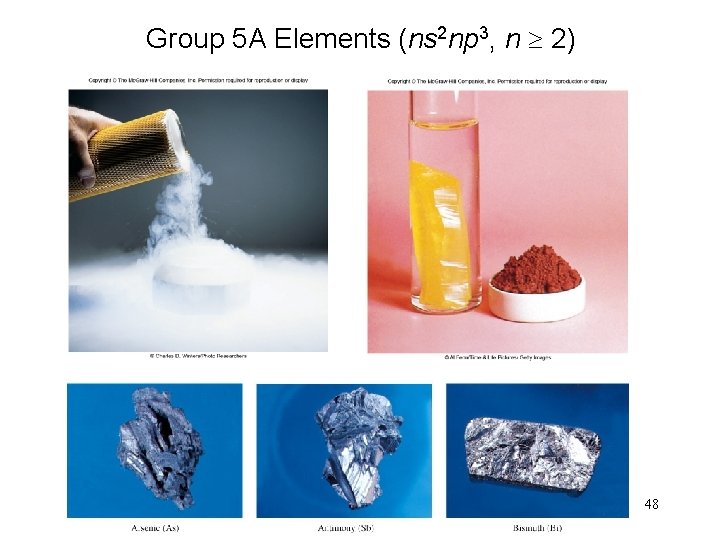
Group 5 A Elements (ns 2 np 3, n 2) 48
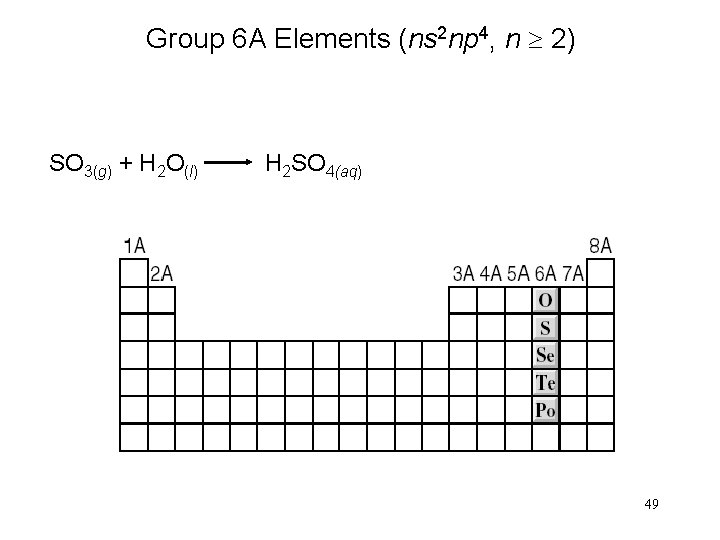
Group 6 A Elements (ns 2 np 4, n 2) SO 3(g) + H 2 O(l) H 2 SO 4(aq) 49
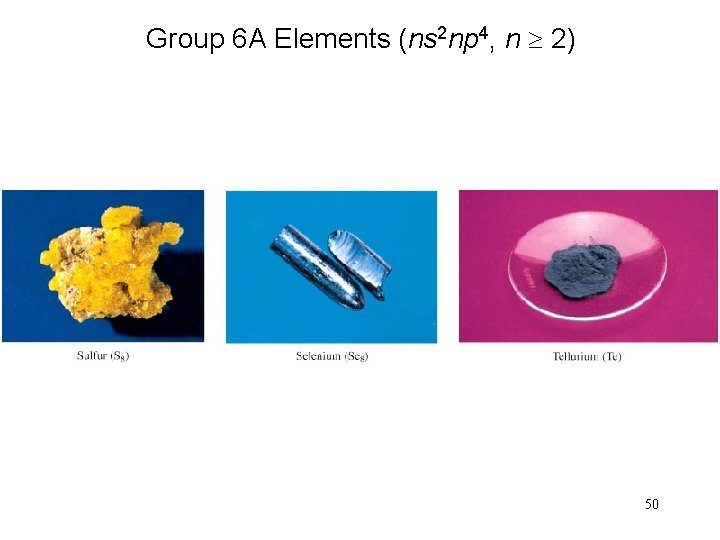
Group 6 A Elements (ns 2 np 4, n 2) 50
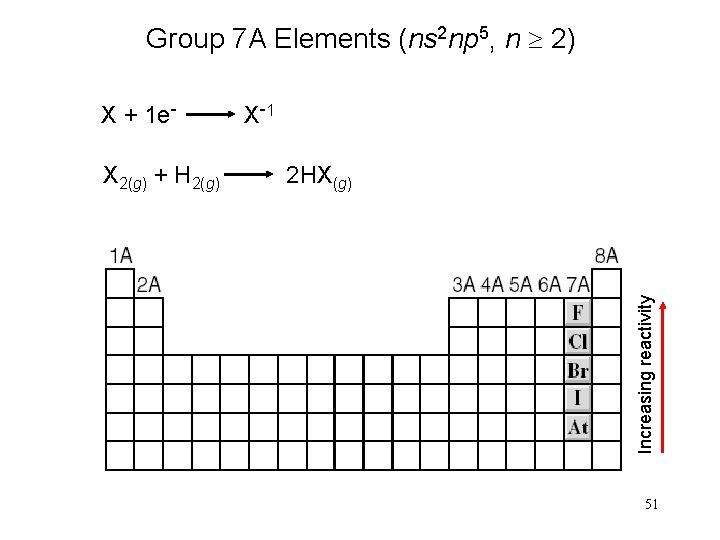
Group 7 A Elements (ns 2 np 5, n 2) X 2(g) + H 2(g) X -1 2 HX(g) Increasing reactivity X + 1 e- 51
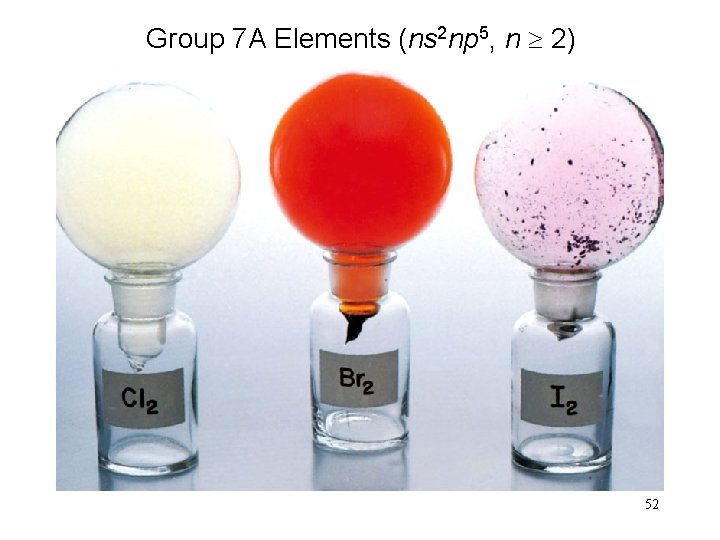
Group 7 A Elements (ns 2 np 5, n 2) 52
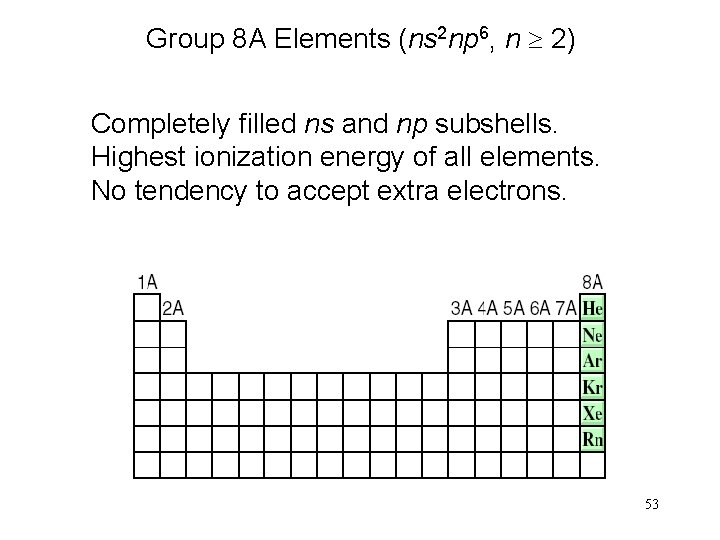
Group 8 A Elements (ns 2 np 6, n 2) Completely filled ns and np subshells. Highest ionization energy of all elements. No tendency to accept extra electrons. 53
Group 8 A Elements (ns 2 np 6, n 2) 54
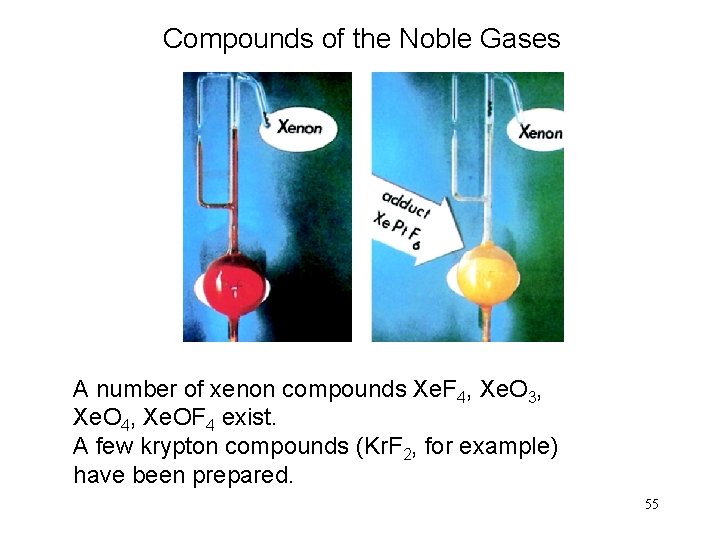
Compounds of the Noble Gases A number of xenon compounds Xe. F 4, Xe. O 3, Xe. O 4, Xe. OF 4 exist. A few krypton compounds (Kr. F 2, for example) have been prepared. 55
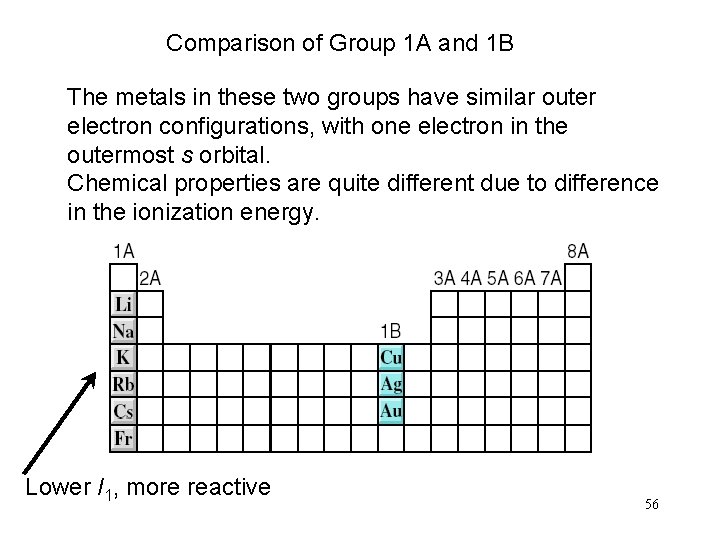
Comparison of Group 1 A and 1 B The metals in these two groups have similar outer electron configurations, with one electron in the outermost s orbital. Chemical properties are quite different due to difference in the ionization energy. Lower I 1, more reactive 56
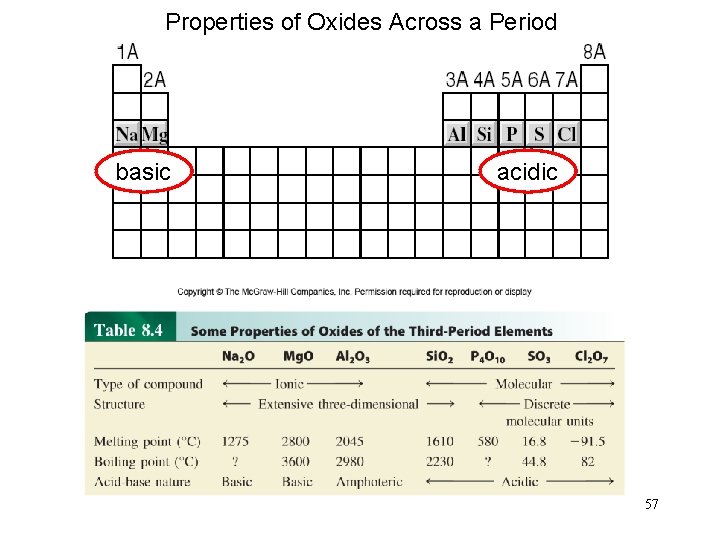
Properties of Oxides Across a Period basic acidic 57
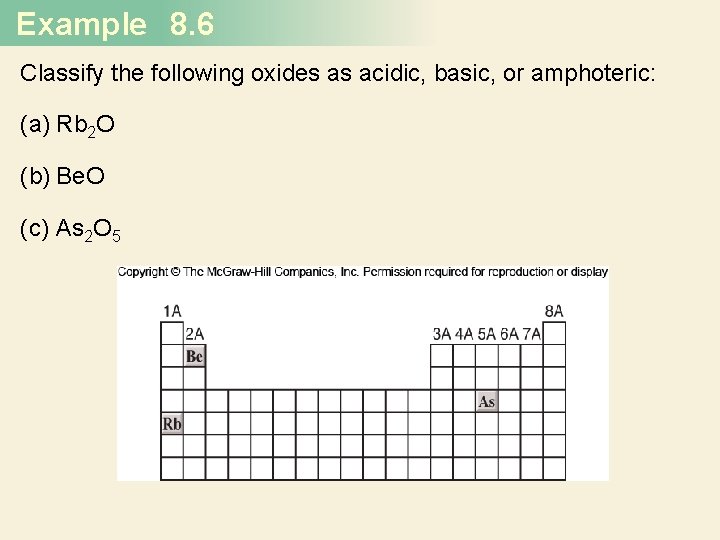
Example 8. 6 Classify the following oxides as acidic, basic, or amphoteric: (a) Rb 2 O (b) Be. O (c) As 2 O 5
Example 8. 6 Strategy What type of elements form acidic oxides? basic oxides? amphoteric oxides? Solution (a) Because rubidium is an alkali metal, we would expect Rb 2 O to be a basic oxide.
Example 8. 6 (b) Beryllium is an alkaline earth metal. However, because it is the first member of Group 2 A, we expect that it may differ somewhat from the other members of the group. In the text we saw that Al 2 O 3 is amphoteric. Because beryllium and aluminum exhibit a diagonal relationship, Be. O may resemble Al 2 O 3 in properties. It turns out that Be. O is also an amphoteric oxide. (b) Because arsenic is a nonmetal, we expect As 2 O 5 to be an acidic oxide.
- Slides: 60