
The Period of PURPLE Crying Assessment of Parental
- Slides: 1
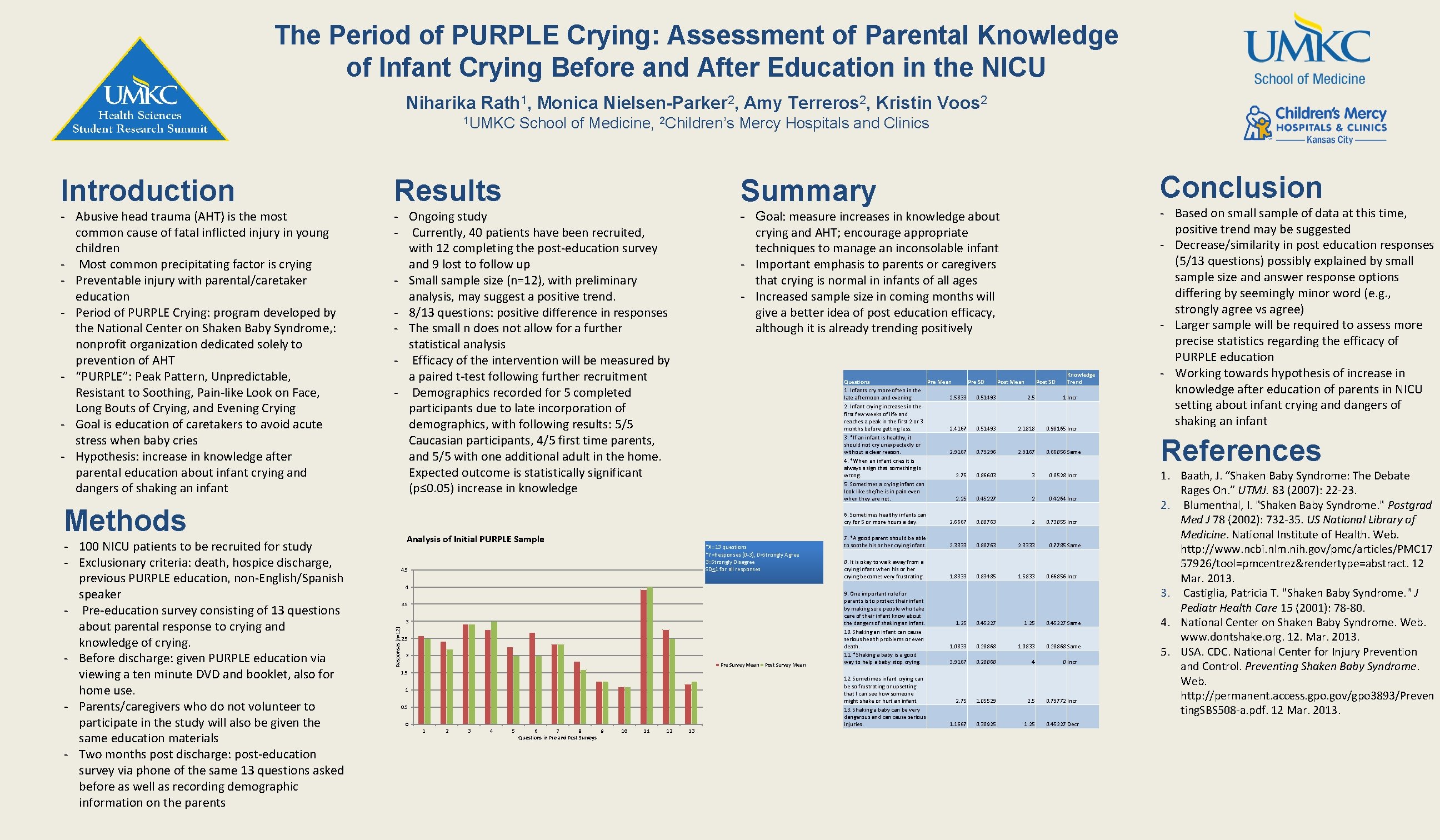
The Period of PURPLE Crying: Assessment of Parental Knowledge of Infant Crying Before and After Education in the NICU Niharika Rath 1, Monica Nielsen-Parker 2, Amy Terreros 2, Kristin Voos 2 1 UMKC School of Medicine, 2 Children’s Mercy Hospitals and Clinics Conclusion Introduction Results Summary - Abusive head trauma (AHT) is the most common cause of fatal inflicted injury in young children - Most common precipitating factor is crying - Preventable injury with parental/caretaker education - Period of PURPLE Crying: program developed by the National Center on Shaken Baby Syndrome, : nonprofit organization dedicated solely to prevention of AHT - “PURPLE”: Peak Pattern, Unpredictable, Resistant to Soothing, Pain-like Look on Face, Long Bouts of Crying, and Evening Crying - Goal is education of caretakers to avoid acute stress when baby cries - Hypothesis: increase in knowledge after parental education about infant crying and dangers of shaking an infant - Ongoing study - Currently, 40 patients have been recruited, with 12 completing the post-education survey and 9 lost to follow up - Small sample size (n=12), with preliminary analysis, may suggest a positive trend. - 8/13 questions: positive difference in responses - The small n does not allow for a further statistical analysis - Efficacy of the intervention will be measured by a paired t-test following further recruitment - Demographics recorded for 5 completed participants due to late incorporation of demographics, with following results: 5/5 Caucasian participants, 4/5 first time parents, and 5/5 with one additional adult in the home. Expected outcome is statistically significant (p≤ 0. 05) increase in knowledge - Goal: measure increases in knowledge about crying and AHT; encourage appropriate techniques to manage an inconsolable infant - Important emphasis to parents or caregivers that crying is normal in infants of all ages - Increased sample size in coming months will give a better idea of post education efficacy, although it is already trending positively Methods - 100 NICU patients to be recruited for study - Exclusionary criteria: death, hospice discharge, previous PURPLE education, non-English/Spanish speaker - Pre-education survey consisting of 13 questions about parental response to crying and knowledge of crying. - Before discharge: given PURPLE education via viewing a ten minute DVD and booklet, also for home use. - Parents/caregivers who do not volunteer to participate in the study will also be given the same education materials - Two months post discharge: post-education survey via phone of the same 13 questions asked before as well as recording demographic information on the parents Analysis of Initial PURPLE Sample *X=13 questions *Y=Responses (0 -3), 0=Strongly Agree 3=Strongly Disagree SD<1 for all responses 4. 5 4 3. 5 3 Responses (n=12) Knowledge Questions Pre Mean Pre SD Post Mean Post SD Trend 1. Infants cry more often in the late afternoon and evening. 2. 5833 0. 51493 2. 5 1 Incr 2. Infant crying increases in the first few weeks of life and reaches a peak in the first 2 or 3 months before getting less. 2. 4167 0. 51493 2. 1818 0. 98165 Incr 3. *If an infant is healthy, it should not cry unexpectedly or without a clear reason. 2. 9167 0. 79296 2. 9167 0. 66856 Same 4. *When an infant cries it is always a sign that something is wrong. 2. 75 0. 86603 3 0. 8528 Incr 5. Sometimes a crying infant can look like she/he is in pain even when they are not. 2. 25 0. 45227 2 0. 4264 Incr 2. 5 2 Pre Survey Mean 1. 5 1 0. 5 0 1 2 3 4 5 6 7 8 9 Questions in Pre and Post Surveys 10 11 12 13 Post Survey Mean 6. Sometimes healthy infants can cry for 5 or more hours a day. 2. 6667 0. 88763 2 7. *A good parent should be able to soothe his or her crying infant. 2. 3333 0. 88763 2. 3333 8. It is okay to walk away from a crying infant when his or her crying becomes very frustrating. 1. 8333 0. 83485 1. 5833 1. 25 0. 45227 Same 1. 0833 0. 28868 Same 3. 9167 0. 28868 4 0 Incr 2. 75 1. 05529 2. 5 0. 79772 Incr 1. 1667 0. 38925 1. 25 0. 45227 Decr 9. One important role for parents is to protect their infant by making sure people who take care of their infant know about the dangers of shaking an infant. 10. Shaking an infant can cause serious health problems or even death. 11. *Shaking a baby is a good way to help a baby stop crying. 12. Sometimes infant crying can be so frustrating or upsetting that I can see how someone might shake or hurt an infant. 13. Shaking a baby can be very dangerous and can cause serious injuries. 0. 73855 Incr 0. 7785 Same 0. 66856 Incr - Based on small sample of data at this time, positive trend may be suggested - Decrease/similarity in post education responses (5/13 questions) possibly explained by small sample size and answer response options differing by seemingly minor word (e. g. , strongly agree vs agree) - Larger sample will be required to assess more precise statistics regarding the efficacy of PURPLE education - Working towards hypothesis of increase in knowledge after education of parents in NICU setting about infant crying and dangers of shaking an infant References 1. Baath, J. “Shaken Baby Syndrome: The Debate Rages On. ” UTMJ. 83 (2007): 22 -23. 2. Blumenthal, I. "Shaken Baby Syndrome. " Postgrad Med J 78 (2002): 732 -35. US National Library of Medicine. National Institute of Health. Web. http: //www. ncbi. nlm. nih. gov/pmc/articles/PMC 17 57926/tool=pmcentrez&rendertype=abstract. 12 Mar. 2013. Castiglia, Patricia T. "Shaken Baby Syndrome. " J Pediatr Health Care 15 (2001): 78 -80. 4. National Center on Shaken Baby Syndrome. Web. www. dontshake. org. 12. Mar. 2013. 5. USA. CDC. National Center for Injury Prevention and Control. Preventing Shaken Baby Syndrome. Web. http: //permanent. access. gpo. gov/gpo 3893/Preven ting. SBS 508 -a. pdf. 12 Mar. 2013.