
The Perfect Tense LEARNING OBJECTIVES This Powerpoint will
The Perfect. Tense LEARNING OBJECTIVES: This Powerpoint will teach you how: • To form the Perfect tense • To use the Perfect tense • To improve the quality of your Perfect sentences
The PERFECT Tense The Perfect tense is used to talk about what you : DID or HAVE DONE
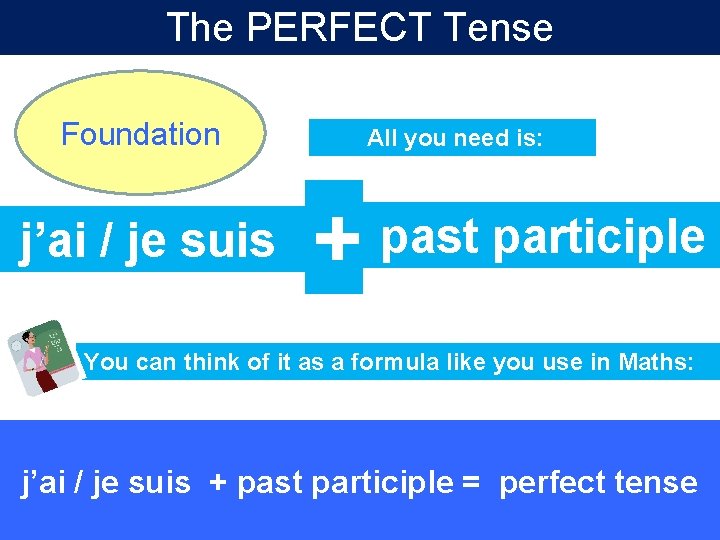
The PERFECT Tense Foundation j’ai / je suis All you need is: + past participle You can think of it as a formula like you use in Maths: j’ai / je suis + past participle = perfect tense
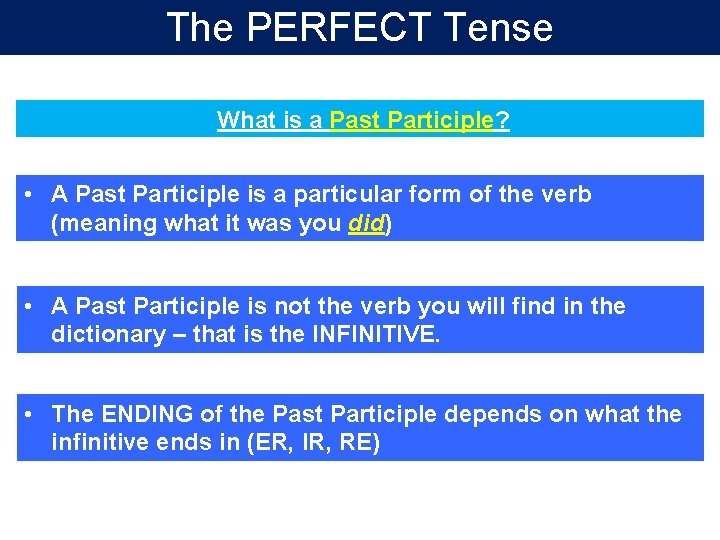
The PERFECT Tense What is a Past Participle? • A Past Participle is a particular form of the verb (meaning what it was you did) • A Past Participle is not the verb you will find in the dictionary – that is the INFINITIVE. • The ENDING of the Past Participle depends on what the infinitive ends in (ER, IR, RE)
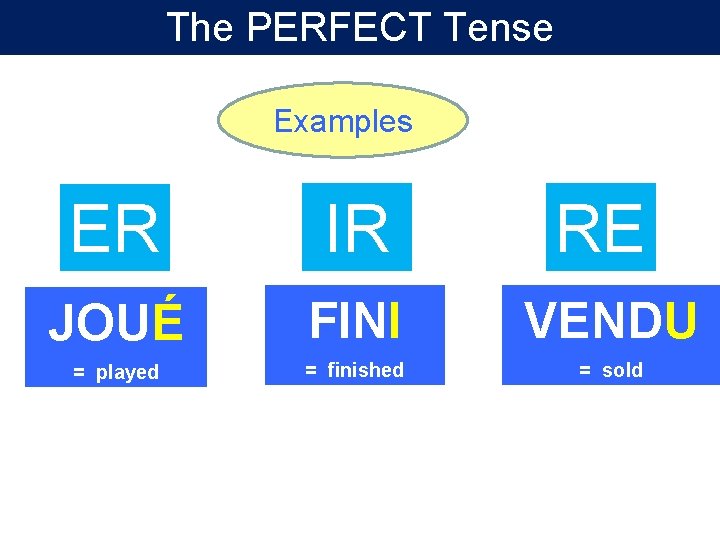
The PERFECT Tense Examples ER IR RE JOUÉ FINI VENDU = played = finished = sold
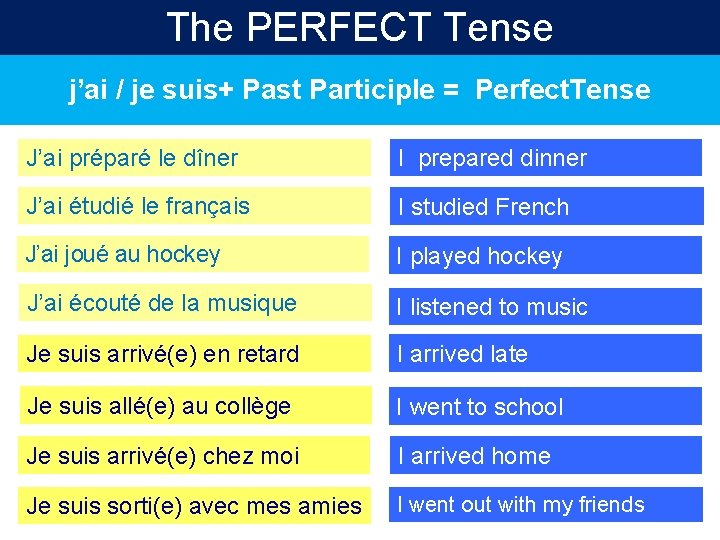
The PERFECT Tense j’ai / je suis+ Past Participle = Perfect. Tense J’ai préparé le dîner I prepared dinner J’ai étudié le français I studied French J’ai joué au hockey I played hockey J’ai écouté de la musique I listened to music Je suis arrivé(e) en retard I arrived late Je suis allé(e) au collège I went to school Je suis arrivé(e) chez moi I arrived home Je suis sorti(e) avec mes amies I went out with my friends
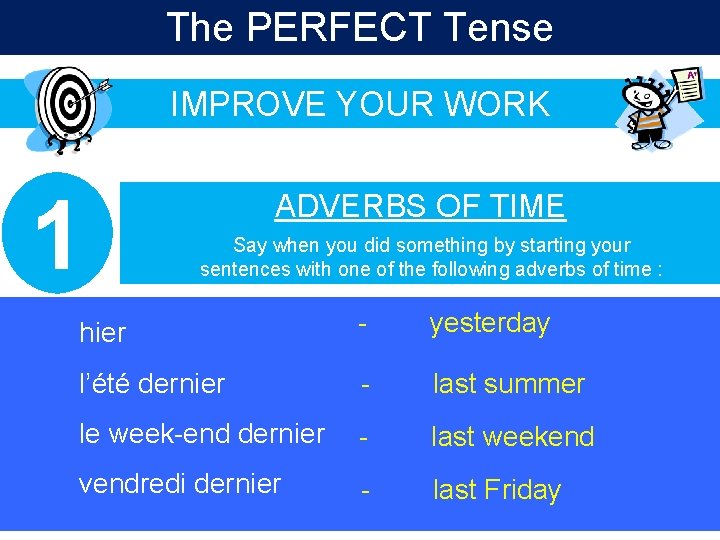
The PERFECT Tense IMPROVE YOUR WORK There are three ways to improve your Perfect sentences : 1 ADVERBS OF TIME Say when you did something by starting your sentences with one of the following adverbs of time : hier - yesterday l’été dernier - last summer le week-end dernier - last weekend vendredi dernier - last Friday
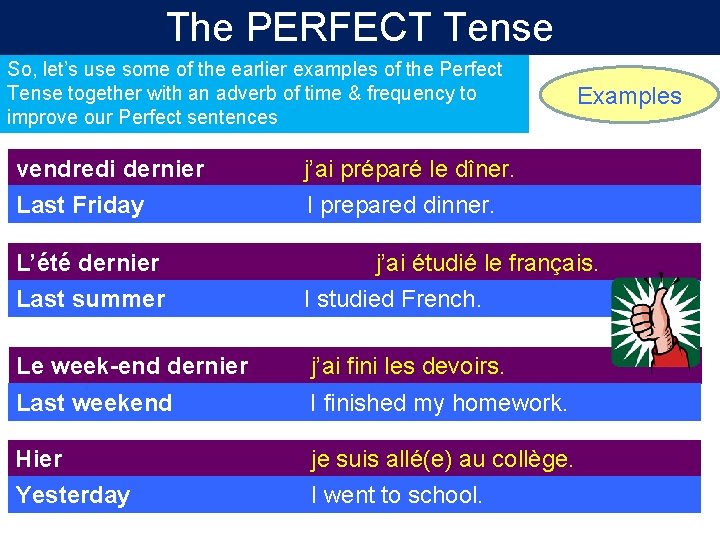
The PERFECT Tense So, let’s use some of the earlier examples of the Perfect Tense together with an adverb of time & frequency to improve our Perfect sentences vendredi dernier Last Friday L’été dernier Examples j’ai préparé le dîner. I prepared dinner. j’ai étudié le français. Last summer I studied French. Le week-end dernier j’ai fini les devoirs. Last weekend I finished my homework. Hier je suis allé(e) au collège. Yesterday I went to school.
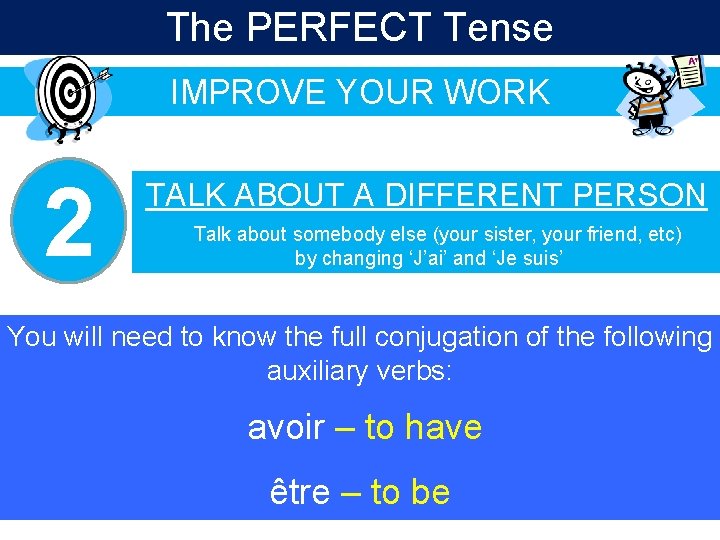
The PERFECT Tense IMPROVE YOUR WORK 2 TALK ABOUT A DIFFERENT PERSON Talk about somebody else (your sister, your friend, etc) by changing ‘J’ai’ and ‘Je suis’ You will need to know the full conjugation of the following auxiliary verbs: avoir – to have être – to be
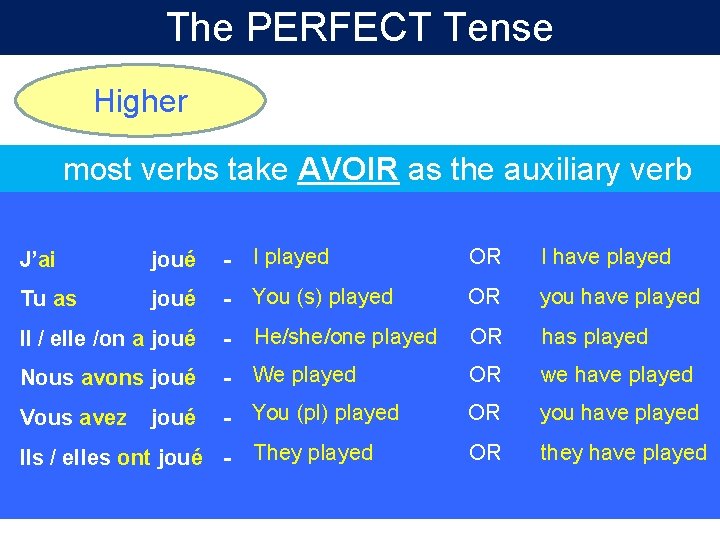
The PERFECT Tense To gain more marks, you need to be able to talk about other people. Higher most verbs take AVOIR as the auxiliary verb J’ai joué - I played OR I have played Tu as joué - You (s) played OR you have played OR has played He/she/one played Il / elle /on a joué - Nous avons joué - We played OR we have played Vous avez - You (pl) played OR you have played They played OR they have played joué Ils / elles ont joué -
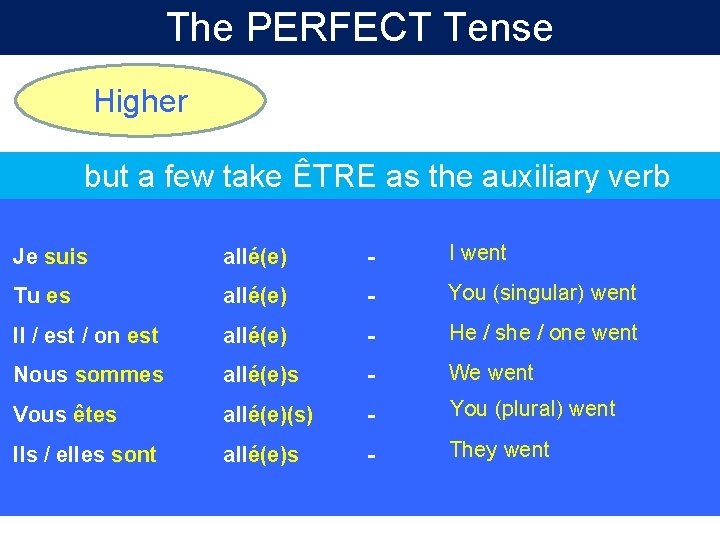
The PERFECT Tense Higher To gain more marks, you need to be able to talk about other people. but a few take ÊTRE as the auxiliary verb Je suis allé(e) - I went Tu es allé(e) - You (singular) went Il / est / on est allé(e) - He / she / one went Nous sommes allé(e)s - We went Vous êtes allé(e)(s) - You (plural) went Ils / elles sont allé(e)s - They went
AVOIR or ÊTRE?
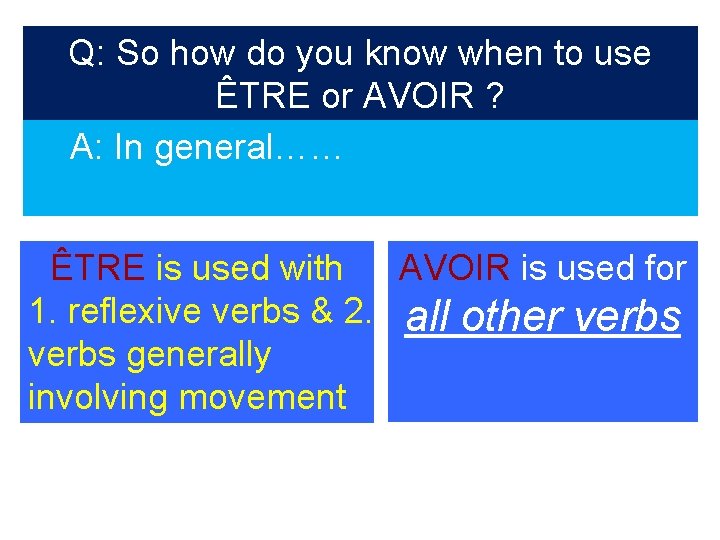
Q: So how do you know when to use ÊTRE or AVOIR ? A: In general…… ÊTRE is used with AVOIR is used for 1. reflexive verbs & 2. all other verbs generally involving movement
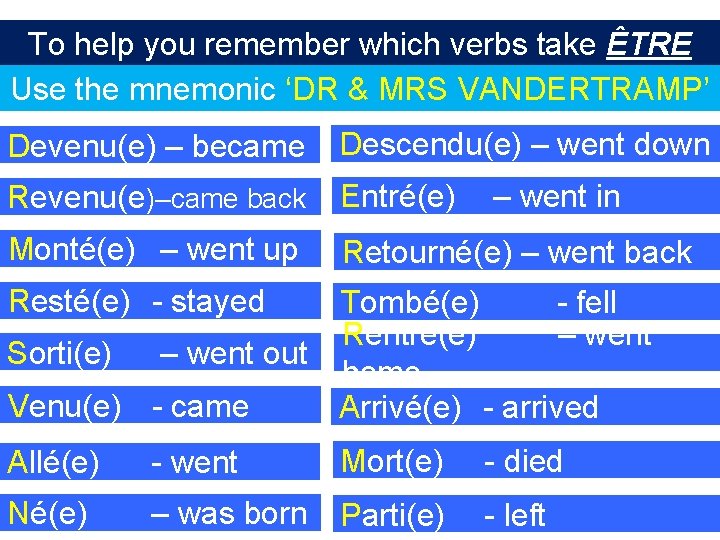
To help you remember which verbs take ÊTRE Use the mnemonic ‘DR & MRS VANDERTRAMP’ Devenu(e) – became Descendu(e) – went down Revenu(e)–came back Entré(e) Monté(e) – went up Retourné(e) – went back – went in Resté(e) - stayed Tombé(e) - fell Rentré(e) – went Sorti(e) – went out home Venu(e) - came Arrivé(e) - arrived Allé(e) - went Mort(e) - died Né(e) – was born Parti(e) - left
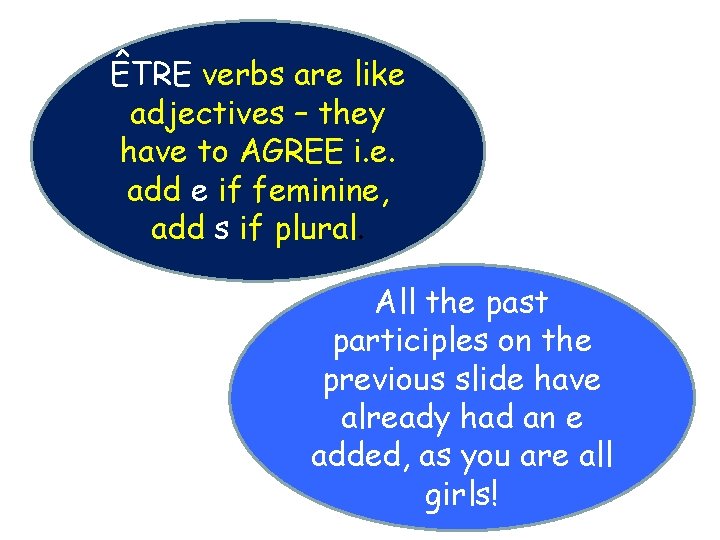
ÊTRE verbs are like adjectives – they have to AGREE i. e. add e if feminine, add s if plural. All the past participles on the previous slide have already had an e added, as you are all girls!
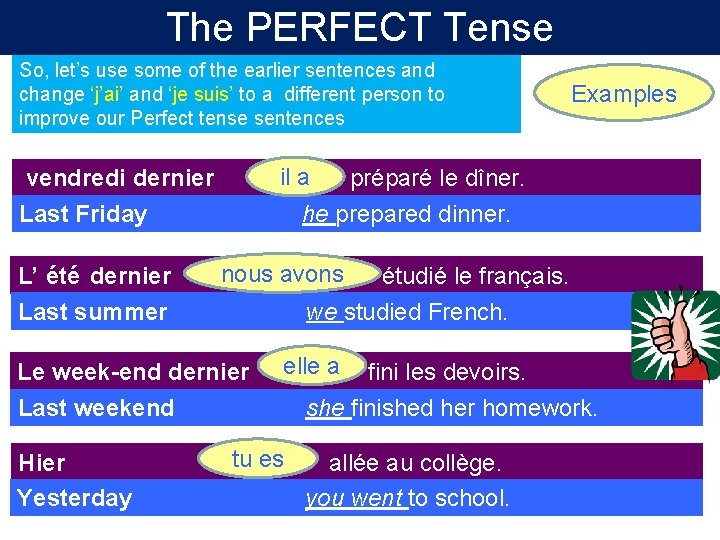
The PERFECT Tense So, let’s use some of the earlier sentences and change ‘j’ai’ and ‘je suis’ to a different person to improve our Perfect tense sentences il aj’ai préparé le dîner. he prepared dinner. vendredi dernier Last Friday L’ été dernier Last summer nous avonsj’ai étudié le français. we studied French. Le week-end dernier Last weekend Hier Yesterday Examples elle j’aia fini les devoirs. she finished her homework. tujees suis allée au collège. you went to school.
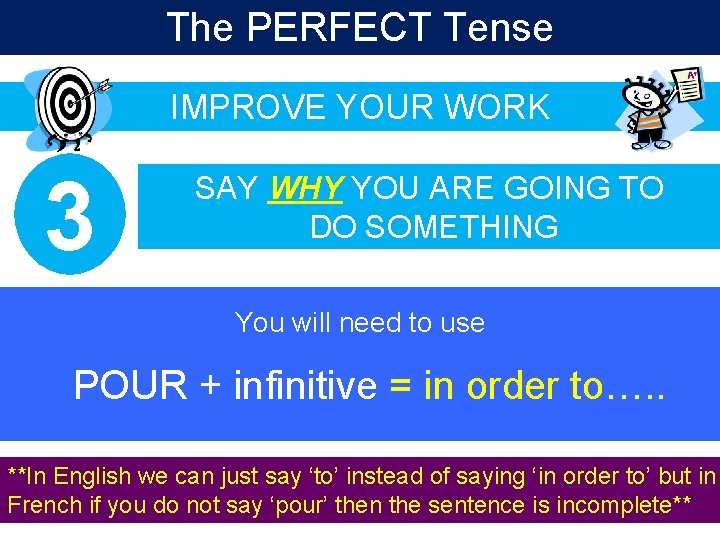
The PERFECT Tense IMPROVE YOUR WORK 3 SAY WHY YOU ARE GOING TO DO SOMETHING You will need to use POUR + infinitive = in order to…. . **In English we can just say ‘to’ instead of saying ‘in order to’ but in French if you do not say ‘pour’ then the sentence is incomplete**
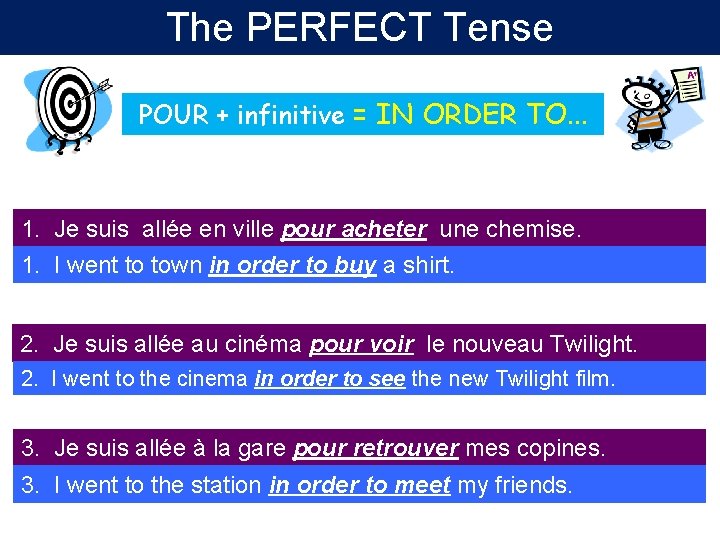
The PERFECT Tense IMPROVE YOUR POUR + infinitive = INLANGUAGE ORDER TO. . . 1. Je suis allée en ville pour acheter une chemise. 1. I went to town in order to buy a shirt. 2. Je suis allée au cinéma pour voir le nouveau Twilight. 2. I went to the cinema in order to see the new Twilight film. 3. Je suis allée à la gare pour retrouver mes copines. 3. I went to the station in order to meet my friends.
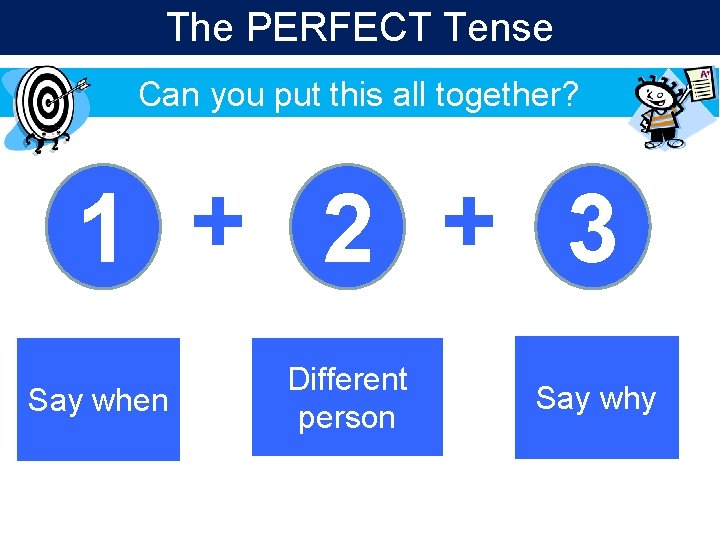
The PERFECT Tense Can you put this all together? 1 + 2 + 3 Say when Different person Say why To make a HIGHER LEVEL sentence
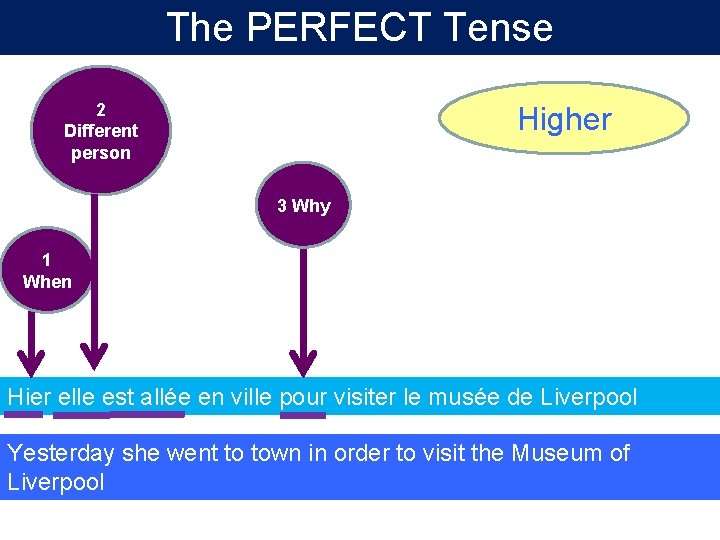
The PERFECT Tense 2 Different person Higher 3 Why 1 When Hier elle est allée en ville pour visiter le musée de Liverpool Yesterday she went to town in order to visit the Museum of Liverpool
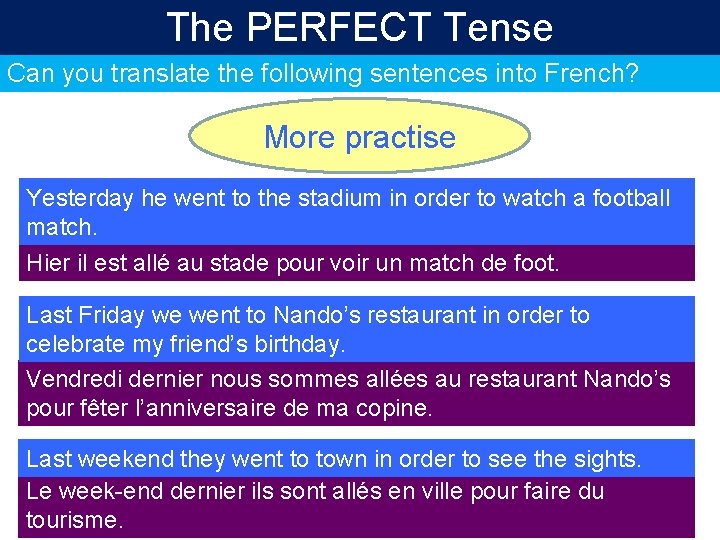
The PERFECT Tense Can you translate the following sentences into French? More practise Yesterday he went to the stadium in order to watch a football match. Hier il est allé au stade pour voir un match de foot. Last Friday we went to Nando’s restaurant in order to celebrate my friend’s birthday. Vendredi dernier nous sommes allées au restaurant Nando’s pour fêter l’anniversaire de ma copine. Last weekend they went to town in order to see the sights. Le week-end dernier ils sont allés en ville pour faire du tourisme.
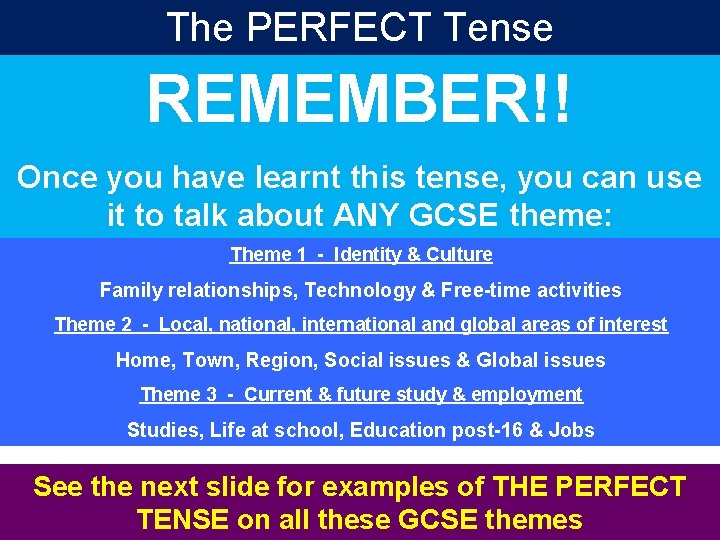
The PERFECT Tense REMEMBER!! Once you have learnt this tense, you can use it to talk about ANY GCSE theme: Theme 1 - Identity & Culture Family relationships, Technology & Free-time activities Theme 2 - Local, national, international and global areas of interest Home, Town, Region, Social issues & Global issues Theme 3 - Current & future study & employment Studies, Life at school, Education post-16 & Jobs See the next slide for examples of THE PERFECT TENSE on all these GCSE themes
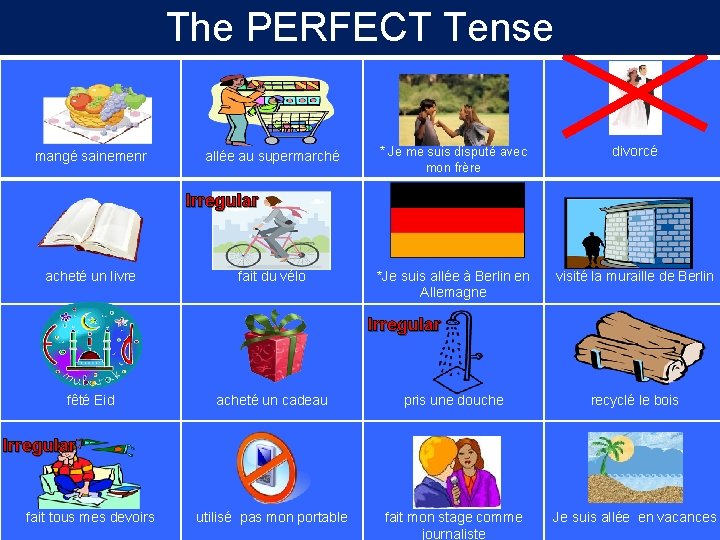
The PERFECT Tense mangé sainemenr allée au supermarché * Je me suis disputé avec mon frère divorcé *Je suis allée à Berlin en Allemagne visité la muraille de Berlin Irregular acheté un livre fait du vélo Irregular fêté Eid acheté un cadeau pris une douche recyclé le bois utilisé pas mon portable fait mon stage comme journaliste Je suis allée en vacances Irregular fait tous mes devoirs
The PERFECT Tense QUICK QUIZ How much have you remembered ?
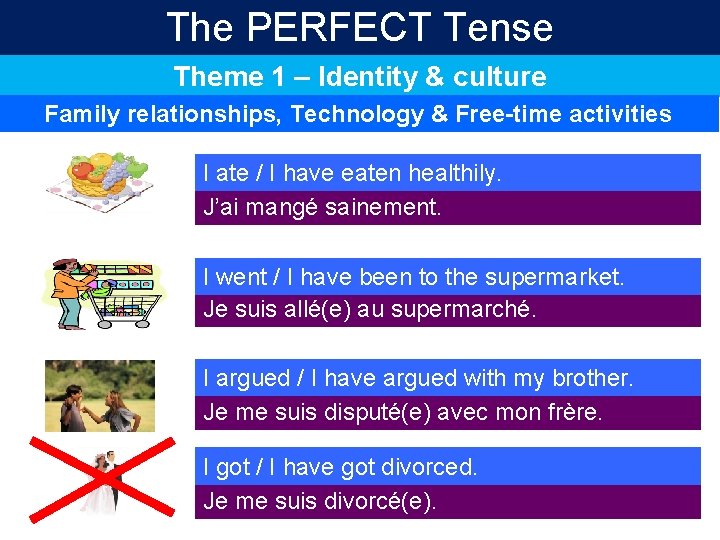
The PERFECT Tense Theme 1 – Identity & culture Family relationships, Technology & Free-time activities I ate / I have eaten healthily. J’ai mangé sainement. I went / I have been to the supermarket. Je suis allé(e) au supermarché. I argued / I have argued with my brother. Je me suis disputé(e) avec mon frère. I got / I have got divorced. Je me suis divorcé(e).

The PERFECT Tense Theme 2 – Local, national, international & global areas of interest Home, Town, Region, Social issues & Global issues I celebrated / have celebrated Eid. J’ai fêté Aïd. I bought / have bought a gift. J’ai acheté un cadeau. I took / have taken a shower. J’ai pris une douche. I recycled / have recycled wood. J’ai recyclé le bois. Irregular
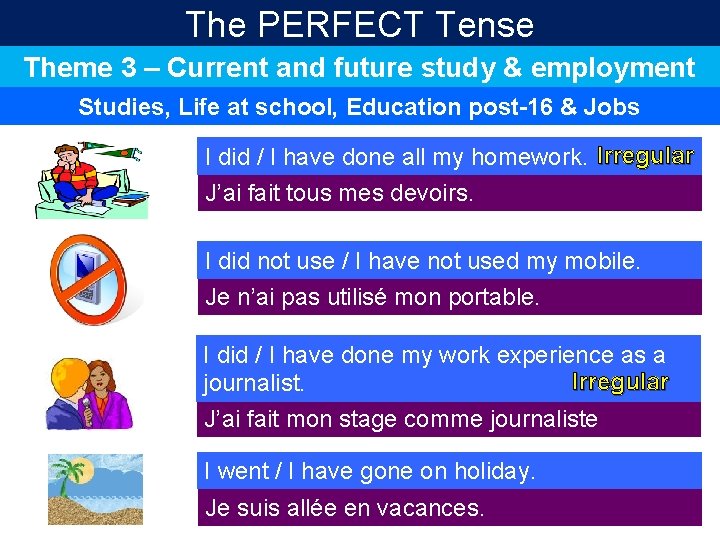
The PERFECT Tense Theme 3 – Current and future study & employment Studies, Life at school, Education post-16 & Jobs I did / I have done all my homework. Irregular J’ai fait tous mes devoirs. I did not use / I have not used my mobile. Je n’ai pas utilisé mon portable. I did / I have done my work experience as a Irregular journalist. J’ai fait mon stage comme journaliste I went / I have gone on holiday. Je suis allée en vacances.
The PERFECT Tense Now it’s YOUR turn
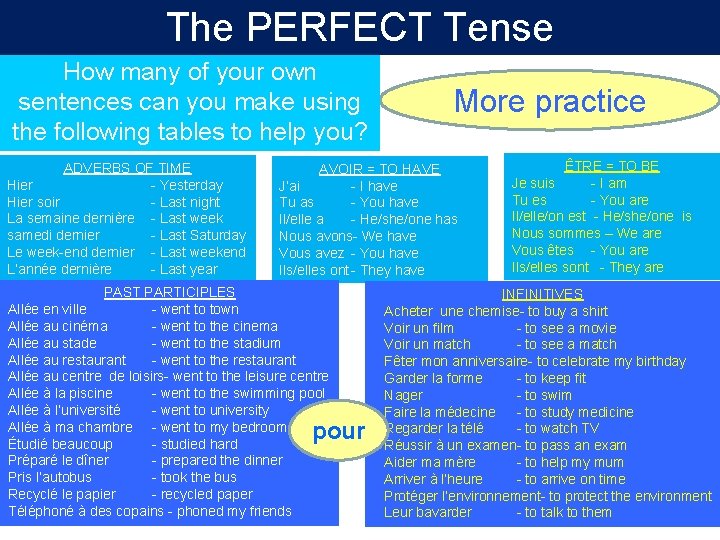
The PERFECT Tense How many of your own sentences can you make using the following tables to help you? ADVERBS OF TIME Hier - Yesterday Hier soir - Last night La semaine dernière - Last week samedi dernier - Last Saturday Le week-end dernier - Last weekend L’année dernière - Last year More practice AVOIR = TO HAVE J’ai - I have Tu as - You have Il/elle a - He/she/one has Nous avons- We have Vous avez - You have Ils/elles ont - They have PAST PARTICIPLES Allée en ville - went to town Allée au cinéma - went to the cinema Allée au stade - went to the stadium Allée au restaurant - went to the restaurant Allée au centre de loisirs- went to the leisure centre Allée à la piscine - went to the swimming pool Allée à l’université - went to university Allée à ma chambre - went to my bedroom Étudié beaucoup - studied hard Préparé le dîner - prepared the dinner Pris l’autobus - took the bus Recyclé le papier - recycled paper Téléphoné à des copains - phoned my friends pour ÊTRE = TO BE Je suis - I am Tu es - You are Il/elle/on est - He/she/one is Nous sommes – We are Vous êtes - You are Ils/elles sont - They are INFINITIVES Acheter une chemise- to buy a shirt Voir un film - to see a movie Voir un match - to see a match Fêter mon anniversaire- to celebrate my birthday Garder la forme - to keep fit Nager - to swim Faire la médecine - to study medicine Regarder la télé - to watch TV Réussir à un examen- to pass an exam Aider ma mère - to help my mum Arriver à l’heure - to arrive on time Protéger l’environnement- to protect the environment Leur bavarder - to talk to them
BONNE CHANCE
- Slides: 30