
The Perception of Distance in Simulated Visual Displays


- Slides: 32
“The Perception of Distance in Simulated Visual Displays: A Comparison of the Effectiveness and Accuracy of Multiple Depth Cues Across Viewing Distances” R. Troy Surdick, Elizabeth T. Davis, Robert A. King, Larry F. Hodges Presence, Vol 6. , No. 5, October 1997, 513 -531. Presentation: Revision 1. 0 © Dr. Zachary Wartell 3/23/2005 1
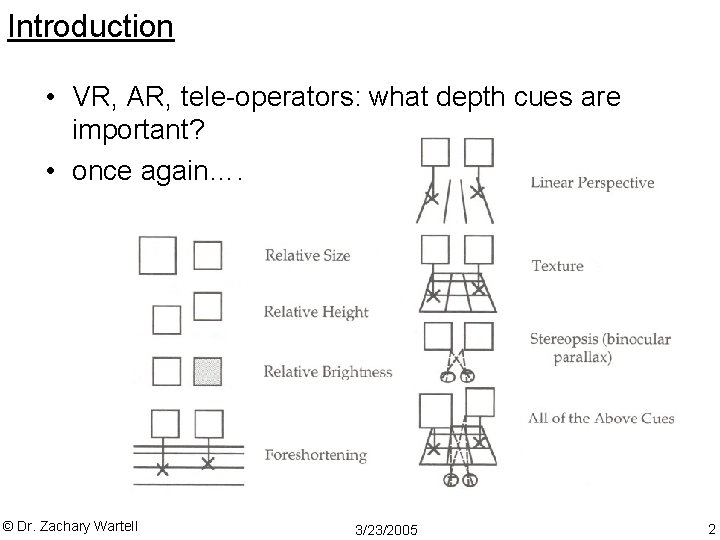
Introduction • VR, AR, tele-operators: what depth cues are important? • once again…. © Dr. Zachary Wartell 3/23/2005 2
Definitions • effective depth cue – “requires only small change in depth to produce perceptible change in perceived distance” • accurate depth cue – “requires that two equidistant objects are perceived to be at the same distance” © Dr. Zachary Wartell 3/23/2005 3
Prior Work • lot’s of © Dr. Zachary Wartell 3/23/2005 4
Prior Work (1) © Dr. Zachary Wartell 3/23/2005 5
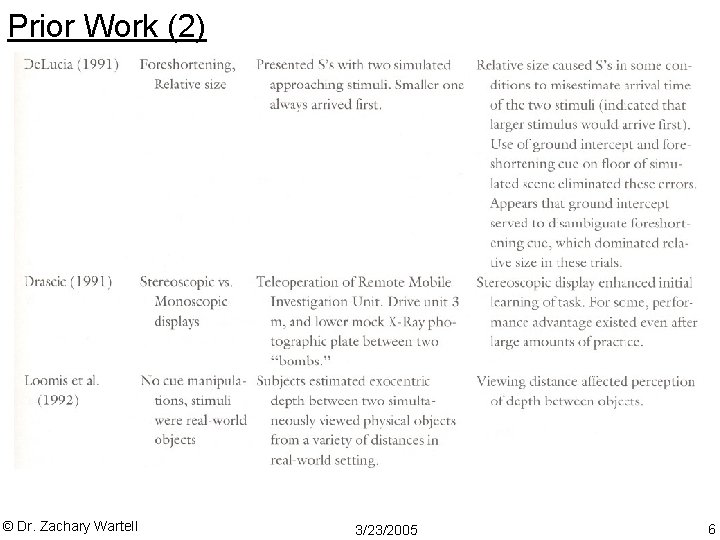
Prior Work (2) © Dr. Zachary Wartell 3/23/2005 6
Prior Work (3) © Dr. Zachary Wartell 3/23/2005 7
Experiment 1: Variables • IV: vary distance 1 m or 2 m • IV: depth cues – {foreshortening, linear perspective, texture gradiant, stereopsis, relative brightness, relative height, relative size, all} • DV: ability to perceive and compare relative distances of two sequentially presented stimuli © Dr. Zachary Wartell 3/23/2005 8
Experiment 1: Hypotheses • 1) perspective cues & stereopsis maybe most effective • 2) stereopsis, relative brightness and relative size less effective farther away • 3) condition with all depth cues should be most effective • 4) at 1 m, perspective cues, all-cues, and stereopsis should each be more effective than rel. brightness, rel. height, rel. size • 5) at 2 m perspective cues, all-cues should be better than stereopsis, rel. brightness, rel. height, rel. size • 6) at 2 m there should be more differences in effectiveness of cues than at 1 m, but accuracies should not change © Dr. Zachary Wartell 3/23/2005 9
Experiment 1: Method • • 10 subjects 6 -7 session/sub. , 2 hr/session 12 -14 hr/sub. Total sub’s have normal or correct eye sight and able to see RDS © Dr. Zachary Wartell 3/23/2005 10
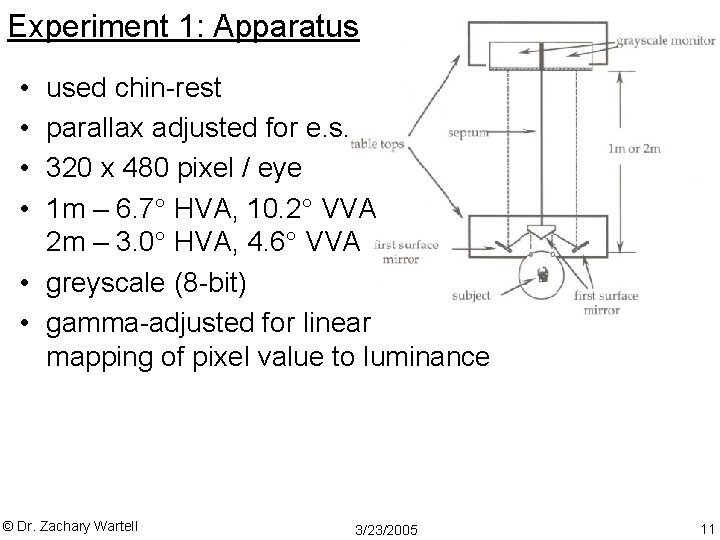
Experiment 1: Apparatus • • used chin-rest parallax adjusted for e. s. 320 x 480 pixel / eye 1 m – 6. 7 HVA, 10. 2 VVA 2 m – 3. 0 HVA, 4. 6 VVA • greyscale (8 -bit) • gamma-adjusted for linear mapping of pixel value to luminance © Dr. Zachary Wartell 3/23/2005 11
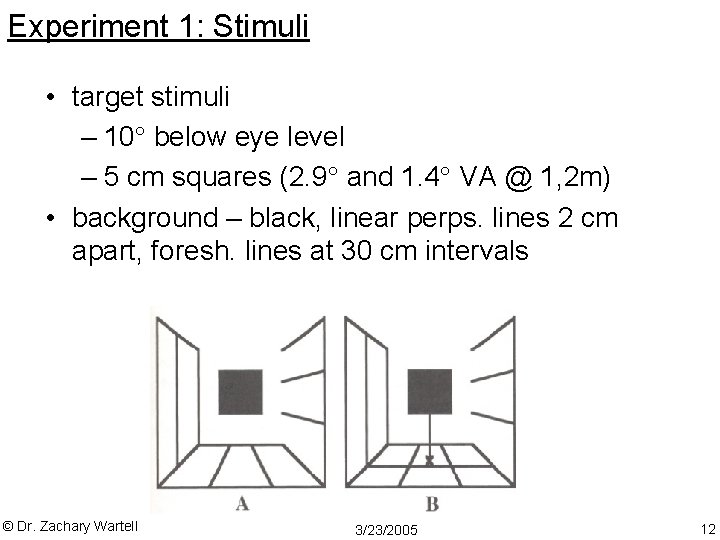
Experiment 1: Stimuli • target stimuli – 10 below eye level – 5 cm squares (2. 9 and 1. 4 VA @ 1, 2 m) • background – black, linear perps. lines 2 cm apart, foresh. lines at 30 cm intervals © Dr. Zachary Wartell 3/23/2005 12
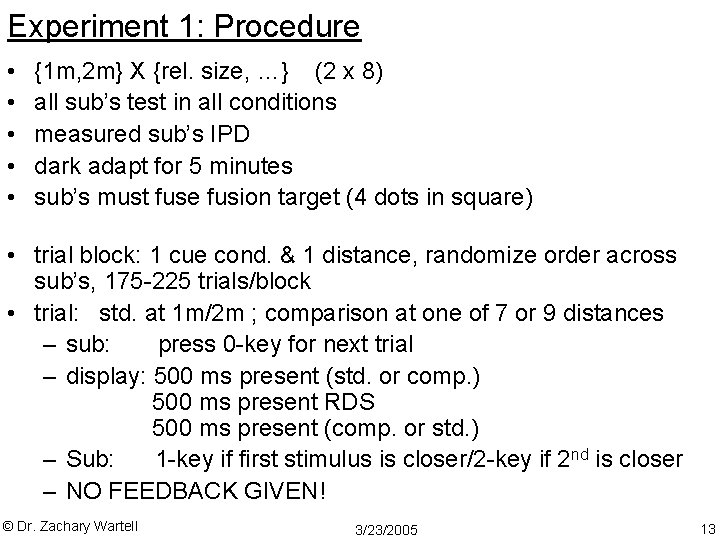
Experiment 1: Procedure • • • {1 m, 2 m} X {rel. size, …} (2 x 8) all sub’s test in all conditions measured sub’s IPD dark adapt for 5 minutes sub’s must fuse fusion target (4 dots in square) • trial block: 1 cue cond. & 1 distance, randomize order across sub’s, 175 -225 trials/block • trial: std. at 1 m/2 m ; comparison at one of 7 or 9 distances – sub: press 0 -key for next trial – display: 500 ms present (std. or comp. ) 500 ms present RDS 500 ms present (comp. or std. ) – Sub: 1 -key if first stimulus is closer/2 -key if 2 nd is closer – NO FEEDBACK GIVEN! © Dr. Zachary Wartell 3/23/2005 13
Practice Trials • pilot study to determine distance range for each depth-cue/view-distance combination • JND – “just noticable difference” • choose closest and farthest stimuli such that they’re correctly perceived > 75% of time • in practice trial range is adjusted if particular sub. performance varies too much from pilot study results © Dr. Zachary Wartell 3/23/2005 14
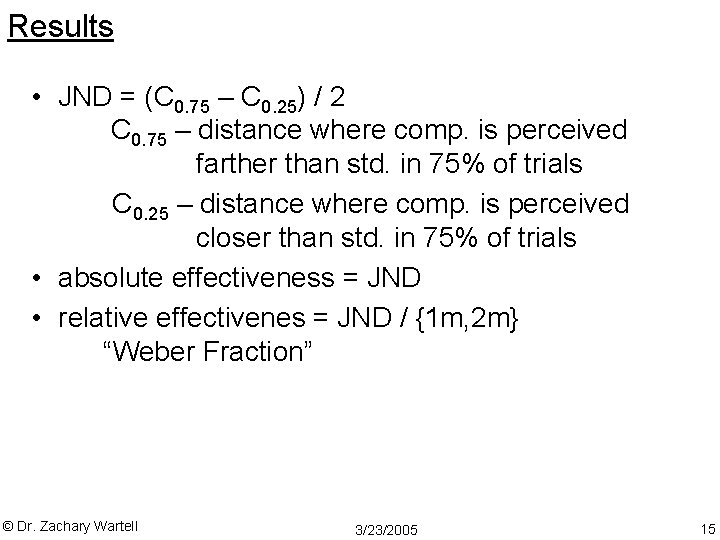
Results • JND = (C 0. 75 – C 0. 25) / 2 C 0. 75 – distance where comp. is perceived farther than std. in 75% of trials C 0. 25 – distance where comp. is perceived closer than std. in 75% of trials • absolute effectiveness = JND • relative effectivenes = JND / {1 m, 2 m} “Weber Fraction” © Dr. Zachary Wartell 3/23/2005 15
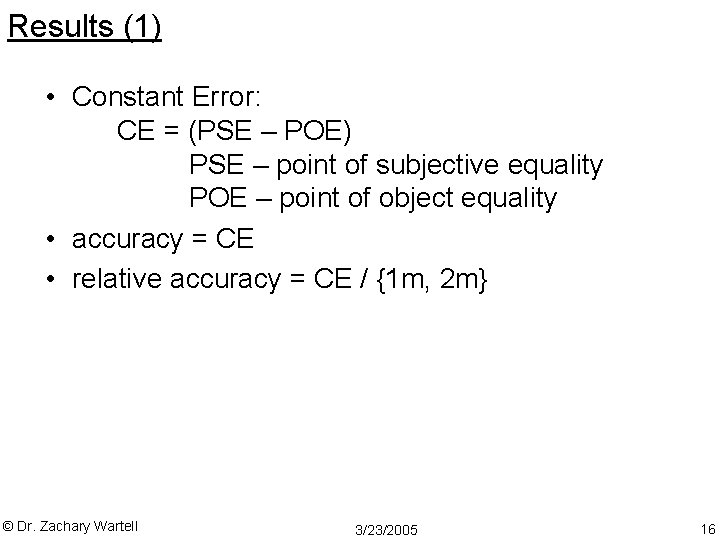
Results (1) • Constant Error: CE = (PSE – POE) PSE – point of subjective equality POE – point of object equality • accuracy = CE • relative accuracy = CE / {1 m, 2 m} © Dr. Zachary Wartell 3/23/2005 16
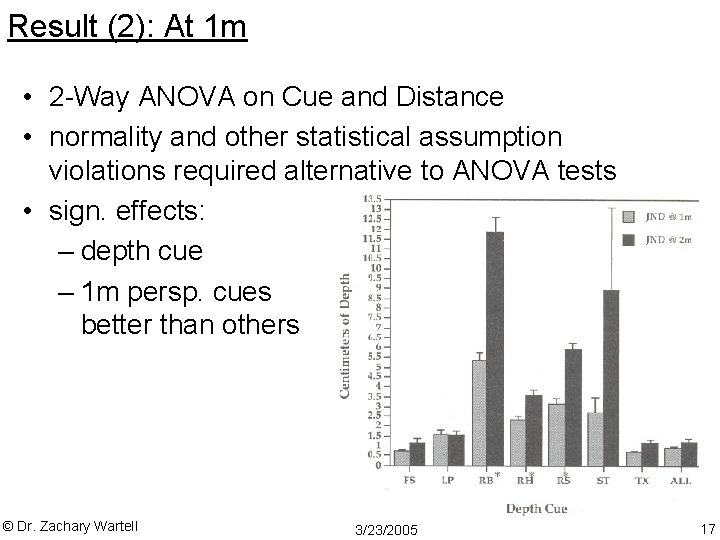
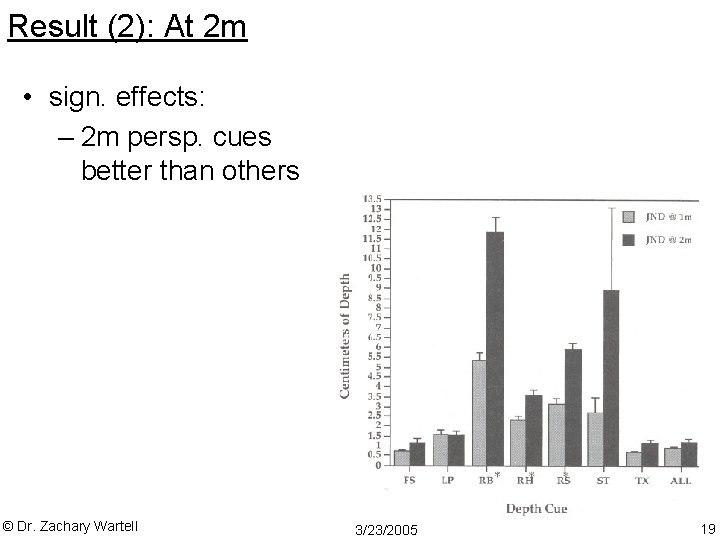
Result (2): At 1 m • 2 -Way ANOVA on Cue and Distance • normality and other statistical assumption violations required alternative to ANOVA tests • sign. effects: – depth cue – 1 m persp. cues better than others © Dr. Zachary Wartell 3/23/2005 17
Results (3): At 1 m • rel. brightness less effective than others • rel. height and size less effective than foresh. , lin. persp. , texture, and all-cues © Dr. Zachary Wartell 3/23/2005 18
Result (2): At 2 m • sign. effects: – 2 m persp. cues better than others © Dr. Zachary Wartell 3/23/2005 19
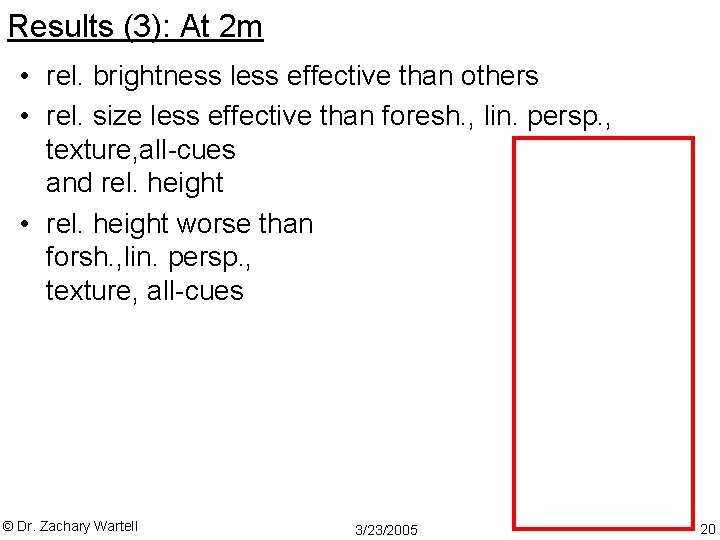
Results (3): At 2 m • rel. brightness less effective than others • rel. size less effective than foresh. , lin. persp. , texture, all-cues and rel. height • rel. height worse than forsh. , lin. persp. , texture, all-cues © Dr. Zachary Wartell 3/23/2005 20
Results (4): Effectiveness Across Distance • main of dist. and interaction of dist. and cue are significant – due to changes in absolute effectiveness of some conditions (not all) • pair-wise tests indicate: – rel. brightness, rel. size, rel. height each decreased in abs. effectiveness with dist. – (not true for persp. cues and all-cues) – no change in relative effectiveness for any cue © Dr. Zachary Wartell 3/23/2005 21
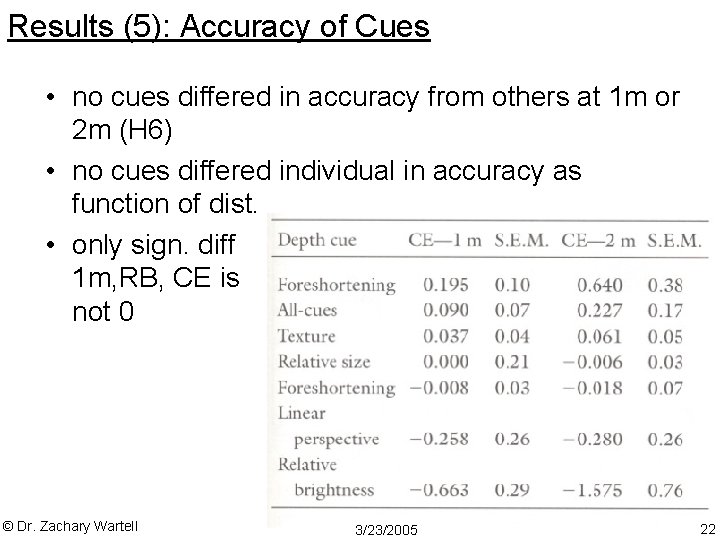
Results (5): Accuracy of Cues • no cues differed in accuracy from others at 1 m or 2 m (H 6) • no cues differed individual in accuracy as function of dist. • only sign. diff 1 m, RB, CE is not 0 © Dr. Zachary Wartell 3/23/2005 22
Discussion • sub’s consistently perceive stimuli at simulated distances • persp. cues with ground intercepts more effective than others at both distance – agrees with prior work and theory • abs. effectiveness of RB & RS decrease with dist. – both agree with expectations • all-cues not most effective! (but = persp. cues) – ceiling effect – maybe sub’s only attended to one cue © Dr. Zachary Wartell 3/23/2005 23
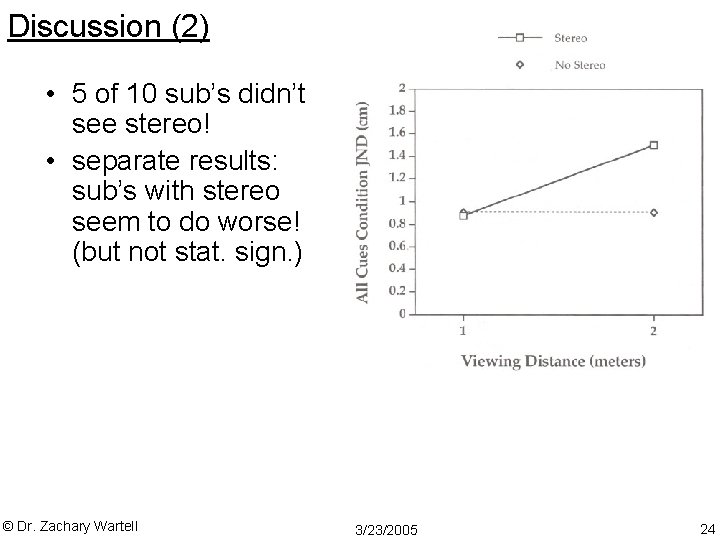
Discussion (2) • 5 of 10 sub’s didn’t see stereo! • separate results: sub’s with stereo seem to do worse! (but not stat. sign. ) © Dr. Zachary Wartell 3/23/2005 24
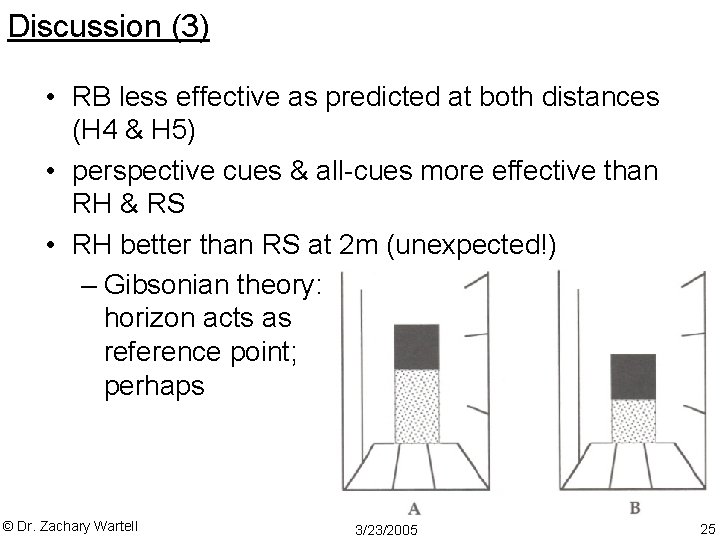
Discussion (3) • RB less effective as predicted at both distances (H 4 & H 5) • perspective cues & all-cues more effective than RH & RS • RH better than RS at 2 m (unexpected!) – Gibsonian theory: horizon acts as reference point; perhaps © Dr. Zachary Wartell 3/23/2005 25
Experiment 2: Motivation • 5 of 10 sub’s appear to get no stereopsis in display! Why? – ? lack of practice – but stereo-anomalous sub’s got extra practice trials (140 -270) during stage of determining each sub’s range of comparison stimuli – ? short viewing duration – prior work suggests too short viewing doesn’t give brain enough time to process stereopsis, but longer viewing in this exp. would add confound of vergence – ? display mis-alignment – but often stereo-anomalous sub’s succeeded stereo-seeing sub’s & display was checked daily – ? lack of motivation – but sub’s new they could only move to next set of trials after reaching certain performance criterion on current block – ? acc. /verg. mismatch – verg. at ∞, acc. at 1 m/2 m, but all sub’s had same situation and 5 sub’s did see stereo © Dr. Zachary Wartell 3/23/2005 26
Experiment 2: Idea • Prior work indicates sub’s may be trainable on stereo displays using smaller modeled e. s. – Does this work with Wheatstone stereoscope? – Can sub. be trained to see stereo? © Dr. Zachary Wartell 3/23/2005 27
Exp. 2: Method • Subjects: 1 stereo-anomalous sub’s from exp. 1 • Apparatus / Stimuli: – like exp. 1 but stereopsis cue only, distance = 1 m – modeled. e. s. = {1/4, 1/2, 3/4} * true e. s. • Method: – 1 block has 10 trials at 5 comparison distances. – experimenter adjusts m. e. s. and viewing duration © Dr. Zachary Wartell 3/23/2005 28
Exp. 2: Results © Dr. Zachary Wartell 3/23/2005 29
Exp. 2: Discussion • demonstrates previously stereo-anomalous sub. trained to see stereo • ramification: for binocular VR/AR systems certain users need to be taught how to see stereo! • future work: – large sub. pool – how many stereo-anomalous sub’s can be so trained? – what is optimum training method – trade-off of view dur. versus fraction of m. e. s. – develop training protocol © Dr. Zachary Wartell 3/23/2005 30
General Conclusions • effectiveness of persp. cues w/ ground intercepts superior to others at all distances • effectiveness of rel. bright. vastly interior • rel. bright. , rel. height, rel. size, decrease effectiveness with distance • no depth cues differ in accuracy • 5/10 sub’s stereo-anomalous but all other depth cues have no perception problems • cost-effectiveness (circa 1997): foreshortening and ground intercepts may give adequate depth perception, but beware of screen clutter & and exact eye-level views! • all-cues condition not better than just persp. cues • Rel. brightness least effective • some sub’s can’t see stereo in Wheatstone viewer, but can be trained © Dr. Zachary Wartell 3/23/2005 31
Thoughts? Questions? Concerns? • Wheatstone stereoscopic – vergence at ∞, accommodation at {1 m, 2 m} for 0 screen. parallax • LCD Glasses + CRT – vergence = accommodation at 75 cm for 0 screen. Parallax • What about Titmus stereo screen and random dot stereograms? Where was vergence in these systems used to test sub’s for stereo vision? © Dr. Zachary Wartell 3/23/2005 32