
The pentaquark case stateoftheart Sonia Kabana University of
The pentaquark case: state-of-the-art Sonia Kabana University of Nantes and Subatech, Nantes, France MESON 2006, 12 June 2006, Krakow Contents I Introduction II Review of pentaquark candidates observed: +, ++, 0 c, --, 0, N 0/ 0 I=1/2, Sigma vis non-observations and theory III Conclusions and outlook 1
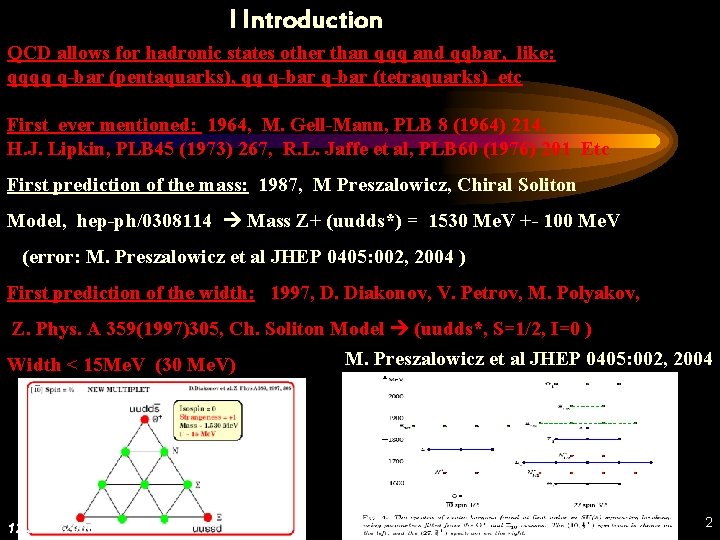
I Introduction QCD allows for hadronic states other than qqq and qqbar, like: qqqq q-bar (pentaquarks), qq q-bar (tetraquarks) etc First ever mentioned: 1964, M. Gell-Mann, PLB 8 (1964) 214. H. J. Lipkin, PLB 45 (1973) 267, R. L. Jaffe et al, PLB 60 (1976) 201 Etc First prediction of the mass: 1987, M Preszalowicz, Chiral Soliton Model, hep-ph/0308114 Mass Z+ (uudds*) = 1530 Me. V +- 100 Me. V (error: M. Preszalowicz et al JHEP 0405: 002, 2004 ) First prediction of the width: 1997, D. Diakonov, V. Petrov, M. Polyakov, Z. Phys. A 359(1997)305, Ch. Soliton Model (uudds*, S=1/2, I=0 ) Width < 15 Me. V (30 Me. V) 12 June 2006 M. Preszalowicz et al JHEP 0405: 002, 2004 2
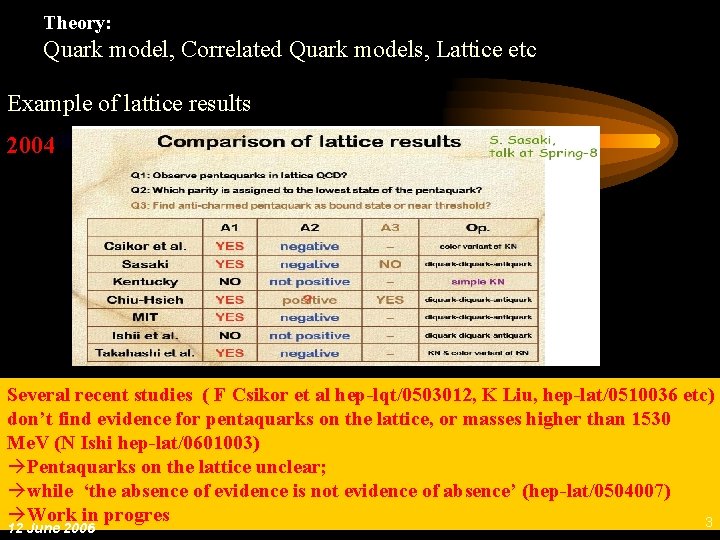
Theory: Quark model, Correlated Quark models, Lattice etc Example of lattice results 2004 Several recent studies ( F Csikor et al hep-lqt/0503012, K Liu, hep-lat/0510036 etc) don’t find evidence for pentaquarks on the lattice, or masses higher than 1530 Me. V (N Ishi hep-lat/0601003) Pentaquarks on the lattice unclear; while ‘the absence of evidence is not evidence of absence’ (hep-lat/0504007) Work in progres 3 12 June 2006
II Review of pentaquark candidates observed +, ++, 0 c, --, 0, N 0/ 0 I=1/2, S 12 June 2006 4
+ uudd sbar 12 June 2006 5
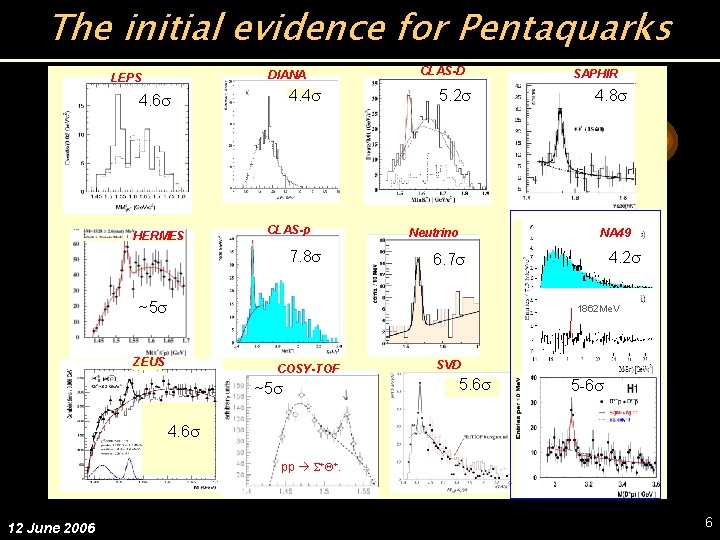
The initial evidence for Pentaquarks DIANA LEPS 4. 4 4. 6 HERMES CLAS-p 7. 8 CLAS-D 5. 2 Neutrino SAPHIR 4. 8 NA 49 6. 7 4. 2 6. 7 ~5 1862 Me. V ZEUS COSY-TOF ~5 SVD 5. 6 5 -6 4. 6 pp S+Q+. 12 June 2006 6
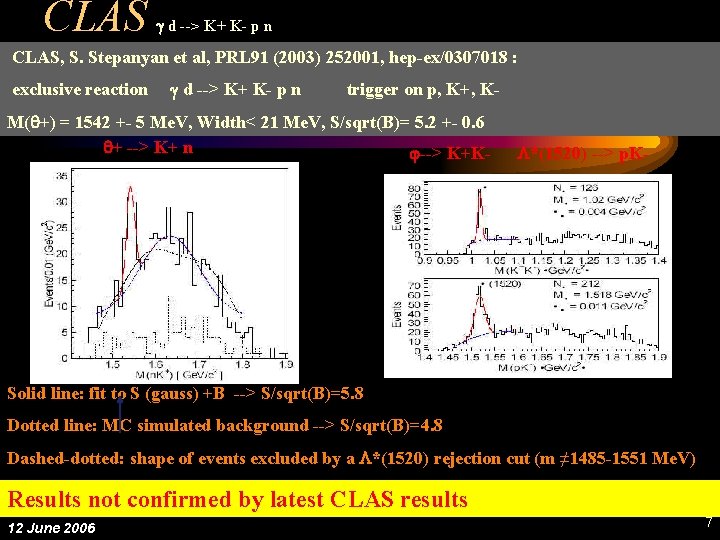
CLAS d --> K+ K- p n CLAS, S. Stepanyan et al, PRL 91 (2003) 252001, hep-ex/0307018 : exclusive reaction d --> K+ K- p n trigger on p, K+, K- M( +) = 1542 +- 5 Me. V, Width< 21 Me. V, S/sqrt(B)= 5. 2 +- 0. 6 + --> K+ n --> K+K- *(1520) --> p. K- Solid line: fit to S (gauss) +B --> S/sqrt(B)=5. 8 Dotted line: MC simulated background --> S/sqrt(B)=4. 8 Dashed-dotted: shape of events excluded by a *(1520) rejection cut (m ≠ 1485 -1551 Me. V) Results not confirmed by latest CLAS results 12 June 2006 7
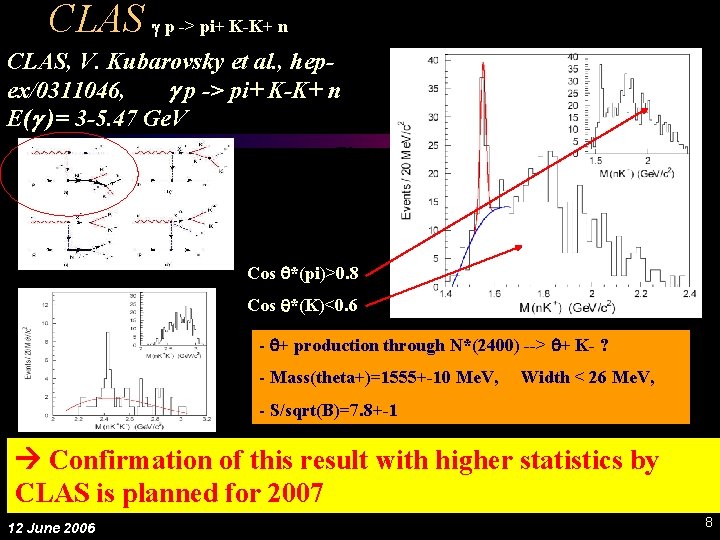
CLAS p -> pi+ K-K+ n CLAS, V. Kubarovsky et al. , hepex/0311046, p -> pi+ K-K+ n E( )= 3 -5. 47 Ge. V Pi+ + Cos *(pi)>0. 8 Cos *(K)<0. 6 - + production through N*(2400) --> + K- ? - Mass(theta+)=1555+-10 Me. V, Width < 26 Me. V, - S/sqrt(B)=7. 8+-1 Confirmation of this result with higher statistics by CLAS is planned for 2007 12 June 2006 8
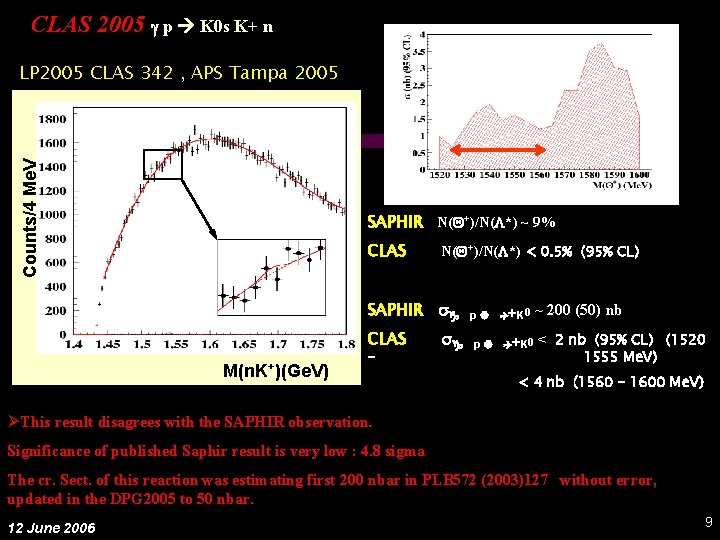
CLAS 2005 p K 0 s K+ n Counts/4 Me. V LP 2005 CLAS 342 , APS Tampa 2005 SAPHIR N(Q+)/N( *) ~ 9% M(n. K+)(Ge. V) CLAS N(Q+)/N( *) < 0. 5% (95% CL) SAPHIR g CLAS g - p Q+ K 0 ~ 200 (50) nb < 2 nb (95% CL) (1520 1555 Me. V) < 4 nb (1560 - 1600 Me. V) ØThis result disagrees with the SAPHIR observation. Significance of published Saphir result is very low : 4. 8 sigma The cr. Sect. of this reaction was estimating first 200 nbar in PLB 572 (2003)127 without error, updated in the DPG 2005 to 50 nbar. 12 June 2006 9
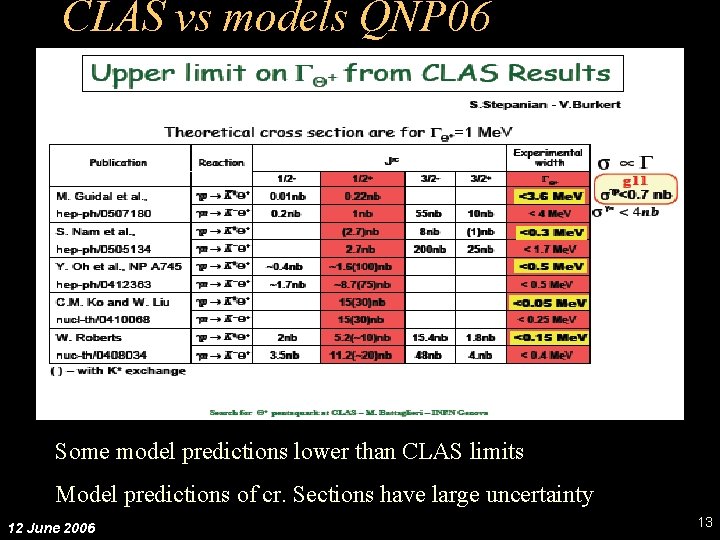
…. . CLAS p K 0 s K+ n vs theory ØThe reported non-observation in g p --> theta+ K 0 do not disagree with the previous CLAS results on p pi+ K+ K- n assuming N 0* -->theta+ KWhat cross section do we expect ? ØS. Nam et al, hep-ph/0403009 estimate 1 nbar for g p --> theta+ K 0 for J^P 1/2+ and a 4 times higher one for n --> theta+ K CLAS may not be sensitive enough for theta+ K 0 However: large uncertainty on theor. Predictions of cr sect. Ø Isospin asymetry leading to larger cross section for gamma n than gamma p channel : Nam, Hosaka and Kim, hep-ph/0505134 , Lipkin and Karliner, hep-ph/0506084 12 June 2006 10
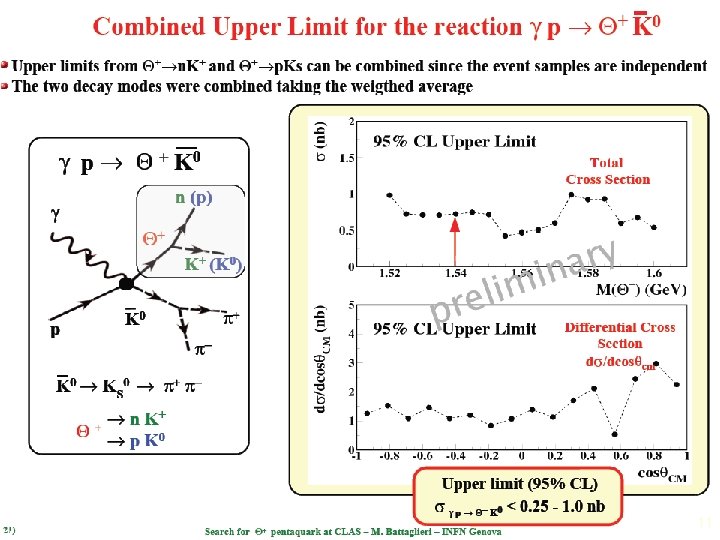
12 June 2006 11
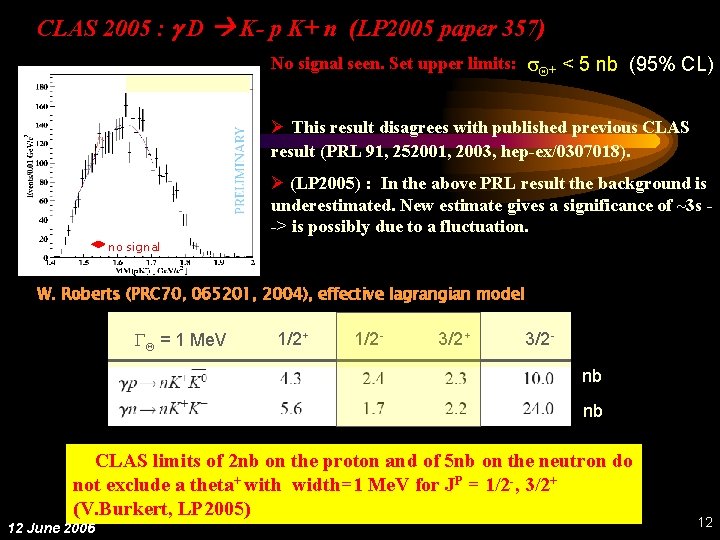
CLAS 2005 : D K- p K+ n (LP 2005 paper 357) No signal seen. Set upper limits: Q+ < 5 nb (95% CL) Ø This result disagrees with published previous CLAS result (PRL 91, 252001, 2003, hep-ex/0307018). Ø (LP 2005) : In the above PRL result the background is underestimated. New estimate gives a significance of ~3 s -> is possibly due to a fluctuation. no signal W. Roberts (PRC 70, 065201, 2004), effective lagrangian model GQ = 1 Me. V 1/2+ 1/2 - 3/2+ 3/2 nb nb Ø CLAS limits of 2 nb on the proton and of 5 nb on the neutron do not exclude a theta+ with width=1 Me. V for JP = 1/2 -, 3/2+ (V. Burkert, LP 2005) 12 June 2006 12
CLAS vs models QNP 06 Some model predictions lower than CLAS limits Model predictions of cr. Sections have large uncertainty 12 June 2006 13
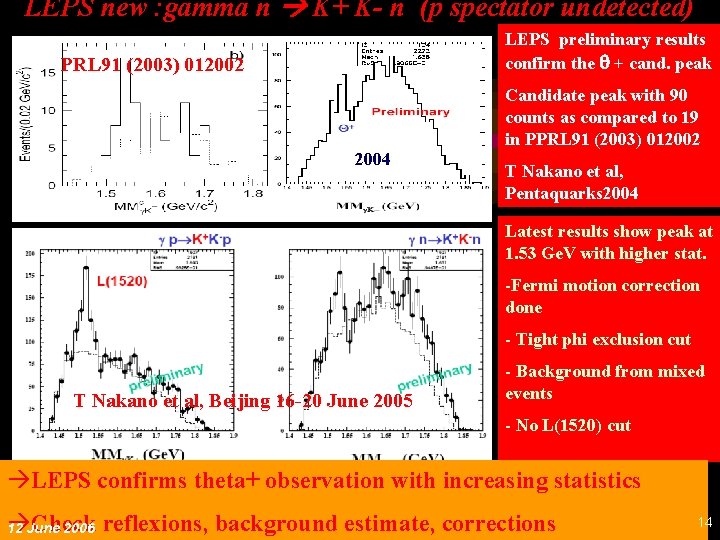
LEPS new : gamma n K+ K- n (p spectator undetected) LEPS preliminary results confirm the + cand. peak PRL 91 (2003) 012002 Candidate peak with 90 counts as compared to 19 in PPRL 91 (2003) 012002 2004 T Nakano et al, Pentaquarks 2004 Latest results show peak at 1. 53 Ge. V with higher stat. -Fermi motion correction done - Tight phi exclusion cut T Nakano et al, Beijing 16 -20 June 2005 - Background from mixed events - No L(1520) cut LEPS confirms theta+ observation with increasing statistics Check 12 June 2006 reflexions, background estimate, corrections 14
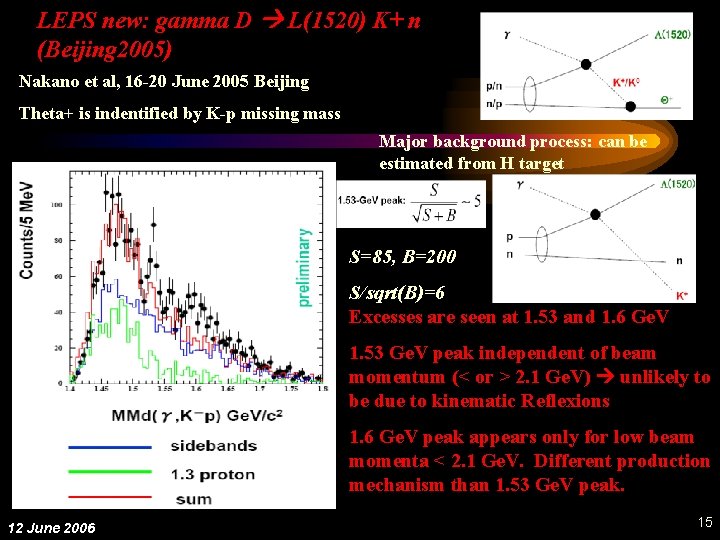
LEPS new: gamma D L(1520) K+ n (Beijing 2005) Nakano et al, 16 -20 June 2005 Beijing Theta+ is indentified by K-p missing mass Major background process: can be estimated from H target S=85, B=200 S/sqrt(B)=6 Excesses are seen at 1. 53 and 1. 6 Ge. V 1. 53 Ge. V peak independent of beam momentum (< or > 2. 1 Ge. V) unlikely to be due to kinematic Reflexions 1. 6 Ge. V peak appears only for low beam momenta < 2. 1 Ge. V. Different production mechanism than 1. 53 Ge. V peak. 12 June 2006 15
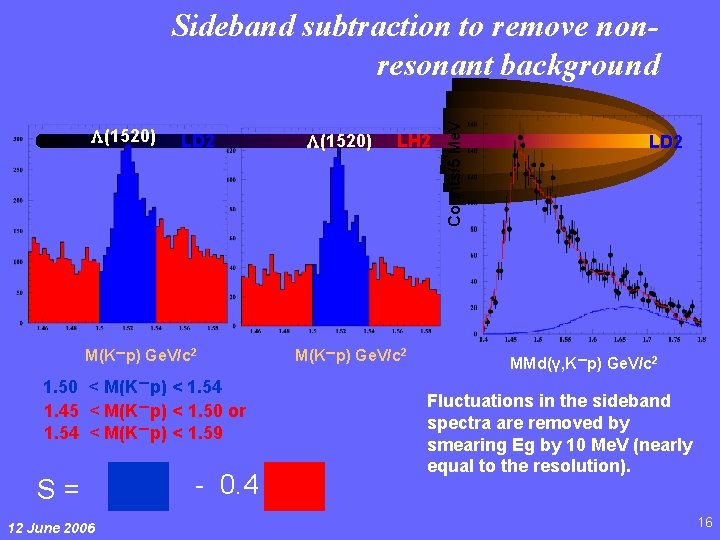
(1520) LD 2 M(K-p) Ge. V/c 2 1. 50 < M(K-p) < 1. 54 1. 45 < M(K-p) < 1. 50 or 1. 54 < M(K-p) < 1. 59 S= 12 June 2006 - 0. 4 (1520) LH 2 M(K-p) Ge. V/c 2 Counts/5 Me. V Sideband subtraction to remove nonresonant background LD 2 MMd(γ, K-p) Ge. V/c 2 Fluctuations in the sideband spectra are removed by smearing Eg by 10 Me. V (nearly equal to the resolution). 16
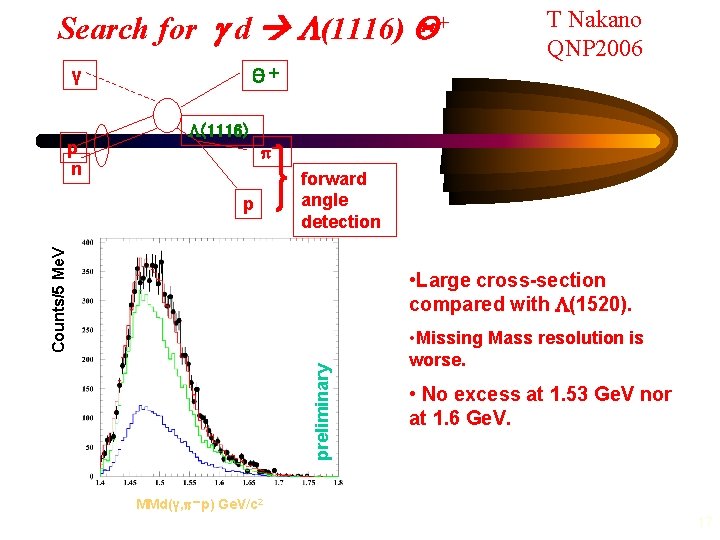
Search for d (1116) Q+ γ p n T Nakano QNP 2006 Θ+ (1116) p- Counts/5 Me. V p forward angle detection preliminary • Large cross-section compared with (1520). • Missing Mass resolution is worse. • No excess at 1. 53 Ge. V nor at 1. 6 Ge. V. MMd(γ, p-p) Ge. V/c 2 12 June 2006 17
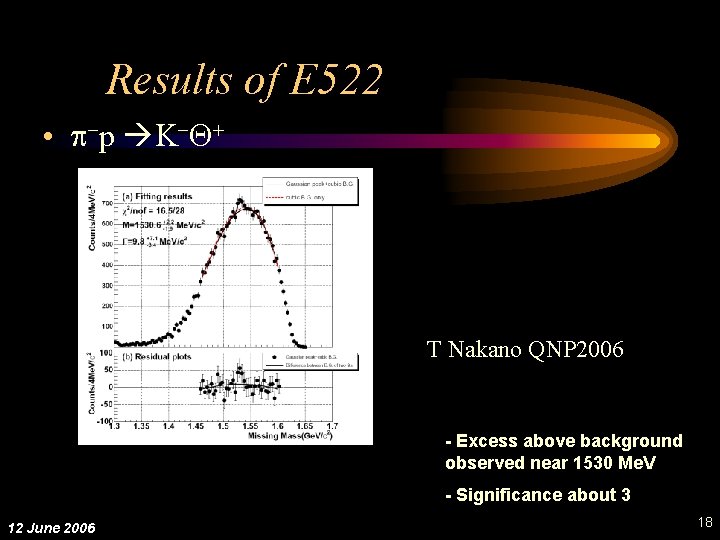
Results of E 522 • p-p K-Q+ T Nakano QNP 2006 - Excess above background observed near 1530 Me. V - Significance about 3 12 June 2006 18
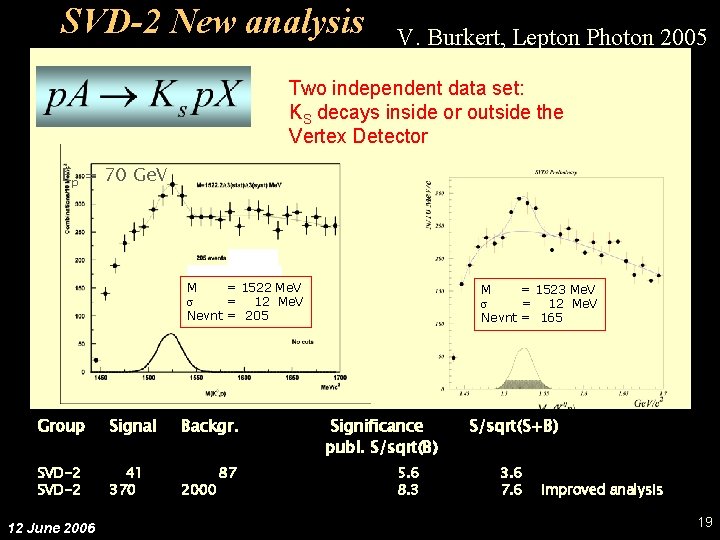
SVD-2 New analysis V. Burkert, Lepton Photon 2005 Two independent data set: KS decays inside or outside the Vertex Detector Ep = 70 Ge. V M = 1522 Me. V = 12 Me. V Nevnt = 205 Group Signal SVD-2 41 370 12 June 2006 Backgr. 2000 87 M = 1523 Me. V = 12 Me. V Nevnt = 165 Significance publ. S/sqrt(B) 5. 6 8. 3 S/sqrt(S+B) 3. 6 7. 6 Improved analysis 19
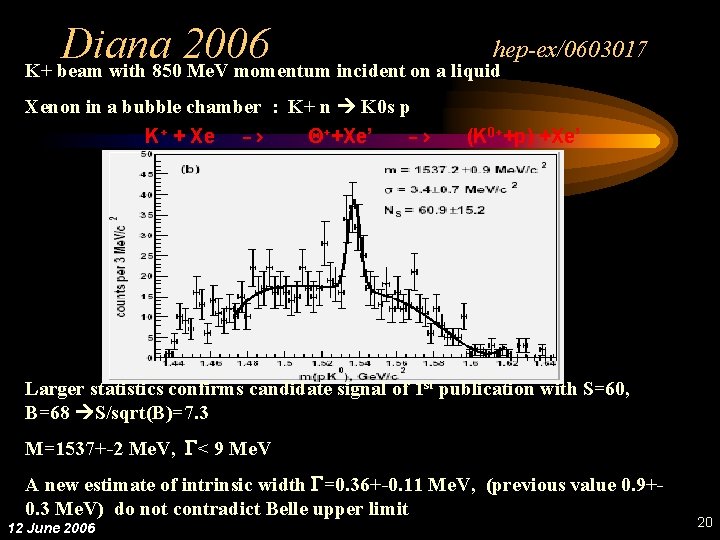
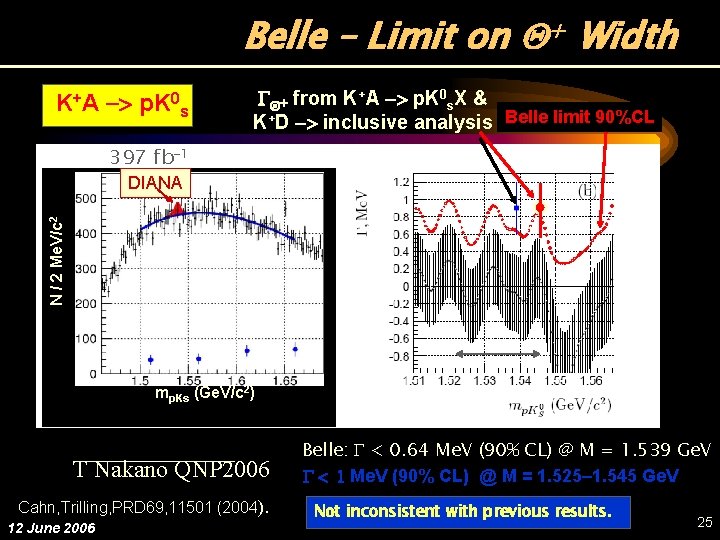
hep-ex/0603017 Diana 2006 K+ beam with 850 Me. V momentum incident on a liquid Xenon in a bubble chamber : K+ n K 0 s p K+ + Xe -> Q++Xe’ -> (K 0++p) +Xe’ Larger statistics confirms candidate signal of 1 st publication with S=60, B=68 S/sqrt(B)=7. 3 M=1537+-2 Me. V, < 9 Me. V A new estimate of intrinsic width =0. 36+-0. 11 Me. V, (previous value 0. 9+0. 3 Me. V) do not contradict Belle upper limit 12 June 2006 20
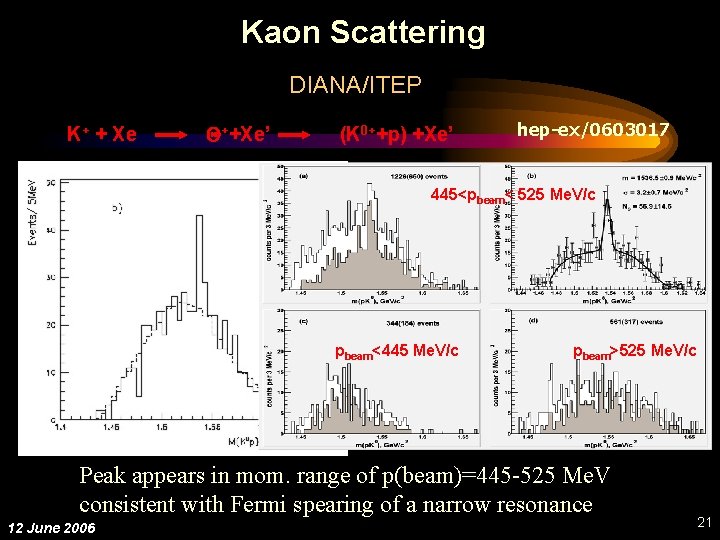
Kaon Scattering DIANA/ITEP K+ + Xe Q++Xe’ hep-ex/0603017 (K 0++p) +Xe’ 445<pbeam< 525 Me. V/c K+ n Q+ Total cross-section is proportional to the decay width pbeam<445 Me. V/c pbeam>525 Me. V/c More pictures were analyzed. Peak appears in mom. range of p(beam)=445 -525 Me. V consistent with Fermi spearing of a narrow resonance 12 June 2006 21
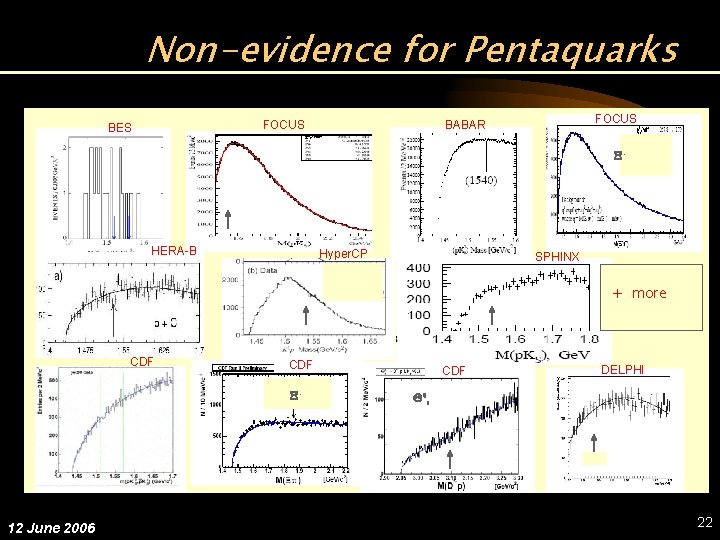
Non-evidence for Pentaquarks FOCUS BES FOCUS BABAR -- HERA-B Hyper. CP SPHINX + more CDF -- 12 June 2006 CDF DELPHI Q 0 c 22
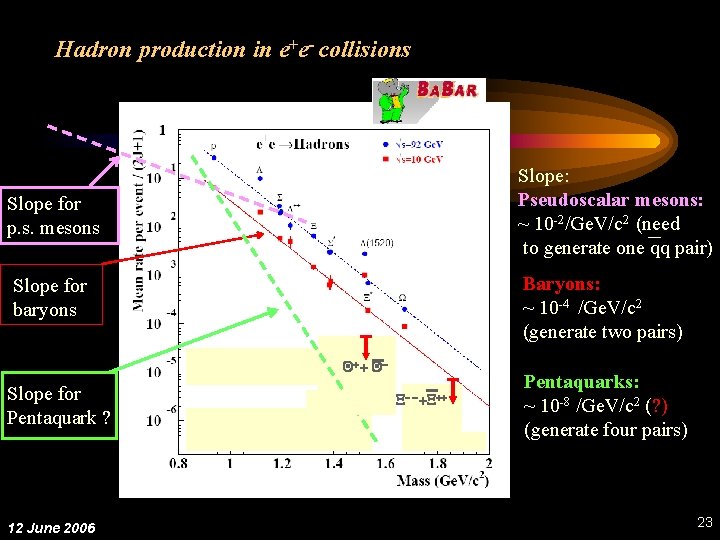
Hadron production in e+e- collisions Slope: Pseudoscalar mesons: ~ 10 -2/Ge. V/c 2 (need to generate one qq pair) Slope for p. s. mesons Baryons: ~ 10 -4 /Ge. V/c 2 (generate two pairs) Slope for baryons Q+ + Q - Slope for Pentaquark ? 12 June 2006 - - + ++ Pentaquarks: ~ 10 -8 /Ge. V/c 2 (? ) (generate four pairs) 23
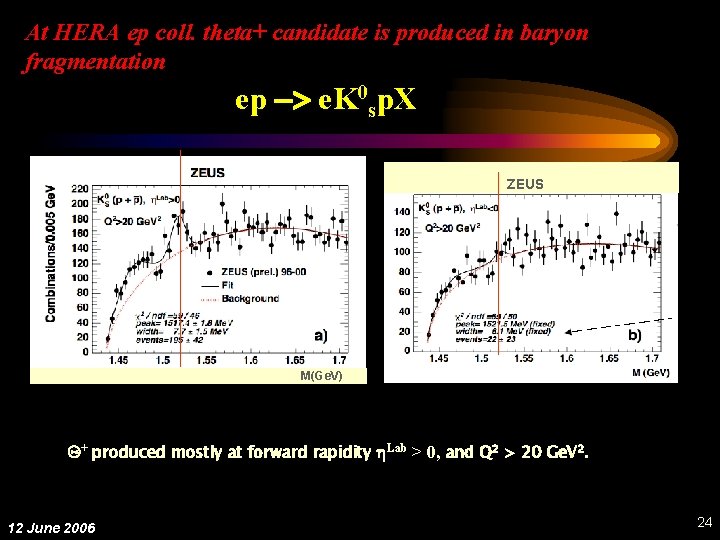
At HERA ep coll. theta+ candidate is produced in baryon fragmentation ep -> e. K 0 sp. X ZEUS M(Ge. V) Q+ produced mostly at forward rapidity h. Lab > 0, and Q 2 > 20 Ge. V 2. 12 June 2006 24
Belle – Limit on Q+ Width K+A -> p. K 0 s Q+ from K+A -> p. K 0 s. X & K+D -> inclusive analysis Belle limit 90%CL 397 fb-1 N / 2 Me. V/c 2 DIANA mp. Ks (Ge. V/c 2) T Nakano QNP 2006 Cahn, Trilling, PRD 69, 11501 (2004). 12 June 2006 Belle: G < 0. 64 Me. V (90% CL) @ M = 1. 539 Ge. V < 1 Me. V (90% CL) @ M = 1. 525– 1. 545 Ge. V Not inconsistent with previous results. 25
PDG 2006 : Two stars for theta+ 12 June 2006 26
Theta++ uudusbar 12 June 2006 27
H Huang et al 18. 6 M d+Au events STAR preliminary D+Au Collisions at 200 Ge. V g Conversion Coulomb Interaction (1520) Coulomb Interaction After background subtraction p. K+ : A 3. 5 -5. 0 sigma signal is seen Mass is ~ 1. 53 Ge. V/c 2. Full width ~ 15 Me. V. Do we understand the residual background? 12 June 2006 28
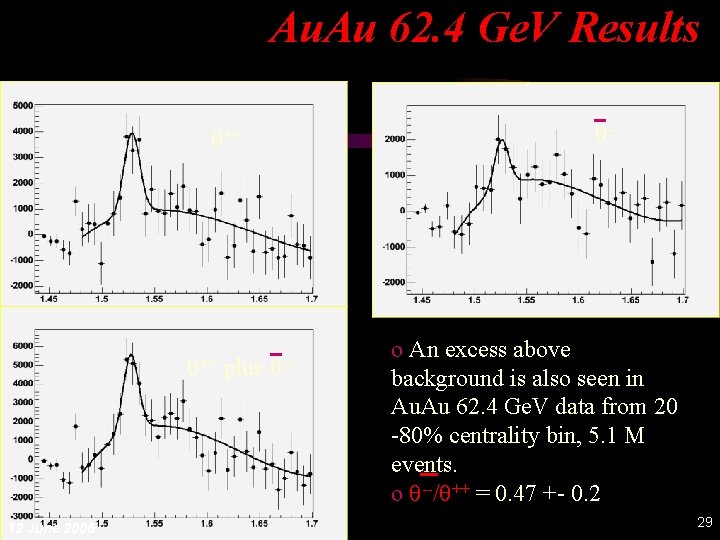
Au. Au 62. 4 Ge. V Results -- ++ 12 June 2006 plus -- o An excess above background is also seen in Au. Au 62. 4 Ge. V data from 20 -80% centrality bin, 5. 1 M events. o --/ ++ = 0. 47 +- 0. 2 29
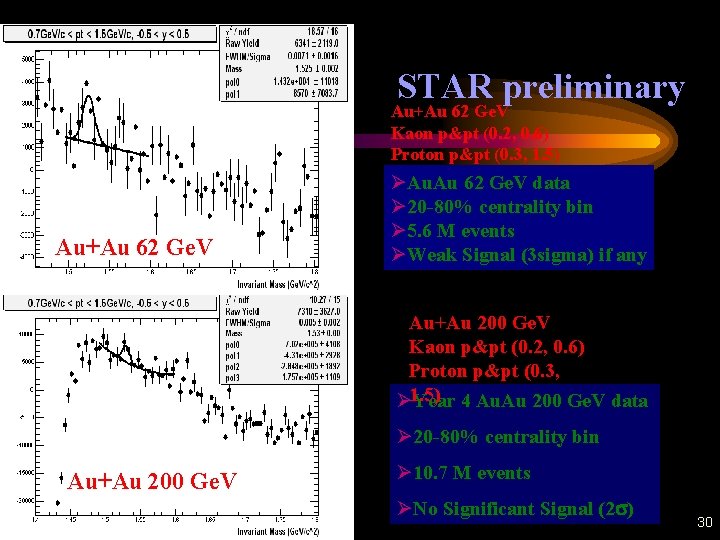
STAR preliminary Au+Au 62 Ge. V Kaon p&pt (0. 2, 0. 6) Proton p&pt (0. 3, 1. 5) Au+Au 62 Ge. V ØAu. Au 62 Ge. V data Ø 20 -80% centrality bin Ø 5. 6 M events ØWeak Signal (3 sigma) if any Au+Au 200 Ge. V Kaon p&pt (0. 2, 0. 6) Proton p&pt (0. 3, Ø 1. 5) Year 4 Au. Au 200 Ge. V data Ø 20 -80% centrality bin Au+Au 200 Ge. V Ø 10. 7 M events ØNo Significant Signal (2 ) 12 June 2006 30
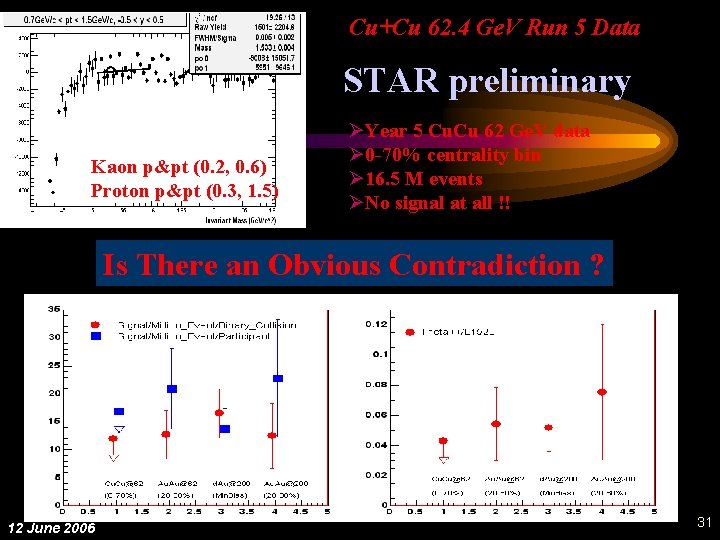
Cu+Cu 62. 4 Ge. V Run 5 Data STAR preliminary Kaon p&pt (0. 2, 0. 6) Proton p&pt (0. 3, 1. 5) ØYear 5 Cu. Cu 62 Ge. V data Ø 0 -70% centrality bin Ø 16. 5 M events ØNo signal at all !! Is There an Obvious Contradiction ? 12 June 2006 31
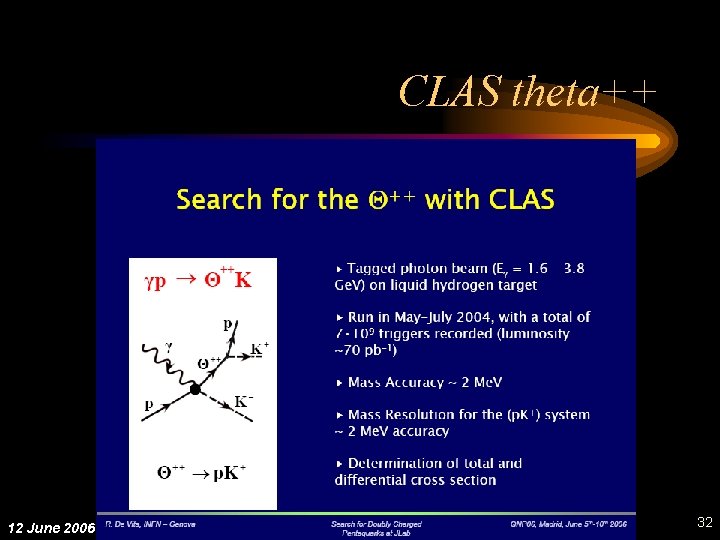
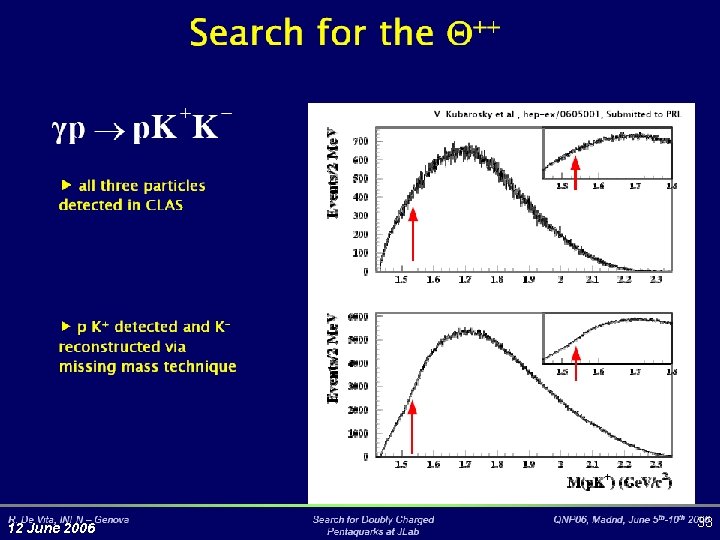
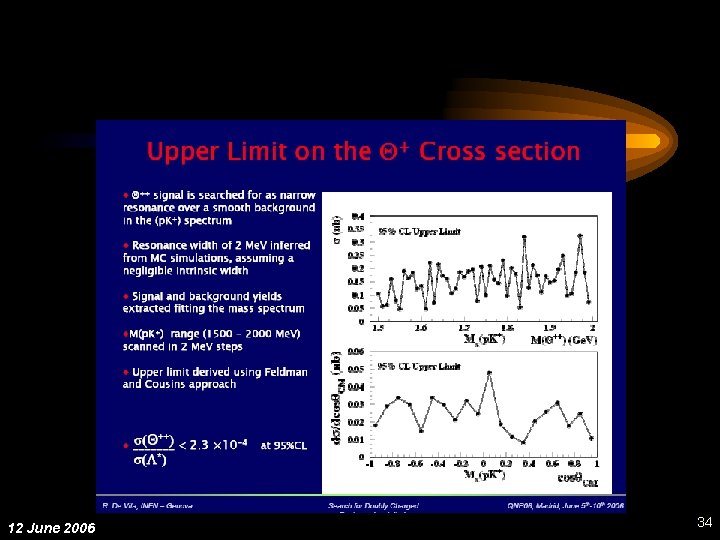
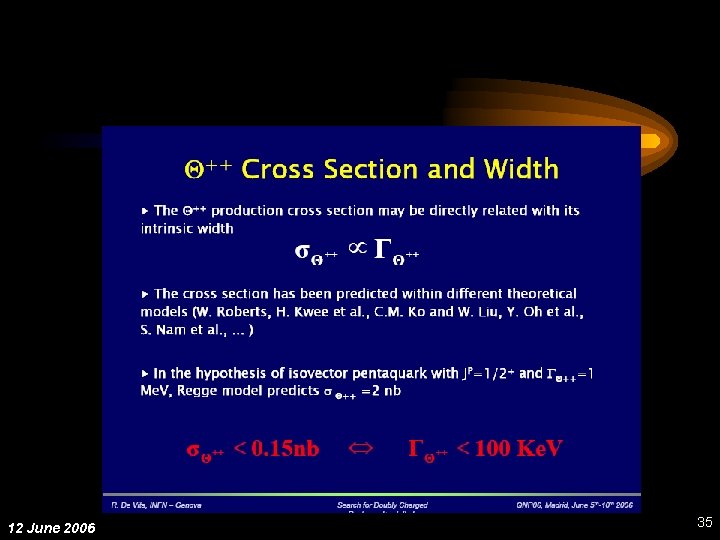
CLAS theta++ 12 June 2006 32
12 June 2006 33
12 June 2006 34
12 June 2006 35
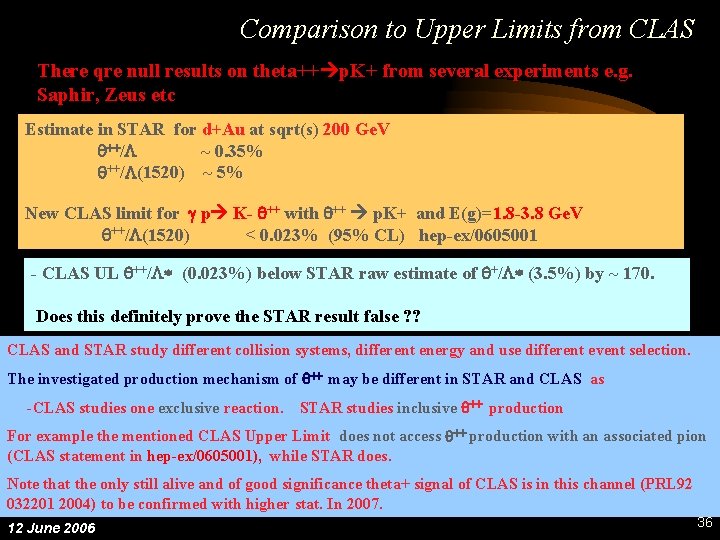
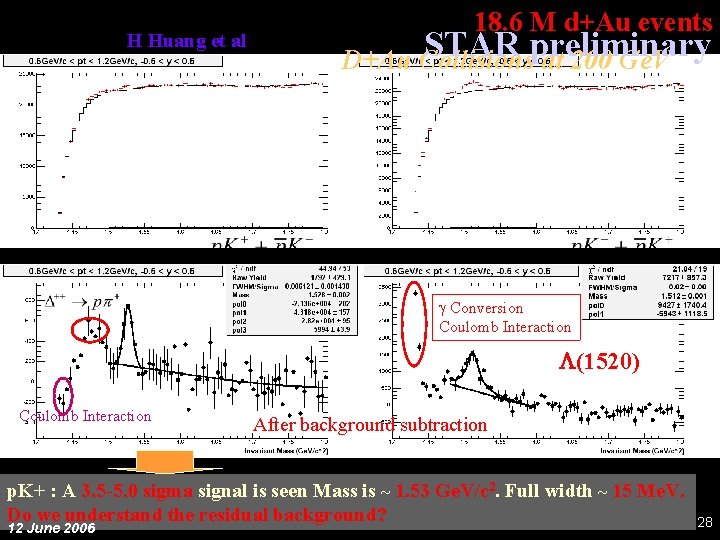
Comparison to Upper Limits from CLAS There qre null results on theta++ p. K+ from several experiments e. g. Saphir, Zeus etc Estimate in STAR for d+Au at sqrt(s) 200 Ge. V ++/ ~ 0. 35% ++/ (1520) ~ 5% New CLAS limit for p K- ++ with ++ p. K+ and E(g)=1. 8 -3. 8 Ge. V ++/ (1520) < 0. 023% (95% CL) hep-ex/0605001 - CLAS UL ++/ * (0. 023%) below STAR raw estimate of +/ * (3. 5%) by ~ 170. Does this definitely prove the STAR result false ? ? CLAS and STAR study different collision systems, different energy and use different event selection. The investigated production mechanism of ++ may be different in STAR and CLAS as -CLAS studies one exclusive reaction. STAR studies inclusive ++ production For example the mentioned CLAS Upper Limit does not access ++ production with an associated pion (CLAS statement in hep-ex/0605001), while STAR does. Note that the only still alive and of good significance theta+ signal of CLAS is in this channel (PRL 92 032201 2004) to be confirmed with higher stat. In 2007. 12 June 2006 36
0 c uudd cbar 12 June 2006 37
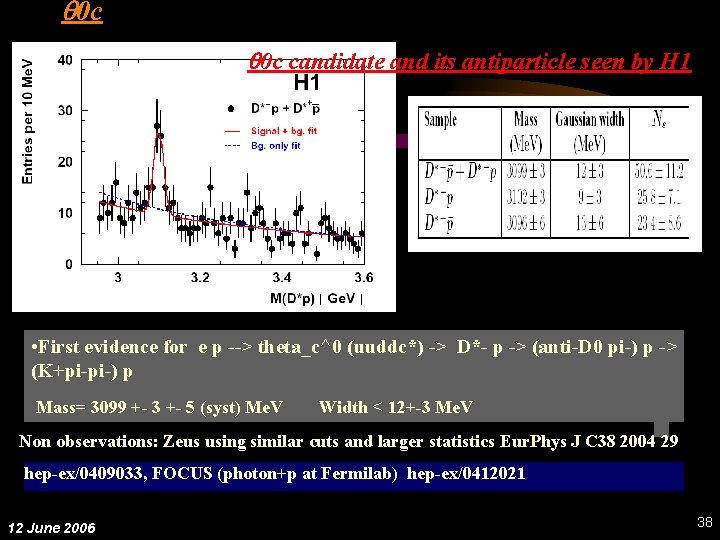
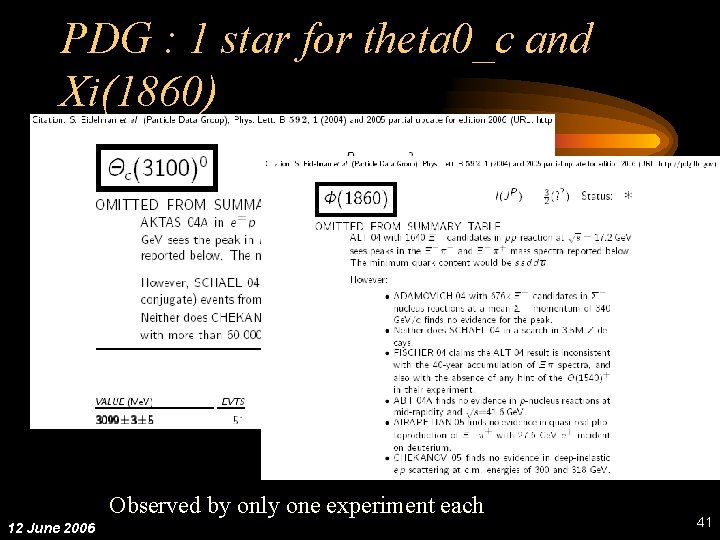
0 c 0 c candidate and its antiparticle seen by H 1 • First evidence for e p --> theta_c^0 (uuddc*) -> D*- p -> (anti-D 0 pi-) p -> (K+pi-pi-) p Mass= 3099 +- 3 +- 5 (syst) Me. V Width < 12+-3 Me. V Non observations: Zeus using similar cuts and larger statistics Eur. Phys J C 38 2004 29 hep-ex/0409033, FOCUS (photon+p at Fermilab) hep-ex/0412021 12 June 2006 38
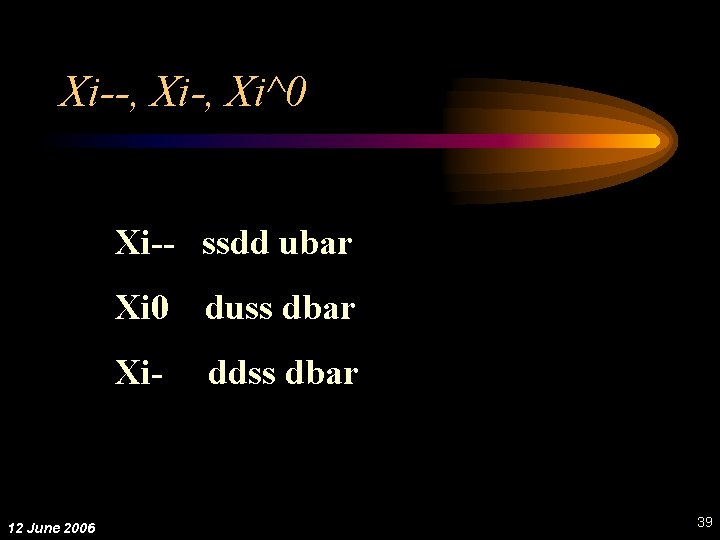
Xi--, Xi^0 Xi-- ssdd ubar 12 June 2006 Xi 0 duss dbar Xi- ddss dbar 39
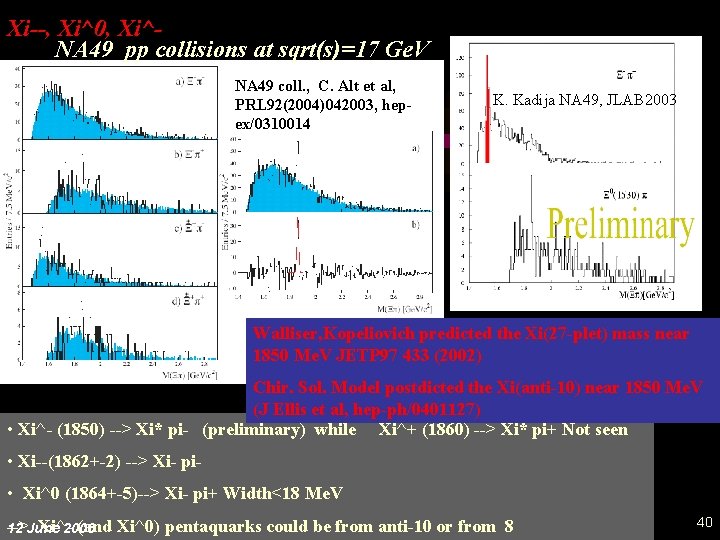
Xi--, Xi^0, Xi^NA 49 pp collisions at sqrt(s)=17 Ge. V NA 49 coll. , C. Alt et al, PRL 92(2004)042003, hepex/0310014 K. Kadija NA 49, JLAB 2003 Walliser, Kopeliovich predicted the Xi(27 -plet) mass near 1850 Me. V JETP 97 433 (2002) Chir. Sol. Model postdicted the Xi(anti-10) near 1850 Me. V (J Ellis et al, hep-ph/0401127) • Xi^- (1850) --> Xi* pi- (preliminary) while Xi^+ (1860) --> Xi* pi+ Not seen • Xi--(1862+-2) --> Xi- pi • Xi^0 (1864+-5)--> Xi- pi+ Width<18 Me. V --> Xi^(and Xi^0) pentaquarks could be from anti-10 or from 8 12 June 2006 40
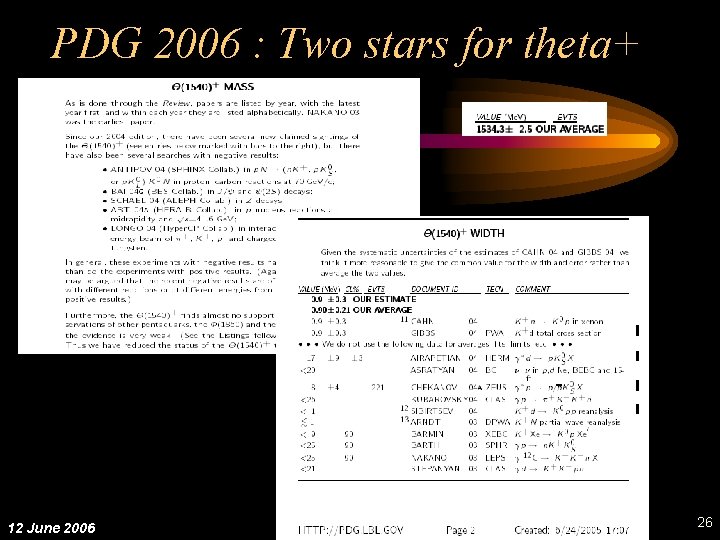
PDG : 1 star for theta 0_c and Xi(1860) Observed by only one experiment each 12 June 2006 41
N 0/Xi 0 N 0 udsd sbar Xi 0 udss dbar 12 June 2006 42
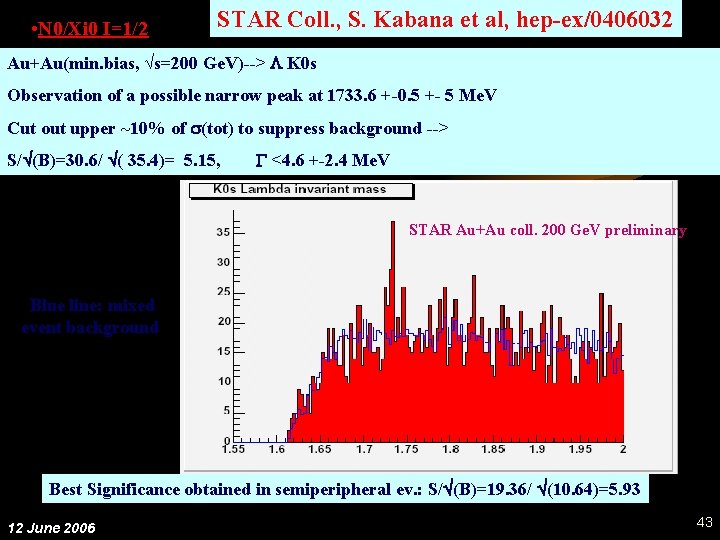
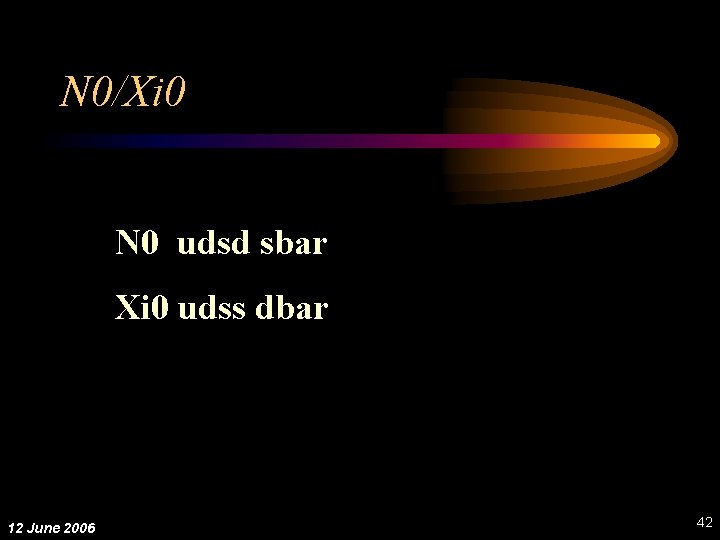
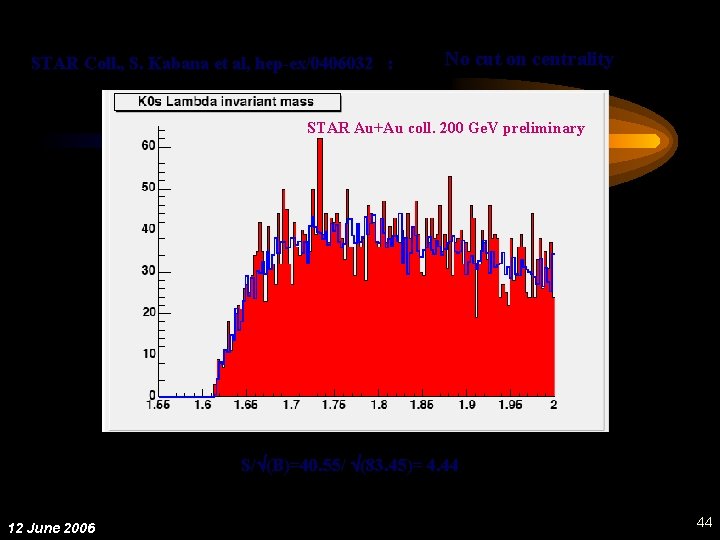
• N 0/Xi 0 I=1/2 STAR Coll. , S. Kabana et al, hep-ex/0406032 Au+Au(min. bias, √s=200 Ge. V)--> K 0 s Observation of a possible narrow peak at 1733. 6 +-0. 5 +- 5 Me. V Cut out upper ~10% of (tot) to suppress background --> S/ (B)=30. 6/ ( 35. 4)= 5. 15, <4. 6 +-2. 4 Me. V STAR Au+Au coll. 200 Ge. V preliminary Blue line: mixed event background Best Significance obtained in semiperipheral ev. : S/ (B)=19. 36/ (10. 64)=5. 93 12 June 2006 43
STAR Coll. , S. Kabana et al, hep-ex/0406032 : No cut on centrality STAR Au+Au coll. 200 Ge. V preliminary S/ (B)=40. 55/ (83. 45)= 4. 44 12 June 2006 44
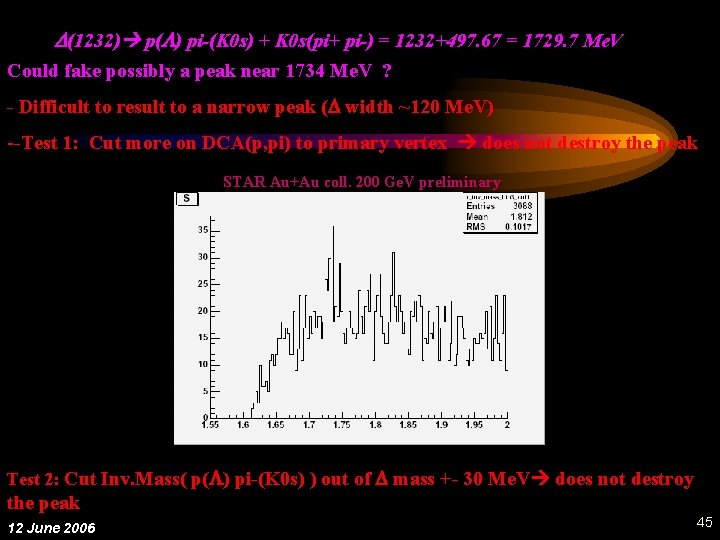
(1232) p( ) pi-(K 0 s) + K 0 s(pi+ pi-) = 1232+497. 67 = 1729. 7 Me. V Could fake possibly a peak near 1734 Me. V ? - Difficult to result to a narrow peak ( width ~120 Me. V) --Test 1: Cut more on DCA(p, pi) to primary vertex does not destroy the peak STAR Au+Au coll. 200 Ge. V preliminary Test 2: Cut Inv. Mass( p( ) pi-(K 0 s) ) out of mass +- 30 Me. V does not destroy the peak 12 June 2006 45
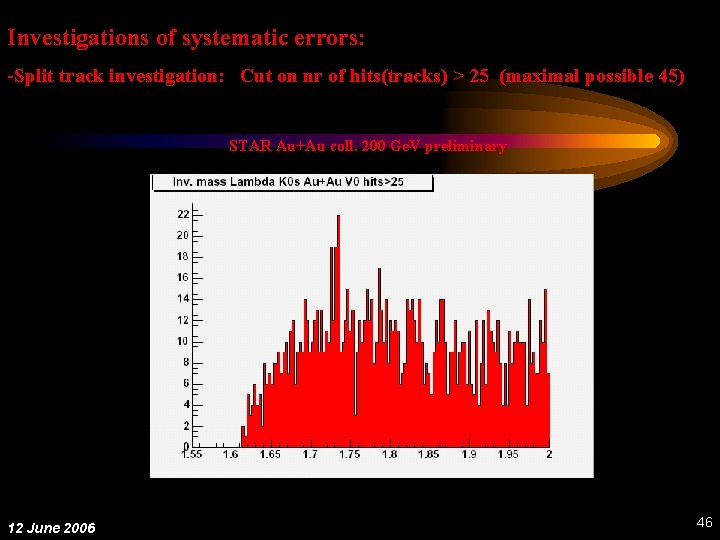
Investigations of systematic errors: -Split track investigation: Cut on nr of hits(tracks) > 25 (maximal possible 45) STAR Au+Au coll. 200 Ge. V preliminary 12 June 2006 46
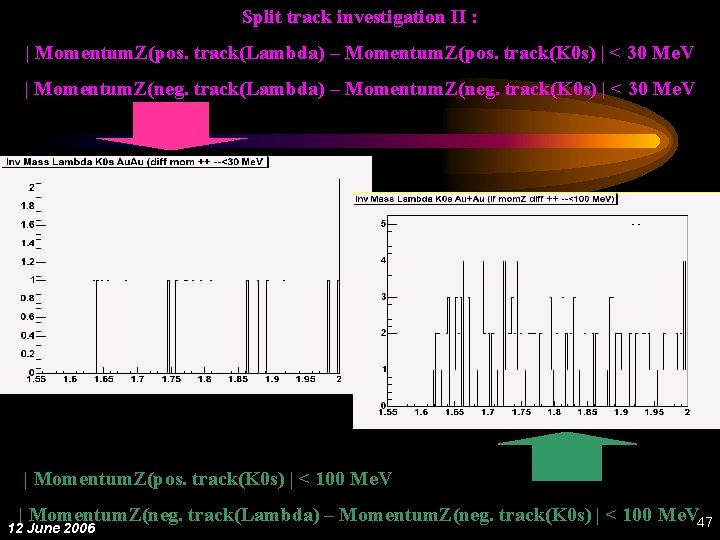
Split track investigation II : | Momentum. Z(pos. track(Lambda) – Momentum. Z(pos. track(K 0 s) | < 30 Me. V | Momentum. Z(neg. track(Lambda) – Momentum. Z(neg. track(K 0 s) | < 30 Me. V | Momentum. Z(pos. track(K 0 s) | < 100 Me. V | Momentum. Z(neg. track(Lambda) – Momentum. Z(neg. track(K 0 s) | < 100 Me. V 47 12 June 2006
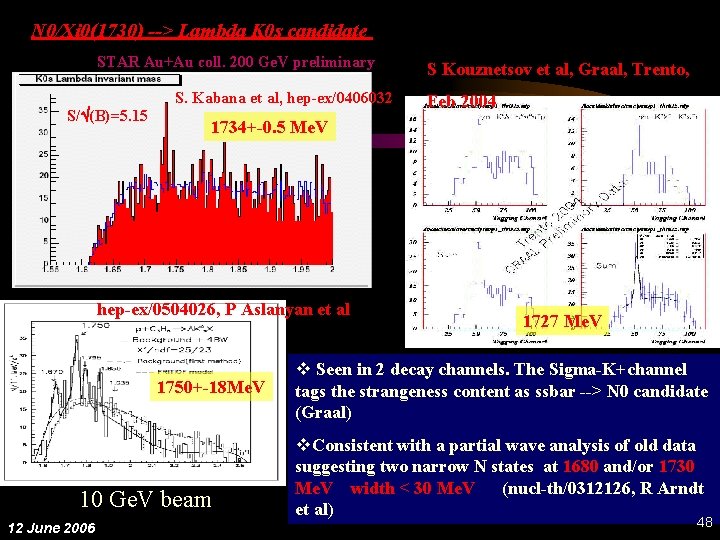
N 0/Xi 0(1730) --> Lambda K 0 s candidate STAR Au+Au coll. 200 Ge. V preliminary S. Kabana et al, hep-ex/0406032 S/ (B)=5. 15 Feb 2004 1734+-0. 5 Me. V hep-ex/0504026, P Aslanyan et al 1750+-18 Me. V 10 Ge. V beam 12 June 2006 S Kouznetsov et al, Graal, Trento, 1727 Me. V v Seen in 2 decay channels. The Sigma-K+channel tags the strangeness content as ssbar --> N 0 candidate (Graal) v. Consistent with a partial wave analysis of old data suggesting two narrow N states at 1680 and/or 1730 Me. V width < 30 Me. V (nucl-th/0312126, R Arndt et al) 48
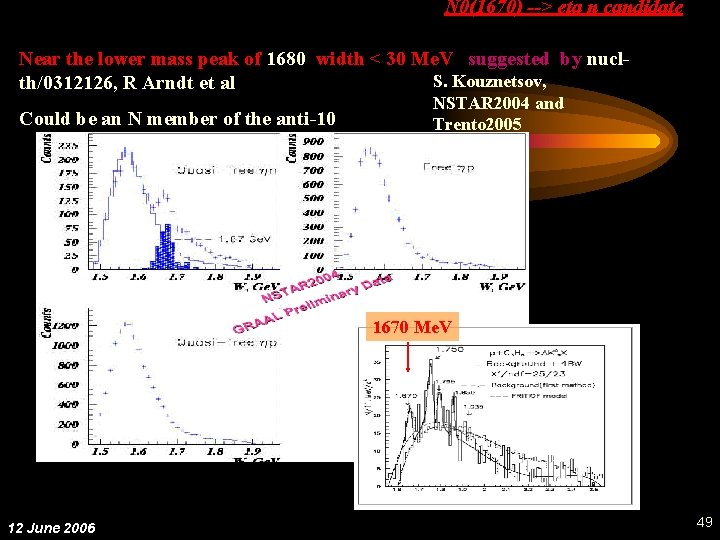
N 0(1670) --> eta n candidate Near the lower mass peak of 1680 width < 30 Me. V suggested by nucl. S. Kouznetsov, th/0312126, R Arndt et al Could be an N member of the anti-10 NSTAR 2004 and Trento 2005 1670 Me. V 12 June 2006 49
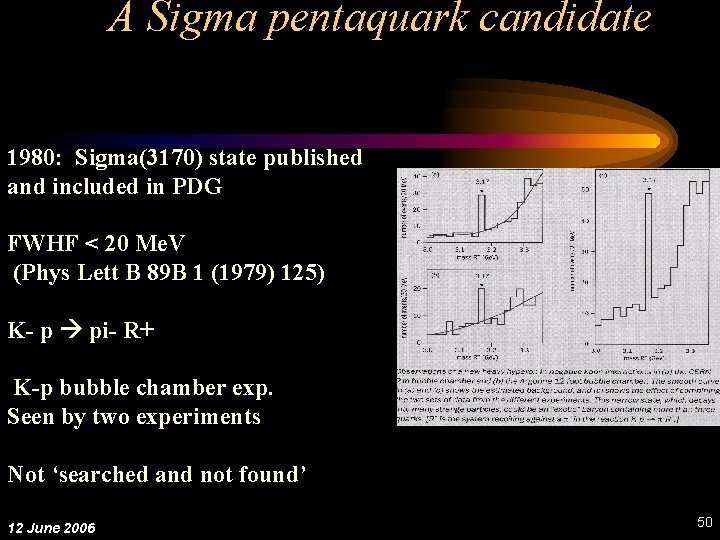
A Sigma pentaquark candidate 1980: Sigma(3170) state published and included in PDG FWHF < 20 Me. V (Phys Lett B 89 B 1 (1979) 125) K- p pi- R+ K-p bubble chamber exp. Seen by two experiments Not ‘searched and not found’ 12 June 2006 50
III Conclusions Observed pentaquark candidates: +(1530), ++(1530), 0 c(3099), - -(1860), -(1850), 0(1860), N 0/ 0 I=1/2(1734)/N 0(1727), N 0(1680), N 0(2400)? , Hyperon(3170) Maybe part of them, or all of them or non of them correspond to true states v. Many non observations mainly in high energy collisions, e+e-, hadr. Int. vthetac, Xi(1860) observed only by one experiment each v. Study the ‘signal’ where seen with higher statistic, kin. Reflexions studies v comp. to theory and other experiments (UL and signals) v continue Studies of production mechanism of theta+ candidate (e. g. LEPS, Zeus, CLAS) v 2006/7: new data from CLAS, LEPS (common acc. LEPS/CLAS), COSY-TOF, STAR, etc. will allow to answer the question if we have observed (some) narrow pentaquarks. 12 June 2006 51
- Slides: 51