
The Pennsylvania System of School Assessment PSSA Presentation
- Slides: 14
The Pennsylvania System of School Assessment PSSA Presentation for Parents and School Community
Overview of the PSSA stands for Pennsylvania System of School Assessment and it is the standardized test given to students in 3 rd-8 th and 11 th grades throughout the state of Pennsylvania. It is a standards based assessment and measures individual student growth. It also measures whether a student can complete on grade level tasks in reading, writing, and mathematics.
PSSA Overview Continued Underlying Principles • • • Applies to ALL schools and districts Based on PA standards and content expectations Goal is to have 100% of students proficient or above in reading and math by 2014 Valid and Reliable testing system Recognizes growth and levels of performance Aligned with NO CHILD LEFT BEHIND legislation Performance Level Descriptors Below Basic- Seldom demonstrates grade level appropriate skills. Basic- At times demonstrates some grade level appropriate skills. Proficient- Routinely demonstrates a variety of grade level appropriate skills. Advanced- Consistently demonstrates a thorough understanding of grade level appropriate skills.
Parent Overview of the PSSA What's the Importance? Facts Regarding the PSSA • ALL students must score 100% proficient or above by the year 2014. • Your child's school district is evaluated on achievement using the following criteria: 1. PSSA and Participation on the test 2. Attendance (Elementary and Middle School level) 3. Graduation Rate (High School level) • These measurements make up the school's Adequate Yearly Progress (AYP). The link below to PDE contains information about percentage needed for schools to meet AYP. • PSSA Fact Sheet
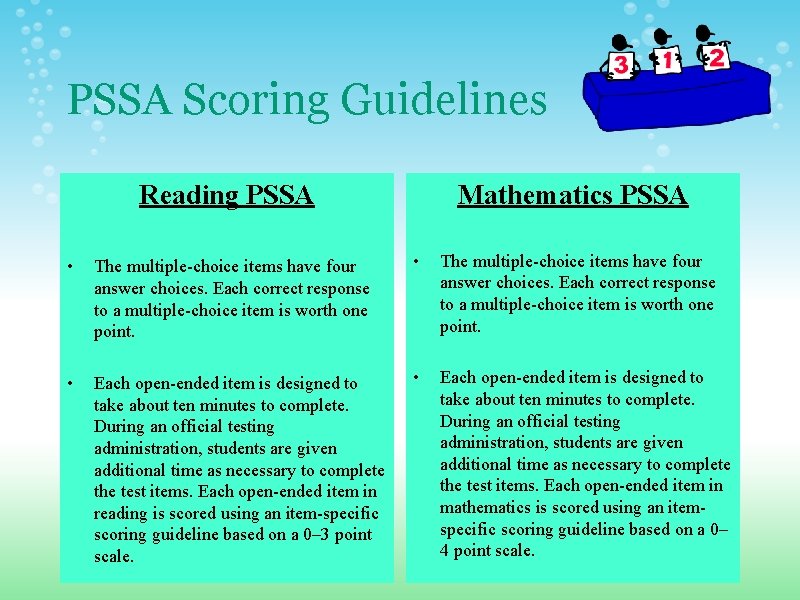
PSSA Scoring Guidelines Reading PSSA Mathematics PSSA • The multiple-choice items have four answer choices. Each correct response to a multiple-choice item is worth one point. • Each open-ended item is designed to take about ten minutes to complete. During an official testing administration, students are given additional time as necessary to complete the test items. Each open-ended item in reading is scored using an item-specific scoring guideline based on a 0– 3 point scale. • Each open-ended item is designed to take about ten minutes to complete. During an official testing administration, students are given additional time as necessary to complete the test items. Each open-ended item in mathematics is scored using an itemspecific scoring guideline based on a 0– 4 point scale.
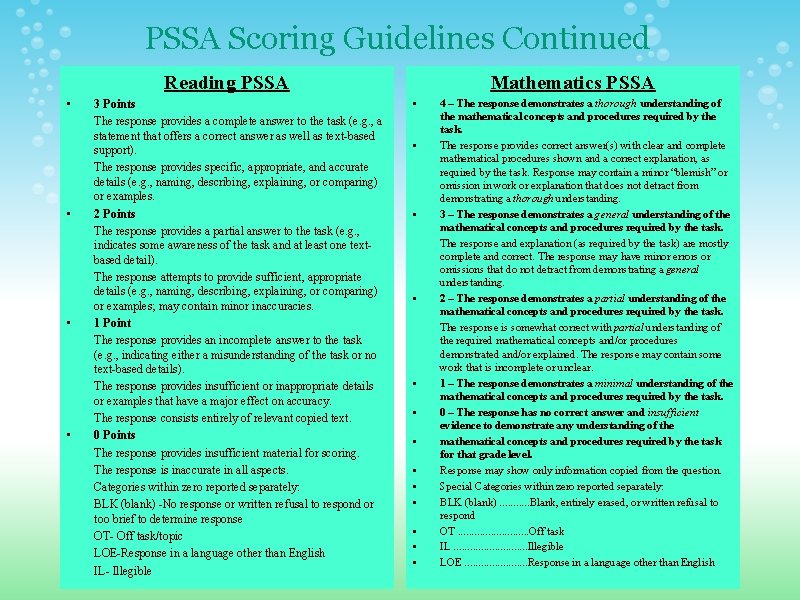
PSSA Scoring Guidelines Continued Reading PSSA • • 3 Points The response provides a complete answer to the task (e. g. , a statement that offers a correct answer as well as text-based support). The response provides specific, appropriate, and accurate details (e. g. , naming, describing, explaining, or comparing) or examples. 2 Points The response provides a partial answer to the task (e. g. , indicates some awareness of the task and at least one textbased detail). The response attempts to provide sufficient, appropriate details (e. g. , naming, describing, explaining, or comparing) or examples; may contain minor inaccuracies. 1 Point The response provides an incomplete answer to the task (e. g. , indicating either a misunderstanding of the task or no text-based details). The response provides insufficient or inappropriate details or examples that have a major effect on accuracy. The response consists entirely of relevant copied text. 0 Points The response provides insufficient material for scoring. The response is inaccurate in all aspects. Categories within zero reported separately: BLK (blank) -No response or written refusal to respond or too brief to determine response OT- Off task/topic LOE-Response in a language other than English IL- Illegible Mathematics PSSA • • • • 4 – The response demonstrates a thorough understanding of the mathematical concepts and procedures required by the task. The response provides correct answer(s) with clear and complete mathematical procedures shown and a correct explanation, as required by the task. Response may contain a minor “blemish” or omission in work or explanation that does not detract from demonstrating a thorough understanding. 3 – The response demonstrates a general understanding of the mathematical concepts and procedures required by the task. The response and explanation (as required by the task) are mostly complete and correct. The response may have minor errors or omissions that do not detract from demonstrating a general understanding. 2 – The response demonstrates a partial understanding of the mathematical concepts and procedures required by the task. The response is somewhat correct with partial understanding of the required mathematical concepts and/or procedures demonstrated and/or explained. The response may contain some work that is incomplete or unclear. 1 – The response demonstrates a minimal understanding of the mathematical concepts and procedures required by the task. 0 – The response has no correct answer and insufficient evidence to demonstrate any understanding of the mathematical concepts and procedures required by the task for that grade level. Response may show only information copied from the question. Special Categories within zero reported separately: BLK (blank). . . Blank, entirely erased, or written refusal to respond OT. . . Off task IL. . . . Illegible LOE. . . Response in a language other than English
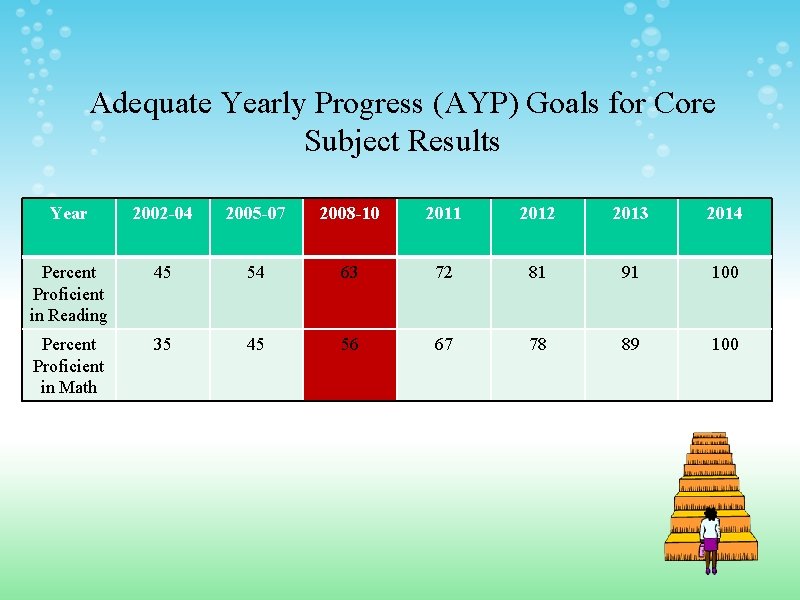
Adequate Yearly Progress (AYP) Goals for Core Subject Results Year 2002 -04 2005 -07 2008 -10 2011 2012 2013 2014 Percent Proficient in Reading 45 54 63 72 81 91 100 Percent Proficient in Math 35 45 56 67 78 89 100
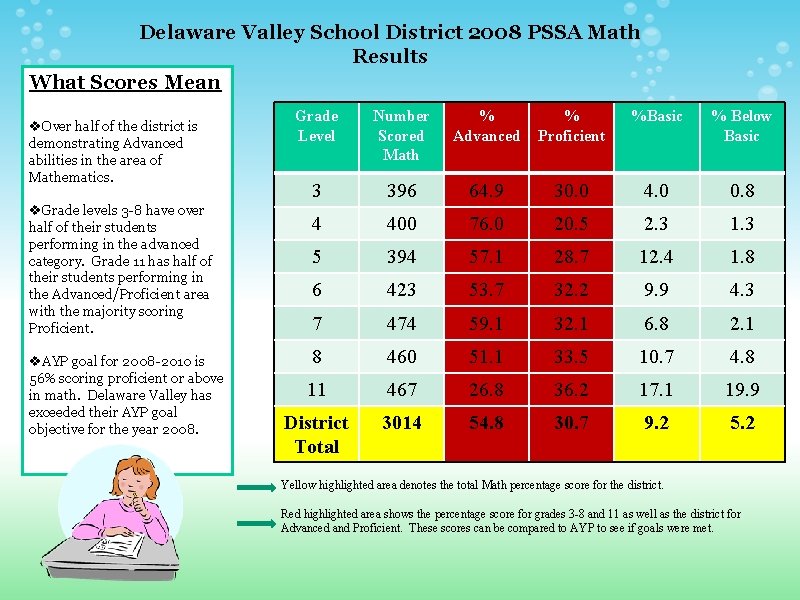
Delaware Valley School District 2008 PSSA Math Results What Scores Mean v. Over half of the district is demonstrating Advanced abilities in the area of Mathematics. v. Grade levels 3 -8 have over half of their students performing in the advanced category. Grade 11 has half of their students performing in the Advanced/Proficient area with the majority scoring Proficient. v. AYP goal for 2008 -2010 is 56% scoring proficient or above in math. Delaware Valley has exceeded their AYP goal objective for the year 2008. Grade Level Number Scored Math % Advanced % Proficient %Basic % Below Basic 3 396 64. 9 30. 0 4. 0 0. 8 4 400 76. 0 20. 5 2. 3 1. 3 5 394 57. 1 28. 7 12. 4 1. 8 6 423 53. 7 32. 2 9. 9 4. 3 7 474 59. 1 32. 1 6. 8 2. 1 8 460 51. 1 33. 5 10. 7 4. 8 11 467 26. 8 36. 2 17. 1 19. 9 District Total 3014 54. 8 30. 7 9. 2 5. 2 Yellow highlighted area denotes the total Math percentage score for the district. Red highlighted area shows the percentage score for grades 3 -8 and 11 as well as the district for Advanced and Proficient. These scores can be compared to AYP to see if goals were met.
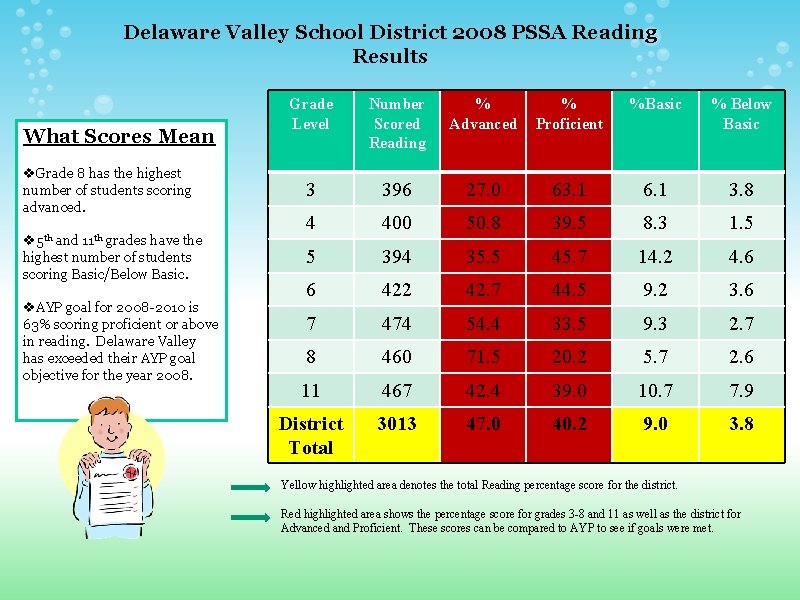
Delaware Valley School District 2008 PSSA Reading Results What Scores Mean v. Grade 8 has the highest number of students scoring advanced. v 5 th 11 th and grades have the highest number of students scoring Basic/Below Basic. v. AYP goal for 2008 -2010 is 63% scoring proficient or above in reading. Delaware Valley has exceeded their AYP goal objective for the year 2008. Grade Level Number Scored Reading % Advanced % Proficient %Basic % Below Basic 3 396 27. 0 63. 1 6. 1 3. 8 4 400 50. 8 39. 5 8. 3 1. 5 5 394 35. 5 45. 7 14. 2 4. 6 6 422 42. 7 44. 5 9. 2 3. 6 7 474 54. 4 33. 5 9. 3 2. 7 8 460 71. 5 20. 2 5. 7 2. 6 11 467 42. 4 39. 0 10. 7 7. 9 District Total 3013 47. 0 40. 2 9. 0 3. 8 Yellow highlighted area denotes the total Reading percentage score for the district. Red highlighted area shows the percentage score for grades 3 -8 and 11 as well as the district for Advanced and Proficient. These scores can be compared to AYP to see if goals were met.
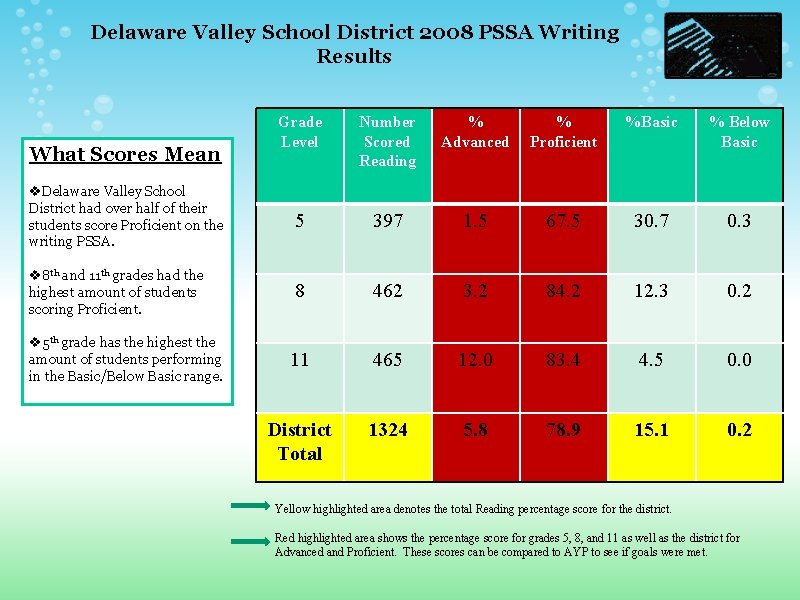
Delaware Valley School District 2008 PSSA Writing Results Grade Level Number Scored Reading % Advanced % Proficient %Basic % Below Basic v. Delaware Valley School District had over half of their students score Proficient on the writing PSSA. 5 397 1. 5 67. 5 30. 7 0. 3 v 8 th and 11 th grades had the highest amount of students scoring Proficient. 8 462 3. 2 84. 2 12. 3 0. 2 11 465 12. 0 83. 4 4. 5 0. 0 District Total 1324 5. 8 78. 9 15. 1 0. 2 What Scores Mean v 5 th grade has the highest the amount of students performing in the Basic/Below Basic range. Yellow highlighted area denotes the total Reading percentage score for the district. Red highlighted area shows the percentage score for grades 5, 8, and 11 as well as the district for Advanced and Proficient. These scores can be compared to AYP to see if goals were met.
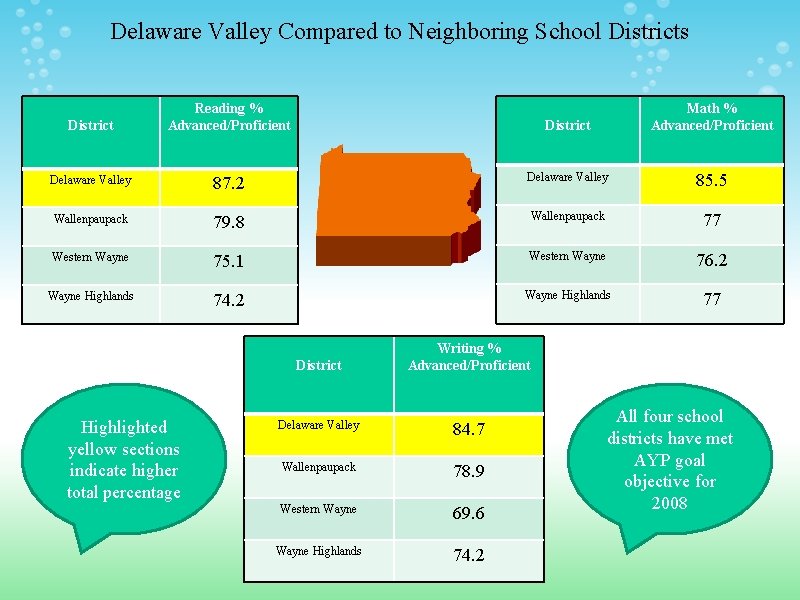
Delaware Valley Compared to Neighboring School Districts District Reading % Advanced/Proficient Math % Advanced/Proficient District Delaware Valley 87. 2 Delaware Valley 85. 5 Wallenpaupack 79. 8 Wallenpaupack 77 Western Wayne 75. 1 Western Wayne 76. 2 Wayne Highlands 74. 2 Wayne Highlands 77 District Highlighted yellow sections indicate higher total percentage Writing % Advanced/Proficient Delaware Valley 84. 7 Wallenpaupack 78. 9 Western Wayne 69. 6 Wayne Highlands 74. 2 All four school districts have met AYP goal objective for 2008
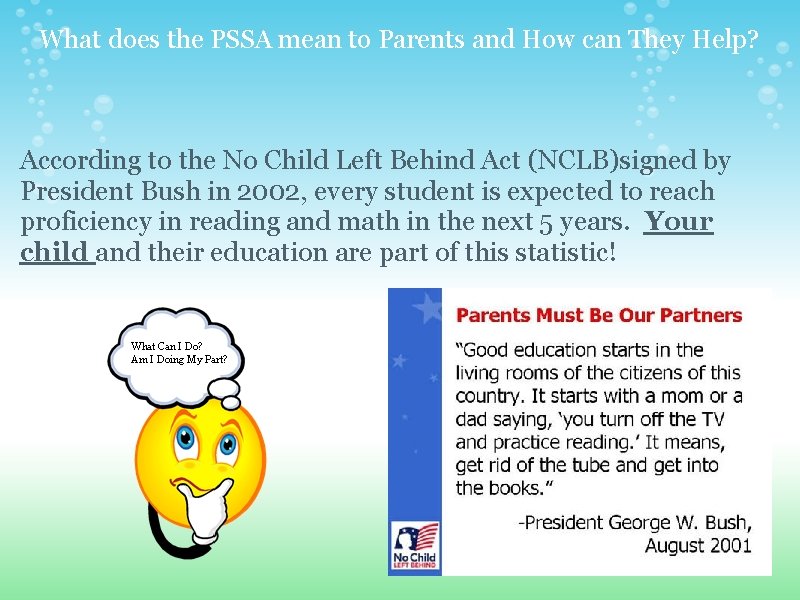
What does the PSSA mean to Parents and How can They Help? According to the No Child Left Behind Act (NCLB)signed by President Bush in 2002, every student is expected to reach proficiency in reading and math in the next 5 years. Your child and their education are part of this statistic! What Can I Do? Am I Doing My Part?
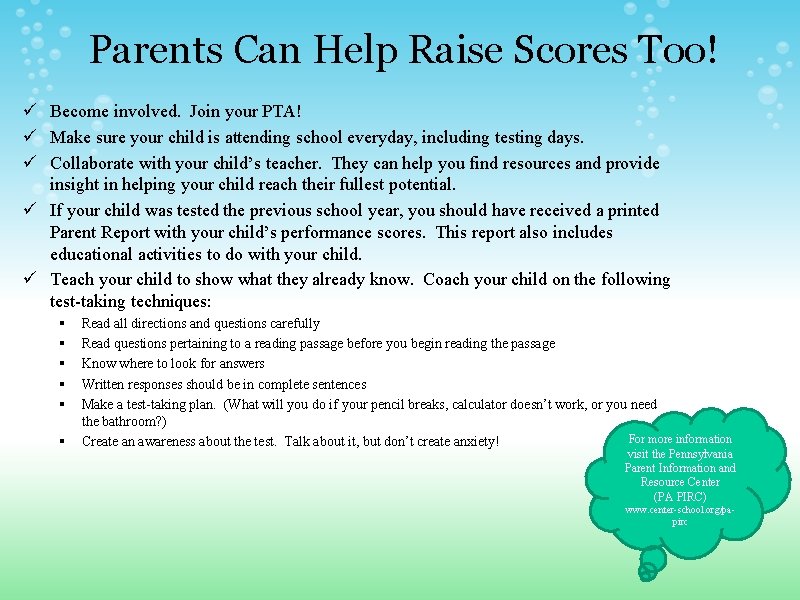
Parents Can Help Raise Scores Too! ü Become involved. Join your PTA! ü Make sure your child is attending school everyday, including testing days. ü Collaborate with your child’s teacher. They can help you find resources and provide insight in helping your child reach their fullest potential. ü If your child was tested the previous school year, you should have received a printed Parent Report with your child’s performance scores. This report also includes educational activities to do with your child. ü Teach your child to show what they already know. Coach your child on the following test-taking techniques: § § § Read all directions and questions carefully Read questions pertaining to a reading passage before you begin reading the passage Know where to look for answers Written responses should be in complete sentences Make a test-taking plan. (What will you do if your pencil breaks, calculator doesn’t work, or you need the bathroom? ) For more information Create an awareness about the test. Talk about it, but don’t create anxiety! visit the Pennsylvania Parent Information and Resource Center (PA PIRC) www. center-school. org/papirc
Something to think about. . . "Insanity: the belief that one can get different results by doing the same thing. " -Albert Einstein What do we do to ensure we get the results we need by 2014?