
The Pelvic Floor Why is it so important



- Slides: 55
The Pelvic Floor Why is it so important?
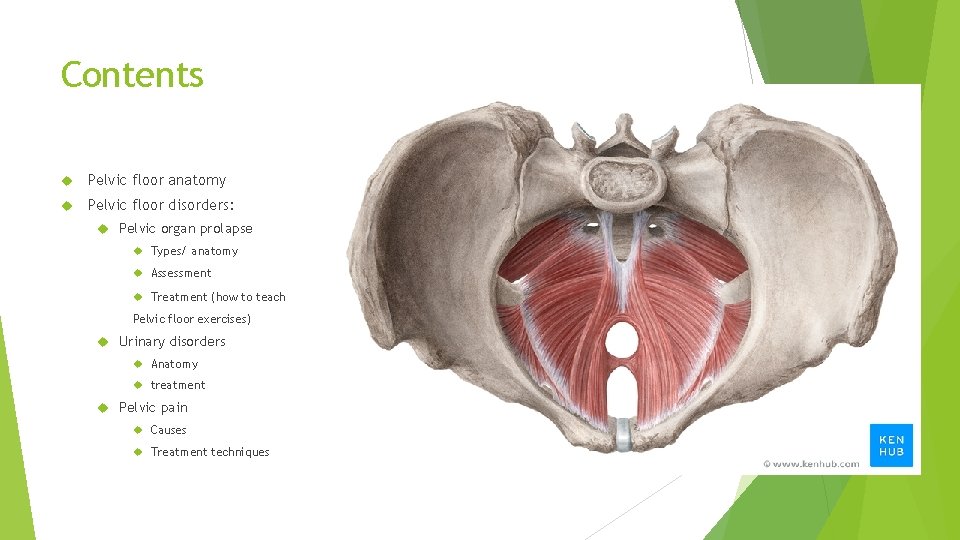
Contents Pelvic floor anatomy Pelvic floor disorders: Pelvic organ prolapse Types/ anatomy Assessment Treatment (how to teach Pelvic floor exercises) Urinary disorders Anatomy treatment Pelvic pain Causes Treatment techniques
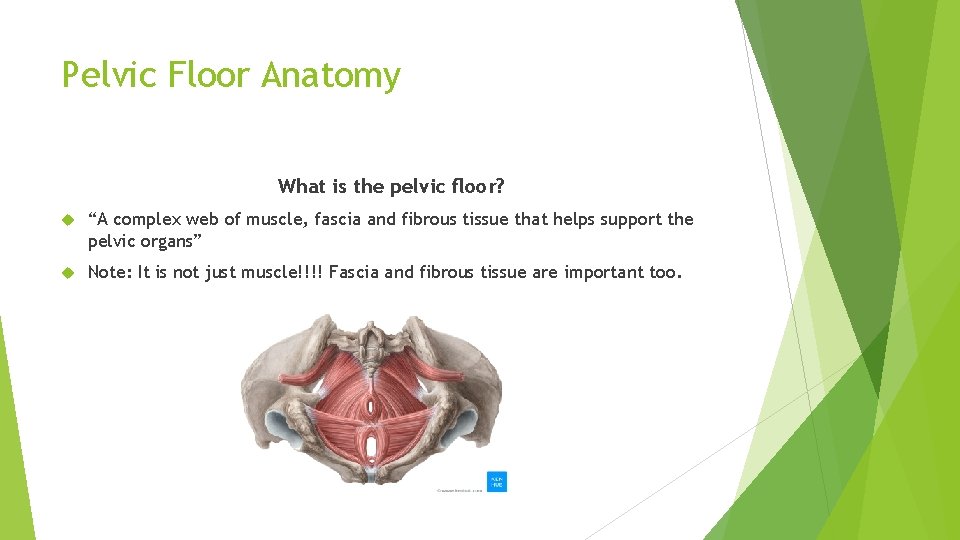
Pelvic Floor Anatomy What is the pelvic floor? “A complex web of muscle, fascia and fibrous tissue that helps support the pelvic organs” Note: It is not just muscle!!!! Fascia and fibrous tissue are important too.
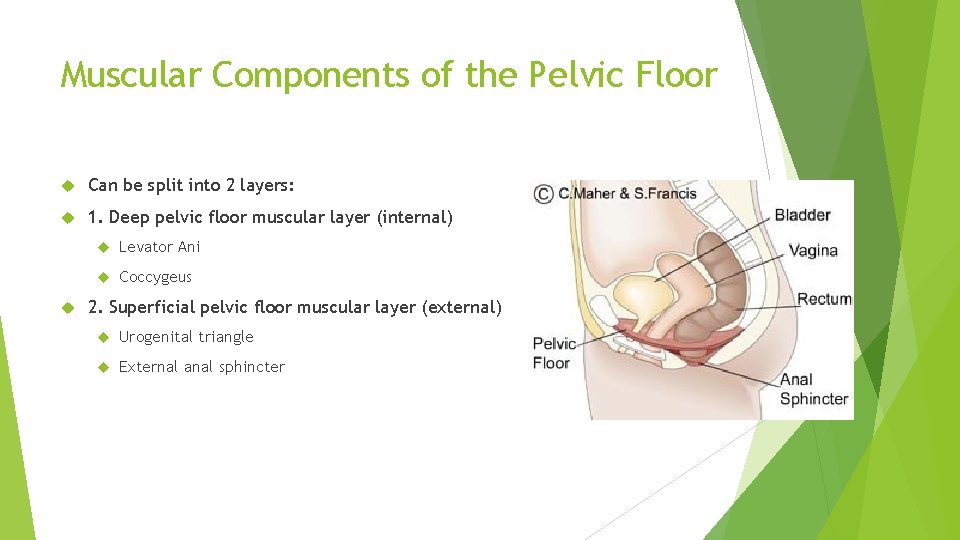
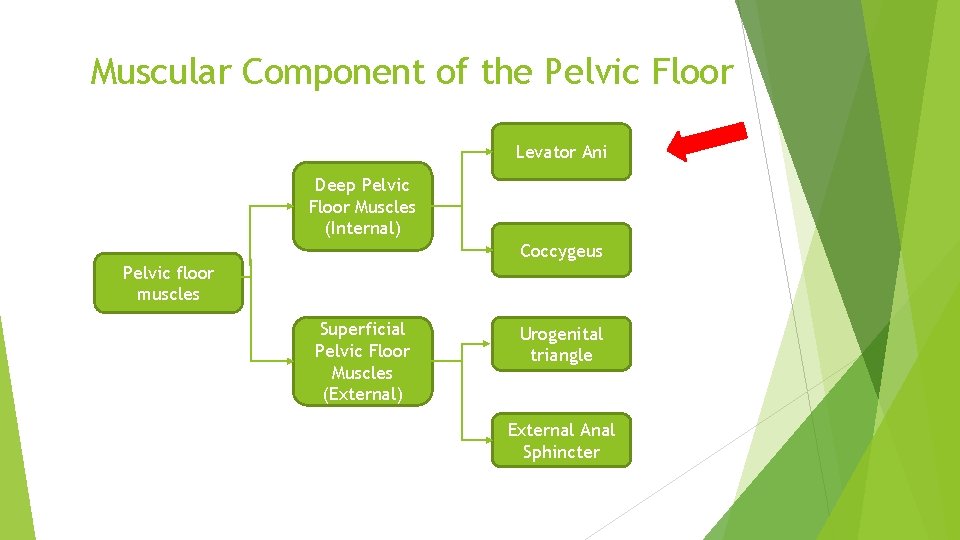
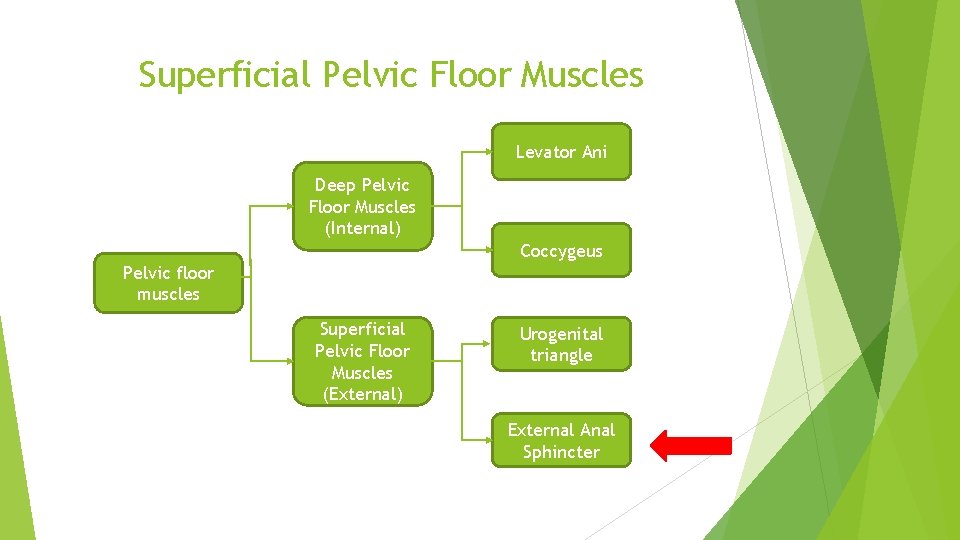
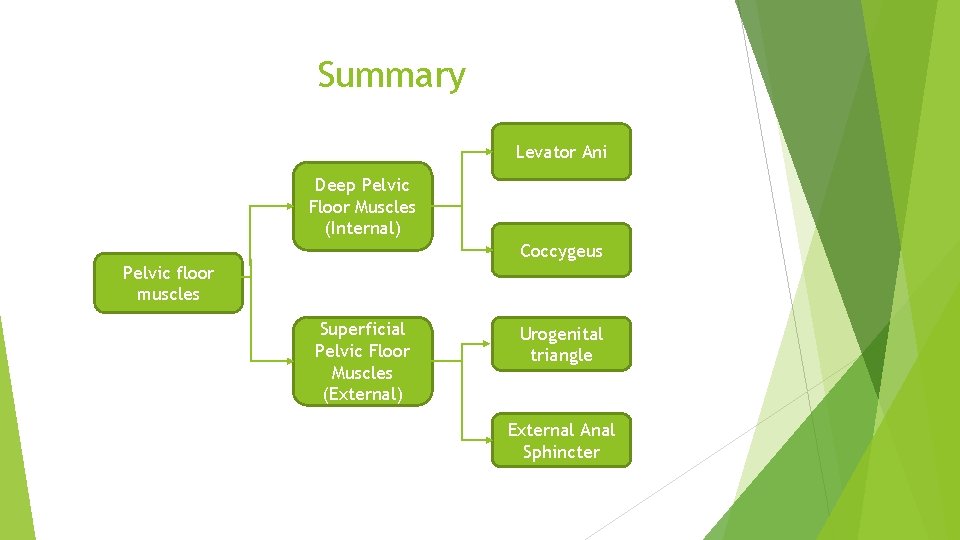
Muscular Components of the Pelvic Floor Can be split into 2 layers: 1. Deep pelvic floor muscular layer (internal) Levator Ani Coccygeus 2. Superficial pelvic floor muscular layer (external) Urogenital triangle External anal sphincter
Muscular Component of the Pelvic Floor Levator Ani Deep Pelvic Floor Muscles (Internal) Coccygeus Pelvic floor muscles Superficial Pelvic Floor Muscles (External) Urogenital triangle External Anal Sphincter
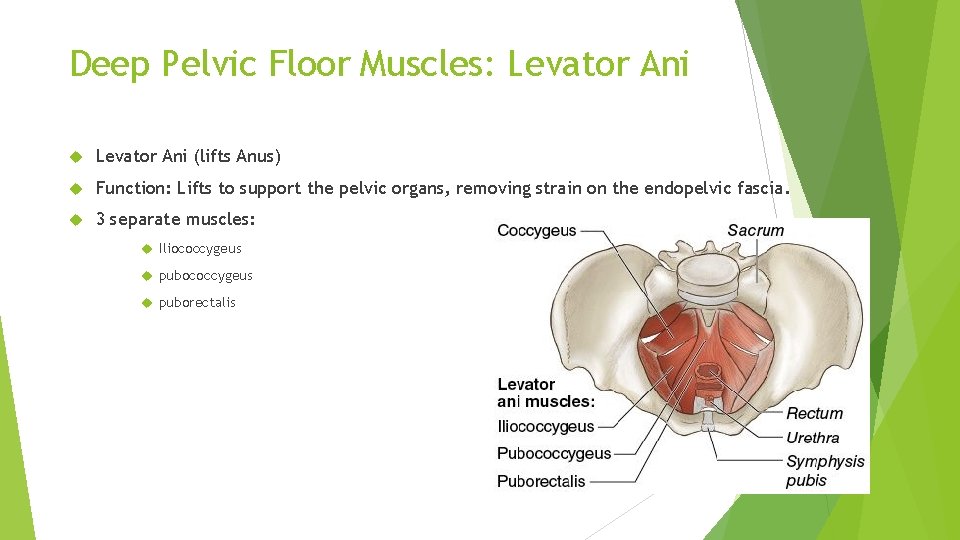
Deep Pelvic Floor Muscles: Levator Ani (lifts Anus) Function: Lifts to support the pelvic organs, removing strain on the endopelvic fascia. 3 separate muscles: Iliococcygeus puborectalis
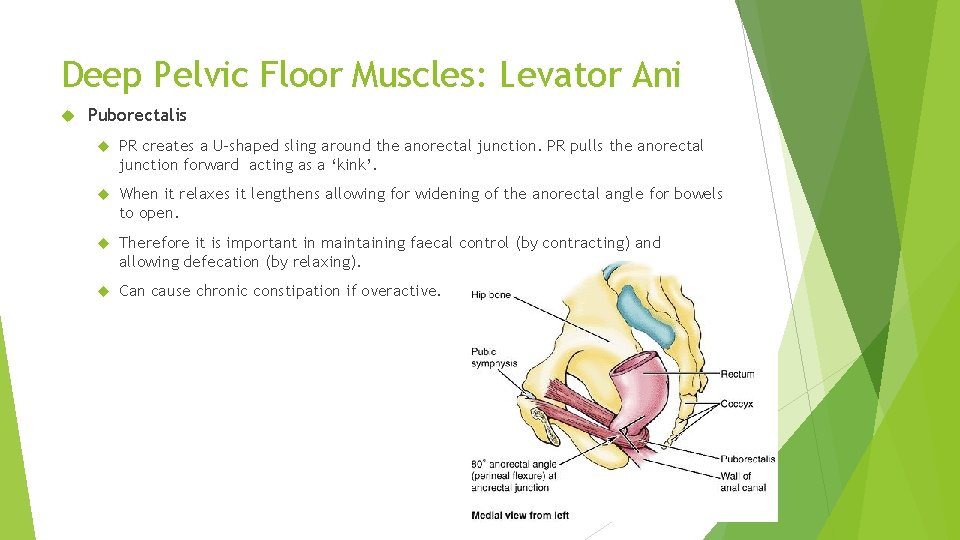
Deep Pelvic Floor Muscles: Levator Ani Puborectalis PR creates a U-shaped sling around the anorectal junction. PR pulls the anorectal junction forward acting as a ‘kink’. When it relaxes it lengthens allowing for widening of the anorectal angle for bowels to open. Therefore it is important in maintaining faecal control (by contracting) and allowing defecation (by relaxing). Can cause chronic constipation if overactive.
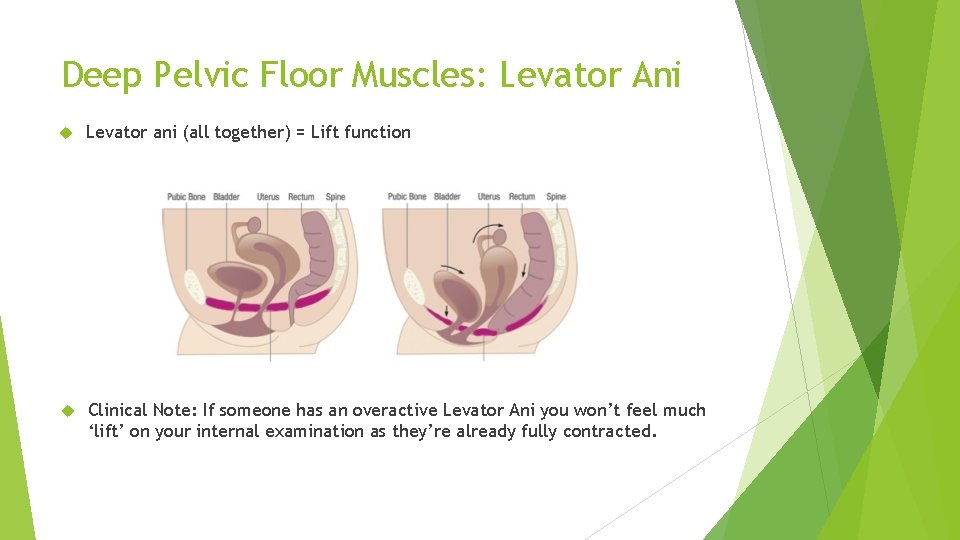
Deep Pelvic Floor Muscles: Levator Ani Levator ani (all together) = Lift function Clinical Note: If someone has an overactive Levator Ani you won’t feel much ‘lift’ on your internal examination as they’re already fully contracted.
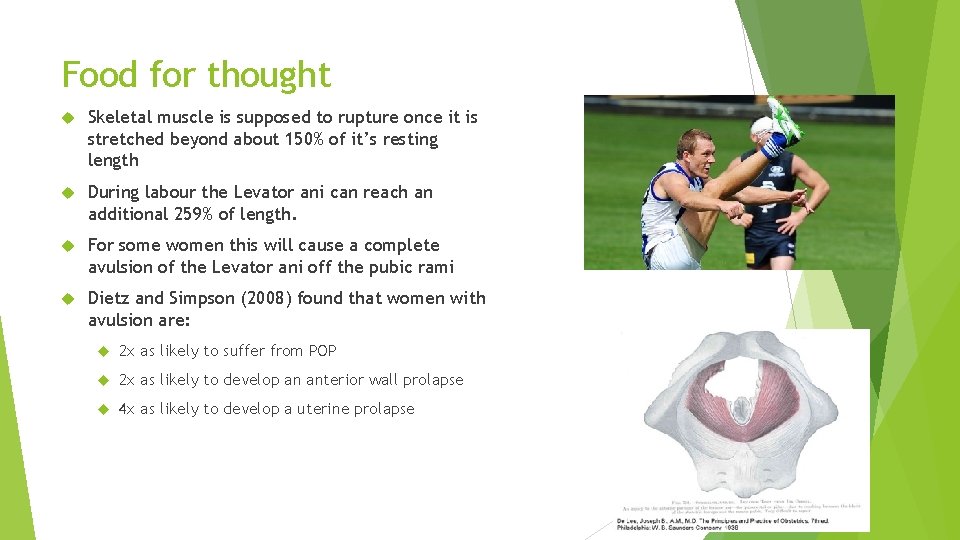
Food for thought Skeletal muscle is supposed to rupture once it is stretched beyond about 150% of it’s resting length During labour the Levator ani can reach an additional 259% of length. For some women this will cause a complete avulsion of the Levator ani off the pubic rami Dietz and Simpson (2008) found that women with avulsion are: 2 x as likely to suffer from POP 2 x as likely to develop an anterior wall prolapse 4 x as likely to develop a uterine prolapse
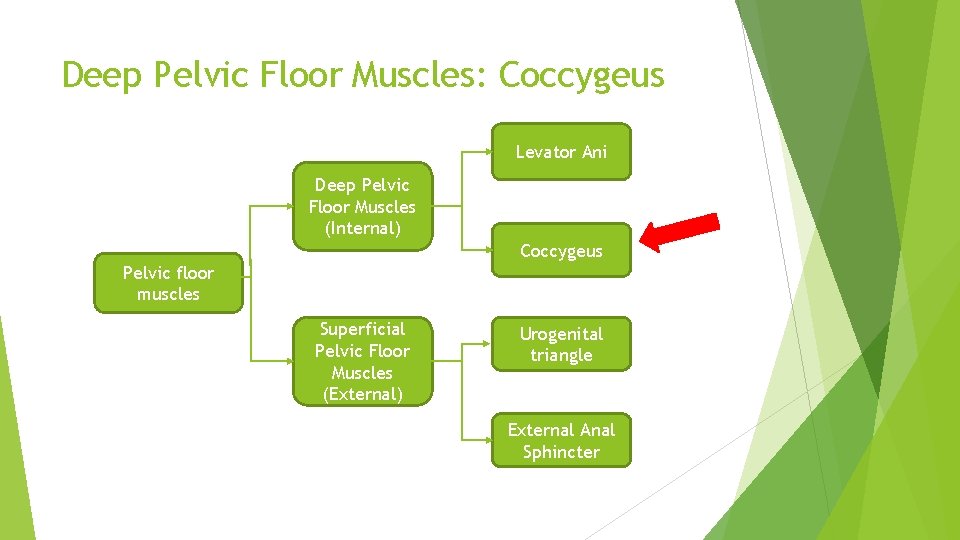
Deep Pelvic Floor Muscles: Coccygeus Levator Ani Deep Pelvic Floor Muscles (Internal) Coccygeus Pelvic floor muscles Superficial Pelvic Floor Muscles (External) Urogenital triangle External Anal Sphincter
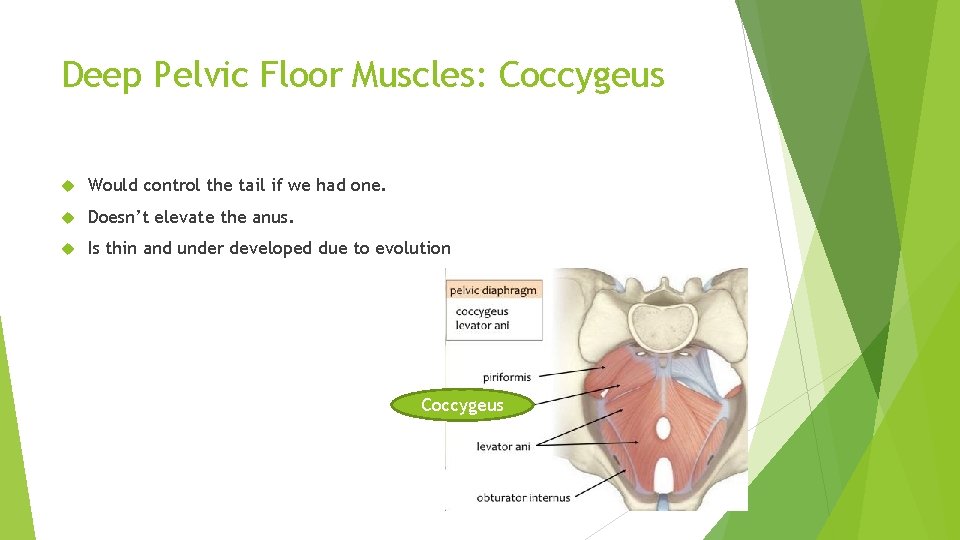
Deep Pelvic Floor Muscles: Coccygeus Would control the tail if we had one. Doesn’t elevate the anus. Is thin and under developed due to evolution Coccygeus
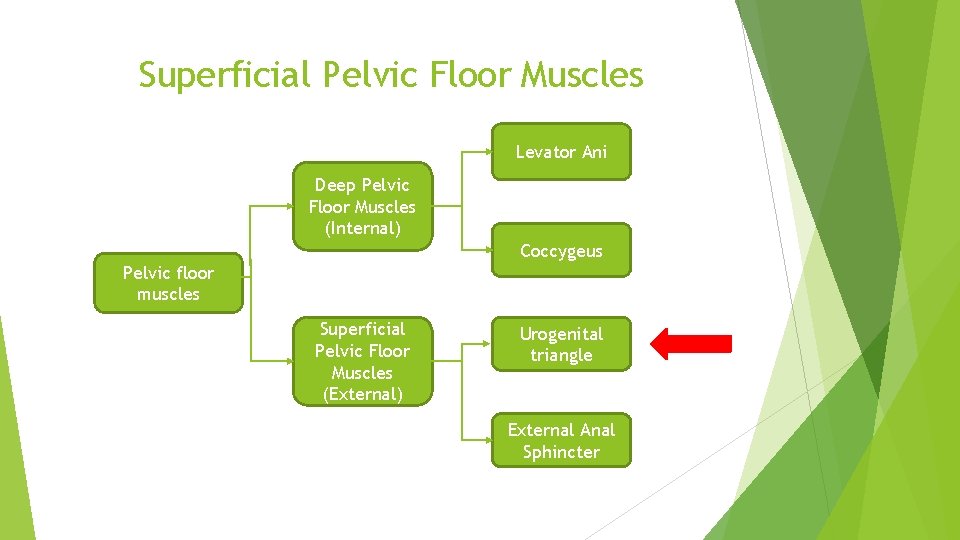
Superficial Pelvic Floor Muscles Levator Ani Deep Pelvic Floor Muscles (Internal) Coccygeus Pelvic floor muscles Superficial Pelvic Floor Muscles (External) Urogenital triangle External Anal Sphincter
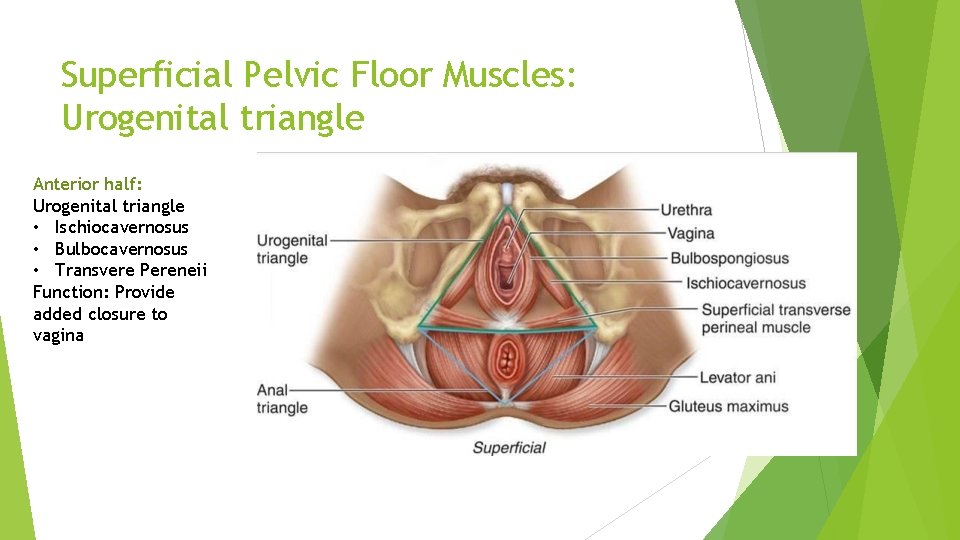
Superficial Pelvic Floor Muscles: Urogenital triangle Anterior half: Urogenital triangle • Ischiocavernosus • Bulbocavernosus • Transvere Pereneii Function: Provide added closure to vagina
Superficial Pelvic Floor Muscles Levator Ani Deep Pelvic Floor Muscles (Internal) Coccygeus Pelvic floor muscles Superficial Pelvic Floor Muscles (External) Urogenital triangle External Anal Sphincter
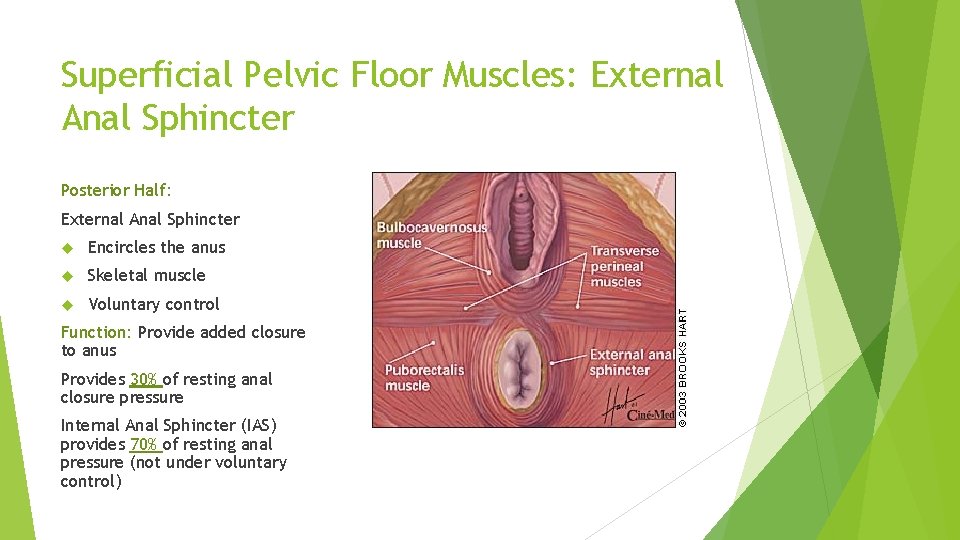
Superficial Pelvic Floor Muscles: External Anal Sphincter Posterior Half: External Anal Sphincter Encircles the anus Skeletal muscle Voluntary control Function: Provide added closure to anus Provides 30% of resting anal closure pressure Internal Anal Sphincter (IAS) provides 70% of resting anal pressure (not under voluntary control)
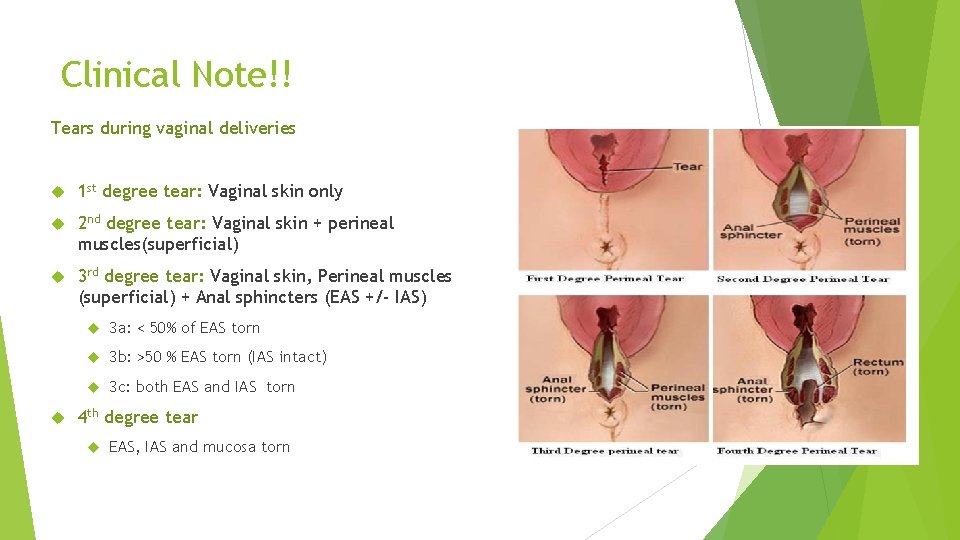
Clinical Note!! Tears during vaginal deliveries 1 st degree tear: Vaginal skin only 2 nd degree tear: Vaginal skin + perineal muscles(superficial) 3 rd degree tear: Vaginal skin, Perineal muscles (superficial) + Anal sphincters (EAS +/- IAS) 3 a: < 50% of EAS torn 3 b: >50 % EAS torn (IAS intact) 3 c: both EAS and IAS torn 4 th degree tear EAS, IAS and mucosa torn
Clinical note!! • 3 c and 4 th degree tears are the primary risk factor faecal incontinence. • Very poor outcomes once IAS is torn. • Pelvic floor muscle training will only increase strength of EAS (skeletal muscles), not IAS (sympathetic)
Summary Levator Ani Deep Pelvic Floor Muscles (Internal) Coccygeus Pelvic floor muscles Superficial Pelvic Floor Muscles (External) Urogenital triangle External Anal Sphincter
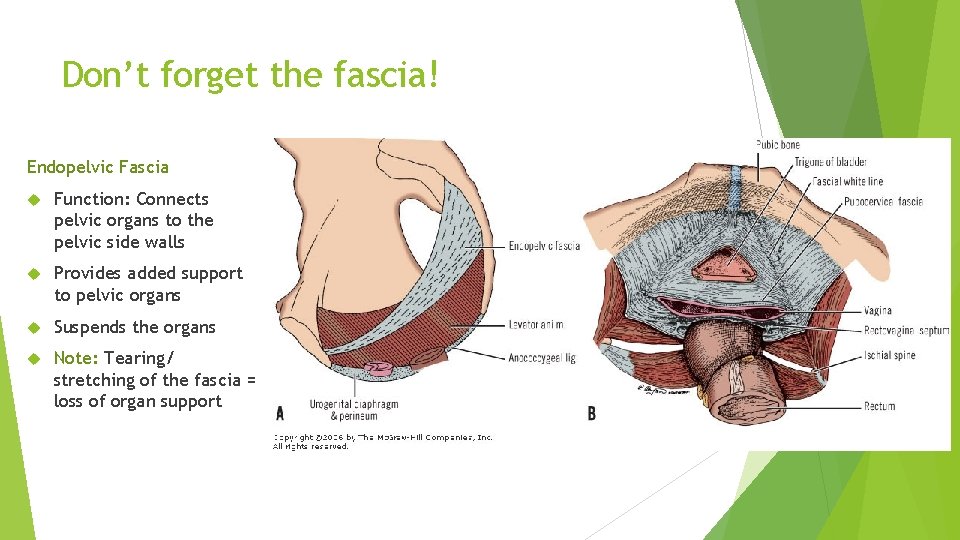
Don’t forget the fascia! Endopelvic Fascia Function: Connects pelvic organs to the pelvic side walls Provides added support to pelvic organs Suspends the organs Note: Tearing/ stretching of the fascia = loss of organ support
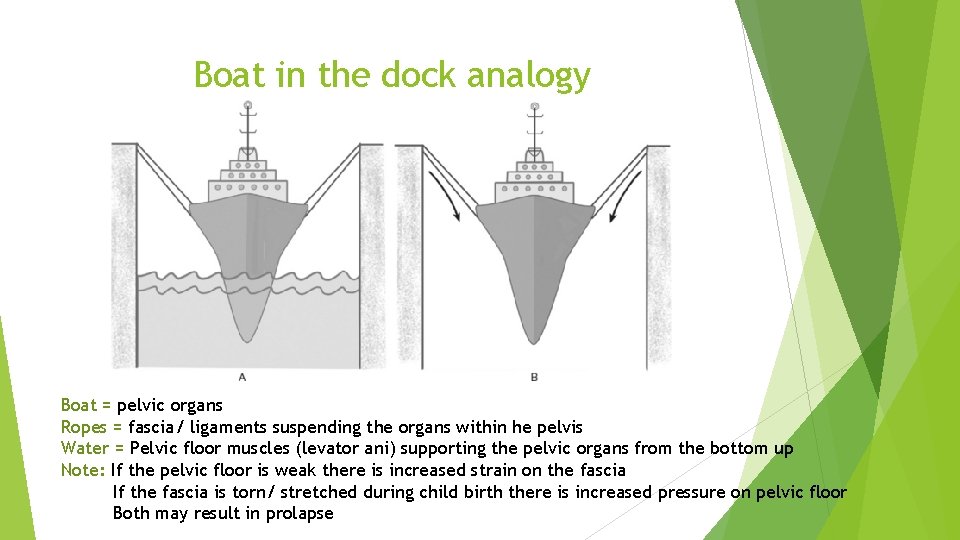
Boat in the dock analogy Boat = pelvic organs Ropes = fascia/ ligaments suspending the organs within he pelvis Water = Pelvic floor muscles (levator ani) supporting the pelvic organs from the bottom up Note: If the pelvic floor is weak there is increased strain on the fascia If the fascia is torn/ stretched during child birth there is increased pressure on pelvic floor Both may result in prolapse
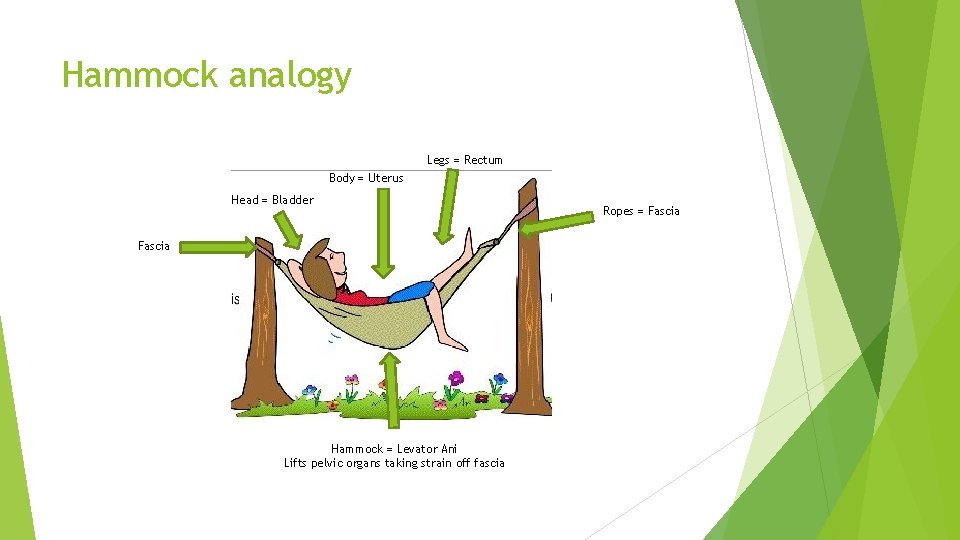
Hammock analogy Legs = Rectum Body = Uterus Head = Bladder Fascia Hammock = Levator Ani Lifts pelvic organs taking strain off fascia Ropes = Fascia
Pelvic Floor Disorders Pelvic Organ Prolapse (POP) Urinary Disorders Bowel disorders Pain disorders
Prolapse
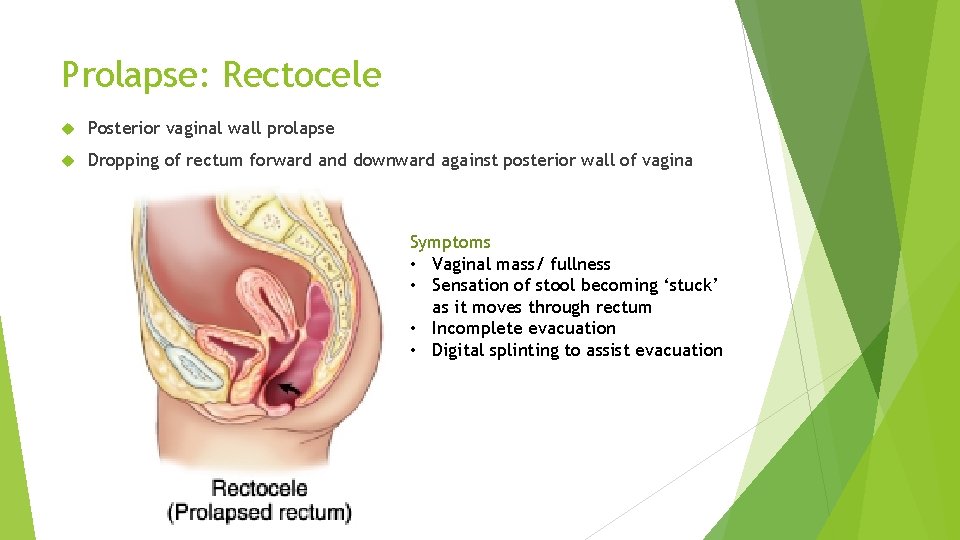
Prolapse: Rectocele Posterior vaginal wall prolapse Dropping of rectum forward and downward against posterior wall of vagina Symptoms • Vaginal mass/ fullness • Sensation of stool becoming ‘stuck’ as it moves through rectum • Incomplete evacuation • Digital splinting to assist evacuation
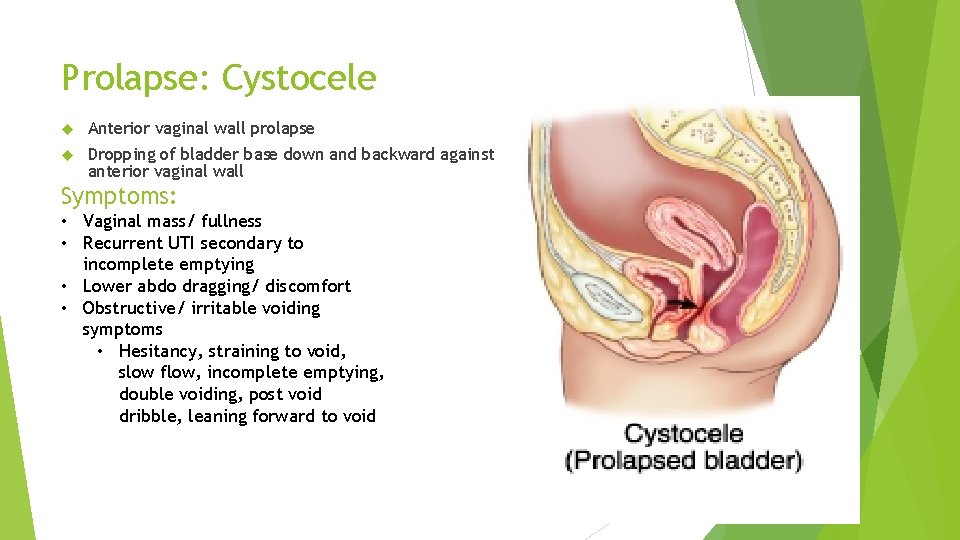
Prolapse: Cystocele Anterior vaginal wall prolapse Dropping of bladder base down and backward against anterior vaginal wall Symptoms: • Vaginal mass/ fullness • Recurrent UTI secondary to incomplete emptying • Lower abdo dragging/ discomfort • Obstructive/ irritable voiding symptoms • Hesitancy, straining to void, slow flow, incomplete emptying, double voiding, post void dribble, leaning forward to void
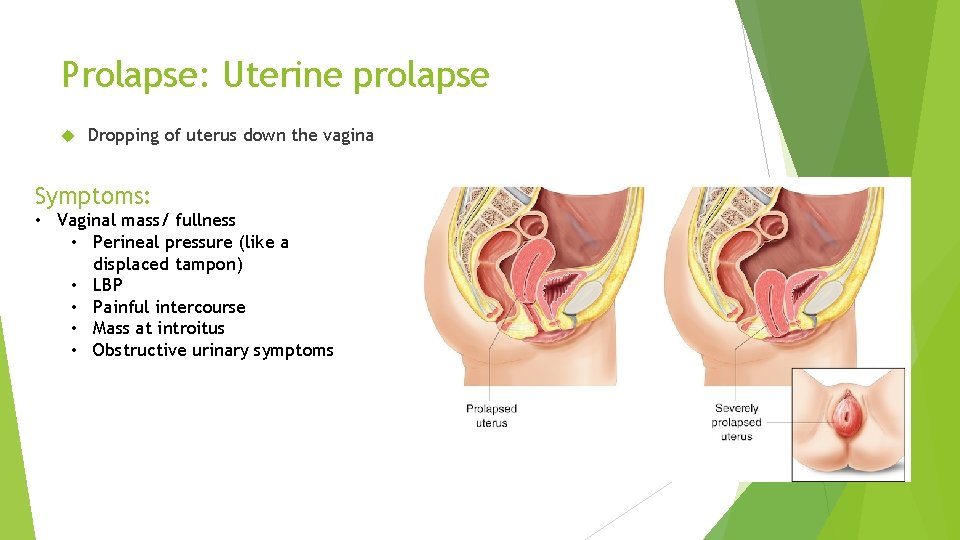
Prolapse: Uterine prolapse Dropping of uterus down the vagina Symptoms: • Vaginal mass/ fullness • Perineal pressure (like a displaced tampon) • LBP • Painful intercourse • Mass at introitus • Obstructive urinary symptoms
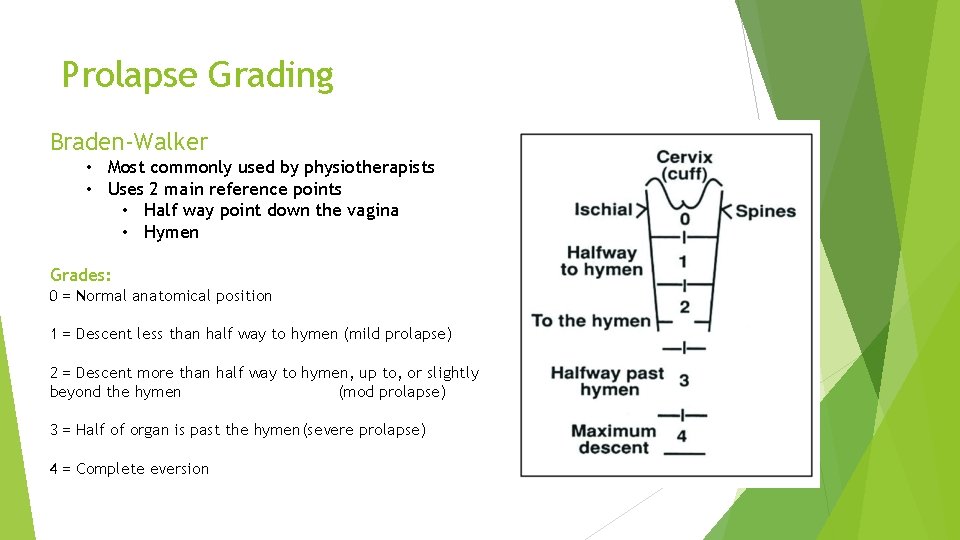
Prolapse Grading Braden-Walker • Most commonly used by physiotherapists • Uses 2 main reference points • Half way point down the vagina • Hymen Grades: 0 = Normal anatomical position 1 = Descent less than half way to hymen (mild prolapse) 2 = Descent more than half way to hymen, up to, or slightly beyond the hymen (mod prolapse) 3 = Half of organ is past the hymen(severe prolapse) 4 = Complete eversion
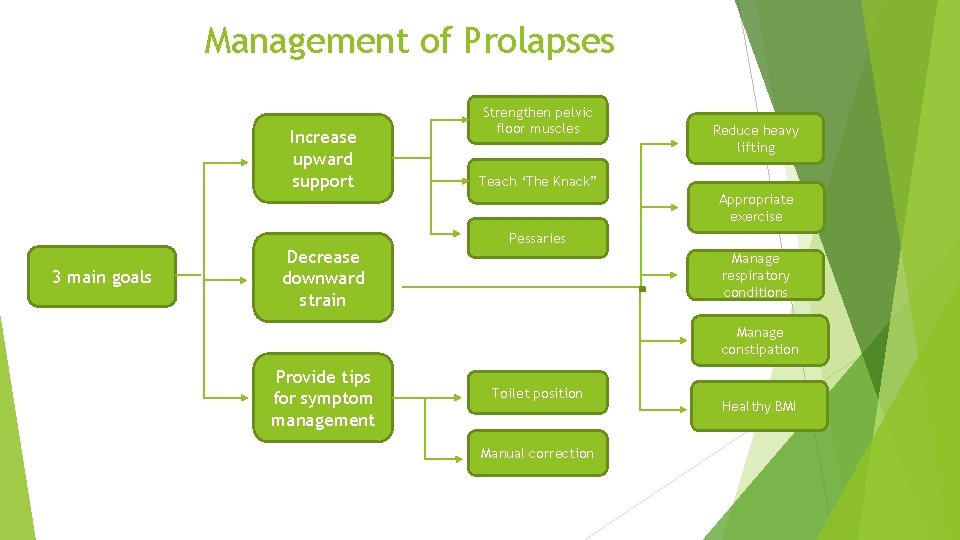
Management of Prolapses Increase upward support Strengthen pelvic floor muscles Reduce heavy lifting Teach ‘The Knack” Appropriate exercise 3 main goals Decrease downward strain Pessaries Manage respiratory conditions Manage constipation Provide tips for symptom management Toilet position Manual correction Healthy BMI
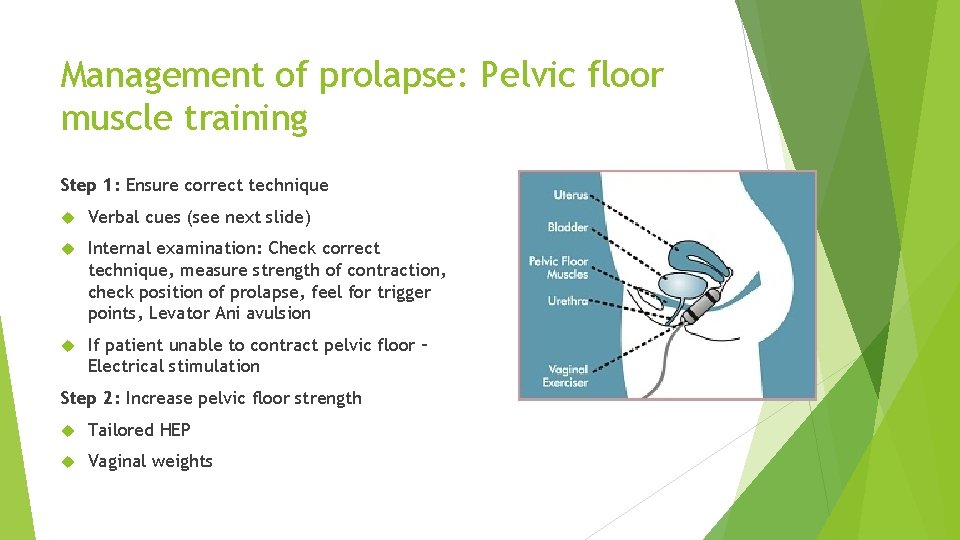
Management of prolapse: Pelvic floor muscle training Step 1: Ensure correct technique Verbal cues (see next slide) Internal examination: Check correct technique, measure strength of contraction, check position of prolapse, feel for trigger points, Levator Ani avulsion If patient unable to contract pelvic floor – Electrical stimulation Step 2: Increase pelvic floor strength Tailored HEP Vaginal weights
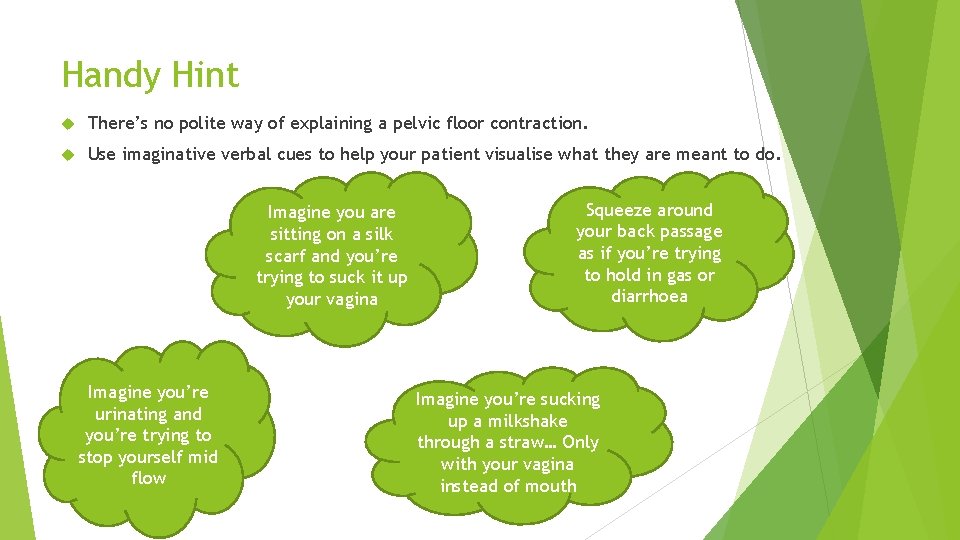
Handy Hint There’s no polite way of explaining a pelvic floor contraction. Use imaginative verbal cues to help your patient visualise what they are meant to do. Imagine you are sitting on a silk scarf and you’re trying to suck it up your vagina Imagine you’re urinating and you’re trying to stop yourself mid flow Squeeze around your back passage as if you’re trying to hold in gas or diarrhoea Imagine you’re sucking up a milkshake through a straw… Only with your vagina instead of mouth
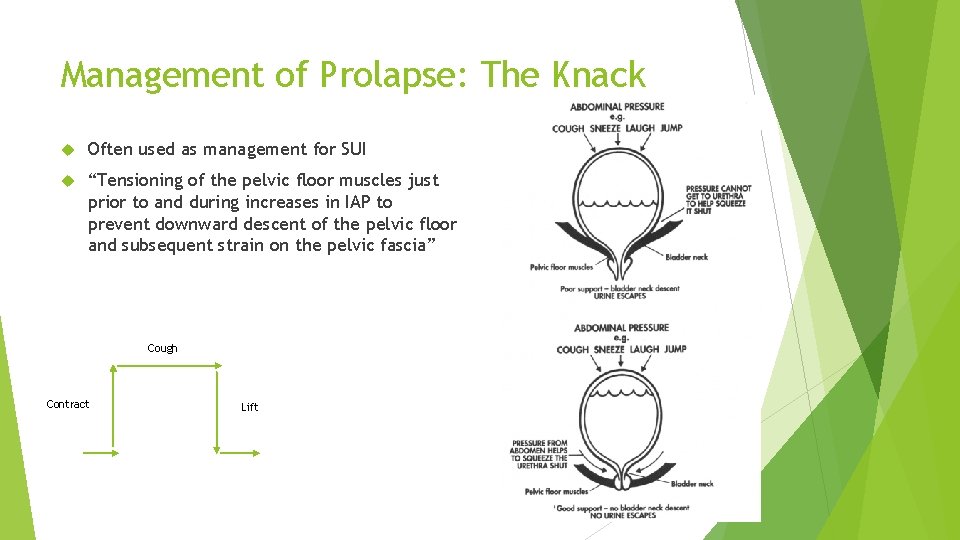
Management of Prolapse: The Knack Often used as management for SUI “Tensioning of the pelvic floor muscles just prior to and during increases in IAP to prevent downward descent of the pelvic floor and subsequent strain on the pelvic fascia” Cough Contract Lift
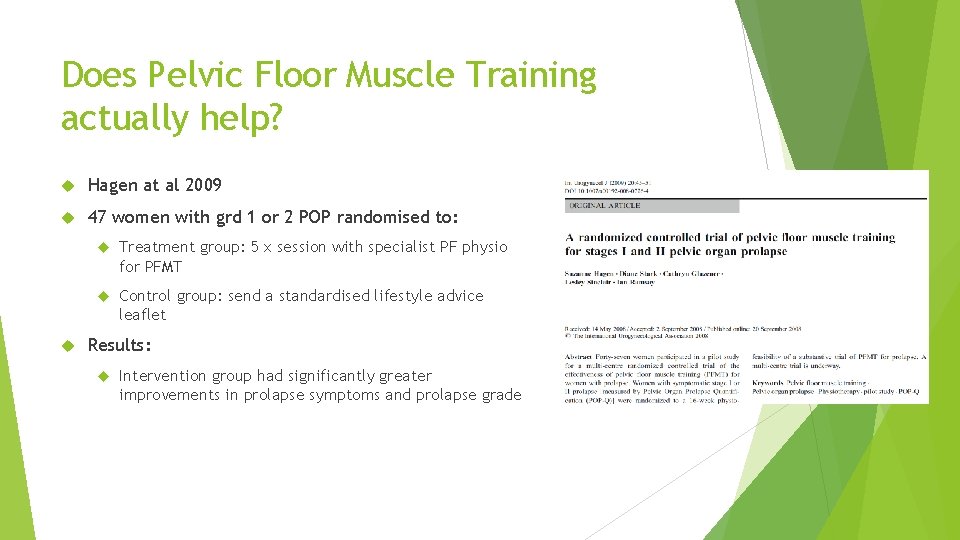
Does Pelvic Floor Muscle Training actually help? Hagen at al 2009 47 women with grd 1 or 2 POP randomised to: Treatment group: 5 x session with specialist PF physio for PFMT Control group: send a standardised lifestyle advice leaflet Results: Intervention group had significantly greater improvements in prolapse symptoms and prolapse grade
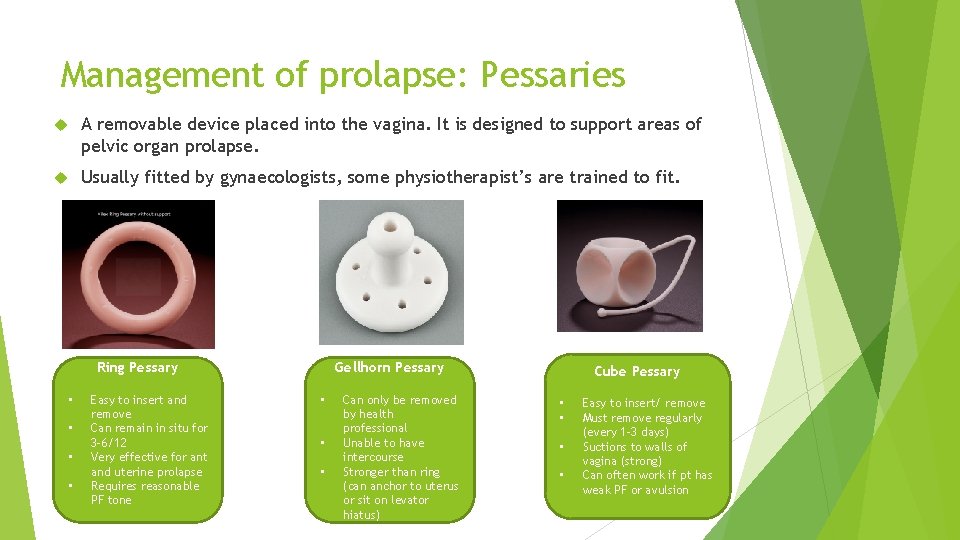
Management of prolapse: Pessaries A removable device placed into the vagina. It is designed to support areas of pelvic organ prolapse. Usually fitted by gynaecologists, some physiotherapist’s are trained to fit. Ring Pessary • • Easy to insert and remove Can remain in situ for 3 -6/12 Very effective for ant and uterine prolapse Requires reasonable PF tone Gellhorn Pessary • • • Can only be removed by health professional Unable to have intercourse Stronger than ring (can anchor to uterus or sit on levator hiatus) Cube Pessary • • Easy to insert/ remove Must remove regularly (every 1 -3 days) Suctions to walls of vagina (strong) Can often work if pt has weak PF or avulsion
Pelvic Floor Disorders Urinary Disorders
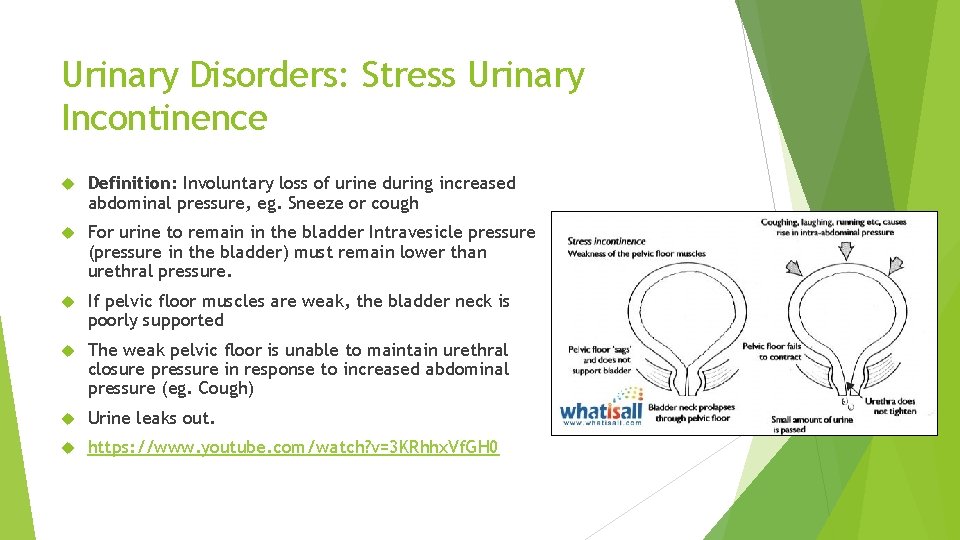
Urinary Disorders: Stress Urinary Incontinence Definition: Involuntary loss of urine during increased abdominal pressure, eg. Sneeze or cough For urine to remain in the bladder Intravesicle pressure (pressure in the bladder) must remain lower than urethral pressure. If pelvic floor muscles are weak, the bladder neck is poorly supported The weak pelvic floor is unable to maintain urethral closure pressure in response to increased abdominal pressure (eg. Cough) Urine leaks out. https: //www. youtube. com/watch? v=3 KRhhx. Vf. GH 0
Management of SUI 1. The knack: Squeeze and lift action of Levator ani provides counteraction to downward IAP – closing compression of urethra 2. Pelvic floor strengthening: Permanent changes to muscle morphology, increased resting tone, increased cross sectional are of the muscle. Teaching the knack is predominantly about improving coordination Level 1 evidence (Cochrane review Dumoulin and Hay-Smith (2010)): Benefits are greatest for women with SUI alone over mixed incontinence 3. Other options Weight loss Oestrogen replacement Artificial supports of urethra
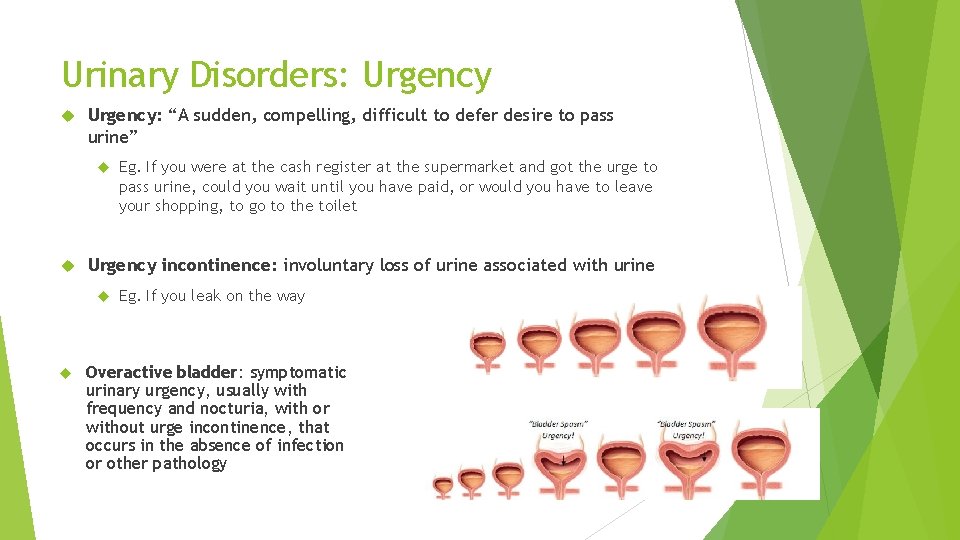
Urinary Disorders: Urgency: “A sudden, compelling, difficult to defer desire to pass urine” Urgency incontinence: involuntary loss of urine associated with urine Eg. If you were at the cash register at the supermarket and got the urge to pass urine, could you wait until you have paid, or would you have to leave your shopping, to go to the toilet Eg. If you leak on the way Overactive bladder: symptomatic urinary urgency, usually with frequency and nocturia, with or without urge incontinence, that occurs in the absence of infection or other pathology
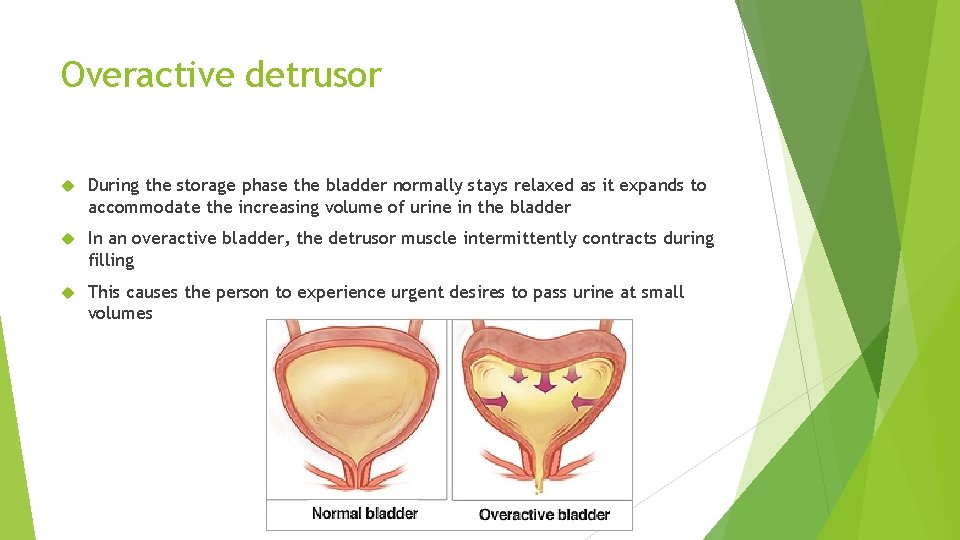
Overactive detrusor During the storage phase the bladder normally stays relaxed as it expands to accommodate the increasing volume of urine in the bladder In an overactive bladder, the detrusor muscle intermittently contracts during filling This causes the person to experience urgent desires to pass urine at small volumes
Management of urgency/ OAB Patient Education: Understanding OAB Lifestyle advice: fluid management Bladder irritants Bowel management Retraining Programs Behaviour retraining Trigger retraining Bladder retraining
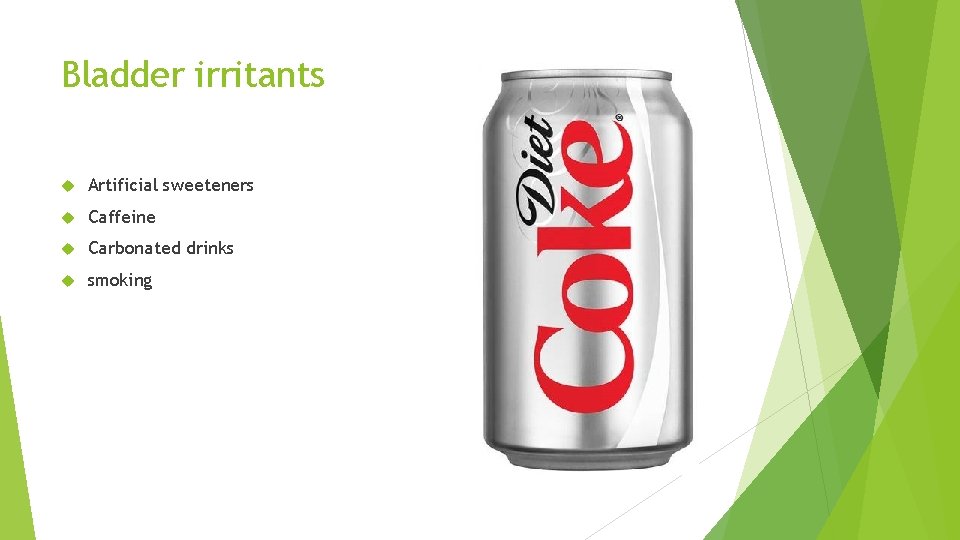
Bladder irritants Artificial sweeteners Caffeine Carbonated drinks smoking
Retraining Programs Behaviour retraining
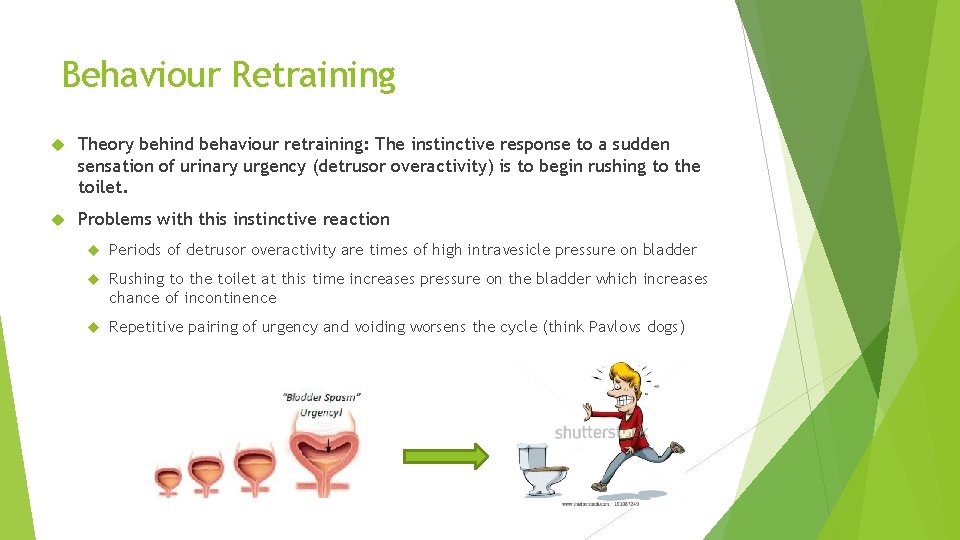
Behaviour Retraining Theory behind behaviour retraining: The instinctive response to a sudden sensation of urinary urgency (detrusor overactivity) is to begin rushing to the toilet. Problems with this instinctive reaction Periods of detrusor overactivity are times of high intravesicle pressure on bladder Rushing to the toilet at this time increases pressure on the bladder which increases chance of incontinence Repetitive pairing of urgency and voiding worsens the cycle (think Pavlovs dogs)
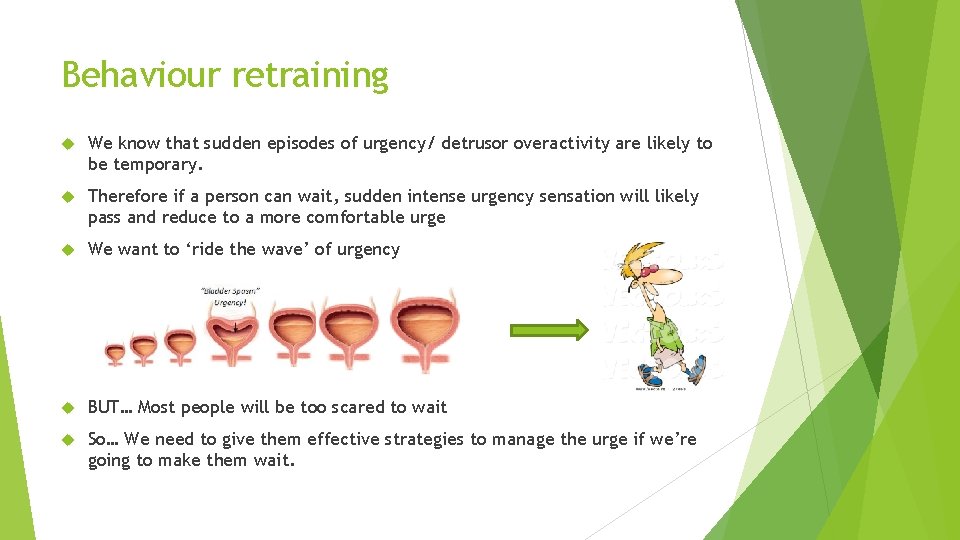
Behaviour retraining We know that sudden episodes of urgency/ detrusor overactivity are likely to be temporary. Therefore if a person can wait, sudden intense urgency sensation will likely pass and reduce to a more comfortable urge We want to ‘ride the wave’ of urgency BUT… Most people will be too scared to wait So… We need to give them effective strategies to manage the urge if we’re going to make them wait.
4 known urge suppression reflexes Activation of posterior tibial nerve Inhibition of detrusor via voluntary guarding reflex Voluntary pelvic floor contraction Facilitation of frontal lobe Toe curling and calf contraction Distraction techniques Pressure on dorsal clitoral nerve of perineum Application of pressure to the perineum
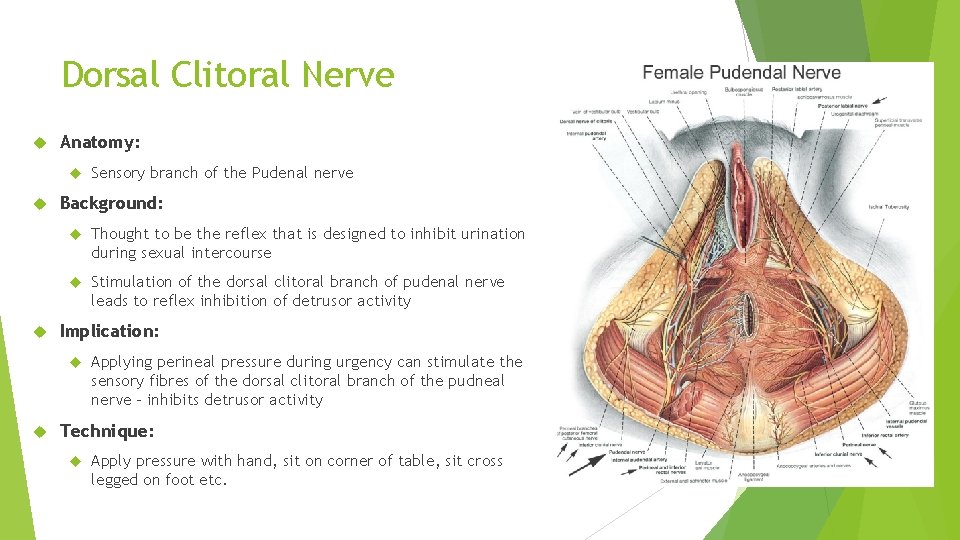
Dorsal Clitoral Nerve Anatomy: Background: Thought to be the reflex that is designed to inhibit urination during sexual intercourse Stimulation of the dorsal clitoral branch of pudenal nerve leads to reflex inhibition of detrusor activity Implication: Sensory branch of the Pudenal nerve Applying perineal pressure during urgency can stimulate the sensory fibres of the dorsal clitoral branch of the pudneal nerve – inhibits detrusor activity Technique: Apply pressure with hand, sit on corner of table, sit cross legged on foot etc.
Posterior Tibial Nerve Inhibitory Reflex Anatomy: Posterior Tibial nerve has mix of m otor and sensory fibres Motor fibres cause ankle and toe movements (plantaflexion, toe curling, calf contraction) Sensory fibres project from these muscles and enter the spinal cord at S 2. It is thought that some sensory fibres from the Bladder also enter the SC at S 2. Implications: Activation of these sensory fibres via calf contraction and toe curling may inhibit the passage of messages to and from the bladder (pain gate theory) Technique: Calf pumps, toe curling
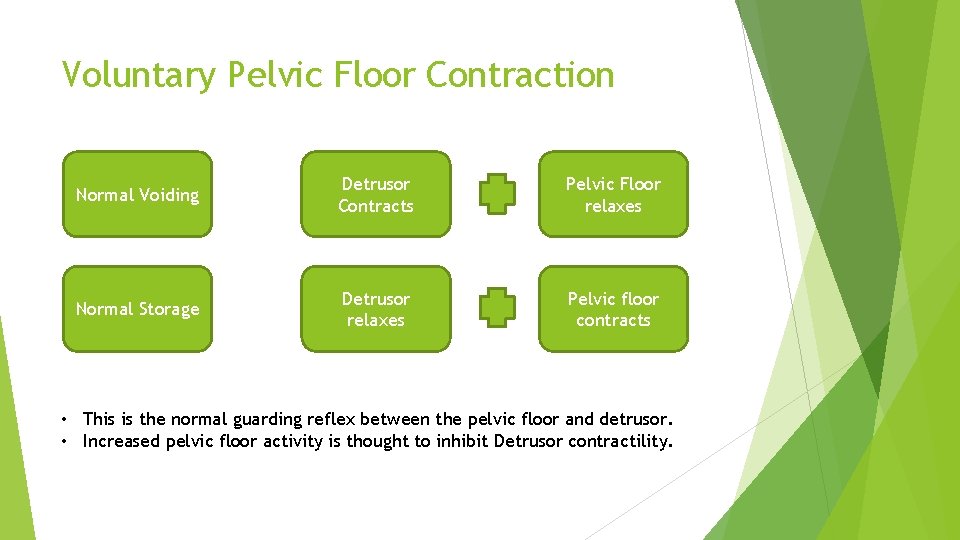
Voluntary Pelvic Floor Contraction Normal Voiding Detrusor Contracts Pelvic Floor relaxes Normal Storage Detrusor relaxes Pelvic floor contracts • This is the normal guarding reflex between the pelvic floor and detrusor. • Increased pelvic floor activity is thought to inhibit Detrusor contractility.
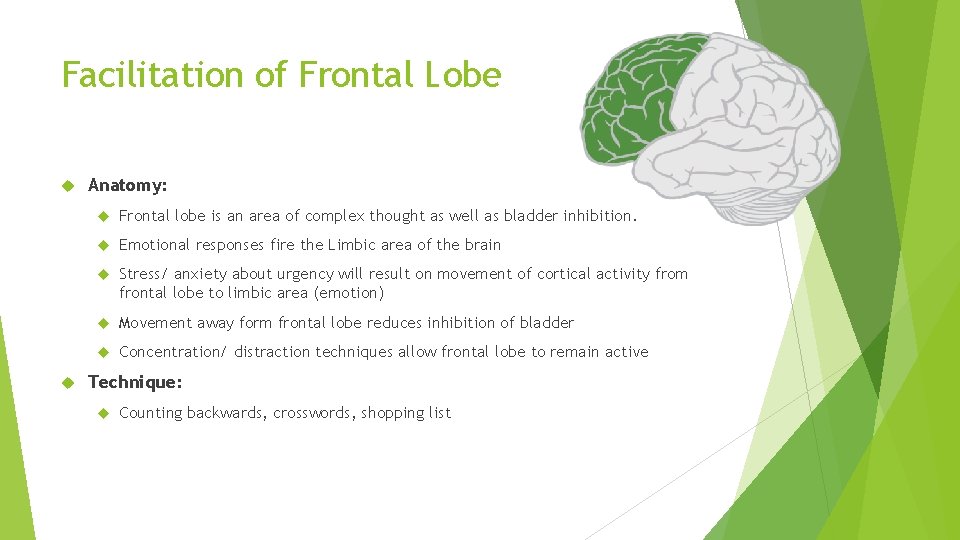
Facilitation of Frontal Lobe Anatomy: Frontal lobe is an area of complex thought as well as bladder inhibition. Emotional responses fire the Limbic area of the brain Stress/ anxiety about urgency will result on movement of cortical activity from frontal lobe to limbic area (emotion) Movement away form frontal lobe reduces inhibition of bladder Concentration/ distraction techniques allow frontal lobe to remain active Technique: Counting backwards, crosswords, shopping list
Pelvic Floor Disorders Pain disorders
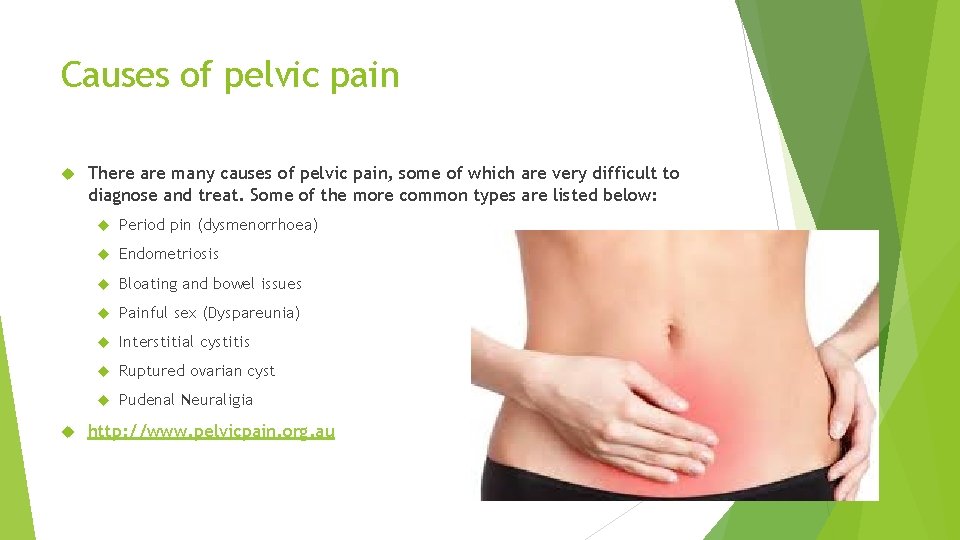
Causes of pelvic pain There are many causes of pelvic pain, some of which are very difficult to diagnose and treat. Some of the more common types are listed below: Period pin (dysmenorrhoea) Endometriosis Bloating and bowel issues Painful sex (Dyspareunia) Interstitial cystitis Ruptured ovarian cyst Pudenal Neuraligia http: //www. pelvicpain. org. au
Pelvic floor muscle spasm For people with stabbing pelvic pain and painful sex, often the cause is overactive pelvic floor muscles. The only way to ascertain if someone has an overactive pelvic floor is via internal examination. Useful treatments: Soft tissue/ trigger point release by physiotherapist Using heat (eg. Hot bath) when spasm occur to relax the muscles Avoid core exercises (eg pilates) as may aggrevate symptoms Treat other causes of pain so there is less need to hold muscles tightly. Pelvic floor relaxation techniques https: //www. pelvicexercises. com. au/pelvic-floor-relaxation-exercises/ https: //www. youtube. com/watch? v=JZtb 6 ZDDQ 2 g If so severe that internal examination is difficult, Botox injection may be appropriate.
Clinical Note! Clinical Note: If someone has an overactive pelvic floor and is told to do pelvic floor exercises, it could make things worse! Always get the patient’s pelvic floor assessed first.
Take Home Messages The pelvic floor is a complex web of muscle and fascia and is important in maintaining continence and supporting the pelvic organs The pelvic floor plays a major role in many conditions such as pelvic organ prolapse, stress urinary incontinence, urgency and urge incontinence, and pelvic pain. Hence it should always be assessed and included in the treatment plan. Ensure internal examination’s are done for accurate diagnosis and tailored treatment programs.
Useful Resources http: //www. pelvicpain. org. au http: //www. womenshealthtrainingassociates. com/ https: //www. continence. org. au/ https: //www. pelvicexercises. com. au/
Acknowledgements Taryn Hallam: Principal Lecturer Women’s Health Training Associates http: //www. pelvicpain. org. au