
The PEAR Friday 2 November 2012 The process

The PEAR Friday 2 November 2012
The process approach • To understand PEARs you must first understand the process approach. • This approach isn’t new to QMS and has been around since ISO 9001: 2000, this has been further developed with the advent of ISO 9001: 2008 and AS 9100 Rev C. • Also AS 9101 D has developed the process further using the Process Effectiveness Assessment Report – The PEAR
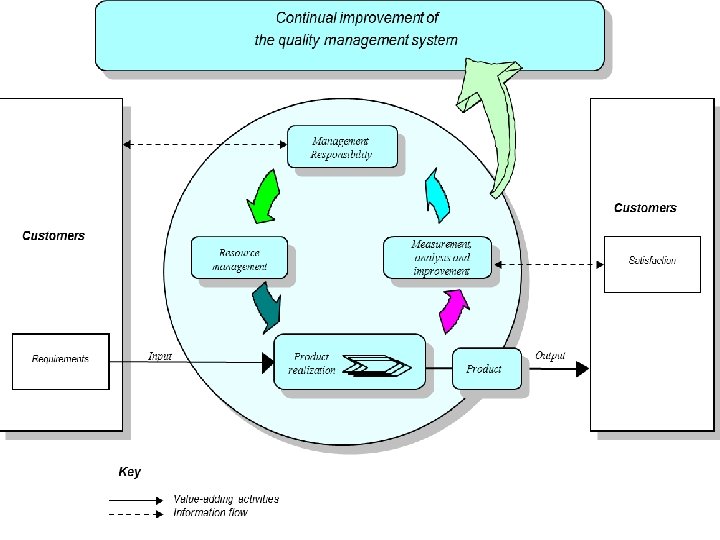
Process Approach Model
Process Performance • 0. 2 Process approach (ISO 9001: 2008) – NOTE In addition, the methodology known as «Plan-Do-Check-Act» (PDCA) can be applied to all Processes. PDCA can be briefly described as follows. – Plan: establish the objectives and Processes necessary to deliver results in accordance with customer requirements and the organisation's policies. – Do: implement the Processes. – Check: monitor and measure Processes and Product against policies, objectives and requirements for the Product and report the results. – Act: take actions to continually improve Process performance.

What does 9101 D say about the PEAR? 3. 7 Process Effectiveness Assessment Report (PEAR) – A document stating results and providing evidence of determination on the effectiveness of a process. • The PEAR is also discussed in clauses 4. 1. 2. 4 and 4. 1. 2. 5
What does 9101 D say about the PEAR? • 4. 1. 2. 4 Process Management – The audit team should conduct quality management system audits using a method that focuses on process performance and effectiveness; this ensures that priority is given to the following: a. b. c. d. e. f. reviewing the organization’s processes, their sequence and interactions, and performance against requirements and defined measures, with focus on processes that directly impact the customer; reviewing the process based management techniques, including the examination of process controls (e. g. , quality, takt time, cycle time, output effectiveness, control limits, process capability determination); reviewing the process objectives/targets, with focus on areas where objectives/targets have not been achieved and on issues that have the greatest impact on the customer(s); reviewing plans in place to ensure performance objectives/targets are met; reviewing applicable corrective action plans in place where objectives/targets are not met; and pursuing audit trails addressing customer concerns or requests for corrective actions, performance against objectives, and relevant process controls.
What does 9101 D say about the PEAR? • 4. 1. 2. 4 Process Management (Cont. ) – The audit team should pursue process based audit trails by following actual products, customer orders, and related documents (e. g. , customer contracts, drawings, shop orders, inspection records) through the organization’s product realization and associated processes; verifying the interfaces between processes and the linked documentation requirements (see 9100 -series standards clause 4. 2); resource management (see 9100 -series standards clause 6); and measurement, analysis, and improvement (see 9100 series standards clause 8).

What is a PEAR? 4. 1. 2. 5 Process Performance and Effectiveness • • The audit team should audit processes to sufficient depth and detail to evaluate if the organization’s processes are capable of meeting planned results and performance levels, including applicable customer specific targets. NOTE 1: Key Performance Indicators (KPIs) are often used to identify organizational emphasis areas and acceptable performance levels.
What does 9101 D say about the PEAR? 4. 1. 2. 5 Process Performance and Effectiveness • The audit team should evaluate, as appropriate, that processes: a. b. • NOTE 2: Often the output from one process directly forms the input to the next (see 9100 -series standards, clause 0. 2 Process Approach). c. d. e. f. g. h. • are identified and appropriately defined; are sequenced and interactions are defined (see 9100 -series standards, clause 4. 1. b); have responsibilities assigned and responsible functions identified; have relevant process controls defined; have the availability of resources and information required to operate and support associated activities, including appropriate training and competency of personnel; are monitored, measured, and analyzed against planned results (determination of process effectiveness); have actions implemented to achieve planned results and to promote continual improvement; and are effective in achieving the desired results (e. g. , verify performance information available - percentage of nonconforming parts/products, percentage OTD). NOTE 3: Planned results can be related to process outputs or the associated activities.
What is a PEAR • All third party auditors need to successfully complete the AATT Course which includes guidance on PEARs, there is also an IAQG online course covering PEARs and NCRs. • This will be included in the updated AATT course at the next revision which will coincide with the release of AS 9101 E
Process Effectiveness Assessment Report (PEAR) • During your audit the level of effectiveness will be recorded on the PEAR for each of your audited product realization processes. (Enquiries/Contract Review/NPI/Design/Purchasing/Manufacturing) • Non-conformances will be raised against clauses 4. 1. c and f on process that are not effective or are not supported by actions with defined responsibilities and timescales.

Process Performance • Therefore for a company to fully address AS 9100 requirements: – All the Product Realisation processes and their interaction needs to be defined – Process performance indicators to measure process performance need to be defined – There must be a review process • If we take each of the above

Process Performance • Product Realisation processes and their interaction:
Defining and implementing your Process Performance KPI’s • A simple way to do this is with a KPI matrix, which can be used to identify the following: – – – – – Measurable Frequency of measure Owner (Department that owns the measure) Responsible Source of the data Method of Calculation Target Type of Chart Where reported
Defining and implementing your KPI’s • We have developed the business plan objectives and completed the KPI Matrix identify the following: – – – – – Measurable Frequency of measure Owner (Department that owns the measure) Responsible Source of the data Method of Calculation Target Type of Chart Where reported
KPI’s • KPI’s can be categorised as: – Customer Focus KPI’s, e. g. -To measure customer satisfaction – Operational KPI’s - To measure manufacturing performance and H&S – Supplier KPI’s - To measure supplier performance
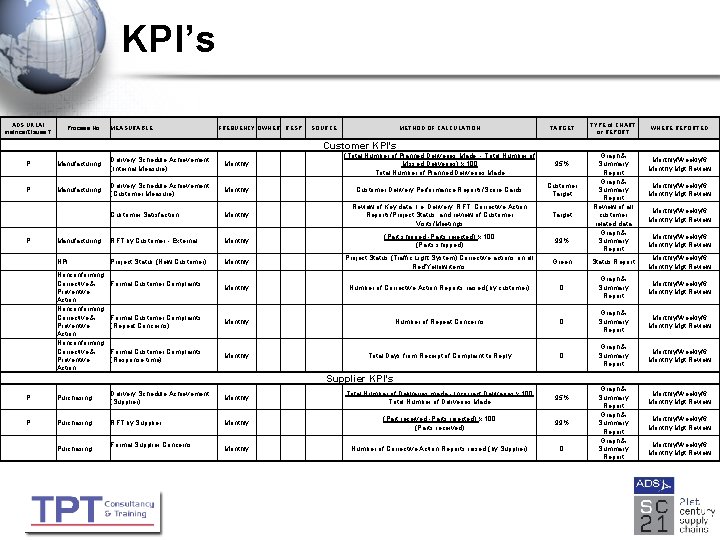
KPI’s ADS UKLAI metrics/Clause 7 Process No MEASURABLE FREQUENCY OWNER RESP SOURCE METHOD OF CALCULATION TARGET TYPE of CHART or REPORT WHERE REPORTED Customer KPI's Monthly (Total Number of Planned Deliveries Made - Total Number of Missed Deliveries) x 100 Total Number of Planned Deliveries Made 95% Graph & Summary Report Review of all customer related data Graph & Summary Report P Manufacturing Delivery Schedule Achievement (Internal Measure) P Manufacturing Delivery Schedule Achievement (Customer Measure) Monthly Customer Delivery Performance Reports/Score Cards Customer Target Customer Satisfaction Monthly Review of Key data, I. e. Delivery, RFT, Corrective Action Reports/Project Status, and review of Customer Visits/Meetings Target P Manufacturing RFT by Customer - External Monthly (Part shipped -Parts rejected) x 100 (Parts shipped) 99% NPI Project Status (New Customer) Monthly Project Status (Traffic Light System) Corrective actions on all Red/Yellow items. Green Status Report Monthly/Weekly/6 Monthly Mgt Review Monthly Number of Corrective Action Reports raised (by customer) 0 Graph & Summary Report Monthly/Weekly/6 Monthly Mgt Review Formal Customer Complaints (Repeat Concerns) Monthly Number of Repeat Concerns 0 Graph & Summary Report Monthly/Weekly/6 Monthly Mgt Review Formal Customer Complaints (Response time) Monthly Total Days from Receipt of Complaint to Reply 0 Graph & Summary Report Monthly/Weekly/6 Monthly Mgt Review Nonconforming Corrective & Preventive Action Formal Customer Complaints Monthly/Weekly/6 Monthly Mgt Review Supplier KPI's P Purchasing Delivery Schedule Achievement (Supplier) P Purchasing RFT by Supplier Purchasing Formal Supplier Concerns Monthly Total Number of Deliveries made - Incorrect Deliveries x 100 Total Number of Deliveries Made 95% Monthly (Part received -Parts rejected) x 100 (Parts received) 99% Monthly Number of Corrective Action Reports raised (by Supplier) 0 Graph & Summary Report Monthly/Weekly/6 Monthly Mgt Review
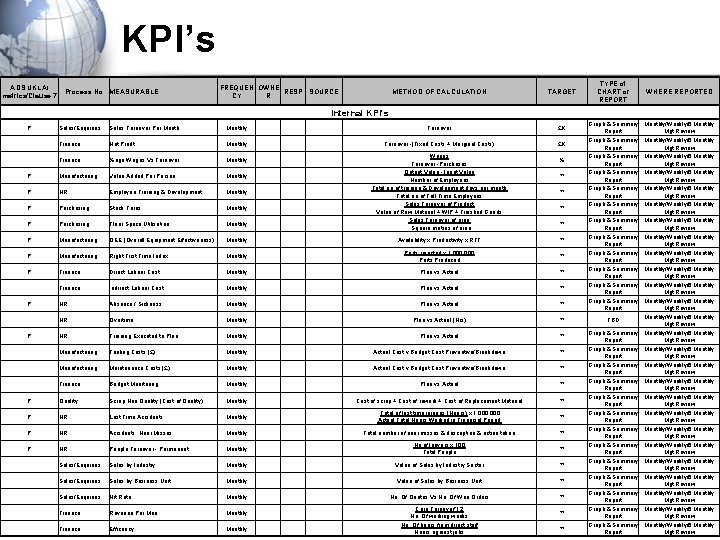
KPI’s ADS UKLAI metrics/Clause 7 Process No MEASURABLE FREQUEN OWNE RESP SOURCE CY R METHOD OF CALCULATION TARGET TYPE of CHART or REPORT WHERE REPORTED Internal KPI's P Sales/Enquiries Sales Turnover Per Monthly Turnover £K Finance Net Profit Monthly Turnover -(Fixed Costs + Marginal Costs) £K Wages Turnover -Purchases Output Value - Input Value Number of Employees Total no of training & Development days per month Total no of Full Time Employees Sales Turnover of Product Value of Raw Material + WIP + Finished Goods Sales Turnover of area Square metres of area Finance %age Wages Vs Turnover Monthly % P Manufacturing Value Added Person Monthly P HR Employee Training & Development Monthly P Purchasing Stock Turns Monthly P Purchasing Floor Space Utilisation Monthly P Manufacturing OEE (Overall Equipment Effectiveness) Monthly Availability x Productivity x RFT "" "" "" P Manufacturing Right First Time Index Monthly Parts rejected x 1, 000 Parts Produced P Finance Direct Labour Cost Monthly Plan vs Actual "" Finance Indirect Labour Cost Monthly Plan vs Actual "" P HR Absence / Sickness Monthly Plan vs Actual "" HR Overtime Monthly Plan vs Actual (Hrs) "" P HR Training Executed to Plan Monthly Plan vs Actual "" Manufacturing Tooling Costs (£) Monthly Actual Cost v Budget Cost Preventive/Breakdown "" Manufacturing Maintenance Costs (£) Monthly Actual Cost v Budget Cost Preventive/Breakdown "" Finance Budget Monitoring Monthly Plan vs Actual "" P Quality Scrap Non Quality (Cost of Quality) Monthly Cost of scrap + Cost of rework + Cost of Replacement Material "" "" P HR Lost Time Accidents Monthly Total of lost time injuries (Hours) x 1, 000 Actual Total Hours Worked in Financial Period P HR Accidents, Near Misses Monthly Total number of near misses & description & action taken "" "" P HR People Turnover - Permanent Monthly No of leavers x 100 Total People Sales/Enquiries Sales by Industry Monthly Value of Sales by Industry Sector "" Sales/Enquiries Sales by Business Unit Monthly Value of Sales by Business Unit "" Sales/Enquiries Hit Rate Monthly No. Of Quotes Vs No. Of Won Orders "" Finance Revenue Per Man Monthly Finance Efficency Monthly Core Turnover*12 No. Of working weeks No. Of hours from direct staff Hours against jobs "" "" Graph & Summary Report Graph & Summary Report Graph & Summary Report TBD Graph & Summary Report Graph & Summary Report Graph & Summary Report Graph & Summary Report Monthly/Weekly/6 Monthly Mgt Review Monthly/Weekly/6 Monthly Mgt Review Monthly/Weekly/6 Monthly Mgt Review Monthly/Weekly/6 Monthly Mgt Review Monthly/Weekly/6 Monthly Mgt Review Monthly/Weekly/6 Monthly Mgt Review Monthly/Weekly/6 Monthly Mgt Review
Defining and implementing your KPI’s • The next step is to Plan the calendar for the meetings, examples below: – – – Quarterly Directors Meeting Monthly Management Meeting Weekly Production Meeting Monthly Safety Meeting and, the Monthly Quality Meeting

Typical Meeting Agenda


Meeting Action Log
Summary • For the KPI’s to be successfully implemented they must be: – – – Relevant to the business Supported by senior management team Have clear ownership Realistic targets Be reviewed on a Weekly, Monthly and Quarterly basis When target is not being achieved the root cause identified and corrective actions implemented – When required, support is given to achieve the goals
How to identify Performance Measure • From an audit perspective, it’s quite easy to identify the Performance Measure, note this should be done at Stage 1: – – – Is there a list of processes and their interaction Is the process addressing product realisation Is the process owner defined Is there a target Is there a review process



• Any Questions
- Slides: 29