
The pblock elements Made By Manas Mahajan Position
The p-block elements Made By – Manas Mahajan
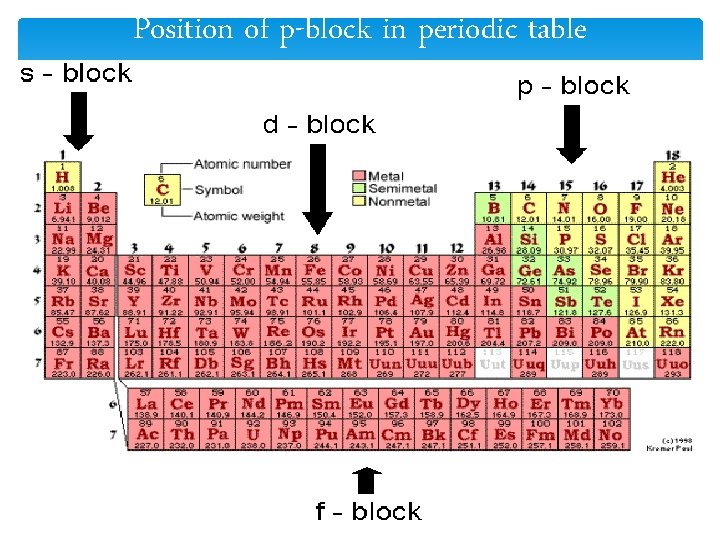
Position of p-block in periodic table
What are p-block elements? p-block elements are the elements in which the last electron enters ‘np’ orbital which include six groups of elements i. e. group 13 to 18 boron family, carbon family, pnicogens, chalcogens, halogens and noble gases.
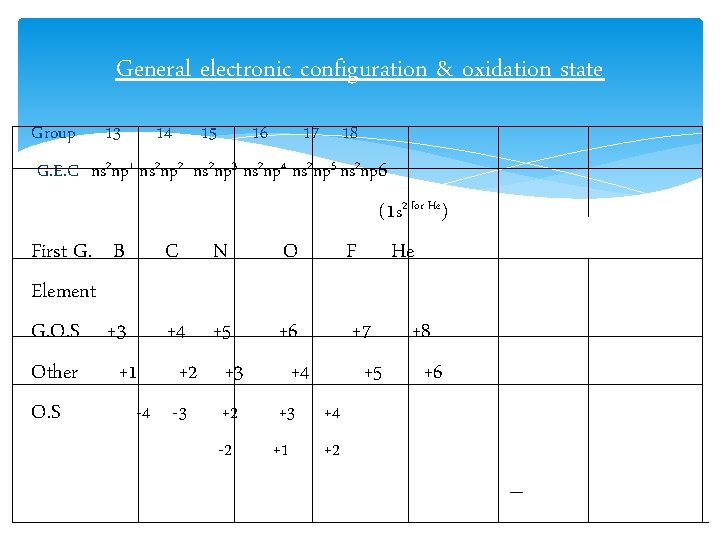
General electronic configuration & oxidation state Group 13 14 15 16 17 18 G. E. C ns 2 np 1 ns 2 np 2 ns 2 np 3 ns 2 np 4 ns 2 np 5 ns 2 np 6 First G. B C Element G. O. S +3 +4 Other +1 +2 O. S -4 -3 N O (1 s 2 for He) F He +5 +3 +6 +4 +7 +5 +2 +3 +4 -2 +1 +2 +8 +6
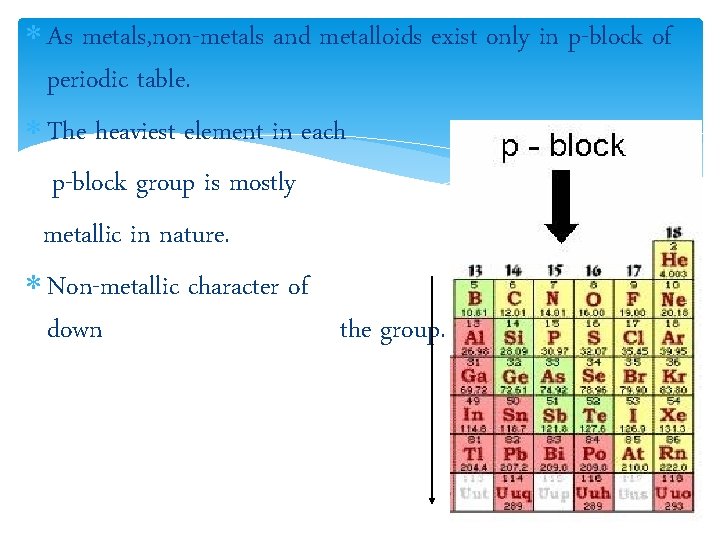
As metals, non-metals and metalloids exist only in p-block of periodic table. The heaviest element in each p-block group is mostly metallic in nature. Non-metallic character of elements decreases down the group.
Non metals have higher ionization enthalpy and electronegetivity than the metals. Hence metals form cations, and non metals form anions. Compounds formed between non metals are largely covalent in nature, while the compounds formed by highly reactive non-metal and metal have large difference in electronegativities.
p-block elements differ… Size and all the properties of size because of this the lightest p-block elements show the same kind of differences as the lightest s-block element i. e. lithium and beryllium. Elements starting from boron are restricted to maximum covalence of four (using 2 s and three 2 p orbitals).
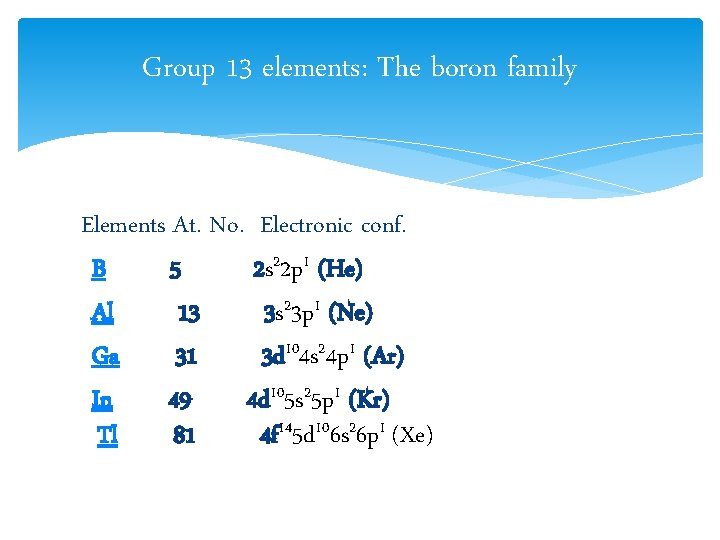
Group 13 elements: The boron family Elements At. No. Electronic conf. B 5 2 s 22 p 1 (He) Al 13 3 s 23 p 1 (Ne) Ga 31 3 d 104 s 24 p 1 (Ar) In 49 4 d 105 s 25 p 1 (Kr) Tl 81 4 f 145 d 106 s 26 p 1 (Xe)
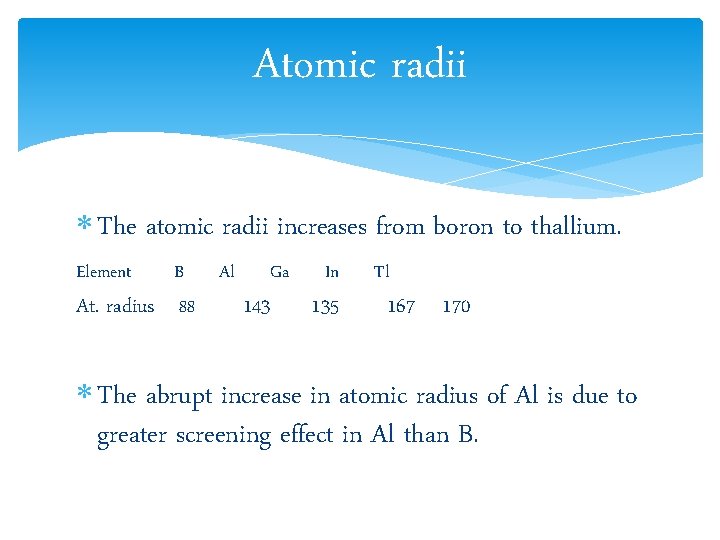
Atomic radii The atomic radii increases from boron to thallium. Element B At. radius 88 Al Ga 143 In 135 Tl 167 170 The abrupt increase in atomic radius of Al is due to greater screening effect in Al than B.
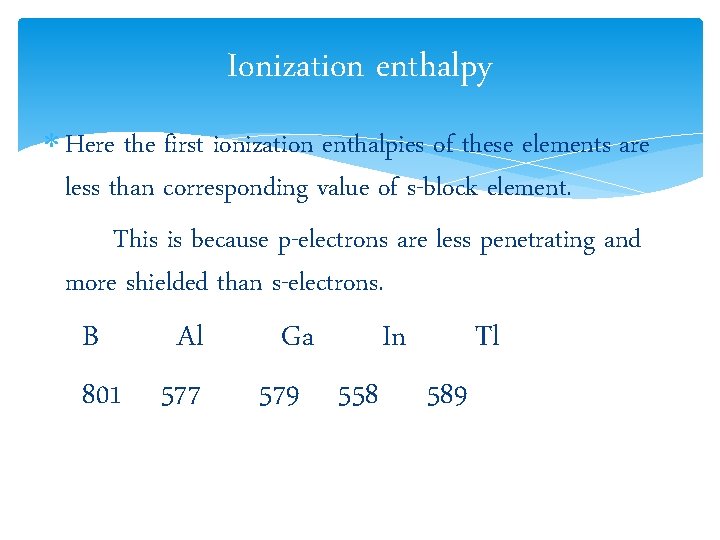
Ionization enthalpy Here the first ionization enthalpies of these elements are less than corresponding value of s-block element. This is because p-electrons are less penetrating and more shielded than s-electrons. B Al 801 577 Ga In Tl 579 558 589
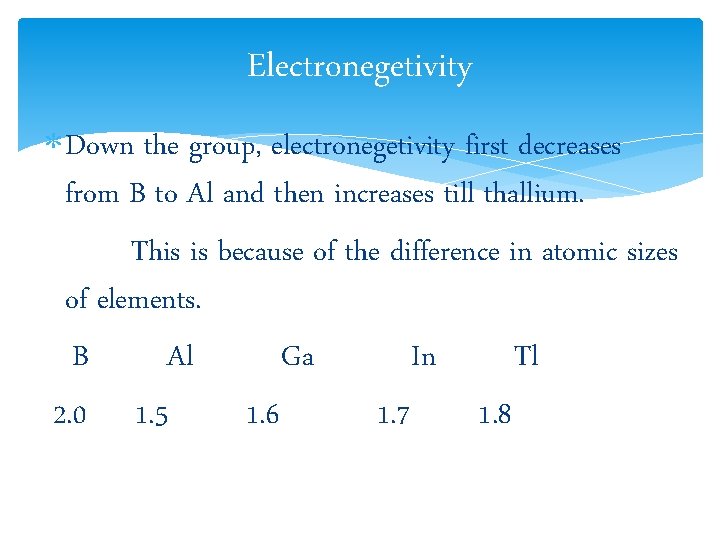
Electronegetivity Down the group, electronegetivity first decreases from B to Al and then increases till thallium. This is because of the difference in atomic sizes of elements. B Al Ga In Tl 2. 0 1. 5 1. 6 1. 7 1. 8
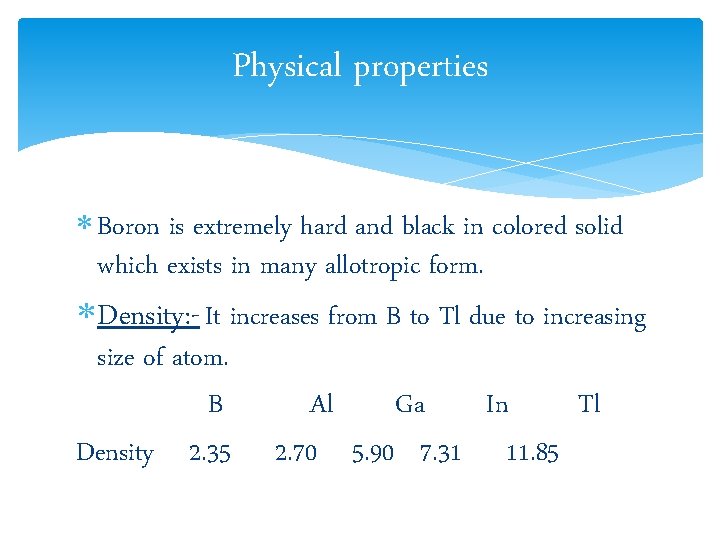
Physical properties Boron is extremely hard and black in colored solid which exists in many allotropic form. Density: - It increases from B to Tl due to increasing size of atom. B Al Ga In Tl Density 2. 35 2. 70 5. 90 7. 31 11. 85
Metallic character: -The elements of boron family are less metallic or electropositive as compared to group 2. On moving down the group, the metallic character increases initially from B to Al but decreases from Al to Tl.
Oxidation states: - The elements of boron family have ns 2 np 1 configuration which means that they have 3 valance electron available for bond formation. By loosing these electrons they are accepted to show +3 oxidation states in there compounds.
Chemical Properties Of Group 13
Introduction 1)Group 13 elements and their uses 2)Boron – Electronic structure Chemical properties 3)Aluminium- Structure and properties 4) Equations 5) Concluion
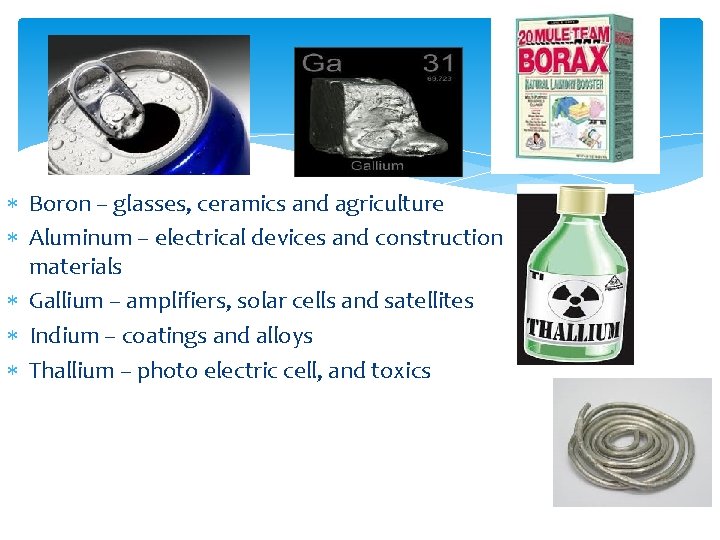
Boron – glasses, ceramics and agriculture Aluminum – electrical devices and construction materials Gallium – amplifiers, solar cells and satellites Indium – coatings and alloys Thallium – photo electric cell, and toxics
Boron • Electronic structure – 1 s 2 2 p 1 Atomic radius – 90 pm. • Due to this relatively small size of boron, the sum of its first three ionization enthalpies is very high. • This prevents it to form 3+ ions and forces it to form only covalent compounds. • In the trivalent state, boron can be called as electron deficient as it will have only 6 electrons in its outer most orbit. Thus, Boron has a tendency to accept a lone pair of electrons from another compound to become stable. • This property also makes the compound a Lewis acid.
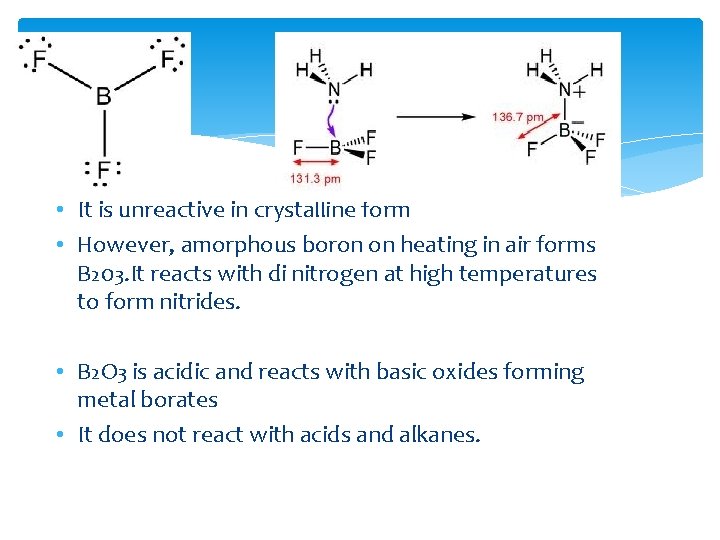
• It is unreactive in crystalline form • However, amorphous boron on heating in air forms B 203. It reacts with di nitrogen at high temperatures to form nitrides. • B 2 O 3 is acidic and reacts with basic oxides forming metal borates • It does not react with acids and alkanes.
Aluminum and other group 13 elements • Sum of the first three ionization enthalpies is less, as compared to Boron. Thus, it due to the easy tendency to lose electrons It is able to form Al 3+. • In the other elements, due to poor shielding effect of d and f orbitals, the nucleus holds the outer most s electrons tightly. Thus, only p bonding may be available for bonding. • In all 3 elements, both +1 and +3 oxidation states are seen. • The compounds in +1 state are more ionic than those in +3 state.
Aluminum forms a very thin oxide layer. With di nitrogen at high temperatures they form nitrides. It dissolves in mineral acids and aqueous alkalies and thus show amphoteric character. All the group 13 elements except thallium show reactivity towards halogens.
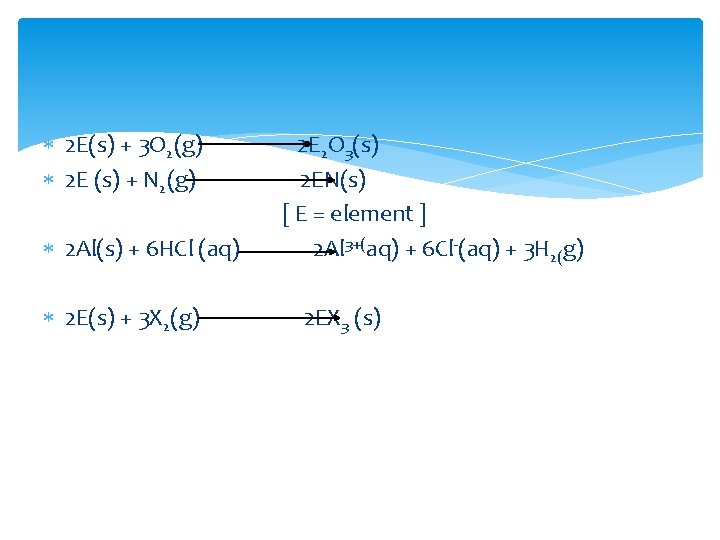
2 E(s) + 3 O 2(g) 2 E (s) + N 2(g) 2 Al(s) + 6 HCl (aq) 2 E(s) + 3 X 2(g) 2 E 2 O 3(s) 2 EN(s) [ E = element ] 2 Al 3+(aq) + 6 Cl-(aq) + 3 H 2(g) 2 EX 3 (s)
Conclusion We have learnt the far and wide reaching applications of all the group 13 elements. We learnt the chemical properties of boron, and aluminium in detail, how they form compounds with other elements their structures; and their reactivity with certain substances.
BORON AND ITS COMPOUNDS
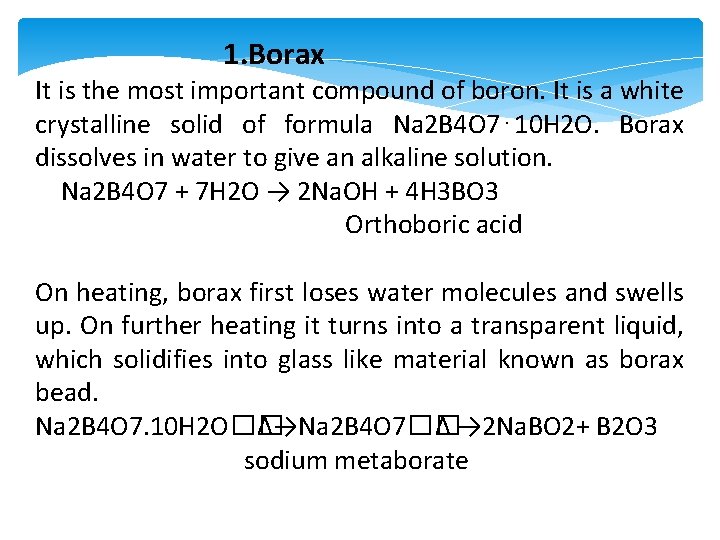
1. Borax It is the most important compound of boron. It is a white crystalline solid of formula Na 2 B 4 O 7⋅10 H 2 O. Borax dissolves in water to give an alkaline solution. Na 2 B 4 O 7 + 7 H 2 O → 2 Na. OH + 4 H 3 BO 3 Orthoboric acid On heating, borax first loses water molecules and swells up. On further heating it turns into a transparent liquid, which solidifies into glass like material known as borax bead. Na 2 B 4 O 7. 10 H 2 O�� Δ→Na 2 B 4 O 7�� Δ → 2 Na. BO 2+ B 2 O 3 sodium metaborate
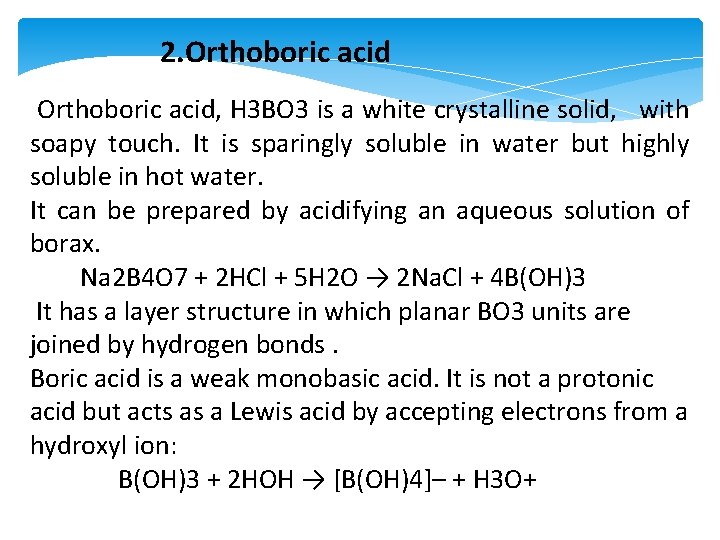
2. Orthoboric acid, H 3 BO 3 is a white crystalline solid, with soapy touch. It is sparingly soluble in water but highly soluble in hot water. It can be prepared by acidifying an aqueous solution of borax. Na 2 B 4 O 7 + 2 HCl + 5 H 2 O → 2 Na. Cl + 4 B(OH)3 It has a layer structure in which planar BO 3 units are joined by hydrogen bonds. Boric acid is a weak monobasic acid. It is not a protonic acid but acts as a Lewis acid by accepting electrons from a hydroxyl ion: B(OH)3 + 2 HOH → [B(OH)4]– + H 3 O+
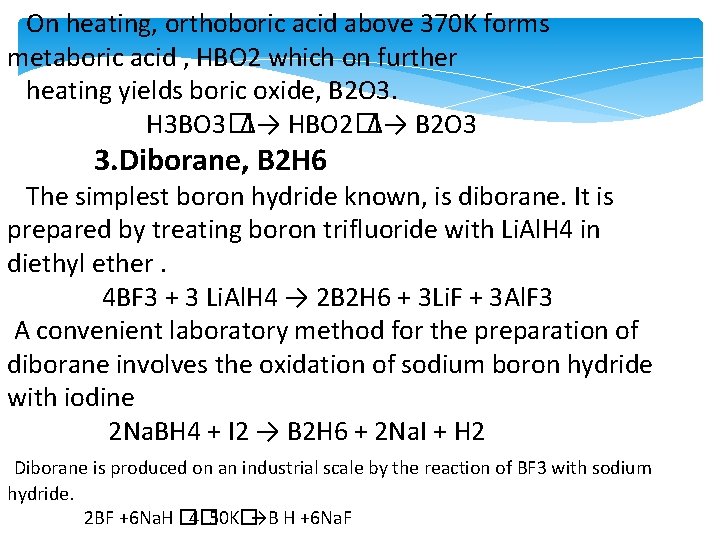
On heating, orthoboric acid above 370 K forms metaboric acid , HBO 2 which on further heating yields boric oxide, B 2 O 3. H 3 BO 3�Δ→ HBO 2�Δ→ B 2 O 3 3. Diborane, B 2 H 6 The simplest boron hydride known, is diborane. It is prepared by treating boron trifluoride with Li. Al. H 4 in diethyl ether. 4 BF 3 + 3 Li. Al. H 4 → 2 B 2 H 6 + 3 Li. F + 3 Al. F 3 A convenient laboratory method for the preparation of diborane involves the oxidation of sodium boron hydride with iodine 2 Na. BH 4 + I 2 → B 2 H 6 + 2 Na. I + H 2 Diborane is produced on an industrial scale by the reaction of BF 3 with sodium hydride. 2 BF +6 Na. H � 4� 50 K�→B H +6 Na. F
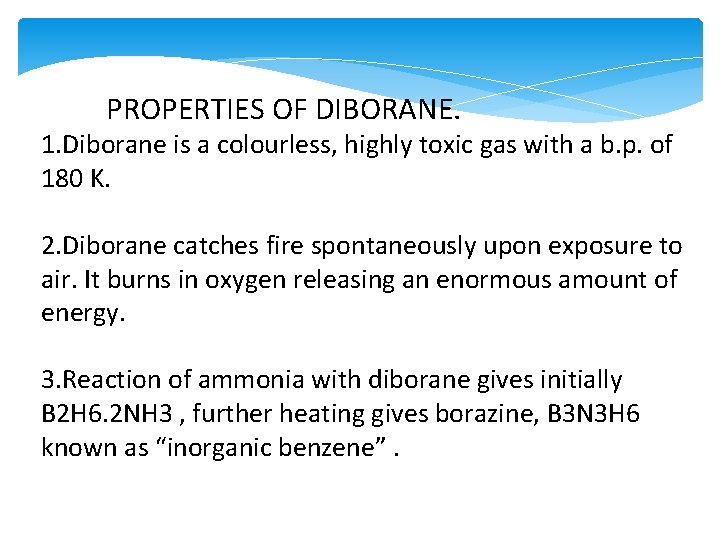
PROPERTIES OF DIBORANE. 1. Diborane is a colourless, highly toxic gas with a b. p. of 180 K. 2. Diborane catches fire spontaneously upon exposure to air. It burns in oxygen releasing an enormous amount of energy. 3. Reaction of ammonia with diborane gives initially B 2 H 6. 2 NH 3 , further heating gives borazine, B 3 N 3 H 6 known as “inorganic benzene”.
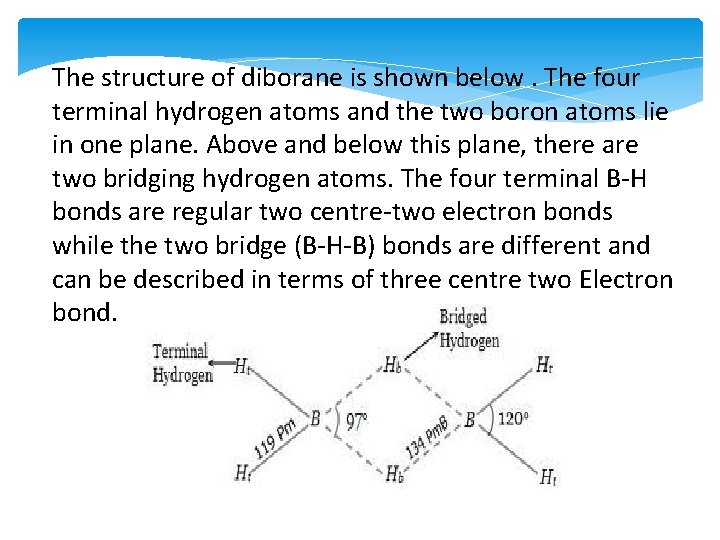
The structure of diborane is shown below. The four terminal hydrogen atoms and the two boron atoms lie in one plane. Above and below this plane, there are two bridging hydrogen atoms. The four terminal B-H bonds are regular two centre-two electron bonds while the two bridge (B-H-B) bonds are different and can be described in terms of three centre two Electron bond.
USES OF BORON AND ALUMINIUM AND THEIR COMPOUNDS BORON Boron has low density and very low electrical conductivity, finds many applications. 1. Boron fibres are used in making bullet-proof vest and light material for aircraft. 2. The boron-10 isotope has high ability to absorb neutrons and there f metal borides are used in nuclear industry as protective shields and control rods. 3. The main industrial application of borax and boric acid is in the manufacture of heat resistant glasses like glass-wool and fibreglass. 4. Borax is used as a constituent of medicinal soaps. An aqueous solution of orthoboric acid is generally used as a mild antiseptic.
ALUMINIUM 1. Aluminium is a bright silvery-white metal. It has a high electrical and thermal conductivity. 2. It forms alloys with Cu, Mn, Mg, Si and Zn. Aluminium and its alloys can be given shapes of pipe, tubes, rods, wires, plates or foils and, therefore, find uses in packing, utensil making, construction, aeroplane and transportation industry. 3. The use of aluminium and its compounds for domestic purposes is now reduced considerably because of their toxic nature.
GROUP 14 ELEMENTS
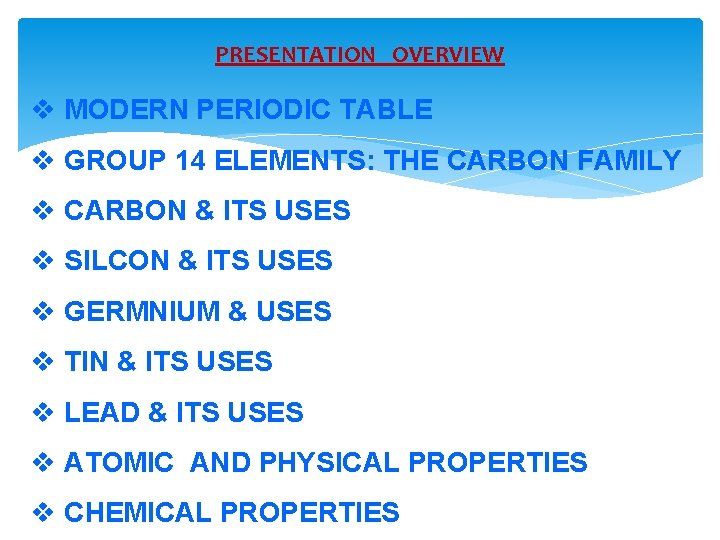
PRESENTATION OVERVIEW v MODERN PERIODIC TABLE v GROUP 14 ELEMENTS: THE CARBON FAMILY v CARBON & ITS USES v SILCON & ITS USES v GERMNIUM & USES v TIN & ITS USES v LEAD & ITS USES v ATOMIC AND PHYSICAL PROPERTIES v CHEMICAL PROPERTIES
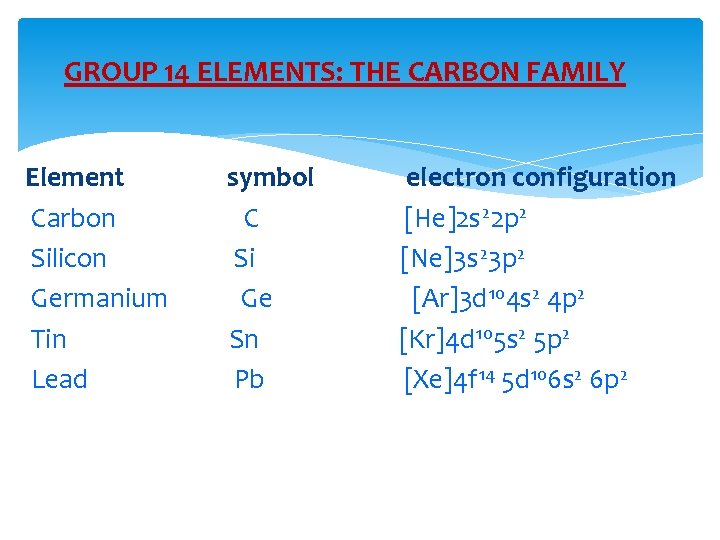
GROUP 14 ELEMENTS: THE CARBON FAMILY Element Carbon Silicon Germanium Tin Lead symbol C Si Ge Sn Pb electron configuration [He]2 s 22 p 2 [Ne]3 s 23 p 2 [Ar]3 d 104 s 2 4 p 2 [Kr]4 d 105 s 2 5 p 2 [Xe]4 f 14 5 d 106 s 2 6 p 2
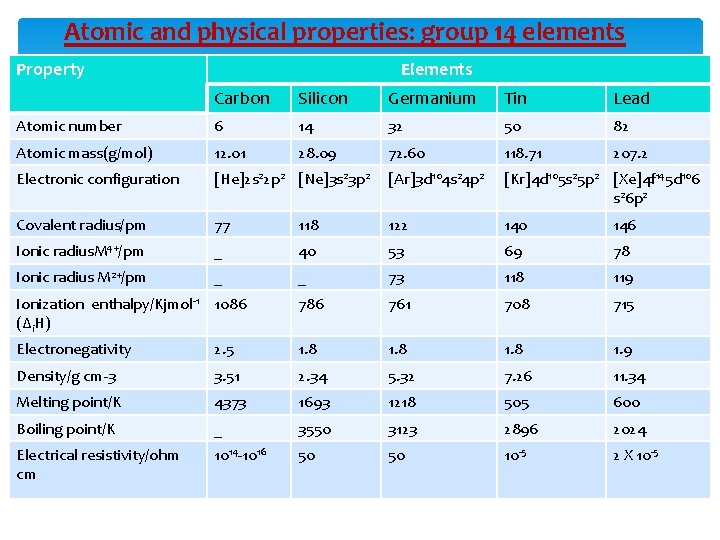
Atomic and physical properties: group 14 elements Property Elements Carbon Silicon Germanium Tin Lead Atomic number 6 14 32 50 82 Atomic mass(g/mol) 12. 01 28. 09 72. 60 118. 71 207. 2 Electronic configuration [He]2 s 22 p 2 [Ne]3 s 23 p 2 [Ar]3 d 104 s 24 p 2 [Kr]4 d 105 s 25 p 2 [Xe]4 f 145 d 106 s 26 p 2 Covalent radius/pm 77 118 122 140 146 Ionic radius. M 4+/pm _ 40 53 69 78 Ionic radius M 2+/pm _ _ 73 118 119 Ionization enthalpy/Kjmol-1 1086 (∆i. H) 786 761 708 715 Electronegativity 2. 5 1. 8 1. 9 Density/g cm-3 3. 51 2. 34 5. 32 7. 26 11. 34 Melting point/K 4373 1693 1218 505 600 Boiling point/K _ 3550 3123 2896 2024 Electrical resistivity/ohm cm 1014 -1016 50 50 10 -5 2 X 10 -5
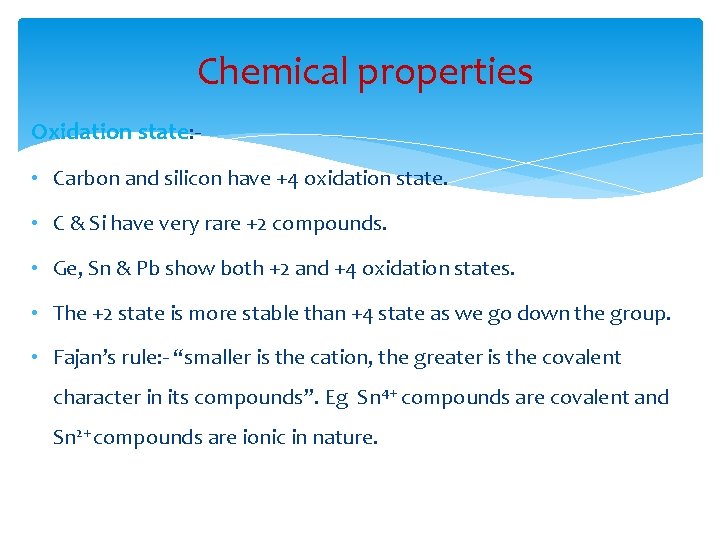
Chemical properties Oxidation state: • Carbon and silicon have +4 oxidation state. • C & Si have very rare +2 compounds. • Ge, Sn & Pb show both +2 and +4 oxidation states. • The +2 state is more stable than +4 state as we go down the group. • Fajan’s rule: - “smaller is the cation, the greater is the covalent character in its compounds”. Eg Sn 4+ compounds are covalent and Sn 2+ compounds are ionic in nature.
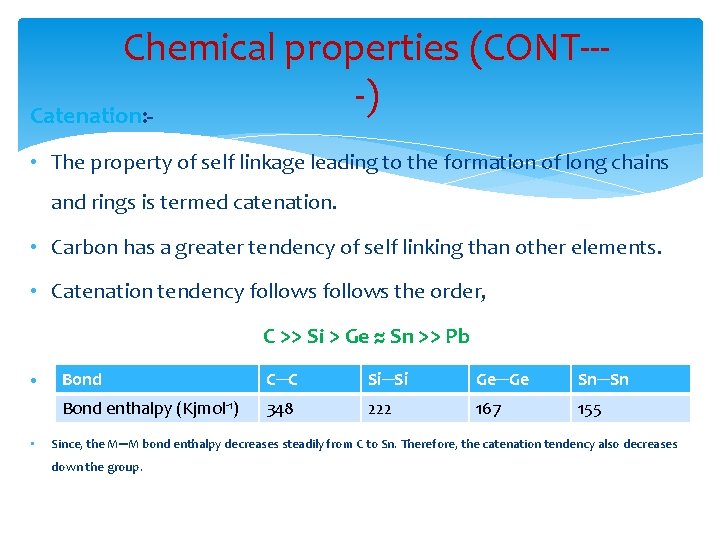
Chemical properties (CONT---) Catenation: • The property of self linkage leading to the formation of long chains and rings is termed catenation. • Carbon has a greater tendency of self linking than other elements. • Catenation tendency follows the order, C >> Si > Ge ≈ Sn >> Pb • • Bond C─C Si─Si Ge─Ge Sn─Sn Bond enthalpy (Kjmol-1) 348 222 167 155 Since, the M─M bond enthalpy decreases steadily from C to Sn. Therefore, the catenation tendency also decreases down the group.
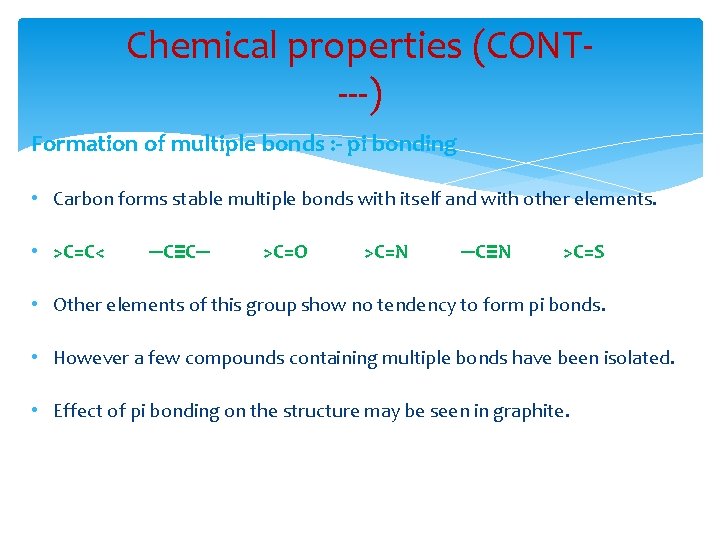
Chemical properties (CONT---) Formation of multiple bonds : - pi bonding • Carbon forms stable multiple bonds with itself and with other elements. • >C=C< ─C≡C─ >C=O >C=N ─C≡N >C=S • Other elements of this group show no tendency to form pi bonds. • However a few compounds containing multiple bonds have been isolated. • Effect of pi bonding on the structure may be seen in graphite.
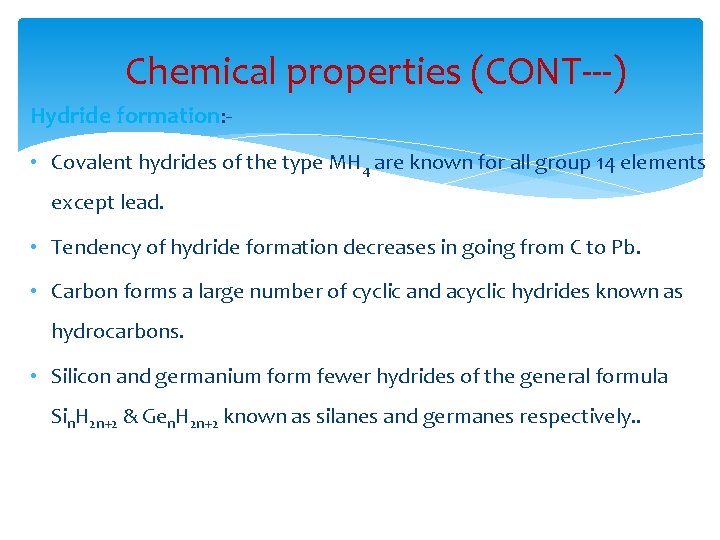
Chemical properties (CONT---) Hydride formation: • Covalent hydrides of the type MH 4 are known for all group 14 elements except lead. • Tendency of hydride formation decreases in going from C to Pb. • Carbon forms a large number of cyclic and acyclic hydrides known as hydrocarbons. • Silicon and germanium form fewer hydrides of the general formula Sin. H 2 n+2 & Gen. H 2 n+2 known as silanes and germanes respectively. .
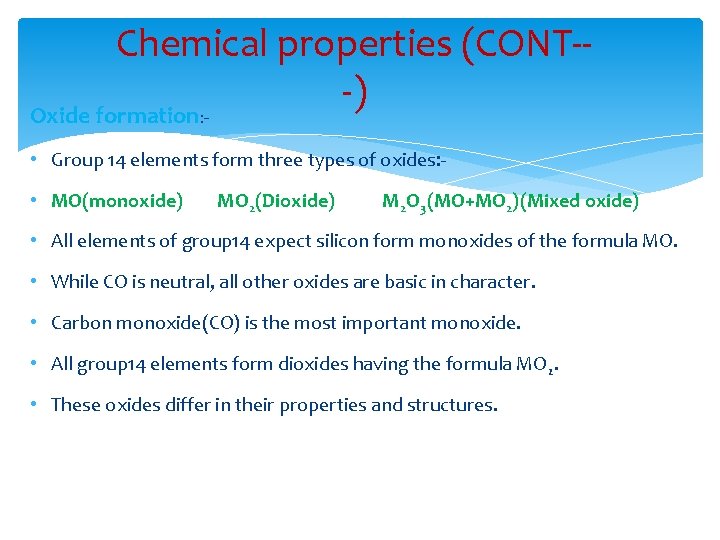
Chemical properties (CONT--) Oxide formation: • Group 14 elements form three types of oxides: • MO(monoxide) MO 2(Dioxide) M 2 O 3(MO+MO 2)(Mixed oxide) • All elements of group 14 expect silicon form monoxides of the formula MO. • While CO is neutral, all other oxides are basic in character. • Carbon monoxide(CO) is the most important monoxide. • All group 14 elements form dioxides having the formula MO 2. • These oxides differ in their properties and structures.
Chemical properties (CONT--) Halide formation: - • Elements of group 14 form the following types of halides, MX 4 type eg. , CCL 4 (carbon tetrachloride) MHX 3 type eg. , CHCL 3 (Chloroform) MX 2 type eg. , SICL 2 (Silicon dichloride) • Dihalides of Ge, Sn & Pb are more ionic in nature. • The stability of dihalides increases in going down the group • Tetrahalides of the type MX 4 are known for all the elements of group 14. • Tetrahalides are tetradedral and covalent. • The tetrahalides of all elements except of carbon undergo hydrolysis.
CARBON Introduction • • • Symbol : -C. Latin word: - "carbo" meaning"charcoal" Atomic Number = 6, Atomic Mass = 12. 01 Most common element: graphite, diamonds and coal. Most common compounds: - Hydrocarbons and Carbon dioxide. Physical Properties • Carbon is a soft, dull gray or black non-metal that can be scratched with a fingernail. • The density of carbon as graphite is 2. 267 g/m. L, which means it will sink in water.
Diamond CARBON-Uses • Jewellery • Manufacturing tools • In making dies Graphite • Lubricant at high temperature • Manufacturing lead pencils Coal • Fuel • Manufacturing coal tar, coke and coal gas • Manufacturing synthetic petrol
Introduction • • SILICON Symbol : -Si. Latin word: - “Silicium” Atomic Number = 14, Atomic Mass = 28. 09 Most common compounds: -Silicon dioxide (Si. O 2), Silicon carbide (Si. C), Sodium silicate (Na 2 Si. O 3) and Silicon tetrachloride (Si. Cl 4) Physical Properties • Crystalline silicon has a metallic grayish color • Silicon is relatively inert, but it is attacked by dilute alkali and by halogens • Silicon transmits over 95% of all infrared wavelengths (1. 3 -6. 7 mm)
SILICON-Uses • Electronic devices such as transistors, diodes and chips • For producing ferrosilicon • As a deoxidiser in steal industry • Important to plant and animal life
Introduction • • GERMANIUM Symbol : -Ge Latin word: - “Germania” Atomic Number = 32, Atomic Mass = 72. 60 Most common compounds: - Oxide(s): Ge. O, Ge. O 2 Chloride(s): Ge. Cl 2, Ge. Cl 4 , Hydride(s): Ge. H 4, Ge 2 H 6 Physical Properties • Germanium is a lustrous, hard, gray-white semi-metallic element • Germanium expands as it freezes • It is a semiconductor • Germanium and the oxide are transparent to infrared radiation
GERMANIUM-Uses • Semiconductor devices • Making prisms, lenses and windows in instruments based on IR • As catalyst
Introduction • • TIN Symbol : -Sn Latin word: - “Stannum” Atomic Number = 50, Atomic Mass = 118. 69 Most common compounds: -Sn. F 4, Sncl 4, Snbr 4 and Sn. Cl 2 Physical Properties • Tin is a malleable silvery-white metal which takes a high polish • It possesses a highly crystalline structure and is moderately ductile. • When a bar of tin is bent, the crystals break, producing a characteristic 'tin cry‘. • Tin has a cubic structure. • Upon warming, at 13. 2°C gray tin changes to white
TIN-Uses • For tinning of copper and brass utensils • For making tin foils for wrapping cigarettes • For making alloy: - solder, bronze and gun metal • Sno 2 coated glass is scratch resistant i. e. aircraft windows • Used in agriculture to control fungi such as potato blight
Introduction • • LEAD Symbol : -Pb Latin word: - “plumbum” Atomic Number = 82, Atomic Mass = 207. 19 Most common compounds: - Pb. Cl 2 , Pb. O 2 , Pb(NO 2)2 , Pb 3 O 4 , Pb(CH 3)4 Physical Properties • Lead is a soft, malleable and poor metal • It is also counted as one of the heavy metals • Metallic lead has a bluish-white color after being freshly cut, but it soon tarnishes to a dull grayish color when exposed to air • Lead has a shiny chrome-silver luster when it is melted into a liquid
LEAD-Uses • For making water pipes • Lead storage battery • For making bullets, shots, etc • Alloys: - solder • Used for preparing high refractive index glasses
- Slides: 51