
The Pathophysiology of Acute Respiratory Distress Syndrome ARDS
- Slides: 1
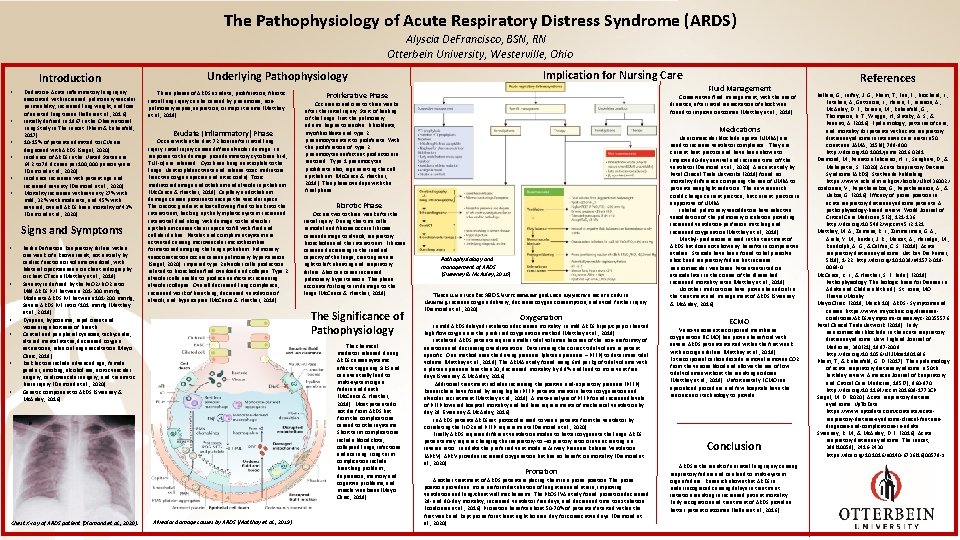
The Pathophysiology of Acute Respiratory Distress Syndrome (ARDS) Alyscia De. Francisco, BSN, RN Otterbein University, Westerville, Ohio Introduction • • • Definition- Acute inflammatory lung injury associated with increased pulmonary vascular permeability, increased lung weight, and loss of aerated lung tissue (Bellani et al. , 2016). Initially defined in 1967 in the Observational Lung Study in The Lancet (Pham & Rubenfeld, 2017). 10 -15% of patients admitted to ICUs are diagnosed with ARDS (Siegel, 2020). Incidence of ARDS in the United States are 64. 2 to 78. 9 cases per 100, 000 person years (Diamond et al. , 2020). Incidence increases with patient age and increased severity (Diamond et al. , 2020). Mortality increases with severity 27% with mild, 32% with moderate, and 45% with severed, overall ARDS has a mortality of 43% (Diamond et al. , 2020). Signs and Symptoms • • • Berlin Definition: Respiratory failure within one week of a known insult, not entirely by cardiac function or volume overload, with bilateral opacities seen on chest radiography or chest CT scan (Matthay et al. , 2019). Severity is defined by the Pa. O 2/Fi. O 2 ratio. Mild ARDS P/F between 201 -300 mm. Hg, Moderate ARDS P/F between 101 -200 mm. Hg, Severe ARDS P/F ratio <101 mm. Hg (Matthay et al. , 2019). Dyspnea, hypoxemia, rapid onset and worsening shortness of breath. Central and peripheral cyanosis, tachycardia, altered mental status, decreased oxygen saturations, rales on lung auscultation (Mayo Clinic, 2018). Risk Factors include advanced age, female gender, smoking, alcohol use, aortic vascular surgery, cardiovascular surgery, and traumatic brain injury (Diamond et al. , 2020). Genetic component to ARDS (Sweeney & Mc. Auley, 2016). Chest X-ray of ARDS patient (Diamond et al. , 2020). Implication for Nursing Care Underlying Pathophysiology Three phases of ARDS exudate, proliferation, fibrotic. Initial lung injury can be caused by pneumonia, nonpulmonary sepsis, aspiration, or major trauma (Matthay et al. , 2019). Exudate (Inflammatory) Phase Occurs within the first 72 hours after initial lung injury. Initial injury causes diffuse alveolar damage. In response to the damage proinflammatory cytokines (IL-8, TNF-α) are released. Cytokines bring neutrophils to the lungs. Neutrophils activate and release toxic mediators (reactive oxygen species and nitric oxide). Toxic mediators damage endothelium and alveolar epithelium (Mc. Cance & Huether, 2018). Capillary endothelium damage causes proteins to escape the vascular space. The oncotic gradient is lost allowing fluid to leak into the interstitium, backing up the lymphatic system. Increased interstitial fluid along with damage to the alveolar epithelium causes the air space to fill with fluid and cellular debris. Platelet and compliment system are activated causing microvascular microthrombus formations damaging the lung epithelium. Pulmonary vasoconstriction occurs causes pulmonary hypertension (Siegel, 2020). Impaired type 2 alveolar cells production related to bronchioles fluid overload and collapse. Type 2 alveolar cells unable to produce surfactant increasing alveolar collapse. Overall decreased lung compliance, increased work of breathing, decreased ventilation of alveoli, and hypercapnia (Mc. Cance & Huether, 2018). Proliferative Phase Conservative fluid management, with the use of diuretics, after initial resuscitation of shock was found to improve outcomes (Matthay et al. , 2019). Occurs around one to three weeks after the initial injury. Start of healing of the lungs. First the pulmonary edema begins to resolve. Fibroblasts, myofibroblasts and type 2 pneumocytes start to proliferate. With the proliferation of type 2 pneumocytes surfactant production is restored. Type 1 pneumocytes proliferate also, regenerating the cell epithelium. (Mc. Cance & Huether, 2018). This phase overlaps with the final phase. Medications Fibrotic Phase Occurs two to three week after the initial injury. During this time cells remodel and fibrosis occurs Fibrosis causes damage to alveoli, respiratory bronchioles and the interstitium. Fibrosis causes a decreasing in the residual capacity of the lungs, creating severe right to left shunting and respiratory failure. Also can cause increased pulmonary hypertension. This phase accounts for long term damage to the lungs (Mc. Cance & Huether, 2018). The Significance of Pathophysiology The chemical mediator released during ARDS causes systemic effects triggering SIRS and can eventually lead to multi-system organ failure and death (Mc. Cance & Huether, 2018). Most patients do not die from ARDS but from the complications caused to other systems. Short term complications include blood clots, collapsed lungs, infections and scarring. Long term complication include breathing problem , depression, memory and cognitive problems, and muscle weakness (Mayo Clinic, 2018). Alveolar damage causes by ARDS (Matthay et al. , 2019) Fluid Management Pathophysiology and management of ARDS (Sweeney & Mc. Auley, 2016) There is no cure for ARDS, but treatment goals are supportive care to reduce shunting, increase oxygen delivery, decrease oxygen consumption, and avoid further injury (Diamond et al. , 2020). Oxygenation In mild ARDS delayed intubation decreases mortality. In mild ARDS bipap/cpap or heated high flow oxygen are the preferred oxygenation method (Matthay et al. , 2019). Intubated ARDS patients require smaller tidal volumes because of the non-uniformity of aerations and decreasing overdistention. Determining the correct tidal volume is patient specific. One method uses the driving pressure (plateau pressure – PEEP) to determine tidal volume (Matthay et al. , 2019). The ARMA study found using 6 ml per kg of tidal volume with a plateau pressure less than 30, decreased mortality by 8. 8% and lead to more vent free days (Sweeney & Mc. Auley, 2016). Additional treatment includes increasing the positive end-expiratory pressure (PEEP). Researchers have found by using higher PEEP patients maintain better oxygenation and alveolar recruitment (Matthay et al. , 2019). A meta-analysis of PEEP found increased levels of PEEP lowered hospital mortality and had less requirements of mechanical ventilation by day 28 (Sweeney & Mc. Auley, 2016). In ARDS patients ARDSnet protocol is used to wean patients from the ventilator by correlating the FIO 2 and PEEP requirements (Diamond et al. , 2020). Finally ARDS requires different ventilation modes to better oxygenate the lungs. ARDS patients may require changing the inspiratory-to –expiratory ratio or even creating an inverse ratio. In adults the preferred vent mode is Airway Pressure Release Ventilation (APRV). APRV provides increased oxygenation but has no benefit on mortality (Diamond et al. , 2020). Pronation Another treatment of ARDS patients is placing them in a prone position. The prone position provides a more uniform distribution of lung stress and strain, improving ventilation and lung/chest wall mechanisms. The PROSEVA study found pronation decreased 28 - and 90 -day mortality, increased ventilator free days, and decreased time to extubation (Koulouras et al. , 2016). Pronation benefits about 50 -70% of patients if started within the first week and kept prone for at least eight hours a day for consecutive days. (Diamond et al. , 2020). Neuromuscular blockade agents (NMBA) are used to increase ventilator compliance. They are current best practice and have been shown to improve 90 -day survival and increase time off the ventilator (Diamond et al. , 2020). A recent study by Petal Clinical Trials Networks (2019) found no mortality difference comparing the use of NMBA to patients using light sedation. The new research could change current practice, but current practice is supportive of NMBA. Inhaled pulmonary vasodilators have selective vasodilation of the pulmonary circulation providing increased ventilation-perfusion matching and increased oxygenation (Matthay et al. , 2019). Methyl-prednisone is used in the treatment of ARDS but does not show any benefits in comparative studies. Steroids have been found to help resolve shock and respiratory failure but increase neuromuscular weakness. Patients started on steroids later in the course of the illness had increased mortality rates (Matthay et al. , 2019) No other medications have proven beneficial in the treatment and management of ARDS (Sweeney & Mc. Auley, 2016). ECMO Veno-venous extracorporeal membrane oxygenation (ECMO) has proven beneficial with severe ARDS patients started within the first week with no organ failure (Matthay et al. , 2019). Extracorporeal carbon dioxide removal removes CO 2 from the venous blood and allows the use of low tidal volumes without the resulting acidosis (Matthay et al. , 2019). Unfortunately ECMO is a specialized procedure and few hospitals have the resources or technology to provide. Conclusion ARDS is the result of an initial lung injury causing respiratory failure and can lead to multi-system organ failure. Research shows that ARDS is underrecognized causing delays in treatment initiation resulting in increased patient mortality. Early recognition and treatment of ARDS provides better patient outcomes (Bellani et al. , 2016). References Bellani, G. , Laffey, J. G. , Pham, T. , Fan, E. , Brochard, L. , Esteban, A. , Gattinoni, L. , Haren, F. , Larsson, A. , Mc. Auley, D. F. , Ranieri, M. , Rubenfeld, G. , Thompson, B. T. , Wrigge, H. , Slutsky, A. S. , & Pesenti, A. (2016). Epidemiology, patterns of care, and mortality for patients with acute respiratory distress syndrome in intensive care units in 50 countries. JAMA, 315(8), 788 -800. http: //doi. org/10. 1001/jama. 2016. 0291 Diamond, M. , Peniston Feliciano, H. L. , Sanghavi, D. , & Mahapatra, S. (2020). Acute Respiratory Distress Syndrome (ARDS). Stat. Pearls Publishing. https: //www. ncbi. nlm. nih. gov/books/NBK 436002/ Koulouras, V. , Papathanakos, G. , Papathanasiou, A. , & Nakos, G. (2016). Efficacy of prone position in acute respiratory distress syndrome patients: A pathophysiology-based review. World Journal of Critical Care Medicine, 5(2), 121 -136. http: //doi. org/10. 5492/wjccm. v 5. i 2. 121 Matthay, M. A. , Zemans, R. L. , Zimmerman, G. A. , Arabi, Y. M. , Beitler, J. R. , Mercat, A. , Herridge, M. , Randolph, A. G. , & Calfee, C. S. (2019). Acute respiratory distress syndrome. Nat Rev Dis Primer, 5(18), 1 -22. http: //doi. org/10. 1038/s 41572 -0190069 -0 Mc. Cance, K. L. , & Huether, S. E. (eds. ). (2018). Pathophysiology: The Biologic Basis for Disease in Adults and Children (8 th ed. ). St. Louis, MO: Elsevier/Mosby Mayo Clinic. (2018, March 10). ARDS - Symptoms and causes. https: //www. mayoclinic. org/diseasesconditions/ARDS/symptoms-causes/syc-20355576 Petal Clinical Trials Network. (2019). Early neuromuscular blockade in the acute respiratory distress syndrome. New England Journal of Medicine, 380(21), 1997 -2008. http: //doi. org/10. 1056/NEJMoa 1901686 Pham, T. , & Rubenfeld, G. D. (2017). The epidemiology of acute respiratory distress syndrome: a 50 th birthday review. American Journal of Respiratory and Critical Care Medicine, 195(7), 860 -870. http: //doi. org/10. 1164/rccm. 201609 -1773 CP Siegel, M. D. (2020). Acute respiratory distress syndrome. Up. To. Date. https: //www. uptodate. com/contents/acuterespiratory-distress-syndrome-clinical-featuresdiagnosis-and-complications-in-adults Sweeney, R. M. , & Mc. Auley, D. F. (2016). Acute respiratory distress syndrome. The Lancet, 388(10058), 2416 -2430. https: //doi. org/10. 1016/s 0140 -6736(16)00578 -x