
The Path to Common Core State Standards Implementation



- Slides: 42
The Path to Common Core State Standards Implementation: Step One - AWARENESS
Module 1: Overview English Language Arts & Literacy in History/Social Studies, Science, and Technical Subjects Mathematics 2011 © CA County Superintendents Educational Services Association
The Path to Common Core State Standards (CCSS) Implementation Step 1 : Awareness. An introduction to the CCSS, the initial planning of systems implementation, and establishment of collaborations. Step 2: Transition. Concentration on building foundational resources, implementing needs assessments, establishing new professional learning opportunities, and expanding collaborations between all stakeholders. Step 3: Implementation. Expands on the new professional learning support, fully aligns curriculum, instruction, and assessments, and effectively integrates these elements across the field.
Common Core State Standards Awareness: Objectives and Outcomes Examine the genesis of the Common Core State Standards (CCSS) Explore Theories of Action Realize the need to continually evolve our practice Recognize the benefits for both teachers and students Begin a multi-year transition plan
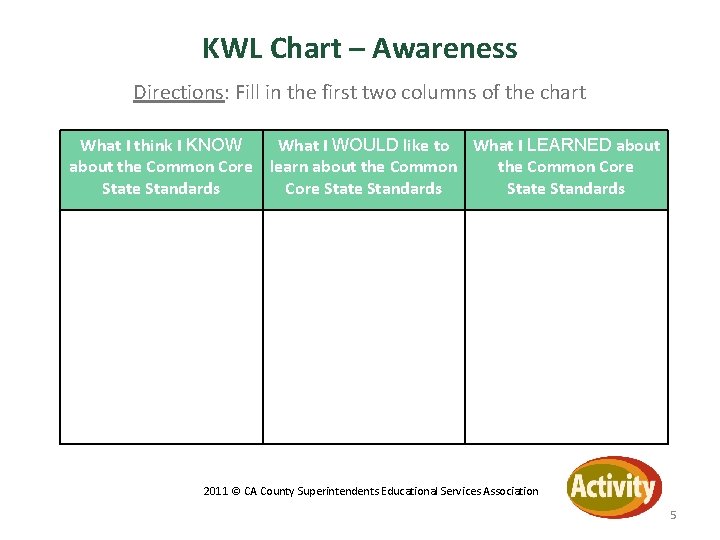
KWL Chart – Awareness Directions: Fill in the first two columns of the chart What I think I KNOW What I WOULD like to What I LEARNED about the Common Core learn about the Common Core State Standards 2011 © CA County Superintendents Educational Services Association 5
Give One/Get One • At your instructor’s signal, stand up, find a partner and give one/get one idea you would like to know about the CCSS. • Repeat until you have talked to 3 different participants. • Return to your seats at instructor’s signal. 6
The Next Step… • Read the following 4 quotes regarding the development of the CCSS. • Identify a quote that resonates with you and discuss at your table. 7
To Build a Foundation… “There is also evidence that current standards, curriculum, and instructional practice have not done enough to foster the independent reading of complex texts so crucial for college and career readiness, particularly in the case of informational texts…. . Students must have ample opportunities to take part in a variety of rich, structured conversations - as part of a whole class, in small groups, and with a partner……
Students must read widely and deeply from among a broad range of high-quality, increasingly challenging literary and informational text… by reading texts in history/social studies, science, and other disciplines, students build a foundation of knowledge in these fields that will also give them the background to be better readers in all content areas. The need to conduct research and to produce and consume media is embedded into every aspect of today’s curriculum. In like fashion, research and media skills and understandings are embedded throughout the Standards rather than treated in a separate section…” National Governors Association Center for Best Practices and Council of Chief State School Officers (2010) Common Core State Standards for ELA 9
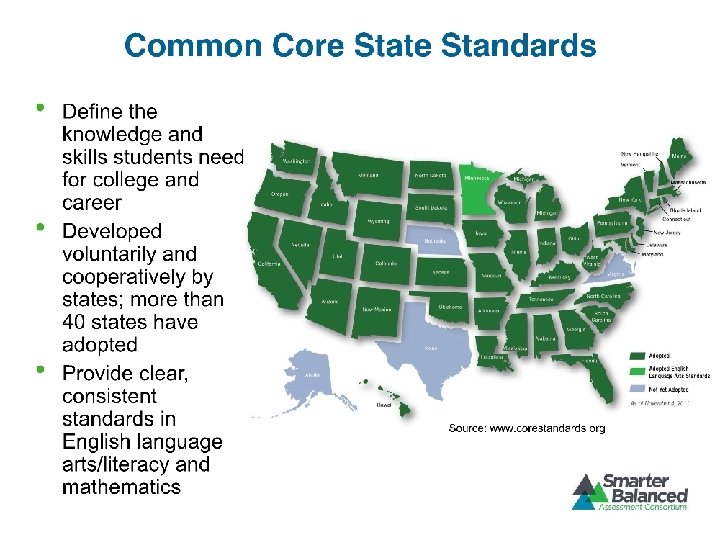
Who: • Originated and led by the National Governors’ Association Center for Best Practices and Council of Chief State School Officers (CCSSO) • The Common Core State Standards are anchored in the goal of ensuring all students graduate ready for college and careers, and reflect the knowledge and skills most valued by employers and higher education.
Why? To ensure that our students are… • meeting college and career expectations (Text Complexity needs to be increased K-12); • provided a vision of what it means to be an academically literate person in the twenty-first century; • prepared to succeed in our global economy and society; and • provided with rigorous content and applications of higher knowledge through higher order thinking skills. 2011 © CA County Superintendents Educational Services Association 11
Why? • Disparate standards across the states created unequal opportunities (mile wide/inch deep) • Current high school instruction was not preparing many young people for careers or college • Economics are driven by global competition - not regional • Critical Mass is needed to share best practices • Consistent expectations will ensure access to a rigorous curriculum regardless of a student’s zip code • Educators, parents and students will be provided with clear, focused guideposts 12
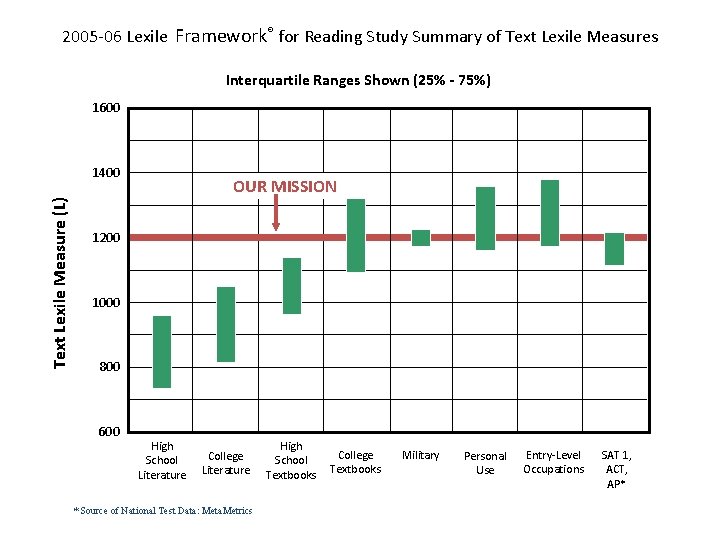
2005 -06 Lexile Framework® for Reading Study Summary of Text Lexile Measures Interquartile Ranges Shown (25% - 75%) 1600 Text Lexile Measure (L) 1400 OUR MISSION 1200 1000 800 600 High School Literature College Literature * Source of National Test Data: Meta. Metrics High School Textbooks College Textbooks Military Personal Use Entry-Level Occupations SAT 1, ACT, AP*
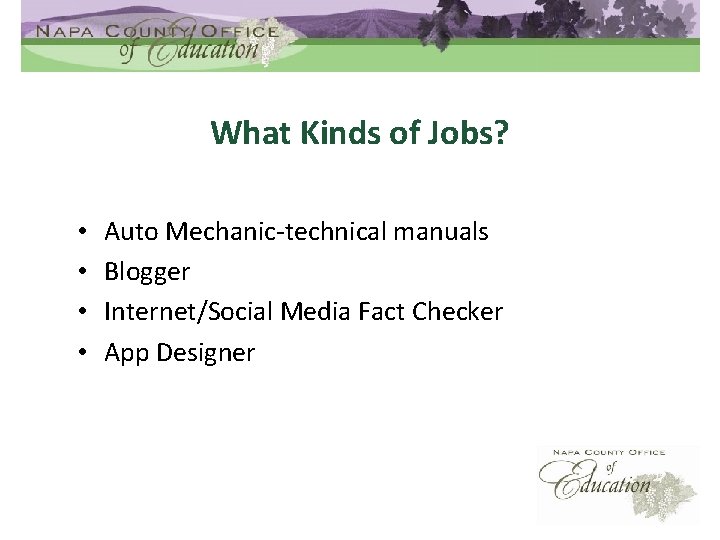
What Kinds of Jobs? • • Auto Mechanic-technical manuals Blogger Internet/Social Media Fact Checker App Designer
Early Assessment of Progress-CSU • More than 60 percent of the nearly 40, 000 first-time freshmen admitted to the CSU require remedial education in English, mathematics or both. • These 25, 000 freshmen all have taken the required college preparatory curriculum and earned at least a B grade point average in high school. • The cost in time and money to these students and to the state is substantial. • Moreover, these students are confused by seemingly having done the right things in high school only to find out after admission to the CSU that they need further preparation.
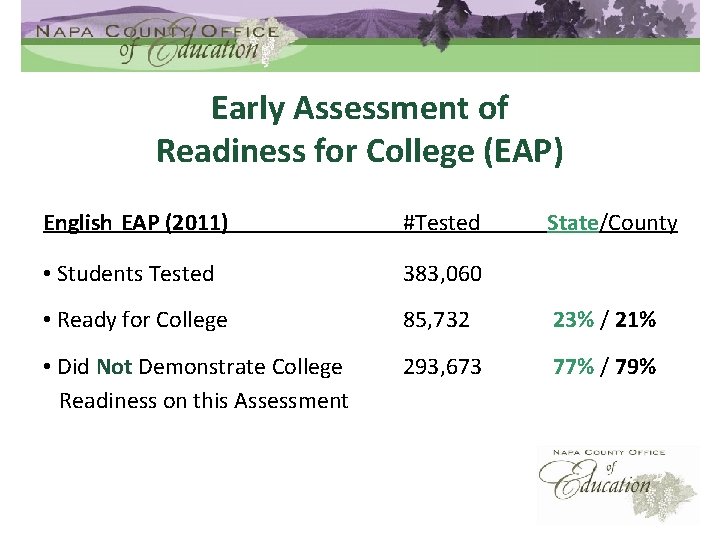
Early Assessment of Readiness for College (EAP) English EAP (2011) #Tested • Students Tested 383, 060 • Ready for College 85, 732 • Did Not Demonstrate College 293, 673 Readiness on this Assessment State/County 23% / 21% 77% / 79%
What: • Represent a baseline of the academic knowledge and skills that all students need to pursue a career and/or college; • Prepare students for success in entry-level, credit-bearing, academic college courses (2 - and 4 - year postsecondary institutions) • Prepare students for success in careers that offer competitive, livable salaries above the poverty line, opportunities for career advancement, and are in growing or sustainable industries • Prepare our students to succeed in our global economy and society; • Provide our students with rigorous content and applications of higher knowledge through higher order thinking skills.
Features of CCSS Aligned with college and work expectations Focused and coherent Included rigorous content and application of knowledge through high-order skills Build upon strengths and lessons of current state standards Internationally benchmarked so that all students are prepared to succeed in our global economy and society Research and evidence based State led - coordinated by NGA Center and CCSSO and Were developed collaboratively by 48 states, hundreds of experts, and thousands of educators
How the CCSS Support us in Educating All Students to High Levels • Equity: Expectations are consistent for all. • Preparation: The standards are career and college-ready. • Competition: The standards are internationally benchmarked. • Clarity: The standards are focused, coherent, and clear. • Collaboration: The standards create a foundation to work collaboratively.
Evidence Based Evidence was used to guide critical decisions in the following areas: Ø Ø Ø Inclusion of particular content Timing of when content should be introduced and the progression of that content Ensuring focus and coherence Organizing and formatting the standards Determining emphasis on particular topics in standards
Evidence Based • Evidence includes: Ø Ø Ø Standards from high-performing countries, leading states, and nationally-regarded frameworks Research on adolescent literacy, text complexity, mathematics instruction, quantitative literacy Lists of works consulted and research base included in standards’ appendices
Process: • • • State led - coordinated by NGA Center and CCSSO Used strengths and lessons of current state standards Core writing teams in English Language Arts and Mathematics (www. corestandards. org for list of team members) • External and state feedback teams provided on-going feedback to writing teams throughout the process • Draft K-12 standards were released for public comment on March 10, 2010 (9, 600 comments received) • Validation Committee of leading experts reviews standards • Final standards were released June 2, 2010 Adopted in CA August 2010 •
Feedback and Review External and State Feedback teams included: • • K-12 teachers Postsecondary faculty State curriculum and assessments experts Researchers National organizations (including, but not limited, to): • • American Council on Education (ACE) American Federation of Teachers (AFT) Campaign for High School Equity (CHSE) Conference Board of the Mathematical Sciences (CBMS) Modern Language Association (MLA) National Council of Teachers of English (NCTE) National Council of Teachers of Mathematics (NCTM) National Education Association (NEA)
Heart and Soul ELA: Mathematics: • College and Career Readiness Anchor Standards • Standards for Mathematical Practice 2011 © CA County Superintendents Educational Services Association 25
Mathematics Common Core State Standards for Mathematics 26
Common Core California Standards Two Types of Standards: • Mathematical Practice (recurring throughout the grades) • Mathematical Content (different at each grade level) ü Both aim to balance mathematical understanding and procedural skill. 27
Organization of Common Core State Standards for Mathematics Grade-Level Standards • K-8 grade-by-grade standards organized by domain • 9 -12 high school standards organized by conceptual categories Standards for Mathematical Practice • Describe mathematical “habits of mind” • Connect with content standards in each grade 28
Standards for Mathematical Practice Eight Standards for Mathematical Practice: • Make sense of problems and persevere in solving them • Reason abstractly and quantitatively • Construct viable arguments and critique the understanding of others • Model with mathematics • Use appropriate tools strategically • Attend to precision • Look for and make use of structure • Look for and express regularity in repeated reasoning 29
• Format of K-8 Mathematics Standards Domains: Overarching ideas that connect topics across the grades. • Clusters: Illustrate progression of increasing complexity from grade to grade. • Standards: Define what students should know and be able to do at each grade level.
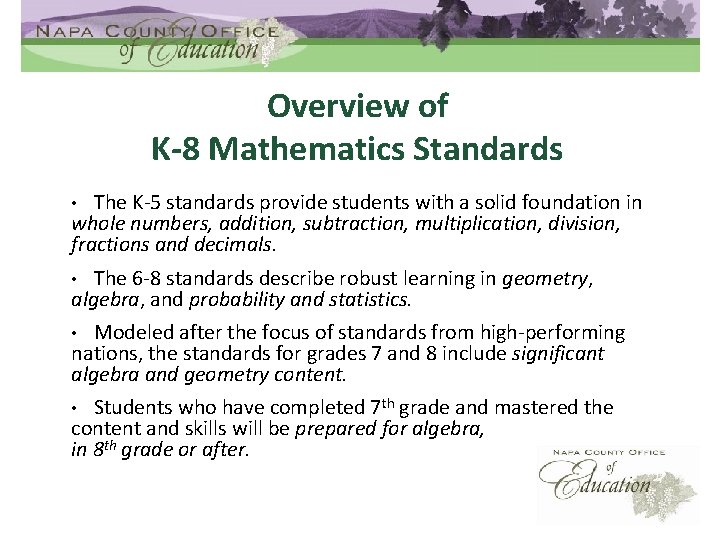
Overview of K-8 Mathematics Standards The K-5 standards provide students with a solid foundation in whole numbers, addition, subtraction, multiplication, division, fractions and decimals. • The 6 -8 standards describe robust learning in geometry, algebra, and probability and statistics. • Modeled after the focus of standards from high-performing nations, the standards for grades 7 and 8 include significant algebra and geometry content. • Students who have completed 7 th grade and mastered the content and skills will be prepared for algebra, in 8 th grade or after. •
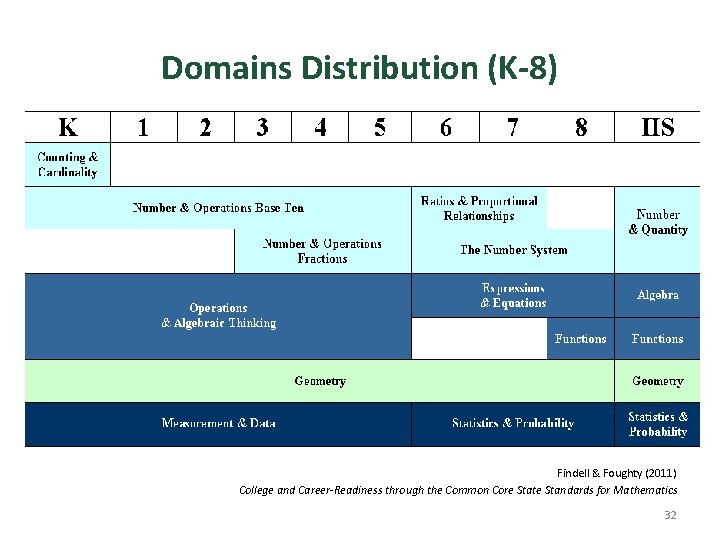
Domains Distribution (K-8) Findell & Foughty (2011) College and Career-Readiness through the Common Core State Standards for Mathematics 32
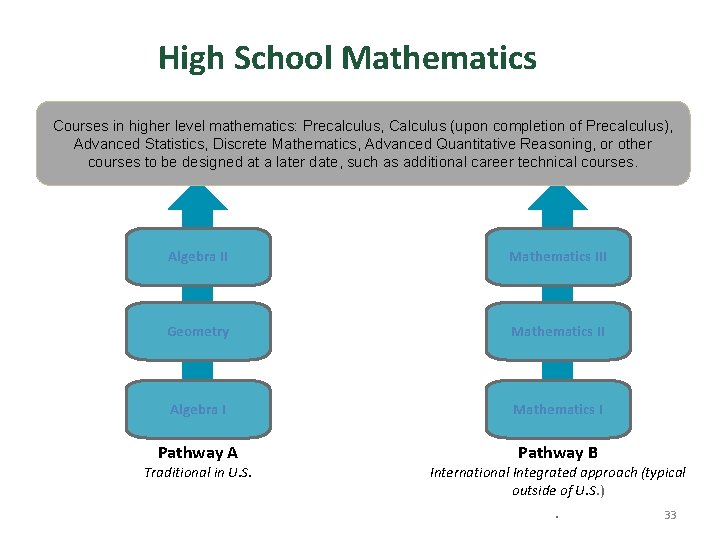
High School Mathematics Model Course Pathways for Mathematics Courses in higher level mathematics: Precalculus, Calculus (upon completion of Precalculus), Advanced Statistics, Discrete Mathematics, Advanced Quantitative Reasoning, or other courses to be designed at a later date, such as additional career technical courses. Algebra II Mathematics III Geometry Mathematics II Algebra I Mathematics I Pathway A Pathway B Traditional in U. S. International Integrated approach (typical outside of U. S. ) . 33
8 th Grade Math/Algebra • Most of California’s use of the 15% of state specific standards went into 8 th grade math. • California will also have option for Algebra. • Still unsure of what the testing will be like. • Reauthorization of NCLB.
Coherence • Articulated progressions of topics and performances that are developmental and connected to other progressions. • Conceptual understanding and procedural skills stressed equally. NCTM states coherence also means that instruction, assessment, and curriculum are aligned.
Format of Mathematics Standards Grades K-8: • Grade • Domain • Cluster • Standards • Note: There are no pre-K Common Core Standards High School: • Conceptual Category • Domain • Cluster • Standards
Format of High School Mathematics Standards • High school standards are organized around five conceptual categories: Number and Quantity, Algebra, Functions, Geometry, and Statistics and Probability. • Modeling standards are distributed under the five major headings and are indicated with a ( ) symbol. • Standards indicated as (+) are beyond the college and career readiness level but are necessary for advanced mathematics courses, such as calculus, discrete mathematics, and advanced statistics. Standards with a (+) may still be found in courses expected for all students.
Overview of High School Mathematics Standards • Apply mathematical ways of thinking to real world issues and challenges. • Develop a depth of understanding and ability to apply mathematics to novel situations, as college students and employees regularly are called to do. • Emphasize mathematical modeling, the use of mathematics and statistics to analyze empirical situations, understand them better, and improve decisions • Identify the mathematics that all students should study in order to be career and college ready
Model Course Pathways for Mathematics • Developed by a panel of experts convened by Achieve, including many of the standards writers and reviewers • Organize the content of the standards into coherent and rigorous courses • Illustrate possible approaches—models, not mandates or prescriptions for organization, curriculum or pedagogy • Require completion of the Common Core in three years, allowing for specialization in the fourth year • Prepare students for a menu of courses in higher-level mathematics
Tracing a Standard • Select and trace one standard from Kindergarten through 12 th grade. • Note how format and language change across grade levels. • Discuss your professional learning with your table group. 40
On Your Own • Locate the CCSS (cde. ca. gov/ci/cc) • Browse the standards and locate ELA, Math, Literacy, History/Social Science, and CTE • Record notes about how format and language change across grade levels. 41
Evaluation 1. What surprised me the most about the common core… 2. Today’s workshop has left me convinced that… 3. Today’s workshop has me continuing to wonder… 4. To act on today’s workshop, I plan to…