
The Passive Voice Relevant terminology Subject Judy the
The Passive Voice – Relevant terminology • Subject – Judy the house love we etc. • Object – direct vs. indirect Direct object: The dog chased the cat. Indirect object: The dog chased the cat up the tree. → Indirect objects are introduced with a preposition (in, on, at, etc. ) • Verbs – eat want love do develop etc. Transitive verb: The bird ate the bread on the ground. direct object indirect object D . → Transitive verbs have a direct object (and possibly an indirect object) Intransitive verb: The children are sleeping. → Intransitive verbs do NOT have a direct object. They may have an indirect object. → Therefore, they cannot be used in the passive voice. Ex: The children are sleeping in the living room. . preposition + indirect object • Auxiliary verbs – can could would should will may might etc. – have / has Ex: They have gone home. – be Ex: They are studying English. . .
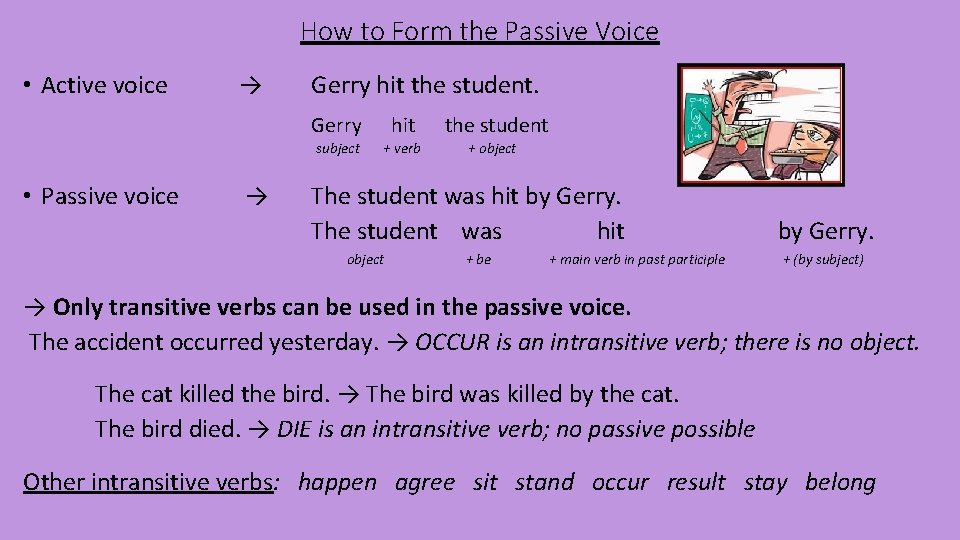
How to Form the Passive Voice • Active voice • Passive voice → → Gerry hit the student subject + verb + object The student was hit by Gerry. The student was hit object + be + main verb in past participle by Gerry. + (by subject) → Only transitive verbs can be used in the passive voice. The accident occurred yesterday. → OCCUR is an intransitive verb; there is no object. The cat killed the bird. → The bird was killed by the cat. The bird died. → DIE is an intransitive verb; no passive possible Other intransitive verbs: happen agree sit stand occur result stay belong
Common intransitive verbs Intransitive verbs cannot be used in passive voice agree belong go live remain appear cry happen look respond stand arrive consist depend exist result sleep stay become cost fall lie occur smile swim wait die laugh vanish sit
The Passive Voice - Uses • When the subject is unimportant or understood → James was given a promotion. (by the boss) • To describe a process → We are going to learn how beer is made. • To avoid responsibility / to avoid identifying the subject → Many mistakes were made. • To describe a general truth → Rice is grown in many countries.
Forming the Passive Voice in different tenses • Someone makes this car in Japan. subject verb object indirect object tense of the main verb = simple present → BE must be in the simple present object + BE verb + past participle (+ by…) + indirect object → This car is made in Japan. • Someone is following her. tense of the main verb = present continuous → BE must be in the present continuous object → She + BE verb + past participle (+ by…) is being followed. • The police stopped him for speeding. tense of the main verb = simple past → BE must be in the simple past object → He + BE verb + past participle (+ by…) + indirect object was stopped by the police for speeding.
• The teacher was marking the tests when I entered the room. tense of the main verb = past continuous → BE must be in the past continuous object + BE verb + past participle (+ by…) → The tests were being marked when I entered the room. • Someone has hired Tina to be the new marketing director. tense of the main verb = present perfect → BE must be in the present perfect object → Tina + BE verb + past participle (+ by…) has been hired to be the new marketing director. • We will announce our decision at the meeting. tense of the main verb = future → BE must be in the future object + BE verb + past participle (+ by…) + indirect object → Our decision will be announced at the meeting.
• They are going to install the new computer system this afternoon. tense of the main verb = future with ‘going to’ → BE must be in the future with ‘going to’ object + BE verb + past participle (+ by…) → The new computer system is going to be installed + indirect object this afternoon. • The janitor hadn’t locked the door. tense of the main verb = past perfect → BE must be in the past perfect object → The door + BE verb + past participle (+ by…) hadn’t been locked by the janitor. • Someone must do something immediately. Form of the main verb = ‘must’ + infinitive → BE must be in the form of ‘must’ + infinitive object + BE verb → Something must be + past participle (+ by…) done immediately.
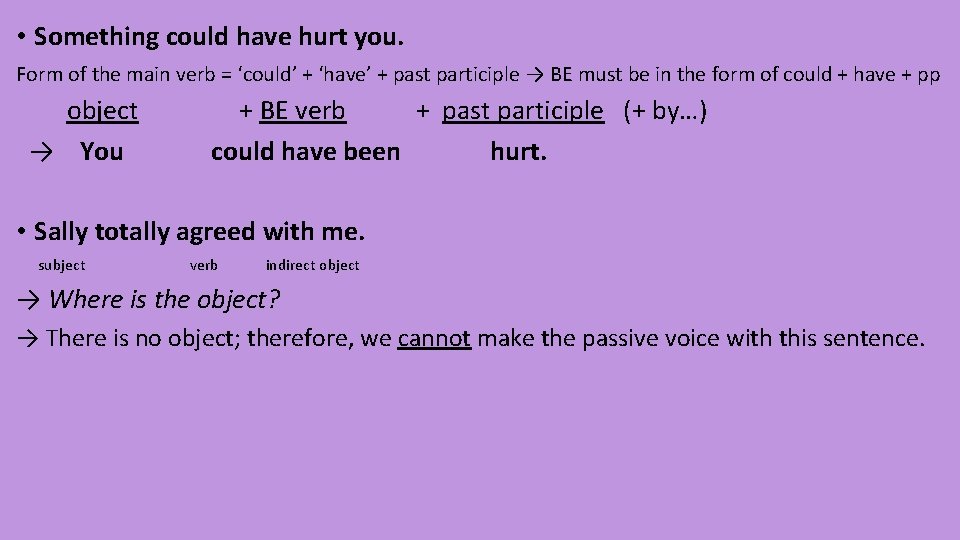
• Something could have hurt you. Form of the main verb = ‘could’ + ‘have’ + past participle → BE must be in the form of could + have + pp object → You + BE verb + past participle (+ by…) could have been hurt. • Sally totally agreed with me. subject verb indirect object → Where is the object? → There is no object; therefore, we cannot make the passive voice with this sentence.
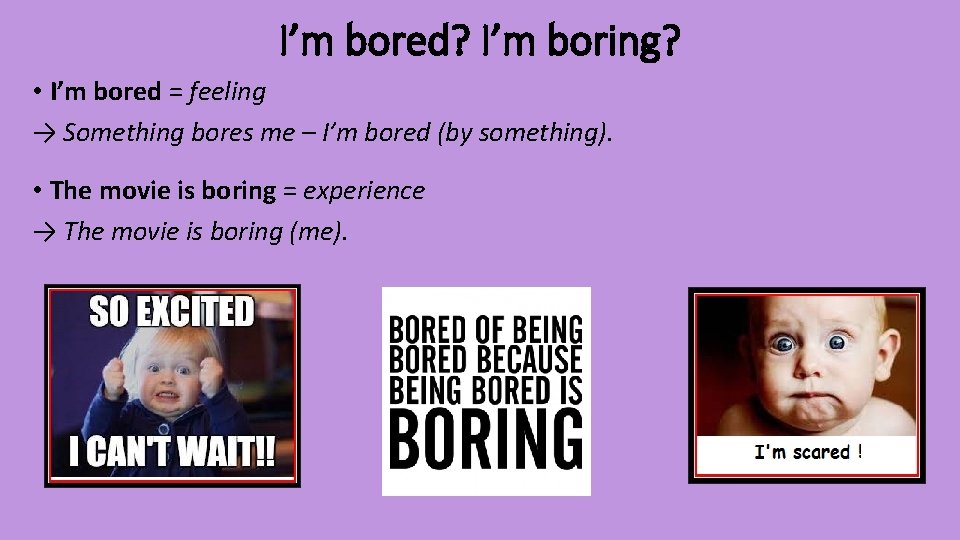
I’m bored? I’m boring? • I’m bored = feeling → Something bores me – I’m bored (by something). • The movie is boring = experience → The movie is boring (me).
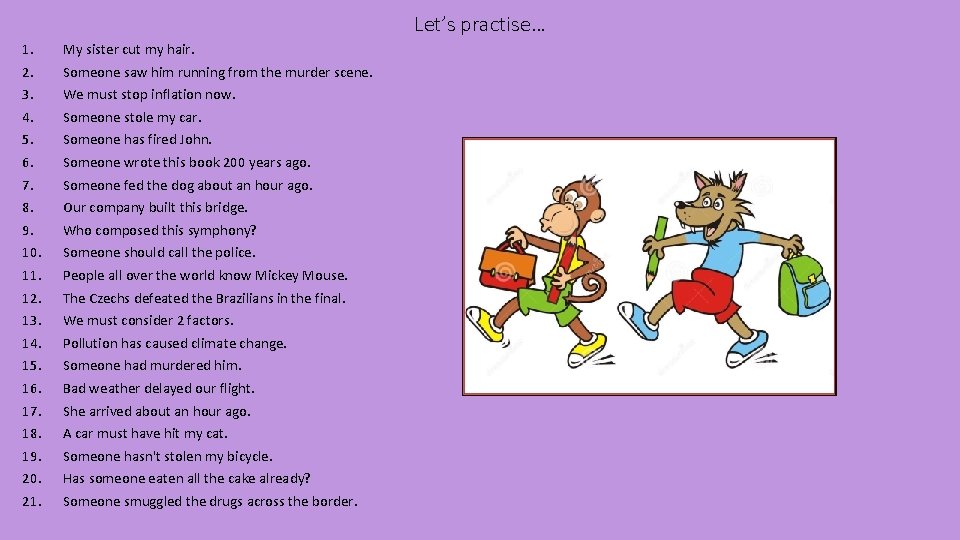
Let’s practise… 1. 2. 3. 4. 5. 6. 7. 8. 9. 10. 11. 12. 13. 14. 15. 16. 17. 18. 19. 20. 21. My sister cut my hair. Someone saw him running from the murder scene. We must stop inflation now. Someone stole my car. Someone has fired John. Someone wrote this book 200 years ago. Someone fed the dog about an hour ago. Our company built this bridge. Who composed this symphony? Someone should call the police. People all over the world know Mickey Mouse. The Czechs defeated the Brazilians in the final. We must consider 2 factors. Pollution has caused climate change. Someone had murdered him. Bad weather delayed our flight. She arrived about an hour ago. A car must have hit my cat. Someone hasn't stolen my bicycle. Has someone eaten all the cake already? Someone smuggled the drugs across the border.
- Slides: 11