
THE PARTICIPLE l The participle is a verb
THE PARTICIPLE l. The participle is a verb ending in -ing.
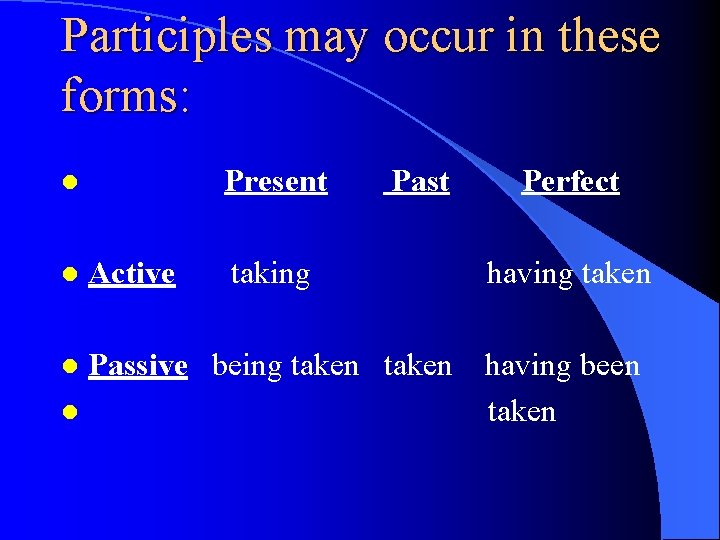
Participles may occur in these forms: Present l Past Perfect l Active taking having taken l Passive being taken having been taken l

Participles can be used: A. as adjectives l. Mrs Chan is a hard-working woman. l. I like fried chicken legs.
Note (1) l. When the participle is a phrase, it is put after the noun it qualifies.
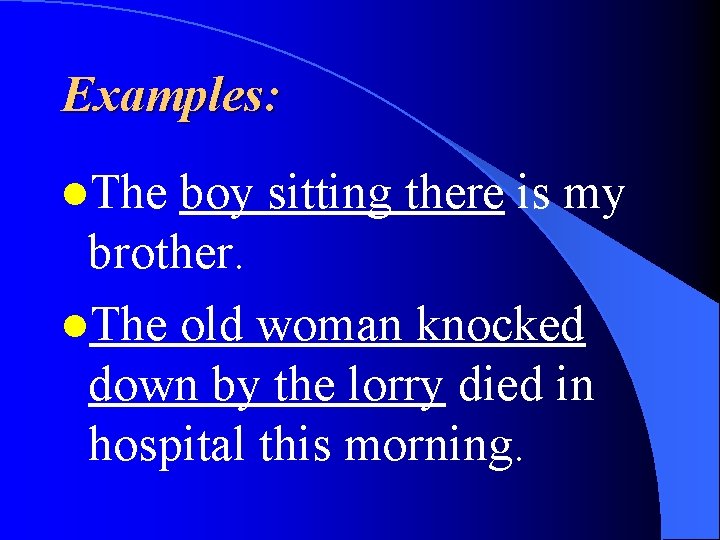
Examples: l. The boy sitting there is my brother. l. The old woman knocked down by the lorry died in hospital this morning.
Note (2) l. To decide whether to use a present participle or a past participle to qualify a noun, bear the following points in mind:
1. The present participle refers to a continuous action. The past participle refers to a completed action. l. Look! People are running out of the burning building. l. After the blaze the fire victims looked at their burnt huts in anguish.
2. The present participle is active in meaning. The past participle is passive in meaning. l. The man giving the lecture is an expert in biology. l. The lecture given by the expert is very instructive.
• 3. The present participle is used to refer to things while the participle is used to refer to persons. l. The film was boring. We were all bored to death. l. Your results are disappointing. I’m disappointed with your results.
iii) A participle phrase can be used to replace an adjective clause. Example 1: l. There were some children who were playing in the playground. l. There were some children playing in the playground.
Example 2: l. The book which was written by the young writer is a success. l. The book written by the young writer is a success.
B. Participles can be used as adverbs expressing: 1) time (Example 1) l. When he heard a cry for help, he rushed outside. l. Hearing a cry for help, he rushed outside.
Example 2: l. When the private car was hit by the lorry, it rolled down the slope. l. Being hit by the lorry, / Hit by the lorry, the private car rolled down the slope.
Example 3: l. After Mary had finished her homework, she cleared the table. l. Having finished her homework, Mary cleared the table.

2) reason Example 1: l. Because Mary felt curious, she read the letter. l. Feeling curious, Mary read the letter.
Example 2: l. As Tom was in a hurry, he took a taxi. l. Being in a hurry, Tom took a taxi.
Example 3: l. Since she has come of age, Mary has to apply for an adult I. D. card. l. Having come of age, Mary has to apply for an adult I. D. card.
Example 4: l. As he had been warned not to do it, he was held responsible for what happened. l. Having been warned not to do it, he was held responsible for what happened.
3) condition Example 1: l. If you keep a diary, you can practise writing every day. l. Keeping a diary, you can practise writing every day.
Example 2: l. If he had been given encouragement and help, he would not have failed. l. Given encouragement and help, he would not have failed.
4) manner Example: l. He stood on the kerb and waited for a taxi. l. He stood on the kerb waiting for a taxi.
This construction is very common in English. Here are some more examples: l She lay on the bed reading a magazine. l The old man sat on the bench watching the children play. l In the library some students were sitting there buried in their studies.
Note: l. In using participle phrases as adverbs, the following points should not be overlooked:
Note (1) l If the subject of the adverb clause which is to be replaced by the participle phrase is not the same person or thing as the subject of the main clause, it cannot be omitted.
Example: l. As it was a cold day, Mary put on her coat. l. It being a cold day, Mary put on her coat.
Compare: l. As Mary felt cold, she put on her coat. l. Feeling cold, Mary put on her coat.
Note (2) l. The negative is formed by adding NOT before the participle phrase.
Example 1: l. Since she was not used to hard work, she found the job very tiring. l. Not being used to hard work, she found the job very tiring.
Example 2: l. She could not go with us because her mother had not returned. l. Her mother not having returned, she could not go with us.
Note (3) l. When the verb in the clause is in the continuous tense, we may use the construction WHEN/WHILE + PRESENT PARTICIPLE.
Example 1: l. Be careful when you are crossing the street. l. Be careful when crossing the street.
Example 2: l. While he was waiting for a bus yesterday, Tom witnessed an accident. l. While waiting for a bus yesterday, Tom witnessed an accident.
Note (4) l. Sometimes we can use the ON + GERUND construction to replace a participle phrase expressing time.
Examples: l. As soon as she heard the news, she collapsed. l. Hearing the news, she collpased. l. On hearing the news, she collpased.
Note (5) l. Care should be taken in using the participle construction to see that its logical subject is the same person or thing as the subject of the main clause.
Example (Wrong): l. Reading the newspaper, the news of the assassination of the president shocked me. (It was NOT the news that was reading the newspaper!)
Example (Right): l. Reading the newspaper, I was shocked by the news of the assassination of the president.
Note (6) l However, there are cases where a participle phrase may not be logically related to the subject of the main clause. This occurs in a number of expressions so frequently used that they have been accepted as correct.
Examples: l Generally speaking, girls are more careful than boys. l Strictly speaking, his work leaves much to be desired. l Roughly speaking, the teenage suicide rate was almost doubled last year.
Examples: l. Beginning tomorrow, tickets for the concert will be available. l. Judging from what you said, the new film is worth seeing. l. There will be five of us going, including Maria.
C. Participles can be used as object complement Example 1: l. He found a letter lying on the floor. (It was the letter that was lying on the floor. )
Example 2: l. He found the stolen car abandoned at the roadside. (It was the car that was abandoned. )
Examples 3, 4: l. Hurry up! Can’t you see a bus coming? l. I will have my watch repaired tomorrow.
- Slides: 43