
The Parenthood Decision Unit 1 1 1 The

- Slides: 41
The Parenthood Decision Unit 1
1. 1 The Parenthood Decision Terms l Adoptive Parent - a person who becomes a parent through a legal process. l Environment - a person’s surroundings and everything in them, including both human and non-human factors. Joyce Glenn
l Biological Parent – Two people who conceive a child; also called birth parents.
1. 1 The Parenthood Decision Terms l Family Planning - a deliberate act of deciding how many children and the spacing of years between each child. l Foster Parent - a person who provides a temporary home for a child. I see lots of kids in your future Joyce Glenn
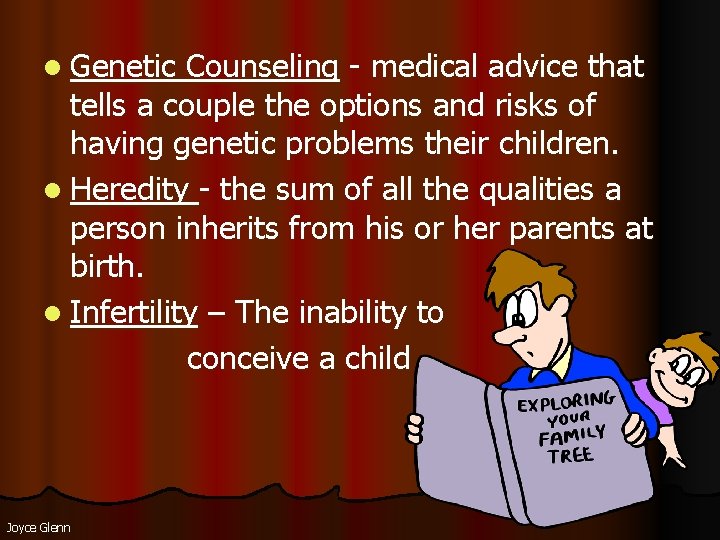
l Genetic Counseling - medical advice that tells a couple the options and risks of having genetic problems their children. l Heredity - the sum of all the qualities a person inherits from his or her parents at birth. l Infertility – The inability to conceive a child Joyce Glenn
l Obstetrician - a doctor who specializes in pregnancy and childbirth. l Parenting - the process of caring for children and helping them grow and learn. l Pediatrician - a doctor who specializes in the care of children. l Sibling – a brother or sister Joyce Glenn
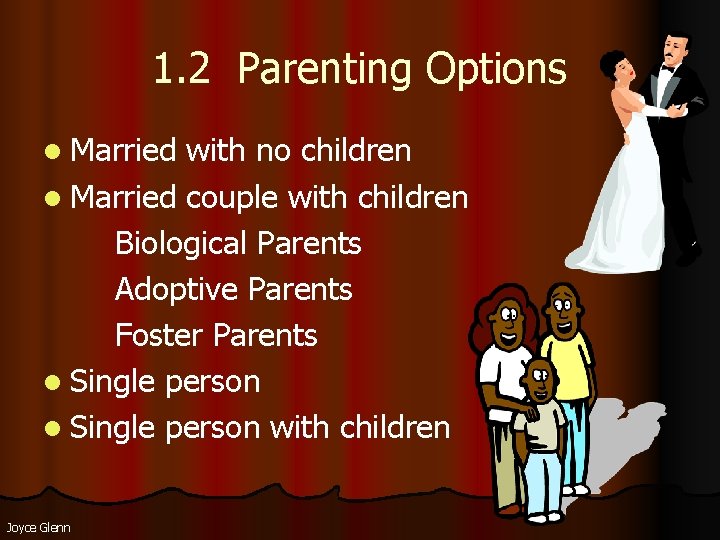
1. 2 Parenting Options l Married with no children l Married couple with children Biological Parents Adoptive Parents Foster Parents l Single person with children Joyce Glenn
1. 3 Factors to Consider in Making a Parenthood Decision l Do both enjoy and desire children? l Would both be positive role models for children? l Is the marriage relationship secure & happy? l Can both share love with a child without feelings of jealousy? Joyce Glenn
l Is one willing and able to accept the changes in lifestyle? l Is one financially able to support a child? l Will becoming a parent affect education goals and career opportunities? l Will employers allow maternity or paternity leave? Joyce Glenn
l Mental or physical health problems? Genetic, age, chronic illness l Do you really want to be a parent or are you being pressured? Family or peer pressure? Joyce Glenn
l Is the mother physically able? l Is the decision based on a desire for a companion? l Are child care services available, if needed? Joyce Glenn
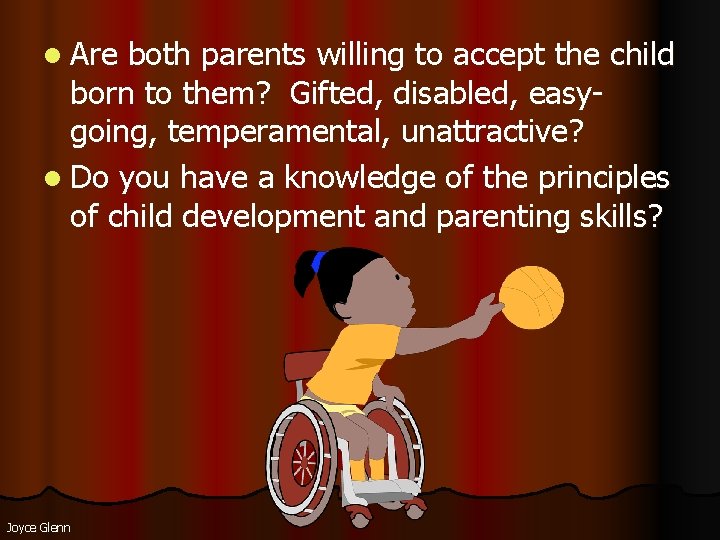
l Are both parents willing to accept the child born to them? Gifted, disabled, easygoing, temperamental, unattractive? l Do you have a knowledge of the principles of child development and parenting skills? Joyce Glenn
l Are living facilities large enough? l Is the home in a neighborhood suitable for raising children? l Do you have the energy required to be a parent? Joyce Glenn
World’s Toughest Job https: //www. youtube. com/watch? v=MWc. JZ 210 Aa. M
1. 4 Describe the influence of heredity and environment on child development l Heredity-the passing on of certain characteristics from earlier generations l Blood type l Eye color l Hair color “Nature” Joyce Glenn
1. 4 Describe the influence of heredity and environment on child development l Environment-the people, places, and things that surround and influence a person l Your family l Your friends l Your community “Nurture” Joyce Glenn
Nature vs. Nurture “Nature affects nurture affects nature and back and forth. ” Psychiatrist Stanley Greenspan Heredity and environment have worked together to make you. From your parents and past generations, you inherited certain physical characteristics. From your family you also learned certain attitudes and ways of doing things. You have also been influenced by the world around you. What you read, what you see on TV, the type community you live in-all these and countless other factors have shaped who you are as well. Joyce Glenn
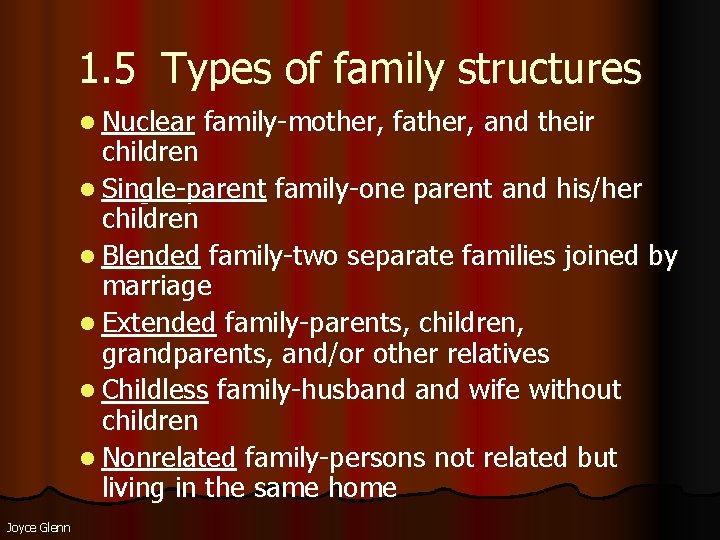
1. 5 Types of family structures l Nuclear family-mother, father, and their children l Single-parent family-one parent and his/her children l Blended family-two separate families joined by marriage l Extended family-parents, children, grandparents, and/or other relatives l Childless family-husband wife without children l Nonrelated family-persons not related but living in the same home Joyce Glenn
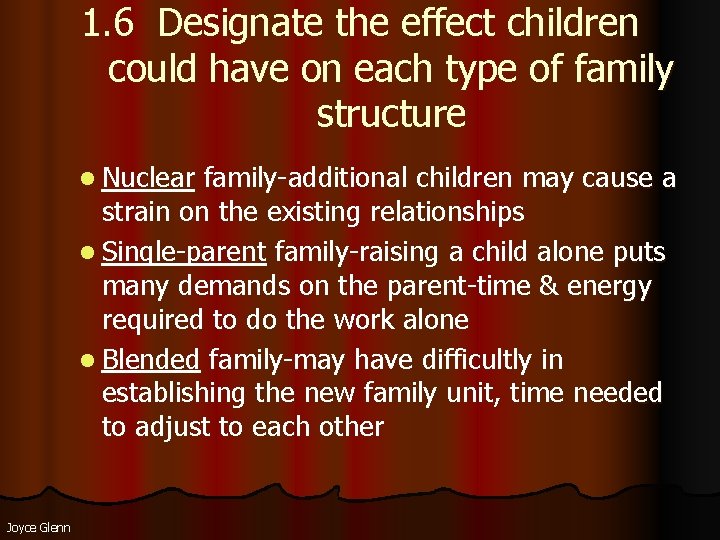
1. 6 Designate the effect children could have on each type of family structure l Nuclear family-additional children may cause a strain on the existing relationships l Single-parent family-raising a child alone puts many demands on the parent-time & energy required to do the work alone l Blended family-may have difficultly in establishing the new family unit, time needed to adjust to each other Joyce Glenn
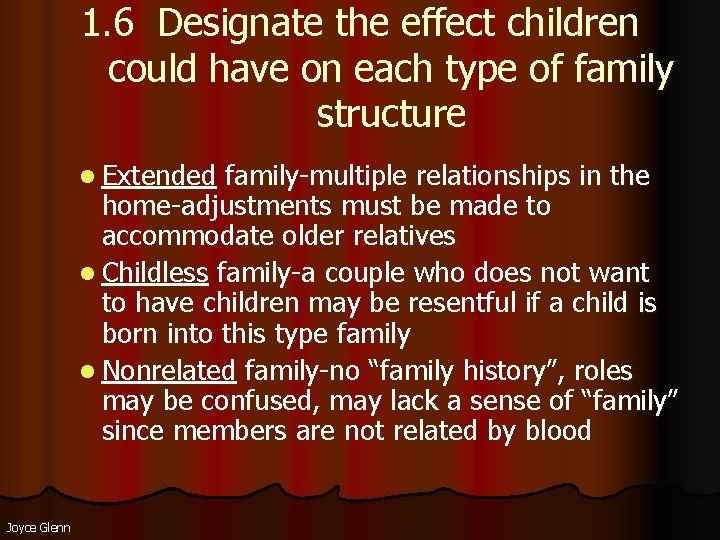
1. 6 Designate the effect children could have on each type of family structure l Extended family-multiple relationships in the home-adjustments must be made to accommodate older relatives l Childless family-a couple who does not want to have children may be resentful if a child is born into this type family l Nonrelated family-no “family history”, roles may be confused, may lack a sense of “family” since members are not related by blood Joyce Glenn
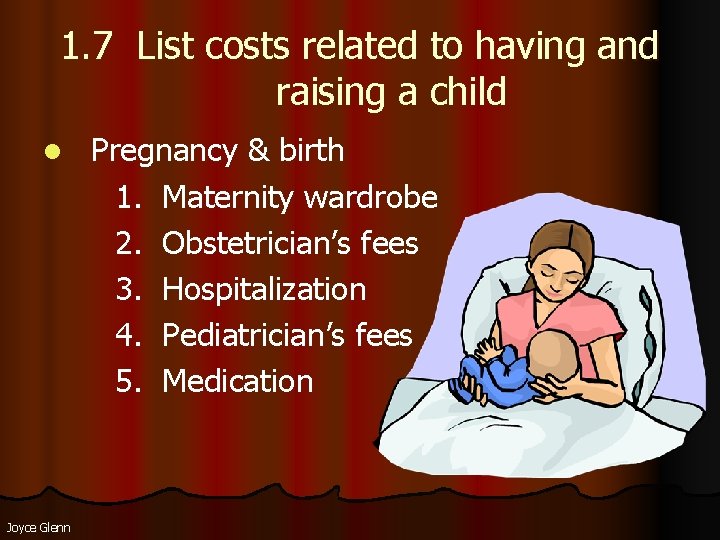
1. 7 List costs related to having and raising a child l Joyce Glenn Pregnancy & birth 1. Maternity wardrobe 2. Obstetrician’s fees 3. Hospitalization 4. Pediatrician’s fees 5. Medication
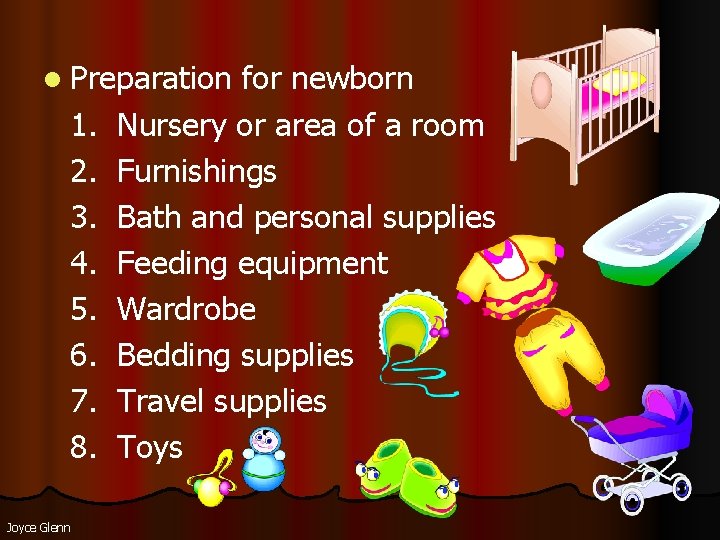
l Preparation for newborn 1. Nursery or area of a room 2. Furnishings 3. Bath and personal supplies 4. Feeding equipment 5. Wardrobe 6. Bedding supplies 7. Travel supplies 8. Toys Joyce Glenn
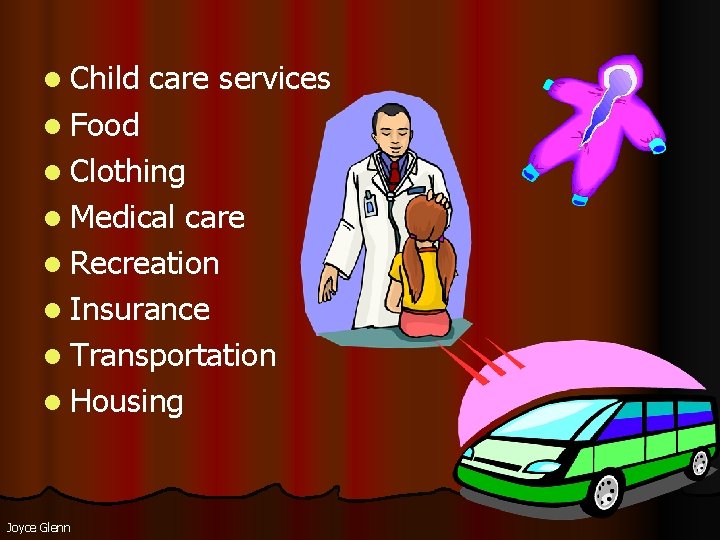
l Child care services l Food l Clothing l Medical care l Recreation l Insurance l Transportation l Housing Joyce Glenn
l According to a 2010 USDA report, the average middle-income family will spend roughly $12, 000 on child-related expenses in their baby’s first year of life. By age two, parents are up to more than $12, 500 per year. l Parents Projected to Spend $245, 340 to Raise a Child Born in 2013, According to USDA Report l http: //www. cnpp. usda. gov/tools/CRC_Calc ulator/ Joyce Glenn
l Education 1. Books & supplies 2. Fees for special activities 3. School tuition 4. Additional costs for college or job training-tuition, room & board 5. Social/lifestyle costs-parties, school activities, extracurricular activities, travel Joyce Glenn
l Private lessons-art, music, karate, dance, gymnastics l Allowances l Expenses related to adult children (children moving back into the home, divorced child, child seeking employment l Expenses related to grandchildren Joyce Glenn
1. 8 Name rewards and challenges associated with parenthood l Rewards l Happiness l Pride l Unique love l See the world through a child’s eyes l Can enrich an already strong marriage l Great sense of accomplishment Joyce Glenn
1. 8 Name rewards and challenges associated with parenthood l Challenges l New responsibilities l Change in lifestyle l Personal freedom is affected l Change in relationships l Career changes l Financial challenges l Emotional adjustments l Demands on time & energy Joyce Glenn
1. 9 Positive effects of parenthood on marriage and personal relationships Close feelings develop between parents during pregnancy, delivery, and birth l Feelings of contentment and self-fulfillment develop while watching children grow and develop l Feelings of satisfaction when they produce a permanent expression of love l Joyce Glenn
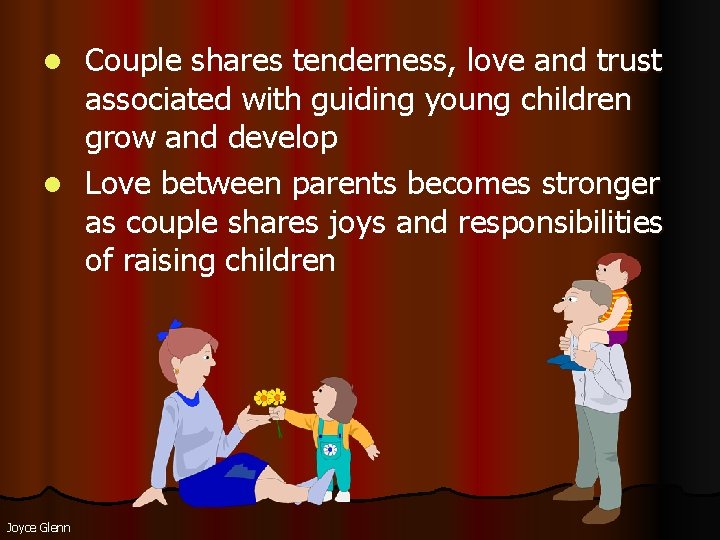
Couple shares tenderness, love and trust associated with guiding young children grow and develop l Love between parents becomes stronger as couple shares joys and responsibilities of raising children l Joyce Glenn
Children create a closer bond between couples in a loving, caring marriage l Respect for mate increases as each watches the other cope with stresses of parenting l Joyce Glenn
Activities associated with children are fun and rewarding for both parents l Couple enjoys sharing in the education and development of children l Feelings of pride and satisfaction occur when children are productive and become successful, happy adults l Joyce Glenn
1. 9 Negative effects of parenthood on marriage and personal relationships l Changes in lifestyle may create problems l Expense of raising a child can cause conflict l Conflict over whether children should seek employment outside the home could occur l Constant demand of children can increase problems in an unstable marriage Joyce Glenn
l Conflict can occur when parents disagree on goals for children in l Conflict may occur when one parent refuses to share in child care l Stress may occur when special needs children increase financial needs and require additional care Joyce Glenn
l Stress occurs when children play one parent against the other l Children place additional burdens on a household when one or both parents have an emotional or physical problem Joyce Glenn
1. 9 Advantages of family planning l Couples have the option to remain childless l Individuals can achieve set goals prior to the arrival of children Joyce Glenn
l Parents can plan for and have the number of children they want l Children are born that are wanted by both parents Joyce Glenn
l Timing for the arrival of each child can b e planned for a specific time that takes into account the welfare of all family members l Couples can plan for children to arrive when each feels physically & psychologically healthy enough to provide love and security for children Joyce Glenn
l Couples can plan for children to arrive when the financial situation is such that children can be well nourished and kept physically healthy. l Couples can be spaced so that the couple can provide financing for each child’s education Joyce Glenn
1. 11 Factors that influence family planning decisions l Parents’ current and future employment l Parents’ educational and career goals l Available time to provide children with necessary love and attention l Finances needed to provide children with basic needs Joyce Glenn
Joyce Glenn