
The Paragraph Writing Strategy By Brenda Benedict SIM
The Paragraph Writing Strategy By Brenda Benedict. SIM Professional Developer bbenedict 07@gmail. com 616 350 -5514 All material available at: Caledoniacommunityschools. weebly. com
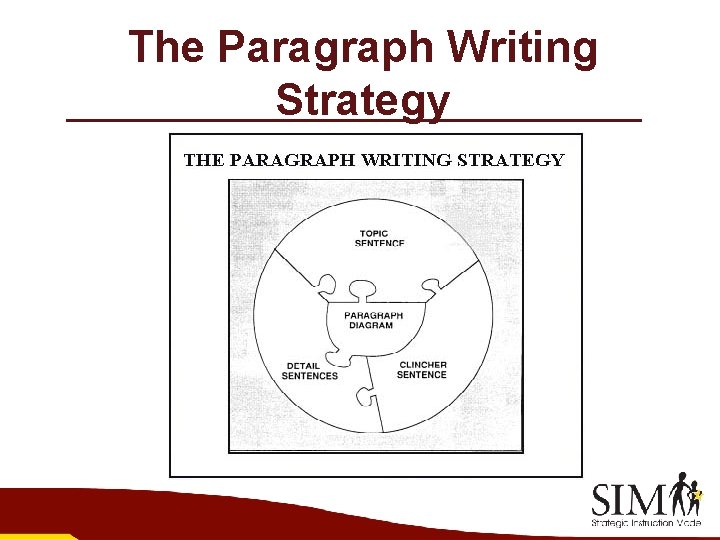
• The Paragraph Writing Strategy will provide students with a structured approach to writing effective paragraphs by organizing information related to the main idea or topic into a logical sequence with topic, detail, and concluding sentences. Students are taught to write different types of paragraphs including narrative, persuasive, and expository paragraphs. Research by the University of Kansas has shown that scores on enumerative paragraphs were 52% in baseline and 92% after instruction; on sequential paragraphs the mean scores were 49% in baseline and 95% after instruction, and on compare-andcontrast paragraphs the mean scores were 38% in baseline and 91% after instruction.
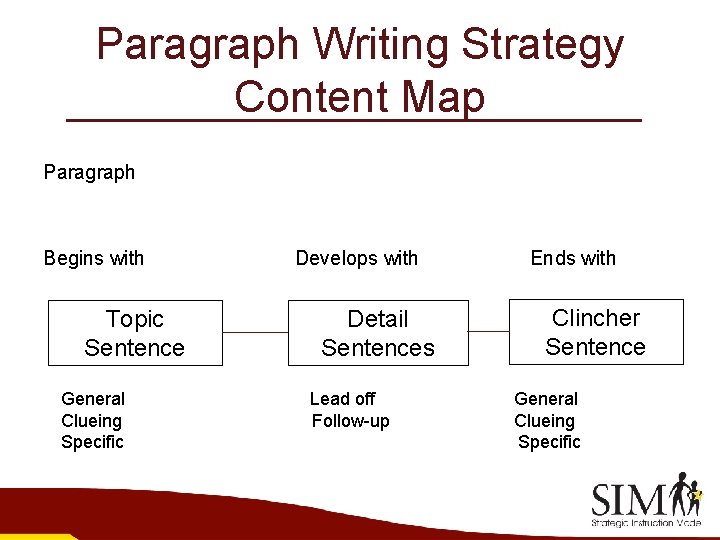
Paragraph Writing Strategy Content Map Paragraph Begins with Topic Sentence General Clueing Specific Develops with Detail Sentences Lead off Follow-up Ends with Clincher Sentence General Clueing Specific
Paragraph Content Map • Whole paragraphs may be
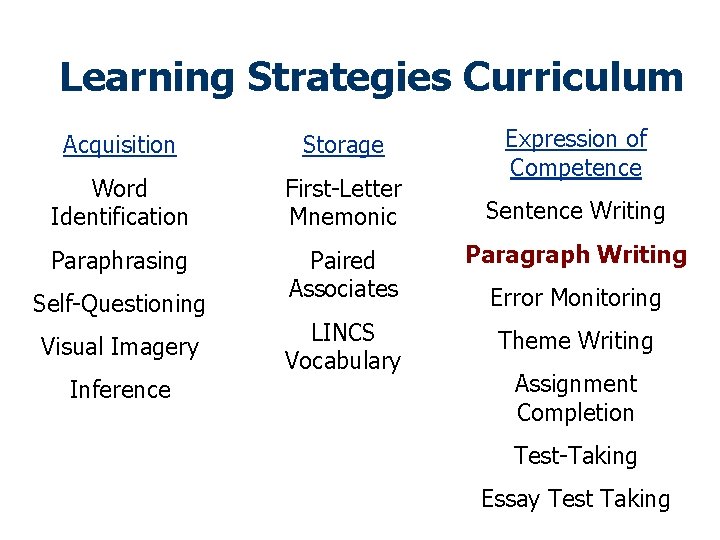
Learning Strategies Curriculum Expression of Competence Acquisition Storage Word Identification First-Letter Mnemonic Paraphrasing Paired Associates Paragraph Writing LINCS Vocabulary Theme Writing Self-Questioning Visual Imagery Inference Sentence Writing Error Monitoring Assignment Completion Test-Taking Essay Test Taking
Guiding Questions 1. Who should receive 3. What is the time instruction in the frame for teaching Paragraph Writing the PWS? Strategy? 4. What is the process 2. What results can I for teaching PWS? expect from using the PWS?
Goal of the Paragraph Writing Strategy 1. Organized paragraphs 2. Interesting writing using 3. Variety of sentence types
The purpose of the strategy instruction To teach students to write wellorganized paragraphs that include: – Topic, Detail, and Clincher Sentences – a consistent point of view – consistency in tense throughout – logically sequenced ideas – appropriate transitions between ideas
The Art and Science of Teaching The Center for Research on Learning at The University of Kansas has given you the science, You must create the art!
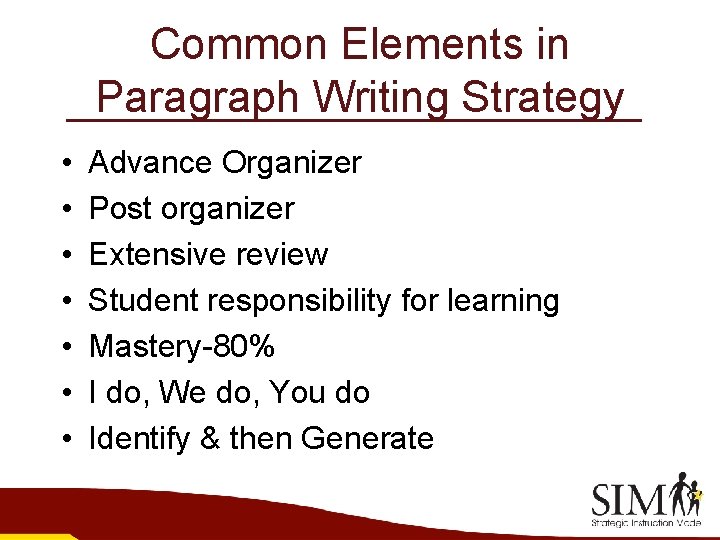
Common Elements in Paragraph Writing Strategy • • Advance Organizer Post organizer Extensive review Student responsibility for learning Mastery-80% I do, We do, You do Identify & then Generate
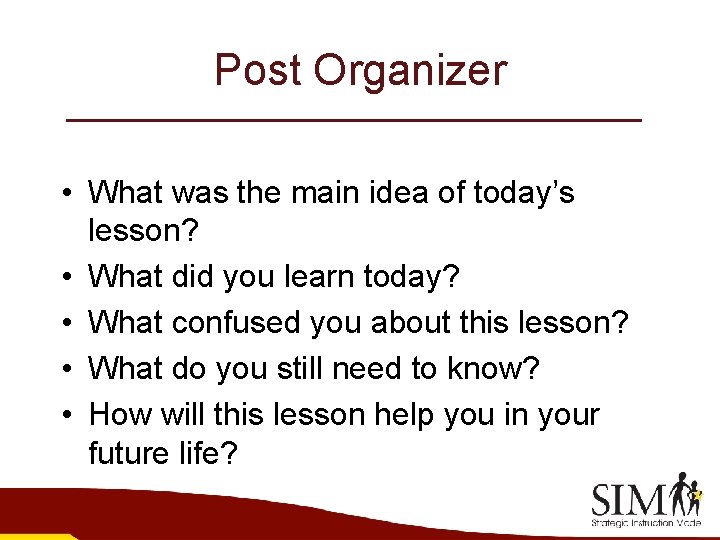
Post Organizer • What was the main idea of today’s lesson? • What did you learn today? • What confused you about this lesson? • What do you still need to know? • How will this lesson help you in your future life?
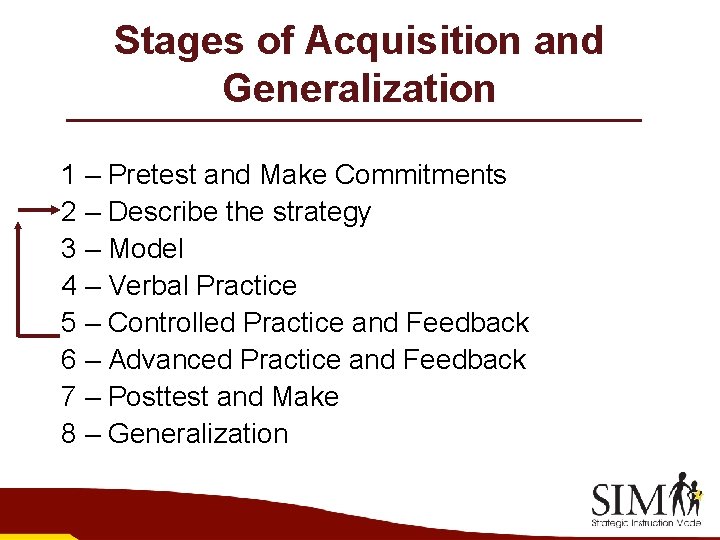
Stages of Acquisition and Generalization 1 – Pretest and Make Commitments 2 – Describe the strategy 3 – Model 4 – Verbal Practice 5 – Controlled Practice and Feedback 6 – Advanced Practice and Feedback 7 – Posttest and Make 8 – Generalization
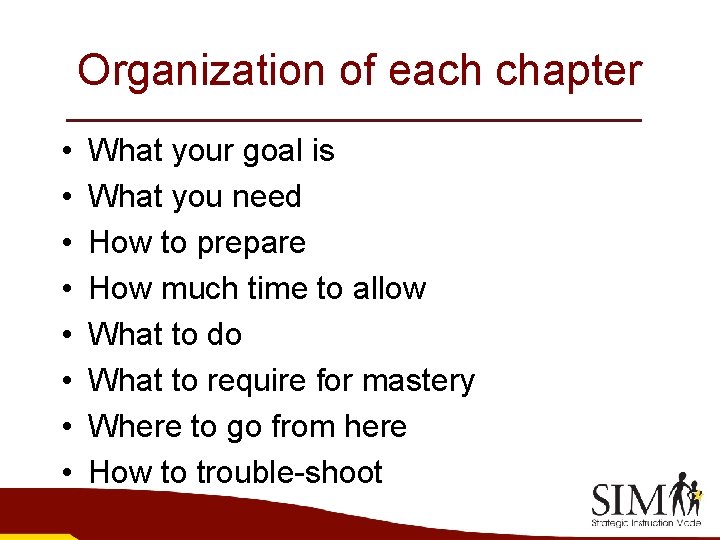
Organization of each chapter • • What your goal is What you need How to prepare How much time to allow What to do What to require for mastery Where to go from here How to trouble-shoot
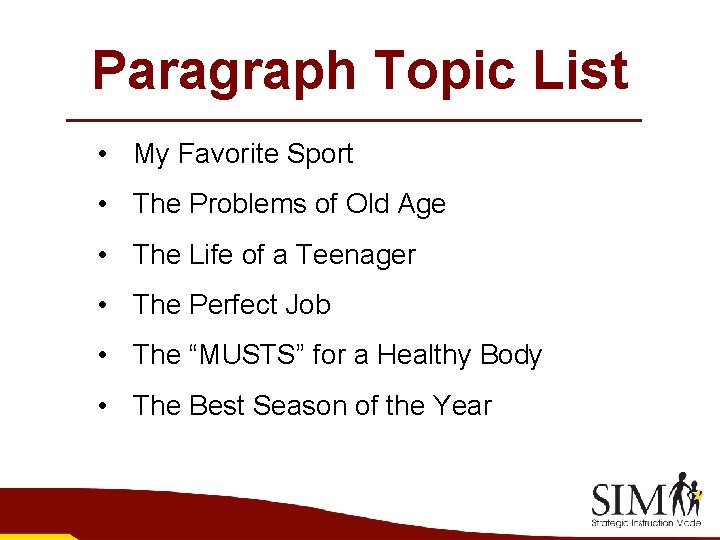
Paragraph Topic List • My Favorite Sport • The Problems of Old Age • The Life of a Teenager • The Perfect Job • The “MUSTS” for a Healthy Body • The Best Season of the Year
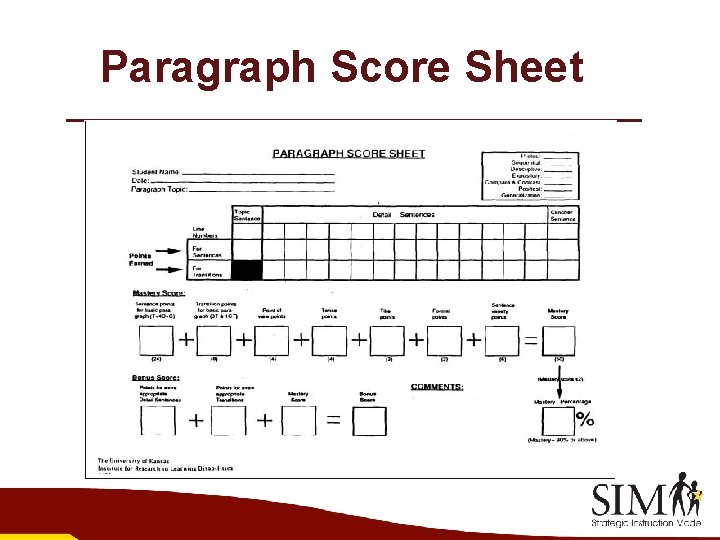
Paragraph Score Sheet
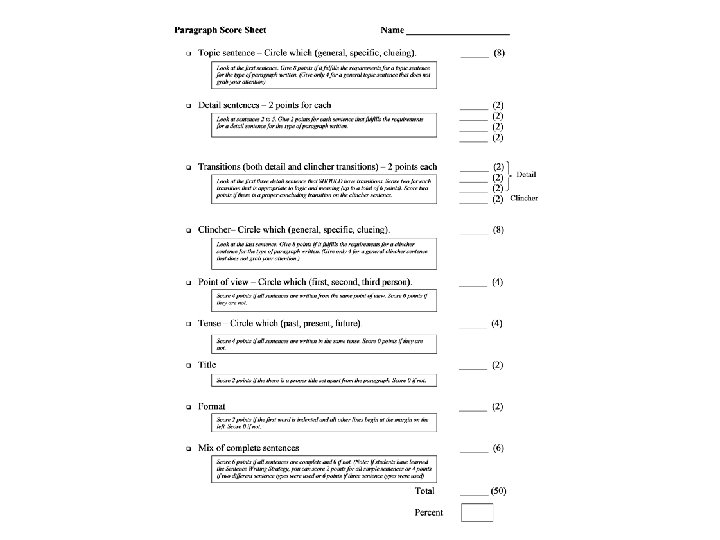
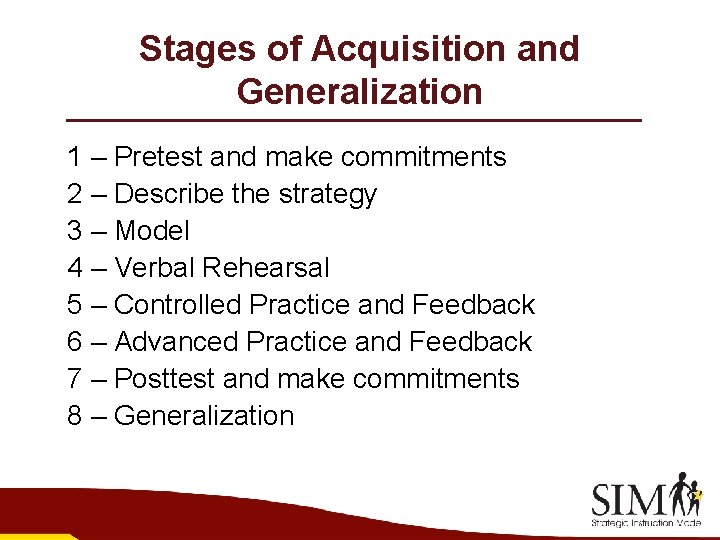
Stages of Acquisition and Generalization 1 – Pretest and make commitments 2 – Describe the strategy 3 – Model 4 – Verbal Rehearsal 5 – Controlled Practice and Feedback 6 – Advanced Practice and Feedback 7 – Posttest and make commitments 8 – Generalization
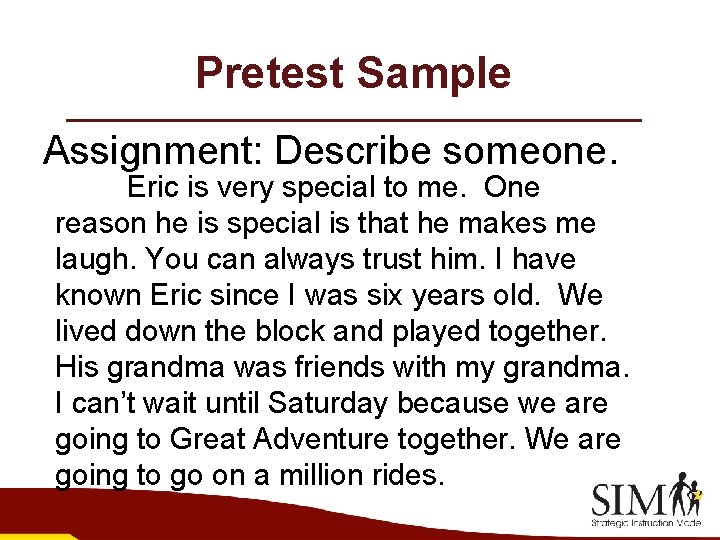
Pretest Sample Assignment: Describe someone. Eric is very special to me. One reason he is special is that he makes me laugh. You can always trust him. I have known Eric since I was six years old. We lived down the block and played together. His grandma was friends with my grandma. I can’t wait until Saturday because we are going to Great Adventure together. We are going to go on a million rides.
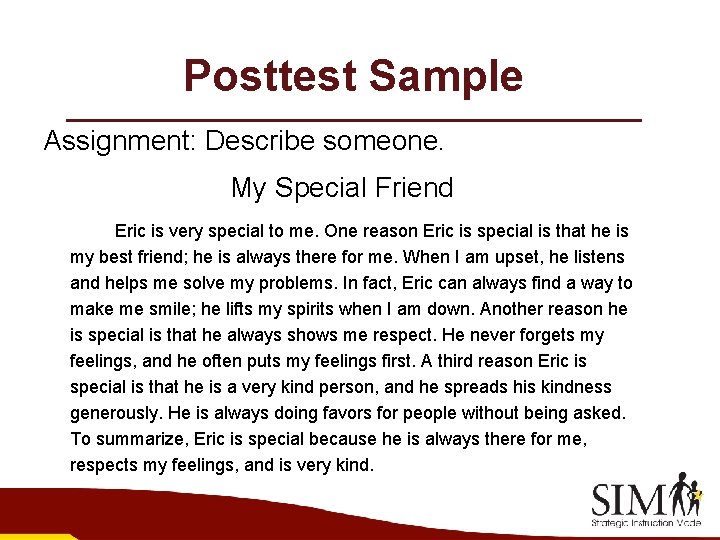
Posttest Sample Assignment: Describe someone. My Special Friend Eric is very special to me. One reason Eric is special is that he is my best friend; he is always there for me. When I am upset, he listens and helps me solve my problems. In fact, Eric can always find a way to make me smile; he lifts my spirits when I am down. Another reason he is special is that he always shows me respect. He never forgets my feelings, and he often puts my feelings first. A third reason Eric is special is that he is a very kind person, and he spreads his kindness generously. He is always doing favors for people without being asked. To summarize, Eric is special because he is always there for me, respects my feelings, and is very kind.
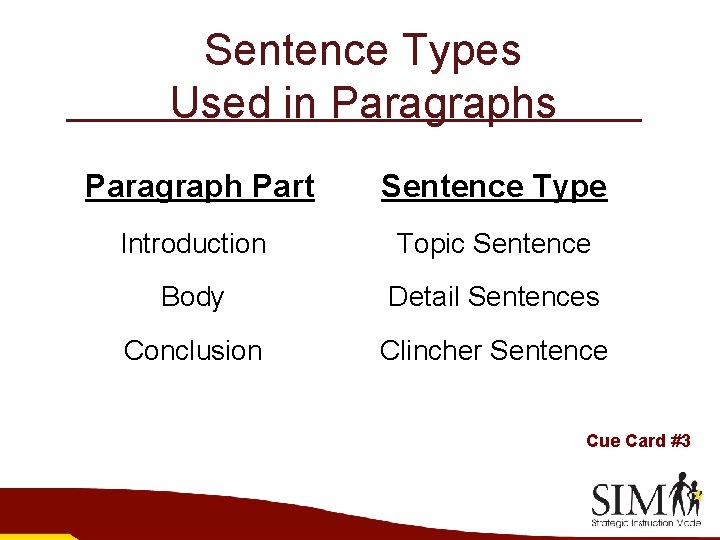
Sentence Types Used in Paragraphs Paragraph Part Sentence Type Introduction Topic Sentence Body Detail Sentences Conclusion Clincher Sentence Cue Card #3
The Paragraph Writing Strategy
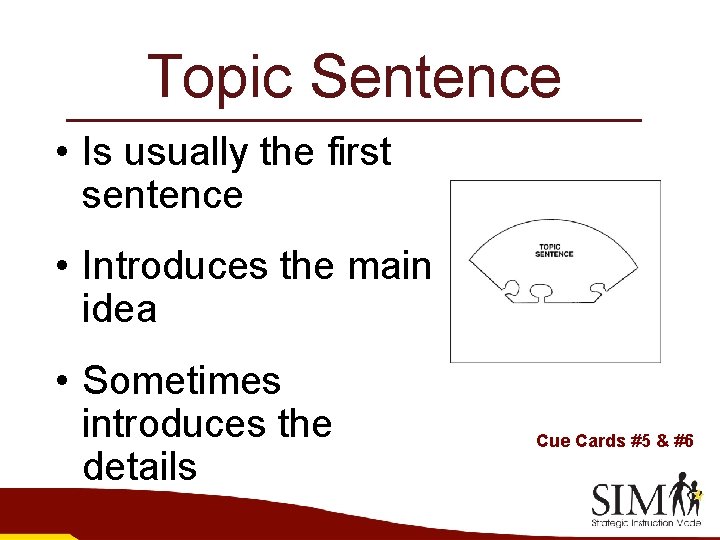
Topic Sentence • Is usually the first sentence • Introduces the main idea • Sometimes introduces the details Cue Cards #5 & #6
Types of Topic Sentences General Topic Sentences Clueing Topic Sentences Specific Topic Sentences Cue Card #7
General Topic Sentence Names the main idea of the paragraph Cue Card #8
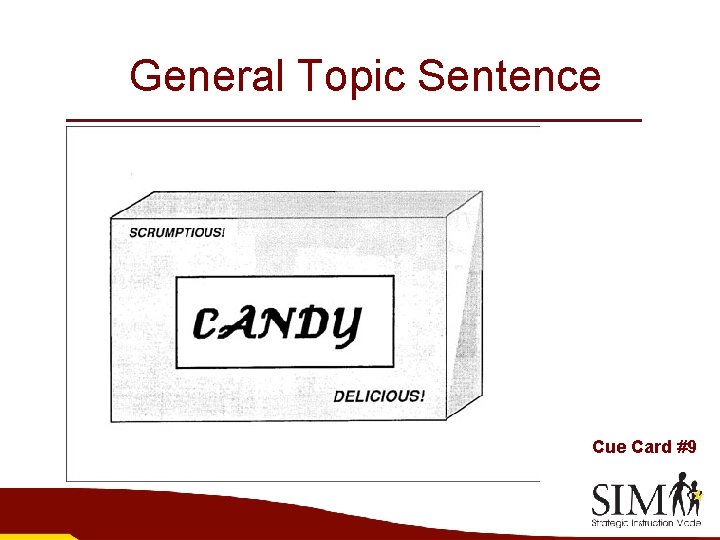
General Topic Sentence Cue Card #9
Examples of General Topic Sentences • The hot trend in advertising these days is to hire real, live stars. • Not much is left of a town known as Nora, Nebraska. • Democracy is thriving at Hillsboro High School. Cue Card #10
Examples of General Topic Sentences • Mr. James is my favorite teacher. • I went to Hawaii on vacation. • We are going to fix up our house.
Clueing Topic Sentence • Names the main idea of the paragraph • Gives a clue about the details Cue Card #11
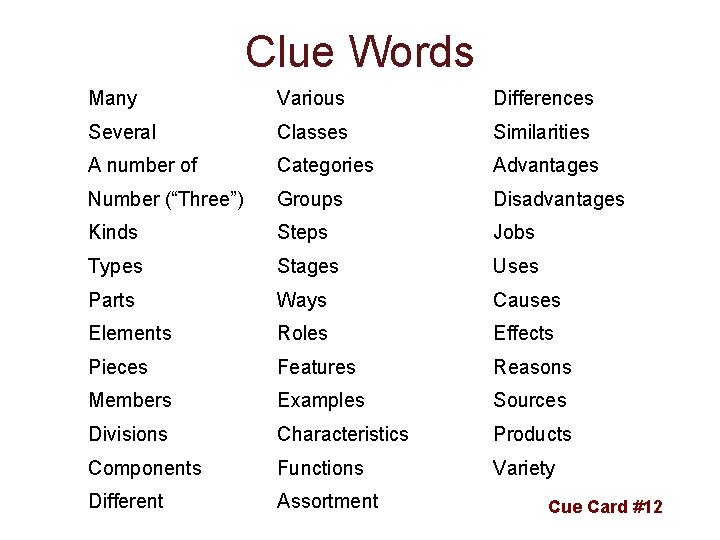
Clue Words Many Various Differences Several Classes Similarities A number of Categories Advantages Number (“Three”) Groups Disadvantages Kinds Steps Jobs Types Stages Uses Parts Ways Causes Elements Roles Effects Pieces Features Reasons Members Examples Sources Divisions Characteristics Products Components Functions Variety Different Assortment Cue Card #12
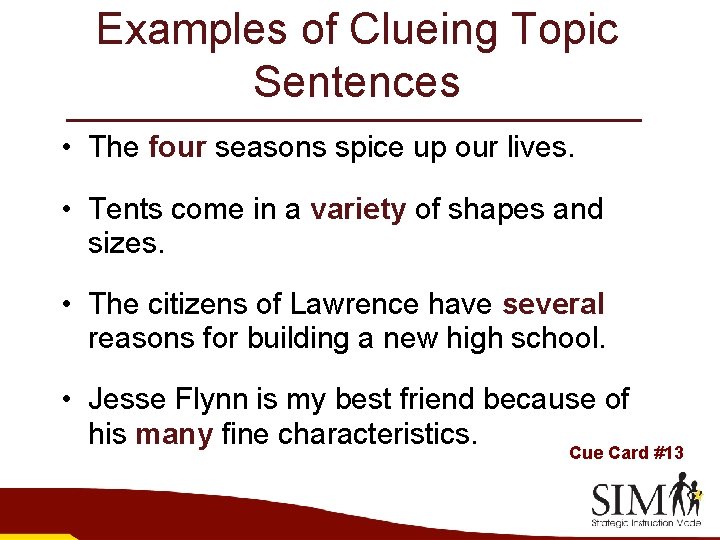
Examples of Clueing Topic Sentences • The four seasons spice up our lives. • Tents come in a variety of shapes and sizes. • The citizens of Lawrence have several reasons for building a new high school. • Jesse Flynn is my best friend because of his many fine characteristics. Cue Card #13
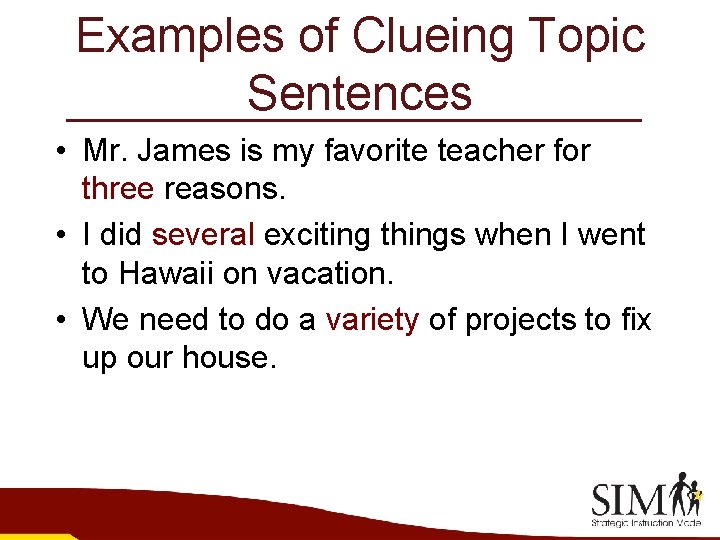
Examples of Clueing Topic Sentences • Mr. James is my favorite teacher for three reasons. • I did several exciting things when I went to Hawaii on vacation. • We need to do a variety of projects to fix up our house.
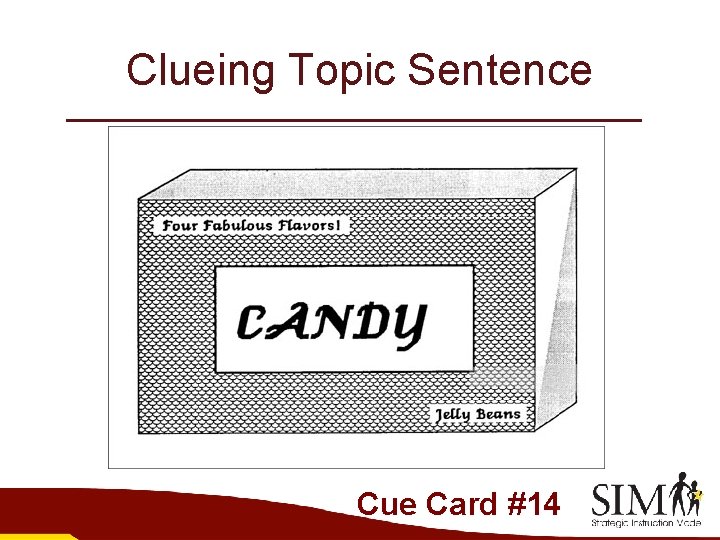
Clueing Topic Sentence Cue Card #14
Specific Topic Sentence • Names the main idea • Names the specific details to be covered Cue Card #15
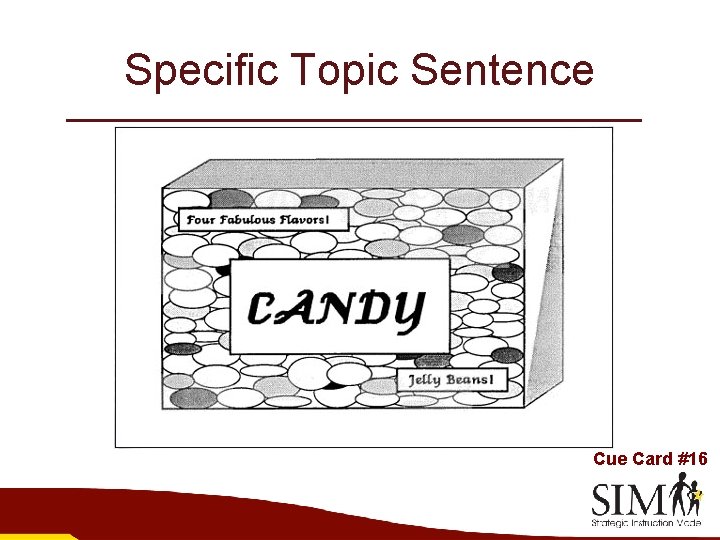
Specific Topic Sentence Cue Card #16
Examples of Specific Topic Sentences • Air pollution is caused by vehicles and industries. • Charles Darwin lived an interesting life as an explorer, writer, and scientist. • Diseases caused by vitamin deficiencies are beri, pellagra, scurvy, and rickets. Cue Card #17
Examples of Specific Topic Sentences • Mr. James is my favorite teacher because he is funny, interesting, and very fair. • When I went to Hawaii on vacation I surfed, went swimming, and skydived. • We are going to fix up our house by putting on a new roof, painting the inside, and buying all new carpets.
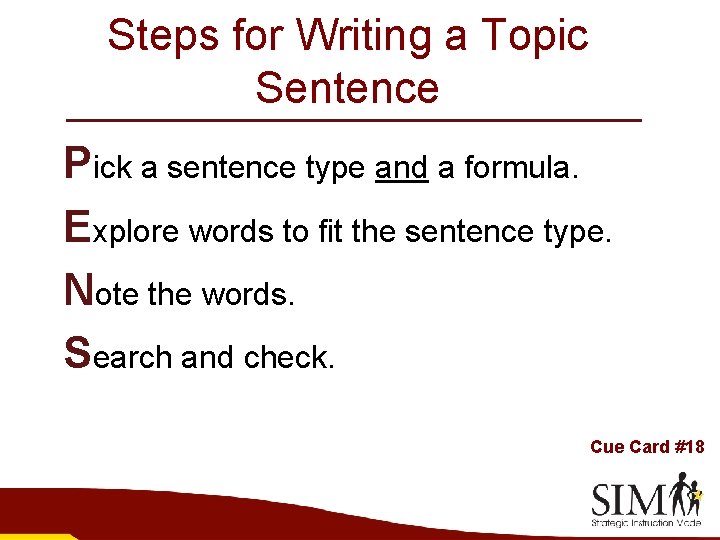
Steps for Writing a Topic Sentence Pick a sentence type and a formula. Explore words to fit the sentence type. Note the words. Search and check. Cue Card #18
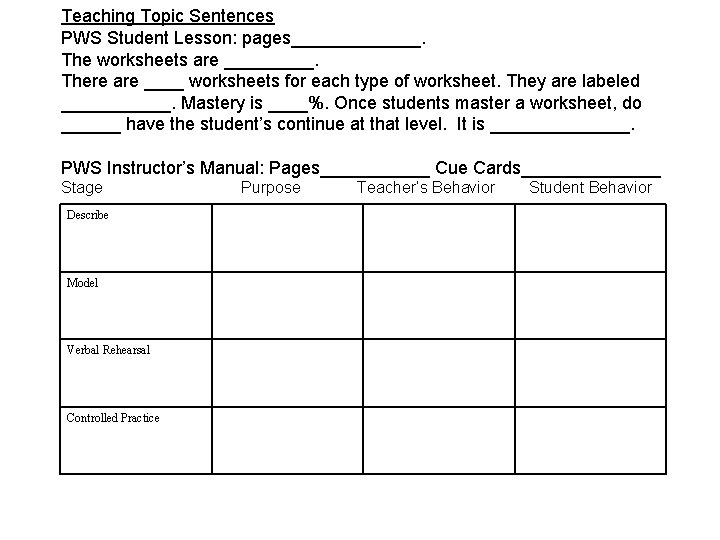
Teaching Topic Sentences PWS Student Lesson: pages_______. The worksheets are _____. There are ____ worksheets for each type of worksheet. They are labeled ______. Mastery is ____%. Once students master a worksheet, do ______ have the student’s continue at that level. It is _______. PWS Instructor’s Manual: Pages______ Cue Cards_______ Stage Describe Model Verbal Rehearsal Controlled Practice Purpose Teacher’s Behavior Student Behavior
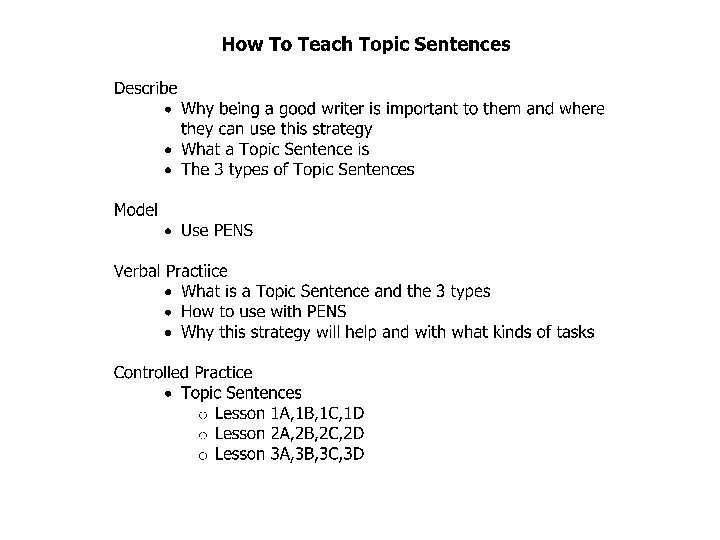
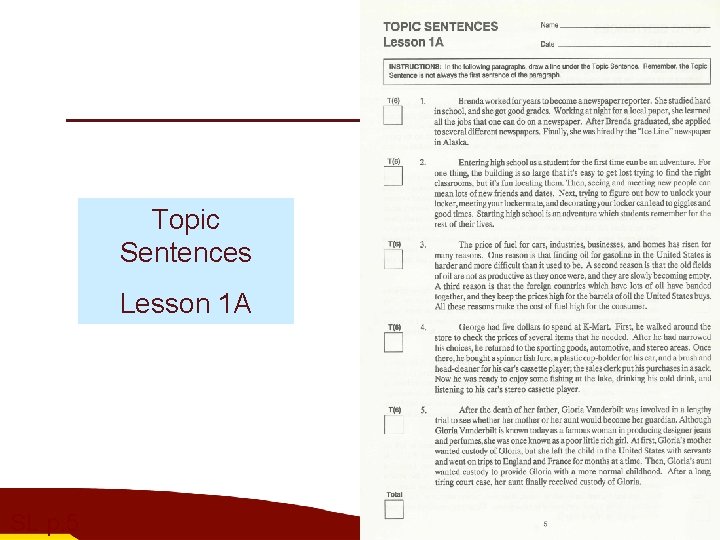
Topic Sentences Lesson 1 A SL p. 5
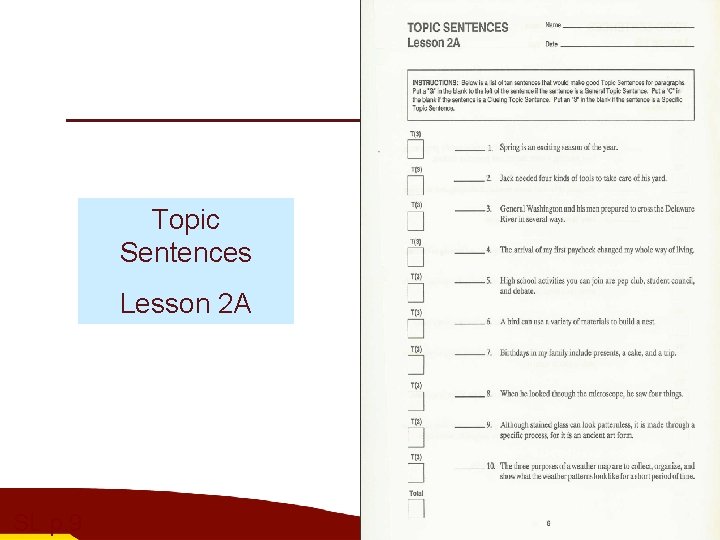
Topic Sentences Lesson 2 A SL p. 9
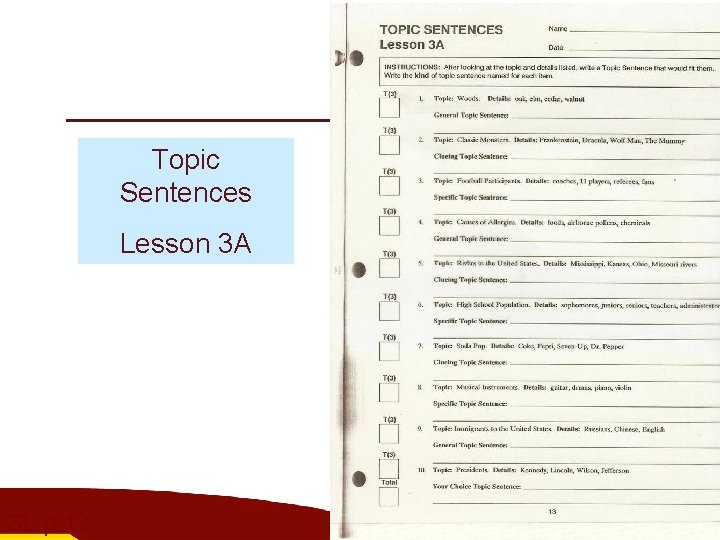
Topic Sentences Lesson 3 A SL p. 13
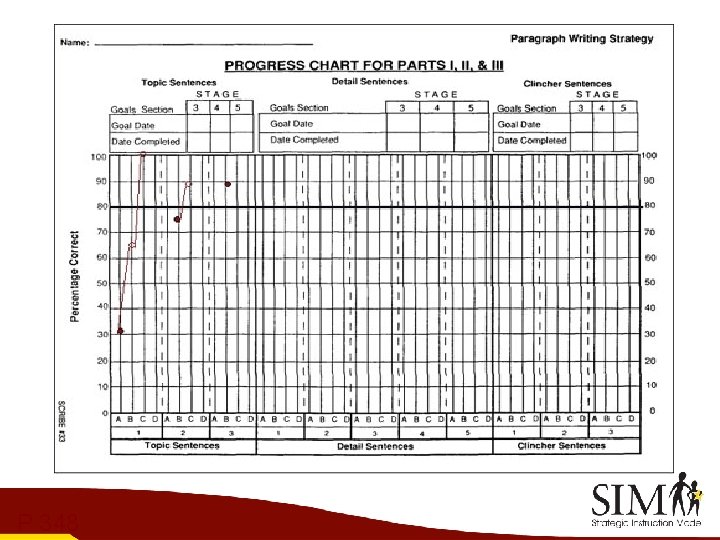
P 348
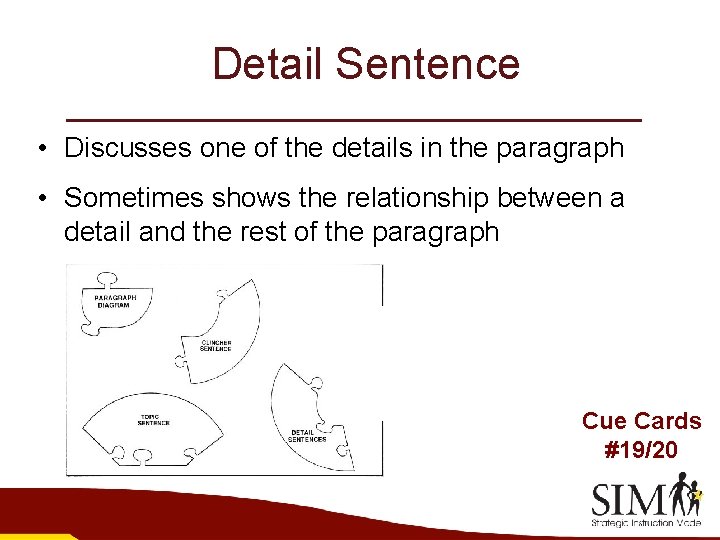
Detail Sentence • Discusses one of the details in the paragraph • Sometimes shows the relationship between a detail and the rest of the paragraph Cue Cards #19/20
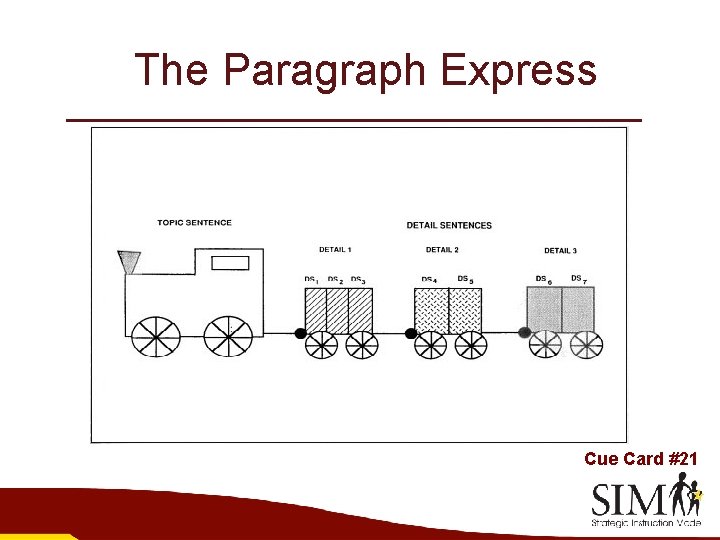
The Paragraph Express Cue Card #21
Transition • Signals the introduction of a new detail. • Shows the relationship between the detail and the rest of the paragraph. Cue Card #22
Types of Detail Sentences Lead-off Sentences Follow-up Sentences Cue Card #23
Lead-off Sentence • Introduces a new detail • Contains a transition Follow-up Sentence Provides more information about the detail.
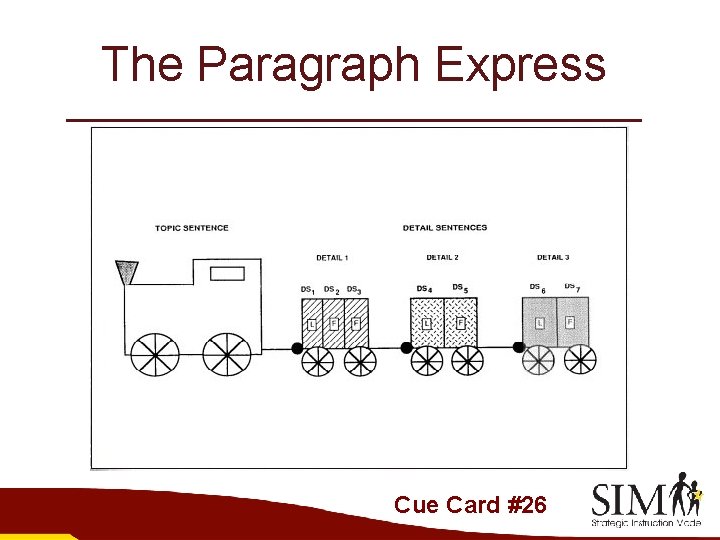
The Paragraph Express Cue Card #26
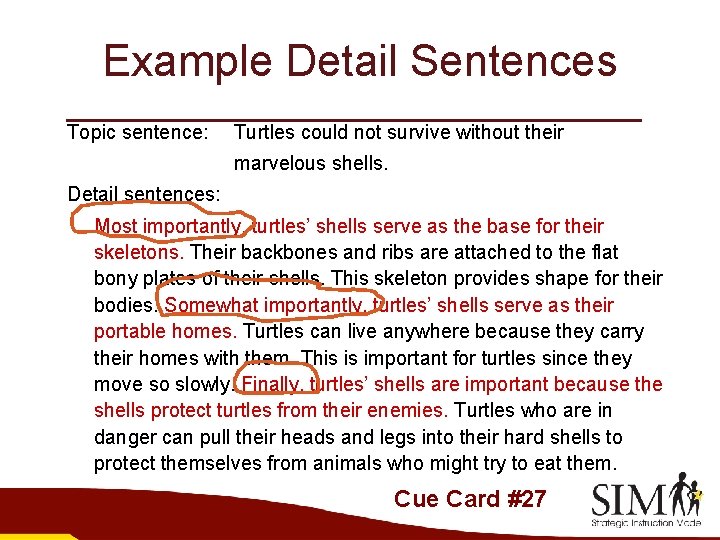
Example Detail Sentences Topic sentence: Turtles could not survive without their marvelous shells. Detail sentences: Most importantly, turtles’ shells serve as the base for their skeletons. Their backbones and ribs are attached to the flat bony plates of their shells. This skeleton provides shape for their bodies. Somewhat importantly, turtles’ shells serve as their portable homes. Turtles can live anywhere because they carry their homes with them. This is important for turtles since they move so slowly. Finally, turtles’ shells are important because the shells protect turtles from their enemies. Turtles who are in danger can pull their heads and legs into their hard shells to protect themselves from animals who might try to eat them. Cue Card #27
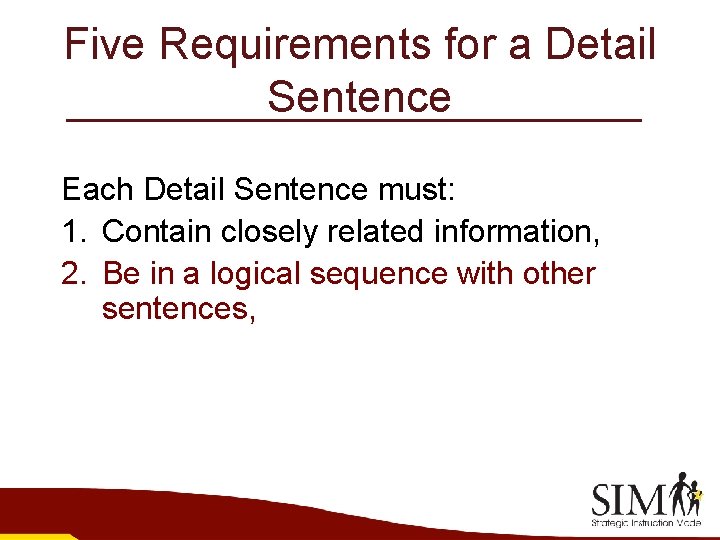
Five Requirements for a Detail Sentence Each Detail Sentence must: 1. Contain closely related information, 2. Be in a logical sequence with other sentences,
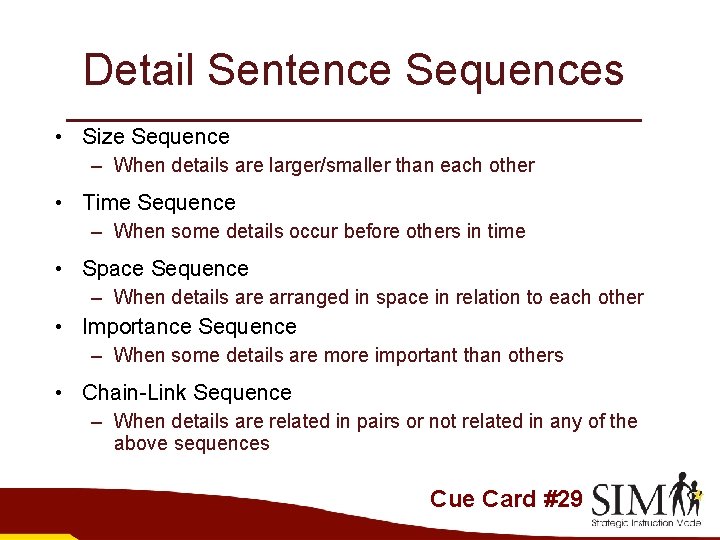
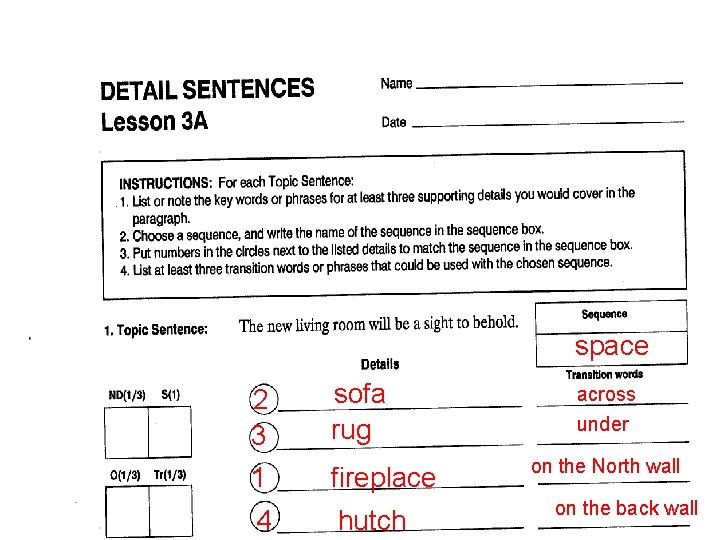
Detail Sentence Sequences • Size Sequence – When details are larger/smaller than each other • Time Sequence – When some details occur before others in time • Space Sequence – When details are arranged in space in relation to each other • Importance Sequence – When some details are more important than others • Chain-Link Sequence – When details are related in pairs or not related in any of the above sequences Cue Card #29
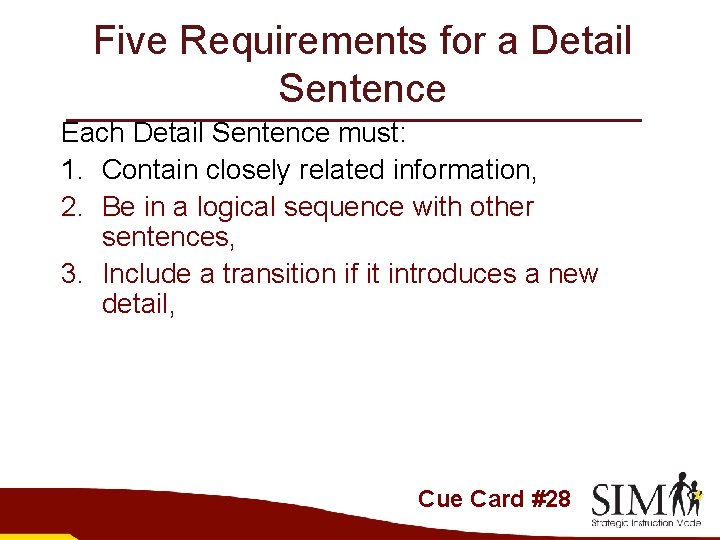
Five Requirements for a Detail Sentence Each Detail Sentence must: 1. Contain closely related information, 2. Be in a logical sequence with other sentences, 3. Include a transition if it introduces a new detail, Cue Card #28
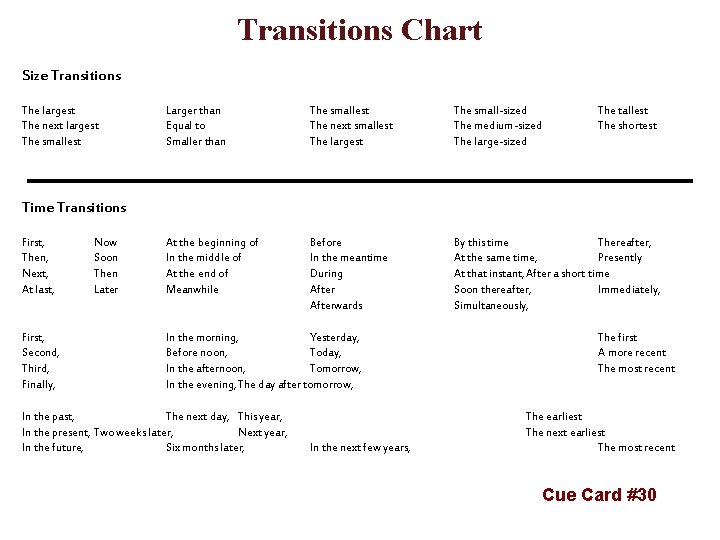
Transitions Chart Size Transitions The largest The next largest The smallest Larger than Equal to Smaller than The smallest The next smallest The largest The small-sized The medium-sized The large-sized The tallest The shortest At the beginning of In the middle of At the end of Meanwhile Before In the meantime During Afterwards By this time Thereafter, At the same time, Presently At that instant, After a short time Soon thereafter, Immediately, Simultaneously, Time Transitions First, Then, Next, At last, First, Second, Third, Finally, Now Soon Then Later In the morning, Yesterday, Before noon, Today, In the afternoon, Tomorrow, In the evening, The day after tomorrow, In the past, The next day, This year, In the present, Two weeks later, Next year, In the future, Six months later, In the next few years, The first A more recent The most recent The earliest The next earliest The most recent Cue Card #30
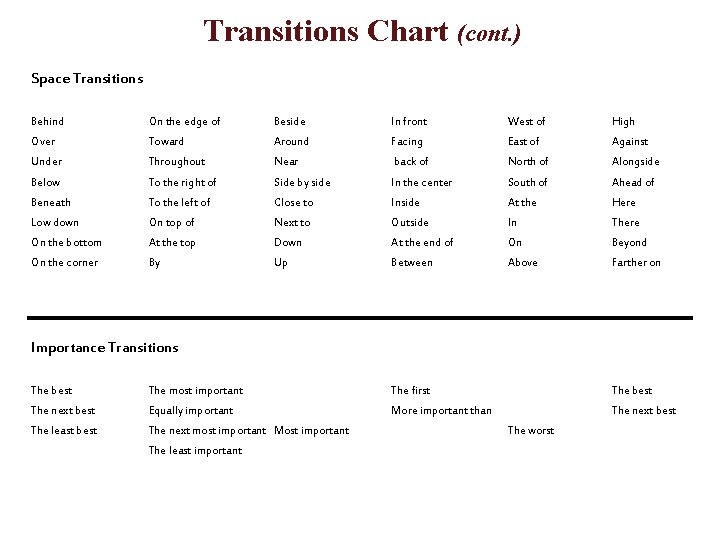
Transitions Chart (cont. ) Space Transitions Behind On the edge of Beside In front West of High Over Toward Around Facing East of Against Under Throughout Near back of North of Alongside Below To the right of Side by side In the center South of Ahead of Beneath To the left of Close to Inside At the Here Low down On top of Next to Outside In There On the bottom At the top Down At the end of On Beyond On the corner By Up Between Above Farther on Importance Transitions The best The most important The first The best The next best Equally important More important than The next best The least best The next most important Most important The least important The worst
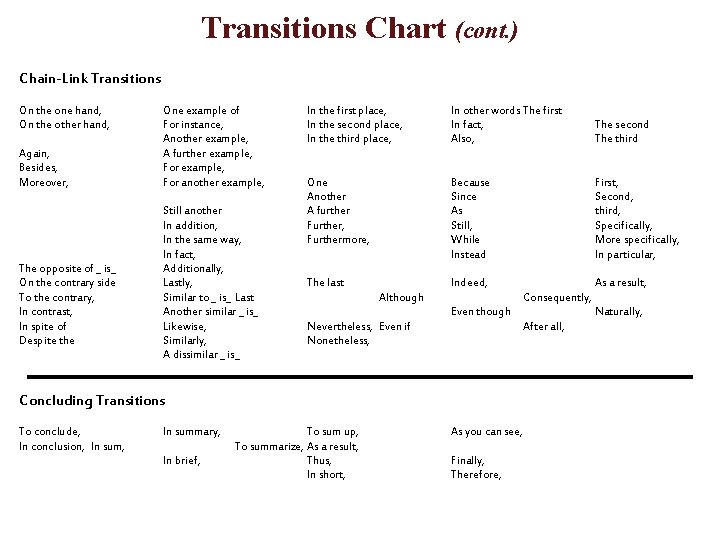
Transitions Chart (cont. ) Chain-Link Transitions On the one hand, On the other hand, Again, Besides, Moreover, The opposite of _ is_ On the contrary side To the contrary, In contrast, In spite of Despite the One example of For instance, Another example, A further example, For another example, Still another In addition, In the same way, In fact, Additionally, Lastly, Similar to _ is_ Last Another similar _ is_ Likewise, Similarly, A dissimilar _ is_ In the first place, In the second place, In the third place, In other words The first In fact, Also, The second The third One Another A further Further, Furthermore, Because Since As Still, While Instead First, Second, third, Specifically, More specifically, In particular, The last Indeed, As a result, Although Consequently, Even though Nevertheless, Even if Nonetheless, After all, Concluding Transitions To conclude, In conclusion, In sum, In summary, In brief, To sum up, To summarize, As a result, Thus, In short, Naturally, As you can see, Finally, Therefore,
Student Lessons on Transitions • • Pretest/Posttest, pages 93 -96 Lessons 1 A-1 D, pages 97 -100 Lessons 2 A-2 D, pages 101 -104 Lessons 3 A-3 D, page 105
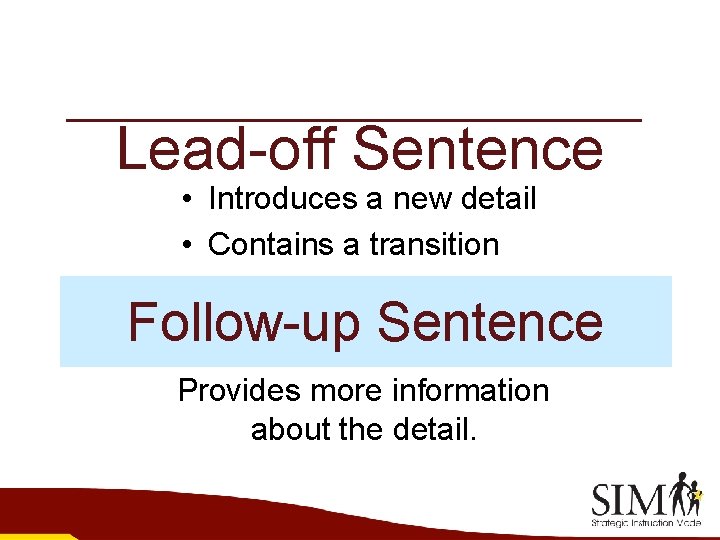
Lead-off Sentence • Introduces a new detail • Contains a transition Follow-up Sentence Provides more information about the detail.
Requirements for a Detail Sentence Each Detail Sentence must: • Contain related information, • Be in a logical sequence with other sentences, • Include a transition if it introduces a new detail, • Be written from the same point of view as the other sentences, and Cue Card #28
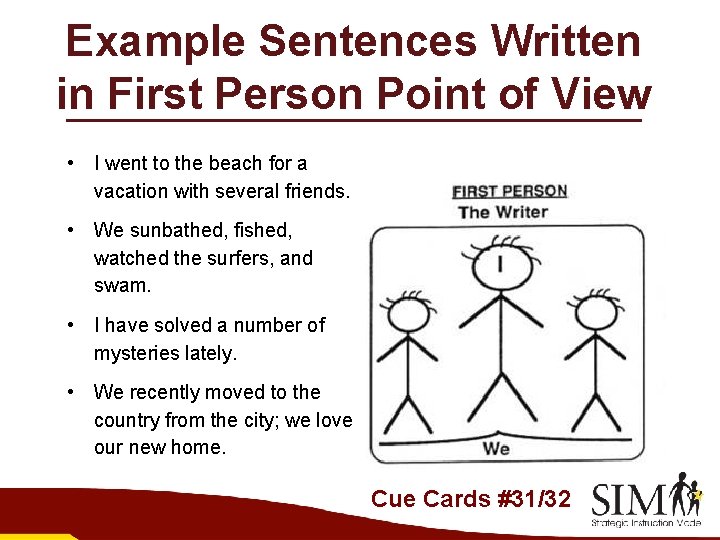
Example Sentences Written in First Person Point of View • I went to the beach for a vacation with several friends. • We sunbathed, fished, watched the surfers, and swam. • I have solved a number of mysteries lately. • We recently moved to the country from the city; we love our new home. Cue Cards #31/32
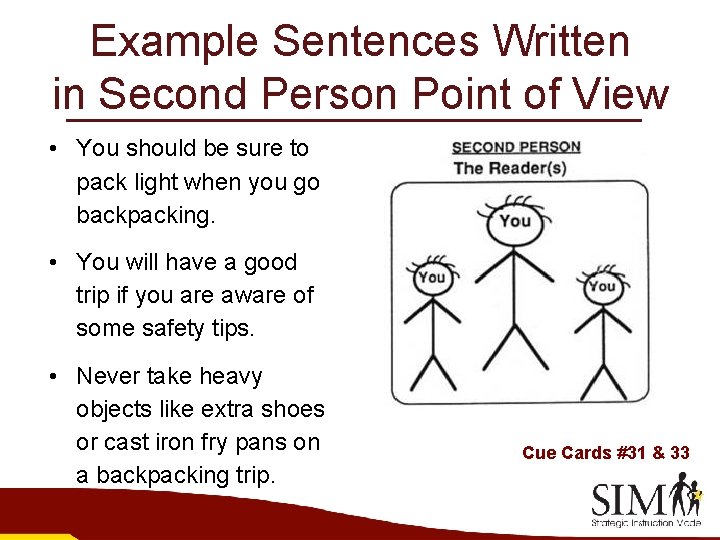
Example Sentences Written in Second Person Point of View • You should be sure to pack light when you go backpacking. • You will have a good trip if you are aware of some safety tips. • Never take heavy objects like extra shoes or cast iron fry pans on a backpacking trip. Cue Cards #31 & 33
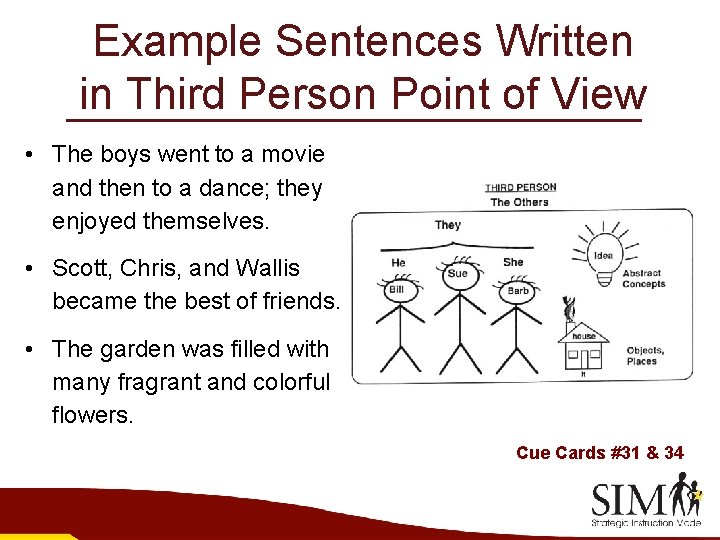
Example Sentences Written in Third Person Point of View • The boys went to a movie and then to a dance; they enjoyed themselves. • Scott, Chris, and Wallis became the best of friends. • The garden was filled with many fragrant and colorful flowers. Cue Cards #31 & 34
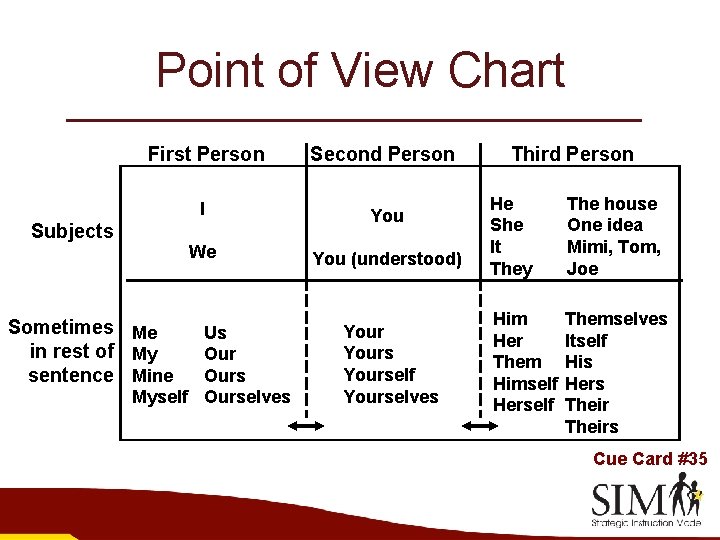
Point of View Chart First Person Second Person I You We You (understood) Subjects Sometimes Me in rest of My sentence Mine Us Ours Myself Ourselves Yourself Yourselves Third Person He She It They The house One idea Mimi, Tom, Joe Him Her Them Himself Herself Themselves Itself His Hers Theirs Cue Card #35
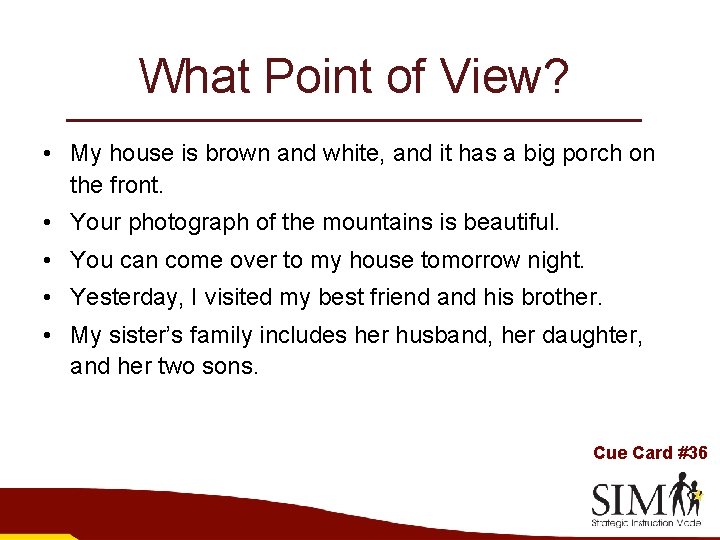
What Point of View? • My house is brown and white, and it has a big porch on the front. • Your photograph of the mountains is beautiful. • You can come over to my house tomorrow night. • Yesterday, I visited my best friend and his brother. • My sister’s family includes her husband, her daughter, and her two sons. Cue Card #36
Student Lessons on Point of View • • Pretest/Posttest, pages 65 -68 Lessons 1 A-1 D, pages 69 -72 Lessons 2 A-2 D, pages 73 -76 Lessons 3 A-3 D, page 77
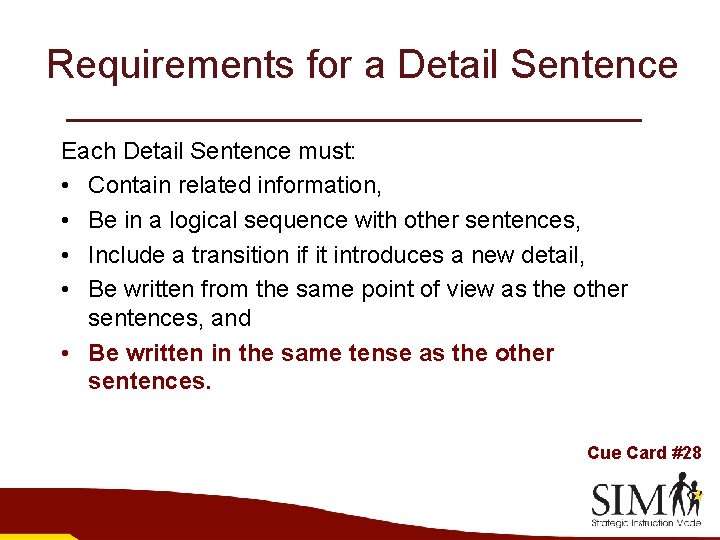
Requirements for a Detail Sentence Each Detail Sentence must: • Contain related information, • Be in a logical sequence with other sentences, • Include a transition if it introduces a new detail, • Be written from the same point of view as the other sentences, and • Be written in the same tense as the other sentences. Cue Card #28
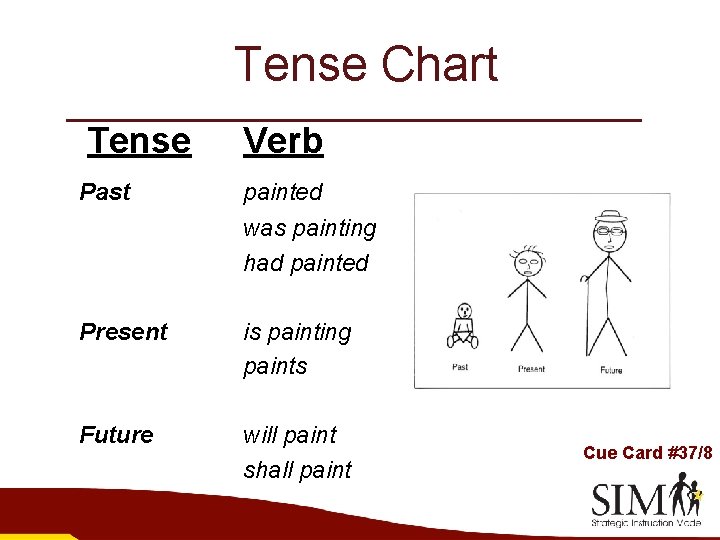
Tense Chart Tense Past Verb painted was painting had painted Present is painting paints Future will paint shall paint Cue Card #37/8
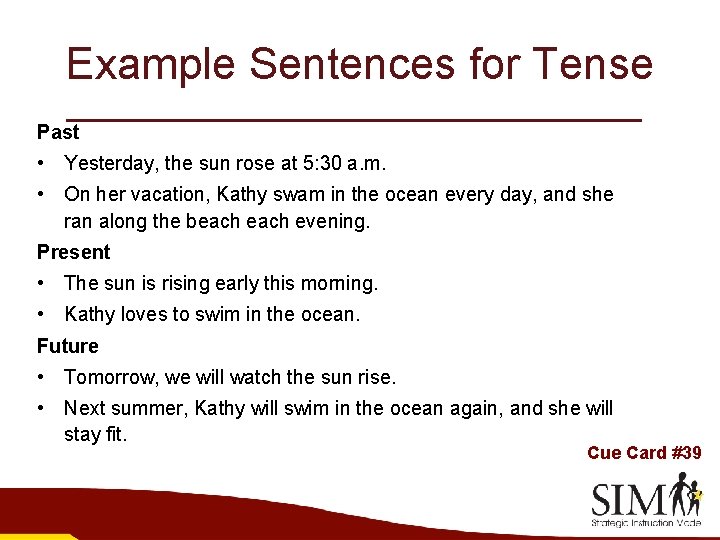
Example Sentences for Tense Past • Yesterday, the sun rose at 5: 30 a. m. • On her vacation, Kathy swam in the ocean every day, and she ran along the beach evening. Present • The sun is rising early this morning. • Kathy loves to swim in the ocean. Future • Tomorrow, we will watch the sun rise. • Next summer, Kathy will swim in the ocean again, and she will stay fit. Cue Card #39
Student Lessons on Tense • • Pretest/Posttest, pages 79 -82 Lessons 1 A-1 D, pages 83 -86 Lessons 2 A-2 D, pages 87 -90 Lessons 3 A-3 D, page 91
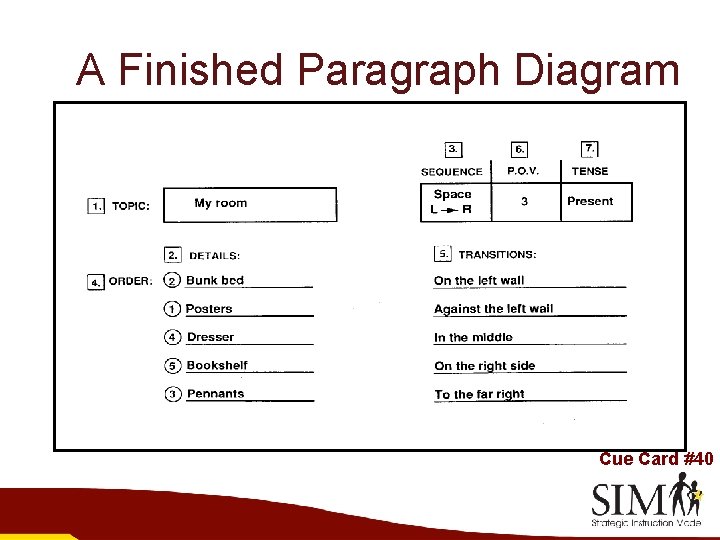
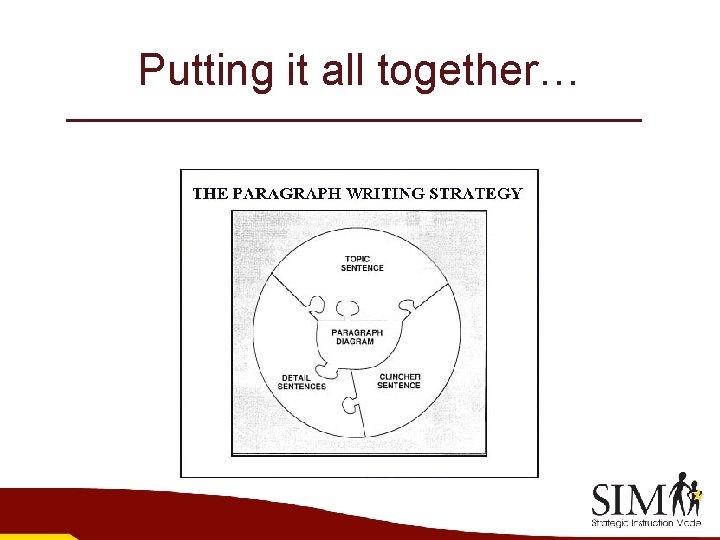
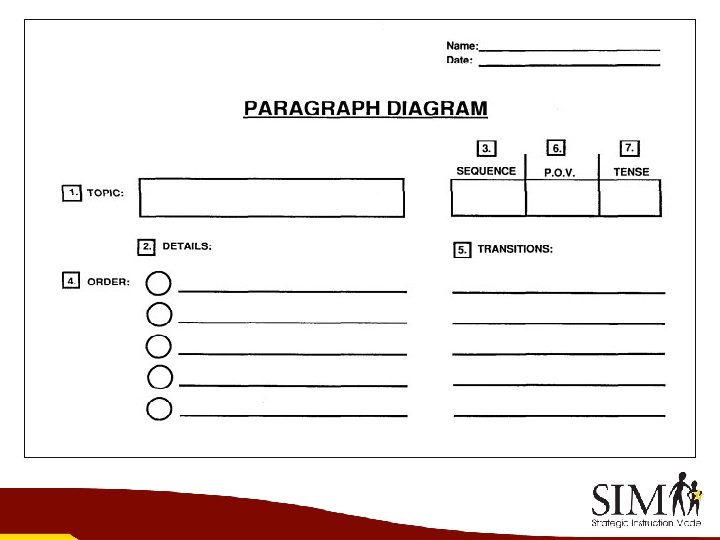
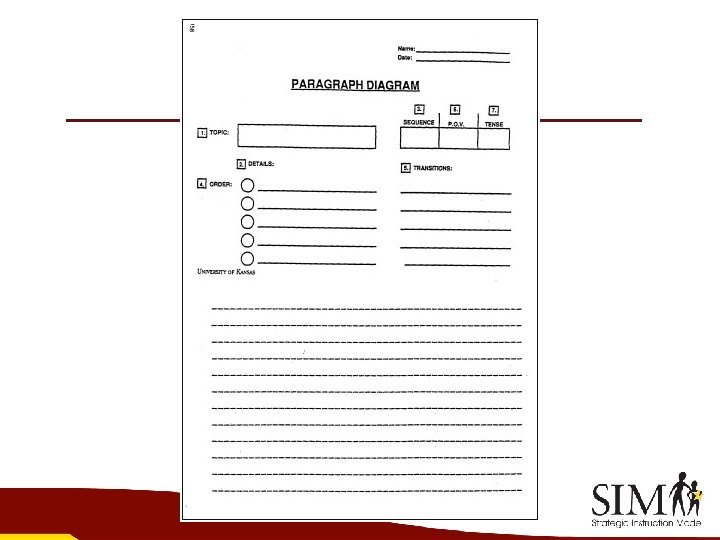
A Finished Paragraph Diagram Cue Card #40
Steps for Writing a Detail Sentence Pick a sentence type Explore words to fit the sentence type Note the words Search and check Cue Card #41
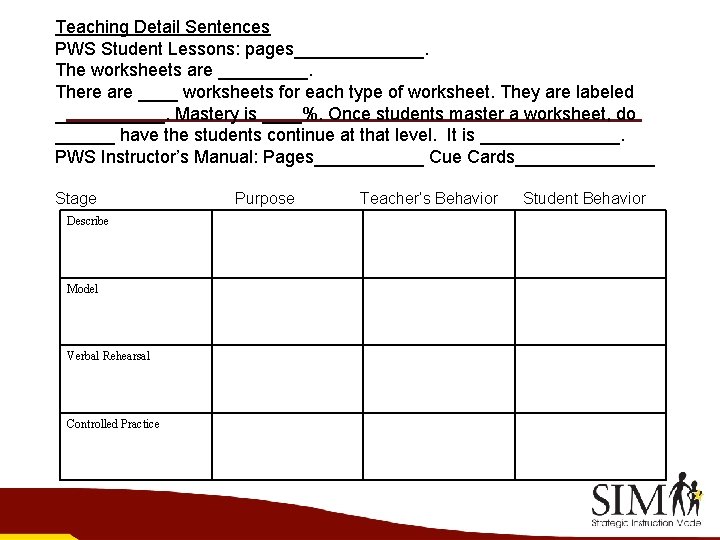
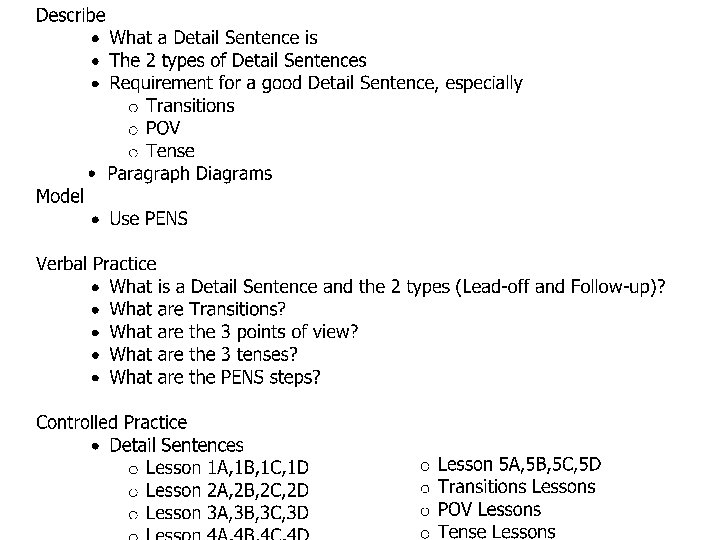
Teaching Detail Sentences PWS Student Lessons: pages_______. The worksheets are _____. There are ____ worksheets for each type of worksheet. They are labeled ______. Mastery is ____%. Once students master a worksheet, do ______ have the students continue at that level. It is _______. PWS Instructor’s Manual: Pages______ Cue Cards_______ Stage Describe Model Verbal Rehearsal Controlled Practice Purpose Teacher’s Behavior Student Behavior
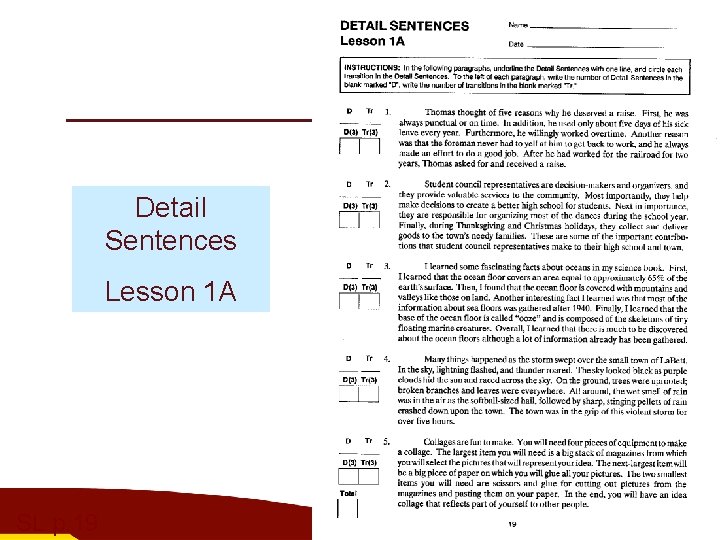
Detail Sentences Lesson 1 A SL p. 19
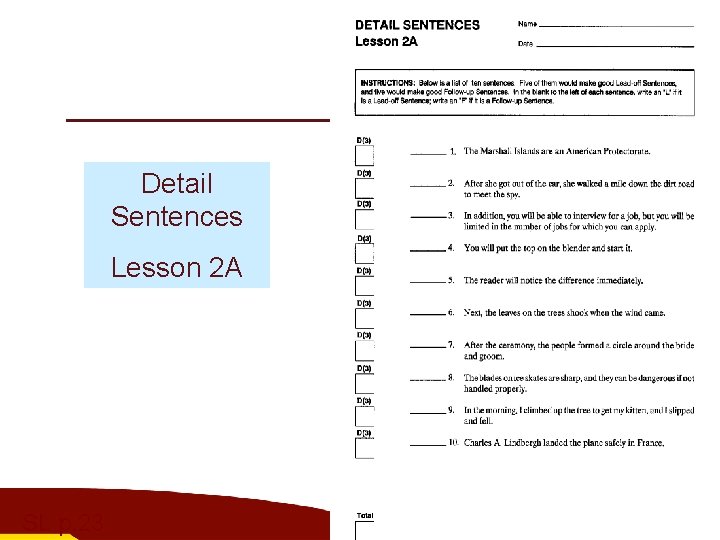
Detail Sentences Lesson 2 A SL p. 23
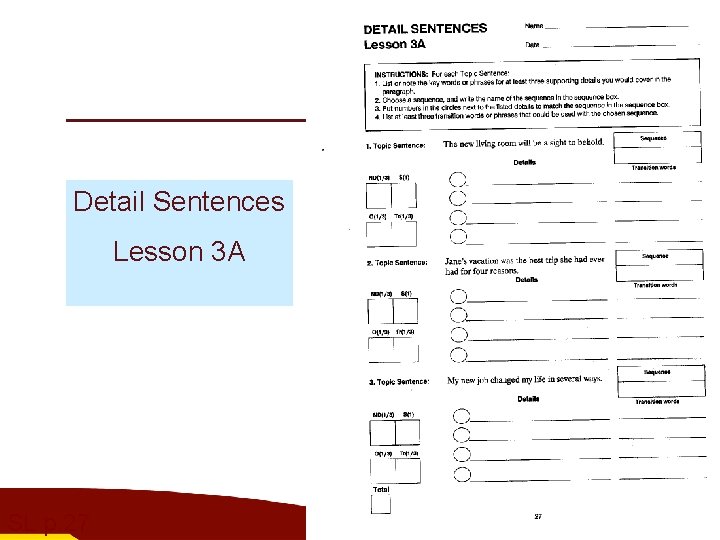
Detail Sentences Lesson 3 A SL p. 27
space 2 3 1 4 sofa rug fireplace hutch across under on the North wall on the back wall
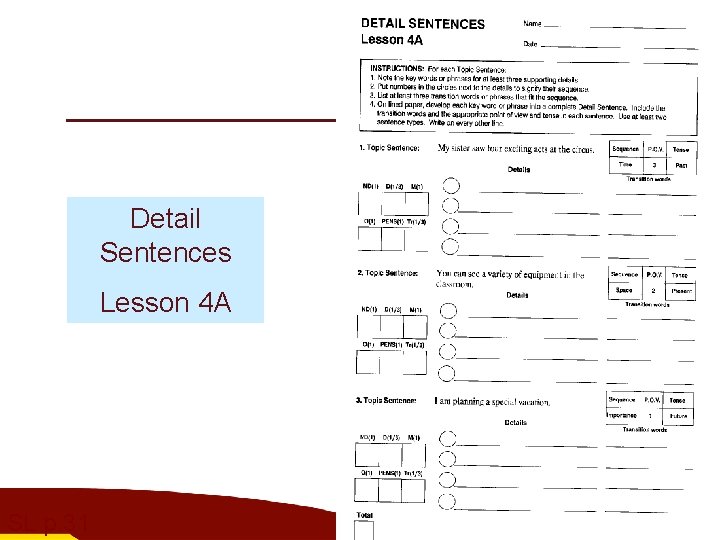
Detail Sentences Lesson 4 A SL p. 31
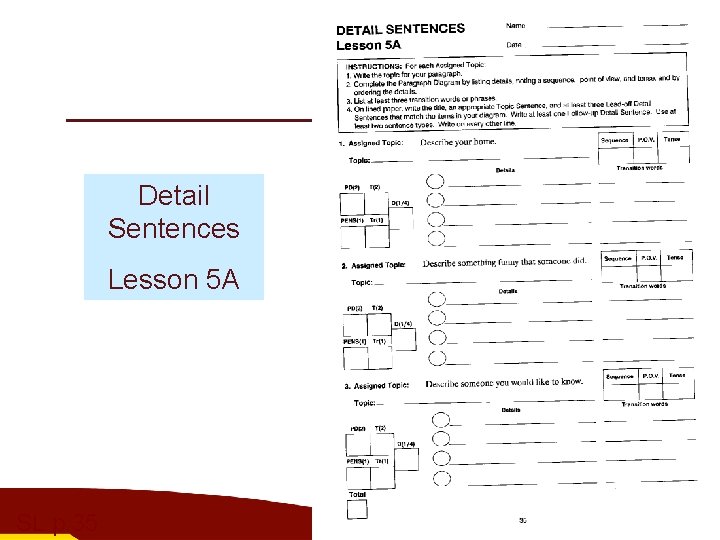
Detail Sentences Lesson 5 A SL p. 35
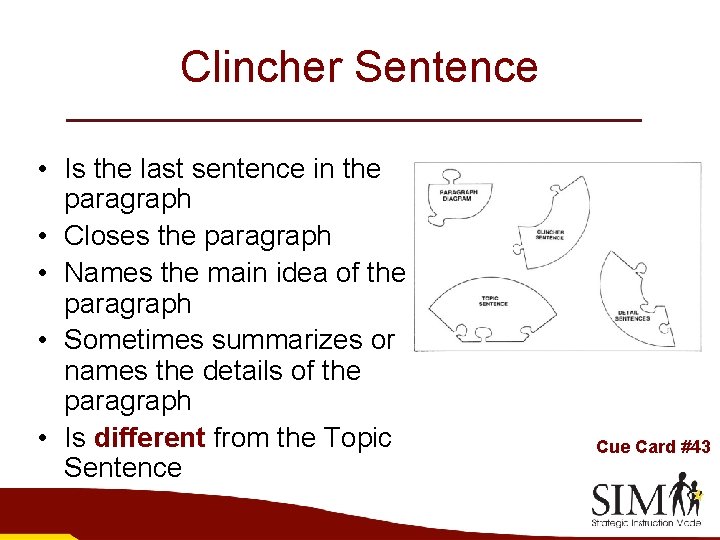
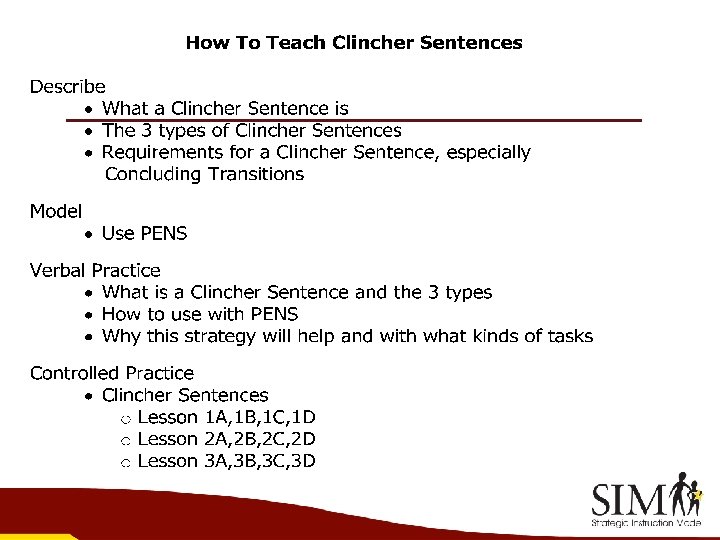
Clincher Sentence • Is the last sentence in the paragraph • Closes the paragraph • Names the main idea of the paragraph • Sometimes summarizes or names the details of the paragraph • Is different from the Topic Sentence Cue Card #43
Concluding Transitions Words that tell the reader that the paragraph is finished. Cue Card #46
Types of Clincher Sentences General Clincher Sentence Clueing Clincher Sentence Specific Clincher Sentence Cue Card #47
General Clincher Sentence Summarizes the main idea of the paragraph. Makes the reader think more about the topic Cue Card #48
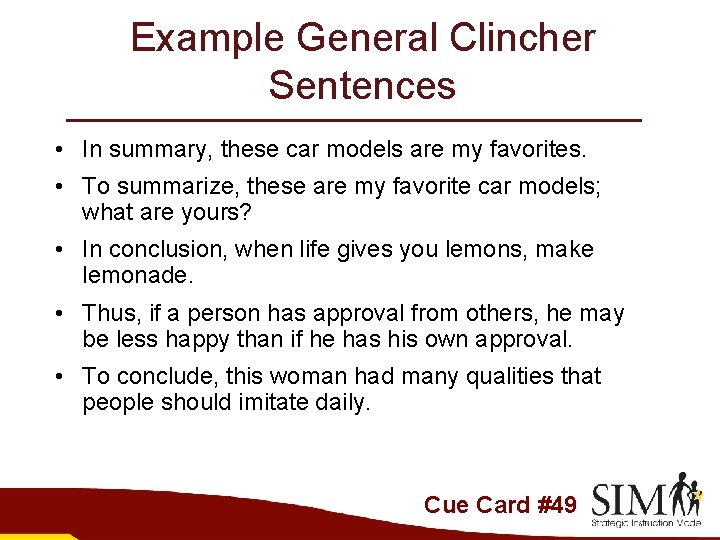
Example General Clincher Sentences • In summary, these car models are my favorites. • To summarize, these are my favorite car models; what are yours? • In conclusion, when life gives you lemons, make lemonade. • Thus, if a person has approval from others, he may be less happy than if he has his own approval. • To conclude, this woman had many qualities that people should imitate daily. Cue Card #49
Clueing Clincher Sentence • Names the main idea • Ties the details together with a clue word Cue Card #51
Example Clueing Clincher Sentences • In sum, these four events served as the spark that ignited the war. • To conclude, life can deal you many cards; it’s how you play them that counts. • In other words, several issues need to be considered before a person accepts a job offer. • In conclusion, plenty of serious reasons exist for staying away from drugs; ignoring them can endanger one’s health and life. Cue Card #53
Specific Clincher Sentence • Names the main idea • Names the specific details that were covered in the paragraph • Names the details in the order in which they were discussed Cue Card #54
Example Specific Clincher Sentences • As you can see, making a snowman involves rolling the parts of his body, stacking the parts, and creating his face and clothes. • In effect, the people followed a clear course: they wrote a petition, held rallies, demanded a vote, and caused the law to be changed. • In summary, the environment is in danger because of our vehicles, our mountains of waste, and our lack of attention to nature’s need to replenish itself. Cue Card #56
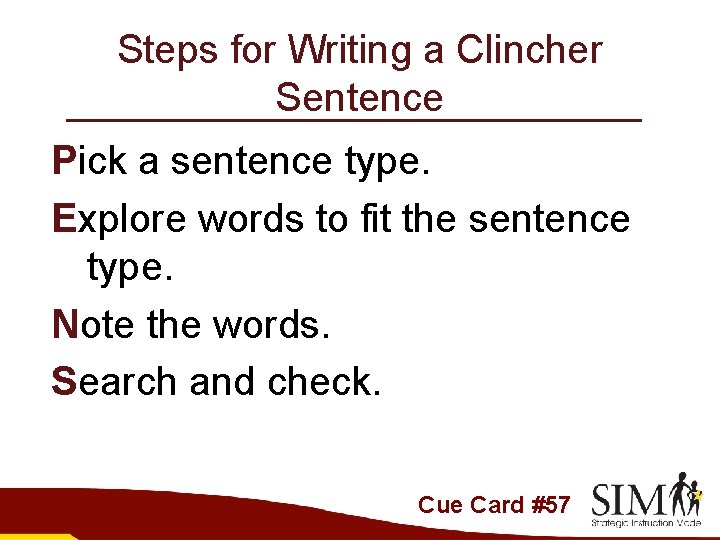
Steps for Writing a Clincher Sentence Pick a sentence type. Explore words to fit the sentence type. Note the words. Search and check. Cue Card #57
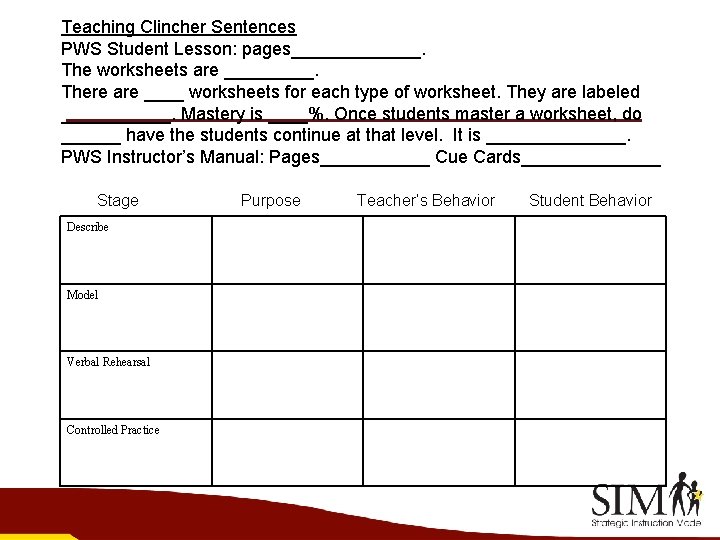
Teaching Clincher Sentences PWS Student Lesson: pages_______. The worksheets are _____. There are ____ worksheets for each type of worksheet. They are labeled ______. Mastery is ____%. Once students master a worksheet, do ______ have the students continue at that level. It is _______. PWS Instructor’s Manual: Pages______ Cue Cards_______ Stage Describe Model Verbal Rehearsal Controlled Practice Purpose Teacher’s Behavior Student Behavior
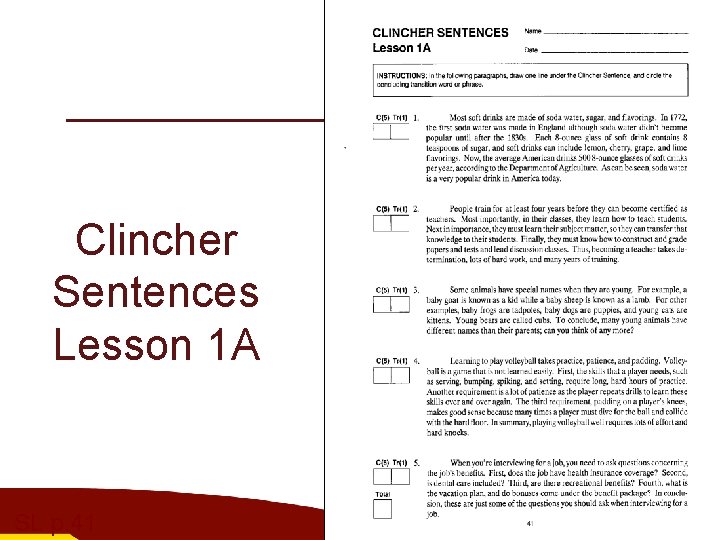
Clincher Sentences Lesson 1 A SL p. 41
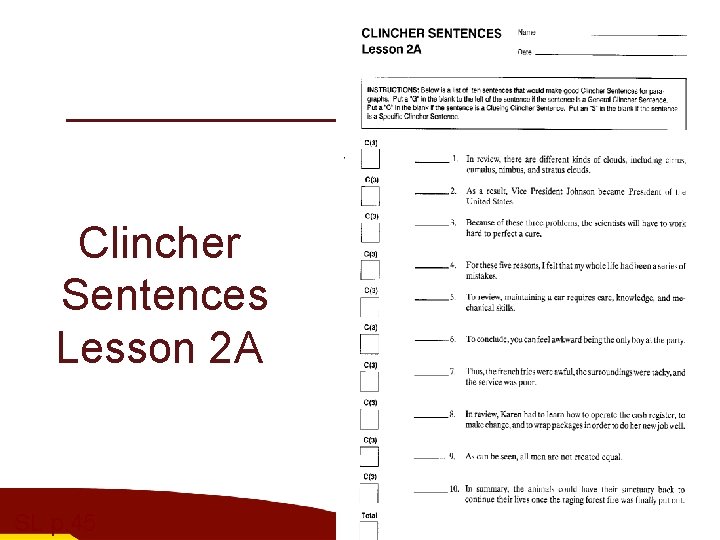
Clincher Sentences Lesson 2 A SL p. 45
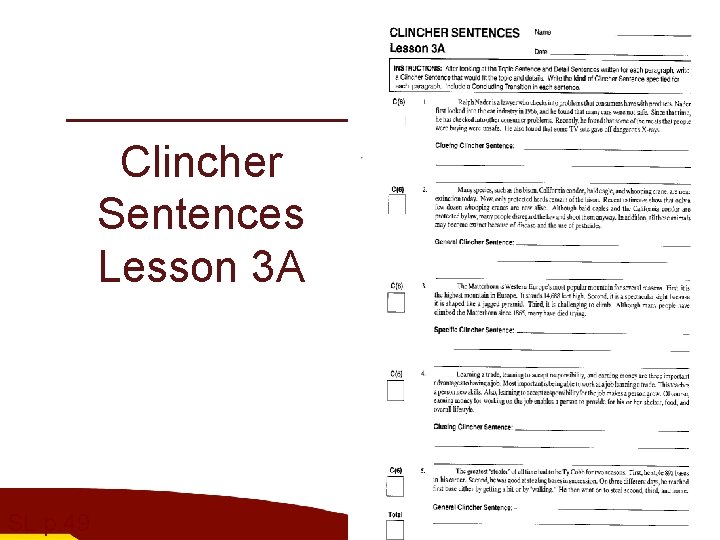
Clincher Sentences Lesson 3 A SL p. 49
Clincher Sentences Model Paragraph 3 How the dinosaurs died out is one of the greatest mysteries of all time. Some scientists think that a giant meteor from outer space hit the earth about 65 million years ago. Its impact could have caused many changes on the earth that might have killed the dinosaurs. For example, the meteor’s impact might have raised tons of dirt and dust into the atmosphere so that sunlight could not reach the earth, or it might have started the eruptions of many volcanoes or created tidal waves. Other scientists theorize that when flowering plants appeared in the world, the plant-eating dinosaurs could not digest these plants and died. In turn, the meat-eating dinosaurs also starved because there were no plant-eating dinosaurs left to eat. Still other scientists propose that a strange disease wiped out the dinosaurs. Finally, other scientists think that the climate of the world became too cold for the dinosaurs’ survival.
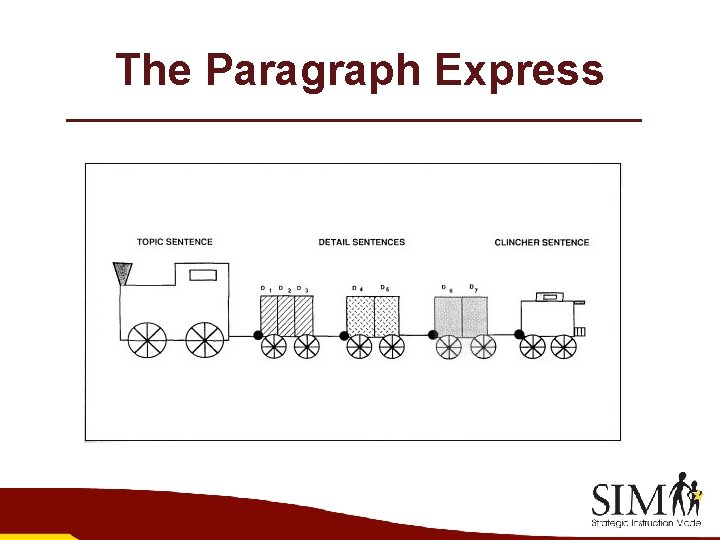
The Paragraph Express
Putting it all together…
Example Paragraph Nonviolent protest has been a major force in the world. In the late 1940 s and early 1950 s, Mahatma Ghandi and his followers used nonviolent protest to gain independence for India from Britain. For the first time in decades, Indians had their own country. In the 1960 s, Martin Luther King and his followers used nonviolent protest to gain rights for Blacks in America. Through nonviolent protest, they obtained rights that had been denied to them since the slaves had been freed, such as the right to sit anywhere on a bus, eat in any restaurant, and vote in elections. Thus, nonviolent protest has been successfully used by oppressed people to gain independence from other nations; it has also been used to gain personal rights and freedoms.
In the example paragraph… 1. Is the Topic Sentence a General, Specific, or Clueing Topic Sentence? 2. What are the two Lead-off Detail Sentences? 3. What are the two transitions that begin those two Detail Sentences? 4. Is the Clincher Sentence a General, Clueing, or Specific Topic Sentence? 5. What is the concluding transition? 6. What is the tense? 7. What is the point of view?
Steps for Writing a Paragraph Set up a diagram. Create the title Reveal the topic. Iron out the details. Bind it together with a clincher. Edit your work.
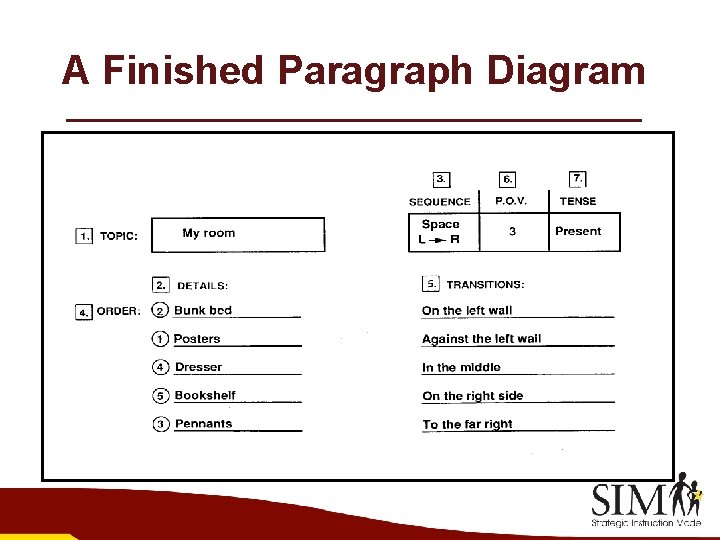
A Finished Paragraph Diagram
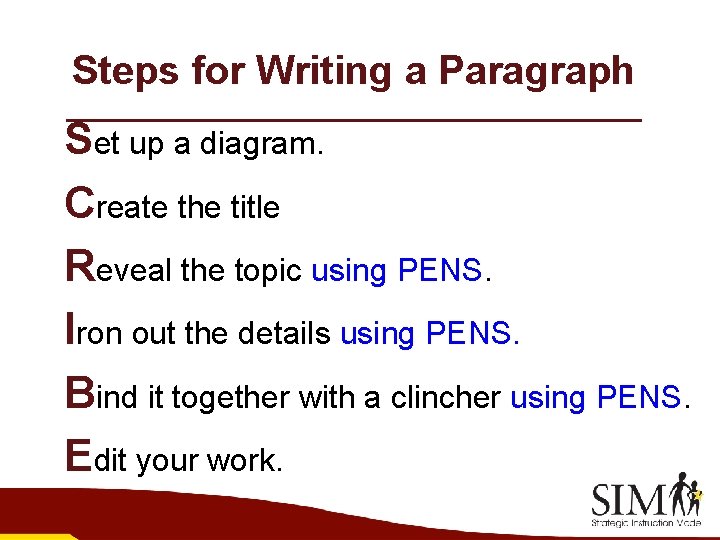
Steps for Writing a Paragraph Set up a diagram. Create the title Reveal the topic using PENS. Iron out the details using PENS. Bind it together with a clincher using PENS. Edit your work.
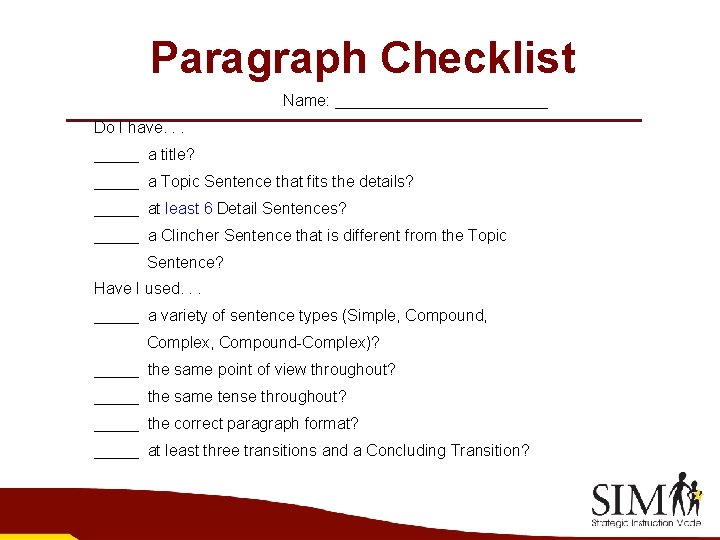
Paragraph Checklist Name: ____________ Do I have. . . _____ a title? _____ a Topic Sentence that fits the details? _____ at least 6 Detail Sentences? _____ a Clincher Sentence that is different from the Topic Sentence? Have I used. . . _____ a variety of sentence types (Simple, Compound, Complex, Compound-Complex)? _____ the same point of view throughout? _____ the same tense throughout? _____ the correct paragraph format? _____ at least three transitions and a Concluding Transition?
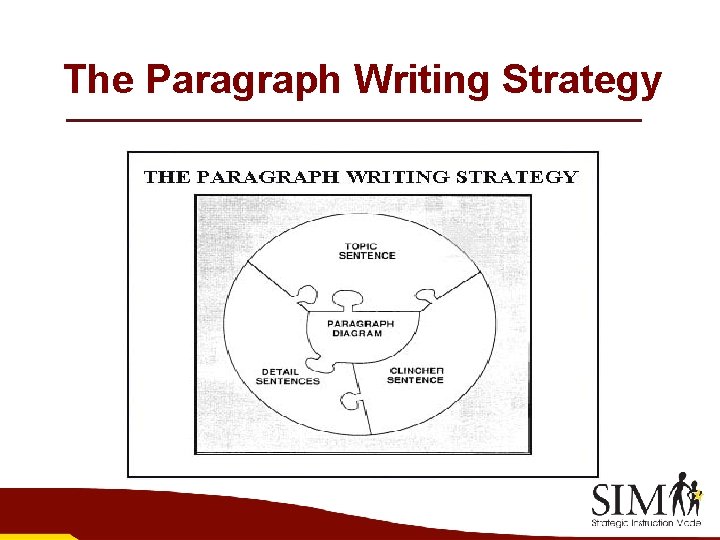
The Paragraph Writing Strategy
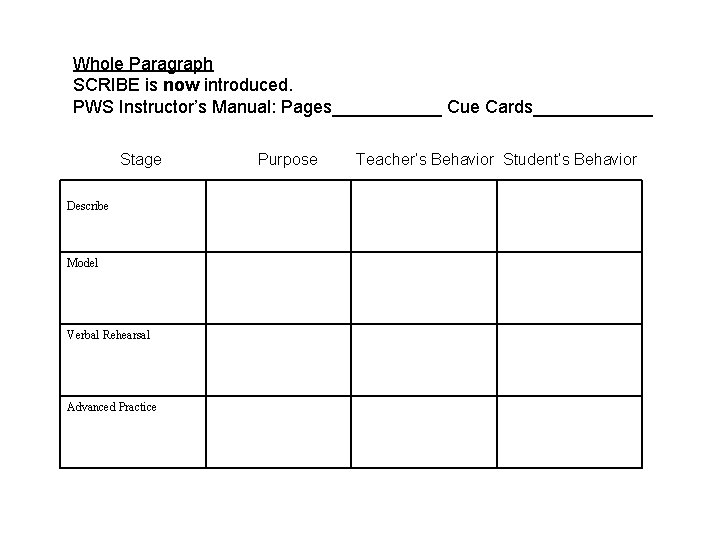
Whole Paragraph SCRIBE is now introduced. PWS Instructor’s Manual: Pages______ Cue Cards______ Stage Describe Model Verbal Rehearsal Advanced Practice Purpose Teacher’s Behavior Student’s Behavior
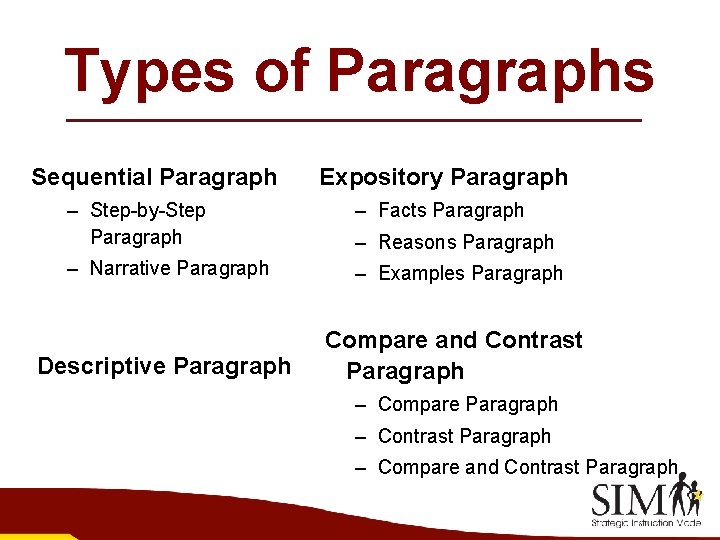
Types of Paragraphs Sequential Paragraph Expository Paragraph – Step-by-Step Paragraph – Facts Paragraph – Narrative Paragraph – Examples Paragraph Descriptive Paragraph Compare and Contrast Paragraph – Reasons Paragraph – Compare Paragraph – Contrast Paragraph – Compare and Contrast Paragraph
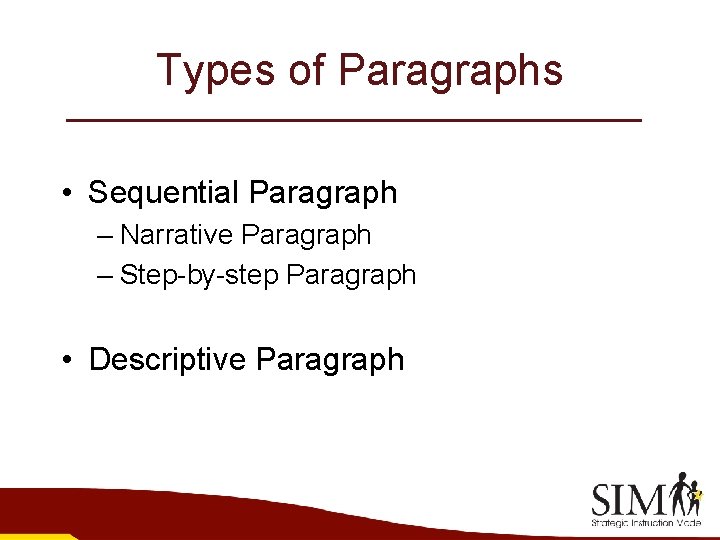
Types of Paragraphs • Sequential Paragraph – Narrative Paragraph – Step-by-step Paragraph • Descriptive Paragraph
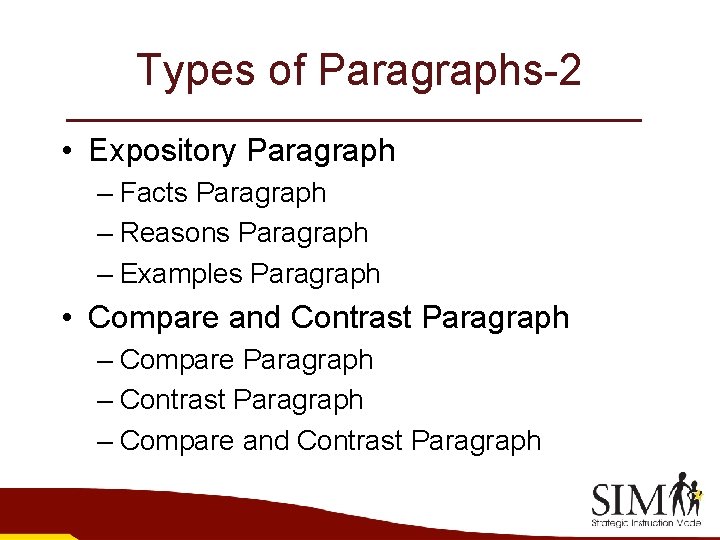
Types of Paragraphs-2 • Expository Paragraph – Facts Paragraph – Reasons Paragraph – Examples Paragraph • Compare and Contrast Paragraph – Compare Paragraph – Contrast Paragraph – Compare and Contrast Paragraph
Sequential Paragraph • Definition: Describes details in a special order • Types – Narrative-tells a story about a sequence of events – Step-by-step-tells how to do something in a step-by-step manner
Narrative Paragraph: Tells a story • Topic Sentence – Introduces the story to be told • Detail Sentences – Tells the reader about the events in the order that they happen, happened, or will happen • Clincher Sentence – Tells the reader the story is finished – Points out the significance of the story
Narrative • Transitions – Time transitions • Point of view – First person – Third person • Tense – Usually past time but sometimes present or future
Step-by-Step Paragraph Tells How to do Something • Topic sentence – Tells the reader that a sequence of steps for a specific task or process will be described • Detail Sentences – Each tells the reader specific information about a step – The steps must be described in the correct order to get the job done right
Step-by-Step • Clincher sentence – Tells the reader the job is done • Transitions – Time transitions • Point of view – Usually second person – Sometimes third person • Tense-usually present tense-sometimes past or future
Descriptive Paragraph • Tells about people, places, events, and things through what the writer • Sees • Hears • Tastes • Smells • Feels
Descriptive Paragraph: Provides a ‘picture’ of a person, place or thing • Topic sentence – Tells the reader that a specific person, place or thing will be described – Sometimes limits the topic by telling time, and/or place, and/or senses used
Descriptive Paragraph • Detail Sentences – Each provides a detail for the ‘picture’ – Each mentions a detail derived by at least one of the senses – Include modifiers (adjectives, adverbs) • Clincher sentence – Sums up the overall impression of the subject
Descriptive Paragraph • Transitions – Usually space transitions – Sometimes chain-link or importance transitions • Points of view – Usually third person sometimes first person • Tense-present, past or future
Expository Paragraph • Definition: Explains something • Types – Facts-explains something through facts – Reasons-explains something through reasons – Examples-explains something through examples
Facts Oaragraog • Topic Sentence – Introduces the main idea • Detail Sentences – Each provides information about a related fact • Clincher Sentence – Sums up the facts
Facts Paragraph • Transitions – Importance, time or chain-link • Point of view – Usually third person – Sometimes first or second • Tense – Usually past or present-sometimes future
Reasons Paragraph Persuades through Reasons • Topic Sentence – Introduces the side of the issue to be supported – Tells the reader reasons will be given • Detail Sentences – Each provides information about a related reason
Reason Paragraph • Clincher Sentence – Sums up the reasons • Transitions – Importance transitions – Chain-link transitions • Point of view-second or third person • Tense-past, present, or future tense
Examples Paragraph: Explains something through examples • Topic Sentence – Introduces the main idea – Tells the reader examples will be given • Detail Sentences – Each provides information about a related example • Clincher Sentence – Sums up the examples
Examples Paragraph • Transitions – Chain-link transitions • Point of View – Third person • Tense – Usually present tense – Sometimes past or future tense
Compare and Contrast Paragraph • Definition: – Shows how people, places, things, or ideas are alike and/or different • Types – Compare paragraph – Contrast paragraph – Compare and contrast paragraph
Compare Paragraph: Shows How Things Are Alike • Topic Sentence – Introduces the two subjects – Tells that they will be compared • Detail Sentences – Each tells one way they are alike • Clincher Sentence – Sums up the similarities
Compare Paragraph • Transitions – Chain-link, importance • Point of View – Usually third person-sometimes first or second • Tense – Present or past tense
Contrast Paragraph: Shows How Things Are Different • Topic Sentence – Introduces the two subjects – Tells that they will be contrasted • Detail Sentences – Each tells one way in which the subjects are different • Clincher Sentence – Sums up the differences
Contrast Paragraph • Transitions – Chain-link, importance • Point of View – Usually third person-sometimes first or second person • Tense – Past or present tense
Compare and Contrast Paragraph: Used to show things or ideas are alike and different • Topic Sentence – Introduces the two subjects – Tells they will be compared and contrasted • Detail Sentences – Each tells at least one way in which the subjects are alike or at least one way they are different
Compare & Contrast • Clincher Sentence – Sums up the similarities & differences • Transitions – Importance, chain-link • Point of view – Usually third person, sometimes first or second person • Tense-present or past tense
Generalization Instruction • • Orientation Phase Activation Phase Adaptation Phase Maintenance Phase
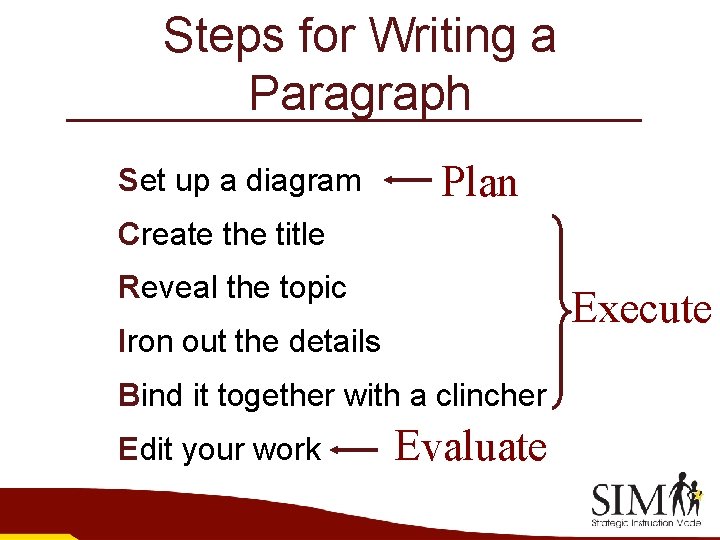
Steps for Writing a Paragraph Set up a diagram Plan Create the title Reveal the topic Execute Iron out the details Bind it together with a clincher Edit your work Evaluate
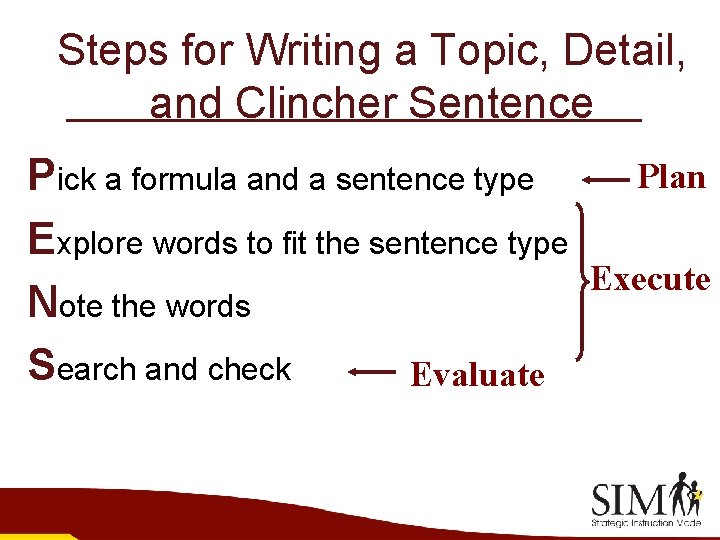
Steps for Writing a Topic, Detail, and Clincher Sentence Plan Pick a formula and a sentence type Explore words to fit the sentence type Execute Note the words Search and check Evaluate
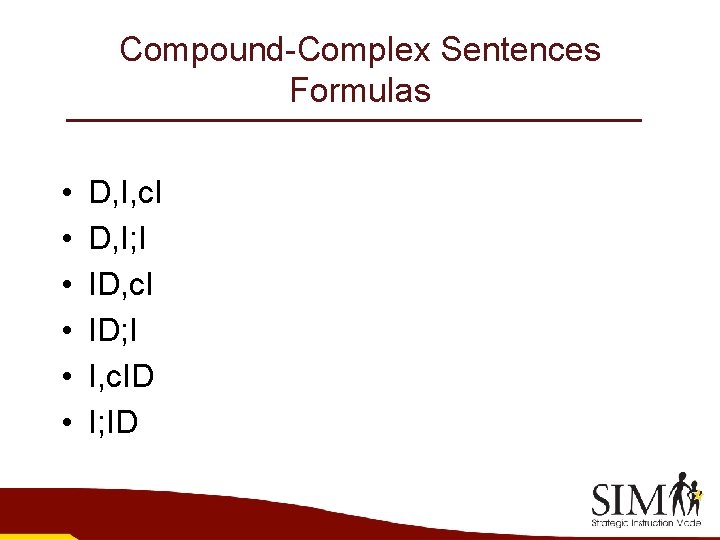
Compound-Complex Sentences Formulas • • • D, I, c. I D, I; I ID, c. I ID; I I, c. ID I; ID
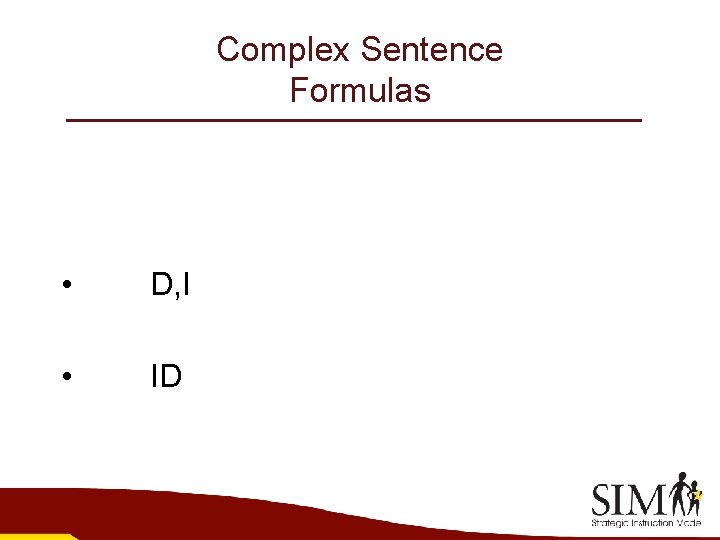
Complex Sentence Formulas • D, I • ID
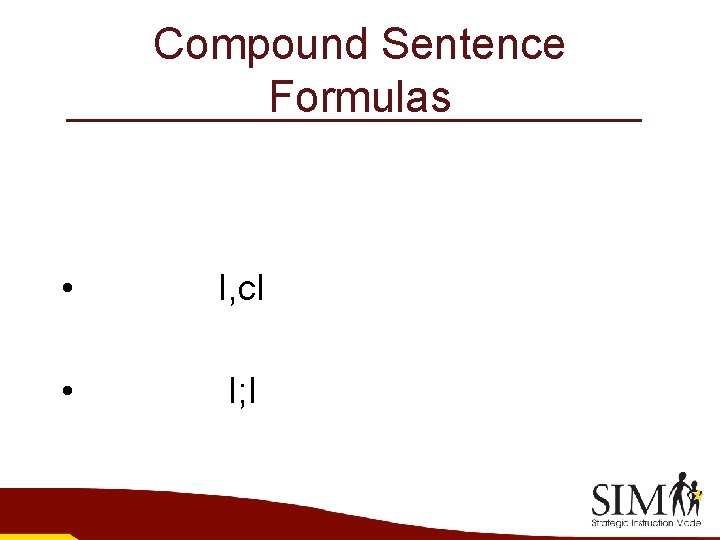
Compound Sentence Formulas • I, c. I • I; I
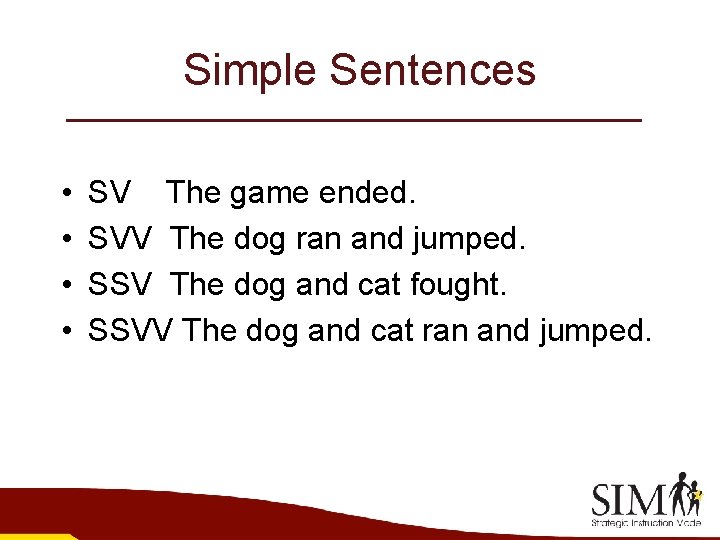
Simple Sentences • • SV The game ended. SVV The dog ran and jumped. SSV The dog and cat fought. SSVV The dog and cat ran and jumped.
- Slides: 140