
The Paired tTest A K A Dependent Samples
- Slides: 22
The Paired t-Test (A. K. A. Dependent Samples t-Test, or t-Test for Correlated Groups) Advanced Research Methods in Psychology - lecture – Matthew Rockloff 1
When to use the paired t-test • In many research designs, it is helpful to measure the same people more than once. • A common example is testing for performance improvements (or decrements) over time. • However, in any circumstance where multiple measurements are made on the same person (or “experimental unit”), it may be useful to observe if there are mean differences between these measurements. • The paired t-test will show whether the differences observed in the 2 measures will be found reliably in repeated samples. 2
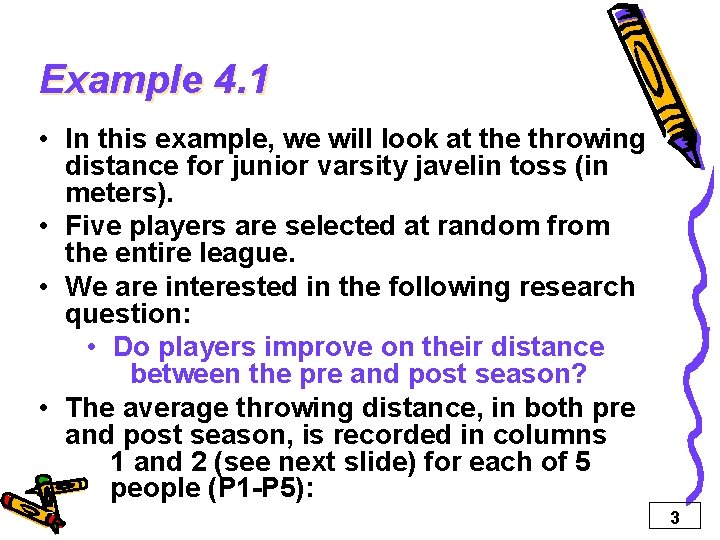
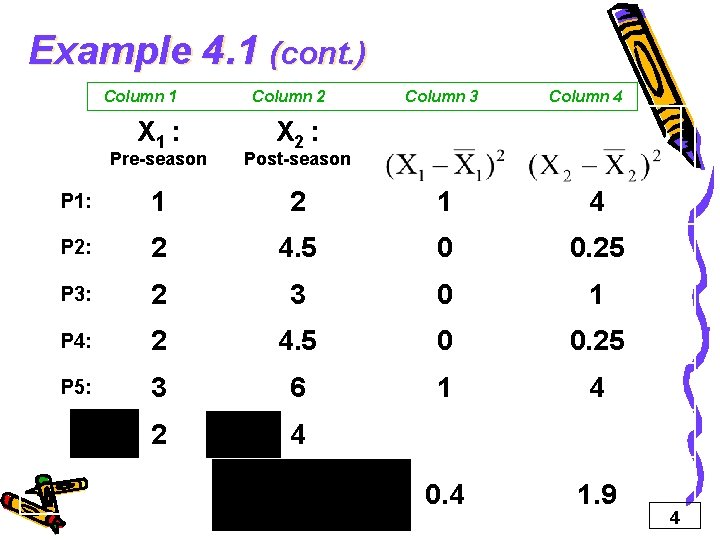
Example 4. 1 • In this example, we will look at the throwing distance for junior varsity javelin toss (in meters). • Five players are selected at random from the entire league. • We are interested in the following research question: • Do players improve on their distance between the pre and post season? • The average throwing distance, in both pre and post season, is recorded in columns 1 and 2 (see next slide) for each of 5 people (P 1 -P 5): 3
Example 4. 1 (cont. ) Column 1 X 1 : Column 2 Column 3 Column 4 X 2 : Pre-season Post-season P 1: 1 2 1 4 P 2: 2 4. 5 0 0. 25 P 3: 2 3 0 1 P 4: 2 4. 5 0 0. 25 P 5: 3 6 1 4 2 4 0. 4 1. 9 4
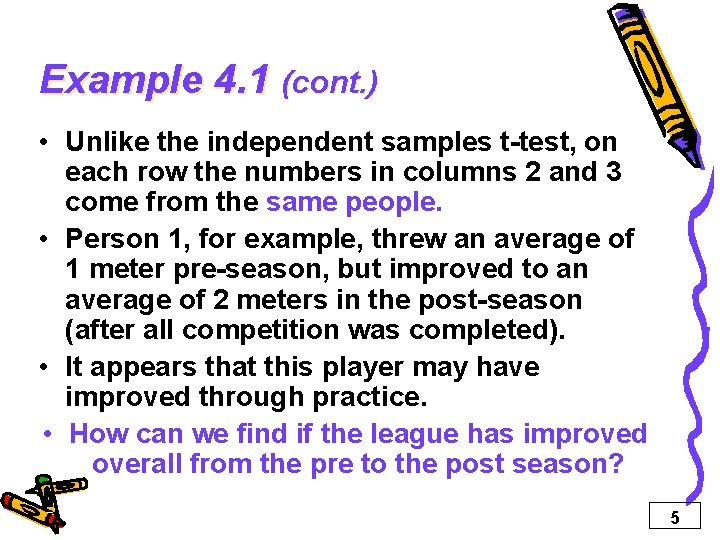
Example 4. 1 (cont. ) • Unlike the independent samples t-test, on each row the numbers in columns 2 and 3 come from the same people. • Person 1, for example, threw an average of 1 meter pre-season, but improved to an average of 2 meters in the post-season (after all competition was completed). • It appears that this player may have improved through practice. • How can we find if the league has improved overall from the pre to the post season? 5
Example 4. 1 (cont. ) • The paired t-test will allow us to see if the improvement that we see in this sample is reliable. • If we selected another 5 players at random from the league, would we still see an improvement? • Without having to go through the trouble and expense of repeated sampling (called replication), we can estimate whether the difference in the 2 means is so large in magnitude that we would likely find the same result if we chose another 5 persons. 6
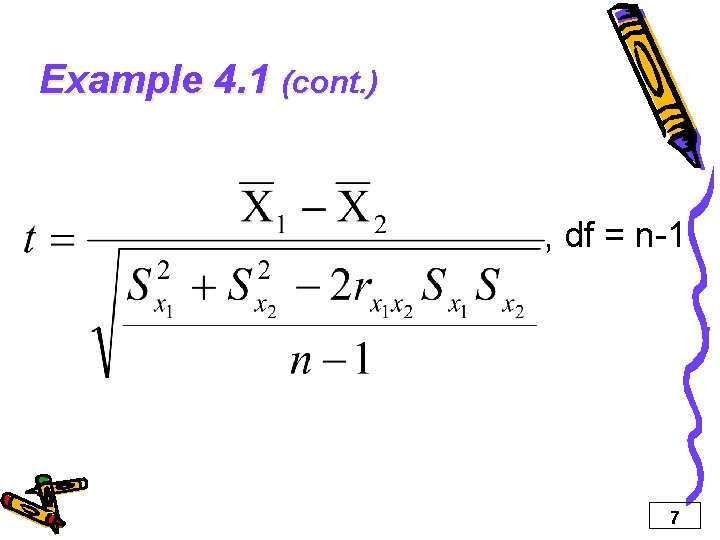
Example 4. 1 (cont. ) , df = n-1 7
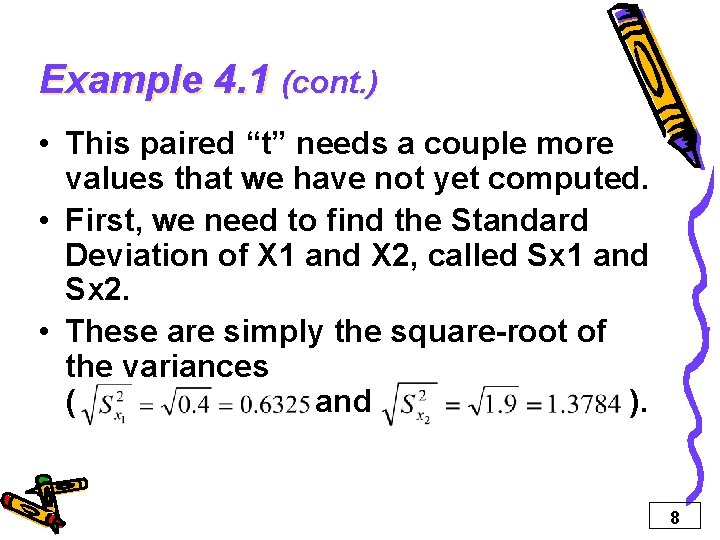
Example 4. 1 (cont. ) • This paired “t” needs a couple more values that we have not yet computed. • First, we need to find the Standard Deviation of X 1 and X 2, called Sx 1 and Sx 2. • These are simply the square-root of the variances ( and ). 8
Example 4. 1 (cont. ) • Second, we need to find the correlation between the pre and post-season distances ( ), or likewise columns 2 and 3. • Another section will illustrate how to compute a correlation. • This computation is somewhat long, so we’ll avoid it for now. • I’ll just tell you the correlation is: rx 1 x 2=0. 9177. • Any scientific or statistical calculator can get you this answer. 9
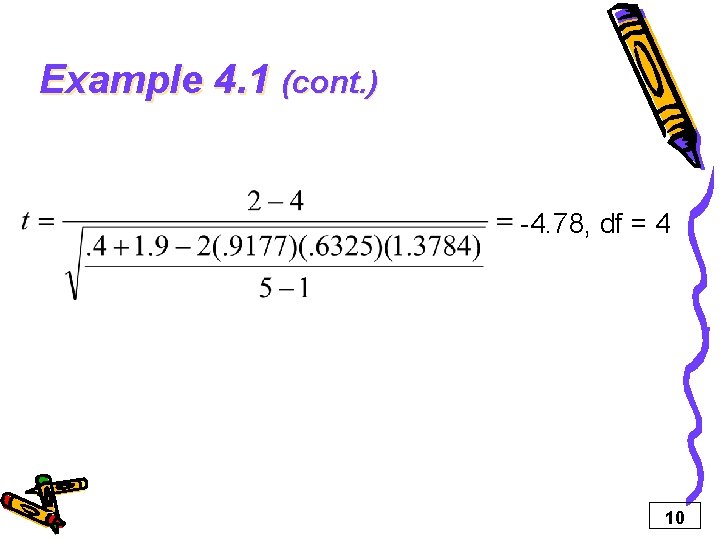
Example 4. 1 (cont. ) -4. 78, df = 4 10
Example 4. 1 (cont. ) • Finally, this computed “t” statistic must be compared with the critical value of the tdistribution. • The critical value of the “t” is the highest magnitude we should expect to find if there is really no difference between the population means of X 1 and X 2, or in other words, no difference between performance in the pre and post season in the league. • Since we expect there should be improvement in throwing distance, this is a 1 -tailed test. 11
Example 4. 1 (cont. ) • The C. V. t(4), α=. 05 = 2. 132, therefore we reject the null hypothesis because the absolute value of our “t” at 4. 78 is greater than the critical value. • This is a 1 -tailed t-test, so we must verify this conclusion by noting that the mean of the post season at 4 meters, is greater than the mean of the pre-season throw average of 2 meters. 12
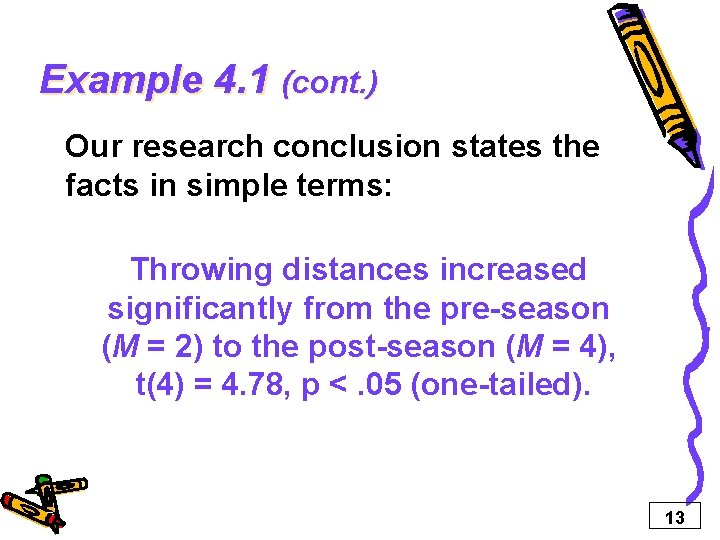
Example 4. 1 (cont. ) Our research conclusion states the facts in simple terms: Throwing distances increased significantly from the pre-season (M = 2) to the post-season (M = 4), t(4) = 4. 78, p <. 05 (one-tailed). 13
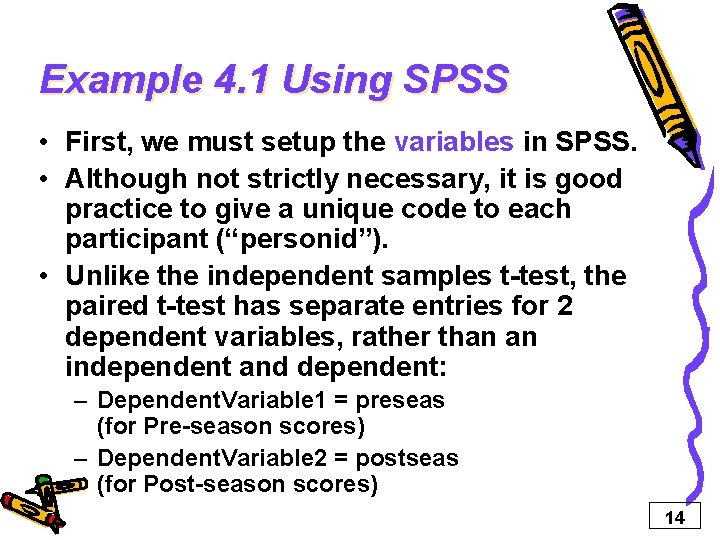
Example 4. 1 Using SPSS • First, we must setup the variables in SPSS. • Although not strictly necessary, it is good practice to give a unique code to each participant (“personid”). • Unlike the independent samples t-test, the paired t-test has separate entries for 2 dependent variables, rather than an independent and dependent: – Dependent. Variable 1 = preseas (for Pre-season scores) – Dependent. Variable 2 = postseas (for Post-season scores) 14
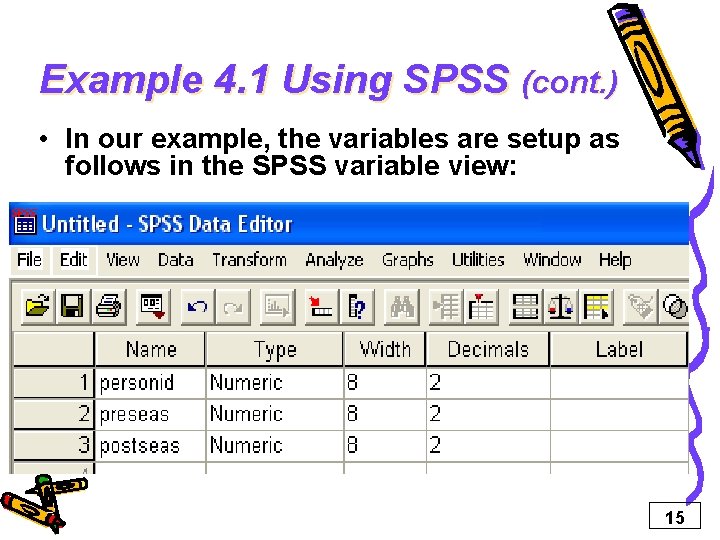
Example 4. 1 Using SPSS (cont. ) • In our example, the variables are setup as follows in the SPSS variable view: 15
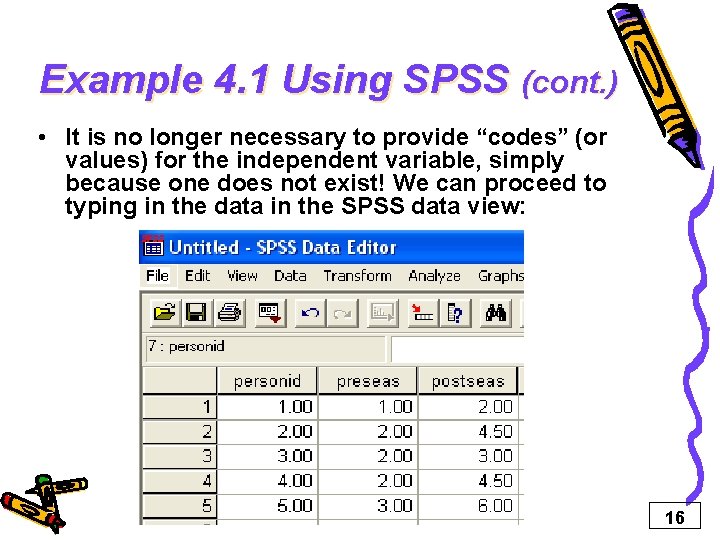
Example 4. 1 Using SPSS (cont. ) • It is no longer necessary to provide “codes” (or values) for the independent variable, simply because one does not exist! We can proceed to typing in the data in the SPSS data view: 16
Example 4. 1 Using SPSS (cont. ) • Notice, this is where the “personid” variables has helped. • If we had incorrectly tried to analyze this problem as an independent samples t-test, then we would have coded for 10 people under “personid. ” • Of course, since we have only 5 people in this example, this would have been incorrect. • The personid variable thus allows a simple check for whether we have typed-in the data correctly. • The number of “rows” in SPSS should always equal the number of “subjects” (or likewise, experimental units). 17
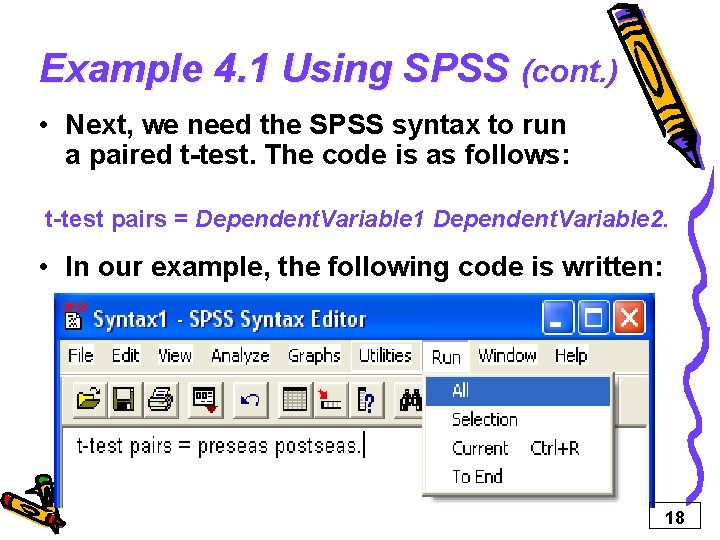
Example 4. 1 Using SPSS (cont. ) • Next, we need the SPSS syntax to run a paired t-test. The code is as follows: t-test pairs = Dependent. Variable 1 Dependent. Variable 2. • In our example, the following code is written: 18
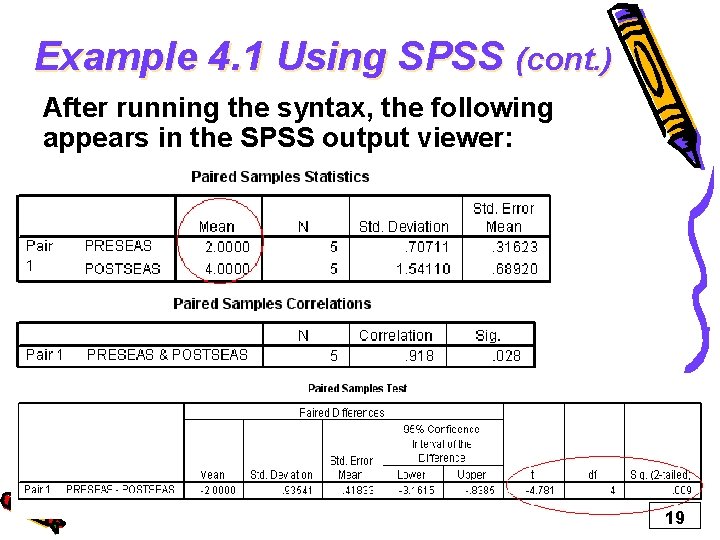
Example 4. 1 Using SPSS (cont. ) After running the syntax, the following appears in the SPSS output viewer: 19
Example 4. 1 Using SPSS (cont. ) • You should focus your attention first of the mean values for the pre and the post season performance. • As before, the means (Pre-season=2 and Post-season=4) give us our conclusion. • Namely, we conclude that performance increased from the pre to the post season. • The statistics tell us that our conclusion is true not only for this sample of 5 persons, but also for other samples of 5 persons in the league. 20
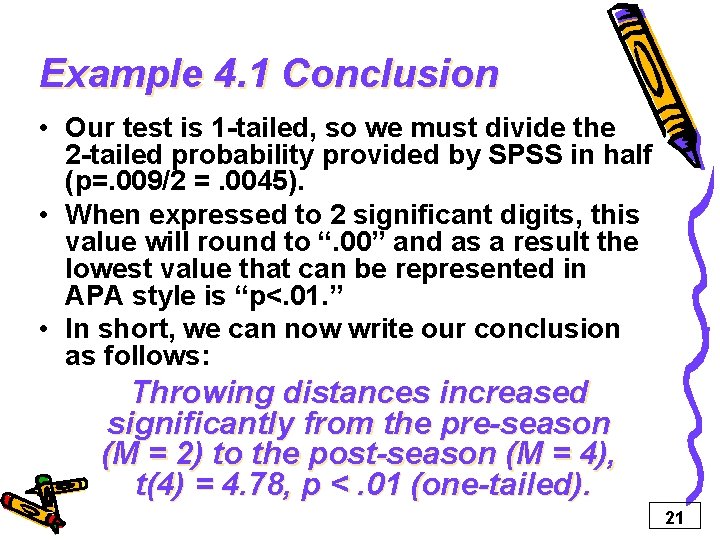
Example 4. 1 Conclusion • Our test is 1 -tailed, so we must divide the 2 -tailed probability provided by SPSS in half (p=. 009/2 =. 0045). • When expressed to 2 significant digits, this value will round to “. 00” and as a result the lowest value that can be represented in APA style is “p<. 01. ” • In short, we can now write our conclusion as follows: Throwing distances increased significantly from the pre-season (M = 2) to the post-season (M = 4), t(4) = 4. 78, p <. 01 (one-tailed). 21
Thus concludes The Paired t-Test (A. K. A. Dependent Samples t-Test, or t-Test for Correlated Groups) Advanced Research Methods in Psychology - Week 3 lecture – Matthew Rockloff 22