
The Page Rank Citation Ranking Bring Order to

The Page. Rank Citation Ranking: Bring Order to the web n Lawrence Page, Sergey Brin, Rajeev Motwani and Terry Winograd n Presented by Fei Li 1
Motivation and Introduction n Why is Page Importance Rating important? – New challenges for information retrieval on the World Wide Web. • Huge number of web pages: 150 million by 1998 1000 billion by 2008 • Diversity of web pages: different topics, different quality, etc. n What is Page. Rank? • A method for rating the importance of web pages objectively and mechanically using the link structure of the web.
The History of Page. Rank n Page. Rank was developed by Larry Page (hence the name Page-Rank) and Sergey Brin. n It is first as part of a research project about a new kind of search engine. That project started in 1995 and led to a functional prototype in 1998. Shortly after, Page and Brin founded Google. n 16 billion… n
Recent News n There are some news about that Page. Rank will be canceled by Google. n There are large numbers of Search Engine Optimization (SEO). n SEO use different trick methods to make a web page more important under the rating of Page. Rank.

Link Structure of the Web n 150 million web pages 1. 7 billion links Backlinks and Forward links: ØA and B are C’s backlinks ØC is A and B’s forward link Intuitively, a webpage is important if it has a lot of backlinks. What if a webpage has only one link off www. yahoo. com?
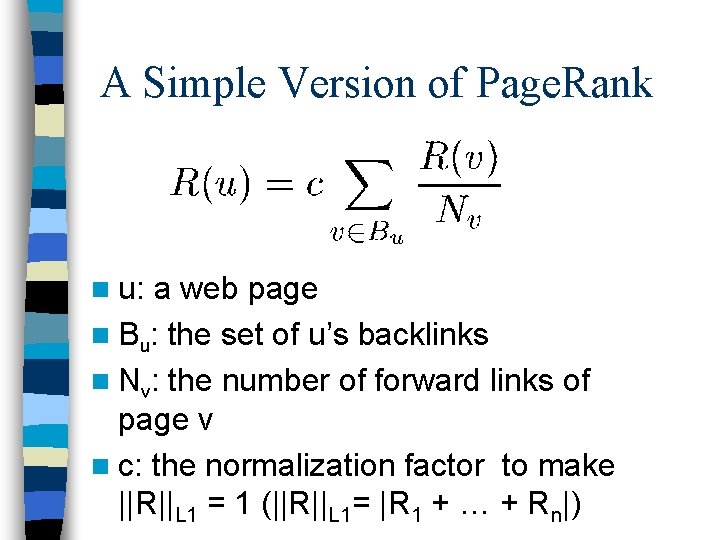
A Simple Version of Page. Rank n u: a web page n Bu: the set of u’s backlinks n Nv: the number of forward links of page v n c: the normalization factor to make ||R||L 1 = 1 (||R||L 1= |R 1 + … + Rn|)
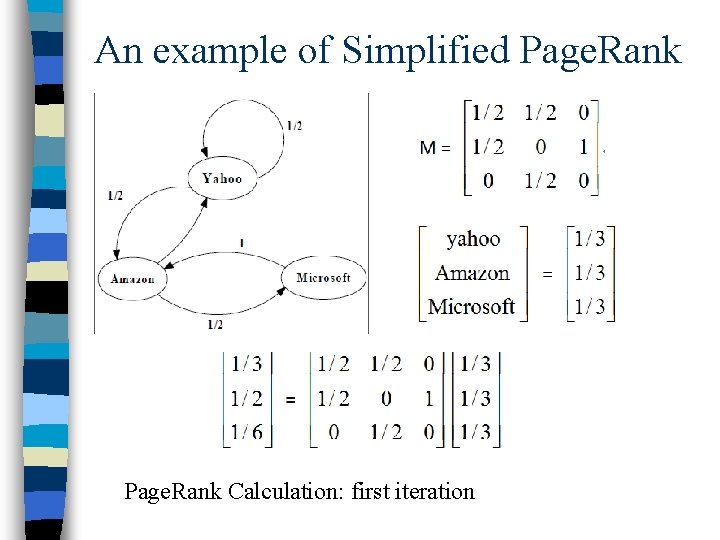
An example of Simplified Page. Rank Calculation: first iteration
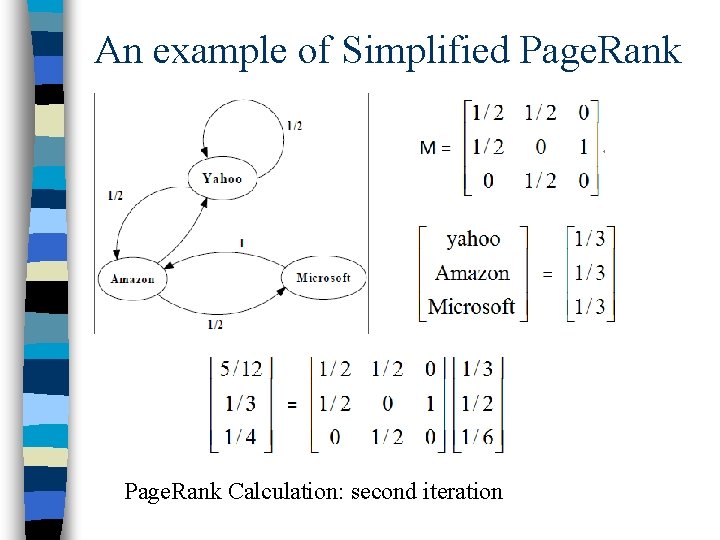
An example of Simplified Page. Rank Calculation: second iteration
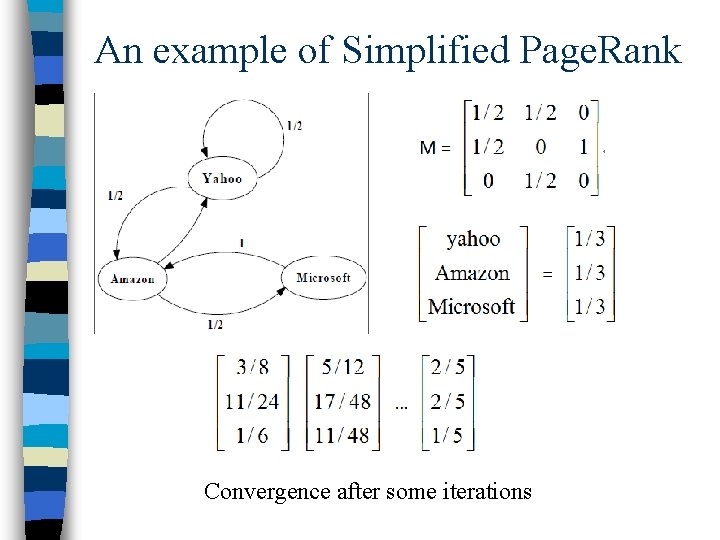
An example of Simplified Page. Rank Convergence after some iterations
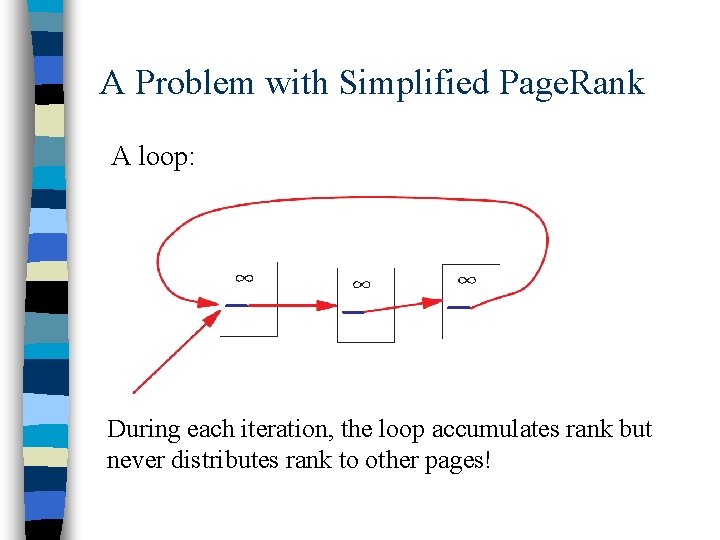
A Problem with Simplified Page. Rank A loop: During each iteration, the loop accumulates rank but never distributes rank to other pages!
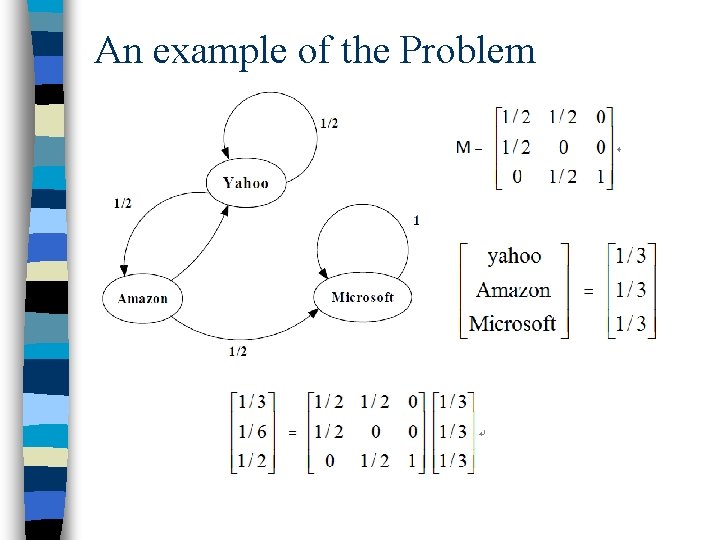
An example of the Problem
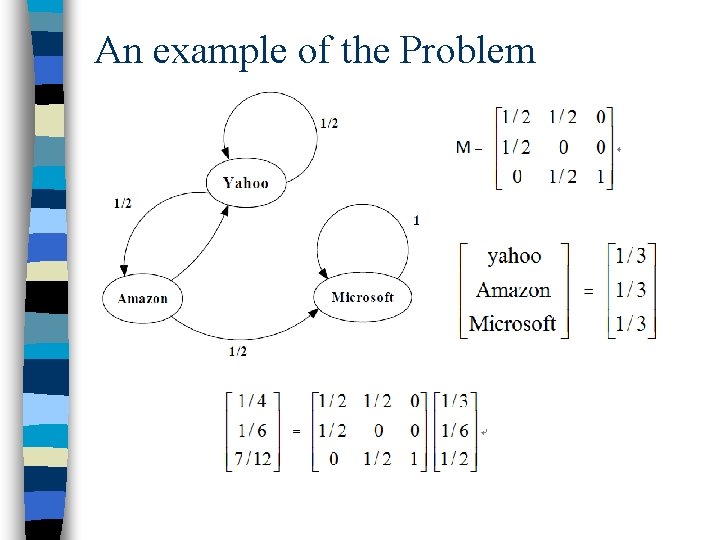
An example of the Problem
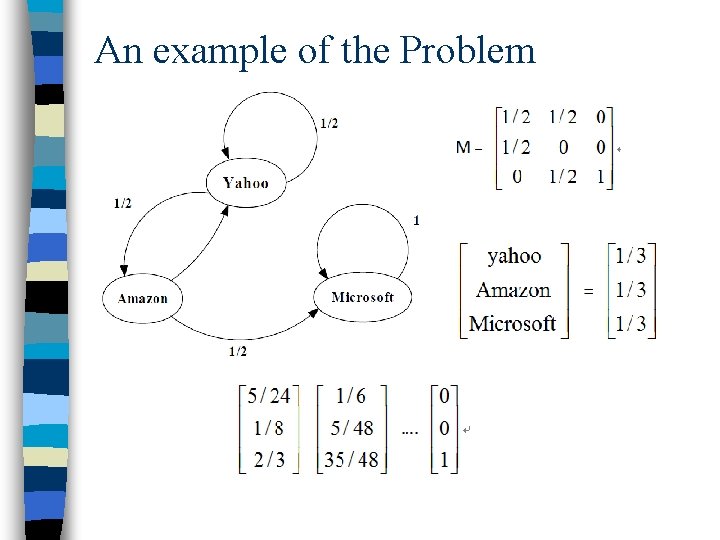
An example of the Problem
Random Walks in Graphs n The Random Surfer Model – The simplified model: the standing probability distribution of a random walk on the graph of the web. simply keeps clicking successive links at random n The Modified Model – The modified model: the “random surfer” simply keeps clicking successive links at random, but periodically “gets bored” and jumps to a random page based on the distribution of E

Modified Version of Page. Rank E(u): a distribution of ranks of web pages that “users” jump to when they “gets bored” after successive links at random.
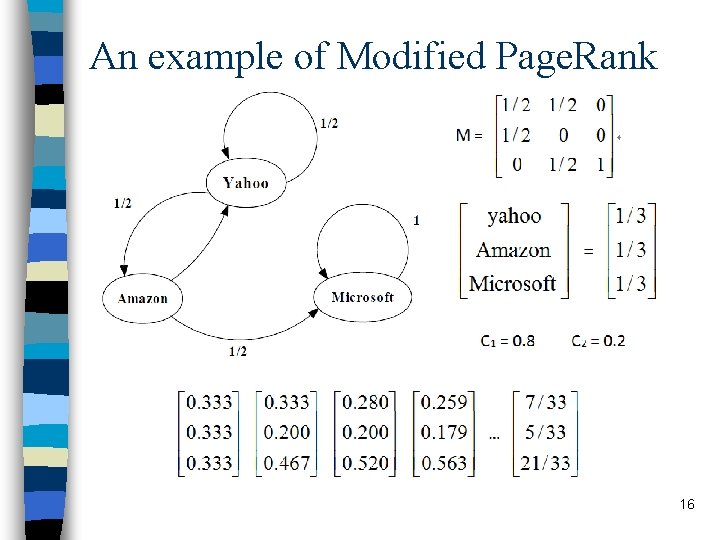
An example of Modified Page. Rank 16
Dangling Links n n n Links that point to any page with no outgoing links Most are pages that have not been downloaded yet Affect the model since it is not clear where their weight should be distributed Do not affect the ranking of any other page directly Can be simply removed before pagerank calculation and added back afterwards
Page. Rank Implementation n Convert each URL into a unique integer and store each hyperlink in a database using the integer IDs to identify pages n Sort the link structure by ID n Remove all the dangling links from the database n Make an initial assignment of ranks and start iteration n n Choosing a good initial assignment can speed up the pagerank Adding the dangling links back.
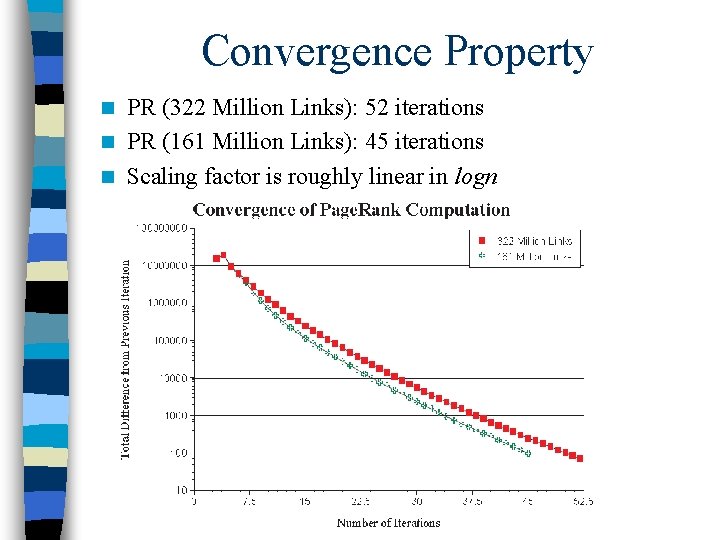
Convergence Property PR (322 Million Links): 52 iterations n PR (161 Million Links): 45 iterations n Scaling factor is roughly linear in logn n
Convergence Property n The Web is an expander-like graph – Theory of random walk: a random walk on a graph is said to be rapidly-mixing if it quickly converges to a limiting distribution on the set of nodes in the graph. A random walk is rapidlymixing on a graph if and only if the graph is an expander graph. – Expander graph: every subset of nodes S has a neighborhood (set of vertices accessible via outedges emanating from nodes in S) that is larger than some factor α times of |S|. A graph has a good expansion factor if and only if the largest eigenvalue is sufficiently larger than the second-largest eigenvalue.
Searching with Page. Rank • Two search engines: – Title-based search engine – Full text search engine • Title-based search engine – – – • Searches only the “Titles” Finds all the web pages whose titles contain all the query words Sorts the results by Page. Rank Very simple and cheap to implement Title match ensures high precision, and Page. Rank ensures high quality Full text search engine – Called Google – Examines all the words in every stored document and also performs Page. Rank (Rank Merging) – More precise but more complicated 21
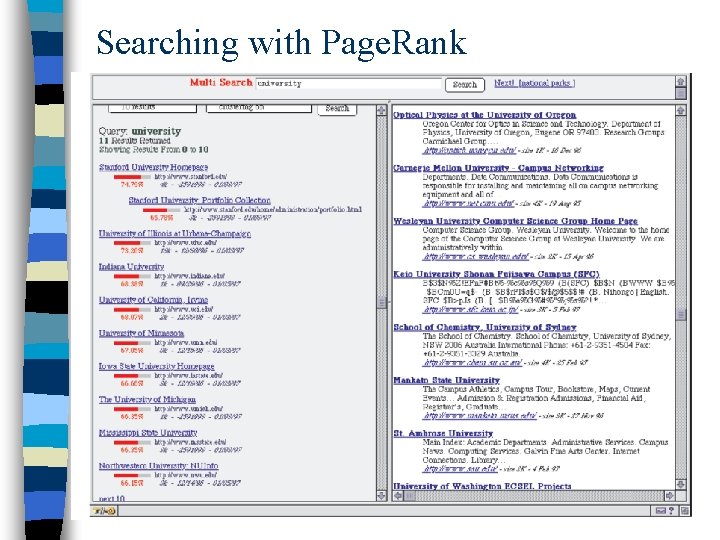
Searching with Page. Rank
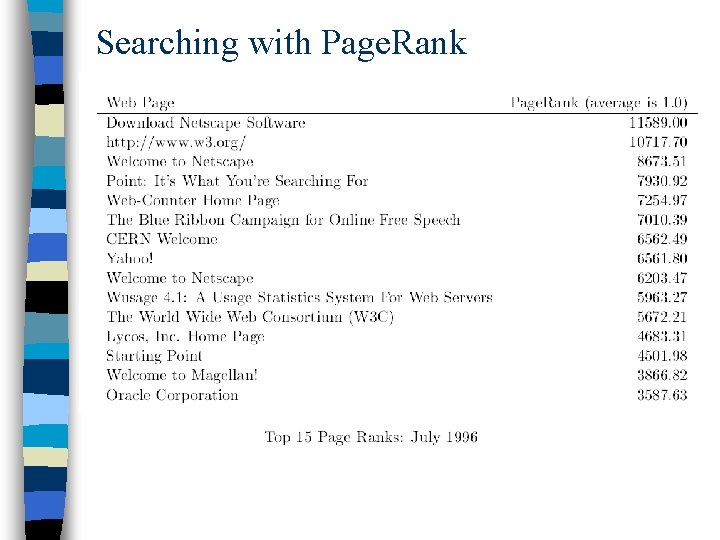
Searching with Page. Rank
Personalized Page. Rank n Important component of Page. Rank calculation is E – A vector over the web pages (used as source of rank) – Powerful parameter to adjust the page ranks n E vector corresponds to the distribution of web pages that a random surfer periodically jumps to n Instead in Personalized Page. Rank E consists of a single web page
Page. Rank vs. Web Traffic n Some highly accessed web pages have low page rank possibly because – People do not want to link to these pages from their own web pages (the example in their paper is pornographic sites…) – Some important backlinks are omitted use usage data as a start vector for Page. Rank.
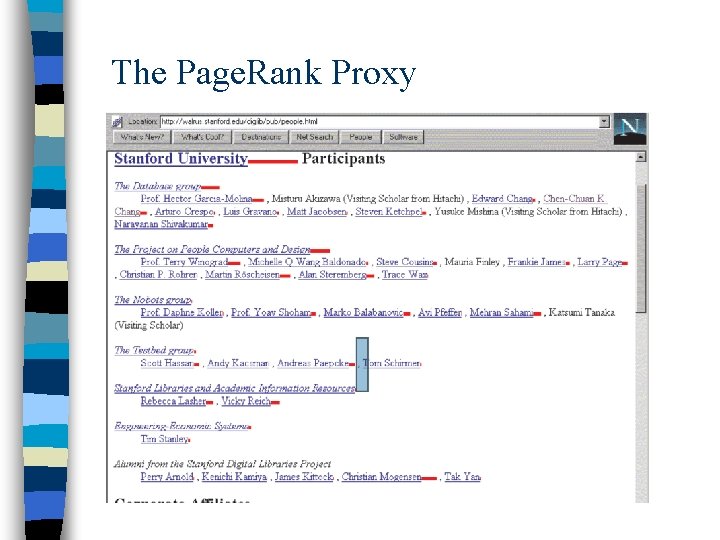
The Page. Rank Proxy
Conclusion n Page. Rank is a global ranking of all web pages based on their locations in the web graph structure n Page. Rank uses information which is external to the web pages – backlinks n Backlinks from important pages are more significant than backlinks from average pages n The structure of the web graph is very useful for information retrieval tasks.
- Slides: 27