
The PADME experiment at LNF Mauro Raggi Laboratori
The PADME experiment at LNF Mauro Raggi – Laboratori Nazionali di Frascati On behalf of the PADME collaboration: LNF, Roma la Sapienza, Lecce, Sofia LDMA 2015 International Workshop Camogli, Italy - June 24 -26 2015
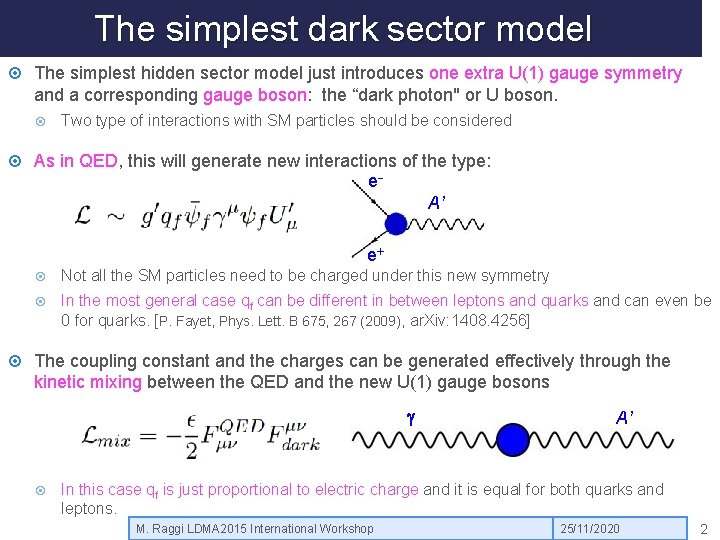
The simplest dark sector model The simplest hidden sector model just introduces one extra U(1) gauge symmetry and a corresponding gauge boson: the “dark photon" or U boson. Two type of interactions with SM particles should be considered As in QED, this will generate new interactions of the type: e. A’ e+ Not all the SM particles need to be charged under this new symmetry In the most general case qf can be different in between leptons and quarks and can even be 0 for quarks. [P. Fayet, Phys. Lett. B 675, 267 (2009), ar. Xiv: 1408. 4256] The coupling constant and the charges can be generated effectively through the kinetic mixing between the QED and the new U(1) gauge bosons g A’ In this case qf is just proportional to electric charge and it is equal for both quarks and leptons. M. Raggi LDMA 2015 International Workshop 25/11/2020 2
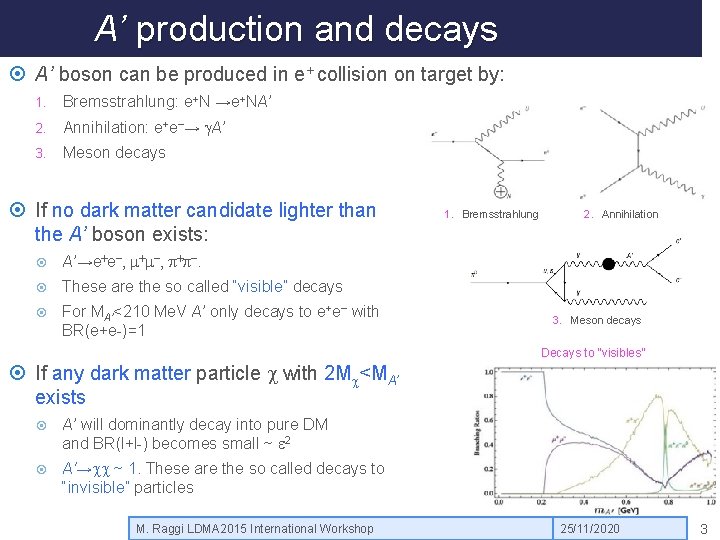
A’ production and decays A’ boson can be produced in e+ collision on target by: 1. Bremsstrahlung: e+N →e+NA’ 2. Annihilation: e+e-→ g. A’ 3. Meson decays If no dark matter candidate lighter than the A’ boson exists: A’→e+e-, m+m-, p+p-. These are the so called “visible” decays For MA’<210 Me. V A’ only decays to e+e- with BR(e+e-)=1 1. Bremsstrahlung 2. Annihilation 3. Meson decays Decays to “visibles” If any dark matter particle c with 2 Mc<MA’ exists A’ will dominantly decay into pure DM and BR(l+l-) becomes small ~ e 2 A'→cc ~ 1. These are the so called decays to “invisible” particles M. Raggi LDMA 2015 International Workshop 25/11/2020 3
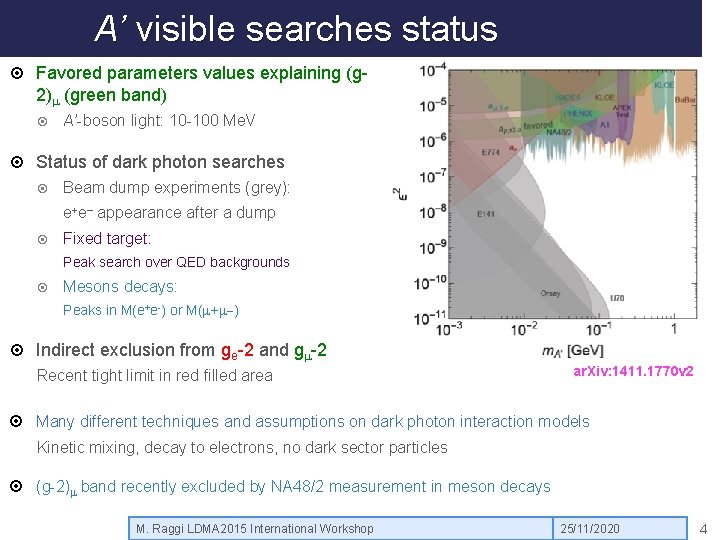
A’ visible searches status Favored parameters values explaining (g 2)m (green band) A’-boson light: 10 -100 Me. V Status of dark photon searches Beam dump experiments (grey): e+e- appearance after a dump Fixed target: Peak search over QED backgrounds Mesons decays: Peaks in M(e+e-) or M(m+m-) Indirect exclusion from ge-2 and gm-2 Recent tight limit in red filled area ar. Xiv: 1411. 1770 v 2 Many different techniques and assumptions on dark photon interaction models Kinetic mixing, decay to electrons, no dark sector particles (g-2)m band recently excluded by NA 48/2 measurement in meson decays M. Raggi LDMA 2015 International Workshop 25/11/2020 4
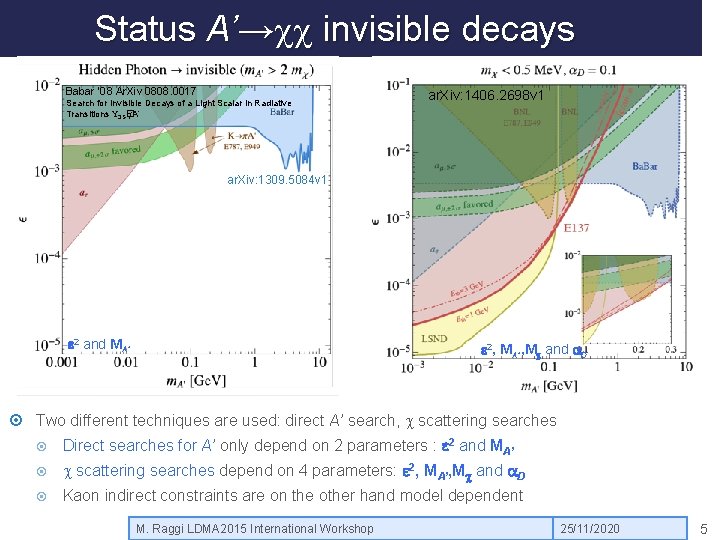
Status A’→cc invisible decays Babar ’ 08 Ar. Xiv 0808. 0017 Search for Invisible Decays of a Light Scalar in Radiative Transitions U 3 S� g. A’ ar. Xiv: 1406. 2698 v 1 ar. Xiv: 1309. 5084 v 1 e 2 and MA’ e 2, MA’, Mc and a. D Two different techniques are used: direct A’ search, c scattering searches Direct searches for A’ only depend on 2 parameters : e 2 and MA’ c scattering searches depend on 4 parameters: e 2, MA’, Mc and a. D Kaon indirect constraints are on the other hand model dependent M. Raggi LDMA 2015 International Workshop 25/11/2020 5
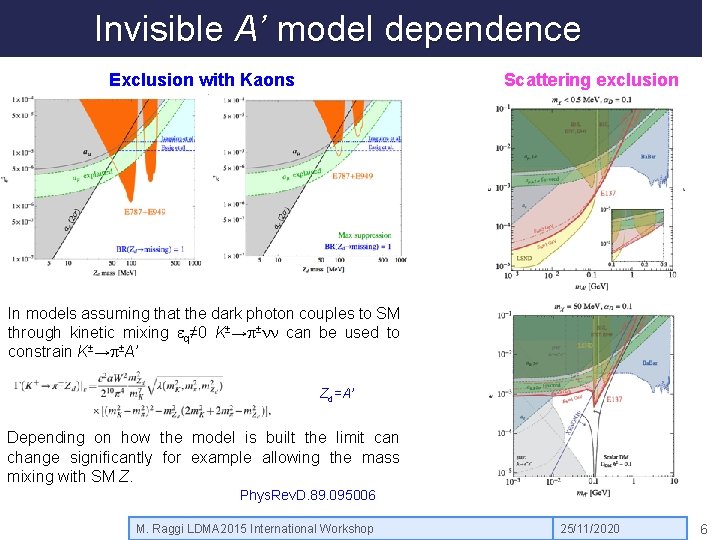
Invisible A’ model dependence Exclusion with Kaons Scattering exclusion In models assuming that the dark photon couples to SM through kinetic mixing eq≠ 0 K±→p±nn can be used to constrain K±→p±A’ Zd=A’ Depending on how the model is built the limit can change significantly for example allowing the mass mixing with SM Z. Phys. Rev. D. 89. 095006 M. Raggi LDMA 2015 International Workshop 25/11/2020 6
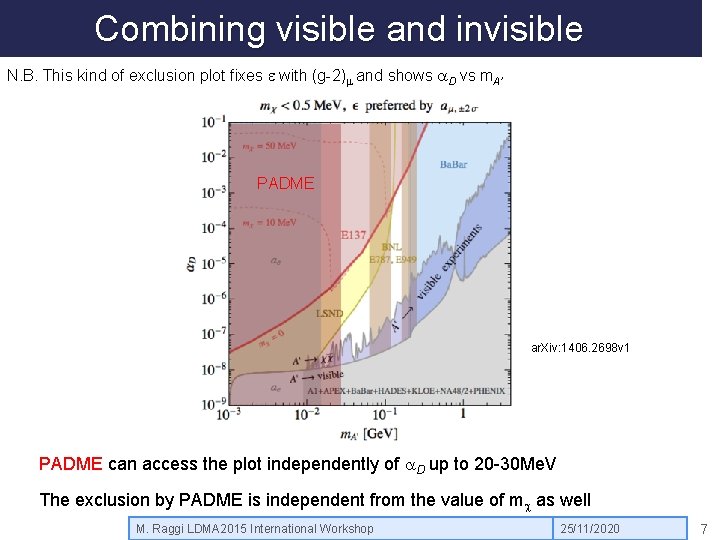
Combining visible and invisible N. B. This kind of exclusion plot fixes e with (g-2)m and shows a. D vs m. A’ PADME ar. Xiv: 1406. 2698 v 1 PADME can access the plot independently of a. D up to 20 -30 Me. V The exclusion by PADME is independent from the value of mc as well M. Raggi LDMA 2015 International Workshop 25/11/2020 7
The PADME approach At present all experimental results rely on at least one of the following model-dependent assumptions: A’ decays to e+e- (visible decays assumption) and thus BR(A’→e+e-) = 1 A’ couples with the same strength to all fermions (eq= el) (kinetic mixing) In the most general scenario (PADME) A’ can decay to dark sector particles c with mc<MA’/2 ⇒ BR(A’→e+e- <<1) Dump and meson decay experiment results suppressed by e 2 A’ can couple to quark with a coupling constant smaller el or even 0 Suppressed or no production at hadronic machines and in mesons decays PADME aims at detecting A’ produced in e+e- annihilation and decaying into any final state by searching for missing mass in e+e→g. A’, A’→cc process No assumption on the A’ decays products and coupling to quarks Only minimal assumption: A’ couples to leptons PADME will limit the coupling of any new light particle produced in e+ecollisions: scalars (Hd), vectors (A’ and Zd) M. Raggi LDMA 2015 International Workshop 25/11/2020 8
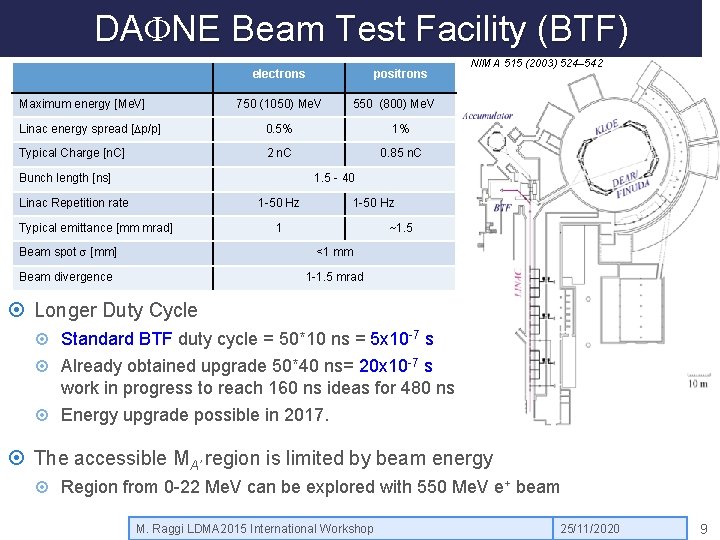
DAFNE Beam Test Facility (BTF) electrons Maximum energy [Me. V] positrons 750 (1050) Me. V 550 (800) Me. V Linac energy spread [Dp/p] 0. 5% 1% Typical Charge [n. C] 2 n. C 0. 85 n. C Bunch length [ns] NIM A 515 (2003) 524– 542 1. 5 - 40 Linac Repetition rate 1 -50 Hz Typical emittance [mm mrad] 1 -50 Hz 1 ~1. 5 Beam spot s [mm] <1 mm Beam divergence 1 -1. 5 mrad Longer Duty Cycle Standard BTF duty cycle = 50*10 ns = 5 x 10 -7 s Already obtained upgrade 50*40 ns= 20 x 10 -7 s work in progress to reach 160 ns ideas for 480 ns Energy upgrade possible in 2017. The accessible MA’ region is limited by beam energy Region from 0 -22 Me. V can be explored with 550 Me. V e+ beam M. Raggi LDMA 2015 International Workshop 25/11/2020 9
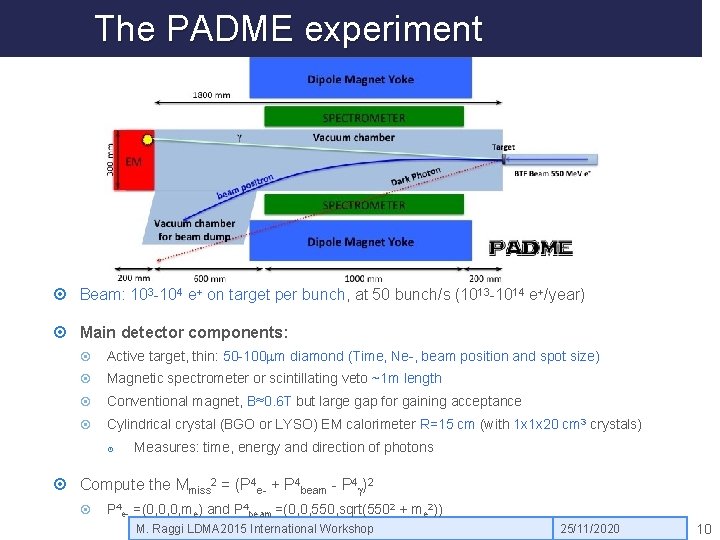
The PADME experiment Beam: 103 -104 e+ on target per bunch, at 50 bunch/s (1013 -1014 e+/year) Main detector components: Active target, thin: 50 -100 mm diamond (Time, Ne-, beam position and spot size) Magnetic spectrometer or scintillating veto ~1 m length Conventional magnet, B≈0. 6 T but large gap for gaining acceptance Cylindrical crystal (BGO or LYSO) EM calorimeter R=15 cm (with 1 x 1 x 20 cm 3 crystals) Measures: time, energy and direction of photons 1. 75 m Compute the Mmiss 2 = (P 4 e- + P 4 beam - P 4 g)2 P 4 e- =(0, 0, 0, me) and P 4 beam =(0, 0, 550, sqrt(5502 + me 2)) M. Raggi LDMA 2015 International Workshop 25/11/2020 10
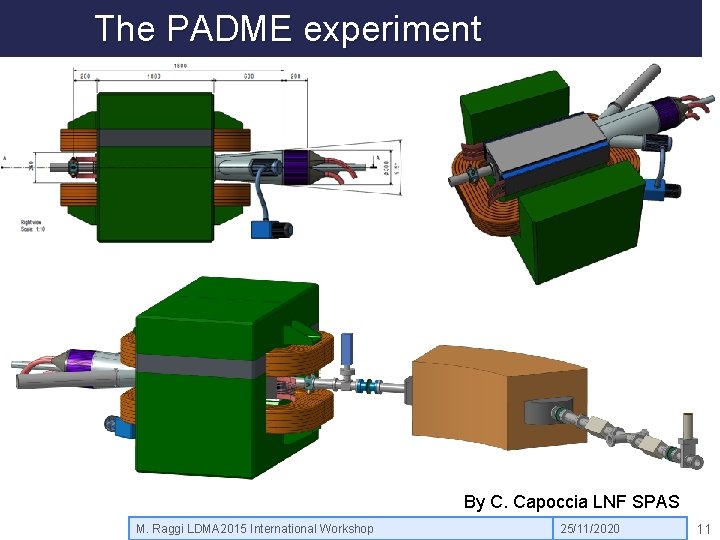
The PADME experiment By C. Capoccia LNF SPAS M. Raggi LDMA 2015 International Workshop 25/11/2020 11
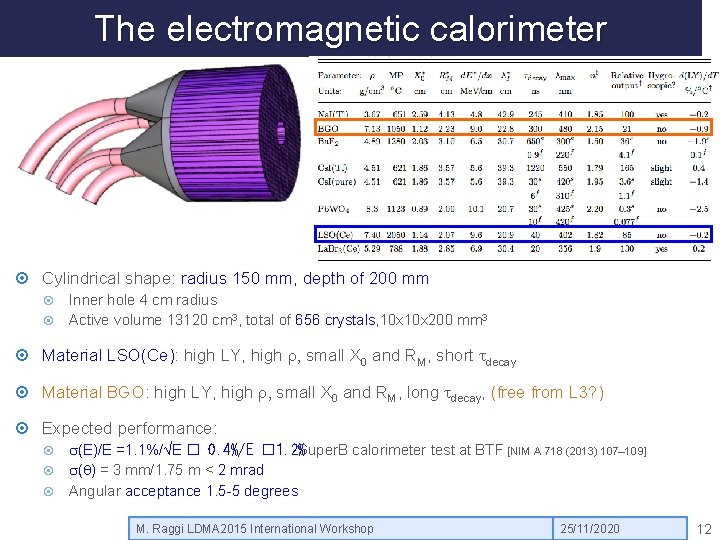
The electromagnetic calorimeter 30 cm Cylindrical shape: radius 150 mm, depth of 200 mm Inner hole 4 cm radius Active volume 13120 cm 3, total of 656 crystals, 10 x 200 mm 3 Material LSO(Ce): high LY, high r, small X 0 and RM, short tdecay Material BGO: high LY, high r, small X 0 and RM, long tdecay, (free from L 3? ) Expected performance: s(E)/E =1. 1%/√E � 0. 4%/E � 1. 2% Super. B calorimeter test at BTF [NIM A 718 (2013) 107– 109] s(q) = 3 mm/1. 75 m < 2 mrad Angular acceptance 1. 5 -5 degrees M. Raggi LDMA 2015 International Workshop 25/11/2020 12
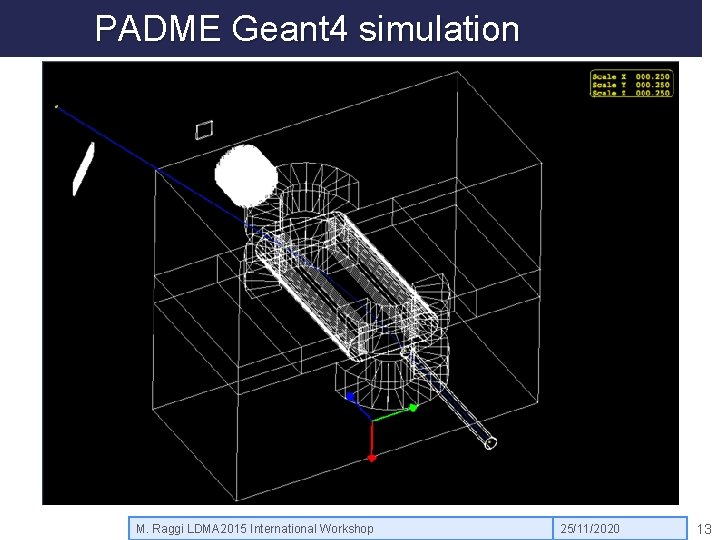
PADME Geant 4 simulation M. Raggi LDMA 2015 International Workshop 25/11/2020 13
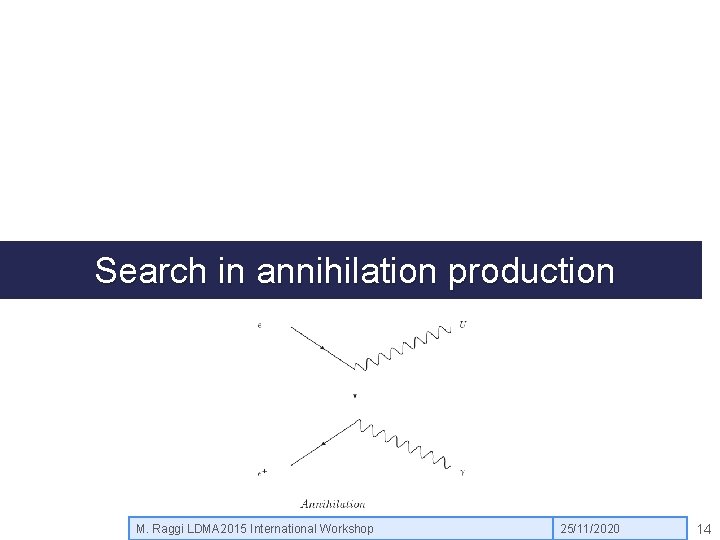
Search in annihilation production M. Raggi LDMA 2015 International Workshop 25/11/2020 14
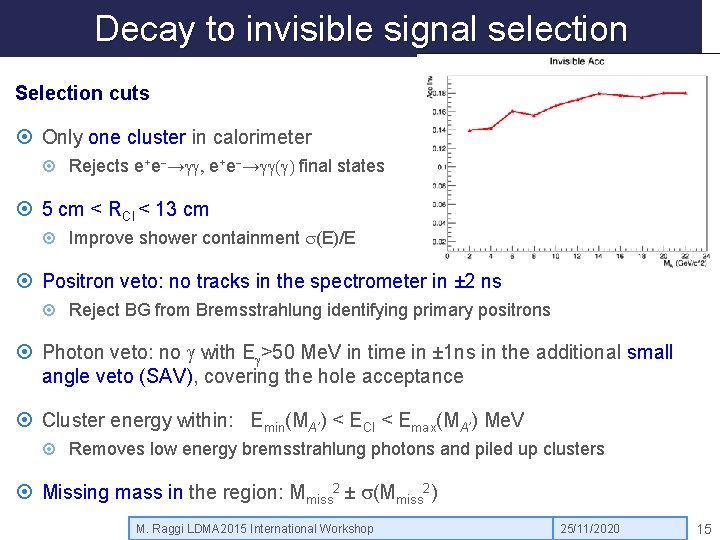
Decay to invisible signal selection Selection cuts Only one cluster in calorimeter Rejects e+e-→gg, e+e-→gg(g) final states 5 cm < RCl < 13 cm Improve shower containment s(E)/E Positron veto: no tracks in the spectrometer in ± 2 ns Reject BG from Bremsstrahlung identifying primary positrons Photon veto: no g with Eg>50 Me. V in time in ± 1 ns in the additional small angle veto (SAV), covering the hole acceptance Cluster energy within: Emin(MA’) < ECl < Emax(MA’) Me. V Removes low energy bremsstrahlung photons and piled up clusters Missing mass in the region: Mmiss 2 ± s(Mmiss 2) M. Raggi LDMA 2015 International Workshop 25/11/2020 15
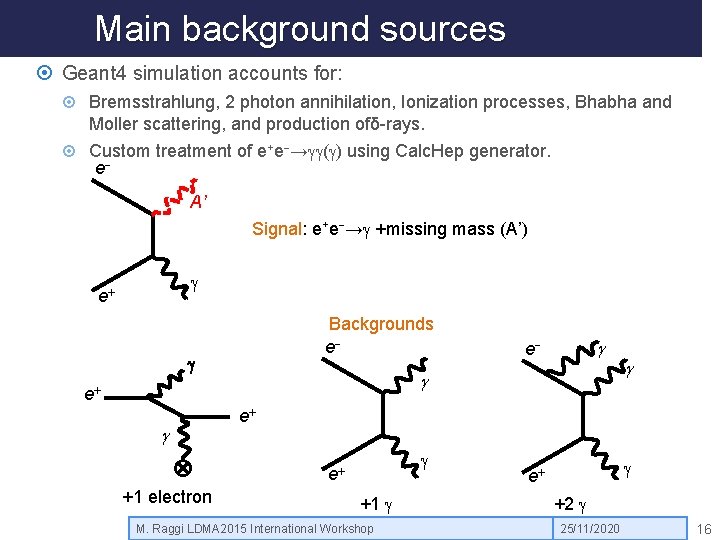
Main background sources Geant 4 simulation accounts for: Bremsstrahlung, 2 photon annihilation, Ionization processes, Bhabha and Moller scattering, and production ofδ-rays. Custom treatment of e+e-→gg(g) using Calc. Hep generator. e. A’ Signal: e+e-→g +missing mass (A’) g e+ Backgrounds e- g g e+ +1 electron g e- +1 g M. Raggi LDMA 2015 International Workshop g e+ +2 g 25/11/2020 16
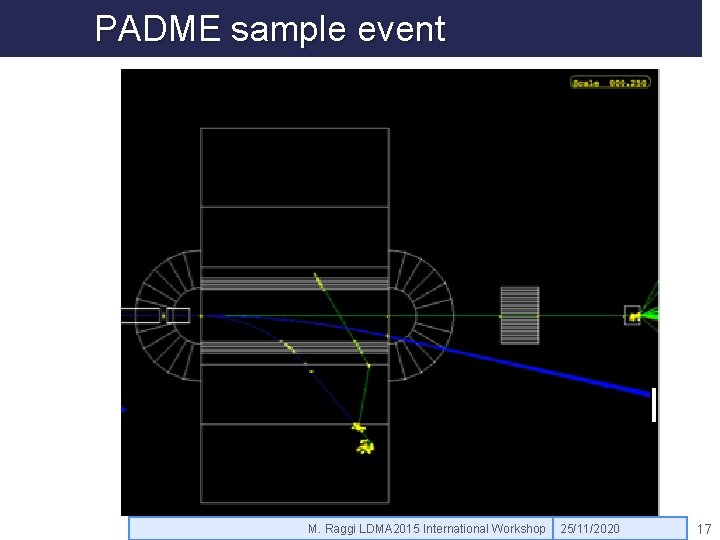
PADME sample event M. Raggi LDMA 2015 International Workshop 25/11/2020 17
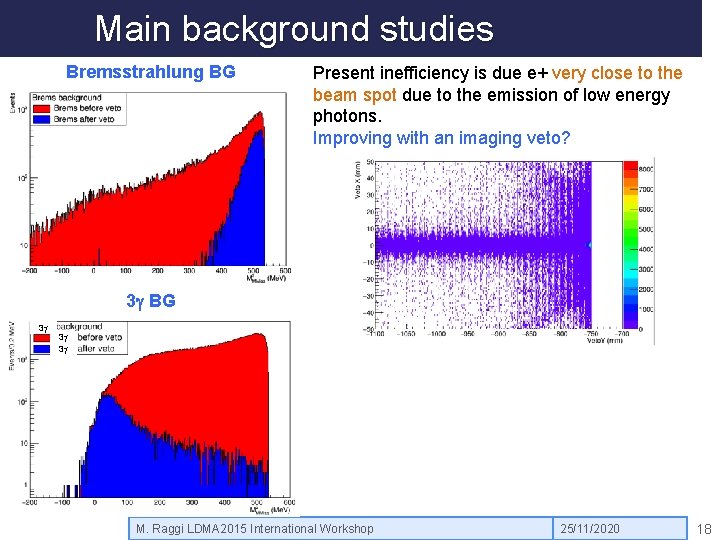
Main background studies Bremsstrahlung BG Present inefficiency is due e+ very close to the beam spot due to the emission of low energy photons. Improving with an imaging veto? 3 g BG 3 g 3 g 3 g M. Raggi LDMA 2015 International Workshop 25/11/2020 18
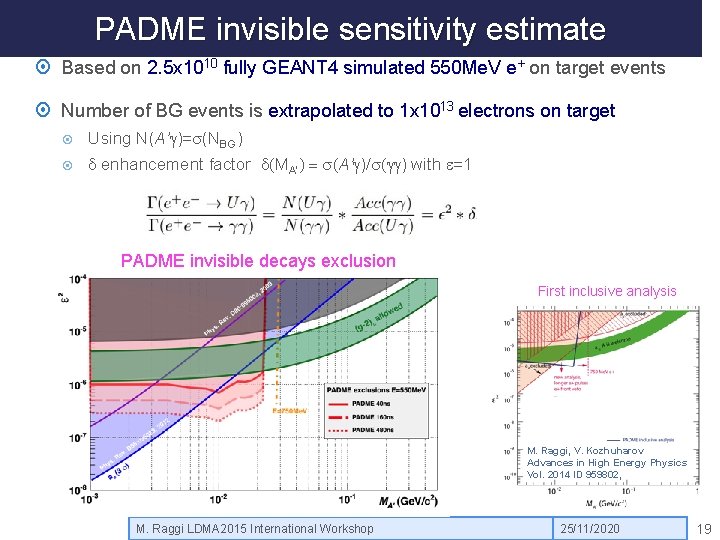
PADME invisible sensitivity estimate Based on 2. 5 x 10¹⁰ fully GEANT 4 simulated 550 Me. V e+ on target events Number of BG events is extrapolated to 1 x 10¹³ electrons on target Using N(A’g)=s(NBG) d enhancement factor d(MA’) = s(A’g)/s(gg) with e=1 PADME invisible decays exclusion First inclusive analysis M. Raggi, V. Kozhuharov Advances in High Energy Physics Vol. 2014 ID 959802, M. Raggi LDMA 2015 International Workshop 25/11/2020 19
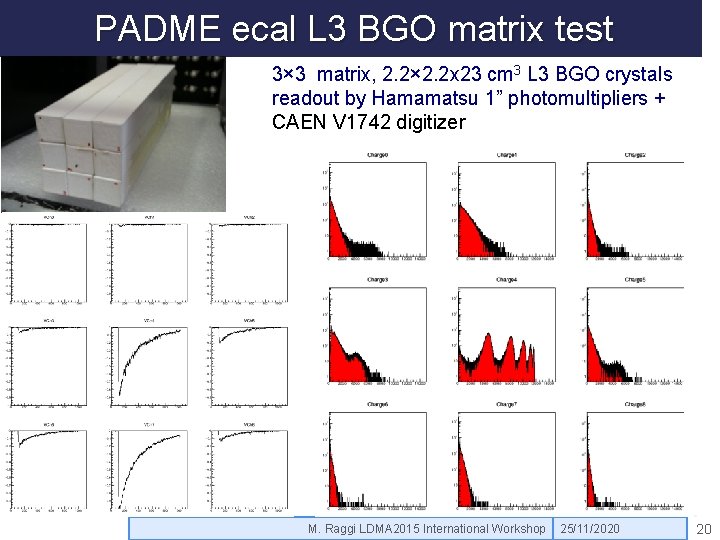
PADME ecal L 3 BGO matrix test 3× 3 matrix, 2. 2× 2. 2 x 23 cm 3 L 3 BGO crystals readout by Hamamatsu 1” photomultipliers + CAEN V 1742 digitizer M. Raggi LDMA 2015 International Workshop 25/11/2020 20
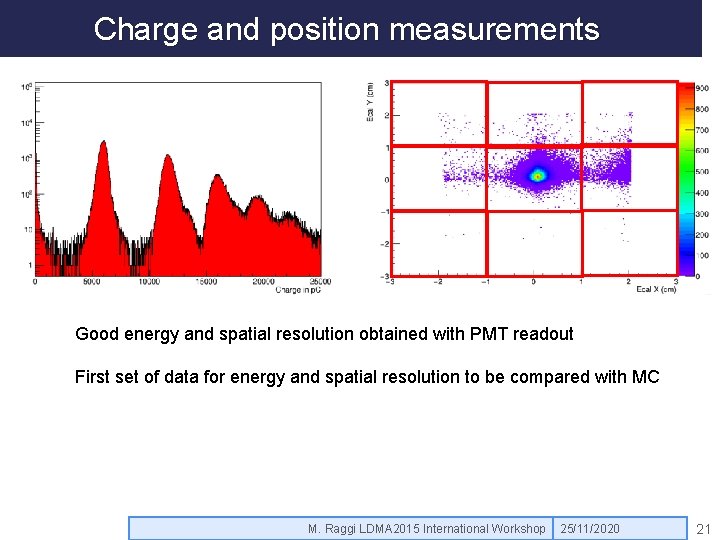
Charge and position measurements Good energy and spatial resolution obtained with PMT readout First set of data for energy and spatial resolution to be compared with MC M. Raggi LDMA 2015 International Workshop 25/11/2020 21
Status of the PADME project The PADME project was born into the INFN “what next” process The project received an endorsement by scientific referee of INFN CSN 1 PADME has been inserted in the CNS 1 “what next” White paper “Proposal for a long term strategy for accelerator based experiments” Frascati Phys. Ser. 60 (2015) 1 -302 Proto collaboration formed in June including: LNF, Roma la Sapienza, Lecce and Sofia University Financial plan for 2015 -2017 has been presented to CSN 1 of INFN 2015 financial request already approved Next steps: Enlarge the collaboration with Italian and non Italian institutions Define responsibilities for detector construction Write the experiment proposal and present it to CSN 1 M. Raggi LDMA 2015 International Workshop 25/11/2020 22
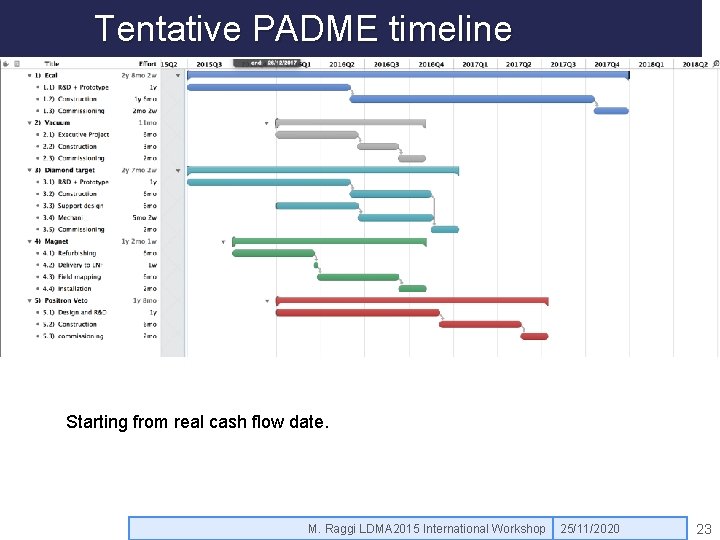
Tentative PADME timeline Starting from real cash flow date. M. Raggi LDMA 2015 International Workshop 25/11/2020 23
PADME dump experiment toymc Try to evaluate driving design parameters for the PADME dump Toymc includes: Production cross section calculated by MADgraph (thanks to A. Celentano) Evaluate the produced number of dark photons Scale by decay length acceptance Scale by electron acceptance in the detector using kinematical distribution from a toy Distribution have been compared with MADGraph for several MU Not yet implemented in depth production of the A’ Next plot not to be considered exclusions still M. Raggi and P. Valente Perugia 09/03/15
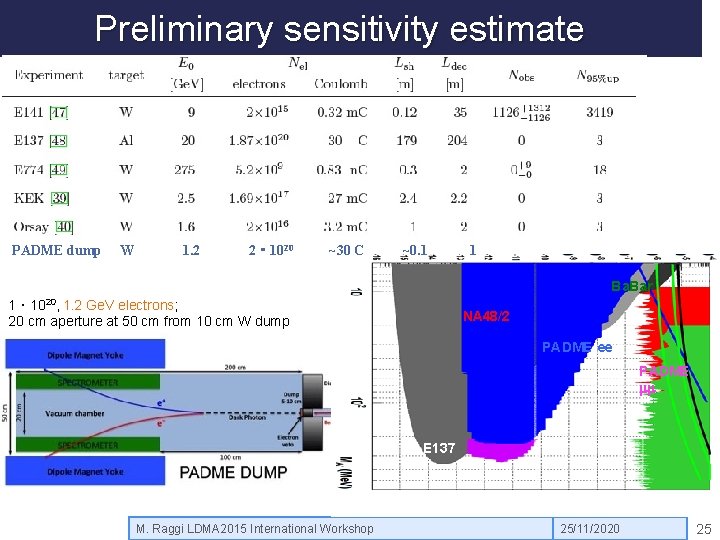
Preliminary sensitivity estimate PADME dump W 1. 2 2・ 1020 ~30 C ~0. 1 1 Ba. Bar 1・ 1020, 1. 2 Ge. V electrons; 20 cm aperture at 50 cm from 10 cm W dump NA 48/2 PADME ee PADME mm E 137 M. Raggi LDMA 2015 International Workshop 25/11/2020 25
SPARE SLIDES M. Raggi LDMA 2015 International Workshop 25/11/2020 26
- Slides: 26