
The Pacific Meridional Mode Diagnostics and Impacts Climate
- Slides: 35
The Pacific Meridional Mode: Diagnostics and Impacts Climate Diagnostics and Prediction Workshop October 21, 2004 Madison, WI Dan Vimont John Chiang Department of Atmospheric and Oceanic Sciences Center for Climatic Research University of Wisconsin, Madison Department of Geography & Berkeley Atmospheric Sciences Center University of California, Berkeley
The Pacific Meridional Mode n n Analogies between the Atlantic and Pacific Modeling the tropical response to midlatitude forcing The spatial structure of decadal ENSOlike variability Conclusions October 21, 2004 Climate Diagnostics and Prediction Workshop 2
The Pacific Meridional Mode n n Analogies between the Atlantic and Pacific Modeling the tropical response to midlatitude forcing The spatial structure of decadal ENSOlike variability Conclusions October 21, 2004 Climate Diagnostics and Prediction Workshop 3
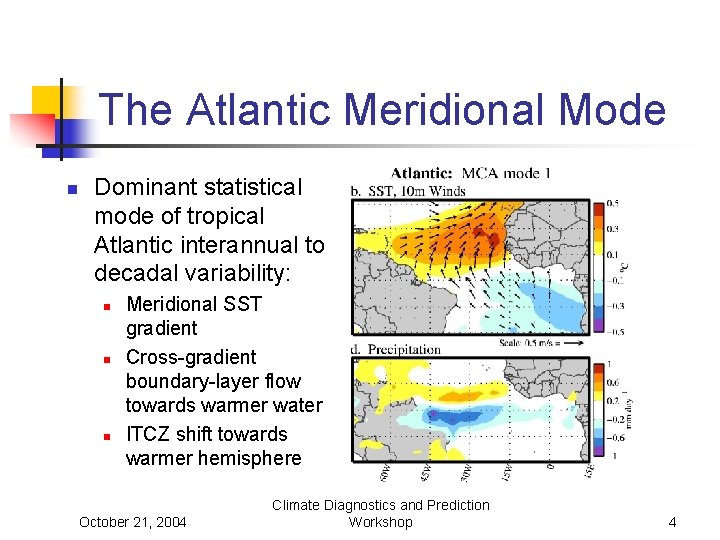
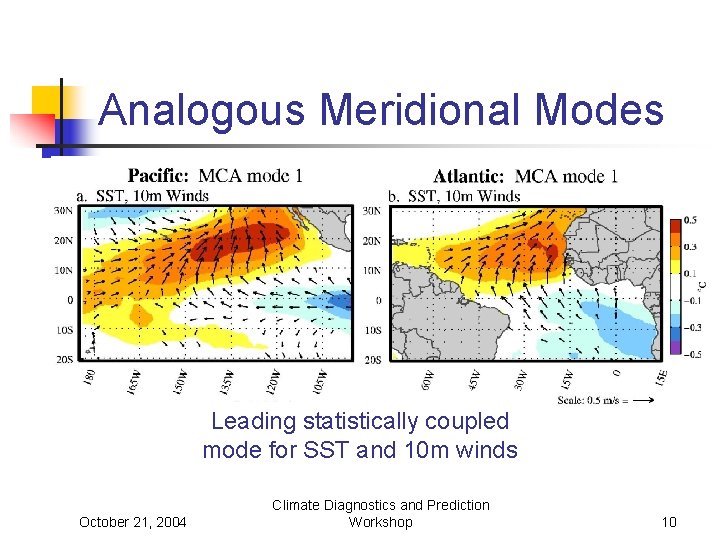
The Atlantic Meridional Mode n Dominant statistical mode of tropical Atlantic interannual to decadal variability: n n n Meridional SST gradient Cross-gradient boundary-layer flow towards warmer water ITCZ shift towards warmer hemisphere October 21, 2004 Climate Diagnostics and Prediction Workshop 4
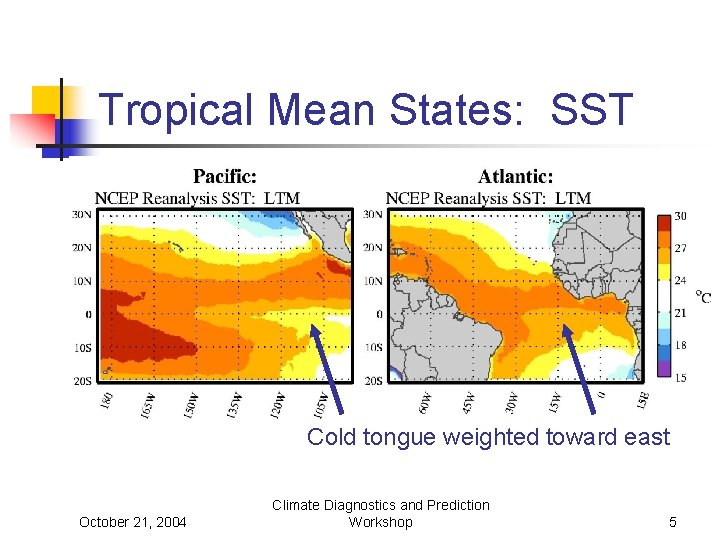
Tropical Mean States: SST Cold tongue weighted toward east October 21, 2004 Climate Diagnostics and Prediction Workshop 5
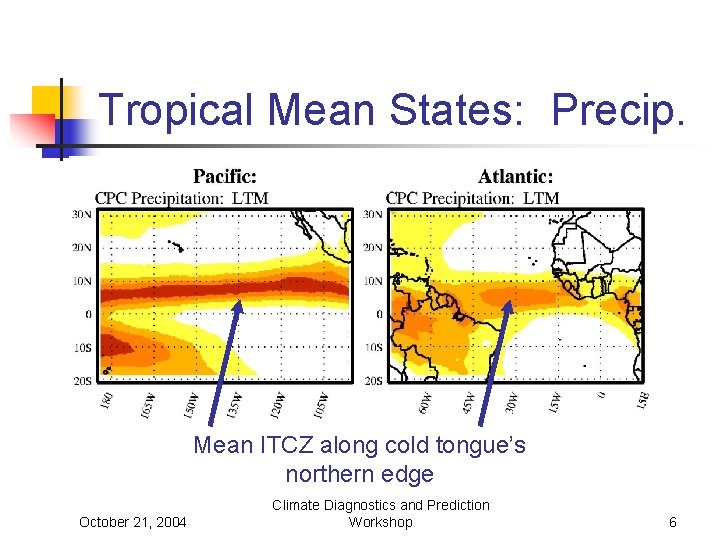
Tropical Mean States: Precip. Mean ITCZ along cold tongue’s northern edge October 21, 2004 Climate Diagnostics and Prediction Workshop 6
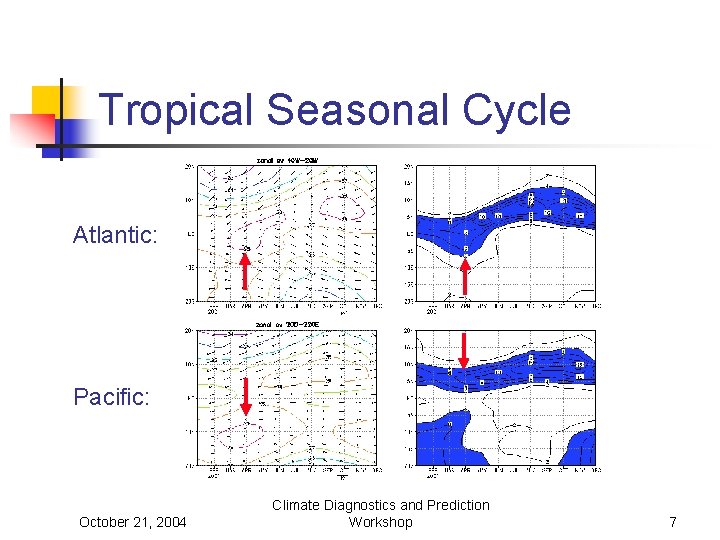
Tropical Seasonal Cycle Atlantic: Pacific: October 21, 2004 Climate Diagnostics and Prediction Workshop 7
Pacific Meridional Mode: Motivation n Each basin possesses similar mean states and seasonal cycle: cold tongue to the east, similar seasonal cycles of ITCZ and cold tongue (Mitchell and Wallace, 1992) Model studies without a thermocline-SST feedback produce meridional variability as the dominant mode (e. g. Xie and Saito, 2001) Similar evidence for mid-latitude forcing of tropical variability in each basin (Curtis and Hastenrath, 1995; Nobre and Shukla; 1996, Xie and Tanimoto; Czaja et al. , 2002; Vimont et al. , 2001, 2003 a, b) October 21, 2004 Climate Diagnostics and Prediction Workshop 8
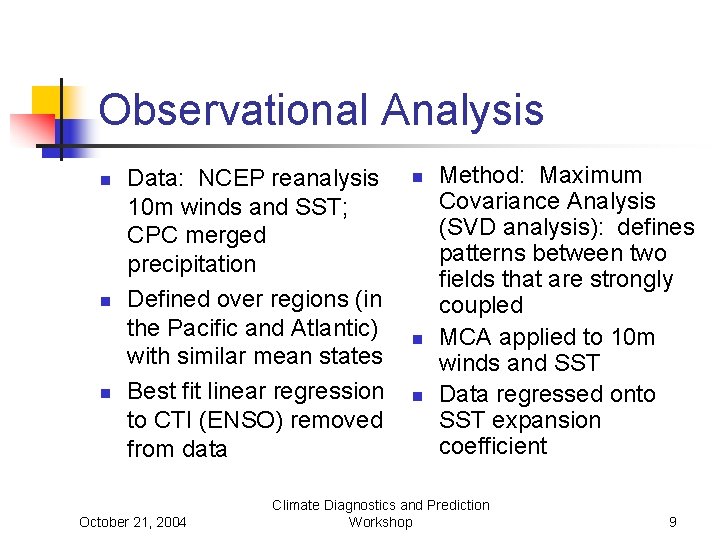
Observational Analysis n n n Data: NCEP reanalysis 10 m winds and SST; CPC merged precipitation Defined over regions (in the Pacific and Atlantic) with similar mean states Best fit linear regression to CTI (ENSO) removed from data October 21, 2004 n n n Method: Maximum Covariance Analysis (SVD analysis): defines patterns between two fields that are strongly coupled MCA applied to 10 m winds and SST Data regressed onto SST expansion coefficient Climate Diagnostics and Prediction Workshop 9
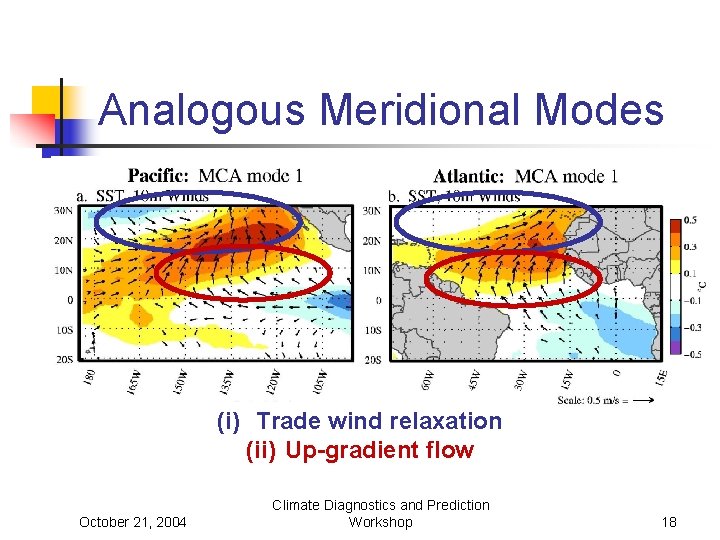
Analogous Meridional Modes Leading statistically coupled mode for SST and 10 m winds October 21, 2004 Climate Diagnostics and Prediction Workshop 10
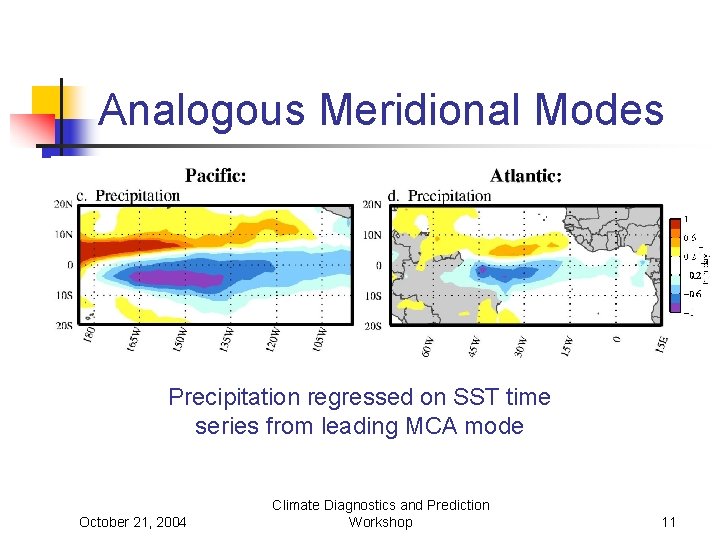
Analogous Meridional Modes Precipitation regressed on SST time series from leading MCA mode October 21, 2004 Climate Diagnostics and Prediction Workshop 11
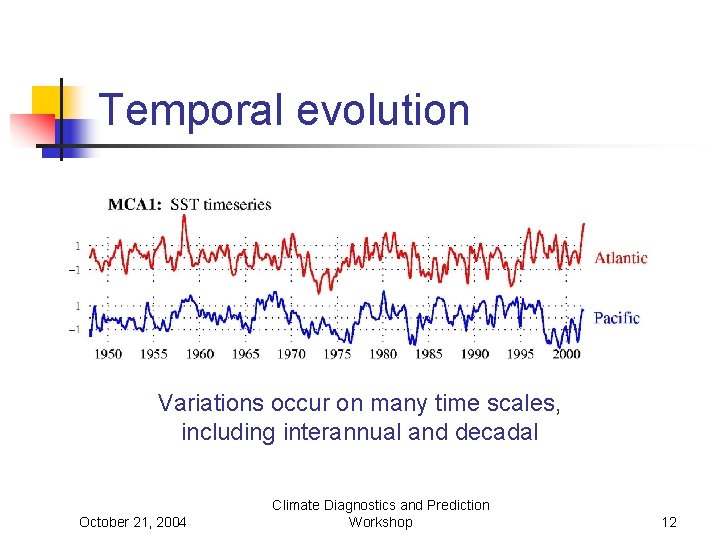
Temporal evolution Variations occur on many time scales, including interannual and decadal October 21, 2004 Climate Diagnostics and Prediction Workshop 12
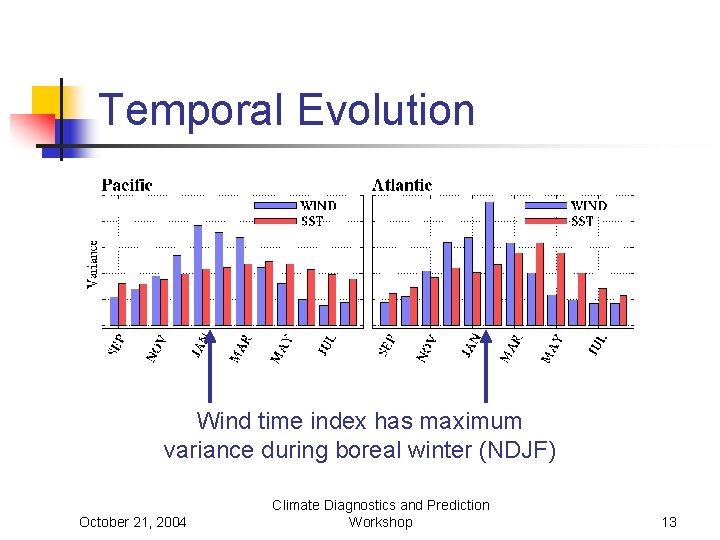
Temporal Evolution Wind time index has maximum variance during boreal winter (NDJF) October 21, 2004 Climate Diagnostics and Prediction Workshop 13
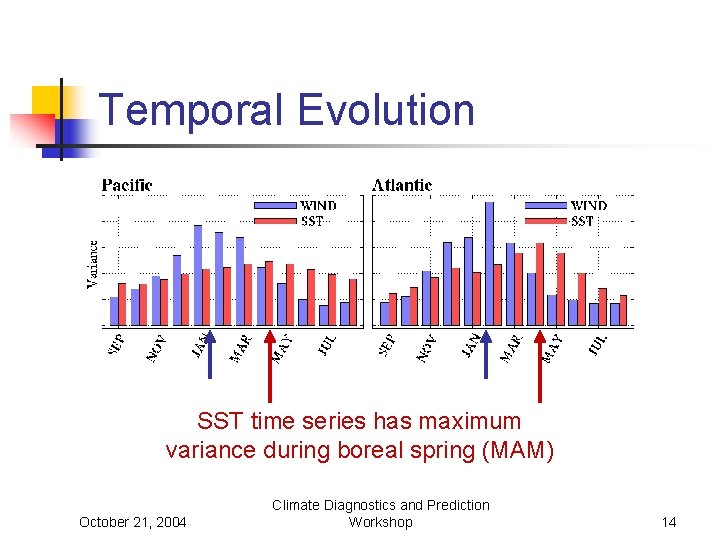
Temporal Evolution SST time series has maximum variance during boreal spring (MAM) October 21, 2004 Climate Diagnostics and Prediction Workshop 14
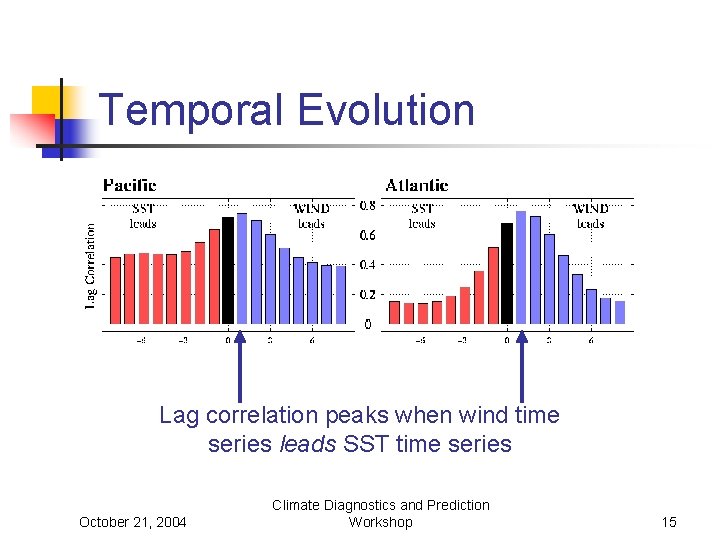
Temporal Evolution Lag correlation peaks when wind time series leads SST time series October 21, 2004 Climate Diagnostics and Prediction Workshop 15
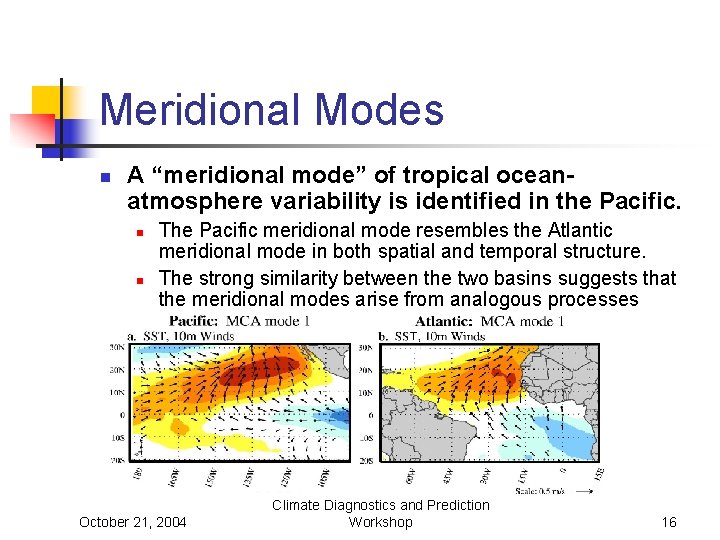
Meridional Modes n A “meridional mode” of tropical oceanatmosphere variability is identified in the Pacific. n n The Pacific meridional mode resembles the Atlantic meridional mode in both spatial and temporal structure. The strong similarity between the two basins suggests that the meridional modes arise from analogous processes October 21, 2004 Climate Diagnostics and Prediction Workshop 16
The Pacific Meridional Mode n n Analogies between the Atlantic and Pacific Modeling the tropical response to mid-latitude forcing The spatial structure of decadal ENSOlike variability Conclusions October 21, 2004 Climate Diagnostics and Prediction Workshop 17
Analogous Meridional Modes (i) Trade wind relaxation (ii) Up-gradient flow October 21, 2004 Climate Diagnostics and Prediction Workshop 18
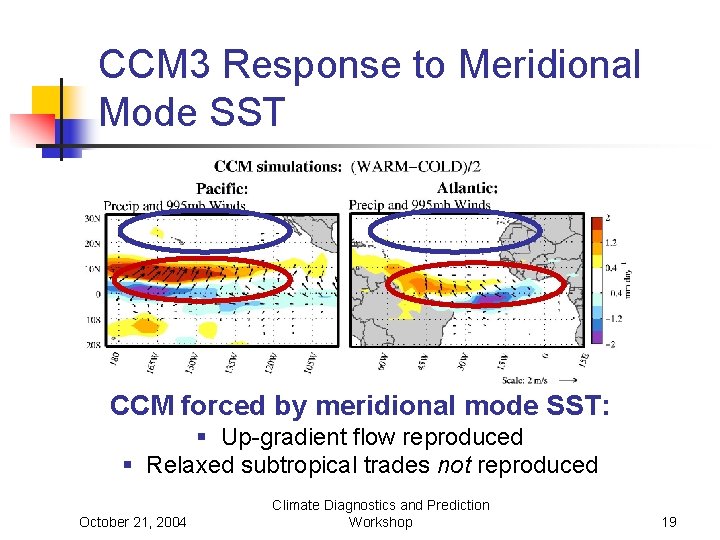
CCM 3 Response to Meridional Mode SST CCM forced by meridional mode SST: § Up-gradient flow reproduced § Relaxed subtropical trades not reproduced October 21, 2004 Climate Diagnostics and Prediction Workshop 19
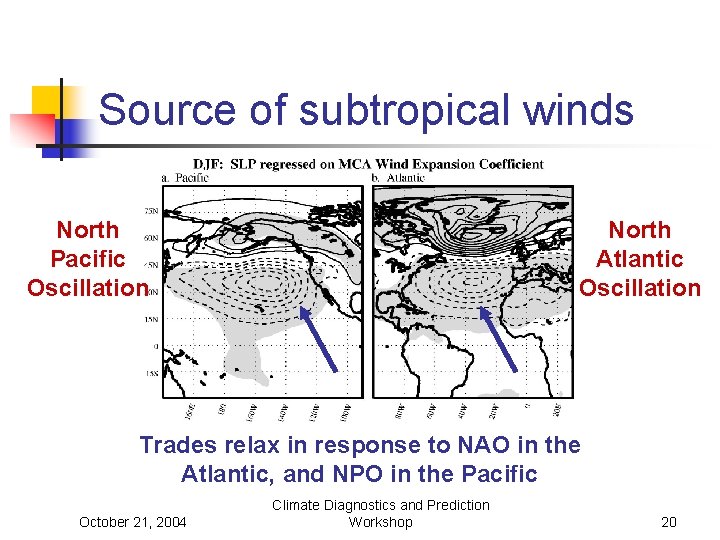
Source of subtropical winds North Pacific Oscillation North Atlantic Oscillation Trades relax in response to NAO in the Atlantic, and NPO in the Pacific October 21, 2004 Climate Diagnostics and Prediction Workshop 20
Meridional Mode Evolution n Wintertime fluctuations in the strength of the subtropical trade winds affect the subtropical SST through surface heat fluxes In the deep tropics, the atmosphere responds by producing surface winds that blow towards the warmer SST Model simulation: we will force a coupled model with heat flux anomalies associated with the NPO during winter, then allow the model to freely evolve. October 21, 2004 Climate Diagnostics and Prediction Workshop 21
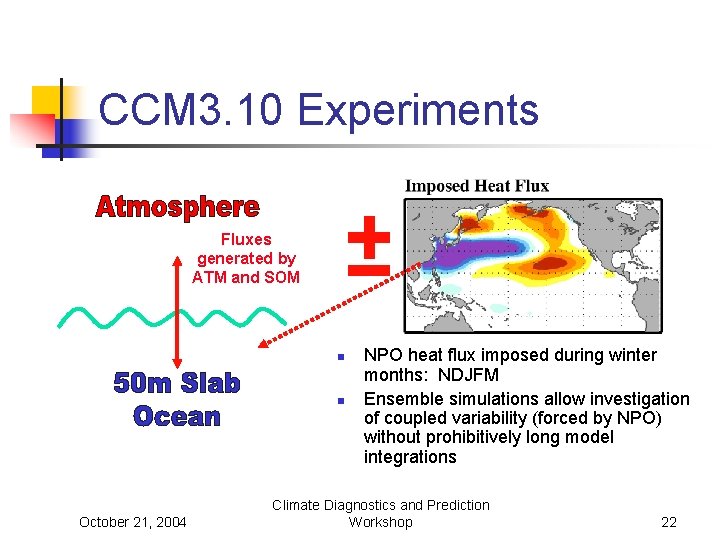
CCM 3. 10 Experiments Fluxes generated by ATM and SOM n n October 21, 2004 NPO heat flux imposed during winter months: NDJFM Ensemble simulations allow investigation of coupled variability (forced by NPO) without prohibitively long model integrations Climate Diagnostics and Prediction Workshop 22
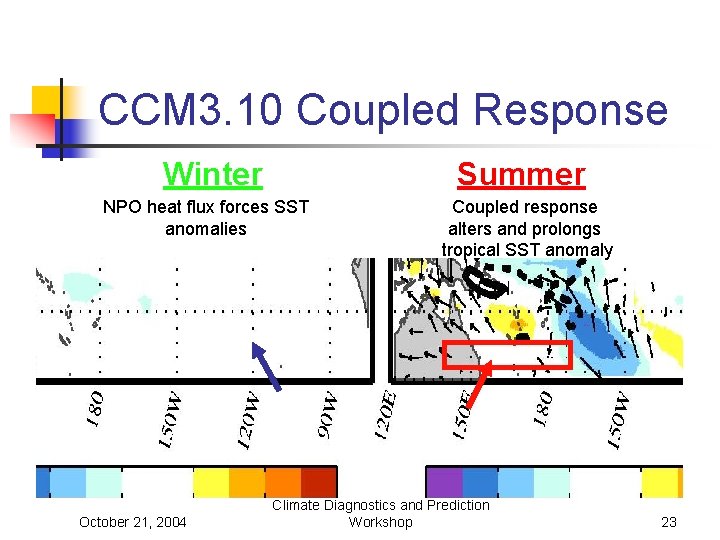
CCM 3. 10 Coupled Response Winter Summer NPO heat flux forces SST anomalies October 21, 2004 Coupled response alters and prolongs tropical SST anomaly Climate Diagnostics and Prediction Workshop 23
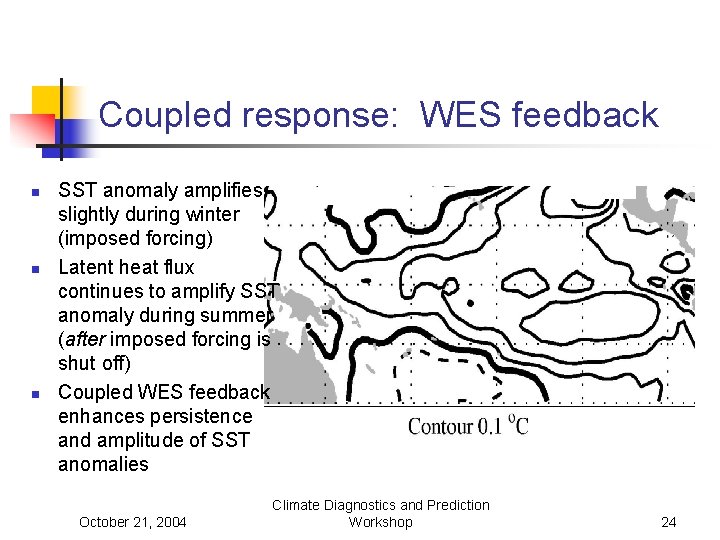
Coupled response: WES feedback n n n SST anomaly amplifies slightly during winter (imposed forcing) Latent heat flux continues to amplify SST anomaly during summer (after imposed forcing is shut off) Coupled WES feedback enhances persistence and amplitude of SST anomalies October 21, 2004 Climate Diagnostics and Prediction Workshop 24
Model Results n The meridional mode can be excited by mid-latitude atmospheric variability n n n Wintertime variations in the trade wind strength associated with the NAO or NPO alter subtropical SSTs through changes in surface heat fluxes The tropics respond to these SST anomalies during spring and summer The coupled WES feedback increases the amplitude and persistence of the tropical response October 21, 2004 Climate Diagnostics and Prediction Workshop 25
The Pacific Meridional Mode n n Analogies between the Atlantic and Pacific Modeling the tropical response to midlatitude forcing The spatial structure of decadal ENSO-like variability Conclusions October 21, 2004 Climate Diagnostics and Prediction Workshop 26
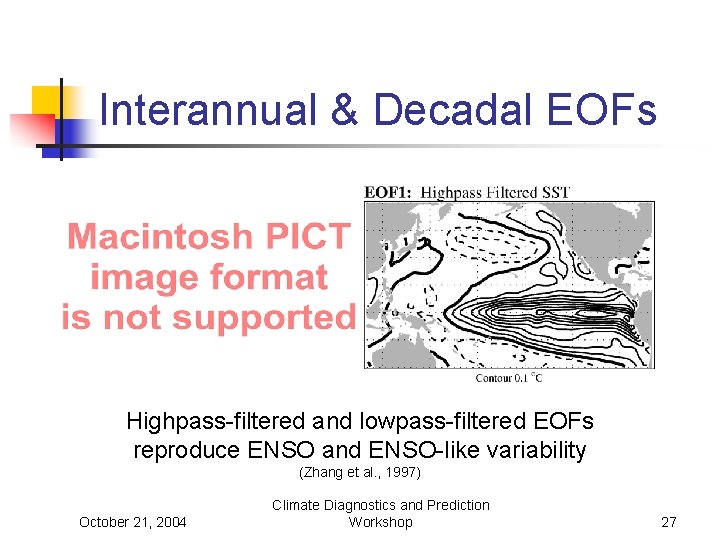
Interannual & Decadal EOFs Highpass-filtered and lowpass-filtered EOFs reproduce ENSO and ENSO-like variability (Zhang et al. , 1997) October 21, 2004 Climate Diagnostics and Prediction Workshop 27
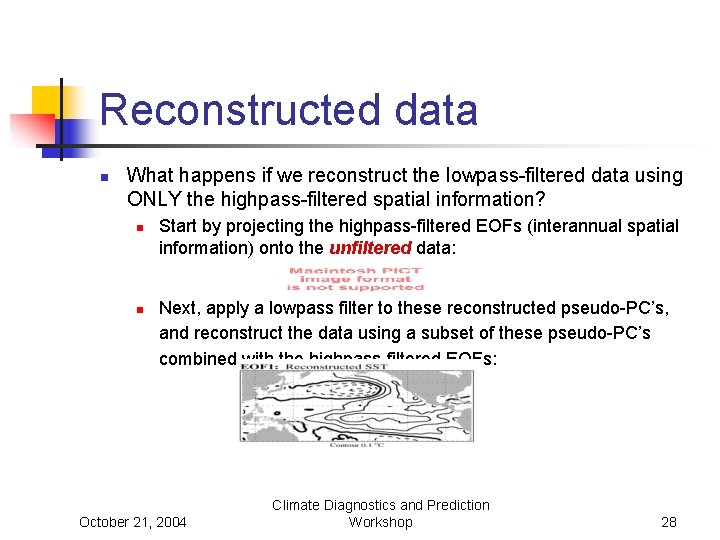
Reconstructed data n What happens if we reconstruct the lowpass-filtered data using ONLY the highpass-filtered spatial information? n n Start by projecting the highpass-filtered EOFs (interannual spatial information) onto the unfiltered data: Next, apply a lowpass filter to these reconstructed pseudo-PC’s, and reconstruct the data using a subset of these pseudo-PC’s combined with the highpass-filtered EOFs: October 21, 2004 Climate Diagnostics and Prediction Workshop 28
Reconstructed data n n Result: XLPR contains decadal temporal information only, and interannual spatial information only. Next, perform EOF/PC anlaysis on XLPR. If decadal processes are responsible for generating the meridionally broadened structure of ENSO-like decadal variability, then the EOFs of XLPR should not have an ENSOlike structure October 21, 2004 Climate Diagnostics and Prediction Workshop 29
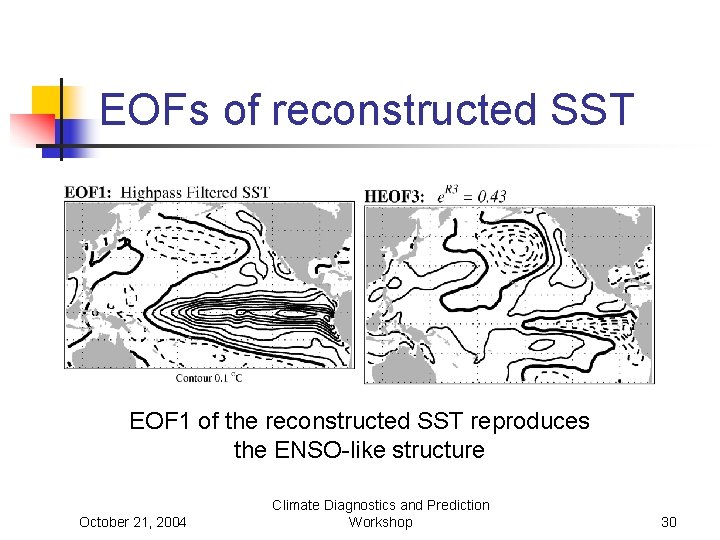
EOFs of reconstructed SST EOF 1 of the reconstructed SST reproduces the ENSO-like structure October 21, 2004 Climate Diagnostics and Prediction Workshop 30
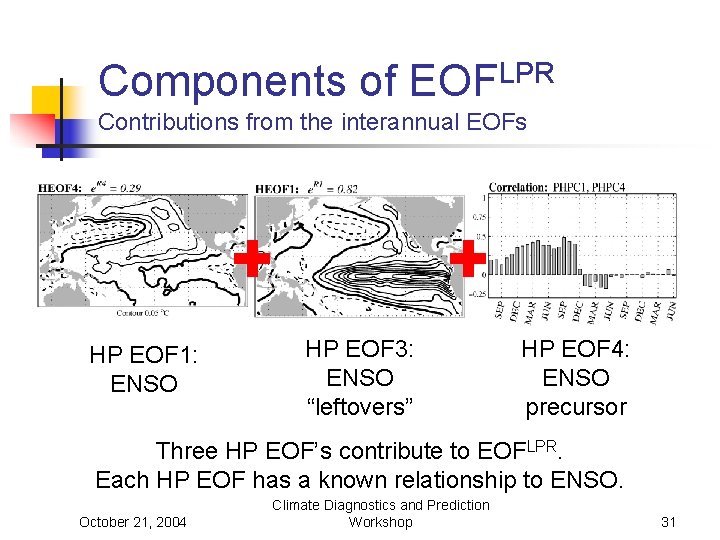
Components of LPR EOF Contributions from the interannual EOFs HP EOF 1: ENSO HP EOF 3: ENSO “leftovers” HP EOF 4: ENSO precursor Three HP EOF’s contribute to EOFLPR. Each HP EOF has a known relationship to ENSO. October 21, 2004 Climate Diagnostics and Prediction Workshop 31
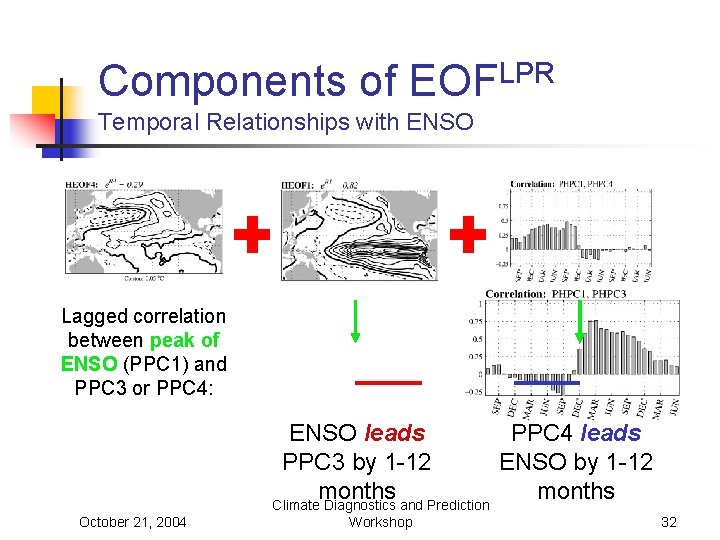
Components of LPR EOF Temporal Relationships with ENSO Lagged correlation between peak of ENSO (PPC 1) and PPC 3 or PPC 4: ENSO leads PPC 4 leads PPC 3 by 1 -12 ENSO by 1 -12 months Climate Diagnostics and Prediction October 21, 2004 Workshop 32
The Pacific Meridional Mode n n Analogies between the Atlantic and Pacific Modeling the tropical response to midlatitude forcing The spatial structure of decadal ENSOlike variability Conclusions October 21, 2004 Climate Diagnostics and Prediction Workshop 33
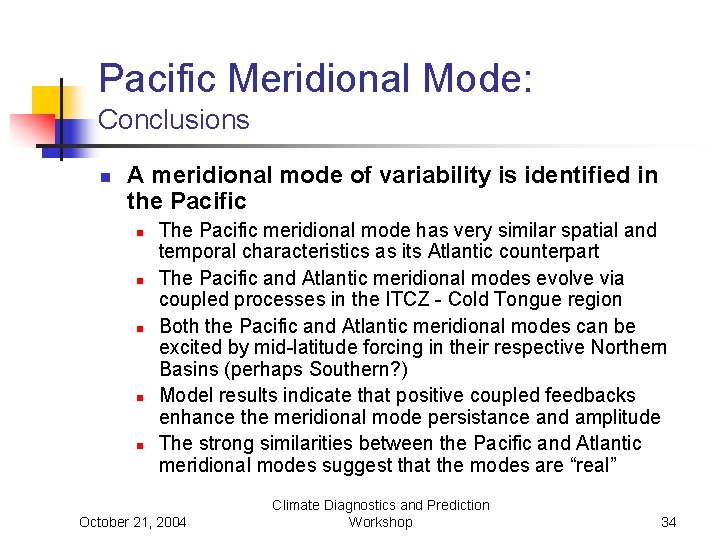
Pacific Meridional Mode: Conclusions n A meridional mode of variability is identified in the Pacific n n n The Pacific meridional mode has very similar spatial and temporal characteristics as its Atlantic counterpart The Pacific and Atlantic meridional modes evolve via coupled processes in the ITCZ - Cold Tongue region Both the Pacific and Atlantic meridional modes can be excited by mid-latitude forcing in their respective Northern Basins (perhaps Southern? ) Model results indicate that positive coupled feedbacks enhance the meridional mode persistance and amplitude The strong similarities between the Pacific and Atlantic meridional modes suggest that the modes are “real” October 21, 2004 Climate Diagnostics and Prediction Workshop 34
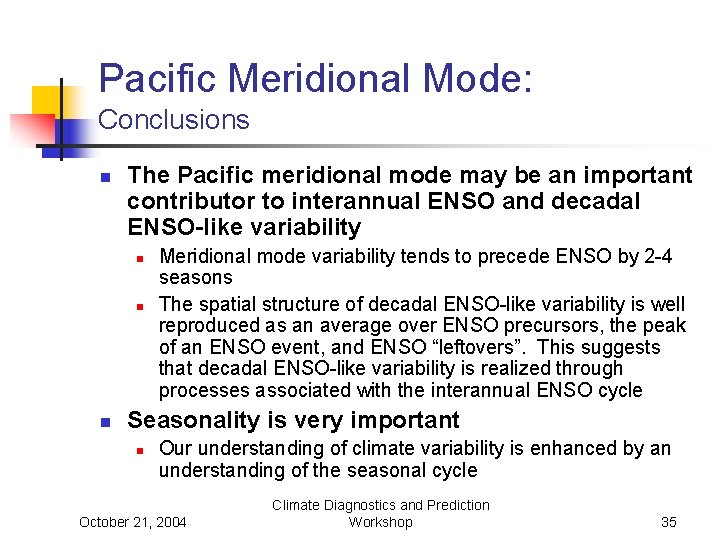
Pacific Meridional Mode: Conclusions n The Pacific meridional mode may be an important contributor to interannual ENSO and decadal ENSO-like variability n n n Meridional mode variability tends to precede ENSO by 2 -4 seasons The spatial structure of decadal ENSO-like variability is well reproduced as an average over ENSO precursors, the peak of an ENSO event, and ENSO “leftovers”. This suggests that decadal ENSO-like variability is realized through processes associated with the interannual ENSO cycle Seasonality is very important n Our understanding of climate variability is enhanced by an understanding of the seasonal cycle October 21, 2004 Climate Diagnostics and Prediction Workshop 35