
The overall equation for the aerobic breakdown of
The overall equation for the aerobic breakdown of glucose is A total of ______ ATP are produced The 4 major stages for this break down are known as:
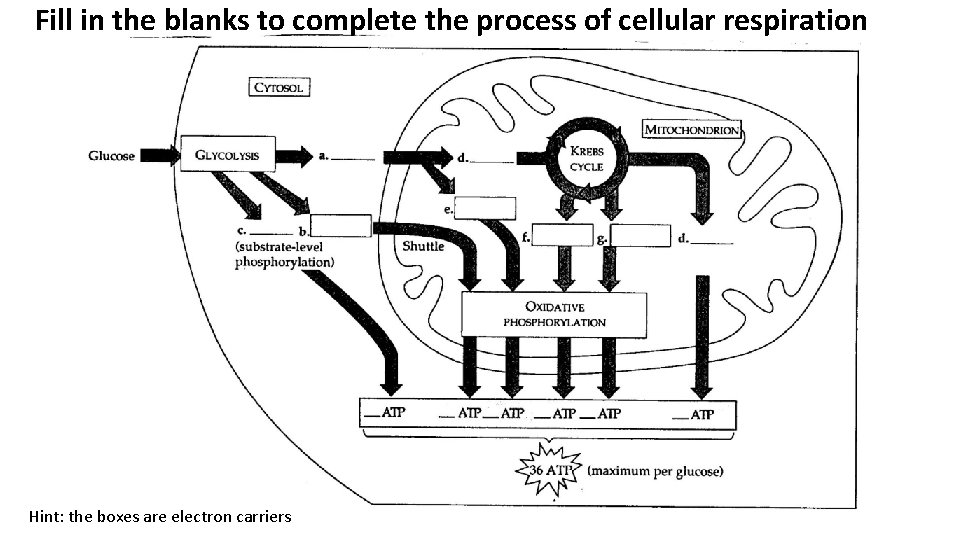
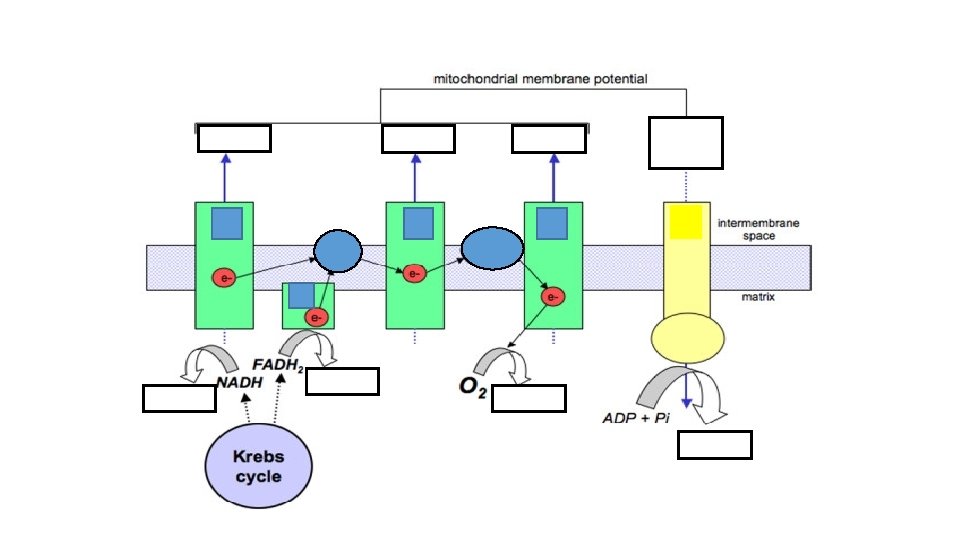
Fill in the blanks to complete the process of cellular respiration Hint: the boxes are electron carriers
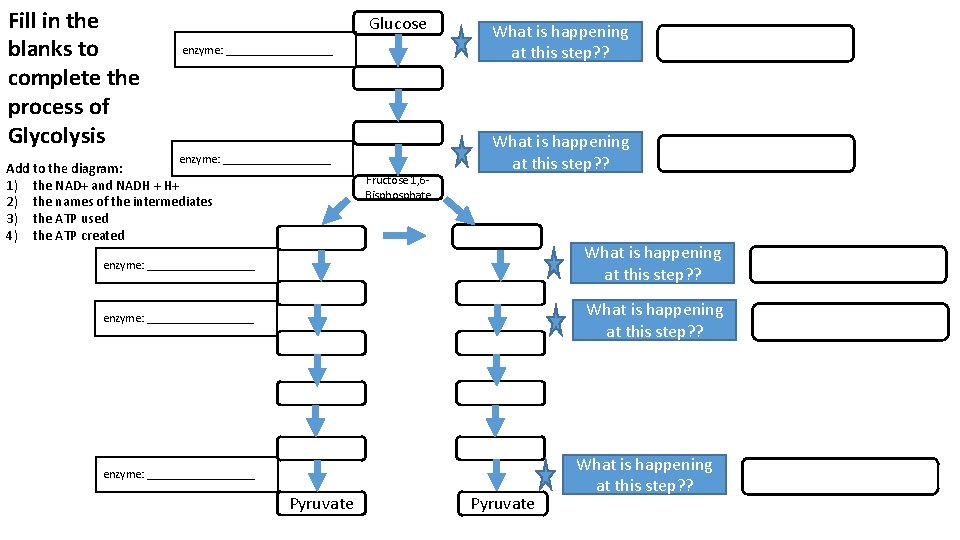
Fill in the blanks to complete the process of Glycolysis Glucose enzyme: __________________ Add to the diagram: 1) the NAD+ and NADH + H+ 2) the names of the intermediates 3) the ATP used 4) the ATP created Fructose 1, 6 Bisphosphate What is happening at this step? ? enzyme: __________________ What is happening at this step? ? enzyme: _________ Pyruvate What is happening at this step? ?
Glycolysis ________ molecule of glucose is broken down into ______ molecules of the 3 carbon sugar _______________________ molecules of ATP are used in Glycolysis ____________ molecules of ATP are produced in Glycolysis A “profit” of _______ molecules of ATP results in Glycolysis ATP is produced in Glycolysis through a process known as ______________________ of these reactions occur in Glycolysis The electron carrier __________ is produced during the conversion of ________ to ___________ of these electron carriers are produced. Each will result in the production of _______ ATP once they enter the Electron Transport Chain.
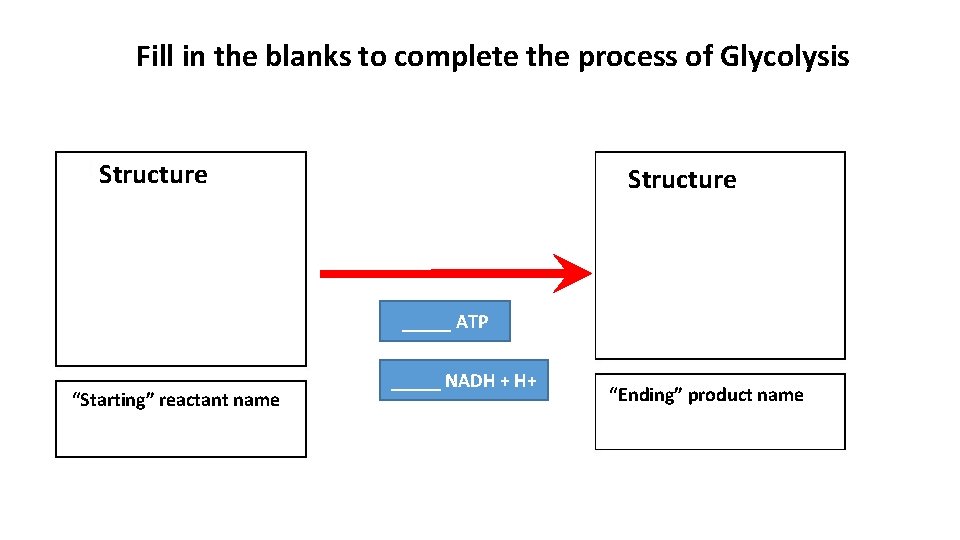
Fill in the blanks to complete the process of Glycolysis Structure _____ ATP “Starting” reactant name _____ NADH + H+ “Ending” product name

Fill in the blanks to complete the oxidation of Pyruvate Structure Reactant Name PYRUVATE Enzyme Name Structure Product Name
Pyruvate Oxidation ____________ enters the mitochondrion from the cytosol. A molecule of __________ is removed Two _________and two __________ are transferred to ________ producing __________. This reaction is known as a __________reaction The functional group ________ is attached producing __________ which then enters the Kreb’s cycle
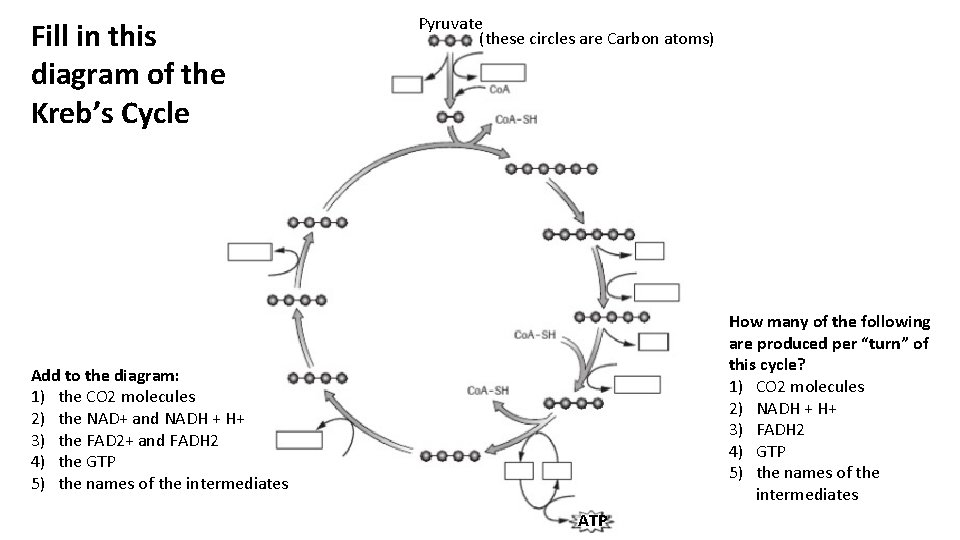
Fill in this diagram of the Kreb’s Cycle Pyruvate (these circles are Carbon atoms) How many of the following are produced per “turn” of this cycle? 1) CO 2 molecules 2) NADH + H+ 3) FADH 2 4) GTP 5) the names of the intermediates Add to the diagram: 1) the CO 2 molecules 2) the NAD+ and NADH + H+ 3) the FAD 2+ and FADH 2 4) the GTP 5) the names of the intermediates ATP
Kreb’s Cycle ____________ enters the cycle and combines with ________________ to produce the six-carbon compound ______________. Four ____________ reactions are performed during this cycle producing the electron carriers __________ and __________. The enzymes that do this are known as ____________ ATP is created through a process known as ________________ 4 molecules of ____________ are released as a waste product ___________ is converted into ___________ so it can be used again
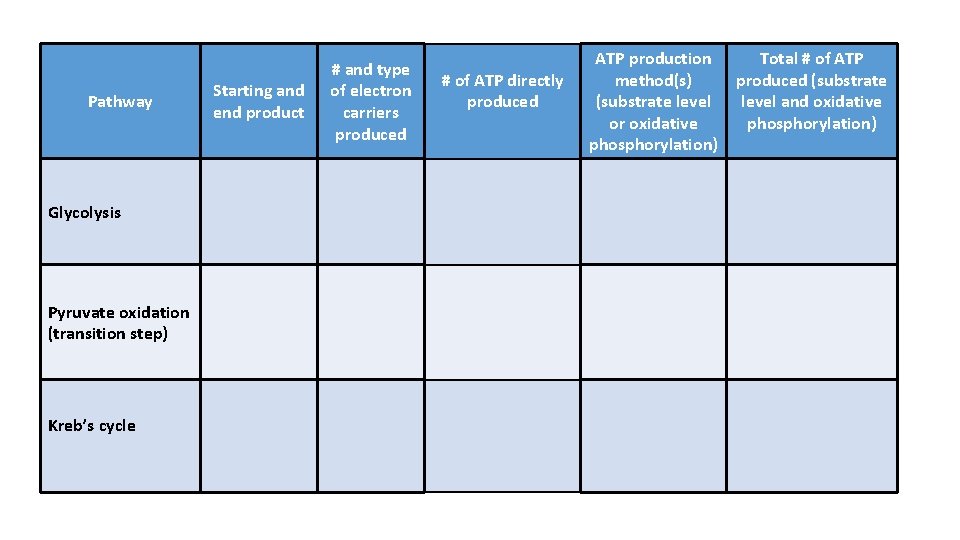
Pathway Glycolysis Pyruvate oxidation (transition step) Kreb’s cycle Starting and end product # and type of electron carriers produced # of ATP directly produced ATP production method(s) (substrate level or oxidative phosphorylation) Total # of ATP produced (substrate level and oxidative phosphorylation)
- Slides: 11