
The outside microenvironment of the CLL cell new
- Slides: 20
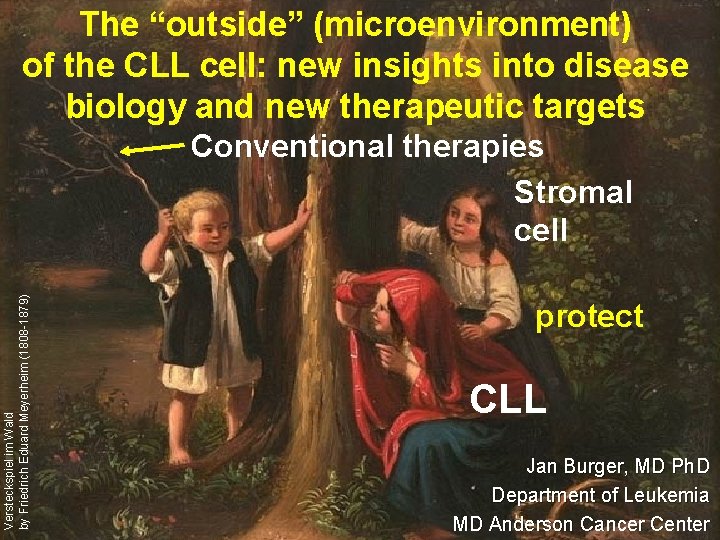
The “outside” (microenvironment) of the CLL cell: new insights into disease biology and new therapeutic targets Versteckspiel im Wald by Friedrich Eduard Meyerheim (1808 -1879) Conventional therapies Stromal cell protect CLL Jan Burger, MD Ph. D Department of Leukemia MD Anderson Cancer Center
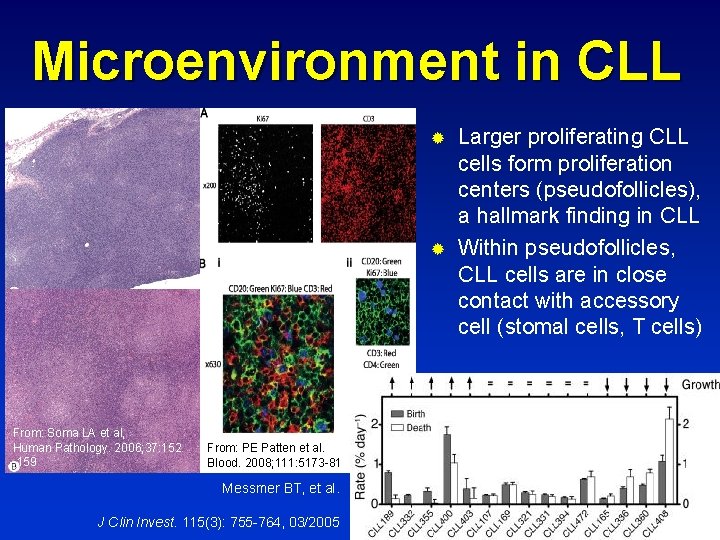
Microenvironment in CLL ® ® From: Soma LA et al, Human Pathology. 2006; 37: 152 -159 From: PE Patten et al. Blood. 2008; 111: 5173 -81 Messmer BT, et al. J Clin Invest. 115(3): 755 -764, 03/2005 Larger proliferating CLL cells form proliferation centers (pseudofollicles), a hallmark finding in CLL Within pseudofollicles, CLL cells are in close contact with accessory cell (stomal cells, T cells)
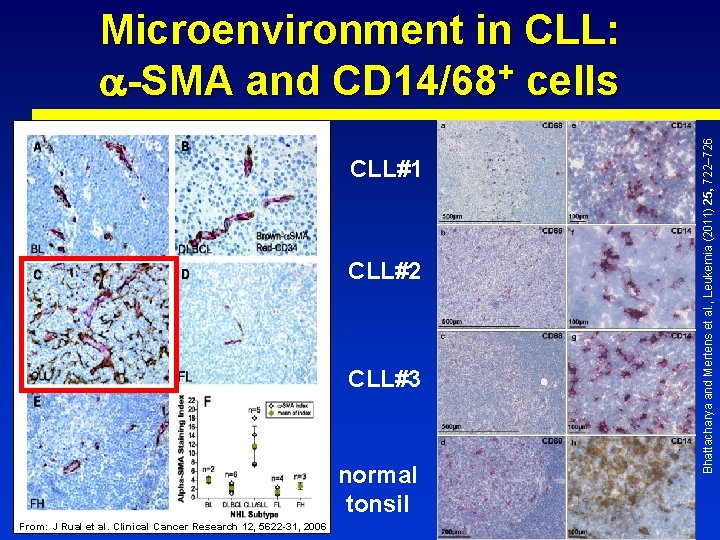
CLL#1 CLL#2 CLL#3 normal tonsil From: J Rual et al. Clinical Cancer Research 12, 5622 -31, 2006 Bhattacharya and Mertens et al. , Leukemia (2011) 25, 722– 726 Microenvironment in CLL: a-SMA and CD 14/68+ cells
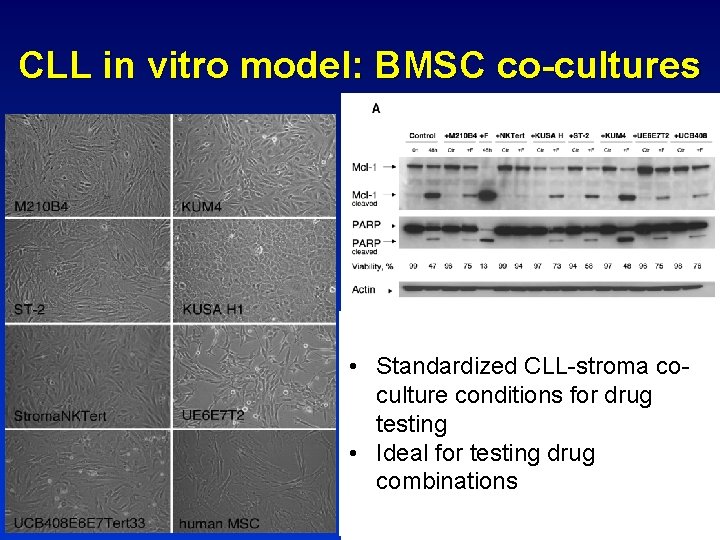
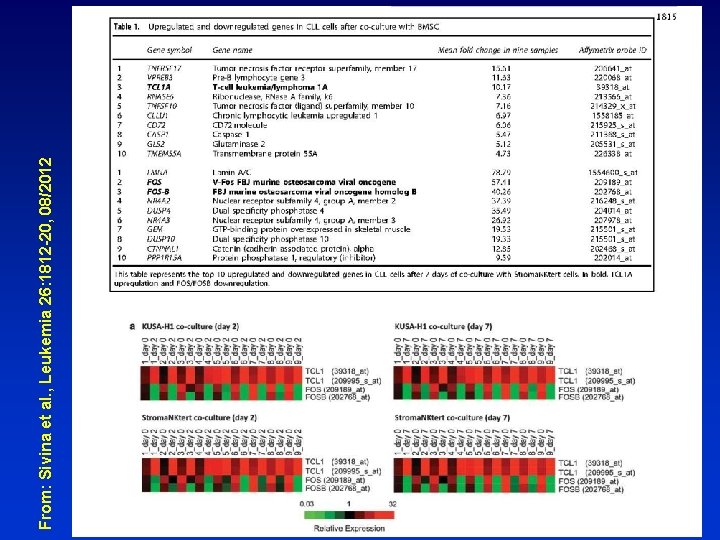
CLL in vitro model: BMSC co-cultures • Standardized CLL-stroma coculture conditions for drug testing • Ideal for testing drug combinations
From: Sivina et al. , Leukemia 26: 1812 -20, 08/2012
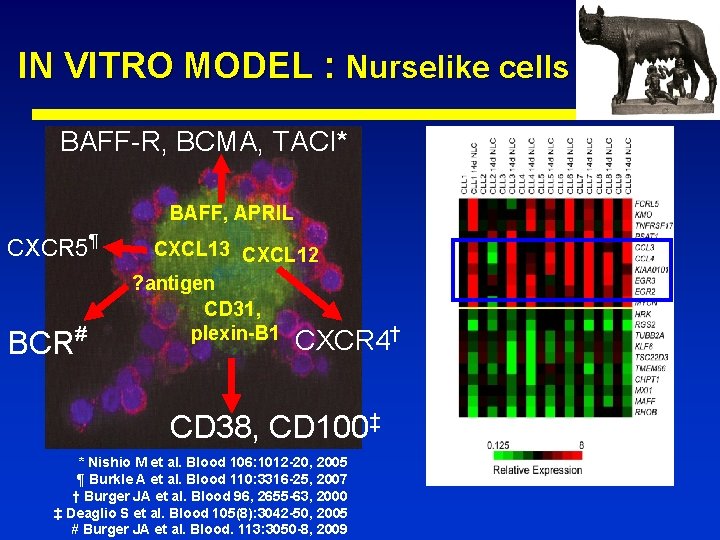
IN VITRO MODEL : Nurselike cells BAFF-R, BCMA, TACI* BAFF, APRIL CXCR 5¶ BCR # CXCL 13 CXCL 12 ? antigen CD 31, plexin-B 1 CXCR 4† CD 38, CD 100‡ * Nishio M et al. Blood 106: 1012 -20, 2005 ¶ Burkle A et al. Blood 110: 3316 -25, 2007 † Burger JA et al. Blood 96, 2655 -63, 2000 ‡ Deaglio S et al. Blood 105(8): 3042 -50, 2005 # Burger JA et al. Blood. 113: 3050 -8, 2009
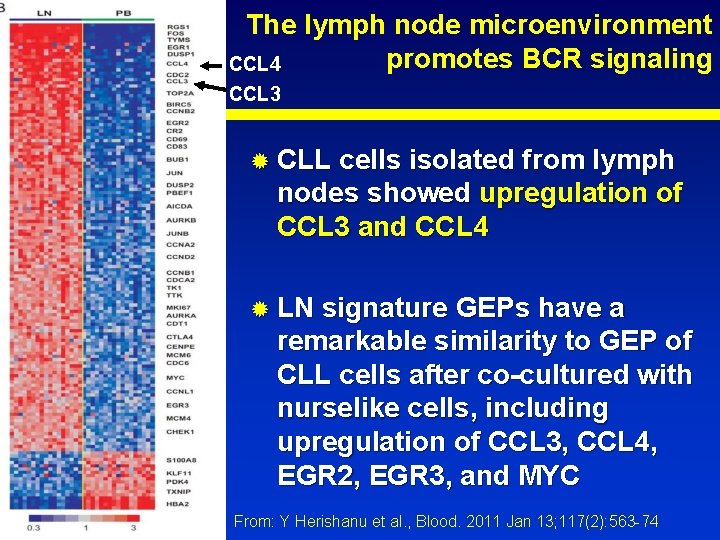
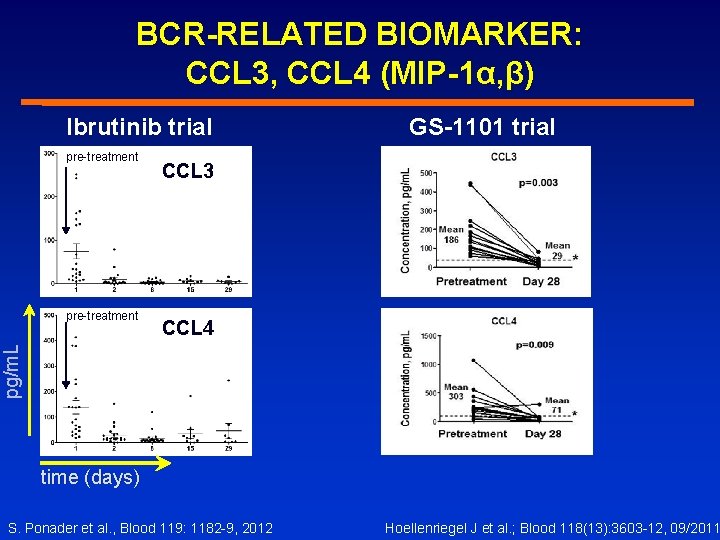
The lymph node microenvironment promotes BCR signaling CCL 4 CCL 3 ® CLL cells isolated from lymph nodes showed upregulation of CCL 3 and CCL 4 ® LN signature GEPs have a remarkable similarity to GEP of CLL cells after co-cultured with nurselike cells, including upregulation of CCL 3, CCL 4, EGR 2, EGR 3, and MYC From: Y Herishanu et al. , Blood. 2011 Jan 13; 117(2): 563 -74
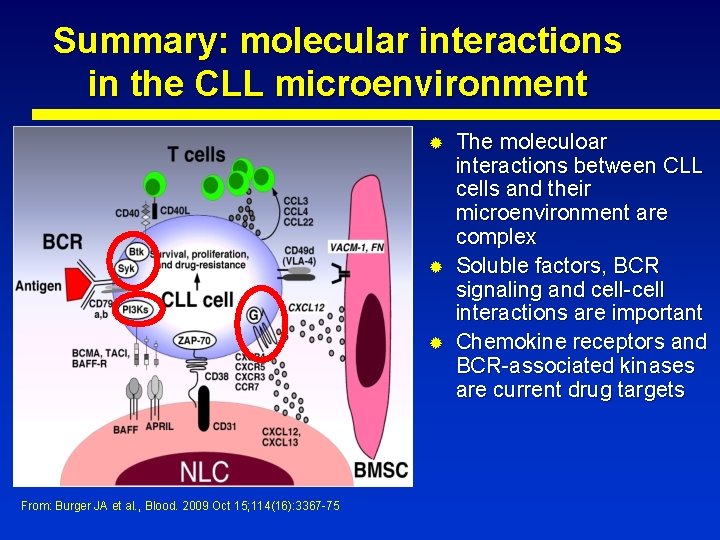
Summary: molecular interactions in the CLL microenvironment ® ® ® From: Burger JA et al. , Blood. 2009 Oct 15; 114(16): 3367 -75 The moleculoar interactions between CLL cells and their microenvironment are complex Soluble factors, BCR signaling and cell-cell interactions are important Chemokine receptors and BCR-associated kinases are current drug targets
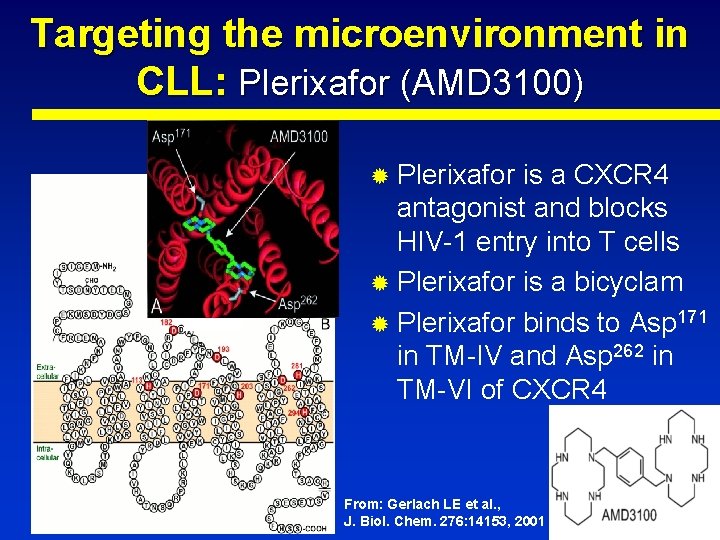
Targeting the microenvironment in CLL: Plerixafor (AMD 3100) Plerixafor is a CXCR 4 antagonist and blocks HIV-1 entry into T cells ® Plerixafor is a bicyclam ® Plerixafor binds to Asp 171 in TM-IV and Asp 262 in TM-VI of CXCR 4 ® From: Gerlach LE et al. , J. Biol. Chem. 276: 14153, 2001
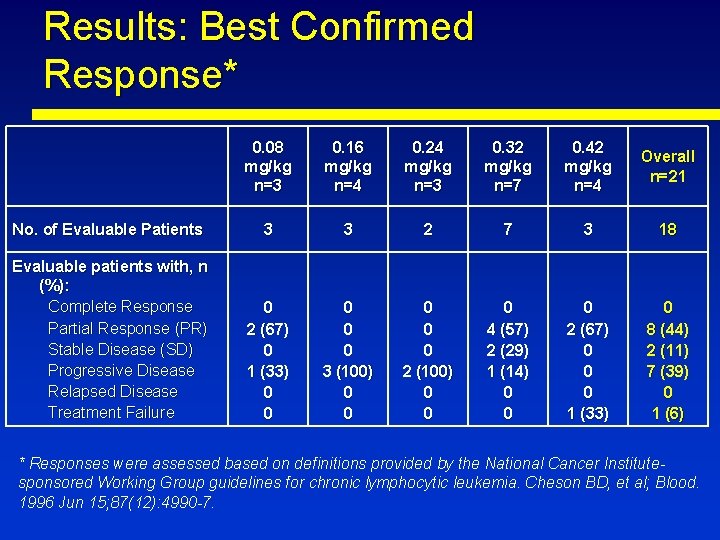
Results: Best Confirmed Response* 0. 08 mg/kg n=3 0. 16 mg/kg n=4 0. 24 mg/kg n=3 0. 32 mg/kg n=7 0. 42 mg/kg n=4 Overall n=21 No. of Evaluable Patients 3 3 2 7 3 18 Evaluable patients with, n (%): Complete Response Partial Response (PR) Stable Disease (SD) Progressive Disease Relapsed Disease Treatment Failure 0 2 (67) 0 1 (33) 0 0 0 3 (100) 0 0 0 2 (100) 0 0 0 4 (57) 2 (29) 1 (14) 0 0 0 2 (67) 0 0 0 1 (33) 0 8 (44) 2 (11) 7 (39) 0 1 (6) * Responses were assessed based on definitions provided by the National Cancer Institutesponsored Working Group guidelines for chronic lymphocytic leukemia. Cheson BD, et al; Blood. 1996 Jun 15; 87(12): 4990 -7.
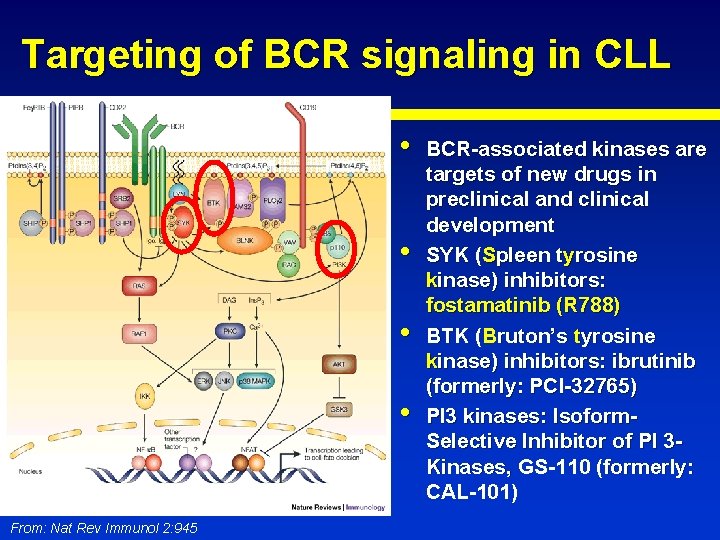
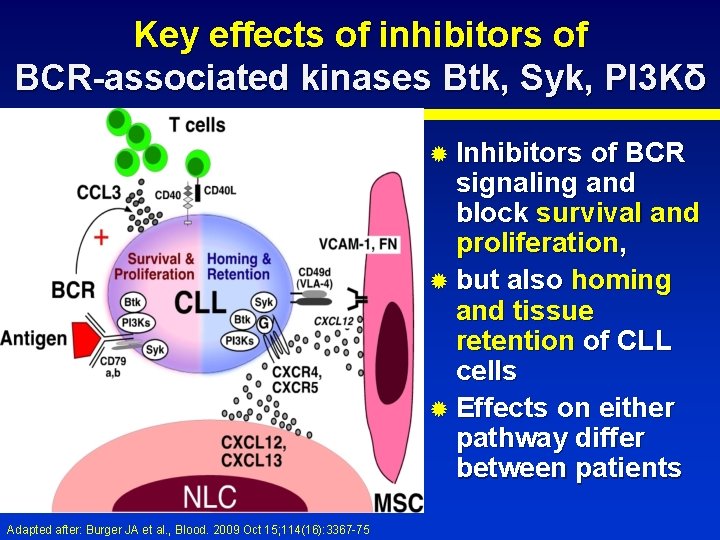
Targeting of BCR signaling in CLL • • From: Nat Rev Immunol 2: 945 BCR-associated kinases are targets of new drugs in preclinical and clinical development SYK (Spleen tyrosine kinase) inhibitors: fostamatinib (R 788) BTK (Bruton’s tyrosine kinase) inhibitors: ibrutinib (formerly: PCI-32765) PI 3 kinases: Isoform. Selective Inhibitor of PI 3 Kinases, GS-110 (formerly: CAL-101)
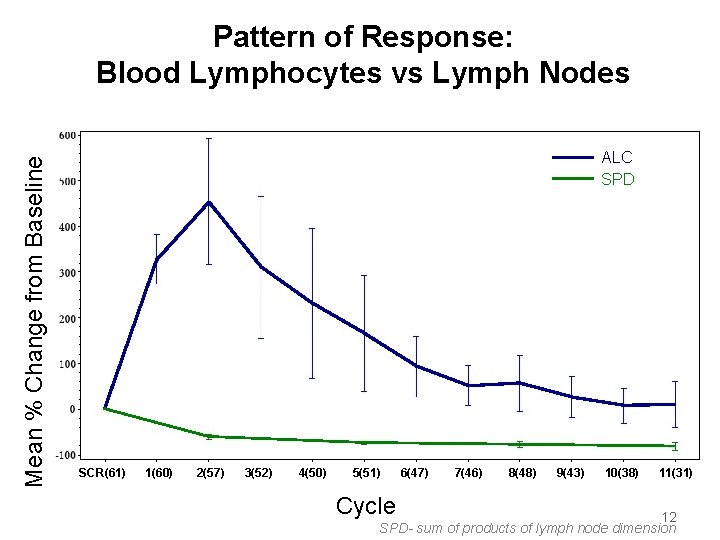
Mean % Change from Baseline Pattern of Response: Blood Lymphocytes vs Lymph Nodes ALC SPD SCR(61) 1(60) 2(57) 3(52) 4(50) 5(51) Cycle 6(47) 7(46) 8(48) 9(43) 10(38) 11(31) 12 SPD- sum of products of lymph node dimension
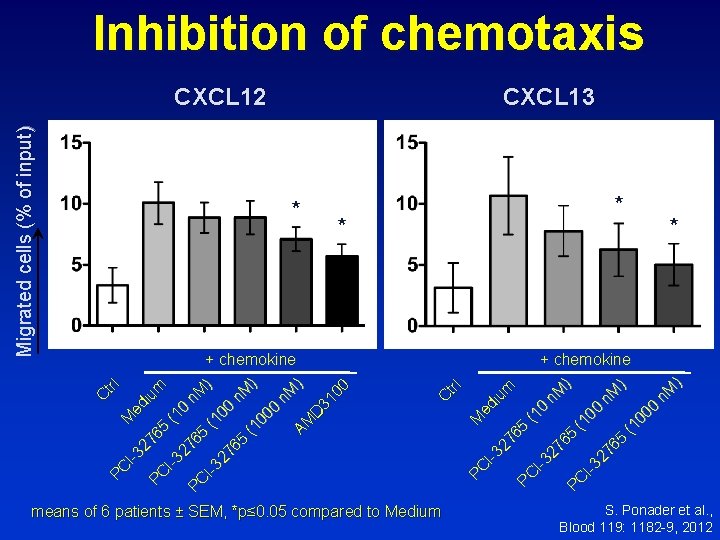
Inhibition of chemotaxis Migrated cells (% of input) CXCL 12 CXCL 13 * * * PC M ed I-3 iu 27 m 6 5 PC (1 I-3 0 n. M 27 65 ) PC (1 I-3 00 27 n. M 65 ) (1 00 0 n. M ) + chemokine C trl PC M I-3 ed 27 iu PC 65 m I-3 (1 0 27 n. M PC 65 ) I-3 (1 00 27 65 n. M (1 ) 00 0 n. M ) AM D 31 00 + chemokine * means of 6 patients ± SEM, *p≤ 0. 05 compared to Medium S. Ponader et al. , Blood 119: 1182 -9, 2012
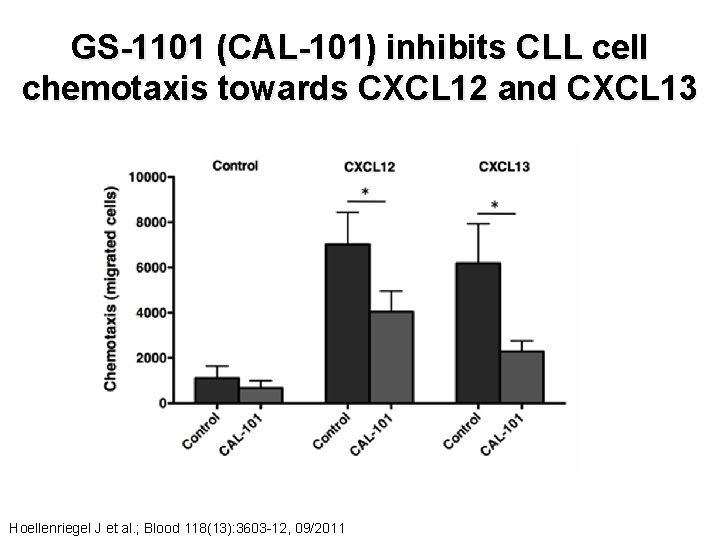
GS-1101 (CAL-101) inhibits CLL cell chemotaxis towards CXCL 12 and CXCL 13 Hoellenriegel J et al. ; Blood 118(13): 3603 -12, 09/2011
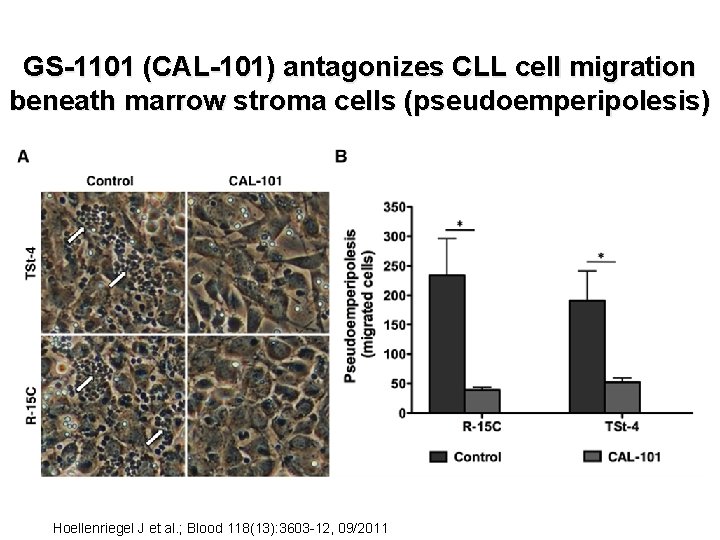
GS-1101 (CAL-101) antagonizes CLL cell migration beneath marrow stroma cells (pseudoemperipolesis) Hoellenriegel J et al. ; Blood 118(13): 3603 -12, 09/2011
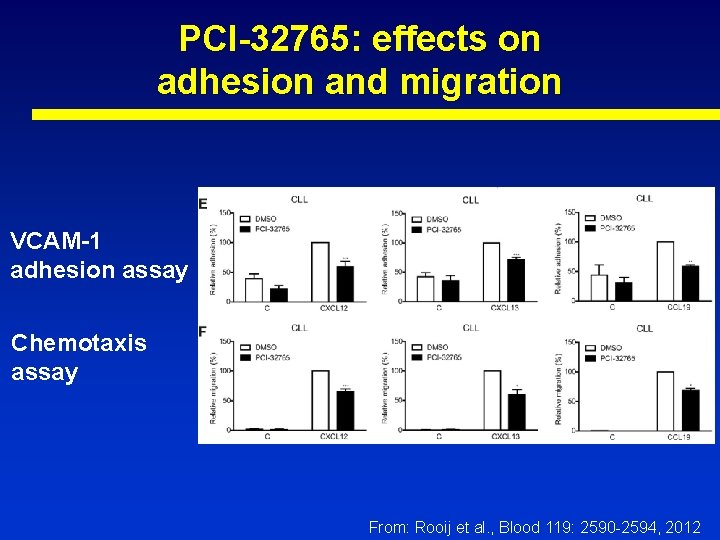
PCI-32765: effects on adhesion and migration VCAM-1 adhesion assay Chemotaxis assay From: Rooij et al. , Blood 119: 2590 -2594, 2012
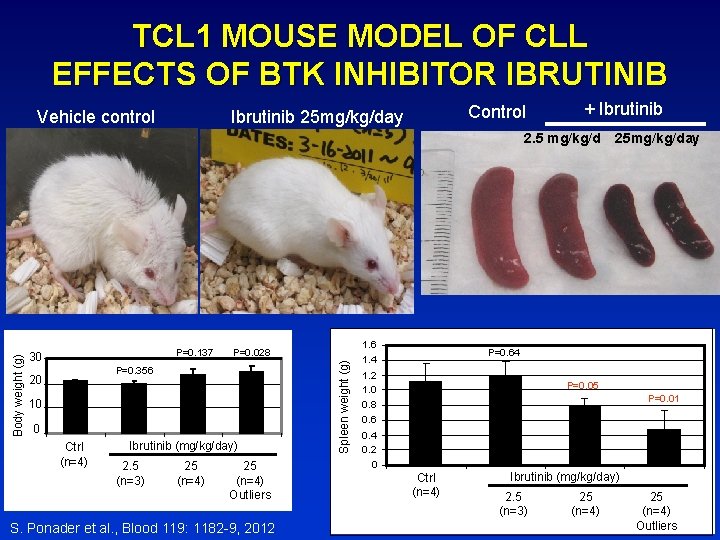
TCL 1 MOUSE MODEL OF CLL EFFECTS OF BTK INHIBITOR IBRUTINIB Vehicle control Control Ibrutinib 25 mg/kg/day + Ibrutinib P=0. 137 30 P=0. 356 20 10 0 Ctrl (n=4) Ibrutinib (mg/kg/day) 2. 5 (n=3) 25 (n=4) 1. 6 P=0. 028 25 (n=4) Outliers S. Ponader et al. , Blood 119: 1182 -9, 2012 Spleen weight (g) Body weight (g) 2. 5 mg/kg/d 25 mg/kg/day P=0. 64 1. 2 1. 0 P=0. 05 P=0. 01 0. 8 0. 6 0. 4 0. 2 0 Ctrl (n=4) Ibrutinib (mg/kg/day) 2. 5 (n=3) 25 (n=4) Outliers
BCR-RELATED BIOMARKER: CCL 3, CCL 4 (MIP-1α, β) Ibrutinib trial pre-treatment CCL 3 CCL 4 pg/m. L pre-treatment GS-1101 trial time (days) S. Ponader et al. , Blood 119: 1182 -9, 2012 Hoellenriegel J et al. ; Blood 118(13): 3603 -12, 09/2011
Key effects of inhibitors of BCR-associated kinases Btk, Syk, PI 3 Kδ Inhibitors of BCR signaling and block survival and proliferation, ® but also homing and tissue retention of CLL cells ® Effects on either pathway differ between patients ® Adapted after: Burger JA et al. , Blood. 2009 Oct 15; 114(16): 3367 -75
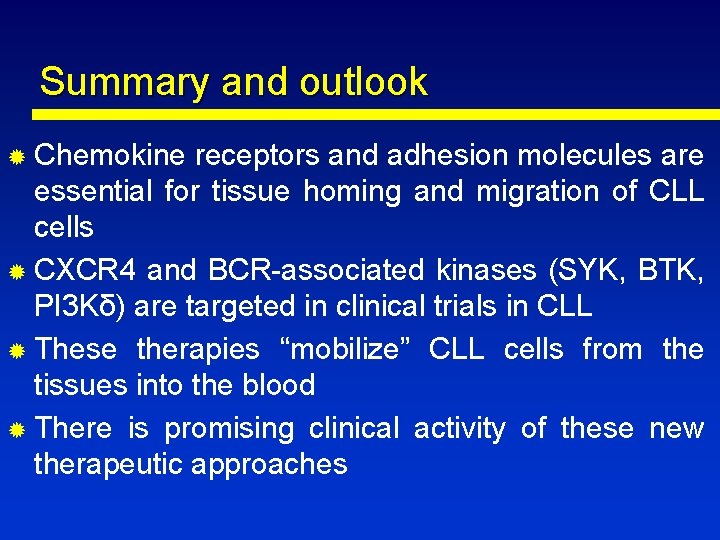
Summary and outlook ® Chemokine receptors and adhesion molecules are essential for tissue homing and migration of CLL cells ® CXCR 4 and BCR-associated kinases (SYK, BTK, PI 3 Kδ) are targeted in clinical trials in CLL ® These therapies “mobilize” CLL cells from the tissues into the blood ® There is promising clinical activity of these new therapeutic approaches