
The Outline The key to your first draft
![The Outline The key to your first draft [Outlines. pptx]](https://slidetodoc.com/presentation_image_h2/84192819229a30515f2ec9967a2d9665/image-1.jpg "The Outline The key to your first draft [Outlines. pptx]")
- Slides: 23
The Outline The key to your first draft [Outlines. pptx]
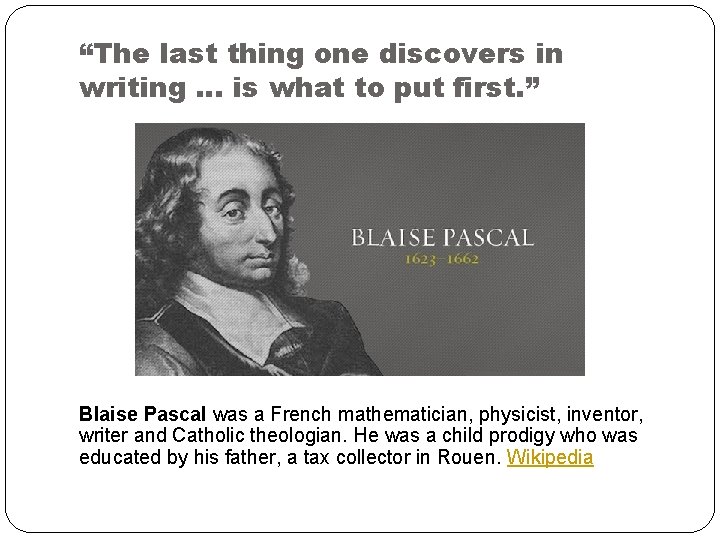
“The last thing one discovers in writing … is what to put first. ” Blaise Pascal was a French mathematician, physicist, inventor, writer and Catholic theologian. He was a child prodigy who was educated by his father, a tax collector in Rouen. Wikipedia
Why Write an Outline Basic in both written and oral communication 1. Helps you formulate your thesis (See next slide. ) 2. Indicates the structure to your communication i. e. , prepares the audience/reader 3. Saves time and effort - writing follows a plan, where the information is 4. Avoids unnecessary repetition, digression, awkward and illogical organization Note: Outlines can be changed if they’re clumsy or if you think of new material or other ways of saying something.
Thesis �“A thesis is a sentence that expresses the main point of an essay” (Hacker 39). �“[A thesis] us a one-sentence summary of a paper’s content” (Behrens 85). �It establishes focus, a basis for inclusion or exclusion of information.
An outline allows you to: �Divide thesis into its main points, �Organize support material for each main point, �Judge the relevance of facts and opinions, �Organize ideas into sections and paragraphs, �Determine relative importance of those ideas, and �Create an effective arrangement.
Kinds of Outlines Different outlines can be used for different purposes in the process of essay writing. They include: 1. Topical map 2. Running outline 3. Working outline 4. Formal outline
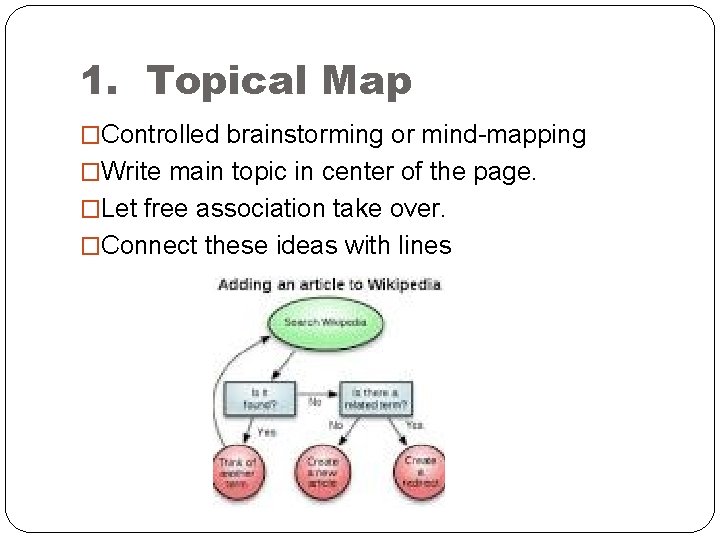
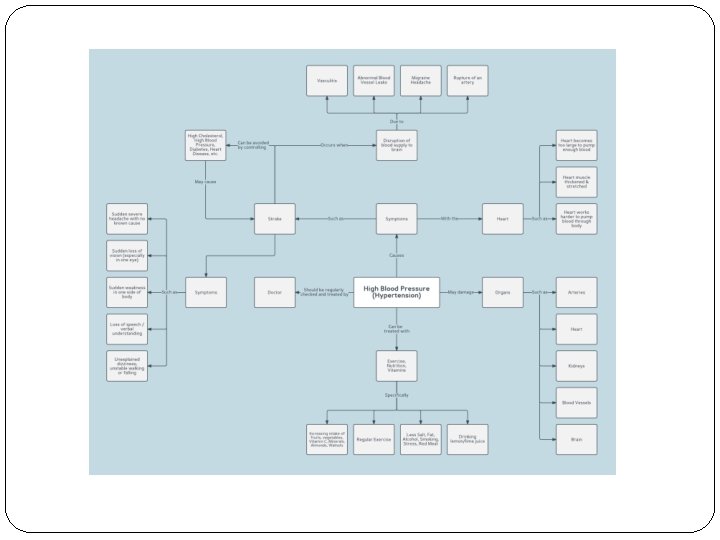
1. Topical Map �Controlled brainstorming or mind-mapping �Write main topic in center of the page. �Let free association take over. �Connect these ideas with lines
Here is some additional information. What is a Concept Map? Concept Map Examples and Templates
2. Running Outline �A list of facts and ideas in no particular order �Useful in the early stages of idea generation �Can lead to topic choice and main points
3. Working Outline �A running outline that has been re-arranged into a TENTATIVE organizational strategy �Keep it flexible. It is simply a tool. �Revise: �Add or delete topics. �Re-evaluate main and sub-topics. �Re-arrange order for better transitions and coherence.
Working Outline Suggestions 1. List what you want to cover - words or phrases. 2. List headings. 3. List questions that your essay will tryto answer. (Heuristic) 4. List topic sentences. You may actually use them later.
4. Formal Outline �Follows the outlining conventions appropriate to the discipline. �Clearly portrays the design of the paper. �Less detailed than a working outline. Blueprint. �You could also think of an outline as a road map.
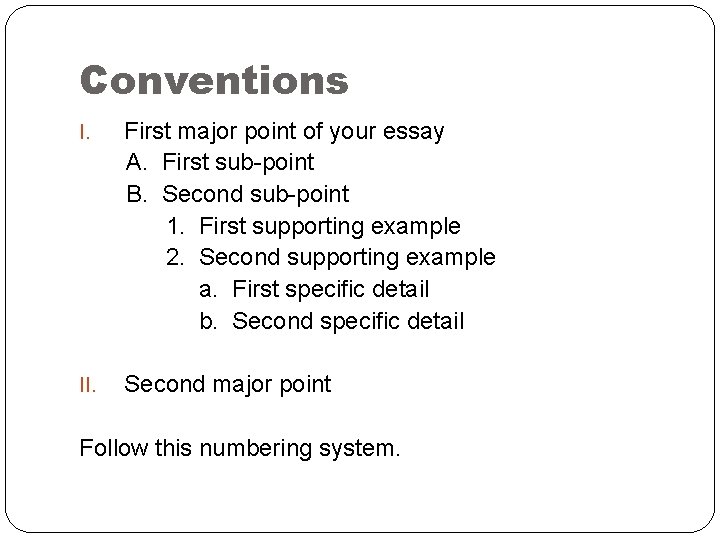
Conventions I. First major point of your essay A. First sub-point B. Second sub-point 1. First supporting example 2. Second supporting example a. First specific detail b. Second specific detail II. Second major point Follow this numbering system.
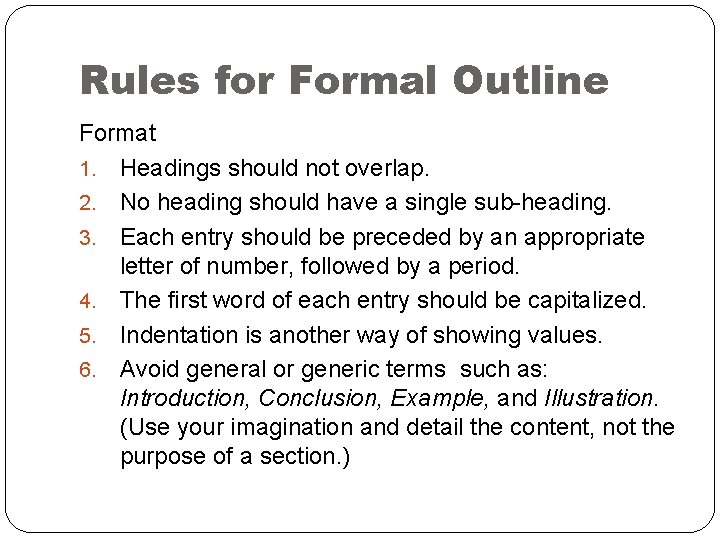
Rules for Formal Outline Format 1. Headings should not overlap. 2. No heading should have a single sub-heading. 3. Each entry should be preceded by an appropriate letter of number, followed by a period. 4. The first word of each entry should be capitalized. 5. Indentation is another way of showing values. 6. Avoid general or generic terms such as: Introduction, Conclusion, Example, and Illustration. (Use your imagination and detail the content, not the purpose of a section. )
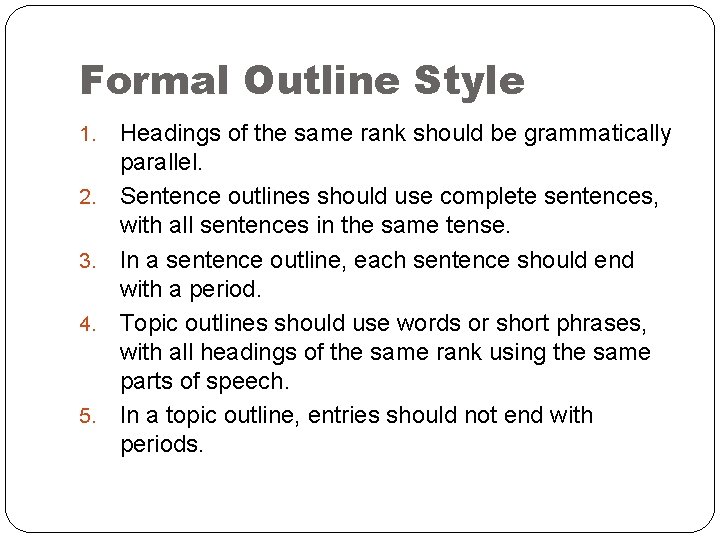
Formal Outline Style 1. 2. 3. 4. 5. Headings of the same rank should be grammatically parallel. Sentence outlines should use complete sentences, with all sentences in the same tense. In a sentence outline, each sentence should end with a period. Topic outlines should use words or short phrases, with all headings of the same rank using the same parts of speech. In a topic outline, entries should not end with periods.
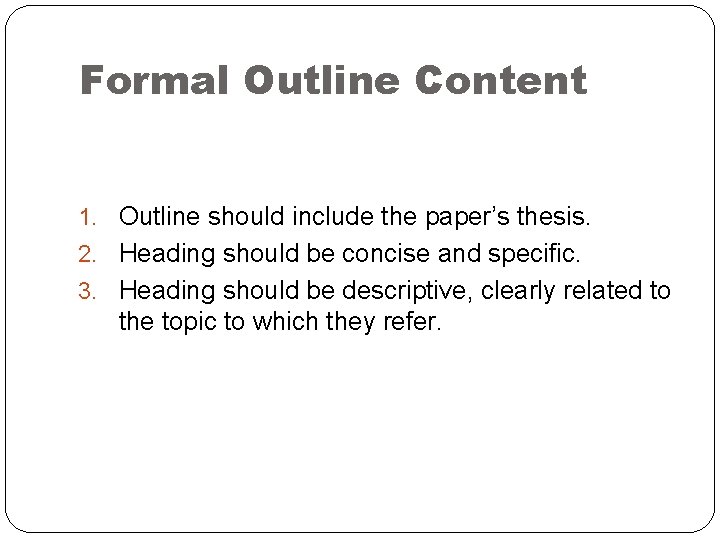
Formal Outline Content 1. Outline should include the paper’s thesis. 2. Heading should be concise and specific. 3. Heading should be descriptive, clearly related to the topic to which they refer.
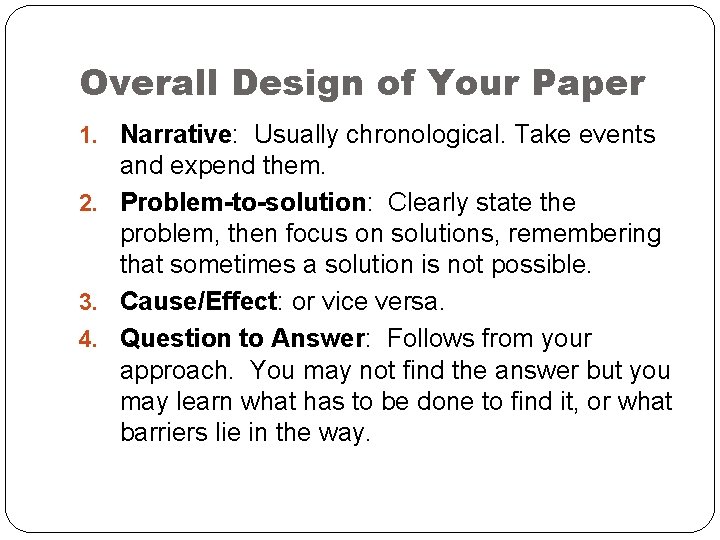
Overall Design of Your Paper 1. Narrative: Usually chronological. Take events and expend them. 2. Problem-to-solution: Clearly state the problem, then focus on solutions, remembering that sometimes a solution is not possible. 3. Cause/Effect: or vice versa. 4. Question to Answer: Follows from your approach. You may not find the answer but you may learn what has to be done to find it, or what barriers lie in the way.
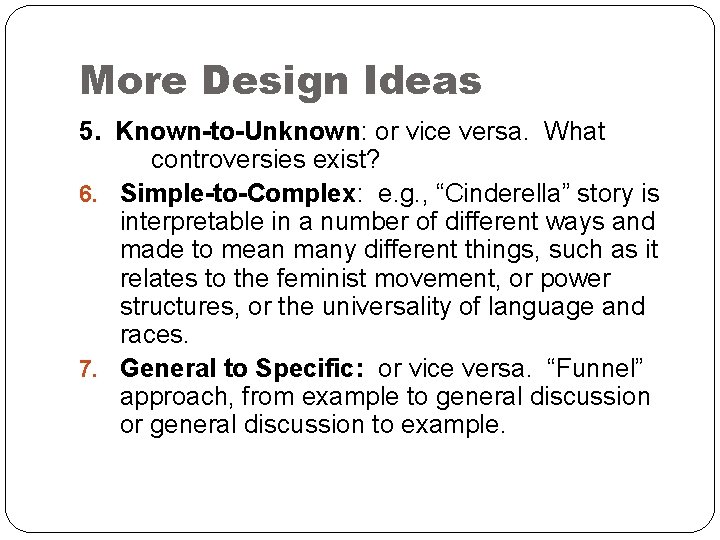
More Design Ideas 5. Known-to-Unknown: or vice versa. What controversies exist? 6. Simple-to-Complex: e. g. , “Cinderella” story is interpretable in a number of different ways and made to mean many different things, such as it relates to the feminist movement, or power structures, or the universality of language and races. 7. General to Specific: or vice versa. “Funnel” approach, from example to general discussion or general discussion to example.
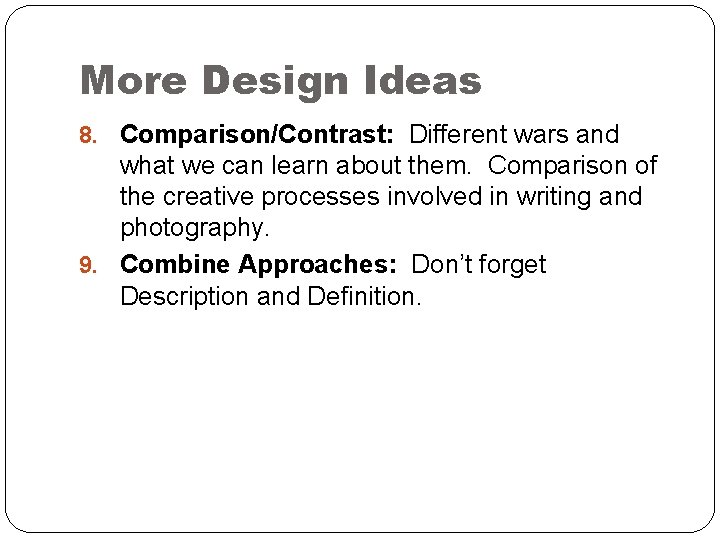
More Design Ideas 8. Comparison/Contrast: Different wars and what we can learn about them. Comparison of the creative processes involved in writing and photography. 9. Combine Approaches: Don’t forget Description and Definition.
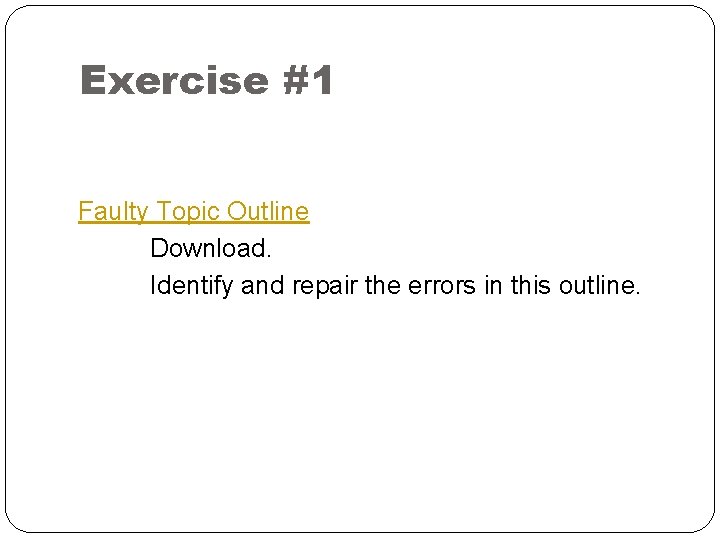
Exercise #1 Faulty Topic Outline Download. Identify and repair the errors in this outline.
Exercise #2 1. Download this newspaper editorial. 2. Prepare a formal, point form outline that includes all the main points and supporting ideas. 3. Give the editorial an interesting and appropriate title.
Check your work �Preliminary analysis �Final outline (with notes)