
The Outbursts of Classical and Recurrent Novae Michael
The Outbursts of Classical and Recurrent Novae Michael Bode Astrophysics Research Institute Liverpool John Moores University, UK
Outline • • • Classical Novae: Background GK Persei: A Case Study Recurrent Novae: Background RS Ophiuchi 2006: A Case Study Concluding Remarks/Open Questions

Classical Novae Also well defined sequence of spectra through the outburst (pre-max; principal; diffuse-enhanced; Orion; nebular) Visual Light Curve “Speed Class”: Correlations with ejection velocities, peak absolute magnitude (“MMRD” relations - e. g. Della Valle & Livio, 1995)
CN Vital Statistics Central System: • WD (CO or ONe) + late-type MS. star, P ~ 1. 5 -8(+) hrs • Macc ~ few x 10 -9 M¤yr-1 • Lqu ~ L¤ At Outburst (TNR on WD): • L ~ few x 104 L¤ ( ~ LEdd) • Mej ~ 10 -5 – 10 -4 M¤ (obs and models disagree) • vej ~ few 100 - several 1000 km/s • Inter-outburst period: ~103– 105 yrs (~ 1000 o/b’s? )
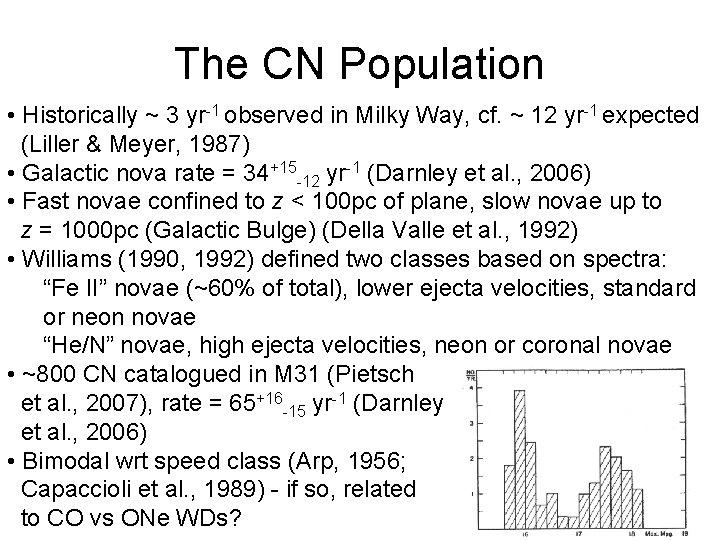
The CN Population • Historically ~ 3 yr-1 observed in Milky Way, cf. ~ 12 yr-1 expected (Liller & Meyer, 1987) • Galactic nova rate = 34+15 -12 yr-1 (Darnley et al. , 2006) • Fast novae confined to z < 100 pc of plane, slow novae up to z = 1000 pc (Galactic Bulge) (Della Valle et al. , 1992) • Williams (1990, 1992) defined two classes based on spectra: “Fe II” novae (~60% of total), lower ejecta velocities, standard or neon novae “He/N” novae, high ejecta velocities, neon or coronal novae • ~800 CN catalogued in M 31 (Pietsch et al. , 2007), rate = 65+16 -15 yr-1 (Darnley et al. , 2006) • Bimodal wrt speed class (Arp, 1956; Capaccioli et al. , 1989) - if so, related to CO vs ONe WDs?
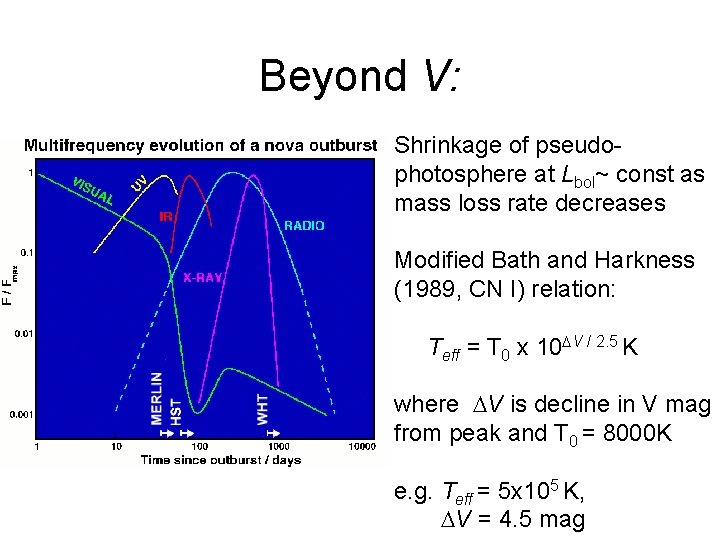
Beyond V: Shrinkage of pseudophotosphere at Lbol~ const as mass loss rate decreases Modified Bath and Harkness (1989, CN I) relation: Teff = T 0 x 10 V / 2. 5 K where V is decline in V mag from peak and T 0 = 8000 K e. g. Teff = 5 x 10⁵ K, V = 4. 5 mag
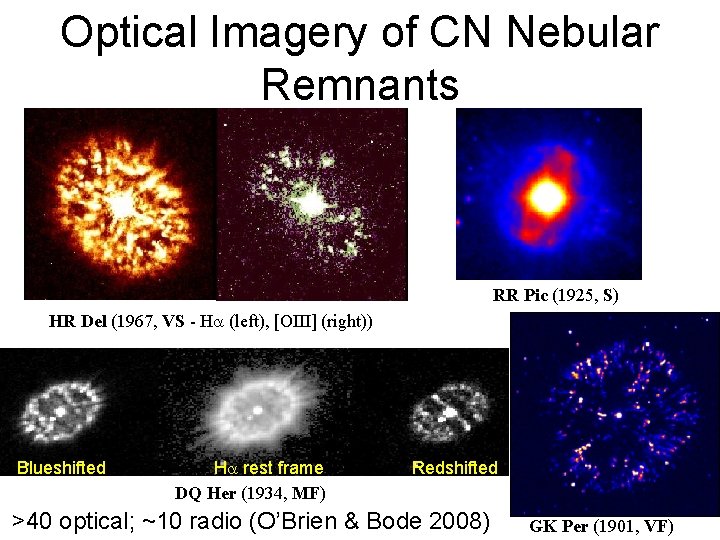
Optical Imagery of CN Nebular Remnants RR Pic (1925, S) HR Del (1967, VS - H (left), [OIII] (right)) Blueshifted H rest frame DQ Her (1934, MF) Redshifted >40 optical; ~10 radio (O’Brien & Bode 2008) GK Per (1901, VF)
Nova GK Persei: Vital Statistics • • Very fast “neon” nova (Feb 22 nd 1901) d = 470 pc (expansion parallax) Lmax ~ 5 x 1038 erg/s; Lqu = 1034 erg/s Mej ~ 10 -4 M¤, vej = 1200 km/s Central System: • P = 1. 904 d; WD (intermediate polar) + K 2 IV • Primary Mass ~ 1 M¤; Secondary Mass ~ 0. 3 M¤ • Dwarf nova outbursts (outer edge of accretion disk? )
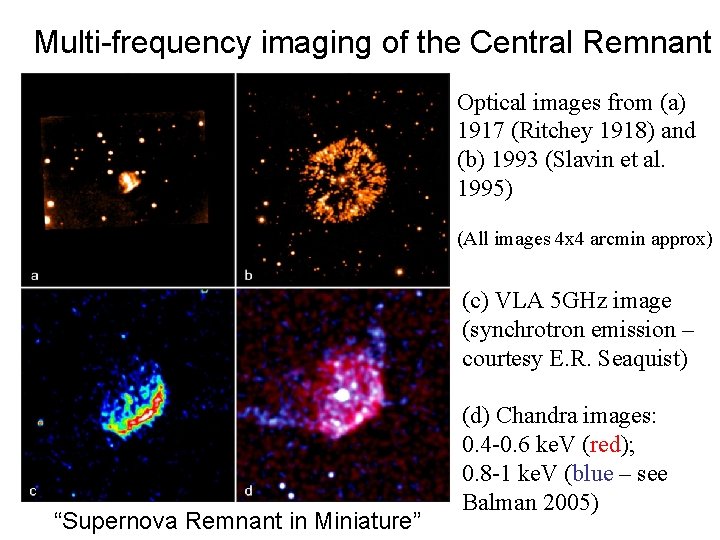
Multi-frequency imaging of the Central Remnant Optical images from (a) 1917 (Ritchey 1918) and (b) 1993 (Slavin et al. 1995) (All images 4 x 4 arcmin approx) (c) VLA 5 GHz image (synchrotron emission – courtesy E. R. Seaquist) “Supernova Remnant in Miniature” (d) Chandra images: 0. 4 -0. 6 ke. V (red); 0. 8 -1 ke. V (blue – see Balman 2005)
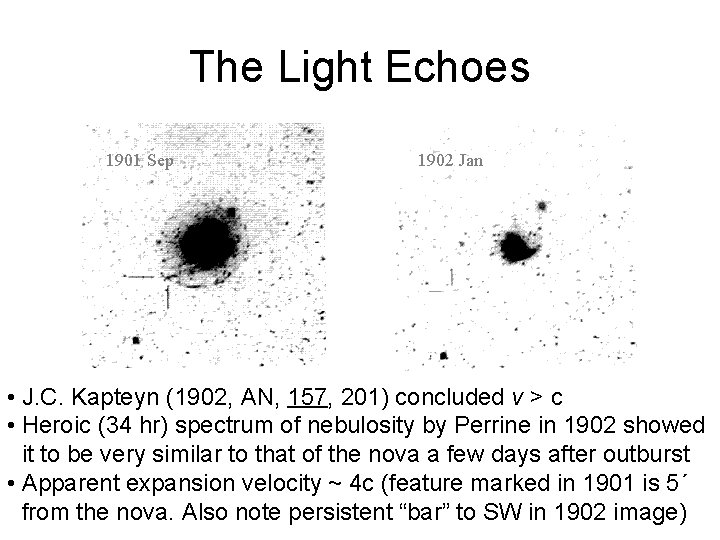
The Light Echoes 1901 Sep 1902 Jan • J. C. Kapteyn (1902, AN, 157, 201) concluded v > c • Heroic (34 hr) spectrum of nebulosity by Perrine in 1902 showed it to be very similar to that of the nova a few days after outburst • Apparent expansion velocity ~ 4 c (feature marked in 1901 is 5´ from the nova. Also note persistent “bar” to SW in 1902 image)
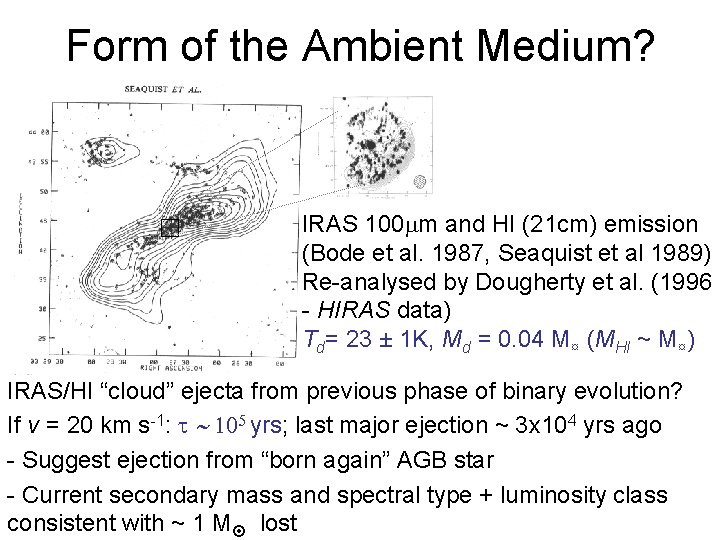
Form of the Ambient Medium? IRAS 100 m and HI (21 cm) emission (Bode et al. 1987, Seaquist et al 1989) Re-analysed by Dougherty et al. (1996 - HIRAS data) Td= 23 ± 1 K, Md = 0. 04 M¤ (MHI ~ M¤) IRAS/HI “cloud” ejecta from previous phase of binary evolution? If v = 20 km s-1: t ~ 105 yrs; last major ejection ~ 3 x 10⁴ yrs ago - Suggest ejection from “born again” AGB star - Current secondary mass and spectral type + luminosity class consistent with ~ 1 M¤ lost
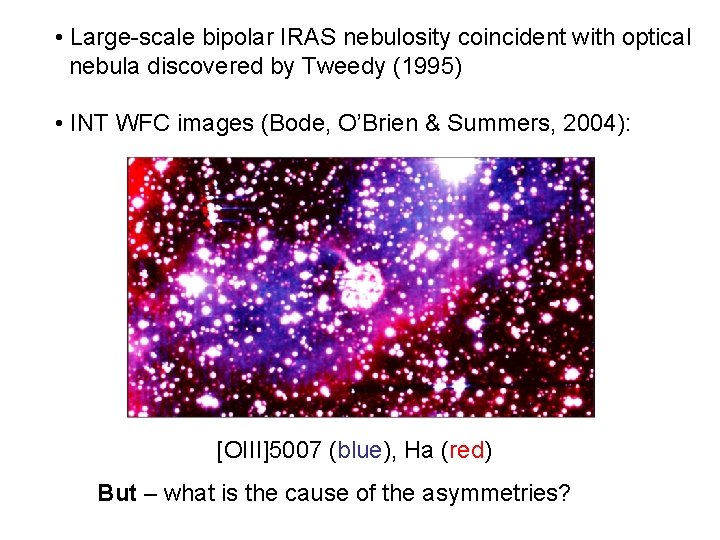
• Large-scale bipolar IRAS nebulosity coincident with optical nebula discovered by Tweedy (1995) • INT WFC images (Bode, O’Brien & Summers, 2004): [OIII]5007 (blue), Ha (red) But – what is the cause of the asymmetries?
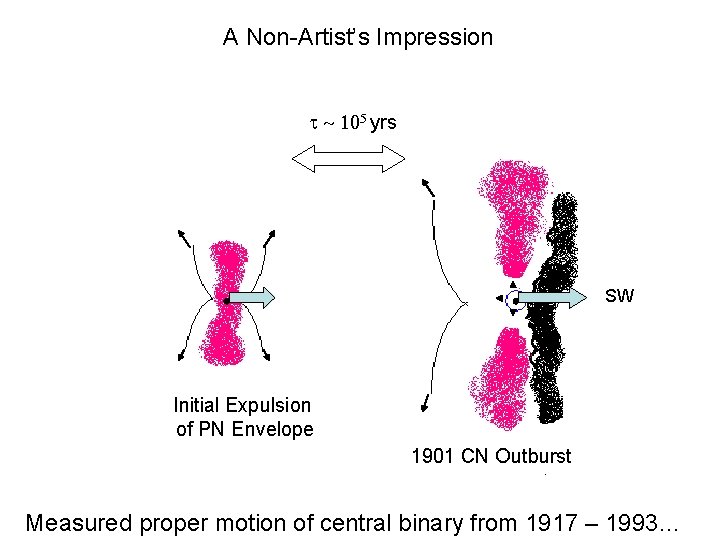
A Non-Artist’s Impression t ~ 105 yrs SW Initial Expulsion of PN Envelope 1901 CN Outburst Measured proper motion of central binary from 1917 – 1993…
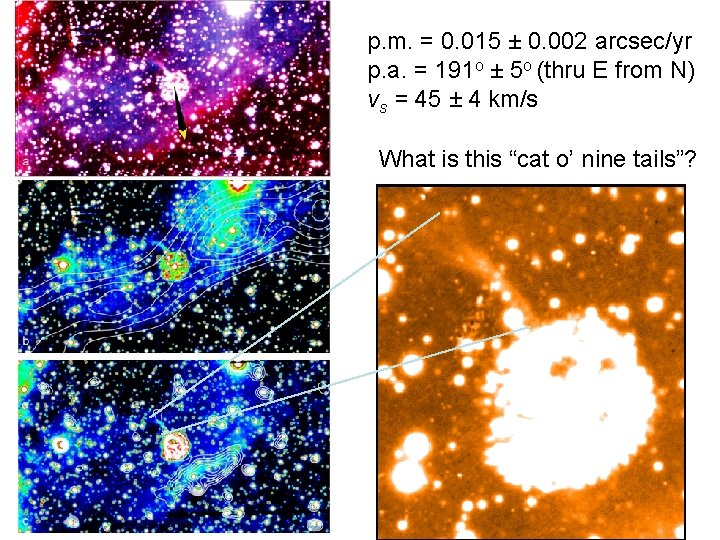
p. m. = 0. 015 ± 0. 002 arcsec/yr p. a. = 191 o ± 5 o (thru E from N) vs = 45 ± 4 km/s What is this “cat o’ nine tails”? [OIII] image plus IRAS 100 m contours H image plus contours of the light echoes from 1902
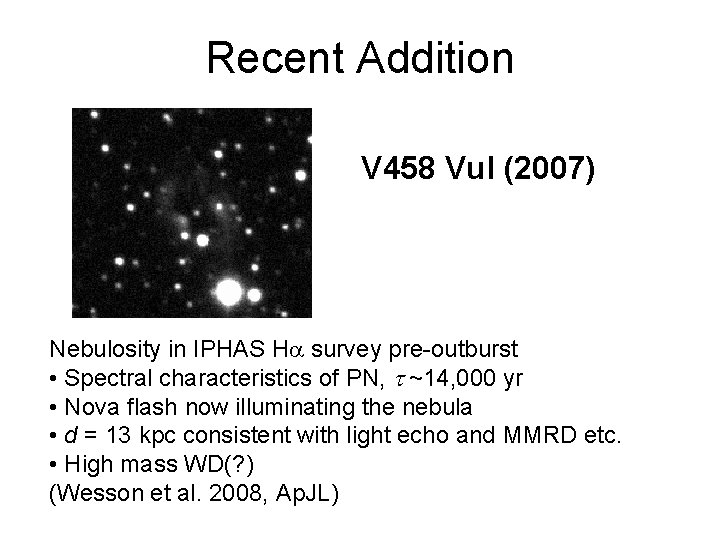
Recent Addition V 458 Vul (2007) Nebulosity in IPHAS H survey pre-outburst • Spectral characteristics of PN, ~14, 000 yr • Nova flash now illuminating the nebula • d = 13 kpc consistent with light echo and MMRD etc. • High mass WD(? ) (Wesson et al. 2008, Ap. JL)
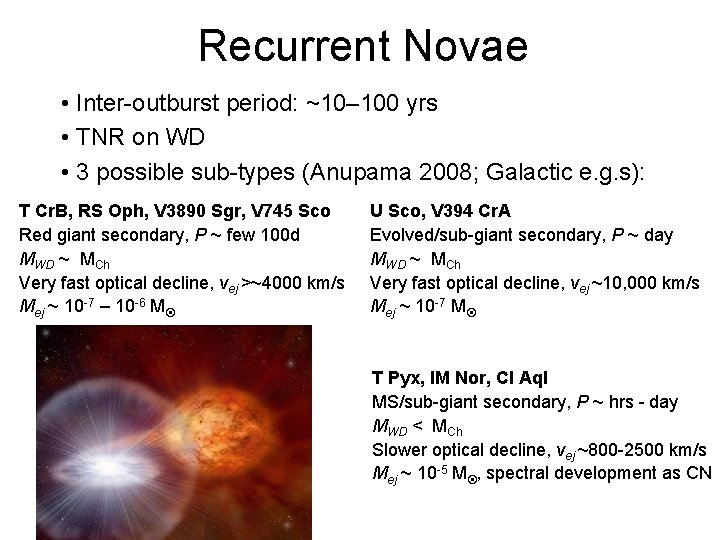
Recurrent Novae • Inter-outburst period: ~10– 100 yrs • TNR on WD • 3 possible sub-types (Anupama 2008; Galactic e. g. s): T Cr. B, RS Oph, V 3890 Sgr, V 745 Sco Red giant secondary, P ~ few 100 d MWD ~ MCh Very fast optical decline, vej >~4000 km/s Mej ~ 10 -7 – 10 -6 M¤ U Sco, V 394 Cr. A Evolved/sub-giant secondary, P ~ day MWD ~ MCh Very fast optical decline, vej ~10, 000 km/s Mej ~ 10 -7 M¤ T Pyx, IM Nor, CI Aql MS/sub-giant secondary, P ~ hrs - day MWD < MCh Slower optical decline, vej ~800 -2500 km/s Mej ~ 10 -5 M¤, spectral development as CN
RS Oph Vital Statistics • Recurrent Nova – outbursts 1898, (1907), 1933, (1945), 1958, 1967, 1985, 2006 • Central system – high mass WD + Red Giant (M 2 III); P = 455 days • d = 1. 6 ± 0. 3 kpc, NH = 2. 4 ± 0. 6 x 1021 cm-2 • Prior to 1985, spectroscopic evidence for red giant wind, systematic reduction in velocities post-outburst, and emergence of coronal lines, led to suggestion of ejecta (v 0 ~ 4000 km s-1) interaction with RG wind (u = 20 km s-1) • 1985 outburst first to be observed beyond the visible, but radio imaging and X-ray observations sparse (and no HST of course!) • Shock models by Bode & Kahn (1985), O’Brien, Bode & Kahn (1992)
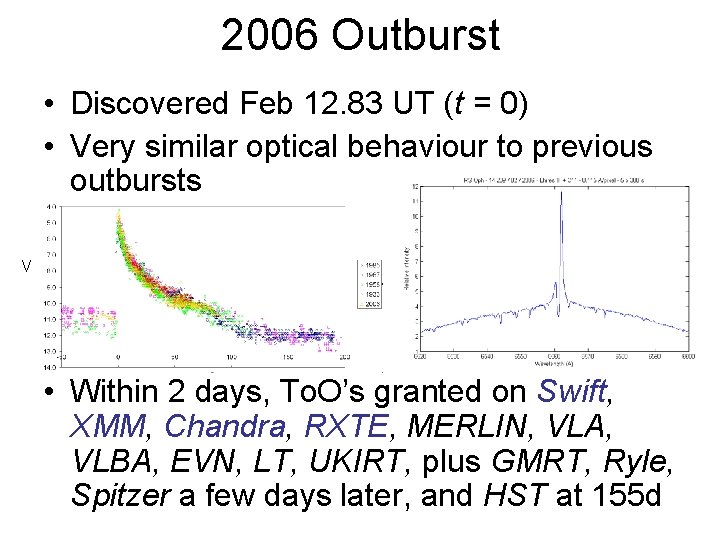
2006 Outburst • Discovered Feb 12. 83 UT (t = 0) • Very similar optical behaviour to previous outbursts Buil (2006) t = 1. 37 d V • Within 2 days, To. O’s granted on Swift, XMM, Chandra, RXTE, MERLIN, VLA, VLBA, EVN, LT, UKIRT, plus GMRT, Ryle, Spitzer a few days later, and HST at 155 d
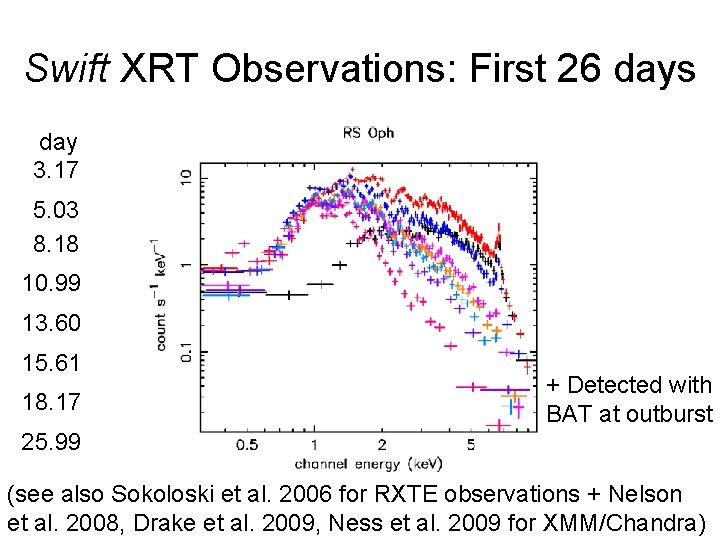
Swift XRT Observations: First 26 days day 3. 17 5. 03 8. 18 10. 99 13. 60 15. 61 18. 17 + Detected with BAT at outburst 25. 99 (see also Sokoloski et al. 2006 for RXTE observations + Nelson et al. 2008, Drake et al. 2009, Ness et al. 2009 for XMM/Chandra)
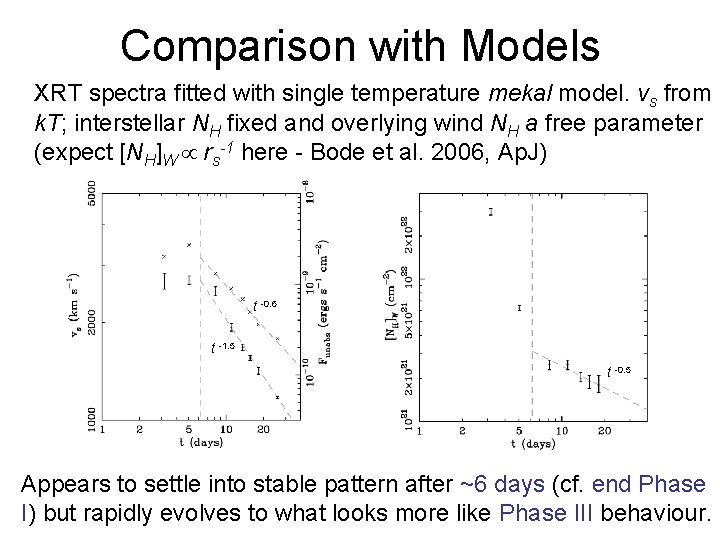
Comparison with Models XRT spectra fitted with single temperature mekal model. vs from k. T; interstellar NH fixed and overlying wind NH a free parameter (expect [NH]W µ rs-1 here - Bode et al. 2006, Ap. J) t -1. 5 t -0. 6 t -0. 5 Appears to settle into stable pattern after ~6 days (cf. end Phase I) but rapidly evolves to what looks more like Phase III behaviour.
SSS phase – The Motion Picture • Starts at t ~ 26 days • Initially highly variable • “Plateau” phase(? ), to t ~ 58 days: Mburn = (1. 7– 3. 8) x 10 -7 M¤ • Secular decline to t ~ 90 days when SSS phase ends: Menv ~ 3 x 10 -7 M¤ • Very much compressed version of e. g. V 1974 Cyg SSS evolution (where trem µ MWD-6. 3) (Nelson et al. 2008; Ness et al. 2009 - XMM/Chandra)
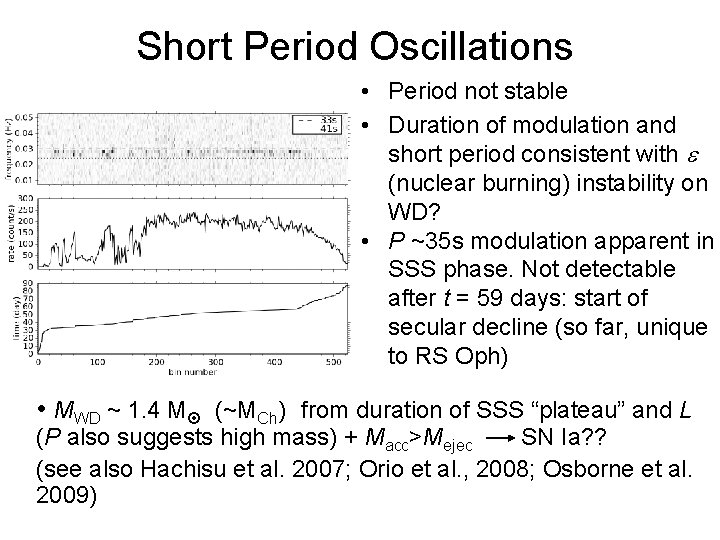
Short Period Oscillations • Period not stable • Duration of modulation and short period consistent with e (nuclear burning) instability on WD? • P ~35 s modulation apparent in SSS phase. Not detectable after t = 59 days: start of secular decline (so far, unique to RS Oph) • MWD ~ 1. 4 M¤ (~MCh) from duration of SSS “plateau” and L (P also suggests high mass) + Macc>Mejec SN Ia? ? (see also Hachisu et al. 2007; Orio et al. , 2008; Osborne et al. 2009)
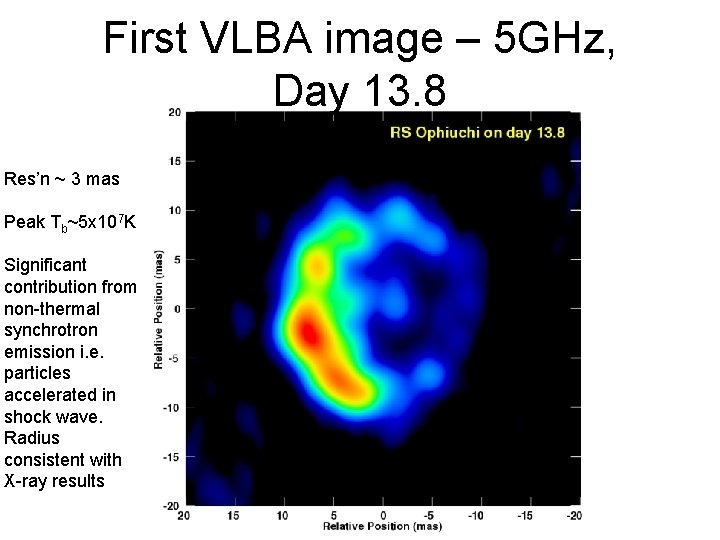
First VLBA image – 5 GHz, Day 13. 8 Res’n ~ 3 mas Peak Tb~5 x 10⁷ K Significant contribution from non-thermal synchrotron emission i. e. particles accelerated in shock wave. Radius consistent with X-ray results
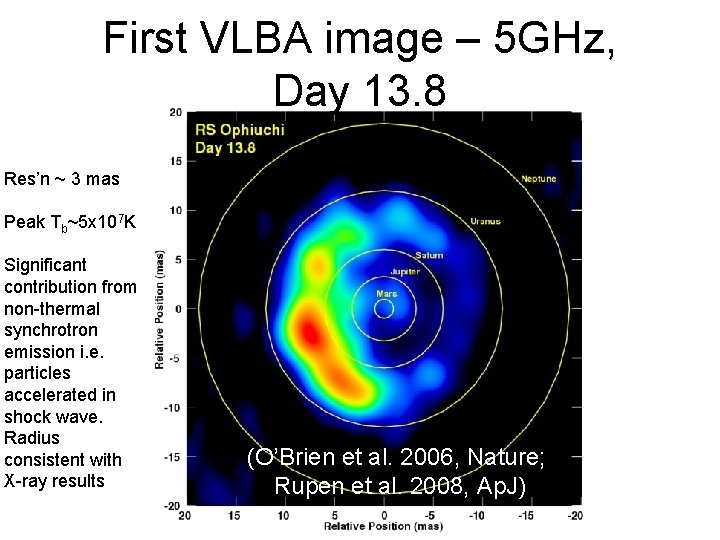
First VLBA image – 5 GHz, Day 13. 8 Res’n ~ 3 mas Peak Tb~5 x 10⁷ K Significant contribution from non-thermal synchrotron emission i. e. particles accelerated in shock wave. Radius consistent with X-ray results (O’Brien et al. 2006, Nature; Rupen et al. 2008, Ap. J)
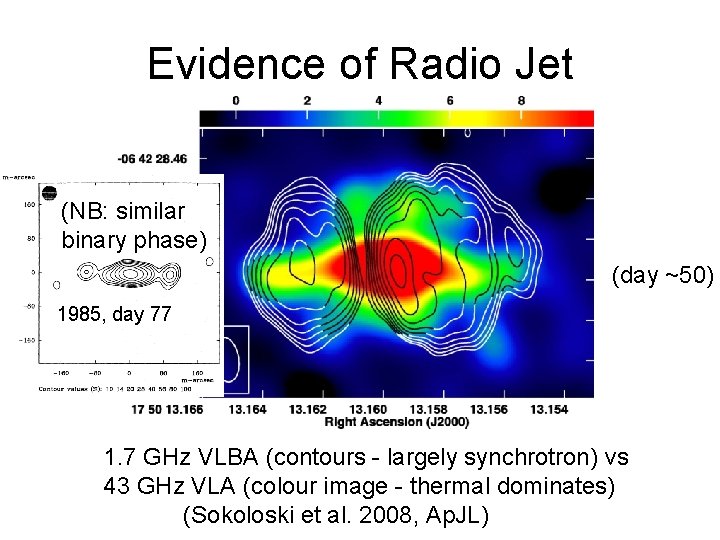
Evidence of Radio Jet (NB: similar binary phase) (day ~50) 1985, day 77? 1. 7 GHz VLBA (contours - largely synchrotron) vs 43 GHz VLA (colour image - thermal dominates) (Sokoloski et al. 2008, Ap. JL)
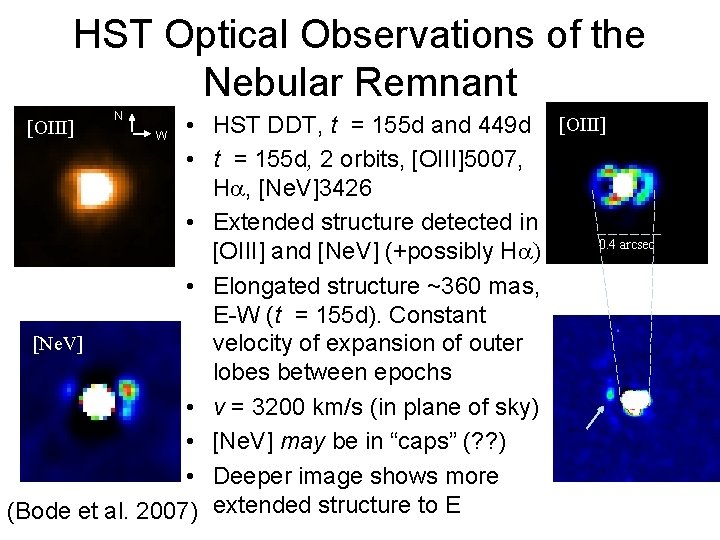
HST Optical Observations of the Nebular Remnant N N • HST DDT, t = 155 d and 449 d [OIII] • t = 155 d, 2 orbits, [OIII]5007, H , [Ne. V]3426 • Extended structure detected in 0. 4 arcsec [OIII] and [Ne. V] (+possibly H ) • Elongated structure ~360 mas, E-W (t = 155 d). Constant [Ne. V] velocity of expansion of outer lobes between epochs • v = 3200 km/s (in plane of sky) • [Ne. V] may be in “caps” (? ? ) • Deeper image shows more (Bode et al. 2007) extended structure to E [OIII] W
![Model of Remnant Structure Model HST + Filter [OIII] Ground-based spectrum • O’Brien et](http://slidetodoc.com/presentation_image/acfeb197698c03850639f3b428bd31cd/image-27.jpg "Model of Remnant Structure Model HST + Filter [OIII] Ground-based spectrum • O’Brien et")
Model of Remnant Structure Model HST + Filter [OIII] Ground-based spectrum • O’Brien et al. (2006) suggested VLBI evolution modelled by bipolar structure • Here, used Shape to model HST images + ground-based spectra • Outer dumbbell and inner hourglass: latter containing lower velocity, denser material • West lobe is approaching observer • i = 39 o +1 -10 (v 0 = 5100 km/s) àbinary orbital plane in “waist” • Consistent with early-time optical interferometry, VLBI, X-ray, plus survival of circumstellar dust (Spitzer data - Evans et al. 2007, Ap. J) (Ribeiro et al. 2009, Ap. J sub. )
Some Open Questions • Evolutionary track of a binary to the CN or RN phase? (Politano) • Continuum of inter-outburst timescales (fundamental properties) from CNe through RNe (sub-type)? • Detailed evolution of the TNR - e. g. Super-Eddington and SSS “plateau” phases? (Hernanz; Kato) • Cause of initial rapid variability of the SSS and origin of oscillations (in RS Oph)? (Osborne) • Mass ejected - resolution of discrepancy between observations and theory? (Hernanz; Pietsch) • Jet formation? (Sokoloski) • Link between RNe and SNe Ia? (Podsiadlowski; Hernanz; Di Stefano; Nelson; Sokoloski) • Refinement of MMRD possible? • Relationship of nova rates and sub-types to stellar populations? (Henze; Orio; Pietsch)

- Slides: 29