
THE OTHER SIDE OF PROMETHEUS Mannaioli Marta Carocci
- Slides: 12
THE OTHER SIDE OF PROMETHEUS Mannaioli Marta & Carocci Ginevra 3 AC a. s. 2019/20
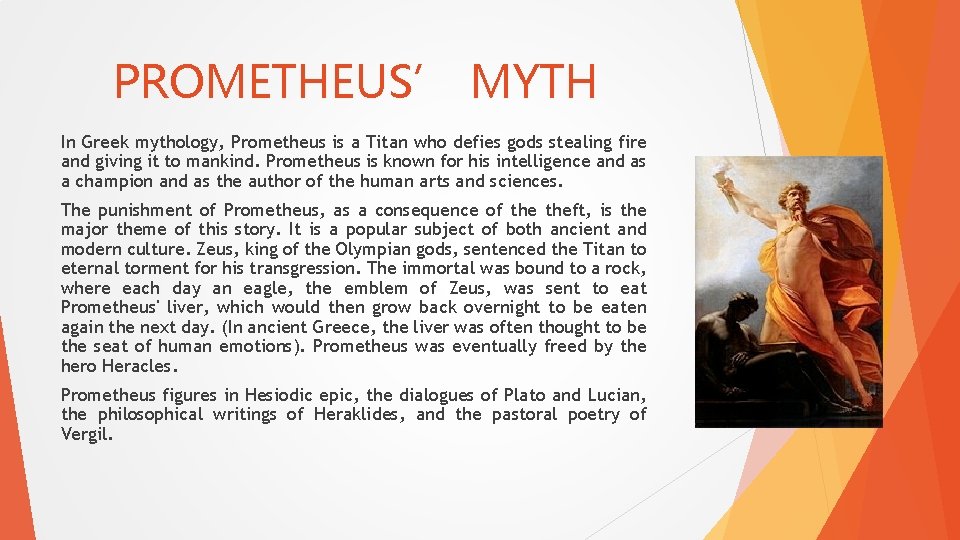
PROMETHEUS’ MYTH In Greek mythology, Prometheus is a Titan who defies gods stealing fire and giving it to mankind. Prometheus is known for his intelligence and as a champion and as the author of the human arts and sciences. The punishment of Prometheus, as a consequence of theft, is the major theme of this story. It is a popular subject of both ancient and modern culture. Zeus, king of the Olympian gods, sentenced the Titan to eternal torment for his transgression. The immortal was bound to a rock, where each day an eagle, the emblem of Zeus, was sent to eat Prometheus' liver, which would then grow back overnight to be eaten again the next day. (In ancient Greece, the liver was often thought to be the seat of human emotions). Prometheus was eventually freed by the hero Heracles. Prometheus figures in Hesiodic epic, the dialogues of Plato and Lucian, the philosophical writings of Heraklides, and the pastoral poetry of Vergil.
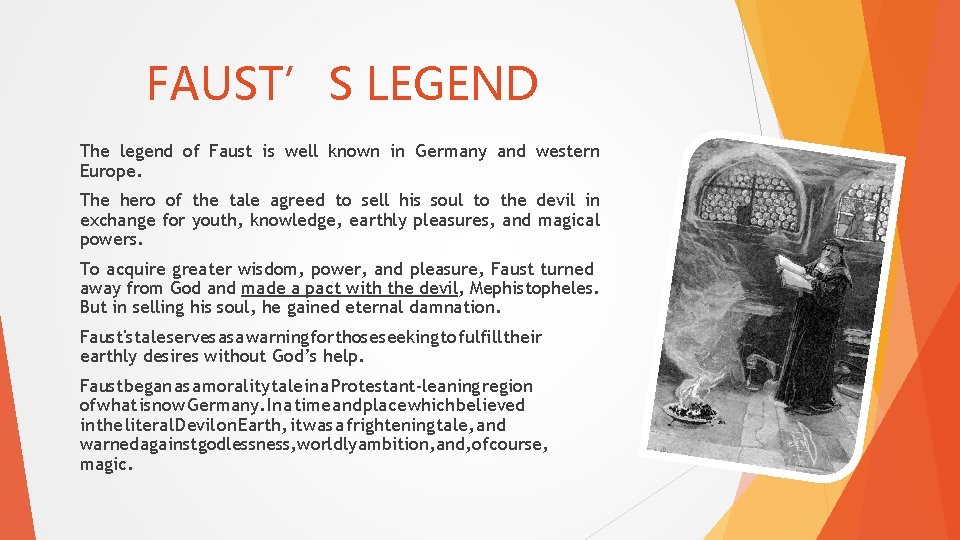
FAUST’S LEGEND The legend of Faust is well known in Germany and western Europe. The hero of the tale agreed to sell his soul to the devil in exchange for youth, knowledge, earthly pleasures, and magical powers. To acquire greater wisdom, power, and pleasure, Faust turned away from God and made a pact with the devil, Mephistopheles. But in selling his soul, he gained eternal damnation. Faust's tale serves as a warning for those seeking to fulfill their earthly desires without God’s help. Faust began as a morality tale in a Protestant-leaning region of what is now Germany. In a time and place which believed in the literal Devil on Earth, it was a frightening tale, and warned against godlessness, worldly ambition, and, of course, magic.
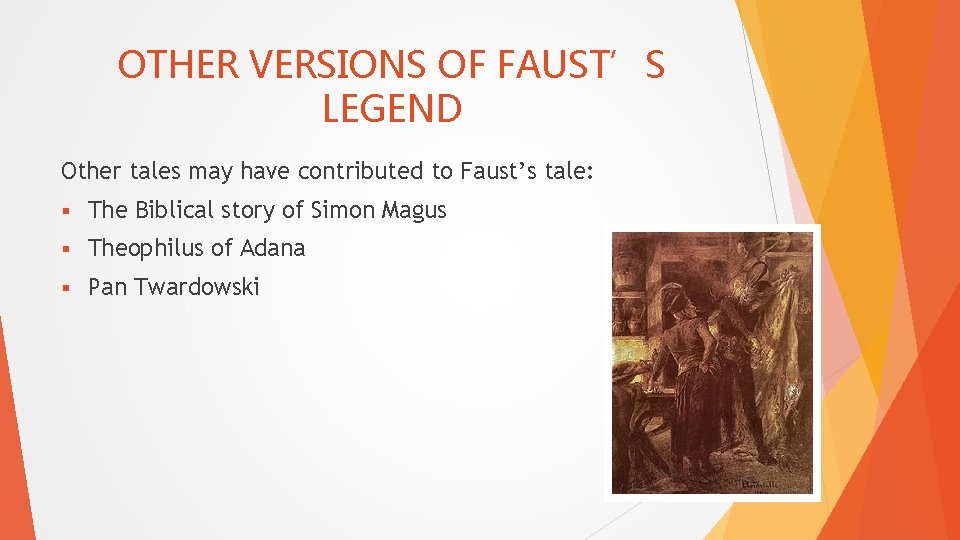
OTHER VERSIONS OF FAUST’S LEGEND Other tales may have contributed to Faust’s tale: § The Biblical story of Simon Magus § Theophilus of Adana § Pan Twardowski
PROMETHEUS AND FAUST: A COMPARISON Prometheus and Faust are two of the most fascinating characters in the history of dramatic literature. Even if the cultures of Archaic Greece and Reformation Germany are separated by time, geographical location, language, world view, and religious outlook, Prometheus is a character whose story seems to match point for point Faust’s story. Both act without caring about the rules imposed by society: they overcome limits and conventions. According to this we could say that authority (lat. “auctoritas”) is replaced by curiosity (lat. “curiositas”) about world and life. It is also important to underline a parallel between Prometheus’ love for humanity and the incarnation of tragedy and crisis of the contemporary man by Faust.
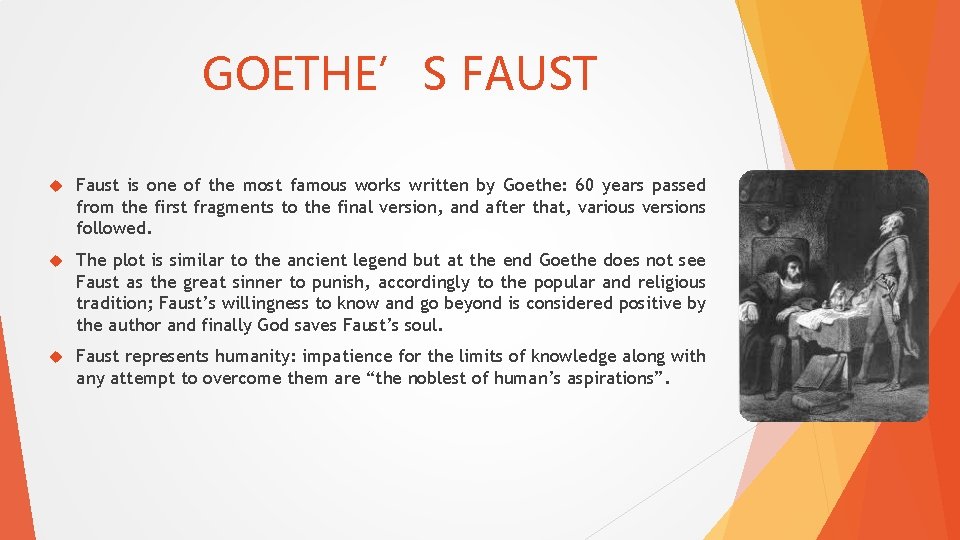
GOETHE’S FAUST Faust is one of the most famous works written by Goethe: 60 years passed from the first fragments to the final version, and after that, various versions followed. The plot is similar to the ancient legend but at the end Goethe does not see Faust as the great sinner to punish, accordingly to the popular and religious tradition; Faust’s willingness to know and go beyond is considered positive by the author and finally God saves Faust’s soul. Faust represents humanity: impatience for the limits of knowledge along with any attempt to overcome them are “the noblest of human’s aspirations”.
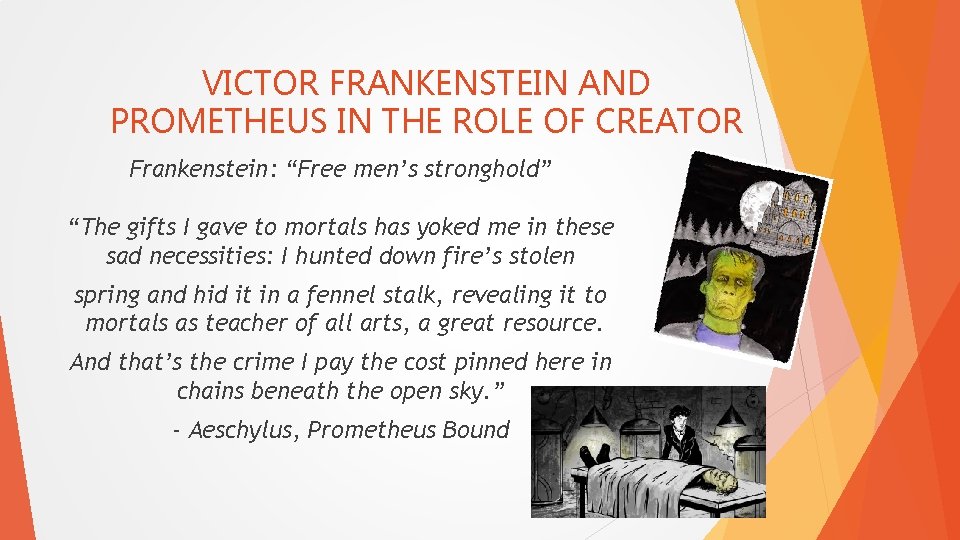
VICTOR FRANKENSTEIN AND PROMETHEUS IN THE ROLE OF CREATOR Frankenstein: “Free men’s stronghold” “The gifts I gave to mortals has yoked me in these sad necessities: I hunted down fire’s stolen spring and hid it in a fennel stalk, revealing it to mortals as teacher of all arts, a great resource. And that’s the crime I pay the cost pinned here in chains beneath the open sky. ” - Aeschylus, Prometheus Bound
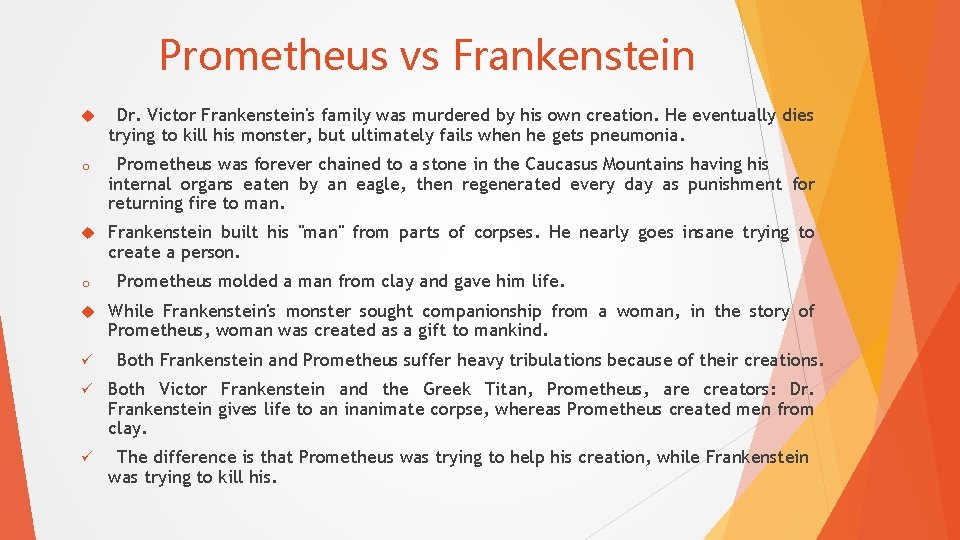
Prometheus vs Frankenstein Dr. Victor Frankenstein's family was murdered by his own creation. He eventually dies trying to kill his monster, but ultimately fails when he gets pneumonia. o Prometheus was forever chained to a stone in the Caucasus Mountains having his internal organs eaten by an eagle, then regenerated every day as punishment for returning fire to man. Frankenstein built his "man" from parts of corpses. He nearly goes insane trying to create a person. o ü Prometheus molded a man from clay and gave him life. While Frankenstein's monster sought companionship from a woman, in the story of Prometheus, woman was created as a gift to mankind. Both Frankenstein and Prometheus suffer heavy tribulations because of their creations. ü Both Victor Frankenstein and the Greek Titan, Prometheus, are creators: Dr. Frankenstein gives life to an inanimate corpse, whereas Prometheus created men from clay. ü The difference is that Prometheus was trying to help his creation, while Frankenstein was trying to kill his.
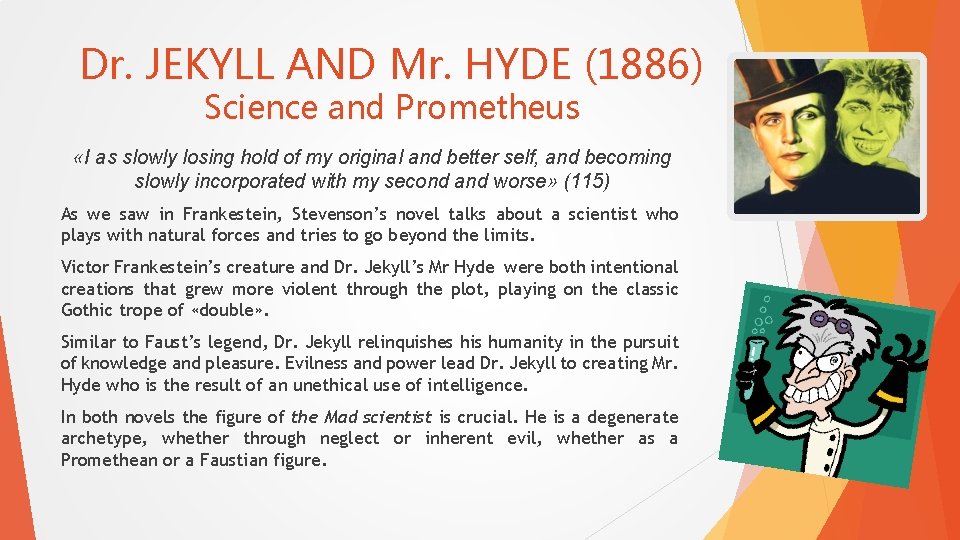
Dr. JEKYLL AND Mr. HYDE (1886) Science and Prometheus «I as slowly losing hold of my original and better self, and becoming slowly incorporated with my second and worse» (115) As we saw in Frankestein, Stevenson’s novel talks about a scientist who plays with natural forces and tries to go beyond the limits. Victor Frankestein’s creature and Dr. Jekyll’s Mr Hyde were both intentional creations that grew more violent through the plot, playing on the classic Gothic trope of «double» . Similar to Faust’s legend, Dr. Jekyll relinquishes his humanity in the pursuit of knowledge and pleasure. Evilness and power lead Dr. Jekyll to creating Mr. Hyde who is the result of an unethical use of intelligence. In both novels the figure of the Mad scientist is crucial. He is a degenerate archetype, whether through neglect or inherent evil, whether as a Promethean or a Faustian figure.
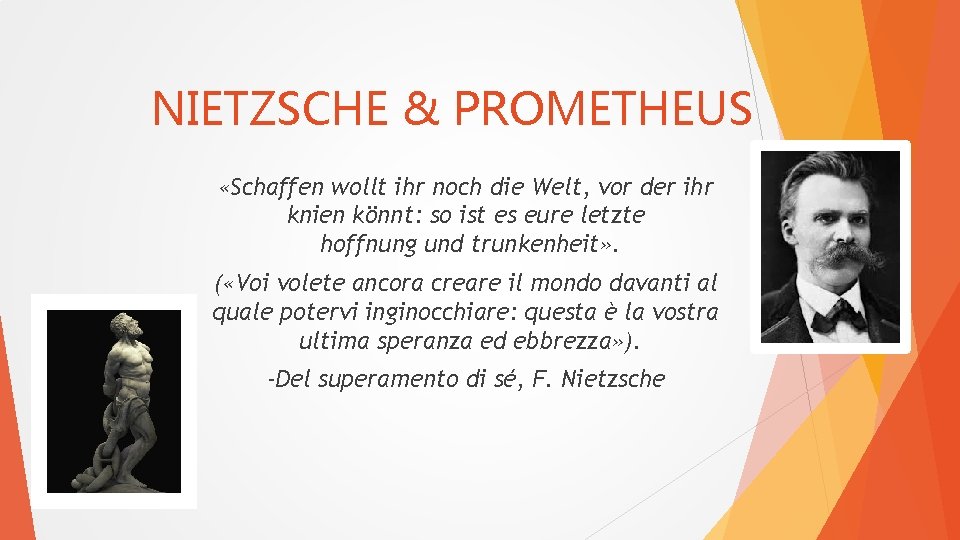
NIETZSCHE & PROMETHEUS «Schaffen wollt ihr noch die Welt, vor der ihr knien könnt: so ist es eure letzte hoffnung und trunkenheit» . ( «Voi volete ancora creare il mondo davanti al quale potervi inginocchiare: questa è la vostra ultima speranza ed ebbrezza» ). -Del superamento di sé, F. Nietzsche
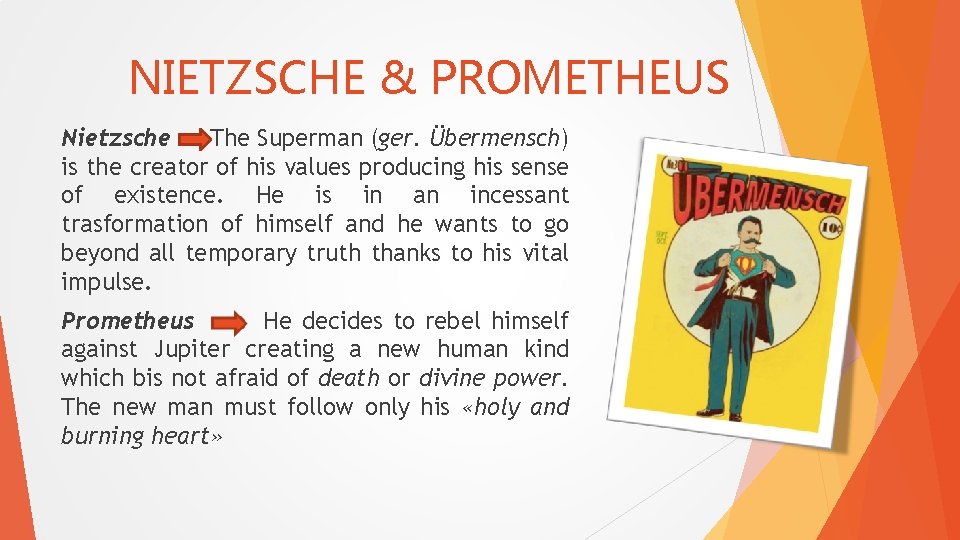
NIETZSCHE & PROMETHEUS Nietzsche The Superman (ger. Übermensch) is the creator of his values producing his sense of existence. He is in an incessant trasformation of himself and he wants to go beyond all temporary truth thanks to his vital impulse. Prometheus He decides to rebel himself against Jupiter creating a new human kind which bis not afraid of death or divine power. The new man must follow only his «holy and burning heart»
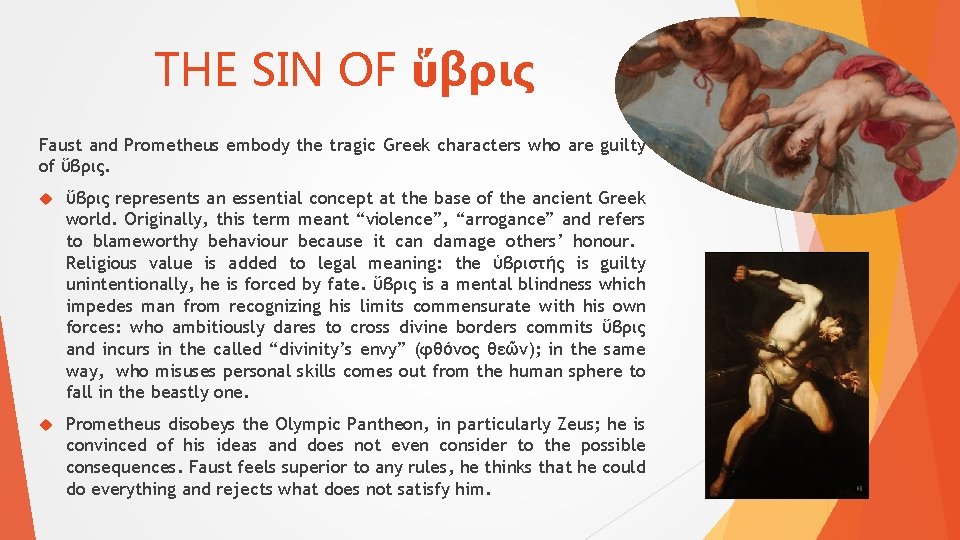
THE SIN OF ὕβρις Faust and Prometheus embody the tragic Greek characters who are guilty of ὕβρις represents an essential concept at the base of the ancient Greek world. Originally, this term meant “violence”, “arrogance” and refers to blameworthy behaviour because it can damage others’ honour. Religious value is added to legal meaning: the ὑβριστής is guilty unintentionally, he is forced by fate. ὕβρις is a mental blindness which impedes man from recognizing his limits commensurate with his own forces: who ambitiously dares to cross divine borders commits ὕβρις and incurs in the called “divinity’s envy” (φθόνος θεῶν); in the same way, who misuses personal skills comes out from the human sphere to fall in the beastly one. Prometheus disobeys the Olympic Pantheon, in particularly Zeus; he is convinced of his ideas and does not even consider to the possible consequences. Faust feels superior to any rules, he thinks that he could do everything and rejects what does not satisfy him.