
The OSI Model A Framework for Communications David

- Slides: 14
The OSI Model A Framework for Communications David A. Abarca July 19, 2005
Background Top to Bottom • Open System Interconnection (OSI) Model: The Layers Application Presentation Session – Was developed in 1984 by the International Organization for Standardization (ISO), a group that provides a worldwide common language for many Transport Network Data Link technology industries, – Is only a framework for communications between Physical Summary computers, not a method of communications.
Background Top to Bottom The Layers Application Presentation Session • Open System Interconnection (OSI) Model – The Model defines the separate functions necessary to process data communications between devices. – The Model uses 7 separate layers, one layer to represent each function. Transport Network Data Link Physical Summary – The layers are stacked on top of each other and pass data from the top of the “stack” to the bottom. – When the data reaches the bottom of the “stack”, the data is transferred across a cable, or other media, and then back up the “stack” to the other device.
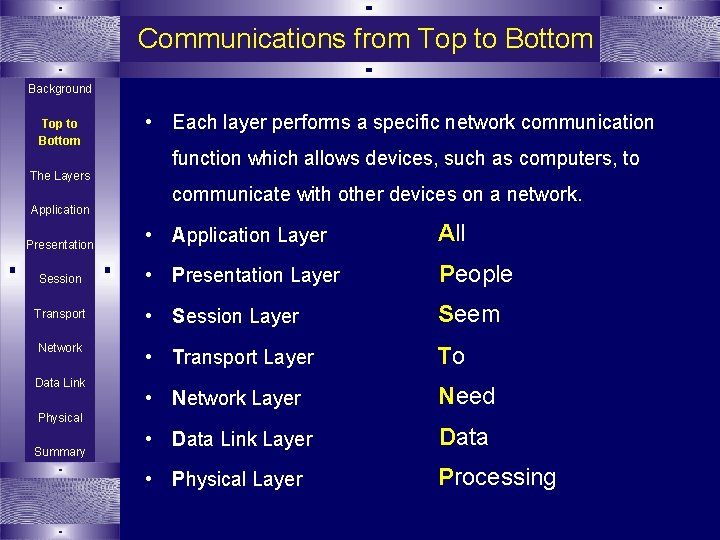
Communications from Top to Bottom Background Top to Bottom The Layers Application Presentation Session Transport Network Data Link • Each layer performs a specific network communication function which allows devices, such as computers, to communicate with other devices on a network. • Application Layer All • Presentation Layer People • Session Layer Seem • Transport Layer To • Network Layer Need • Data Link Layer Data • Physical Layer Processing Physical Summary
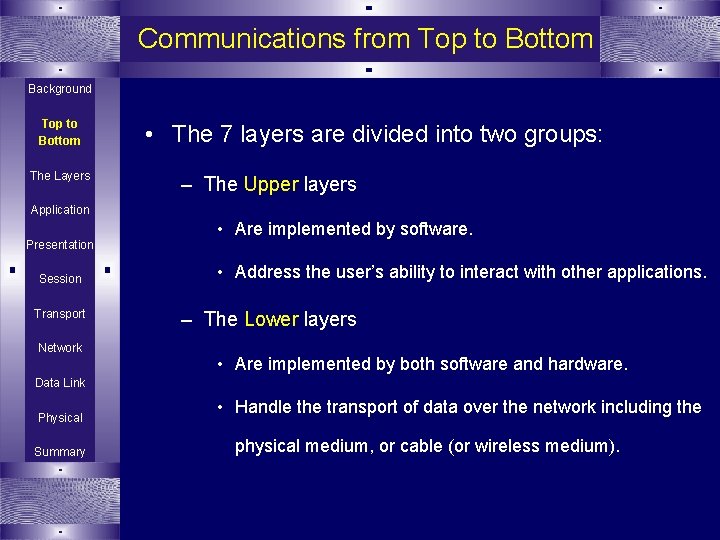
Communications from Top to Bottom Background Top to Bottom The Layers • The 7 layers are divided into two groups: – The Upper layers Application Presentation Session Transport Network • Are implemented by software. • Address the user’s ability to interact with other applications. – The Lower layers • Are implemented by both software and hardware. Data Link Physical Summary • Handle the transport of data over the network including the physical medium, or cable (or wireless medium).
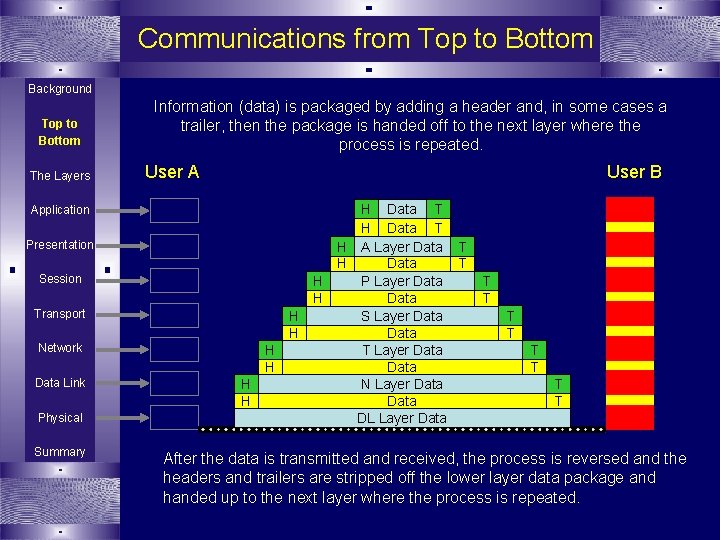
Communications from Top to Bottom Background Top to Bottom The Layers Application Presentation Session Transport Network Data Link Physical Summary Information (data) is packaged by adding a header and, in some cases a trailer, then the package is handed off to the next layer where the process is repeated. User A User B H Data T H A Layer Data T H P Layer Data H S Layer Data H H T Layer Data H N Layer Data H Data DL Layer Data T T T T After the data is transmitted and received, the process is reversed and the headers and trailers are stripped off the lower layer data package and handed up to the next layer where the process is repeated.
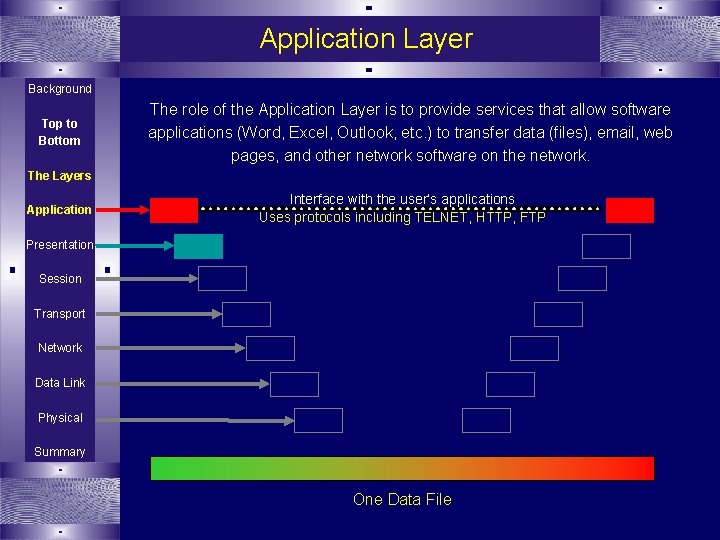
Application Layer Background Top to Bottom The role of the Application Layer is to provide services that allow software applications (Word, Excel, Outlook, etc. ) to transfer data (files), email, web pages, and other network software on the network. The Layers Application Interface with the user’s applications Uses protocols including TELNET, HTTP, FTP Presentation Session Transport Network Data Link Physical Summary One Data File
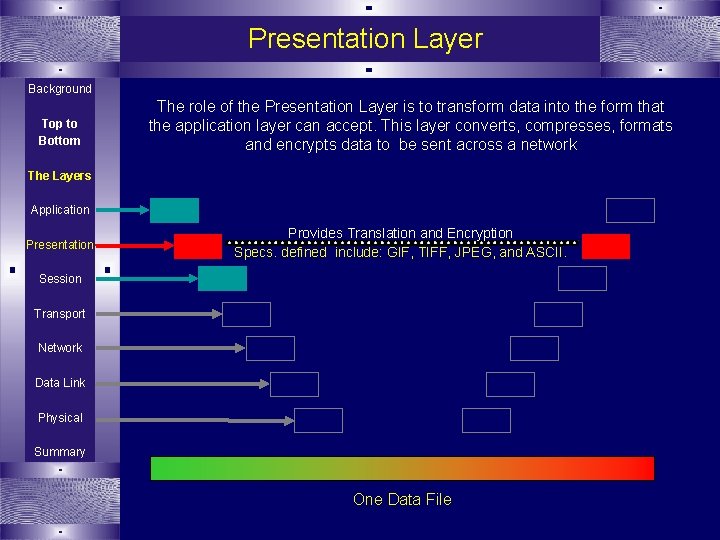
Presentation Layer Background Top to Bottom The role of the Presentation Layer is to transform data into the form that the application layer can accept. This layer converts, compresses, formats and encrypts data to be sent across a network The Layers Application Presentation Provides Translation and Encryption Specs. defined include: GIF, TIFF, JPEG, and ASCII. Session Transport Network Data Link Physical Summary One Data File
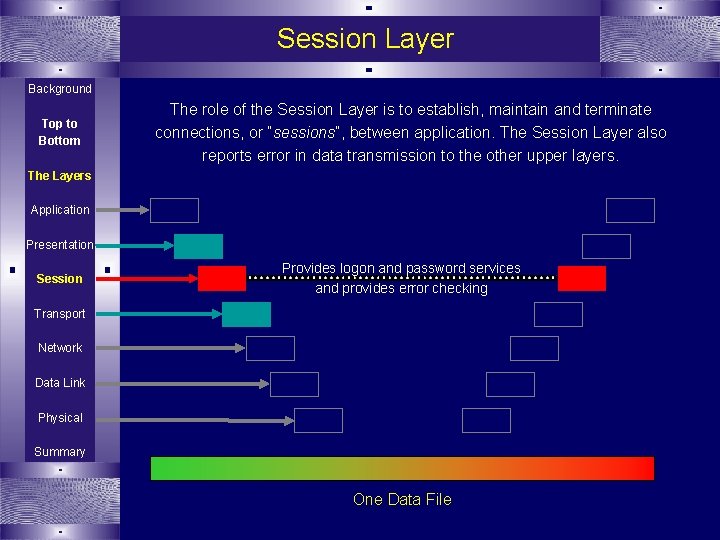
Session Layer Background Top to Bottom The role of the Session Layer is to establish, maintain and terminate connections, or “sessions”, between application. The Session Layer also reports error in data transmission to the other upper layers. The Layers Application Presentation Session Provides logon and password services and provides error checking Transport Network Data Link Physical Summary One Data File
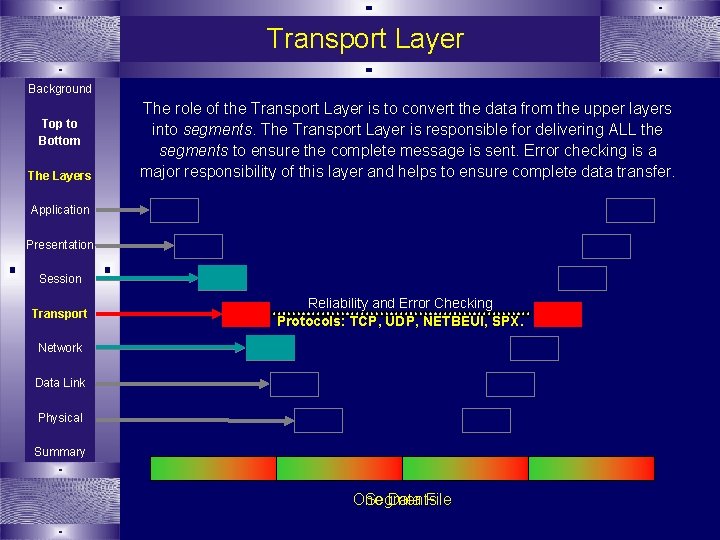
Transport Layer Background Top to Bottom The Layers The role of the Transport Layer is to convert the data from the upper layers into segments. The Transport Layer is responsible for delivering ALL the segments to ensure the complete message is sent. Error checking is a major responsibility of this layer and helps to ensure complete data transfer. Application Presentation Session Transport Reliability and Error Checking Protocols: TCP, UDP, NETBEUI, SPX. Network Data Link Physical Summary One Segments Data File
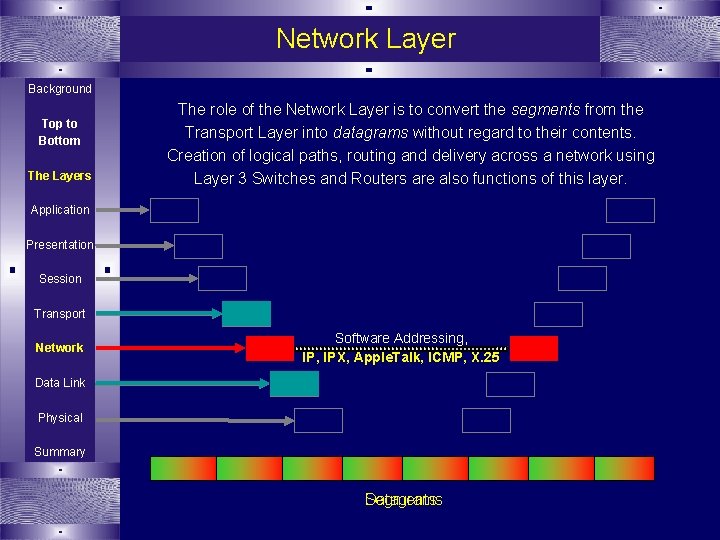
Network Layer Background Top to Bottom The Layers The role of the Network Layer is to convert the segments from the Transport Layer into datagrams without regard to their contents. Creation of logical paths, routing and delivery across a network using Layer 3 Switches and Routers are also functions of this layer. Application Presentation Session Transport Network Software Addressing, IPX, Apple. Talk, ICMP, X. 25 Data Link Physical Summary Datagrams Segments
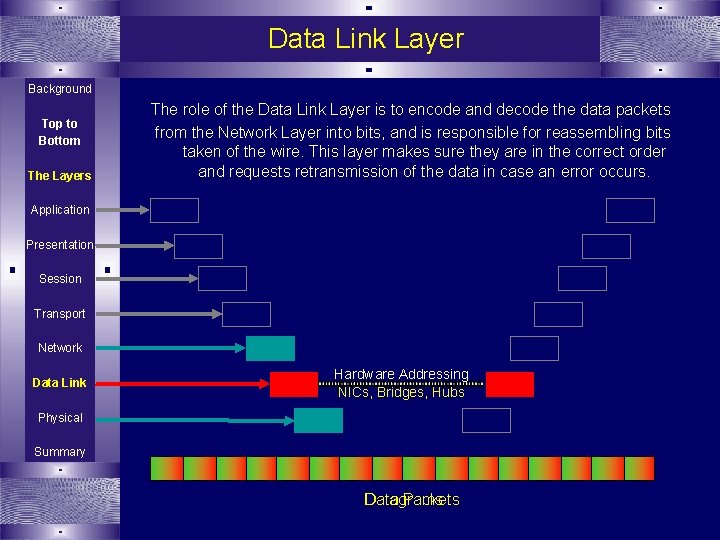
Data Link Layer Background Top to Bottom The Layers The role of the Data Link Layer is to encode and decode the data packets from the Network Layer into bits, and is responsible for reassembling bits taken of the wire. This layer makes sure they are in the correct order and requests retransmission of the data in case an error occurs. Application Presentation Session Transport Network Data Link Hardware Addressing NICs, Bridges, Hubs Physical Summary Datagrams Packets
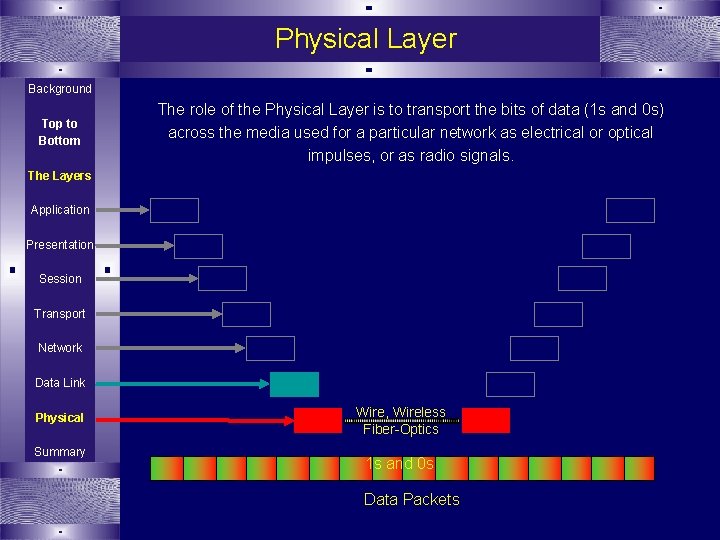
Physical Layer Background Top to Bottom The role of the Physical Layer is to transport the bits of data (1 s and 0 s) across the media used for a particular network as electrical or optical impulses, or as radio signals. The Layers Application Presentation Session Transport Network Data Link Physical Summary Wire, Wireless Fiber-Optics 1 s and 0 s Data Packets
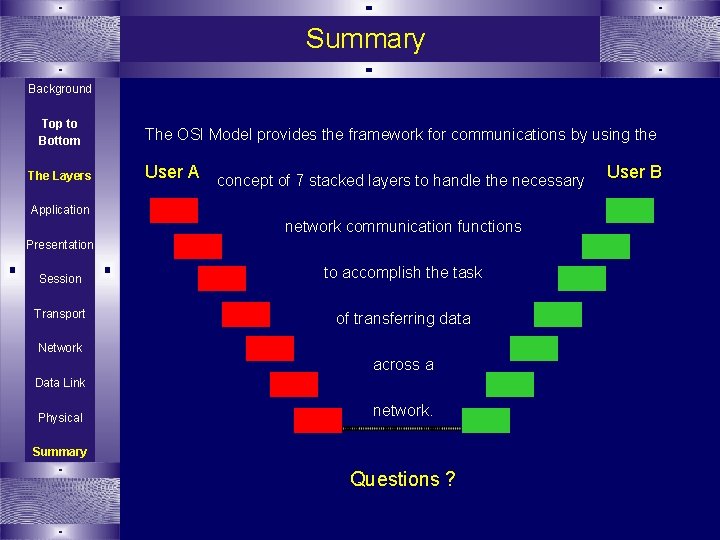
Summary Background Top to Bottom The Layers The OSI Model provides the framework for communications by using the User A concept of 7 stacked layers to handle the necessary Application network communication functions Presentation Session Transport to accomplish the task of transferring data Network across a Data Link Physical network. Summary Questions ? User B