
The Orthogonal Transfer Array PanSTARRS Gigapixel Camera l
- Slides: 21
The Orthogonal Transfer Array Pan-STARRS Gigapixel Camera l An extremely audacious undertaking! l Many IFA contributors (not to mention MIT Lincoln Lab): John Tonry, Gerry Luppino, Peter Onaka, Sidik Isani, Aaron Lee, Robin Uyeshiro, Lou Robertson, Greg Ching, Brian Stalder, Steve Rodney l Significant collaboration with WIYN observatory § Pan-STARRS seminar 17 Sep 04
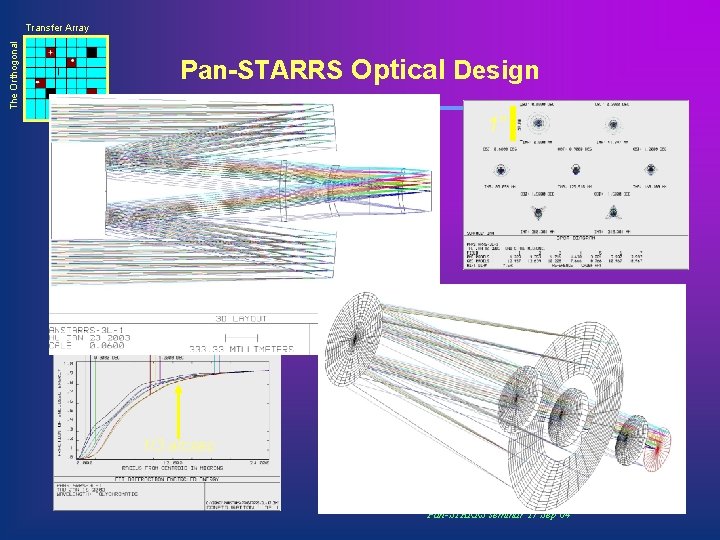
The Orthogonal Transfer Array Pan-STARRS Optical Design 1” 1/3 arcsec Pan-STARRS seminar 17 Sep 04
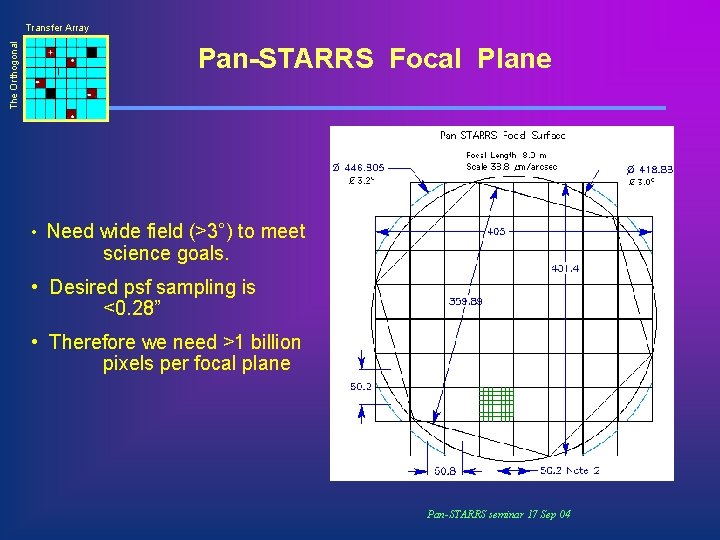
The Orthogonal Transfer Array Pan-STARRS Focal Plane • Need wide field (>3°) to meet science goals. • Desired psf sampling is <0. 28” • Therefore we need >1 billion pixels per focal plane Pan-STARRS seminar 17 Sep 04
The Orthogonal Transfer Array Detector Enhancements l Increasing CCD yield will decrease cost § $ / device ~ ($ / lot) / (CCD yield / lot) l Decrease pixel size (but >8 -10 um to keep red QE) § $ / cm^2 means 10 um is 44% the cost of 15 um l Remove image motion § 20% better psf equivalent to 56% better QE l Fast readout improves duty cycle (e. g. Suprime!) § Readout ~ sky noise dominance << saturation time l Reengineer CCD/cryostat/electronics/host computer with attention to costs and scalability Pan-STARRS seminar 17 Sep 04
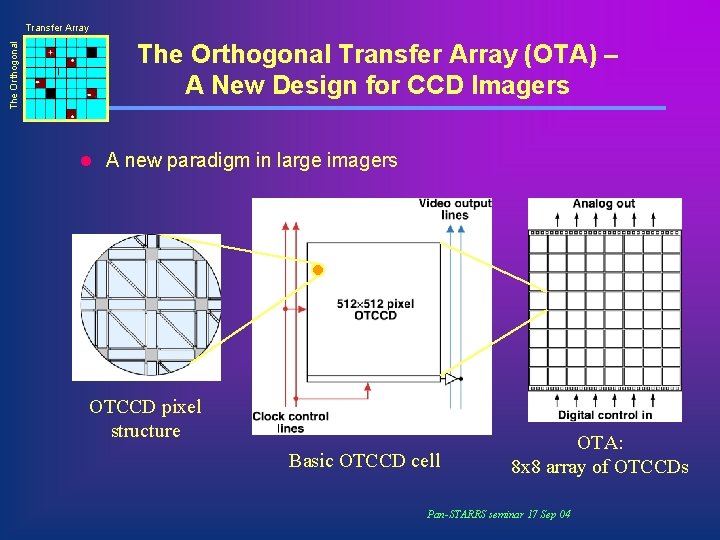
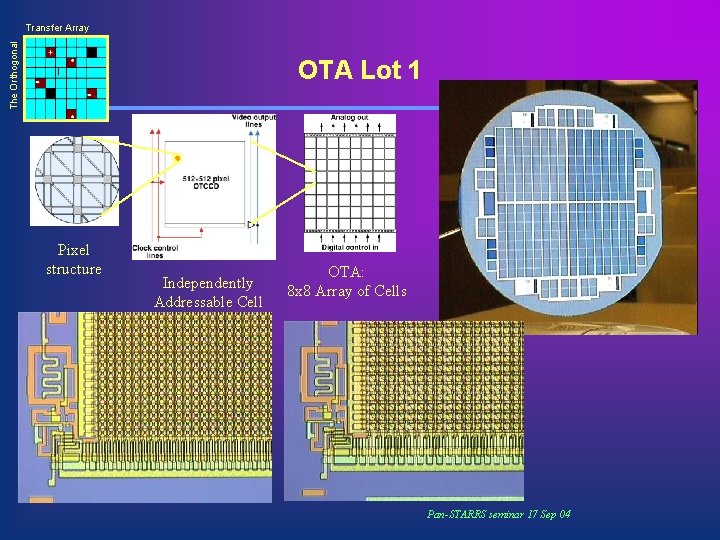
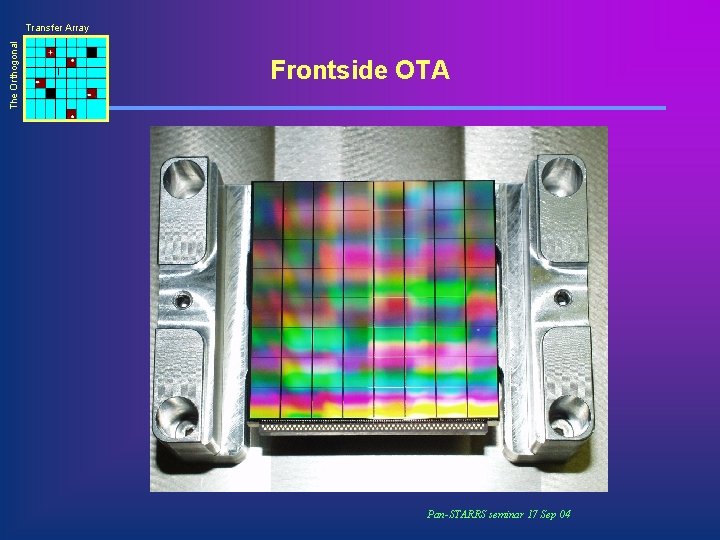
The Orthogonal Transfer Array (OTA) – A New Design for CCD Imagers l A new paradigm in large imagers OTCCD pixel structure Basic OTCCD cell OTA: 8 x 8 array of OTCCDs Pan-STARRS seminar 17 Sep 04
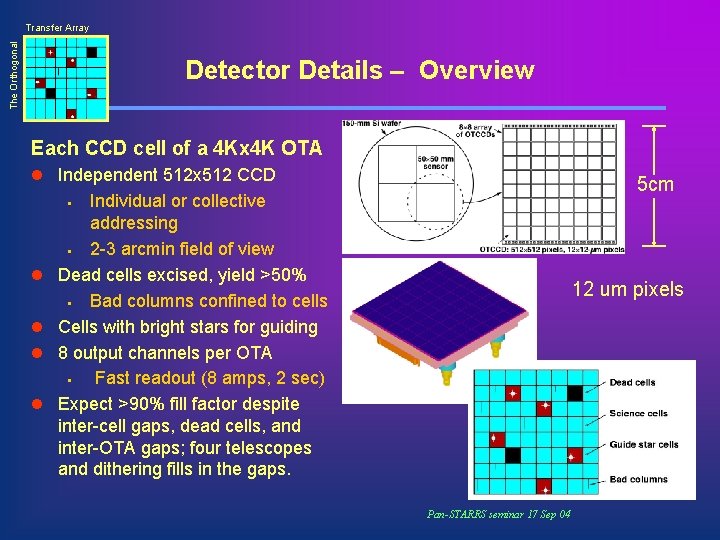
The Orthogonal Transfer Array Detector Details – Overview Each CCD cell of a 4 Kx 4 K OTA l Independent 512 x 512 CCD 5 cm Individual or collective addressing § 2 -3 arcmin field of view Dead cells excised, yield >50% § Bad columns confined to cells Cells with bright stars for guiding 8 output channels per OTA § Fast readout (8 amps, 2 sec) Expect >90% fill factor despite inter-cell gaps, dead cells, and inter-OTA gaps; four telescopes and dithering fills in the gaps. § l l 12 um pixels Pan-STARRS seminar 17 Sep 04
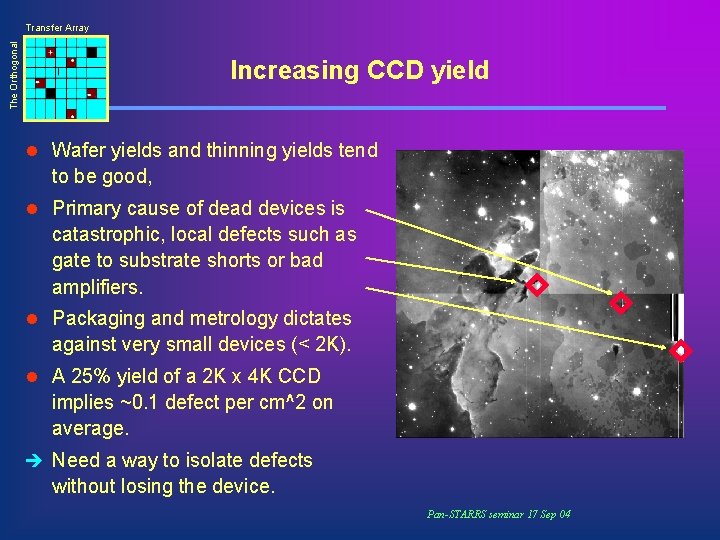
The Orthogonal Transfer Array Increasing CCD yield l Wafer yields and thinning yields tend to be good, l Primary cause of dead devices is catastrophic, local defects such as gate to substrate shorts or bad amplifiers. l Packaging and metrology dictates against very small devices (< 2 K). l A 25% yield of a 2 K x 4 K CCD implies ~0. 1 defect per cm^2 on average. è Need a way to isolate defects without losing the device. Pan-STARRS seminar 17 Sep 04
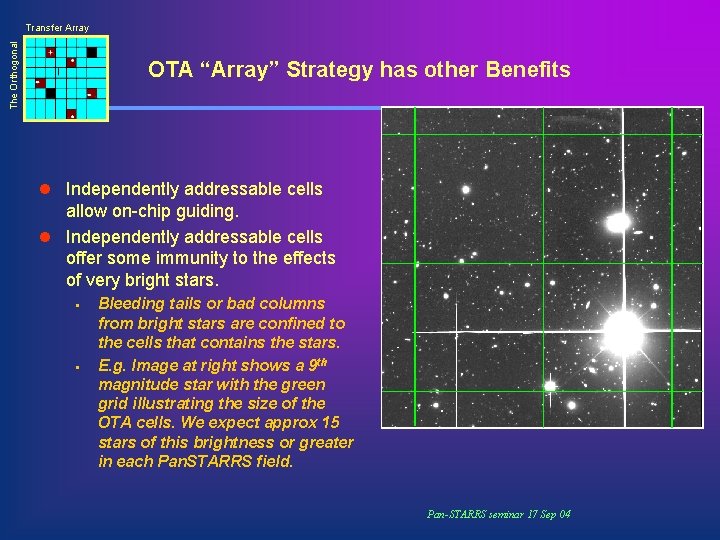
The Orthogonal Transfer Array OTA “Array” Strategy has other Benefits l Independently addressable cells allow on-chip guiding. l Independently addressable cells offer some immunity to the effects of very bright stars. § § Bleeding tails or bad columns from bright stars are confined to the cells that contains the stars. E. g. Image at right shows a 9 th magnitude star with the green grid illustrating the size of the OTA cells. We expect approx 15 stars of this brightness or greater in each Pan. STARRS field. Pan-STARRS seminar 17 Sep 04
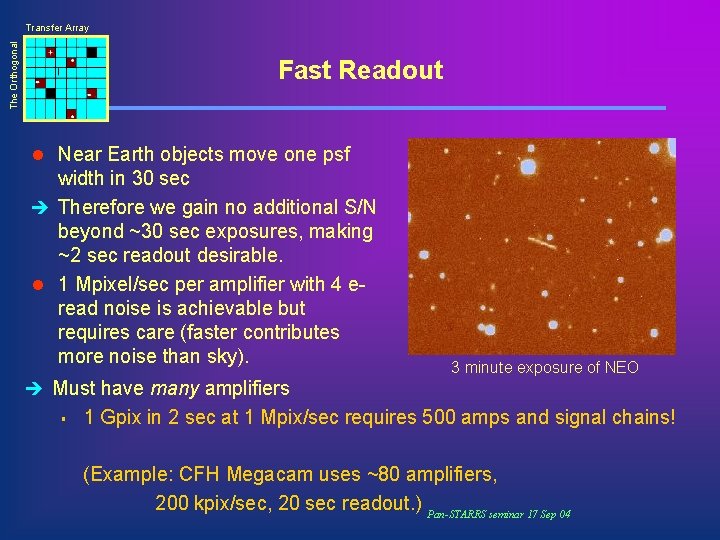
The Orthogonal Transfer Array Fast Readout l Near Earth objects move one psf width in 30 sec è Therefore we gain no additional S/N beyond ~30 sec exposures, making ~2 sec readout desirable. l 1 Mpixel/sec per amplifier with 4 eread noise is achievable but requires care (faster contributes more noise than sky). 3 minute exposure of NEO è Must have many amplifiers § 1 Gpix in 2 sec at 1 Mpix/sec requires 500 amps and signal chains! (Example: CFH Megacam uses ~80 amplifiers, 200 kpix/sec, 20 sec readout. ) Pan-STARRS seminar 17 Sep 04
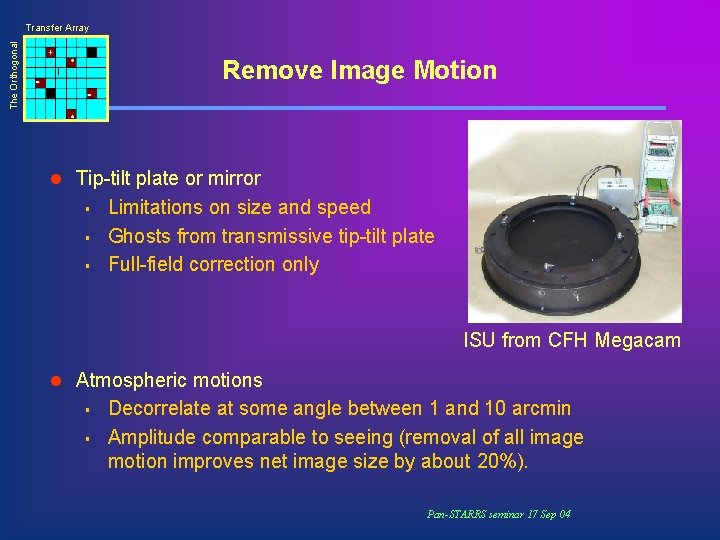
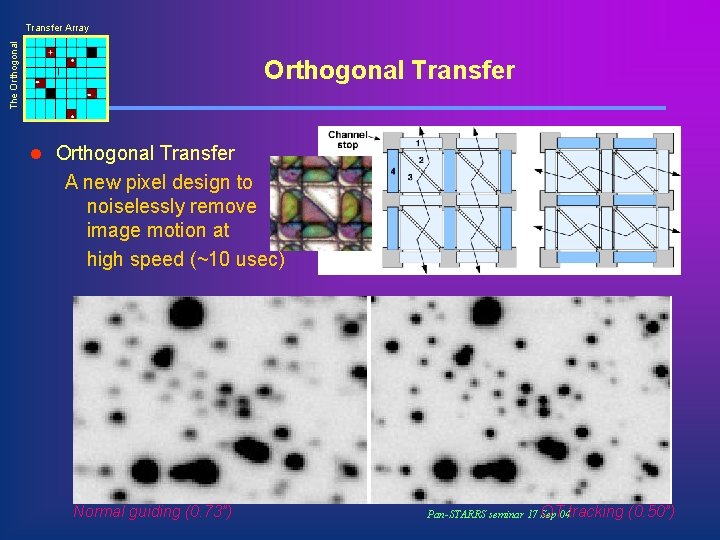
The Orthogonal Transfer Array Remove Image Motion l Tip-tilt plate or mirror § § § Limitations on size and speed Ghosts from transmissive tip-tilt plate Full-field correction only ISU from CFH Megacam l Atmospheric motions § § Decorrelate at some angle between 1 and 10 arcmin Amplitude comparable to seeing (removal of all image motion improves net image size by about 20%). Pan-STARRS seminar 17 Sep 04
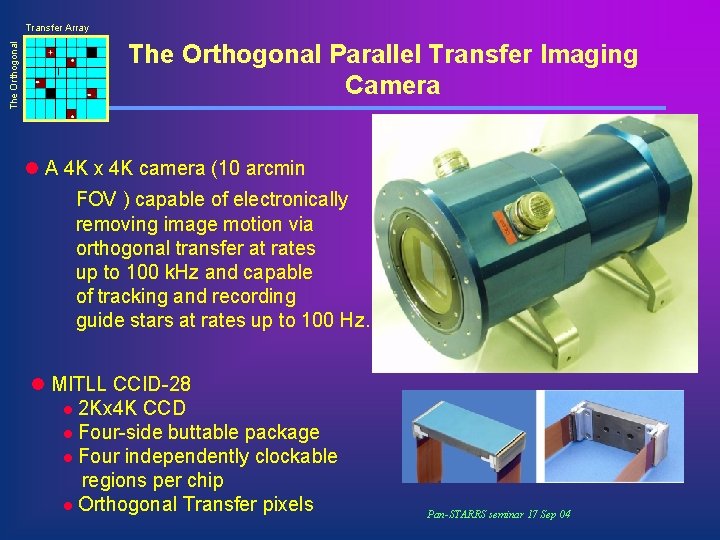
The Orthogonal Transfer Array The Orthogonal Parallel Transfer Imaging Camera l A 4 K x 4 K camera (10 arcmin FOV ) capable of electronically removing image motion via orthogonal transfer at rates up to 100 k. Hz and capable of tracking and recording guide stars at rates up to 100 Hz. l MITLL CCID-28 l 2 Kx 4 K CCD l Four-side buttable package l Four independently clockable regions per chip l Orthogonal Transfer pixels Pan-STARRS seminar 17 Sep 04
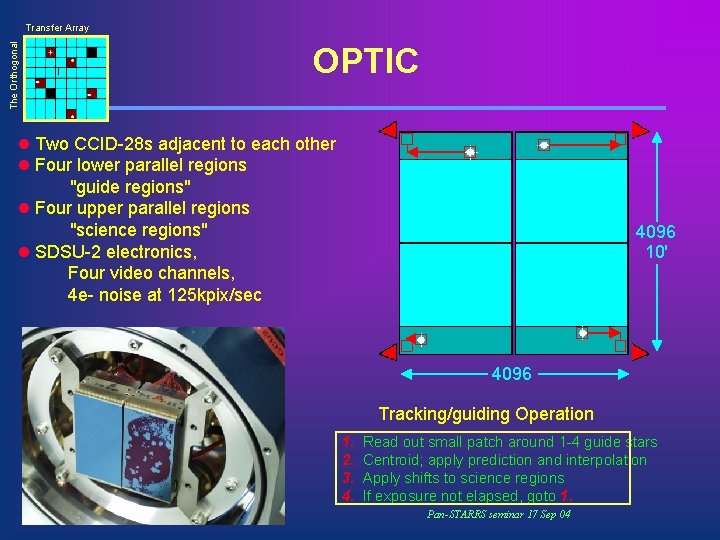
The Orthogonal Transfer Array OPTIC l Two CCID-28 s adjacent to each other l Four lower parallel regions "guide regions" l Four upper parallel regions "science regions" l SDSU-2 electronics, Four video channels, 4 e- noise at 125 kpix/sec 4096 10' 4096 Tracking/guiding Operation 1. 2. 3. 4. Read out small patch around 1 -4 guide stars Centroid; apply prediction and interpolation Apply shifts to science regions If exposure not elapsed, goto 1. Pan-STARRS seminar 17 Sep 04
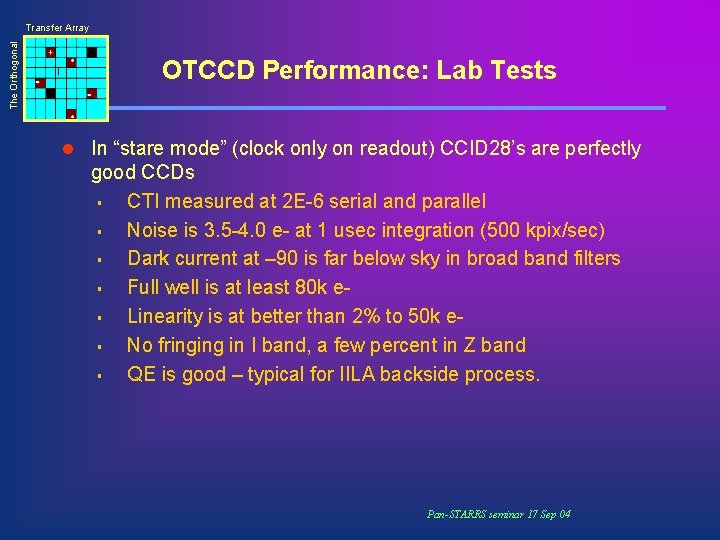
The Orthogonal Transfer Array OTCCD Performance: Lab Tests l In “stare mode” (clock only on readout) CCID 28’s are perfectly good CCDs § CTI measured at 2 E-6 serial and parallel § Noise is 3. 5 -4. 0 e- at 1 usec integration (500 kpix/sec) § Dark current at – 90 is far below sky in broad band filters § Full well is at least 80 k e§ Linearity is at better than 2% to 50 k e§ No fringing in I band, a few percent in Z band § QE is good – typical for IILA backside process. Pan-STARRS seminar 17 Sep 04
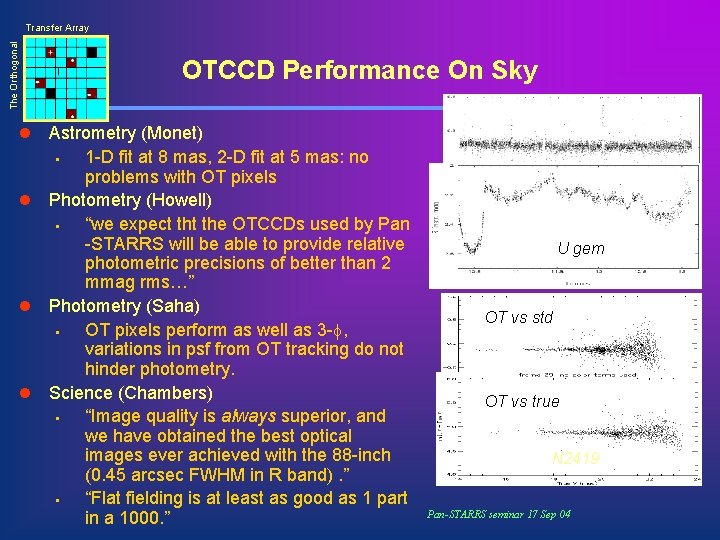
The Orthogonal Transfer Array OTCCD Performance On Sky Astrometry (Monet) § 1 -D fit at 8 mas, 2 -D fit at 5 mas: no problems with OT pixels l Photometry (Howell) § “we expect the OTCCDs used by Pan -STARRS will be able to provide relative photometric precisions of better than 2 mmag rms…” l Photometry (Saha) § OT pixels perform as well as 3 - , variations in psf from OT tracking do not hinder photometry. l Science (Chambers) § “Image quality is always superior, and we have obtained the best optical images ever achieved with the 88 -inch (0. 45 arcsec FWHM in R band). ” § “Flat fielding is at least as good as 1 part in a 1000. ” l U gem OT vs std OT vs true N 2419 Pan-STARRS seminar 17 Sep 04
The Orthogonal Transfer Array Orthogonal Transfer l Orthogonal Transfer A new pixel design to noiselessly remove image motion at high speed (~10 usec) Normal guiding (0. 73”) OT 04 tracking Pan-STARRS seminar 17 Sep (0. 50”)
The Orthogonal Transfer Array OTA Lot 1 Pixel structure Independently Addressable Cell OTA: 8 x 8 Array of Cells Pan-STARRS seminar 17 Sep 04
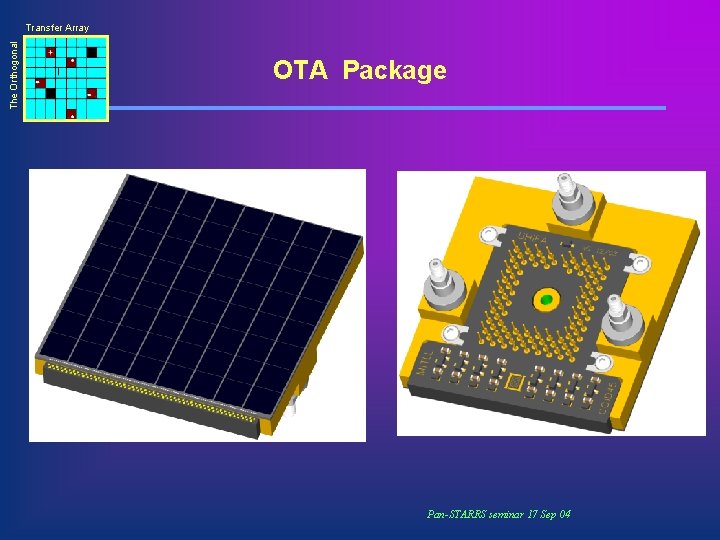
The Orthogonal Transfer Array OTA Package Pan-STARRS seminar 17 Sep 04
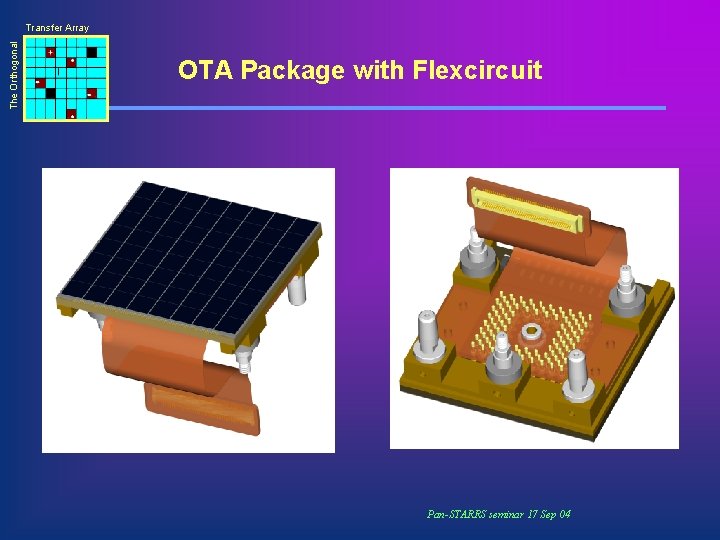
The Orthogonal Transfer Array OTA Package with Flexcircuit Pan-STARRS seminar 17 Sep 04
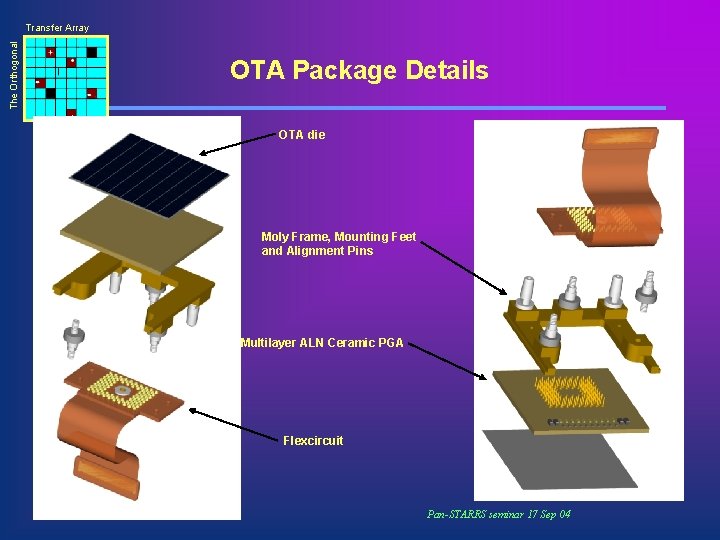
The Orthogonal Transfer Array OTA Package Details OTA die Moly Frame, Mounting Feet and Alignment Pins Multilayer ALN Ceramic PGA Flexcircuit Pan-STARRS seminar 17 Sep 04
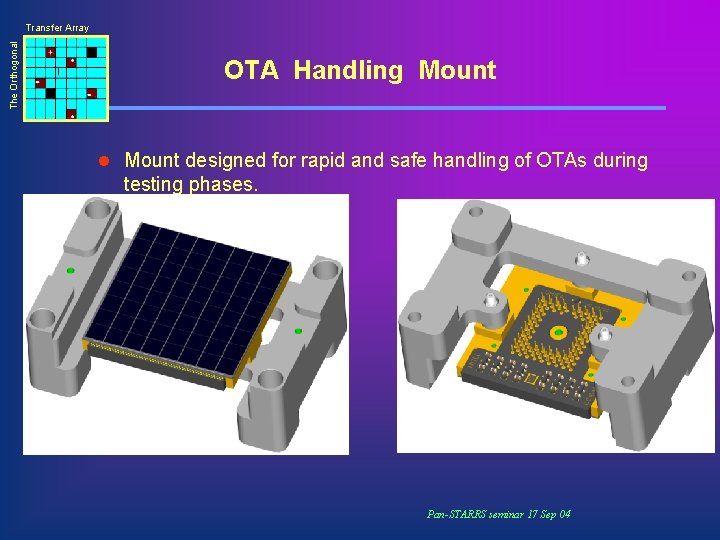
The Orthogonal Transfer Array OTA Handling Mount l Mount designed for rapid and safe handling of OTAs during testing phases. Pan-STARRS seminar 17 Sep 04
The Orthogonal Transfer Array Frontside OTA Pan-STARRS seminar 17 Sep 04