
THE ORIGINS OF CIVILIZATION IN EAST ASIA Out
- Slides: 26
THE ORIGINS OF CIVILIZATION IN EAST ASIA “Out of Africa”: The First East Asians
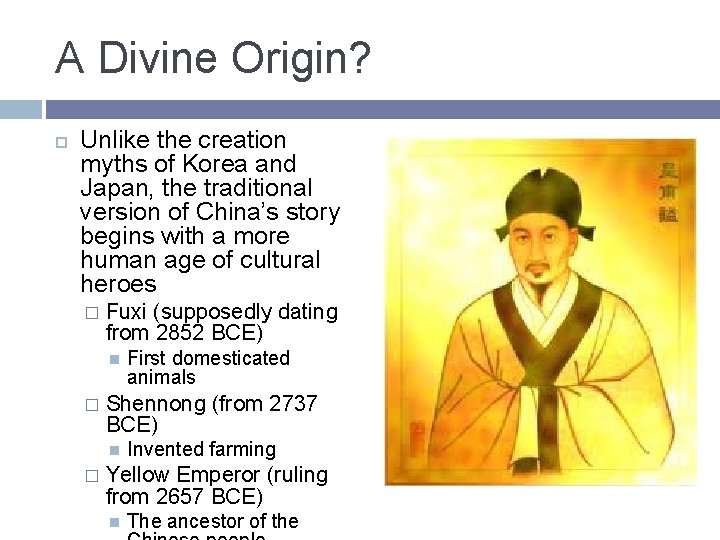
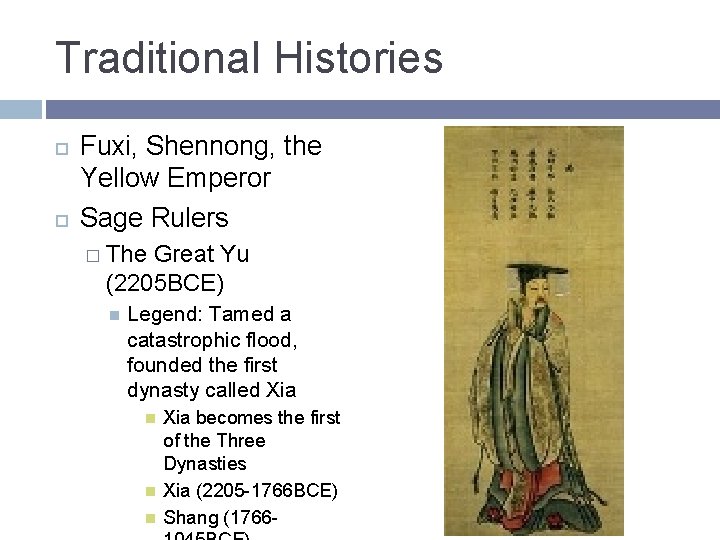
A Divine Origin? Unlike the creation myths of Korea and Japan, the traditional version of China’s story begins with a more human age of cultural heroes � Fuxi (supposedly dating from 2852 BCE) � Shennong (from 2737 BCE) � First domesticated animals Invented farming Yellow Emperor (ruling from 2657 BCE) The ancestor of the
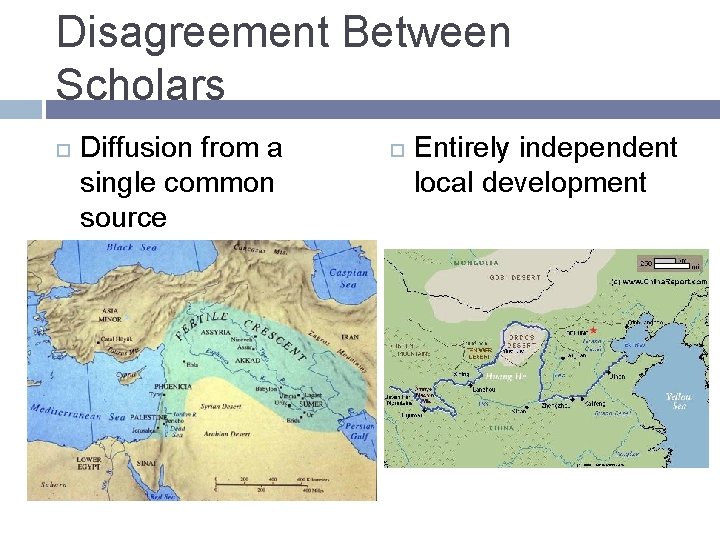
Disagreement Between Scholars Diffusion from a single common source Entirely independent local development
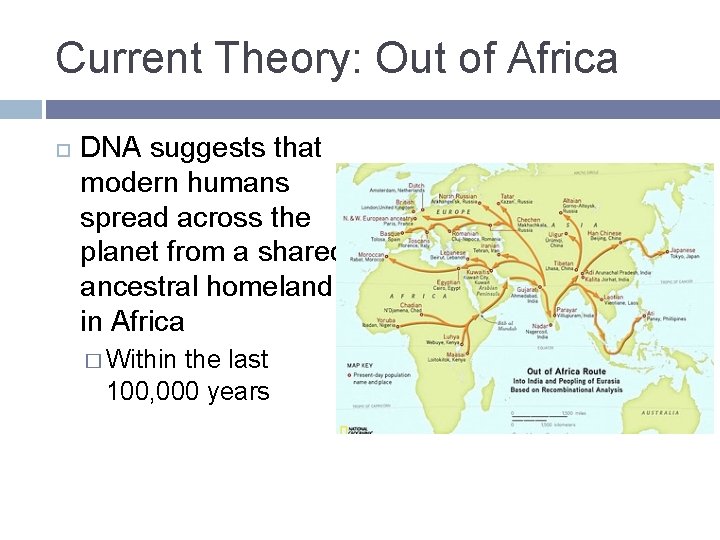
Current Theory: Out of Africa DNA suggests that modern humans spread across the planet from a shared ancestral homeland in Africa � Within the last 100, 000 years
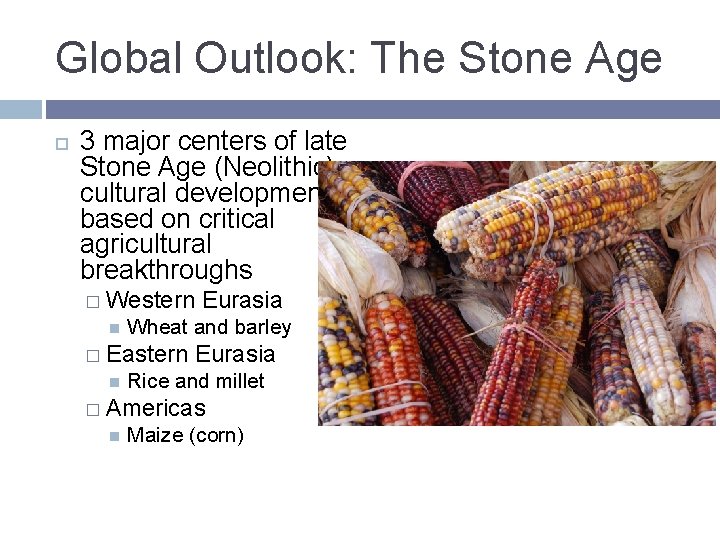
Global Outlook: The Stone Age 3 major centers of late Stone Age (Neolithic) cultural development based on critical agricultural breakthroughs � Western Wheat and barley � Eastern Eurasia Rice and millet � Americas Maize (corn)
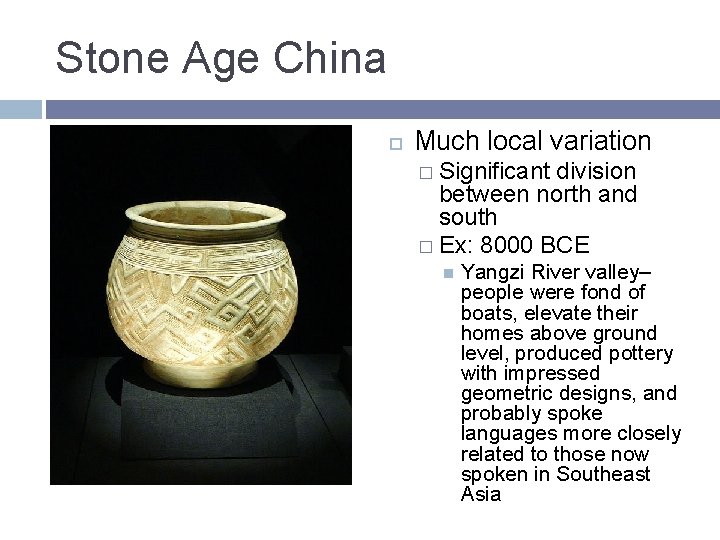
Stone Age China Much local variation � Significant division between north and south � Ex: 8000 BCE Yangzi River valley– people were fond of boats, elevate their homes above ground level, produced pottery with impressed geometric designs, and probably spoke languages more closely related to those now spoken in Southeast Asia
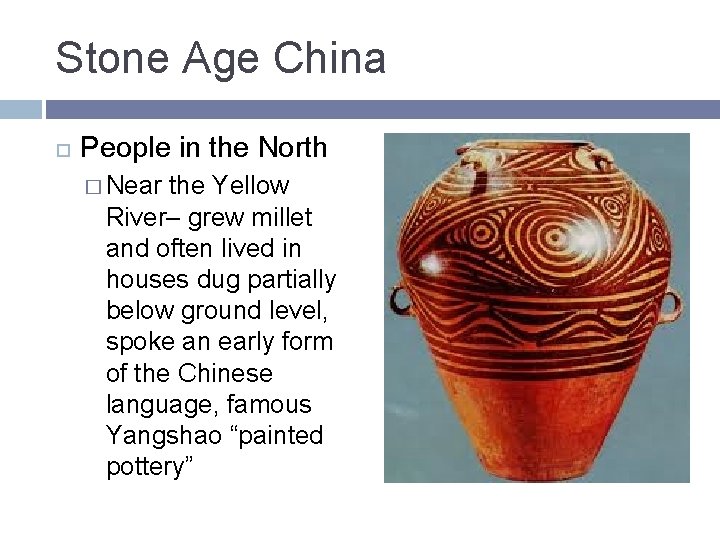
Stone Age China People in the North � Near the Yellow River– grew millet and often lived in houses dug partially below ground level, spoke an early form of the Chinese language, famous Yangshao “painted pottery”
Stone Age China Inner Mongolia– northernmost fringe � Turned from agriculture to raising livestock Pastoral nomads: became the great cultural “other” Frequent military opponent of the Chinese people for most of the pre-modern history
Conclusions: Misleading to think of Stone Age people as already being “Chinese” One visible emblem of East Asian cultural uniqueness: the use of a writing system (script) that is strikingly different from the Middle. Eastern-derived alphabets
Bronze Age China
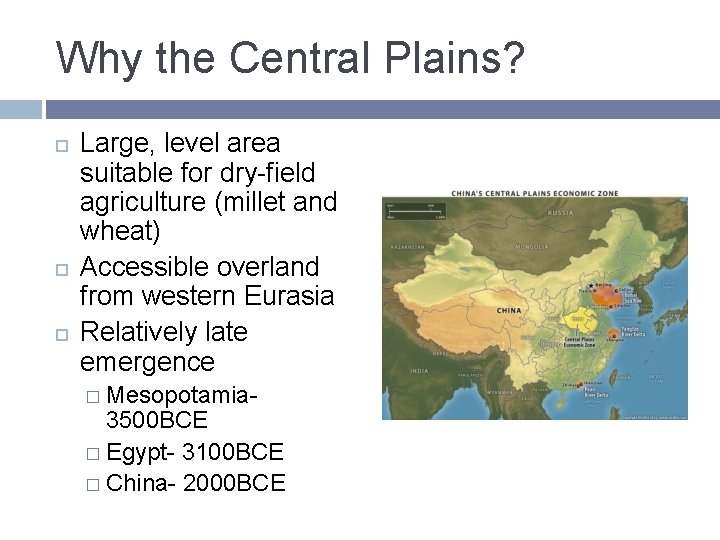
Primary Civilizations Northern China– the Yellow River area known as the Central Plain � Location of one of the world’s major primary civilization Primary civilization: the indigenous development of a civilization under only limited outside influence
Secondary Civilizations Primary vs. Secondary Civilizations � Secondary civilizations emerged chronologically somewhat later, under the influence of older neighbors or predecessors Korea, Japan, Western Europe, the United States
Why the Central Plains? Large, level area suitable for dry-field agriculture (millet and wheat) Accessible overland from western Eurasia Relatively late emergence � Mesopotamia- 3500 BCE � Egypt- 3100 BCE � China- 2000 BCE
Traditional Histories Fuxi, Shennong, the Yellow Emperor Sage Rulers � The Great Yu (2205 BCE) Legend: Tamed a catastrophic flood, founded the first dynasty called Xia becomes the first of the Three Dynasties Xia (2205 -1766 BCE) Shang (1766 -
The Bronze Age: The Shang Dynasty (1766 -1045 BCE) Example of a relatively large, territorial state � Different when compared to the small, independent city-states of Mesopotamia � One sovereign “king” with several local leaders related directly or indirectly to the king The Bronze Age was the time when men learned how to mine and smelt copper and tin to make bronze weapons and tools. � Some evidence for bronze casting being developed independently in China
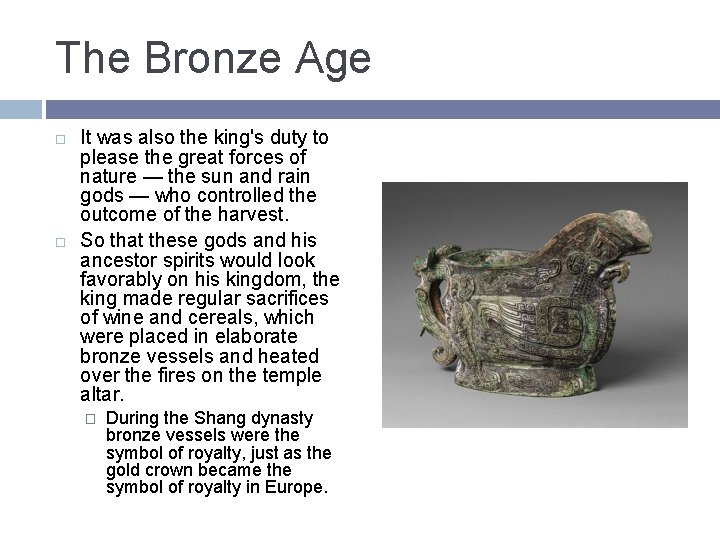
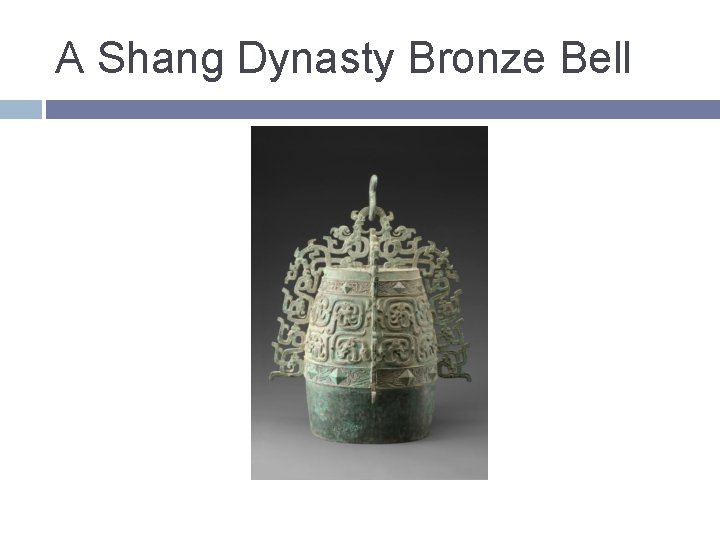
Shang Bronze: Many Shang Bronzes come from burial sites � Early Shang decorations were mainly geometric and arranged in horizontal zones around the vessel � The basic motifs (themes) are animal representations of deer faces, elephant heads, and human heads. As well as some mythical creatures (dragons, etc. )
The Bronze Age Contrary to common notions about the Chinese, the Bronze Age Chinese did not drink tea or eat rice. � Both these commodities came from the south and were not popular in the rest of China until hundreds of years later. � Instead the ordinary people consumed cereals, breads and cakes of millet and barley and drank beer. Members of the royal court could afford to vary their diet with meat and wine.
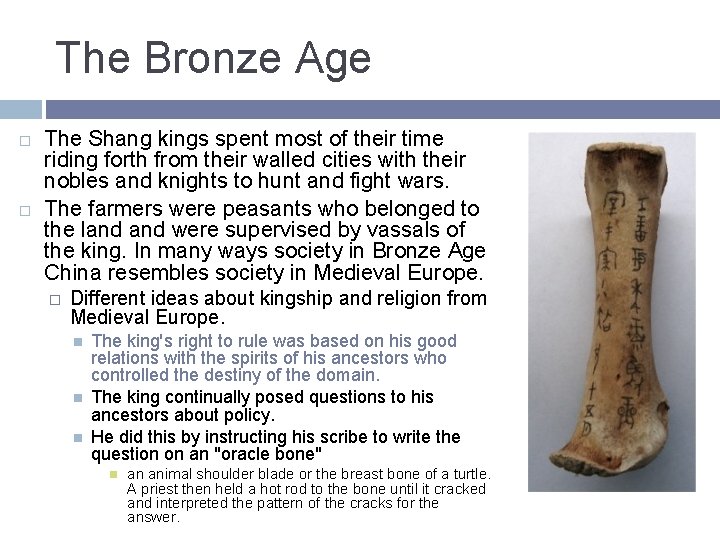
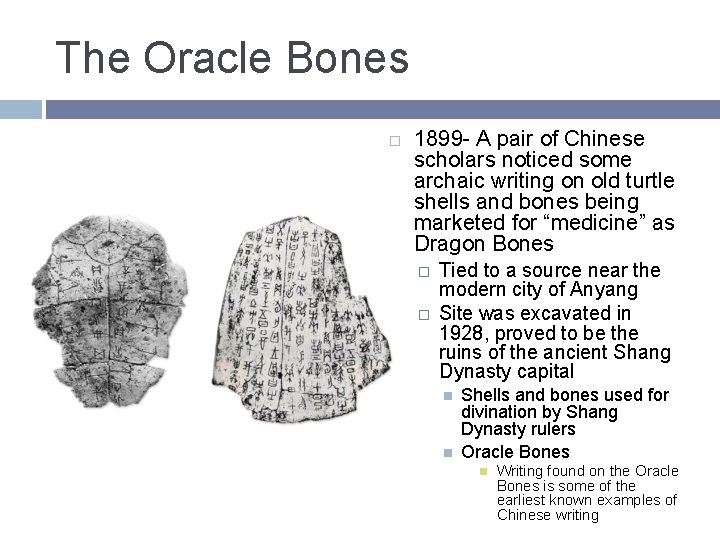
The Bronze Age The Shang kings spent most of their time riding forth from their walled cities with their nobles and knights to hunt and fight wars. The farmers were peasants who belonged to the land were supervised by vassals of the king. In many ways society in Bronze Age China resembles society in Medieval Europe. � Different ideas about kingship and religion from Medieval Europe. The king's right to rule was based on his good relations with the spirits of his ancestors who controlled the destiny of the domain. The king continually posed questions to his ancestors about policy. He did this by instructing his scribe to write the question on an "oracle bone" an animal shoulder blade or the breast bone of a turtle. A priest then held a hot rod to the bone until it cracked and interpreted the pattern of the cracks for the answer.
The Bronze Age It was also the king's duty to please the great forces of nature — the sun and rain gods — who controlled the outcome of the harvest. So that these gods and his ancestor spirits would look favorably on his kingdom, the king made regular sacrifices of wine and cereals, which were placed in elaborate bronze vessels and heated over the fires on the temple altar. � During the Shang dynasty bronze vessels were the symbol of royalty, just as the gold crown became the symbol of royalty in Europe.
The Bronze Age At times the Shang kings made animal and human sacrifices as well; and when the king and powerful members of the royal court died, it was not unusual that their wives, servants, bodyguards, horses and dogs were killed and buried with them.
A Shang Dynasty Bronze Bell
Key Points: The Bronze Age Chinese civilization is one of the oldest, continuous civilizations on earth. Early settlements from the Neolithic period begin in the river valleys as they do elsewhere in the world. The Shang (c. 1750 -c. 1050 BCE) is an early dynasty (succession of rulers of same line of descent) marked by impressive bronze technology and the beginning of China’s distinctive writing system. Several elements found in Shang civilization remain important throughout Chinese history. � � � These include: the notion of a supreme heavenly power, the belief in the power of the spirits of ancestors to affect events on earth; and the importance attached to rituals venerating ancestors and the role assigned to the king in performing these ceremonial rituals. China’s writing system first appears in the Shang dynasty on tortoise shells and cattle bones (called “oracle bones”) used for divination. Written language is a central determinant of the development of civilization; the Chinese writing system was the first developed in East Asia. � Although there are many mutually unintelligible dialects in China, there is only one system of writing — a major unifying factor in Chinese history. (Chinese characters have no set pronunciation; the sound attached to each can vary depending on the dialect. )
The Oracle Bones 1899 - A pair of Chinese scholars noticed some archaic writing on old turtle shells and bones being marketed for “medicine” as Dragon Bones � � Tied to a source near the modern city of Anyang Site was excavated in 1928, proved to be the ruins of the ancient Shang Dynasty capital Shells and bones used for divination by Shang Dynasty rulers Oracle Bones Writing found on the Oracle Bones is some of the earliest known examples of Chinese writing
The Oracle Bones: Reading and Creation Sociology-- Think, Pair Share: � What is the difference between “material culture” and “nonmaterial culture? ” Directions: With a partner, read the provided translations of the Oracle Bones � Break one translation into its four parts Preface Charge (question for the oracle) Prognostication (foretelling or prophecy) Verification (confirmation of truth)
Think, Pair Share What can you discern about the non-material culture of the Chinese from what you now know about the material culture (oracle bones)? Think about what, if any, similarities there are between Shang Dynasty Oracle Bones and divination methods in our history and in our contemporary culture.
Modern Oracle Translation Create your own oracle � Keep in mind: Who is presiding (witnessing) the ceremony Who is your oracle and why? How will you interpret the answer? Be specific! How will you verify (track and record) your oracle? How is your oracle (material culture) a reflection of your non-material culture?