
The Origins and Ionization Mechanisms of Warm Filaments

- Slides: 12
The Origins and Ionization Mechanisms of Warm Filaments in Cool Core Clusters Michael Mc. Donald Postdoctoral Associate - MIT Kavli Institute In collaboration with: S. Veilleux (UMd), R. Mushotzky (UMd), D. Rupke (Rhodes), C. Reynolds (UMd)
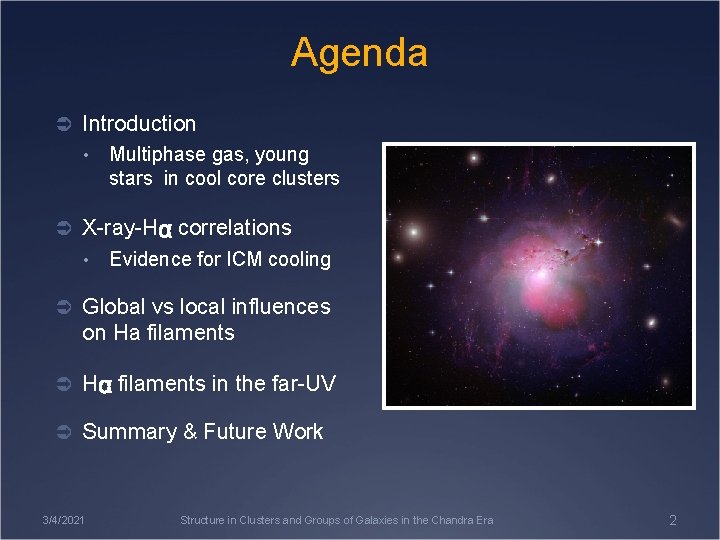
Agenda Ü Introduction • Multiphase gas, young stars in cool core clusters Ü X-ray-H correlations • Evidence for ICM cooling Ü Global vs local influences on Ha filaments Ü H filaments in the far-UV Ü Summary & Future Work 3/4/2021 Structure in Clusters and Groups of Galaxies in the Chandra Era 2
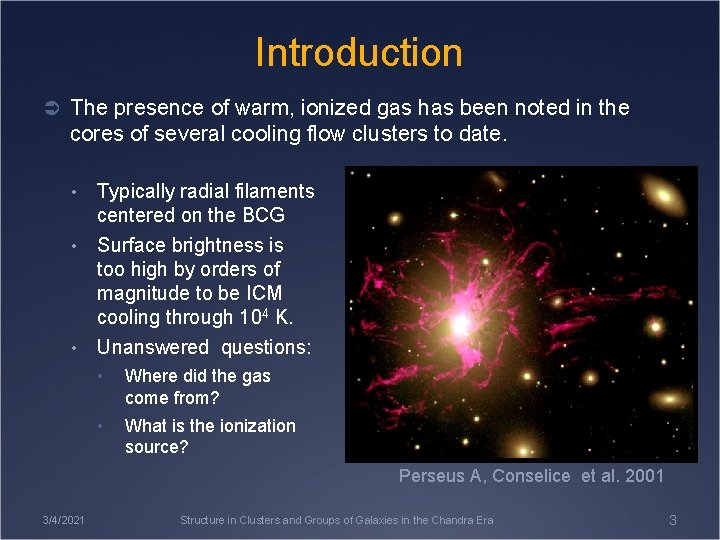
Introduction Ü The presence of warm, ionized gas has been noted in the cores of several cooling flow clusters to date. • Typically radial filaments centered on the BCG Surface brightness is too high by orders of magnitude to be ICM cooling through 104 K. • Unanswered questions: • • Where did the gas come from? • What is the ionization source? Perseus A, Conselice et al. 2001 3/4/2021 Structure in Clusters and Groups of Galaxies in the Chandra Era 3
Motivation & Sample Selection Ü Potential sources of gas: Ü Potential sources of heat: • Starburst/AGN wind • Cosmic ray ionization • Stripped from infalling, gas-rich galaxies X-ray cooling flow Buoyant radio bubbles • AGN Young stellar populations Conduction from ICM Ionization by ICM X-rays • • • Ü In order to isolate the source of cool gas and the ionization mechanism, we assembled a sample of cool core and noncool core clusters. Ü 33 systems (23 clusters, 10 groups) Ü Full sample has X-ray (CXO), H (MMTF), optical (Magellan), and radio (FIRST/SUMSS) data. 3/4/2021 Structure in Clusters and Groups of Galaxies in the Chandra Era 4
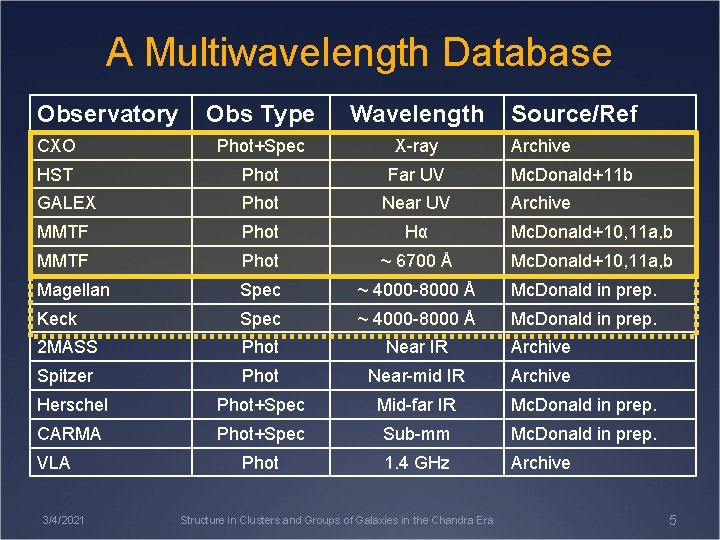
A Multiwavelength Database Observatory Obs Type Wavelength CXO Phot+Spec X-ray HST Phot Far UV GALEX Phot Near UV MMTF Phot Hα Mc. Donald+10, 11 a, b MMTF Phot ~ 6700 Å Mc. Donald+10, 11 a, b Magellan Spec ~ 4000 -8000 Å Mc. Donald in prep. Keck Spec ~ 4000 -8000 Å Mc. Donald in prep. 2 MASS Phot Near IR Archive Spitzer Phot Near-mid IR Archive Herschel Phot+Spec Mid-far IR Mc. Donald in prep. CARMA Phot+Spec Sub-mm Mc. Donald in prep. Phot 1. 4 GHz Archive VLA 3/4/2021 Structure in Clusters and Groups of Galaxies in the Chandra Era Source/Ref Archive Mc. Donald+11 b Archive 5
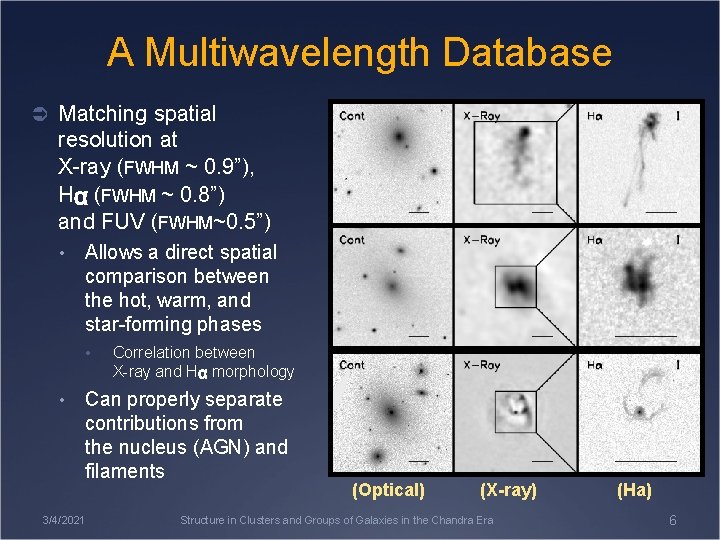
A Multiwavelength Database Ü Matching spatial resolution at X-ray (FWHM ~ 0. 9”), H (FWHM ~ 0. 8”) and FUV (FWHM~0. 5”) • Allows a direct spatial comparison between the hot, warm, and star-forming phases • • Correlation between X-ray and H morphology Can properly separate contributions from the nucleus (AGN) and filaments 3/4/2021 (Optical) (X-ray) Structure in Clusters and Groups of Galaxies in the Chandra Era (Ha) 6
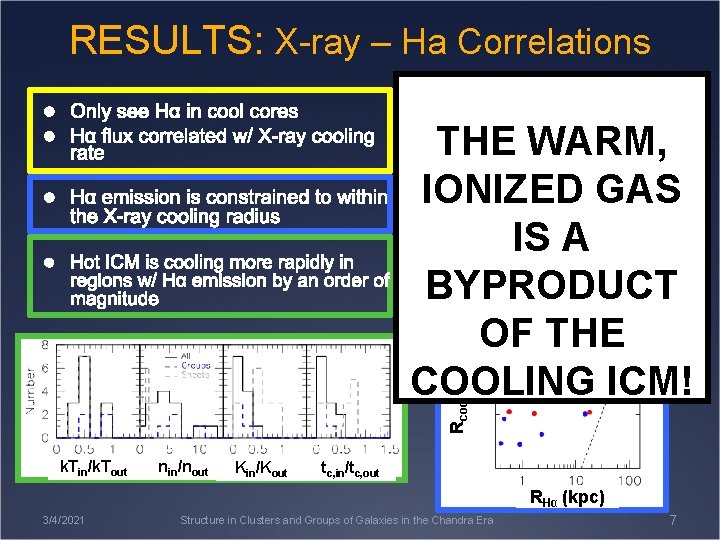
RESULTS: X-ray – Ha Correlations LHα THE WARM, IONIZED GAS IS A k. T d. M/dt BYPRODUCT OF THE COOLING ICM! spec Rcool (kpc) (<100 kpc) k. Tin/k. Tout nin/nout Kin/Kout tc, in/tc, out RHα (kpc) 3/4/2021 Structure in Clusters and Groups of Galaxies in the Chandra Era 7
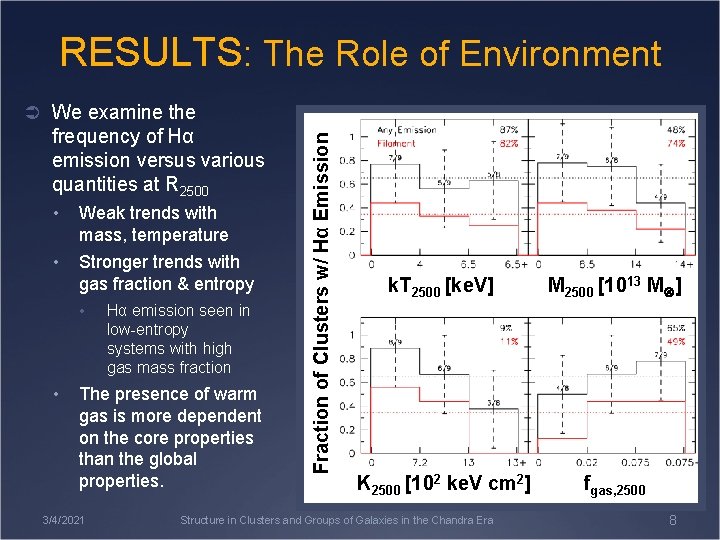
RESULTS: The Role of Environment frequency of Hα emission versus various quantities at R 2500 • Weak trends with mass, temperature • Stronger trends with gas fraction & entropy • • Hα emission seen in low-entropy systems with high gas mass fraction The presence of warm gas is more dependent on the core properties than the global properties. 3/4/2021 Fraction of Clusters w/ Hα Emission Ü We examine the k. T 2500 [ke. V] M 2500 [1013 M ] K 2500 [102 ke. V cm 2] fgas, 2500 Structure in Clusters and Groups of Galaxies in the Chandra Era 8
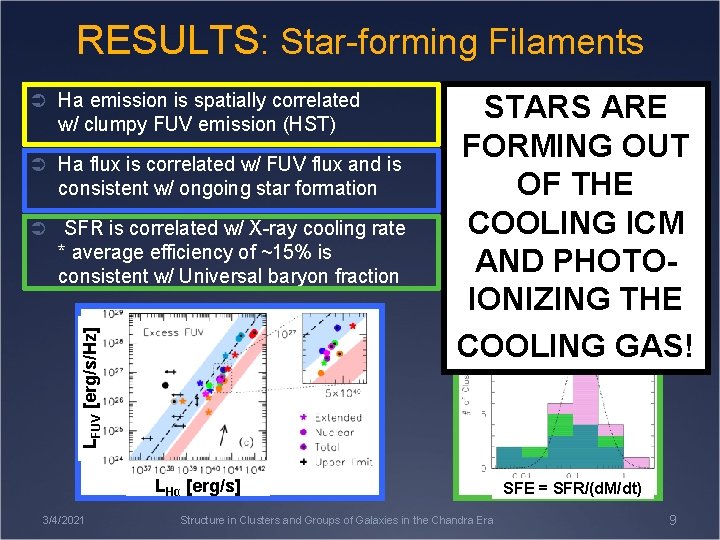
RESULTS: Star-forming Filaments Ü Ha emission is spatially correlated w/ clumpy FUV emission (HST) Ü Ha flux is correlated w/ FUV flux and is consistent w/ ongoing star formation Ü SFR is correlated w/ X-ray cooling rate LFUV [erg/s/Hz] * average efficiency of ~15% is consistent w/ Universal baryon fraction STARS ARE FORMING OUT OF THE COOLING ICM AND PHOTOIONIZING THE COOLING GAS! LHα [erg/s] 3/4/2021 Structure in Clusters and Groups of Galaxies in the Chandra Era SFE = SFR/(d. M/dt) 9
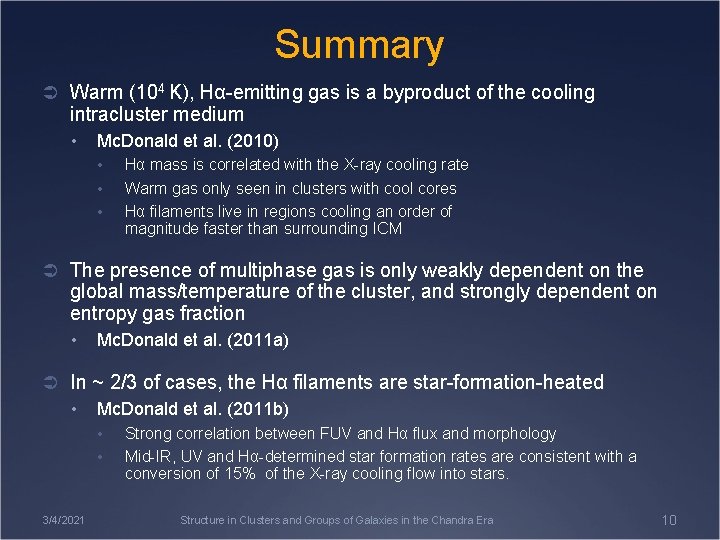
Summary Ü Warm (104 K), Hα-emitting gas is a byproduct of the cooling intracluster medium • Mc. Donald et al. (2010) • • • Hα mass is correlated with the X-ray cooling rate Warm gas only seen in clusters with cool cores Hα filaments live in regions cooling an order of magnitude faster than surrounding ICM Ü The presence of multiphase gas is only weakly dependent on the global mass/temperature of the cluster, and strongly dependent on entropy gas fraction • Mc. Donald et al. (2011 a) Ü In ~ 2/3 of cases, the Hα filaments are star-formation-heated • Mc. Donald et al. (2011 b) • • 3/4/2021 Strong correlation between FUV and Hα flux and morphology Mid-IR, UV and Hα-determined star formation rates are consistent with a conversion of 15% of the X-ray cooling flow into stars. Structure in Clusters and Groups of Galaxies in the Chandra Era 10
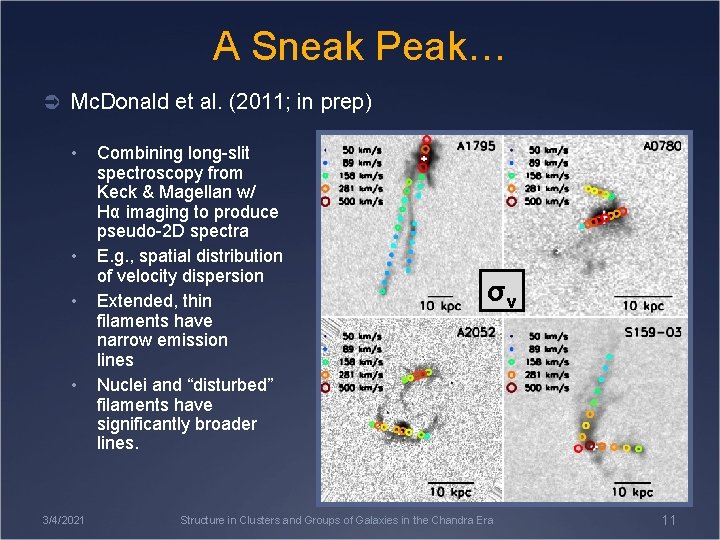
A Sneak Peak… Ü Mc. Donald et al. (2011; in prep) • • 3/4/2021 Combining long-slit spectroscopy from Keck & Magellan w/ Hα imaging to produce pseudo-2 D spectra E. g. , spatial distribution of velocity dispersion Extended, thin filaments have narrow emission lines Nuclei and “disturbed” filaments have significantly broader lines. σv Structure in Clusters and Groups of Galaxies in the Chandra Era 11
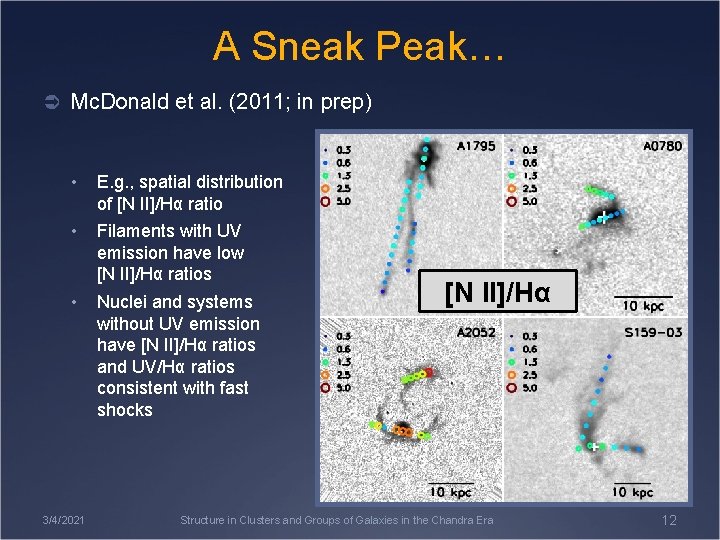
A Sneak Peak… Ü Mc. Donald et al. (2011; in prep) • E. g. , spatial distribution of [N II]/Hα ratio • Filaments with UV emission have low [N II]/Hα ratios • Nuclei and systems without UV emission have [N II]/Hα ratios and UV/Hα ratios consistent with fast shocks 3/4/2021 [N II]/Hα Structure in Clusters and Groups of Galaxies in the Chandra Era 12