
The origin of the cultivated apple Ancient Malus
- Slides: 24
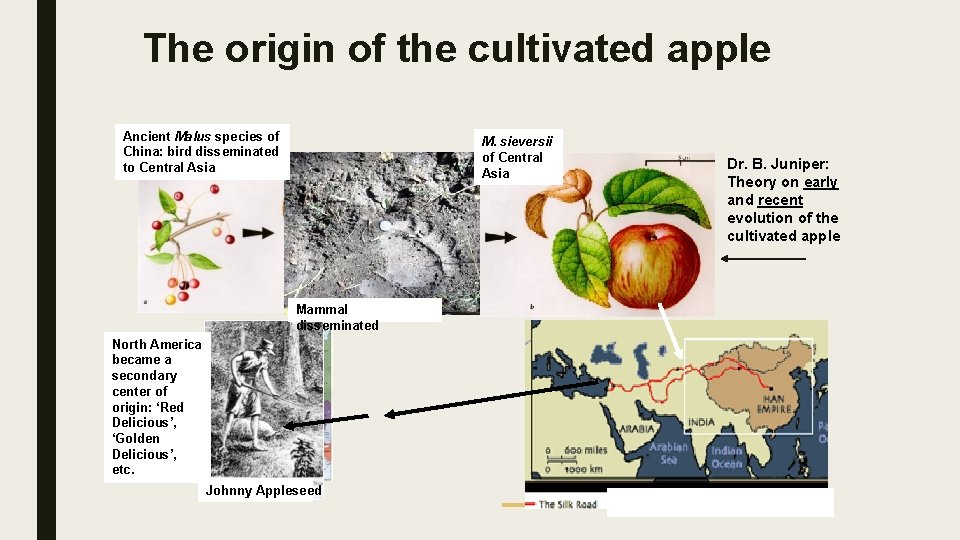
The origin of the cultivated apple Ancient Malus species of China: bird disseminated to Central Asia M. sieversii of Central Asia Mammal disseminated North America became a secondary center of origin: ‘Red Delicious’, ‘Golden Delicious’, etc. Johnny Appleseed Dr. B. Juniper: Theory on early and recent evolution of the cultivated apple
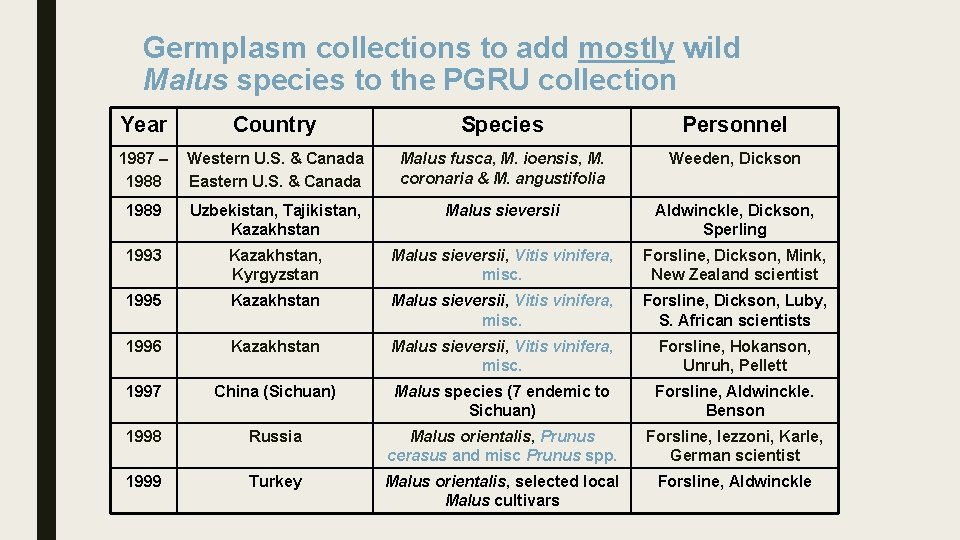
Germplasm collections to add mostly wild Malus species to the PGRU collection Year Country Species Personnel 1987 – 1988 Western U. S. & Canada Eastern U. S. & Canada Malus fusca, M. ioensis, M. coronaria & M. angustifolia Weeden, Dickson 1989 Uzbekistan, Tajikistan, Kazakhstan Malus sieversii Aldwinckle, Dickson, Sperling 1993 Kazakhstan, Kyrgyzstan Malus sieversii, Vitis vinifera, misc. Forsline, Dickson, Mink, New Zealand scientist 1995 Kazakhstan Malus sieversii, Vitis vinifera, misc. Forsline, Dickson, Luby, S. African scientists 1996 Kazakhstan Malus sieversii, Vitis vinifera, misc. Forsline, Hokanson, Unruh, Pellett 1997 China (Sichuan) Malus species (7 endemic to Sichuan) Forsline, Aldwinckle. Benson 1998 Russia Malus orientalis, Prunus cerasus and misc Prunus spp. Forsline, Iezzoni, Karle, German scientist 1999 Turkey Malus orientalis, selected local Malus cultivars Forsline, Aldwinckle
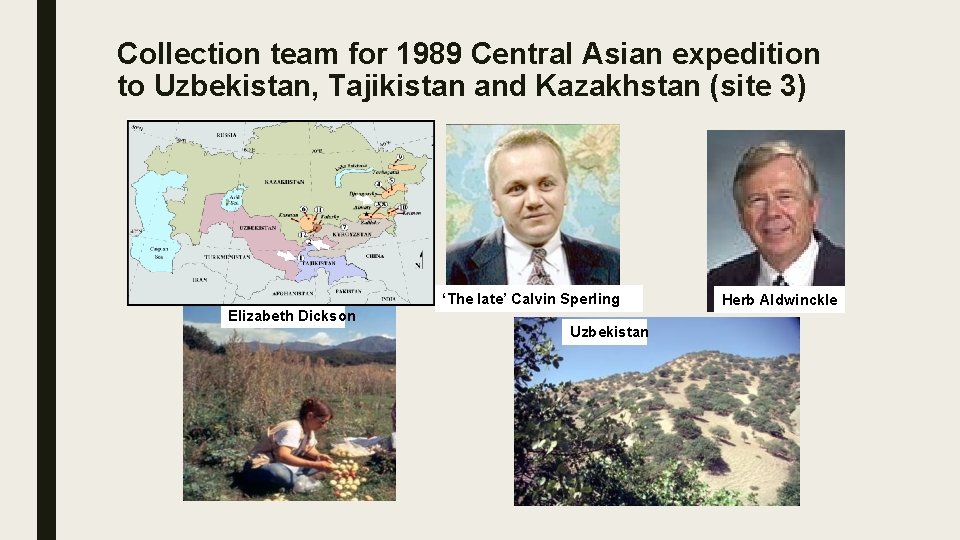
Collection team for 1989 Central Asian expedition to Uzbekistan, Tajikistan and Kazakhstan (site 3) ‘The late’ Calvin Sperling Elizabeth Dickson Uzbekistan Herb Aldwinckle
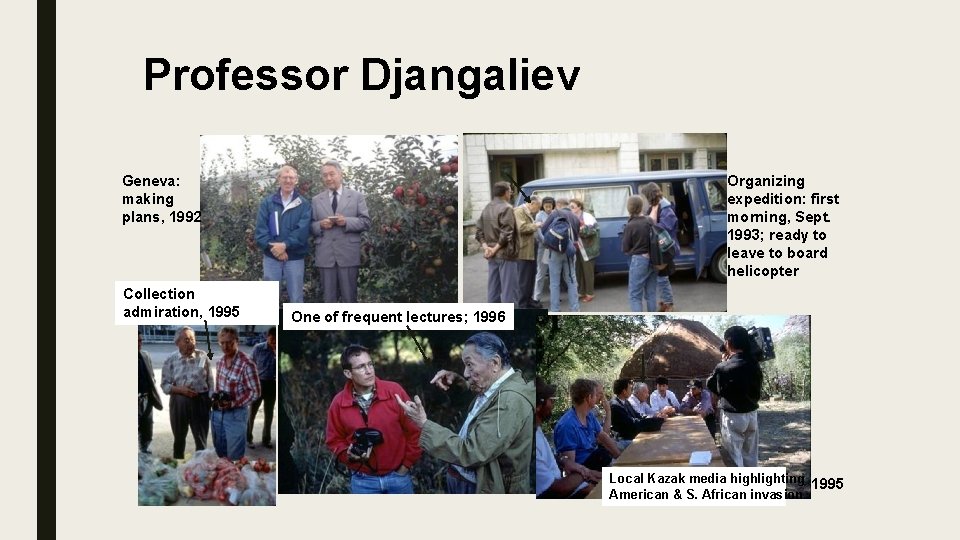
Professor Djangaliev Geneva: making plans, 1992 Collection admiration, 1995 Organizing expedition: first morning, Sept. 1993; ready to leave to board helicopter One of frequent lectures; 1996 Local Kazak media highlighting 1995 American & S. African invasion
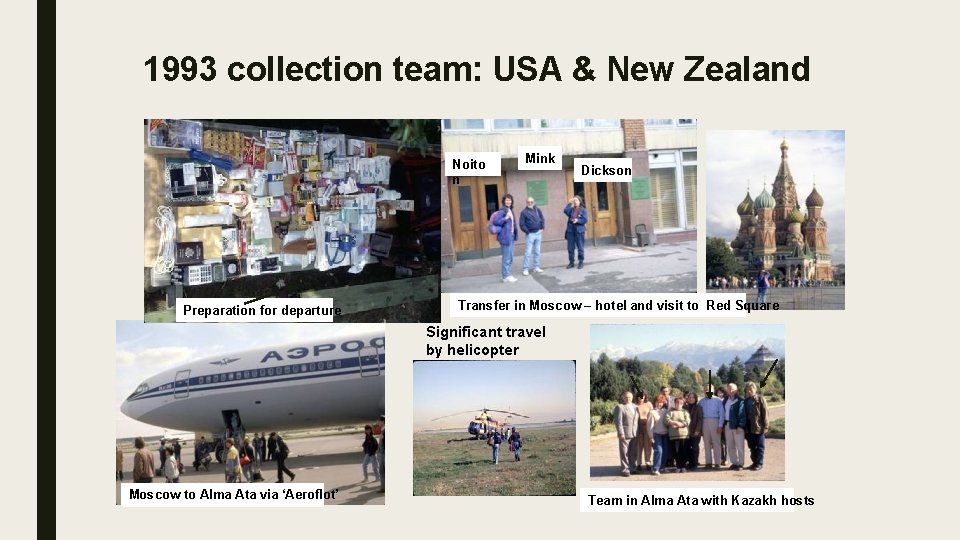
1993 collection team: USA & New Zealand Noito n Preparation for departure Mink Dickson Transfer in Moscow – hotel and visit to Red Square Significant travel by helicopter Moscow to Alma Ata via ‘Aeroflot’ Team in Alma Ata with Kazakh hosts
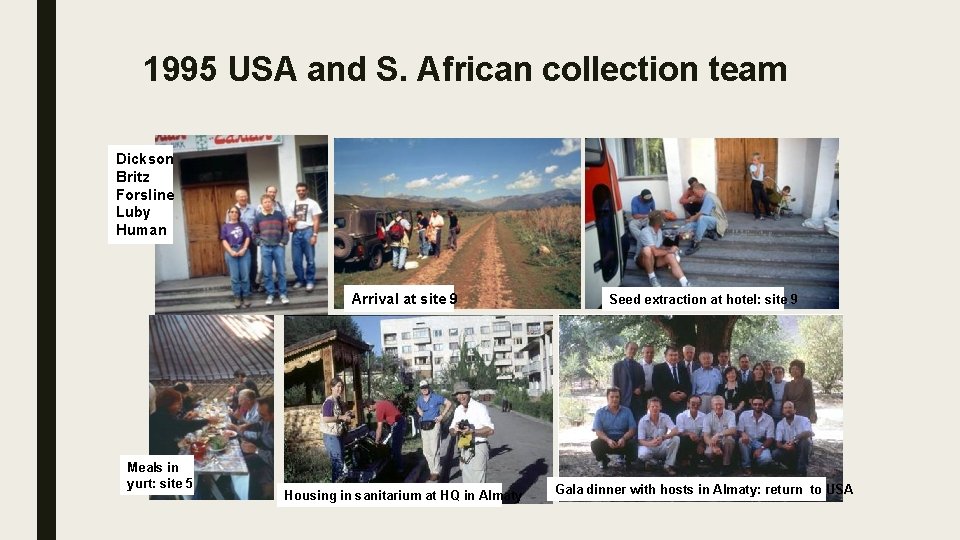
1995 USA and S. African collection team Dickson Britz Forsline Luby Human Meals in yurt: site 5 Arrival at site 9 Seed extraction at hotel: site 9 Housing in sanitarium at HQ in Almaty Gala dinner with hosts in Almaty: return to USA
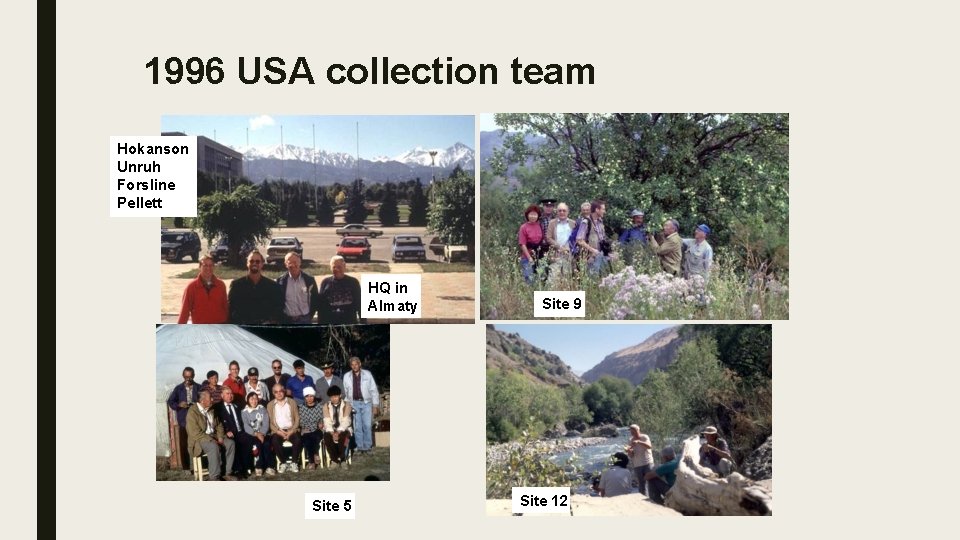
1996 USA collection team Hokanson Unruh Forsline Pellett HQ in Almaty Site 5 Site 9 Site 12
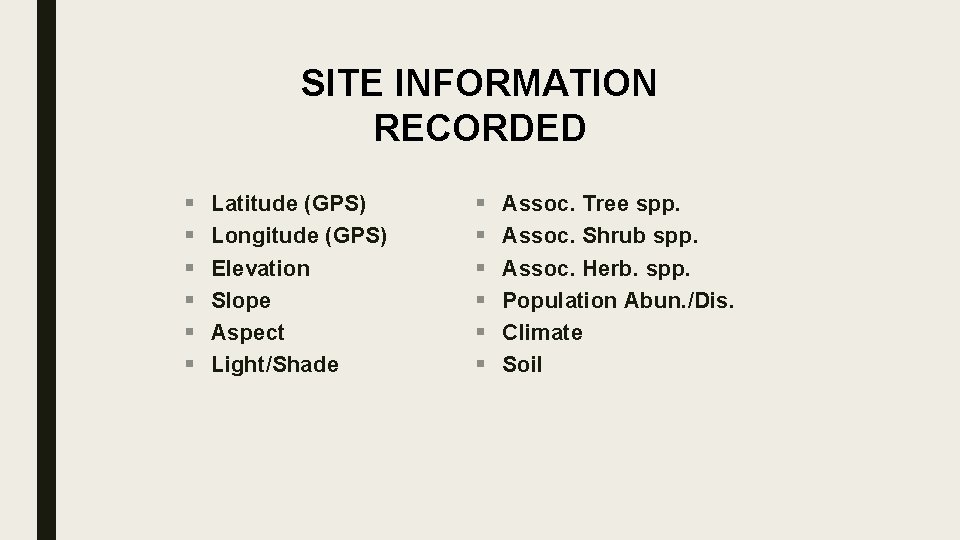
SITE INFORMATION RECORDED § § § Latitude (GPS) Longitude (GPS) Elevation Slope Aspect Light/Shade § § § Assoc. Tree spp. Assoc. Shrub spp. Assoc. Herb. spp. Population Abun. /Dis. Climate Soil
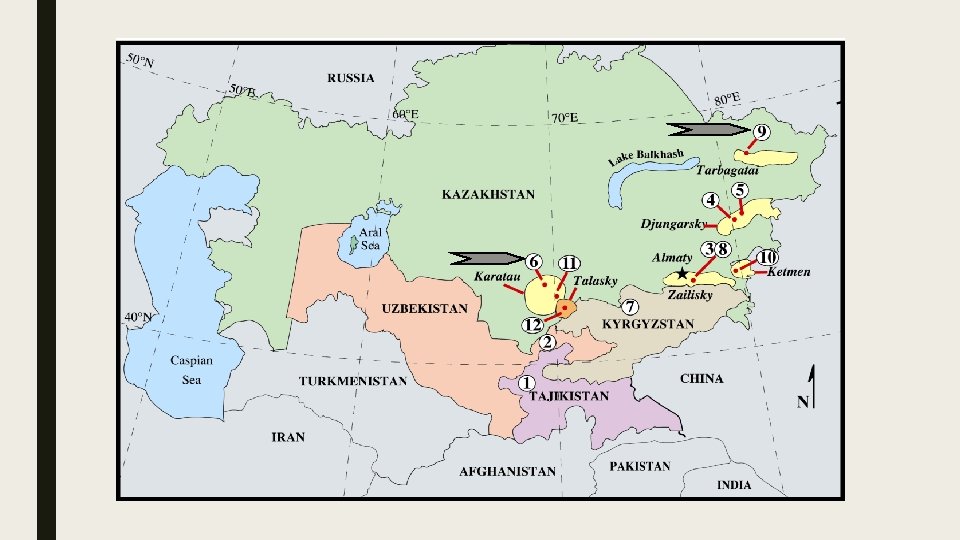
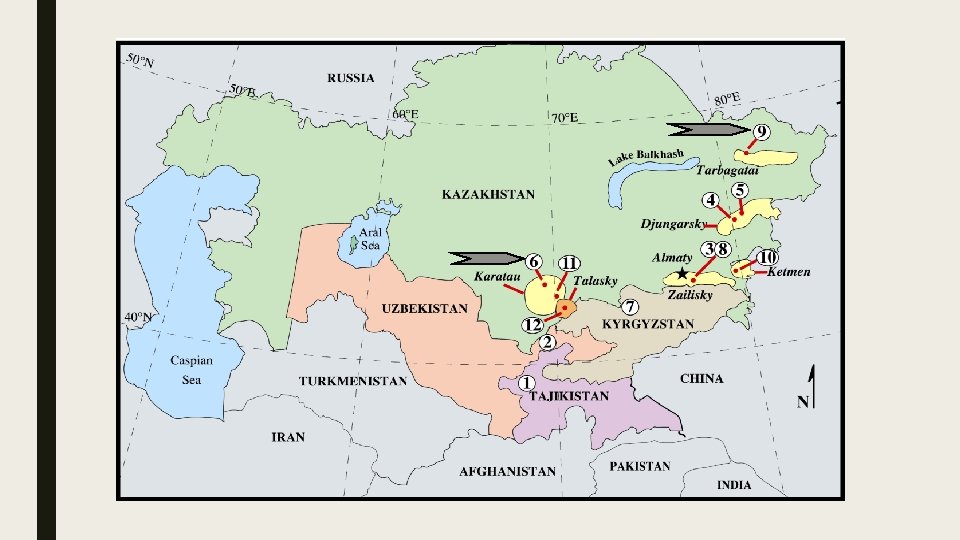
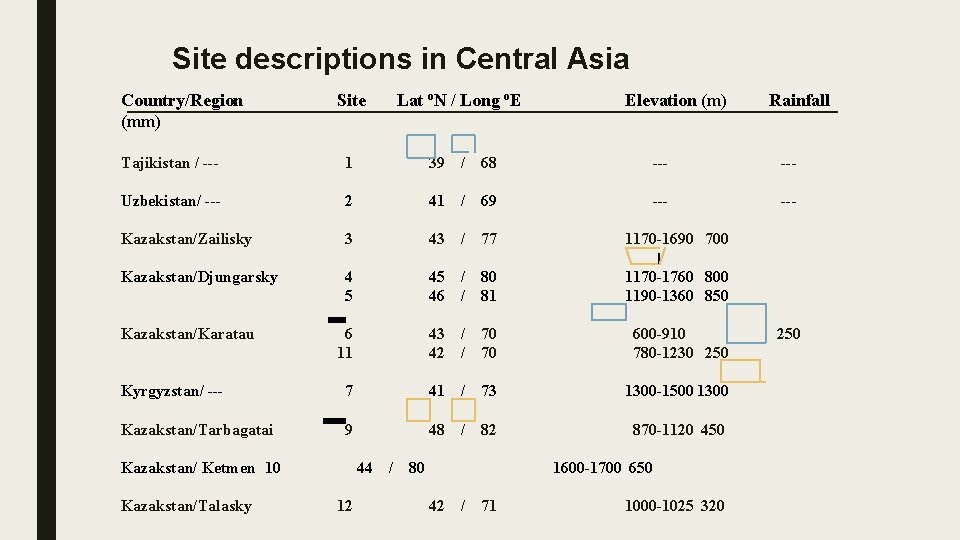
Site descriptions in Central Asia Country/Region (mm) Site Lat o. N / Long o. E Elevation (m) Rainfall Tajikistan / --- 1 39 / 68 --- Uzbekistan/ --- 2 41 / 69 --- Kazakstan/Zailisky 3 43 / 77 1170 -1690 700 Kazakstan/Djungarsky 4 5 45 46 / / 80 81 1170 -1760 800 1190 -1360 850 6 11 43 42 / / 70 70 600 -910 780 -1230 250 Kyrgyzstan/ --- 7 41 / 73 1300 -1500 1300 Kazakstan/Tarbagatai 9 48 / 82 870 -1120 450 Kazakstan/Karatau Kazakstan/ Ketmen 10 Kazakstan/Talasky 44 12 / 80 1600 -1700 650 42 / 71 1000 -1025 320 250
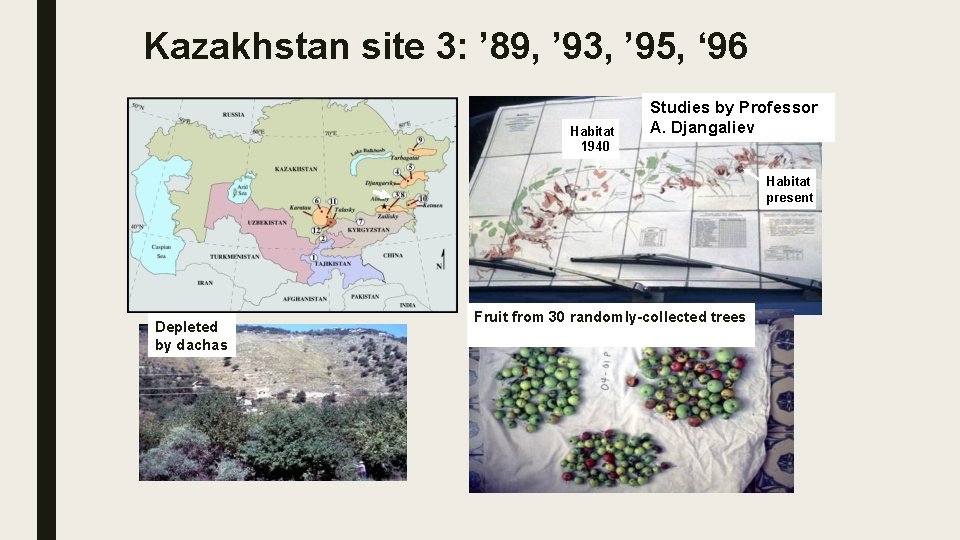
Kazakhstan site 3: ’ 89, ’ 93, ’ 95, ‘ 96 Habitat 1940 Studies by Professor A. Djangaliev Habitat present Depleted by dachas Fruit from 30 randomly-collected trees
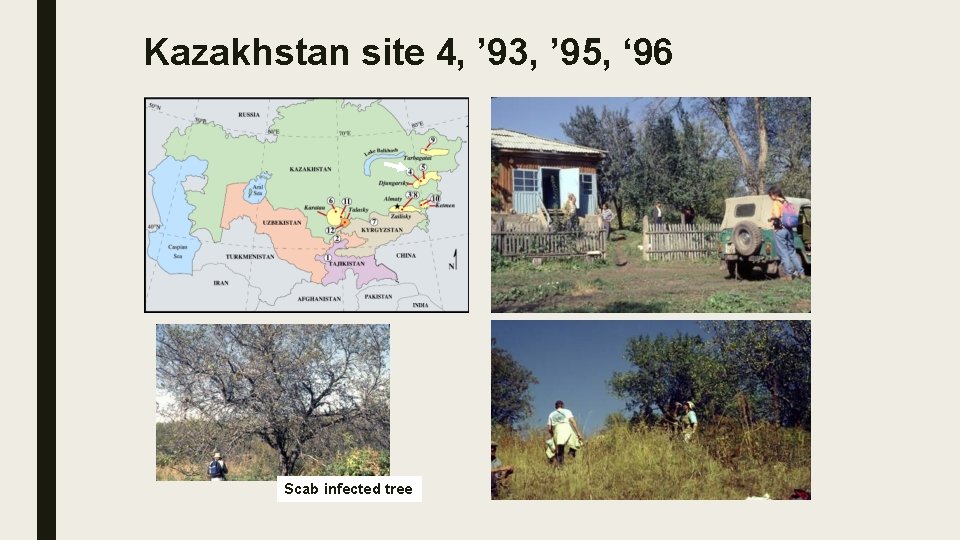
Kazakhstan site 4, ’ 93, ’ 95, ‘ 96 Scab infected tree
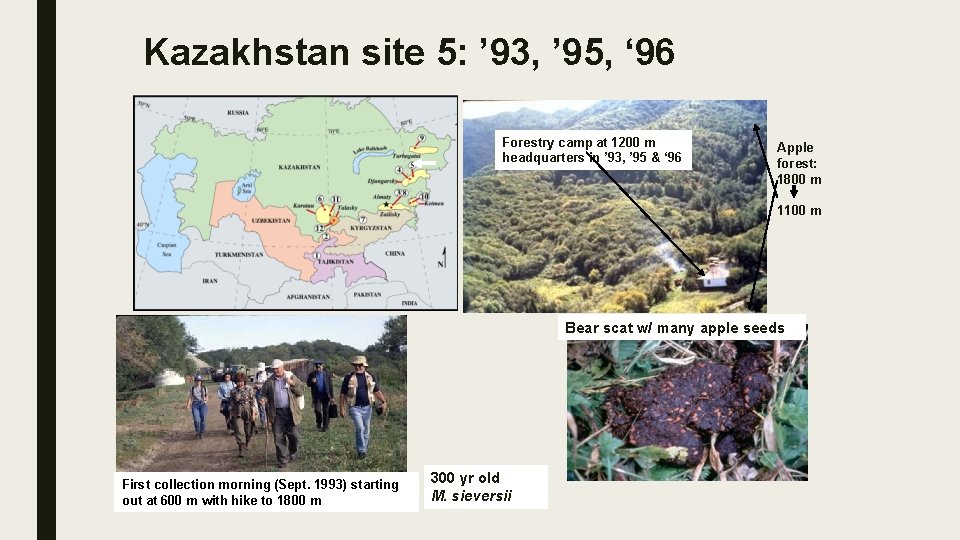
Kazakhstan site 5: ’ 93, ’ 95, ‘ 96 Forestry camp at 1200 m headquarters in ’ 93, ’ 95 & ‘ 96 Apple forest: 1800 m 1100 m Bear scat w/ many apple seeds First collection morning (Sept. 1993) starting out at 600 m with hike to 1800 m 300 yr old M. sieversii
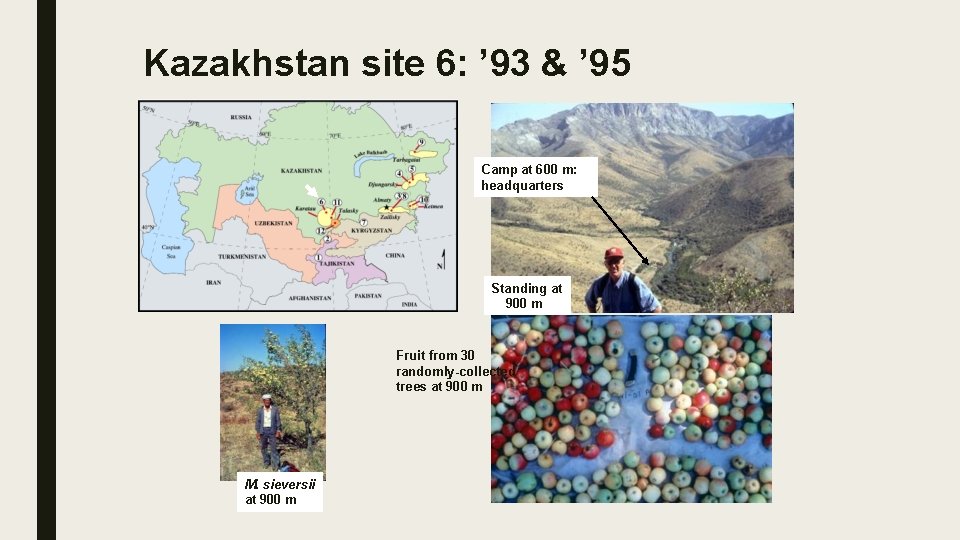
Kazakhstan site 6: ’ 93 & ’ 95 Camp at 600 m: headquarters Standing at 900 m Fruit from 30 randomly-collected trees at 900 m M. sieversii at 900 m
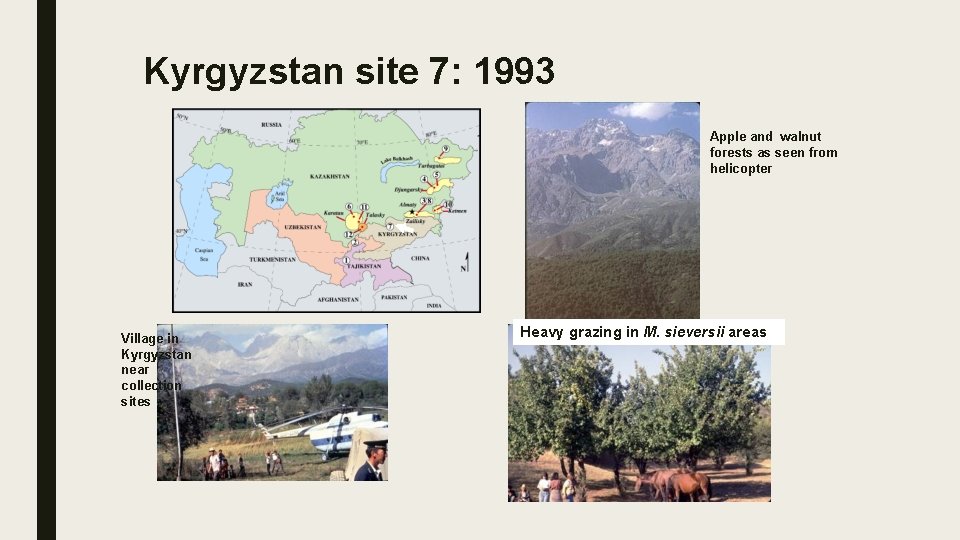
Kyrgyzstan site 7: 1993 Apple and walnut forests as seen from helicopter Village in Kyrgyzstan near collection sites Heavy grazing in M. sieversii areas
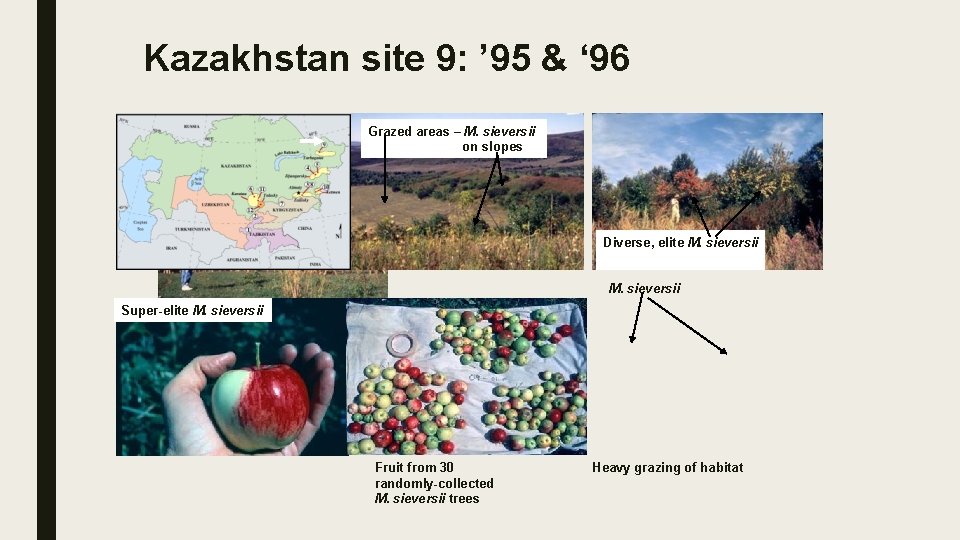
Kazakhstan site 9: ’ 95 & ‘ 96 Grazed areas – M. sieversii on slopes Diverse, elite M. sieversii Super-elite M. sieversii Fruit from 30 randomly-collected M. sieversii trees Heavy grazing of habitat
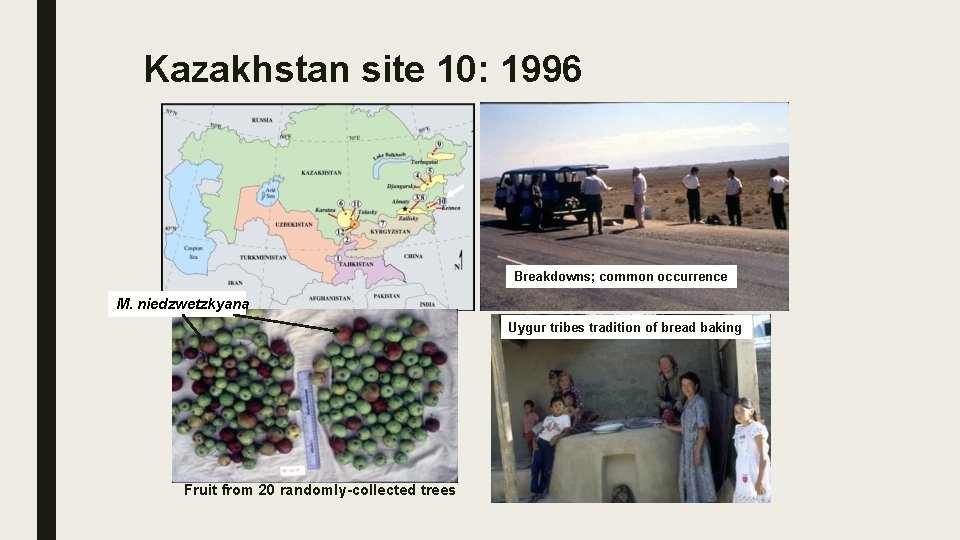
Kazakhstan site 10: 1996 Breakdowns; common occurrence M. niedzwetzkyana Uygur tribes tradition of bread baking Fruit from 20 randomly-collected trees
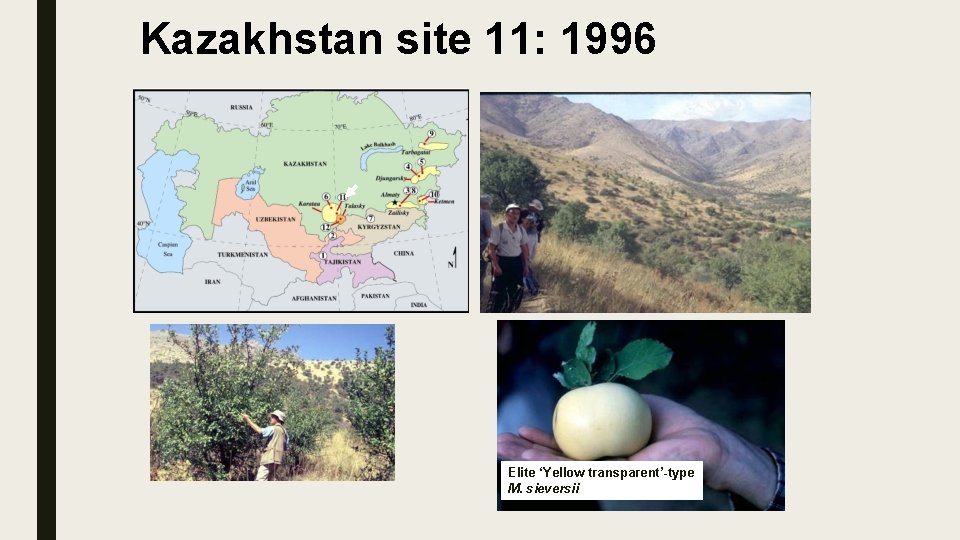
Kazakhstan site 11: 1996 Elite ‘Yellow transparent’-type M. sieversii
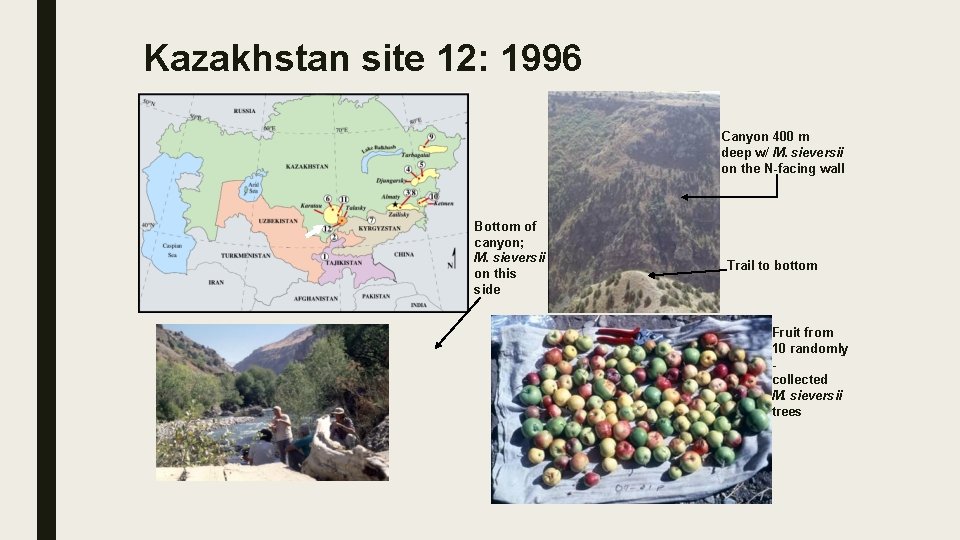
Kazakhstan site 12: 1996 Canyon 400 m deep w/ M. sieversii on the N-facing wall Bottom of canyon; M. sieversii on this side Trail to bottom Fruit from 10 randomly collected M. sieversii trees
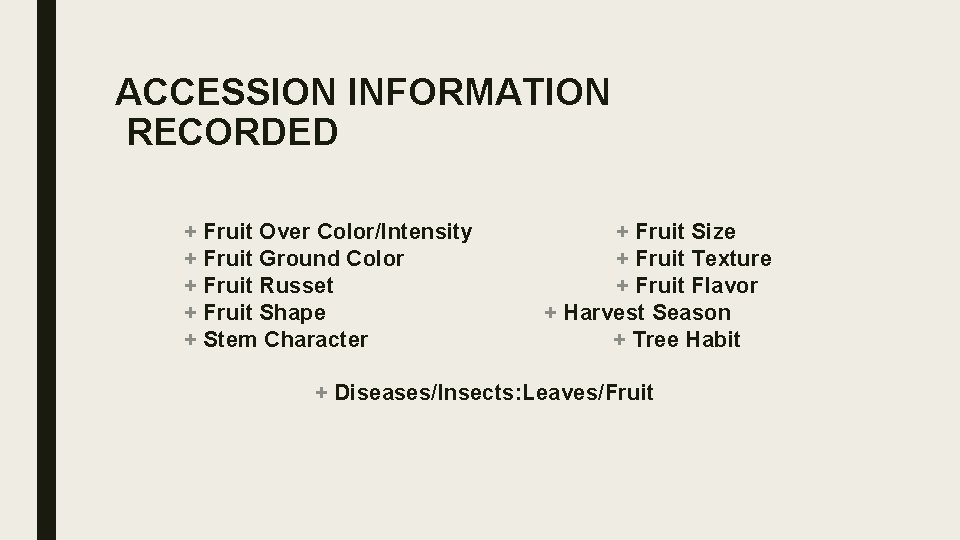
ACCESSION INFORMATION RECORDED + Fruit Over Color/Intensity + Fruit Ground Color + Fruit Russet + Fruit Shape + Stem Character + Fruit Size + Fruit Texture + Fruit Flavor + Harvest Season + Tree Habit + Diseases/Insects: Leaves/Fruit
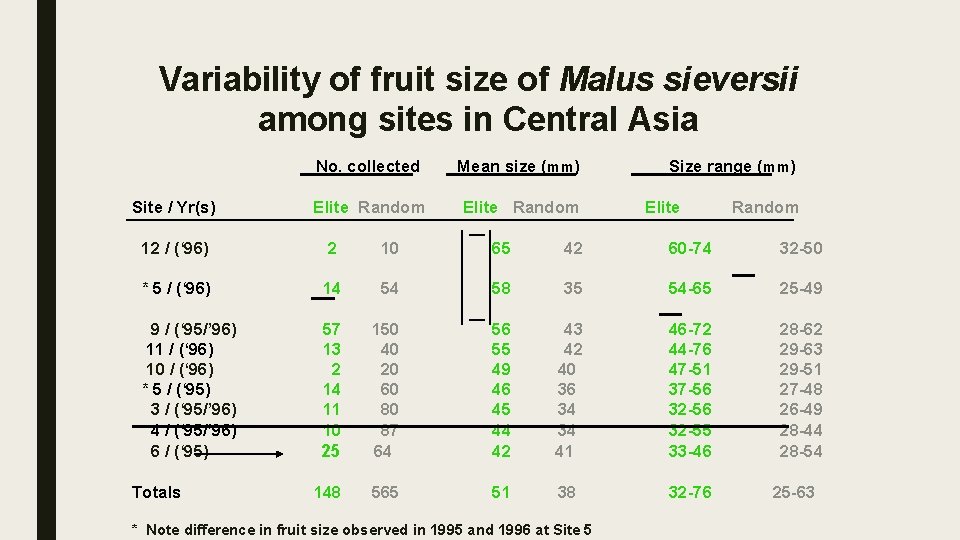
Variability of fruit size of Malus sieversii among sites in Central Asia Site / Yr(s) No. collected Mean size (mm) Elite Random Size range (mm) Elite Random 12 / (‘ 96) 2 10 65 42 60 -74 32 -50 * 5 / (‘ 96) 14 54 58 35 54 -65 25 -49 9 / (‘ 95/’ 96) 11 / (‘ 96) 10 / (‘ 96) * 5 / (‘ 95) 3 / (‘ 95/’ 96) 4 / (‘ 95/’ 96) 6 / (‘ 95) 57 13 2 14 11 10 25 150 40 20 60 80 87 64 56 55 49 46 45 44 42 43 42 40 36 34 34 41 46 -72 44 -76 47 -51 37 -56 32 -55 33 -46 28 -62 29 -63 29 -51 27 -48 26 -49 28 -44 28 -54 148 565 51 38 32 -76 Totals * Note difference in fruit size observed in 1995 and 1996 at Site 5 25 -63
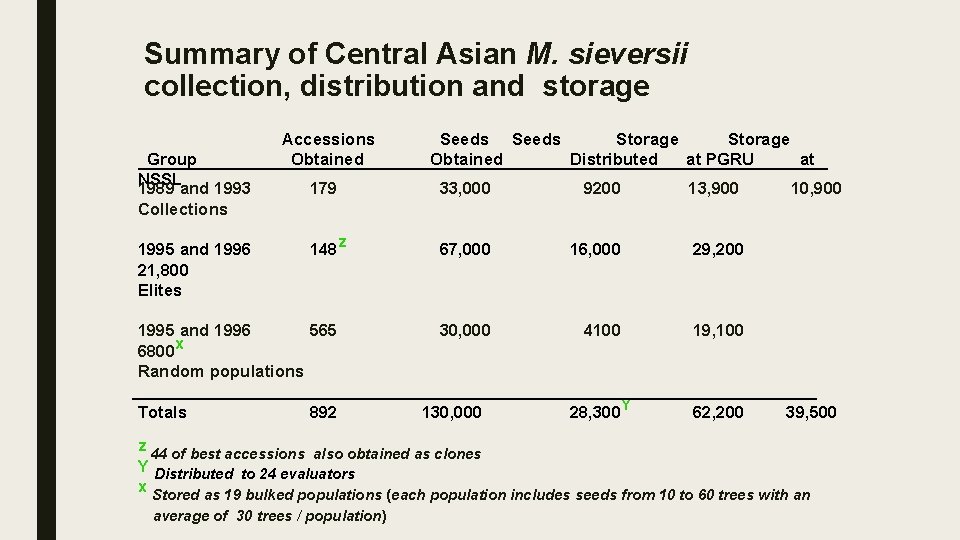
Summary of Central Asian M. sieversii collection, distribution and storage Group NSSL 1989 and 1993 Collections 1995 and 1996 21, 800 Elites Accessions Obtained 179 33, 000 9200 13, 900 148 z 67, 000 16, 000 29, 200 30, 000 4100 19, 100 28, 300 Y 62, 200 1995 and 1996 565 x 6800 Random populations Totals Seeds Storage Obtained Distributed at PGRU at 892 130, 000 10, 900 39, 500 z 44 of best accessions also obtained as clones Y Distributed to 24 evaluators x Stored as 19 bulked populations (each population includes seeds from 10 to 60 trees with an average of 30 trees / population)
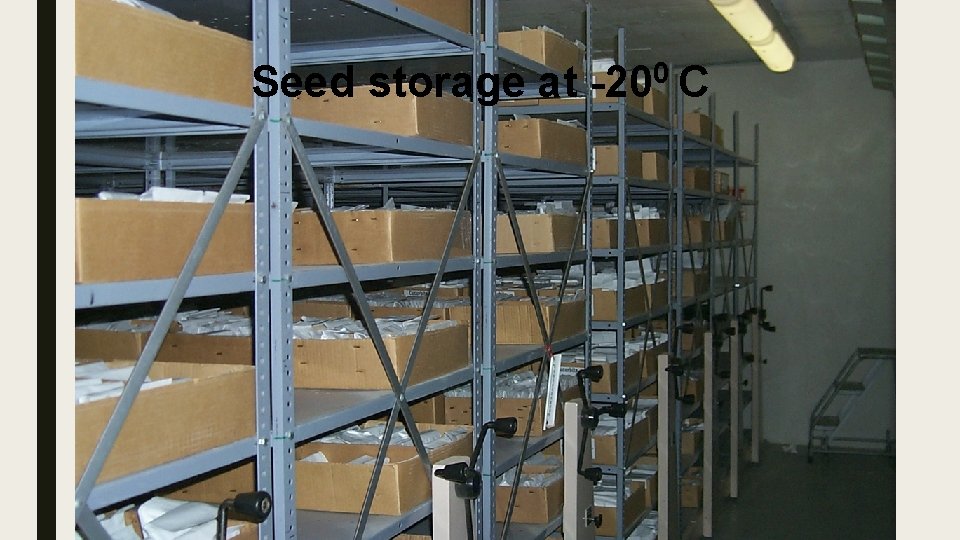
Seed storage at 0 -20 C