
The Origin of Species TAXONOMY Originated with Linnaeus

- Slides: 13
The Origin of Species
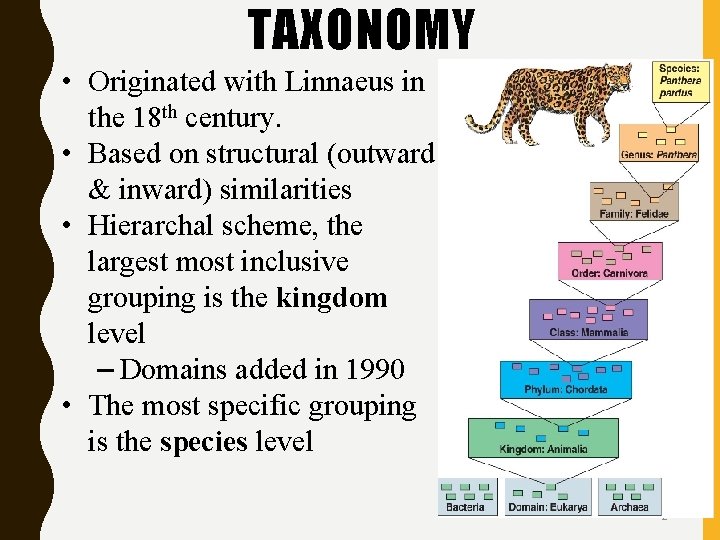
TAXONOMY • Originated with Linnaeus in the 18 th century. • Based on structural (outward & inward) similarities • Hierarchal scheme, the largest most inclusive grouping is the kingdom level – Domains added in 1990 • The most specific grouping is the species level 2
TAXONOMY • A species’s scientific name is Latin and composed of two words: Genus followed by specific epithet (description) • So, the cheetah’s scientific name is Acinonyx jubatus • Taxonomy is the classification of organisms based on shared characteristics. 3
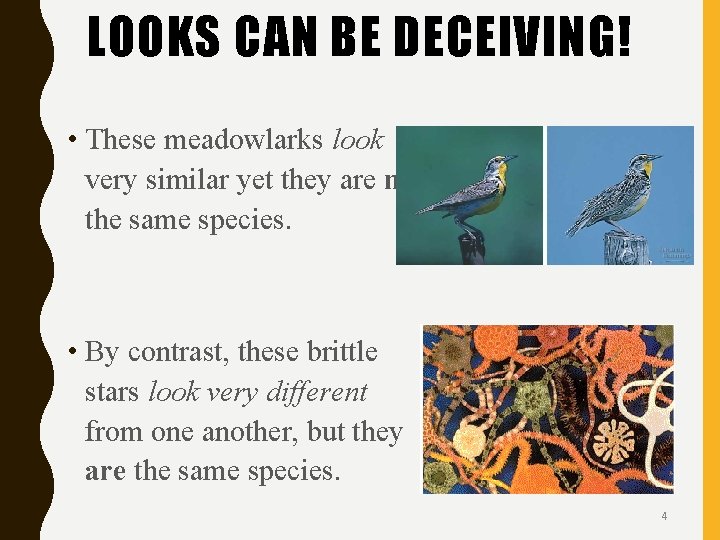
LOOKS CAN BE DECEIVING! • These meadowlarks look very similar yet they are not the same species. • By contrast, these brittle stars look very different from one another, but they are the same species. 4
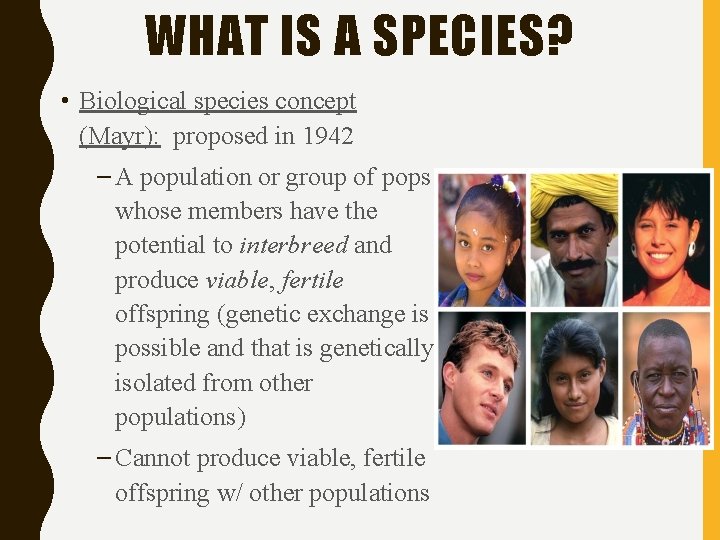
WHAT IS A SPECIES? • Biological species concept (Mayr): proposed in 1942 – A population or group of pops whose members have the potential to interbreed and produce viable, fertile offspring (genetic exchange is possible and that is genetically isolated from other populations) – Cannot produce viable, fertile offspring w/ other populations
OTHER SPECIES CONCEPTS – APPLY TO SEXUAL & ASEXUAL • Morphological – characterizes a species by body shape, size, & structural features • Paleontological – focuses on species known only by fossil record • Ecological – views species in terms of ecological niche & its role in a biological community • Phylogenetic – a set of organisms w/ a unique genetic history
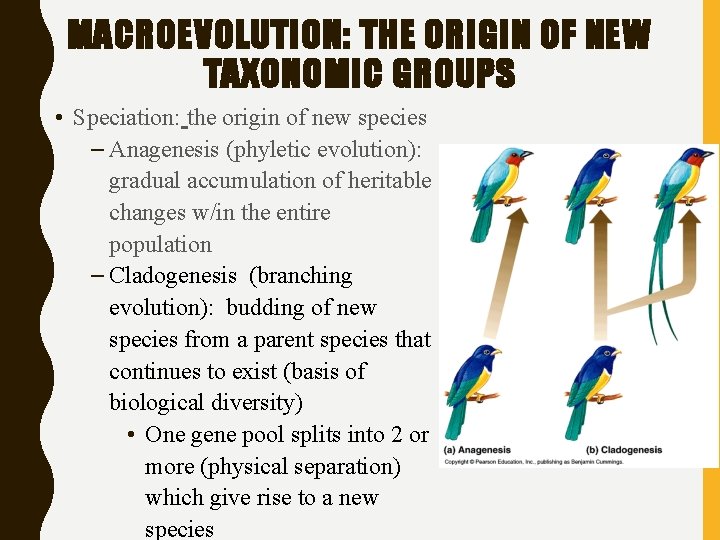
MACROEVOLUTION: THE ORIGIN OF NEW TAXONOMIC GROUPS • Speciation: the origin of new species – Anagenesis (phyletic evolution): gradual accumulation of heritable changes w/in the entire population – Cladogenesis (branching evolution): budding of new species from a parent species that continues to exist (basis of biological diversity) • One gene pool splits into 2 or more (physical separation) which give rise to a new species
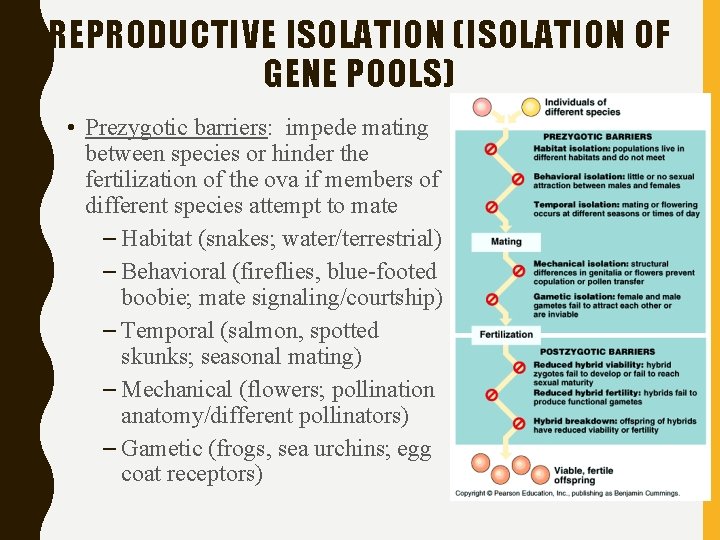
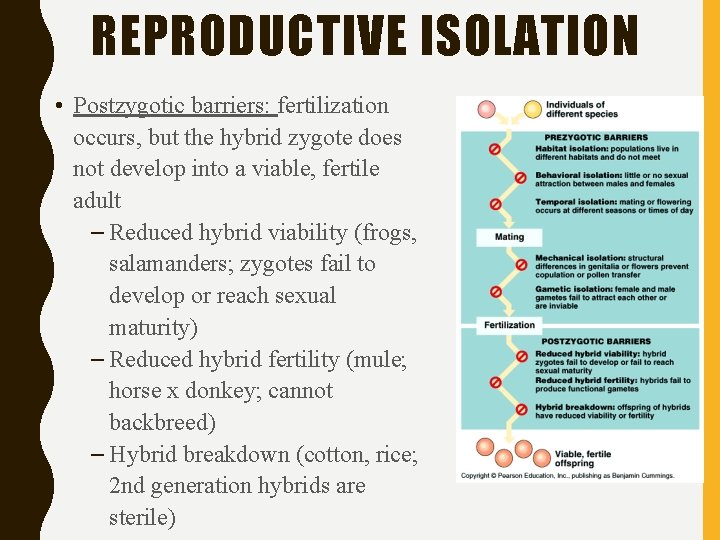
REPRODUCTIVE ISOLATION (ISOLATION OF GENE POOLS) • Prezygotic barriers: impede mating between species or hinder the fertilization of the ova if members of different species attempt to mate – Habitat (snakes; water/terrestrial) – Behavioral (fireflies, blue-footed boobie; mate signaling/courtship) – Temporal (salmon, spotted skunks; seasonal mating) – Mechanical (flowers; pollination anatomy/different pollinators) – Gametic (frogs, sea urchins; egg coat receptors)
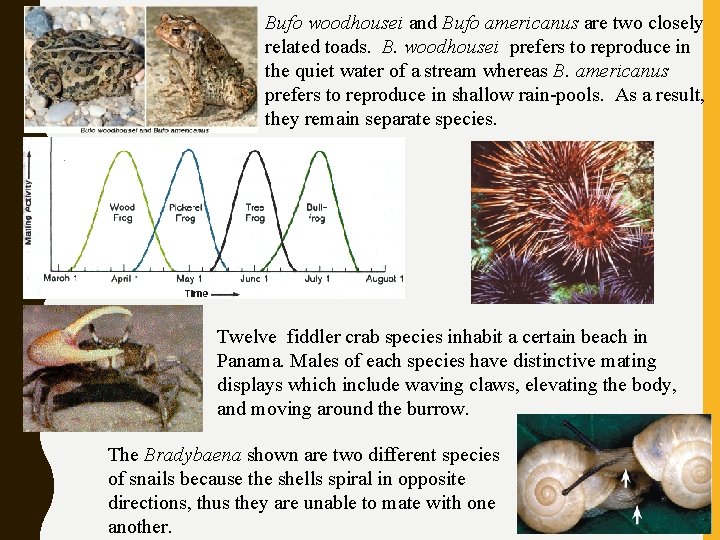
Bufo woodhousei and Bufo americanus are two closely related toads. B. woodhousei prefers to reproduce in the quiet water of a stream whereas B. americanus prefers to reproduce in shallow rain-pools. As a result, they remain separate species. Twelve fiddler crab species inhabit a certain beach in Panama. Males of each species have distinctive mating displays which include waving claws, elevating the body, and moving around the burrow. The Bradybaena shown are two different species of snails because the shells spiral in opposite directions, thus they are unable to mate with one another.
REPRODUCTIVE ISOLATION • Postzygotic barriers: fertilization occurs, but the hybrid zygote does not develop into a viable, fertile adult – Reduced hybrid viability (frogs, salamanders; zygotes fail to develop or reach sexual maturity) – Reduced hybrid fertility (mule; horse x donkey; cannot backbreed) – Hybrid breakdown (cotton, rice; 2 nd generation hybrids are sterile)
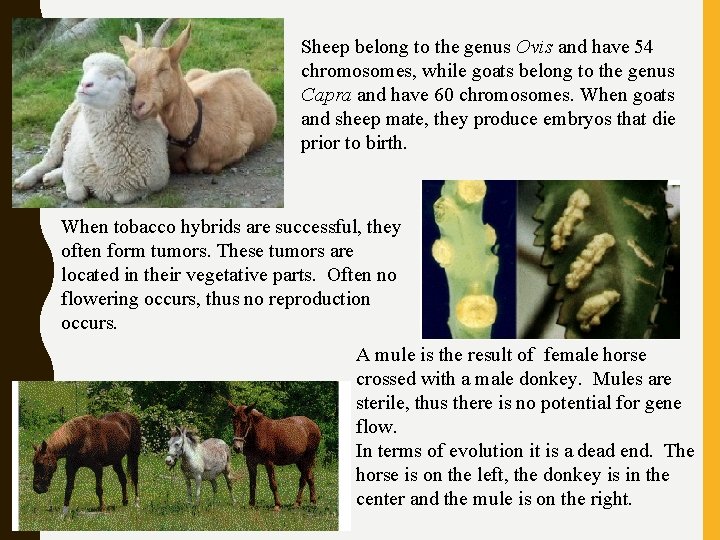
Sheep belong to the genus Ovis and have 54 chromosomes, while goats belong to the genus Capra and have 60 chromosomes. When goats and sheep mate, they produce embryos that die prior to birth. When tobacco hybrids are successful, they often form tumors. These tumors are located in their vegetative parts. Often no flowering occurs, thus no reproduction occurs. A mule is the result of female horse crossed with a male donkey. Mules are sterile, thus there is no potential for gene flow. In terms of evolution it is a dead end. The horse is on the left, the donkey is in the center and the mule is on the right.
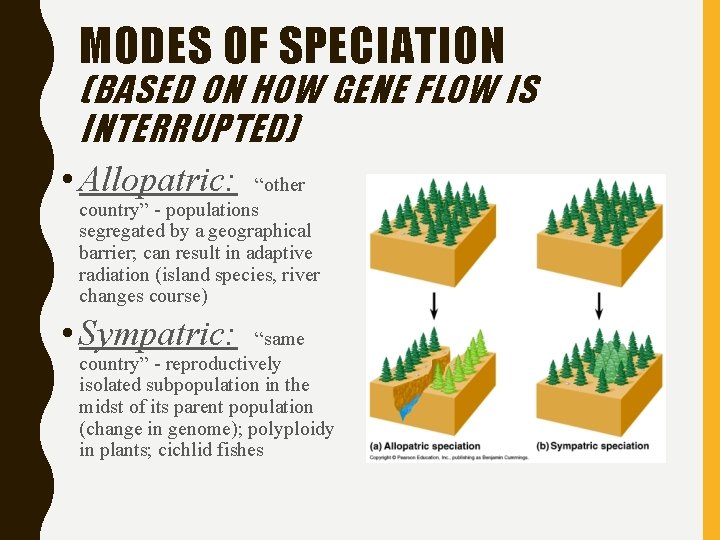
MODES OF SPECIATION (BASED ON HOW GENE FLOW IS INTERRUPTED) • Allopatric: “other country” - populations segregated by a geographical barrier; can result in adaptive radiation (island species, river changes course) • Sympatric: “same country” - reproductively isolated subpopulation in the midst of its parent population (change in genome); polyploidy in plants; cichlid fishes
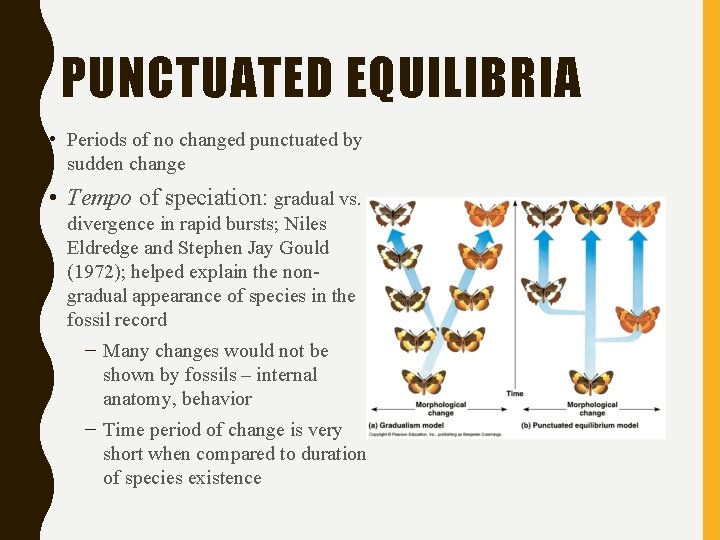
PUNCTUATED EQUILIBRIA • Periods of no changed punctuated by sudden change • Tempo of speciation: gradual vs. divergence in rapid bursts; Niles Eldredge and Stephen Jay Gould (1972); helped explain the nongradual appearance of species in the fossil record – Many changes would not be shown by fossils – internal anatomy, behavior – Time period of change is very short when compared to duration of species existence