
The Origin of Gaps and Holes in Transition



- Slides: 34
The Origin of Gaps and Holes in Transition Disks Uma Gorti (SETI Institute) Collaborators: D. Hollenbach (SETI), G. D’Angelo (SETI/NASA Ames), C. P. Dullemond (Heidelberg), I. Pascucci (LPL), J. Najita (NOAO)
Outline Ø What are transition disks? Ø Observations of transition disks Ø Mechanisms that produce them Ø Some open issues that ALMA can resolve
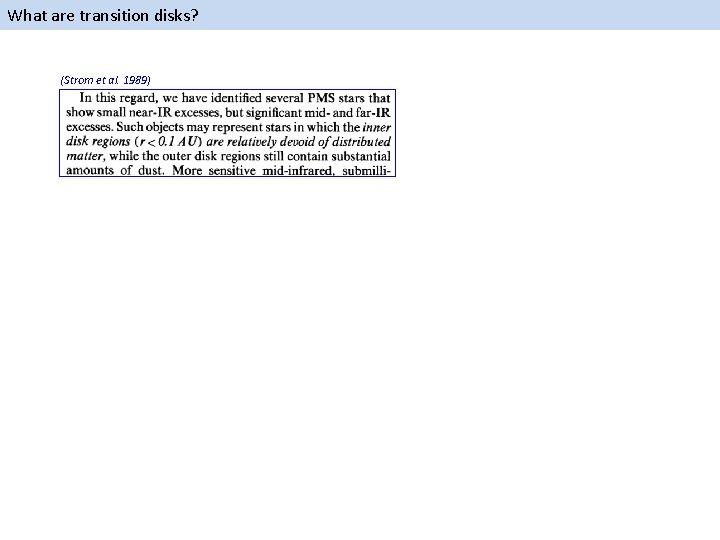
What are transition disks? (Strom et al. 1989)
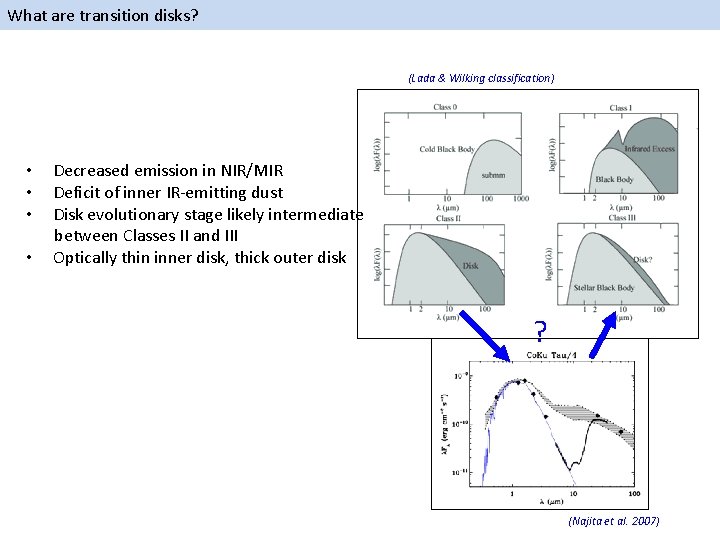
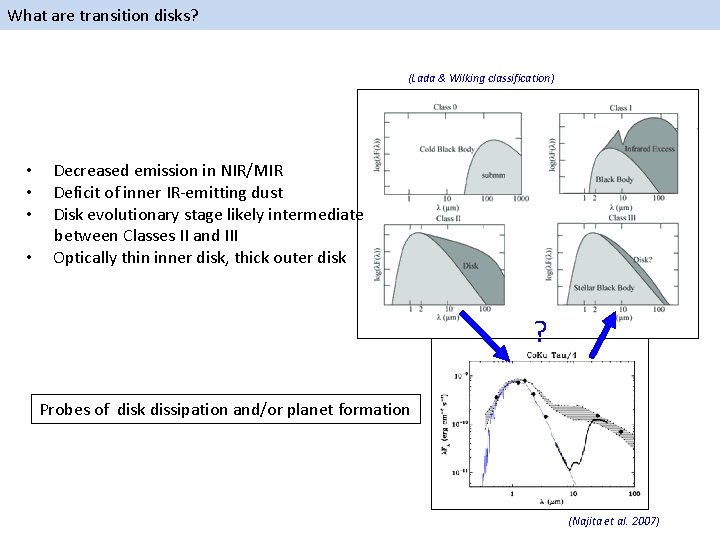
What are transition disks? (Lada & Wilking classification) • • Decreased emission in NIR/MIR Deficit of inner IR-emitting dust Disk evolutionary stage likely intermediate between Classes II and III Optically thin inner disk, thick outer disk ? (Najita et al. 2007)
What are transition disks? (Lada & Wilking classification) • • Decreased emission in NIR/MIR Deficit of inner IR-emitting dust Disk evolutionary stage likely intermediate between Classes II and III Optically thin inner disk, thick outer disk ? Probes of disk dissipation and/or planet formation (Najita et al. 2007)
Observations of Transition Disks
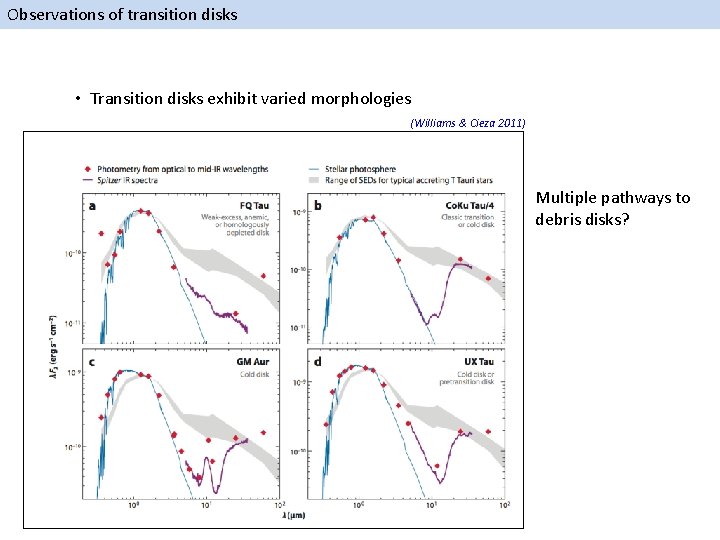
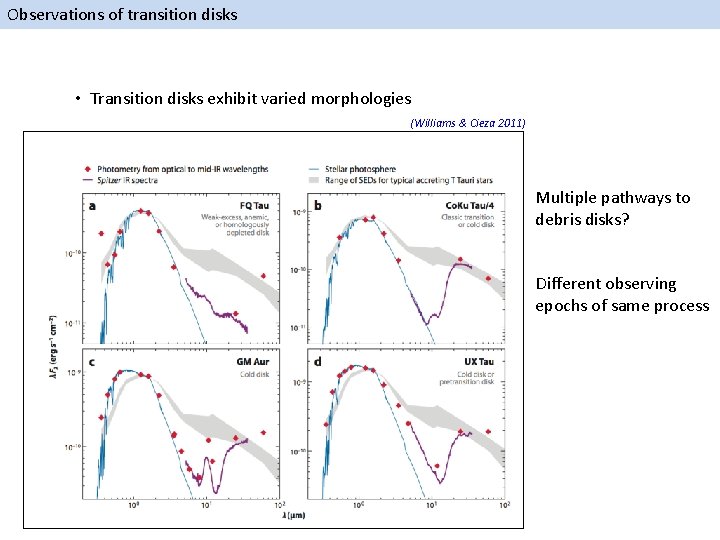
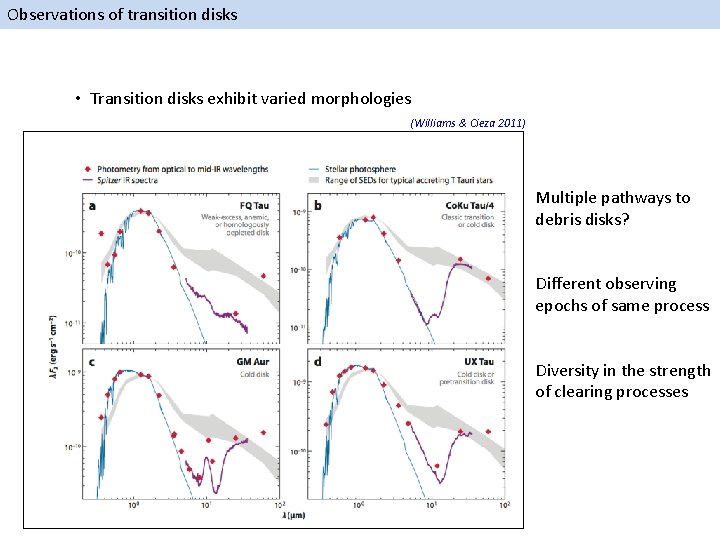
Observations of transition disks • Transition disks exhibit varied morphologies (Williams & Cieza 2011) Multiple pathways to debris disks?
Observations of transition disks • Transition disks exhibit varied morphologies (Williams & Cieza 2011) Multiple pathways to debris disks? Different observing epochs of same process
Observations of transition disks • Transition disks exhibit varied morphologies (Williams & Cieza 2011) Multiple pathways to debris disks? Different observing epochs of same process Diversity in the strength of clearing processes
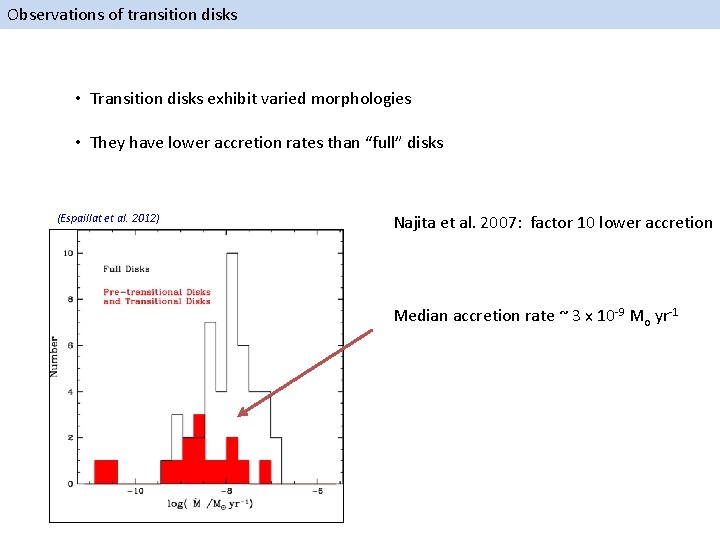
Observations of transition disks • Transition disks exhibit varied morphologies • They have lower accretion rates than “full” disks (Espaillat et al. 2012) Najita et al. 2007: factor 10 lower accretion Median accretion rate ~ 3 x 10 -9 Mo yr-1
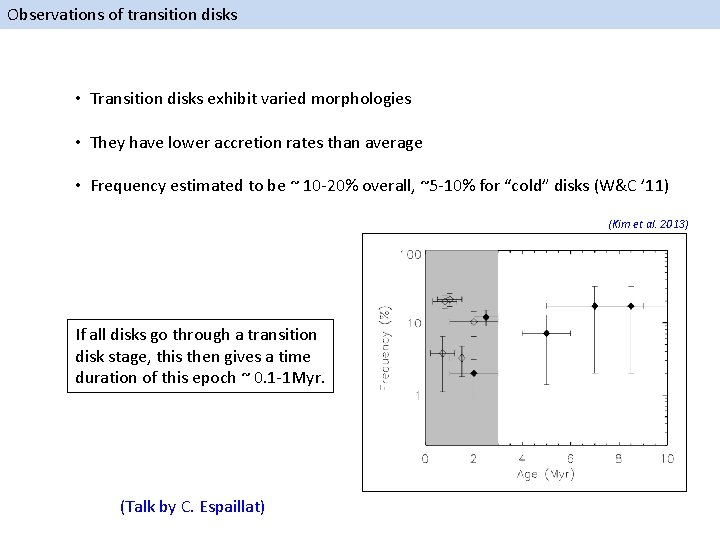
Observations of transition disks • Transition disks exhibit varied morphologies • They have lower accretion rates than average • Frequency estimated to be ~ 10 -20% overall, ~5 -10% for “cold” disks (W&C ’ 11) (Kim et al. 2013) If all disks go through a transition disk stage, this then gives a time duration of this epoch ~ 0. 1 -1 Myr. (Talk by C. Espaillat)
Physical mechanisms that create gaps/holes in transition disks
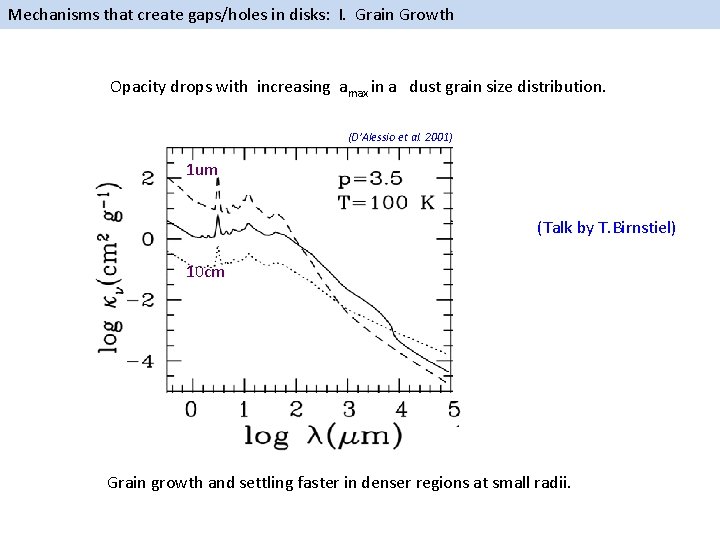
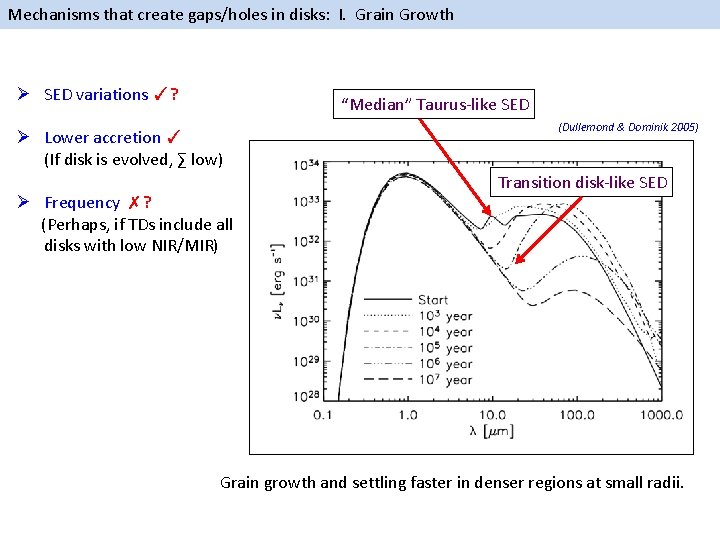
Mechanisms that create gaps/holes in disks: I. Grain Growth Opacity drops with increasing amax in a dust grain size distribution. (D’Alessio et al. 2001) 1 um (Talk by T. Birnstiel) 10 cm Grain growth and settling faster in denser regions at small radii.
Mechanisms that create gaps/holes in disks: I. Grain Growth Ø SED variations ✓? “Median” Taurus-like SED Ø Lower accretion ✓ (If disk is evolved, ∑ low) Ø Frequency ✗? (Perhaps, if TDs include all disks with low NIR/MIR) (Dullemond & Dominik 2005) Transition disk-like SED Grain growth and settling faster in denser regions at small radii.
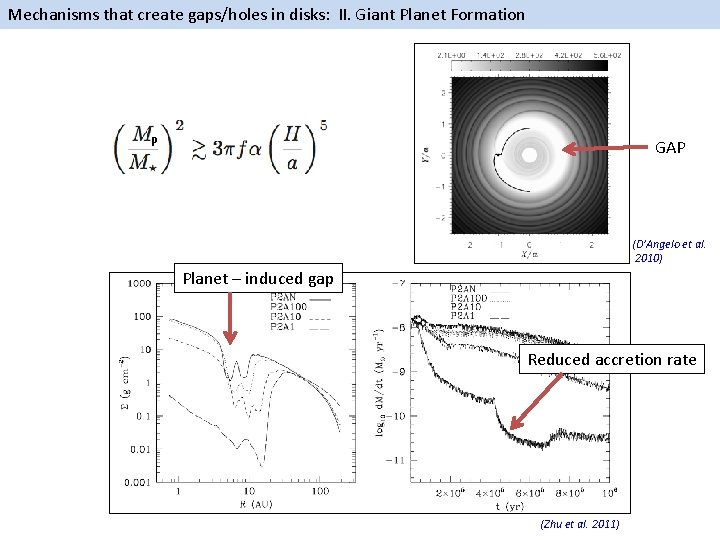
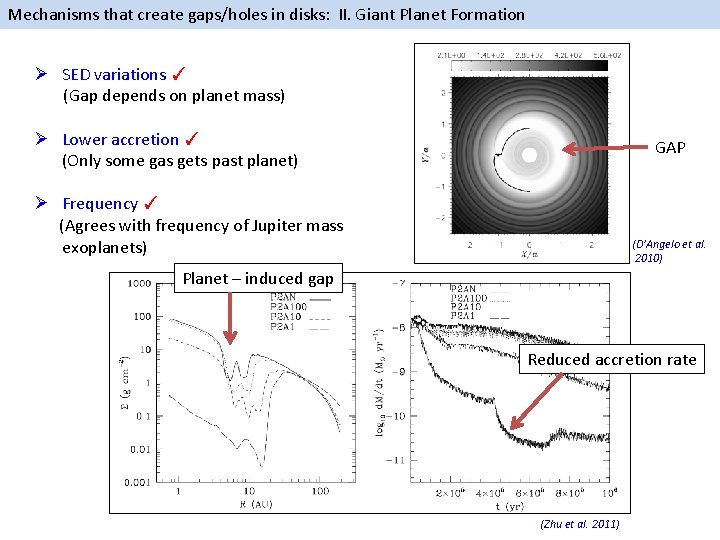
Mechanisms that create gaps/holes in disks: II. Giant Planet Formation P GAP (D’Angelo et al. 2010) Planet – induced gap Reduced accretion rate (Zhu et al. 2011)
Mechanisms that create gaps/holes in disks: II. Giant Planet Formation Ø SED variations ✓ (Gap depends on planet mass) Ø Lower accretion ✓ (Only some gas gets past planet) GAP Ø Frequency ✓ (Agrees with frequency of Jupiter mass exoplanets) (D’Angelo et al. 2010) Planet – induced gap Reduced accretion rate (Zhu et al. 2011)
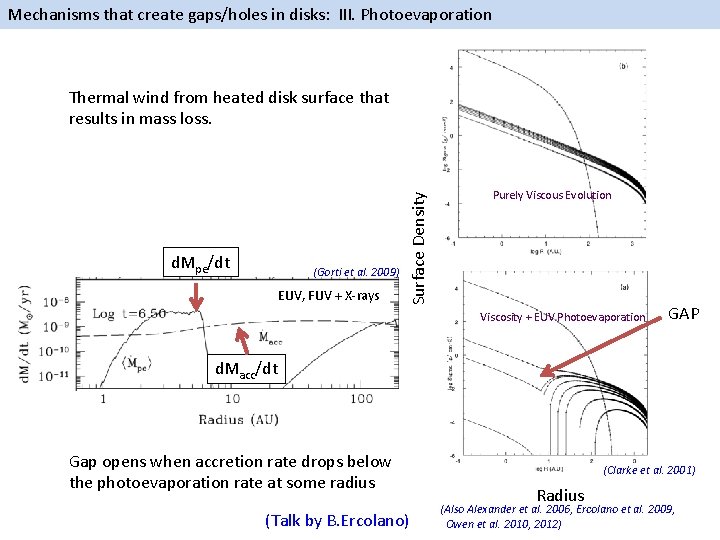
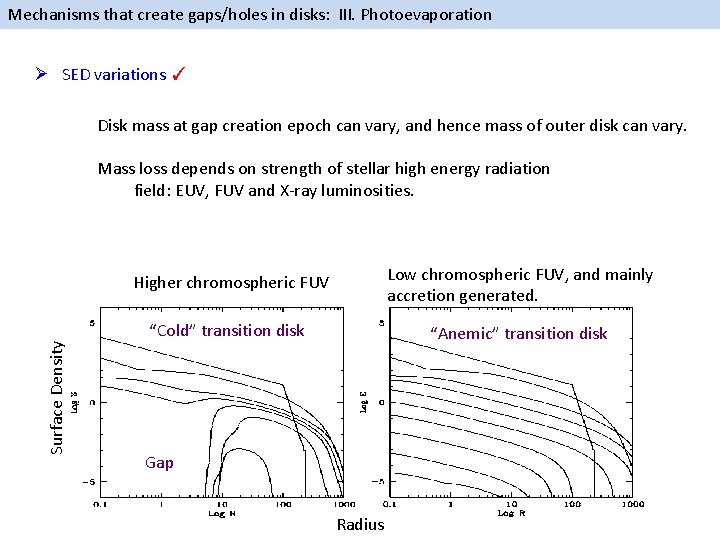
Mechanisms that create gaps/holes in disks: III. Photoevaporation d. Mpe/dt (Gorti et al. 2009) EUV, FUV + X-rays Surface Density Thermal wind from heated disk surface that results in mass loss. Purely Viscous Evolution Viscosity + EUV Photoevaporation GAP d. Macc/dt Gap opens when accretion rate drops below the photoevaporation rate at some radius (Talk by B. Ercolano) (Clarke et al. 2001) Radius (Also Alexander et al. 2006, Ercolano et al. 2009, Owen et al. 2010, 2012)
Mechanisms that create gaps/holes in disks: III. Photoevaporation Ø SED variations ✓ Disk mass at gap creation epoch can vary, and hence mass of outer disk can vary. Surface Density Mass loss depends on strength of stellar high energy radiation field: EUV, FUV and X-ray luminosities. Higher chromospheric FUV Low chromospheric FUV, and mainly accretion generated. “Cold” transition disk “Anemic” transition disk Gap Radius
Mechanisms that create gaps/holes in disks: III. Photoevaporation Ø SED variations ✓ (Strength of radiation field) Ø Lower accretion ✓ (Needs to be lower than photoevaporation rate to create gap)
Mechanisms that create gaps/holes in disks: III. Photoevaporation Ø SED variations ✓ (Strength of radiation field) Ø Lower accretion (✓) ✗ (Needs to be lower than photoevaporation rate to create gap) Ø Frequency ✗ Continued accretion and frequency of accreting disks not compatible with our models of EUV, FUV + X-ray photoevaporation. (Gorti et al. ) Viscous timescale at rcrit (~ 1 AU) is < 105 years, disk lifetimes are ~ 4 -5 Myrs; expected frequency of accreting transition disks is ~ 2%.
Mechanisms that create gaps/holes in disks: III. Photoevaporation Ø SED variations ✓ (Strength of radiation field) Ø Lower accretion ✓(✗) (Needs to be lower than photoevaporation rate to create gap) Ø Frequency ✓(✗) Continued accretion and frequency of accreting disks not compatible with our models of EUV, FUV + X-ray photoevaporation. (Gorti et al. ) Viscous timescale at rcrit (~ 1 AU) is < 105 years, disk lifetimes are 4 -5 Myrs expected frequency of accreting transition disks is 2%. However, XEUV photoevaporation models of Ercolano et al, Owen et al. , obtain shorter disk lifetimes of ~1 Myrs, and can explain the frequency observed. (Talk by B. Ercolano)
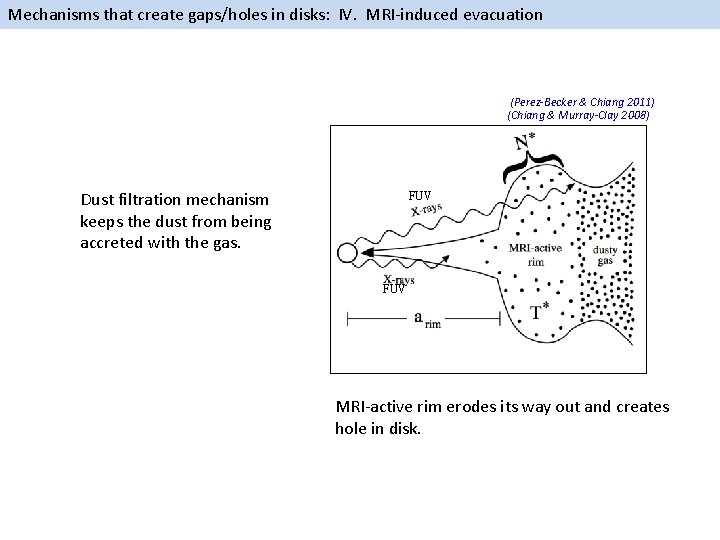
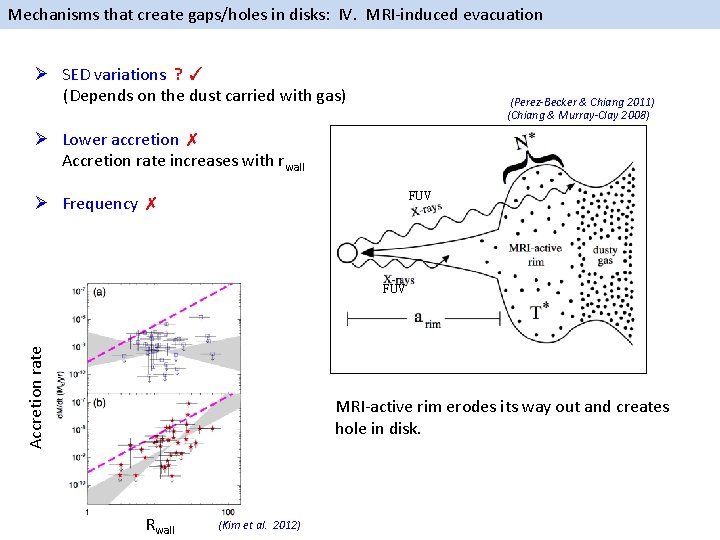
Mechanisms that create gaps/holes in disks: IV. MRI-induced evacuation (Perez-Becker & Chiang 2011) (Chiang & Murray-Clay 2008) Dust filtration mechanism keeps the dust from being accreted with the gas. FUV MRI-active rim erodes its way out and creates hole in disk.
Mechanisms that create gaps/holes in disks: IV. MRI-induced evacuation Ø SED variations ? ✓ (Depends on the dust carried with gas) (Perez-Becker & Chiang 2011) (Chiang & Murray-Clay 2008) Ø Lower accretion ✗ Accretion rate increases with rwall FUV Ø Frequency ✗ Accretion rate FUV MRI-active rim erodes its way out and creates hole in disk. Rwall (Kim et al. 2012)
Some Problems and Issues
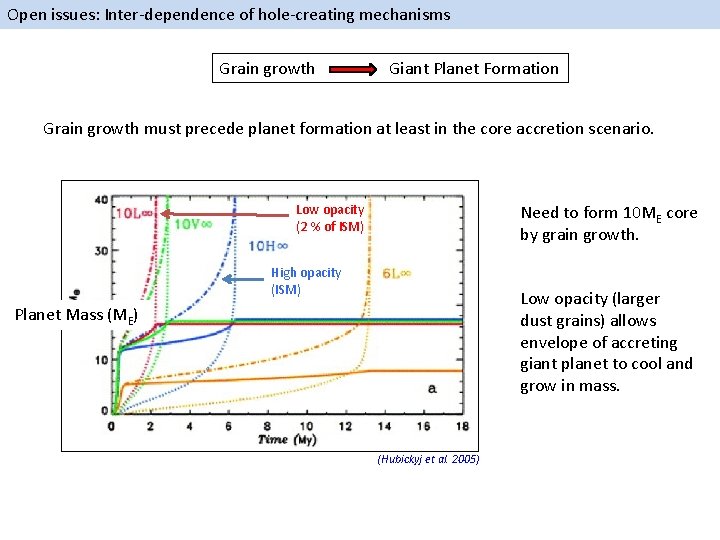
Open issues: Inter-dependence of hole-creating mechanisms Grain growth Giant Planet Formation Grain growth must precede planet formation at least in the core accretion scenario. Need to form 10 ME core by grain growth. Low opacity (2 % of ISM) High opacity (ISM) Low opacity (larger dust grains) allows envelope of accreting giant planet to cool and grow in mass. Planet Mass (ME) (Hubickyj et al. 2005)
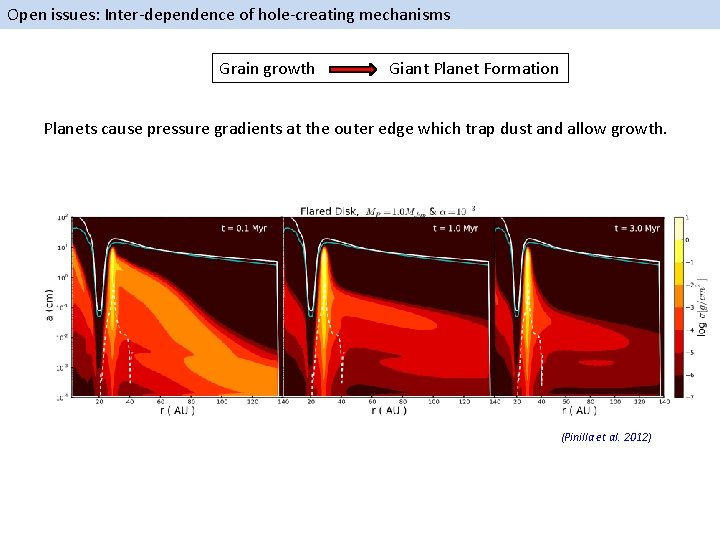
Open issues: Inter-dependence of hole-creating mechanisms Grain growth Giant Planet Formation Planets cause pressure gradients at the outer edge which trap dust and allow growth. (Pinilla et al. 2012)
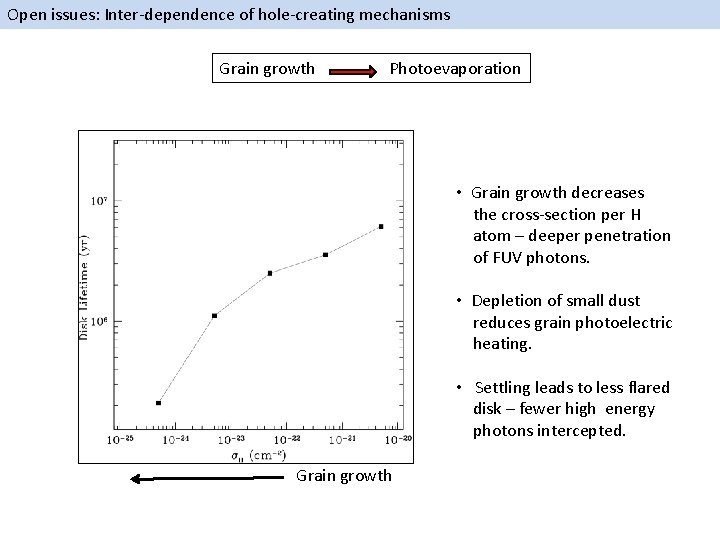
Open issues: Inter-dependence of hole-creating mechanisms Grain growth Photoevaporation • Grain growth decreases the cross-section per H atom – deeper penetration of FUV photons. • Depletion of small dust reduces grain photoelectric heating. • Settling leads to less flared disk – fewer high energy photons intercepted. Grain growth
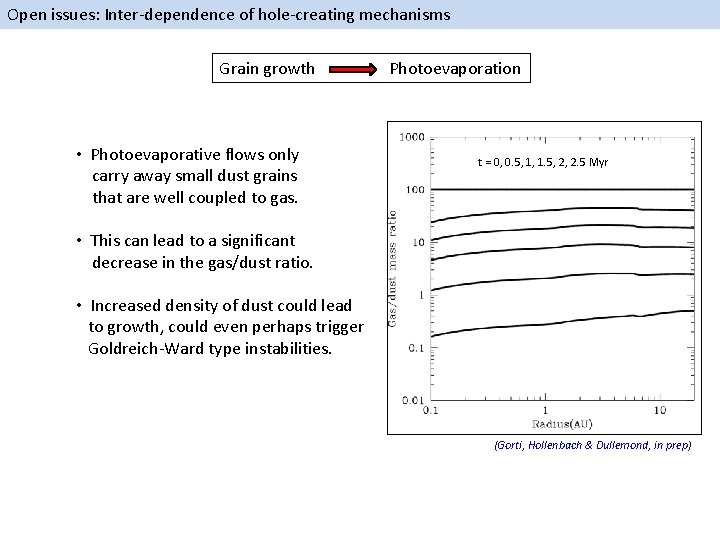
Open issues: Inter-dependence of hole-creating mechanisms Grain growth • Photoevaporative flows only carry away small dust grains that are well coupled to gas. Photoevaporation t = 0, 0. 5, 1, 1. 5, 2, 2. 5 Myr • This can lead to a significant decrease in the gas/dust ratio. • Increased density of dust could lead to growth, could even perhaps trigger Goldreich-Ward type instabilities. (Gorti, Hollenbach & Dullemond, in prep)
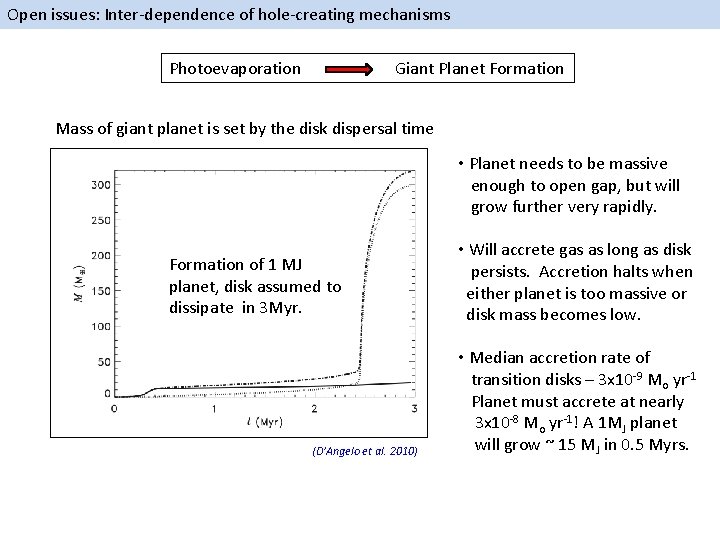
Open issues: Inter-dependence of hole-creating mechanisms Photoevaporation Giant Planet Formation Mass of giant planet is set by the disk dispersal time • Planet needs to be massive enough to open gap, but will grow further very rapidly. Formation of 1 MJ planet, disk assumed to dissipate in 3 Myr. (D’Angelo et al. 2010) • Will accrete gas as long as disk persists. Accretion halts when either planet is too massive or disk mass becomes low. • Median accretion rate of transition disks – 3 x 10 -9 Mo yr-1 Planet must accrete at nearly 3 x 10 -8 Mo yr-1! A 1 MJ planet will grow ~ 15 MJ in 0. 5 Myrs.
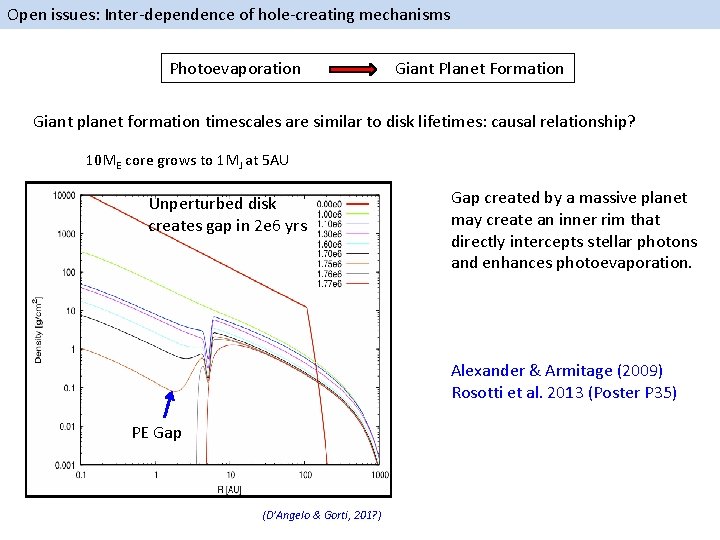
Open issues: Inter-dependence of hole-creating mechanisms Photoevaporation Giant Planet Formation Giant planet formation timescales are similar to disk lifetimes: causal relationship? 10 ME core grows to 1 MJ at 5 AU Unperturbed disk creates gap in 2 e 6 yrs Gap created by a massive planet may create an inner rim that directly intercepts stellar photons and enhances photoevaporation. Alexander & Armitage (2009) Rosotti et al. 2013 (Poster P 35) PE Gap (D’Angelo & Gorti, 201? )
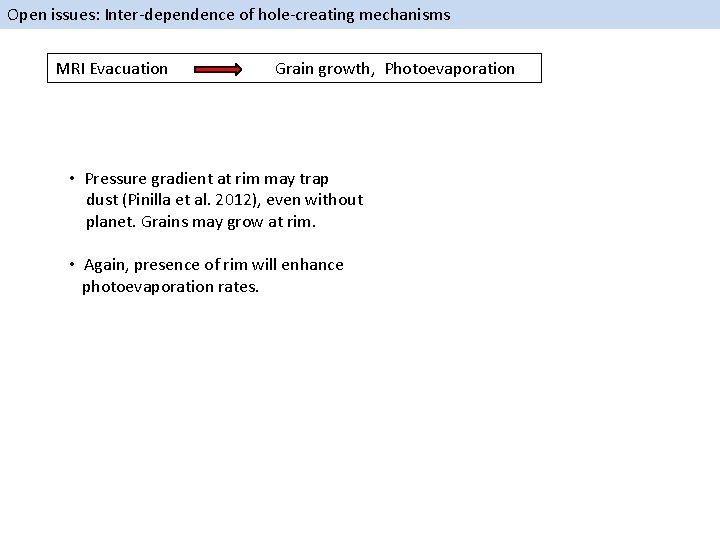
Open issues: Inter-dependence of hole-creating mechanisms MRI Evacuation Grain growth, Photoevaporation • Pressure gradient at rim may trap dust (Pinilla et al. 2012), even without planet. Grains may grow at rim. • Again, presence of rim will enhance photoevaporation rates.
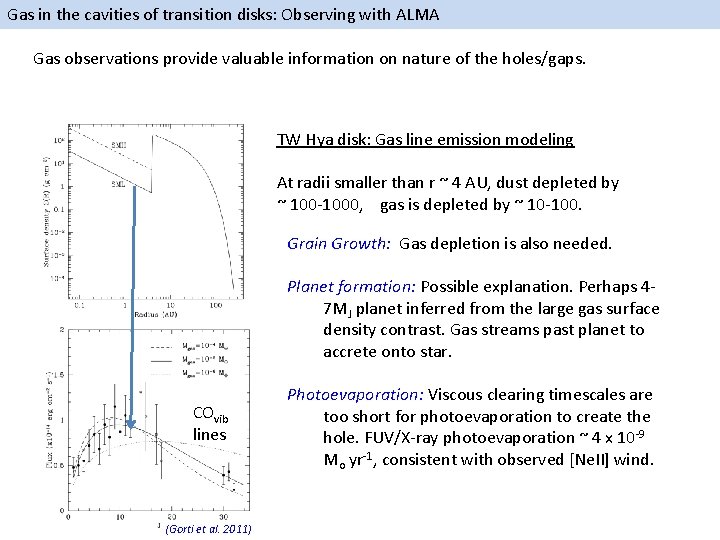
Gas in the cavities of transition disks: Observing with ALMA Gas observations provide valuable information on nature of the holes/gaps. TW Hya disk: Gas line emission modeling At radii smaller than r ~ 4 AU, dust depleted by ~ 100 -1000, gas is depleted by ~ 10 -100. Grain Growth: Gas depletion is also needed. Planet formation: Possible explanation. Perhaps 47 MJ planet inferred from the large gas surface density contrast. Gas streams past planet to accrete onto star. COvib lines (Gorti et al. 2011) Photoevaporation: Viscous clearing timescales are too short for photoevaporation to create the hole. FUV/X-ray photoevaporation ~ 4 x 10 -9 Mo yr-1, consistent with observed [Ne. II] wind.
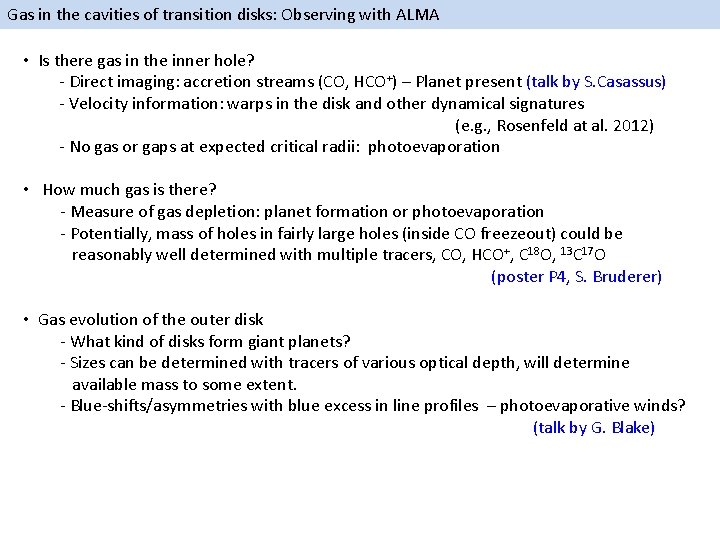
Gas in the cavities of transition disks: Observing with ALMA • Is there gas in the inner hole? - Direct imaging: accretion streams (CO, HCO+) – Planet present (talk by S. Casassus) - Velocity information: warps in the disk and other dynamical signatures (e. g. , Rosenfeld at al. 2012) - No gas or gaps at expected critical radii: photoevaporation • How much gas is there? - Measure of gas depletion: planet formation or photoevaporation - Potentially, mass of holes in fairly large holes (inside CO freezeout) could be reasonably well determined with multiple tracers, CO, HCO+, C 18 O, 13 C 17 O (poster P 4, S. Bruderer) • Gas evolution of the outer disk - What kind of disks form giant planets? - Sizes can be determined with tracers of various optical depth, will determine available mass to some extent. - Blue-shifts/asymmetries with blue excess in line profiles – photoevaporative winds? (talk by G. Blake)
Thank you!