
THE ORIGIN OF CELLS There is an unbroken
THE ORIGIN OF CELLS There is an unbroken chain of life from the first cells on Earth to all cells in organisms alive today. Topic 1. 5 IB Biology Miss Werba
TOPIC 1 – CELL BIOLOGY 1. 1 INTRODUCTION TO CELLS 1. 2 1. 6 CELL DIVISION ULTRASTRUCTUR E OF CELLS 1. 5 1. 3 THE ORIGIN OF CELLS MEMBRANE STRUCTURE 1. 4 MEMBRANE TRANSPORT J WERBA – IB BIOLOGY 2
THINGS TO COVER Statement Guidance U. 1 Cells can only be formed by pre-existing cells. The 64 codons in the genetic code have the same meanings in nearly all organisms, but that there are some minor variations that are likely to have accrued since the common origin of life on Earth. U. 2 The first cells must have arisen from non-living material. U. 3 The origin of eukaryotic cells can be explained by the endosymbiotic theory A. 1 Evidence from Pasteur’s experiments that spontaneous generation of cells and organisms does not now occur on Earth. Evidence for theory is not expected. The origin of eukaryote cilia and flagella does not need to be included. NOS 1. 9 Testing the general principles that underlie the natural world J WERBA – IB BIOLOGY 3
A. 1 PASTEUR’S EXPERIMENTS � Review any of the following animations to help you understand these experiments and the conclusions made as a result: ◦ http: //bcs. whfreeman. com/thelifewire/content/chp 03 /0302003. html ◦ https: //www. youtube. com/watch? v=4 z. LY_B_2 d 8 w ◦ http: //www. sumanasinc. com/webcontent/animation s/content/scientificmethod. html J WERBA – IB BIOLOGY 4
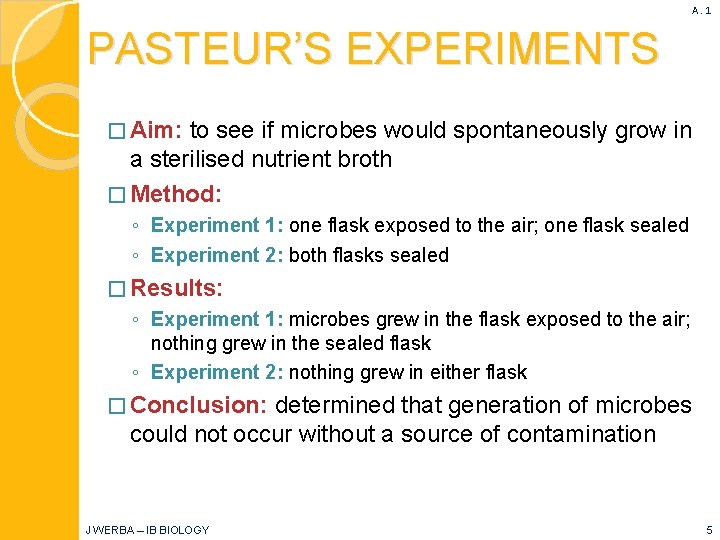
A. 1 PASTEUR’S EXPERIMENTS � Aim: to see if microbes would spontaneously grow in a sterilised nutrient broth � Method: ◦ Experiment 1: one flask exposed to the air; one flask sealed ◦ Experiment 2: both flasks sealed � Results: ◦ Experiment 1: microbes grew in the flask exposed to the air; nothing grew in the sealed flask ◦ Experiment 2: nothing grew in either flask � Conclusion: determined that generation of microbes could not occur without a source of contamination J WERBA – IB BIOLOGY 5
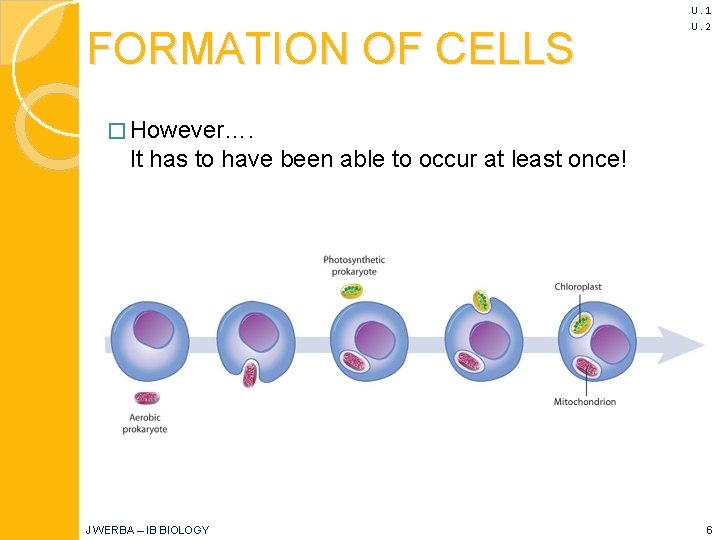
FORMATION OF CELLS U. 1 U. 2 � However…. It has to have been able to occur at least once! J WERBA – IB BIOLOGY 6

U. 1 FORMATION OF CELLS Cells can only be formed by division of pre-existing cells: � Cells multiply through division � Mitosis results in genetically identical daughter cells � Meiosis generates gametes (sex cells) J WERBA – IB BIOLOGY 7
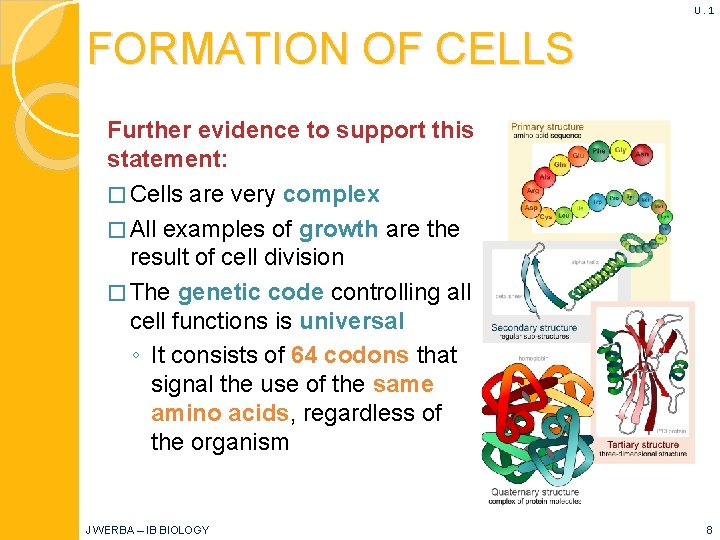
U. 1 FORMATION OF CELLS Further evidence to support this statement: � Cells are very complex � All examples of growth are the result of cell division � The genetic code controlling all cell functions is universal ◦ It consists of 64 codons that signal the use of the same amino acids, regardless of the organism J WERBA – IB BIOLOGY 8
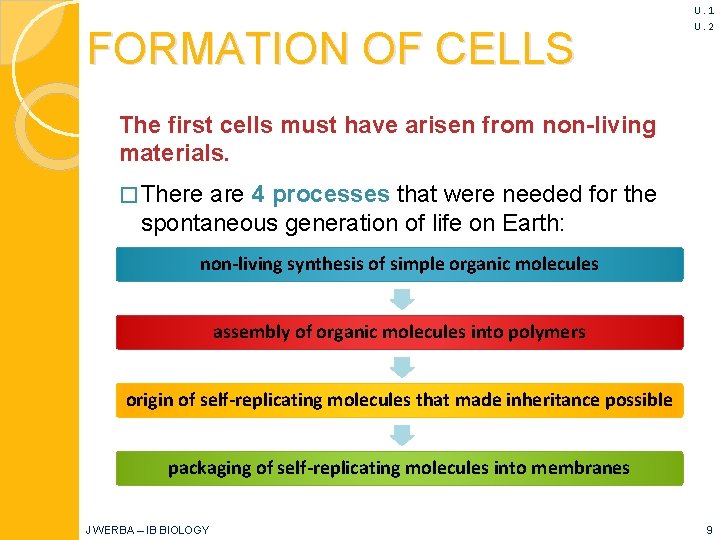
FORMATION OF CELLS U. 1 U. 2 The first cells must have arisen from non-living materials. � There are 4 processes that were needed for the spontaneous generation of life on Earth: non-living synthesis of simple organic molecules assembly of organic molecules into polymers origin of self-replicating molecules that made inheritance possible packaging of self-replicating molecules into membranes J WERBA – IB BIOLOGY 9
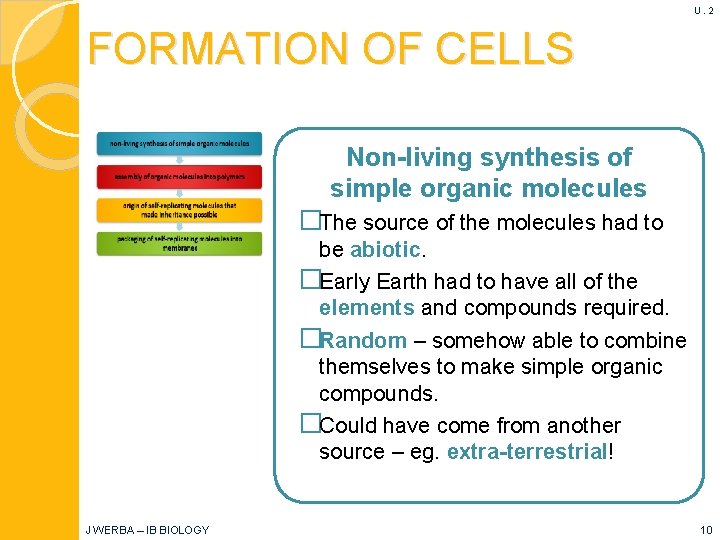
U. 2 FORMATION OF CELLS Non-living synthesis of simple organic molecules �The source of the molecules had to be abiotic. �Early Earth had to have all of the elements and compounds required. �Random – somehow able to combine themselves to make simple organic compounds. �Could have come from another source – eg. extra-terrestrial! J WERBA – IB BIOLOGY 10
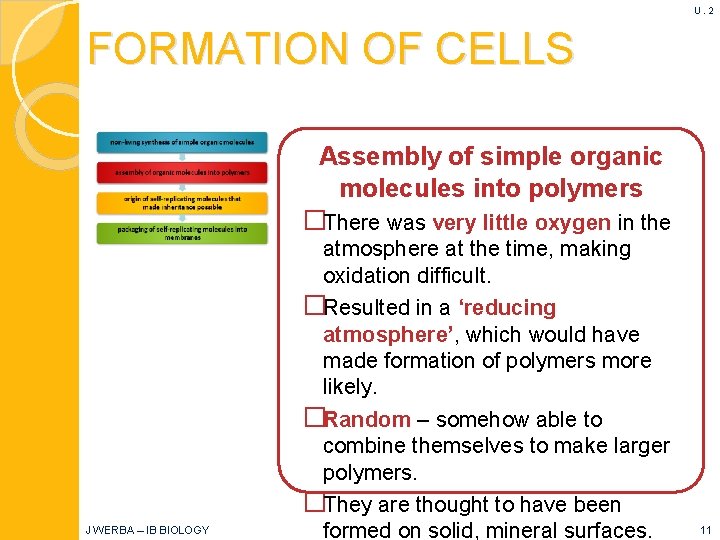
U. 2 FORMATION OF CELLS Assembly of simple organic molecules into polymers �There was very little oxygen in the J WERBA – IB BIOLOGY atmosphere at the time, making oxidation difficult. �Resulted in a ‘reducing atmosphere’, which would have made formation of polymers more likely. �Random – somehow able to combine themselves to make larger polymers. �They are thought to have been formed on solid, mineral surfaces. 11
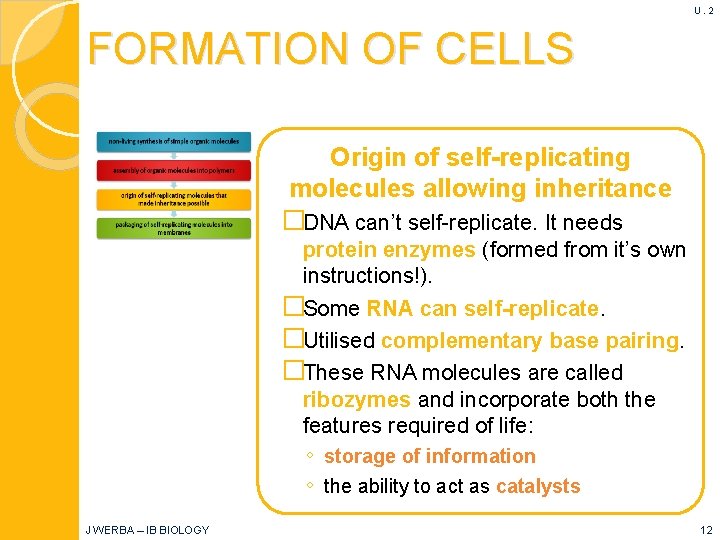
U. 2 FORMATION OF CELLS Origin of self-replicating molecules allowing inheritance �DNA can’t self-replicate. It needs protein enzymes (formed from it’s own instructions!). �Some RNA can self-replicate. �Utilised complementary base pairing. �These RNA molecules are called ribozymes and incorporate both the features required of life: ◦ storage of information ◦ the ability to act as catalysts J WERBA – IB BIOLOGY 12
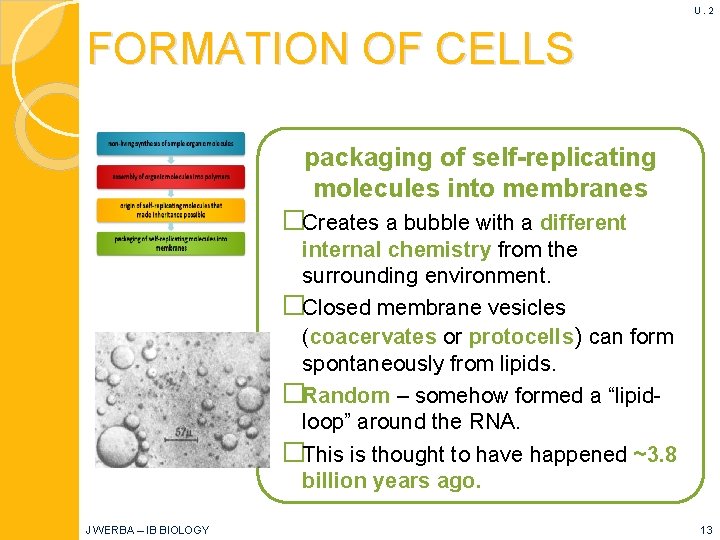
U. 2 FORMATION OF CELLS packaging of self-replicating molecules into membranes �Creates a bubble with a different internal chemistry from the surrounding environment. �Closed membrane vesicles (coacervates or protocells) can form spontaneously from lipids. �Random – somehow formed a “lipidloop” around the RNA. �This is thought to have happened ~3. 8 billion years ago. J WERBA – IB BIOLOGY 13
IOLOGY SOURCE: Purcell, D. (2009) MATION OF CELLS U.
SOURCE: Purcell, D. (2009) U. 2 FORMATION OF CELLS J WERBA – IB BIOLOGY 15
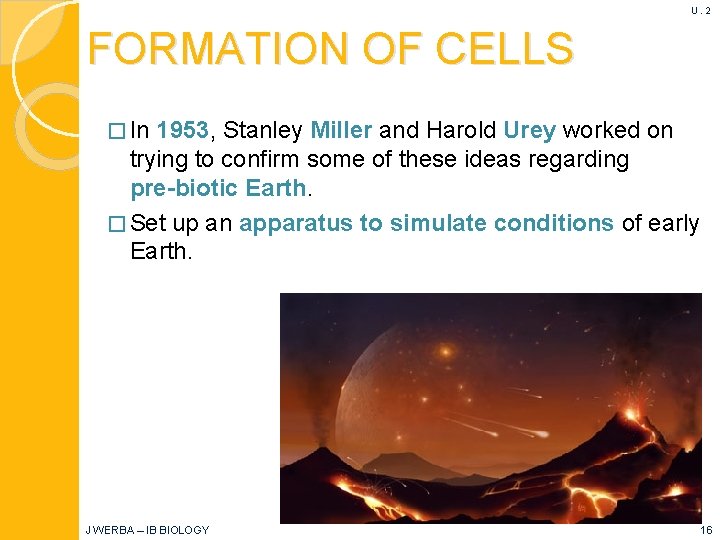
U. 2 FORMATION OF CELLS � In 1953, Stanley Miller and Harold Urey worked on trying to confirm some of these ideas regarding pre-biotic Earth. � Set up an apparatus to simulate conditions of early Earth. J WERBA – IB BIOLOGY 16
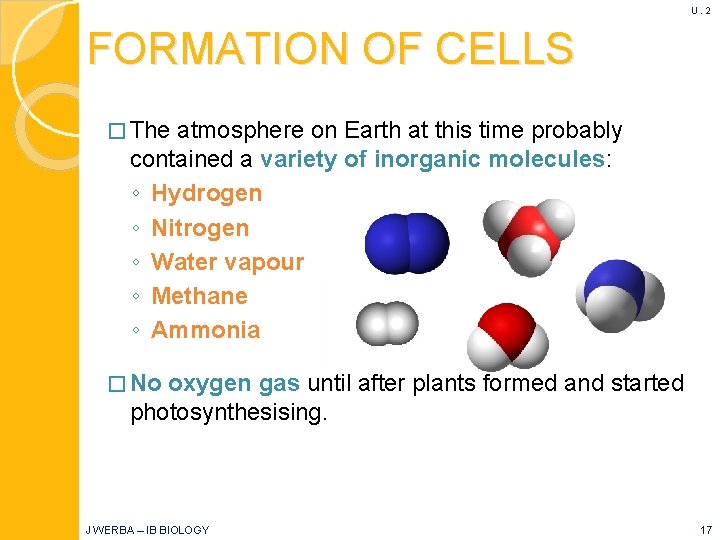
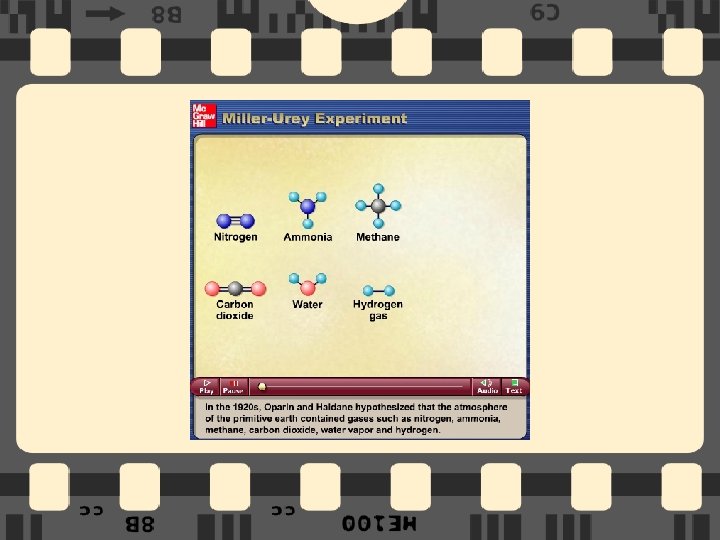
U. 2 FORMATION OF CELLS � The atmosphere on Earth at this time probably contained a variety of inorganic molecules: ◦ Hydrogen ◦ Nitrogen ◦ Water vapour ◦ Methane ◦ Ammonia � No oxygen gas until after plants formed and started photosynthesising. J WERBA – IB BIOLOGY 17
U. 2 FORMATION OF CELLS � The conditions on pre-biotic Earth at this time included: ◦ A reducing atmosphere (resulting from the lack of oxygen) ◦ Frequent electrical storms ◦ High temperatures (due to greenhouse gases) ◦ High radiation levels (no ozone so was extreme) ◦ Volcanic activity ◦ Meteorite bombardment J WERBA – IB BIOLOGY 18
U. 2 FORMATION OF CELLS � Miller and Urey recreated the conditions of pre-biotic Earth in a closed system: ◦ High temperatures/volcanic activity – a flask of water was boiled to generate water vapour ◦ Reducing atmosphere –a mixture of ammonia, methane and hydrogen was introduced ◦ Electrical storms – electric sparks were used to simulate lightning � The mixture was then allowed to cool. � After one week, they found some simple amino acids in the mixture (13 of 20 essential AAs) and 15% of the carbon present were now in organic compounds. J WERBA – IB BIOLOGY 19
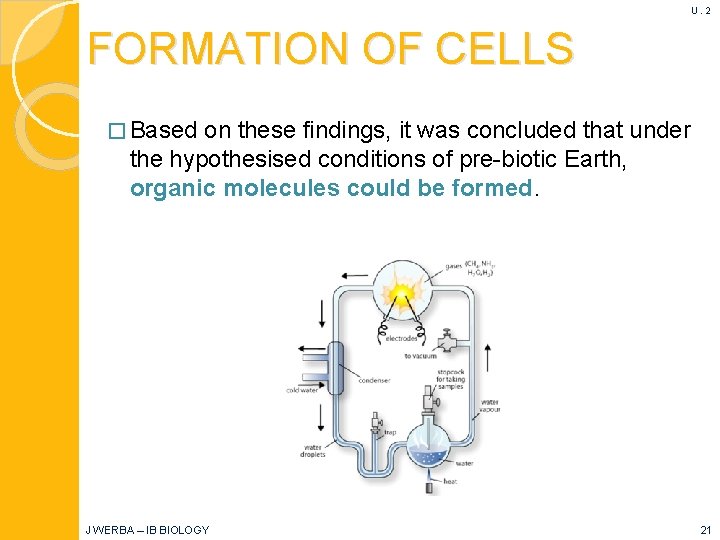
U. 2 FORMATION OF CELLS � Based on these findings, it was concluded that under the hypothesised conditions of pre-biotic Earth, organic molecules could be formed. J WERBA – IB BIOLOGY 21

THE ENDOSYMBIOTIC THEORY U. 3 Grypania is ~2 mm in diameter, so it is too big to be a prokaryotic cell. SOURCE: Mc. Fadden, G. (2009) J WERBA – IB BIOLOGY 22
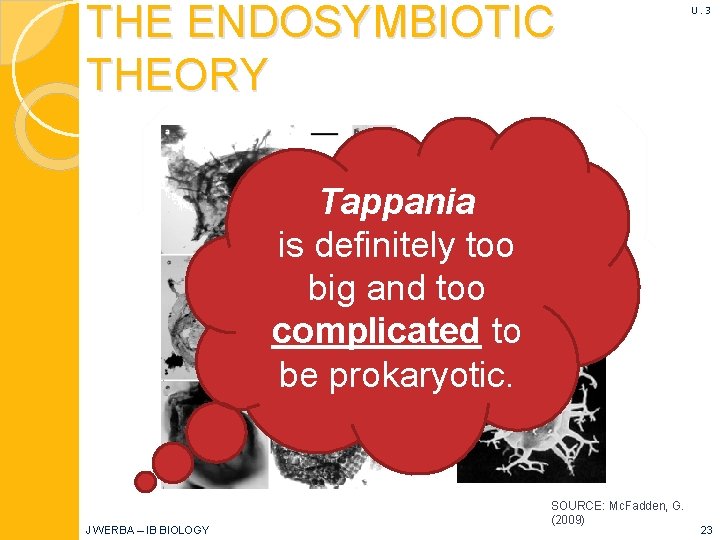
THE ENDOSYMBIOTIC THEORY U. 3 Tappania is definitely too big and too complicated to be prokaryotic. J WERBA – IB BIOLOGY SOURCE: Mc. Fadden, G. (2009) 23
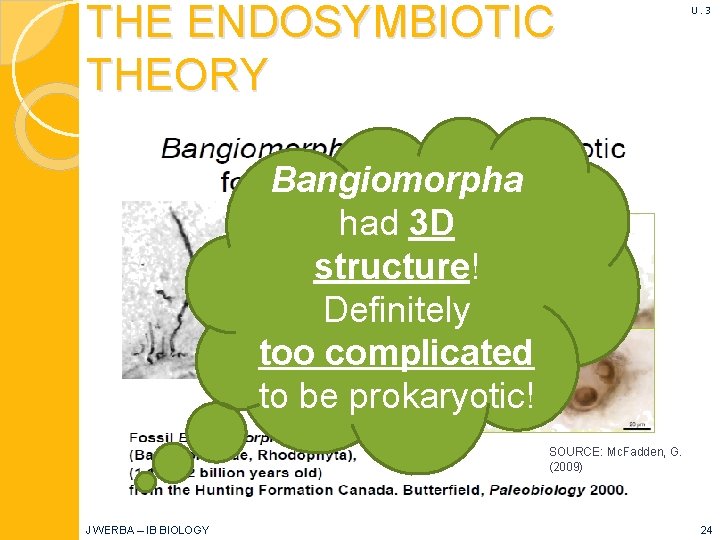
THE ENDOSYMBIOTIC THEORY U. 3 Bangiomorpha had 3 D structure! Definitely too complicated to be prokaryotic! SOURCE: Mc. Fadden, G. (2009) J WERBA – IB BIOLOGY 24
THE ENDOSYMBIOTIC THEORY U. 3 � The oldest fossils of eukaryotic cells have been found to be ~1. 5 billion years old. � The endosymbiotic theory from Lyn Margulis (1967) tries to explain the origin of eukaryotes. � Endosymbiosis: the condition in which one organism lives inside the cell of another organism � Both cells benefit from this - the cells no longer can live separately from each other J WERBA – IB BIOLOGY 25
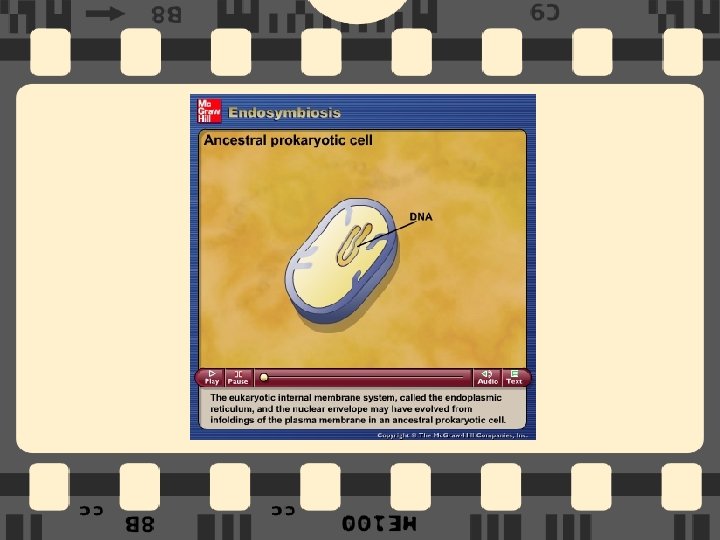
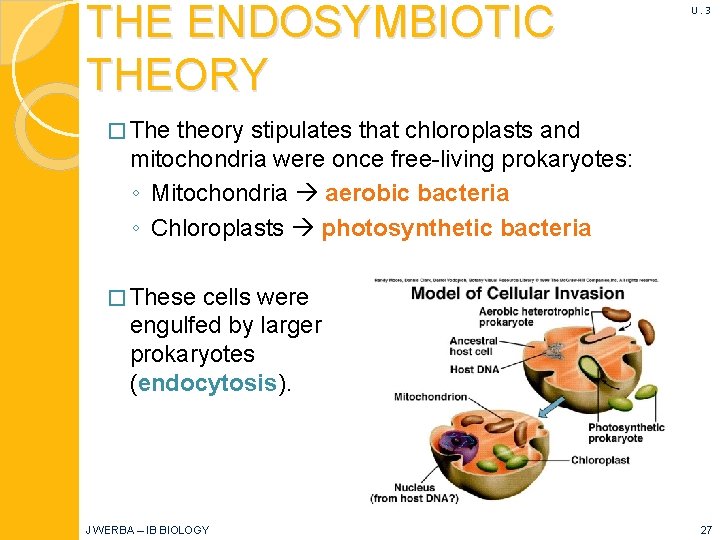
THE ENDOSYMBIOTIC THEORY U. 3 � The theory stipulates that chloroplasts and mitochondria were once free-living prokaryotes: ◦ Mitochondria aerobic bacteria ◦ Chloroplasts photosynthetic bacteria � These cells were engulfed by larger prokaryotes (endocytosis). J WERBA – IB BIOLOGY 27
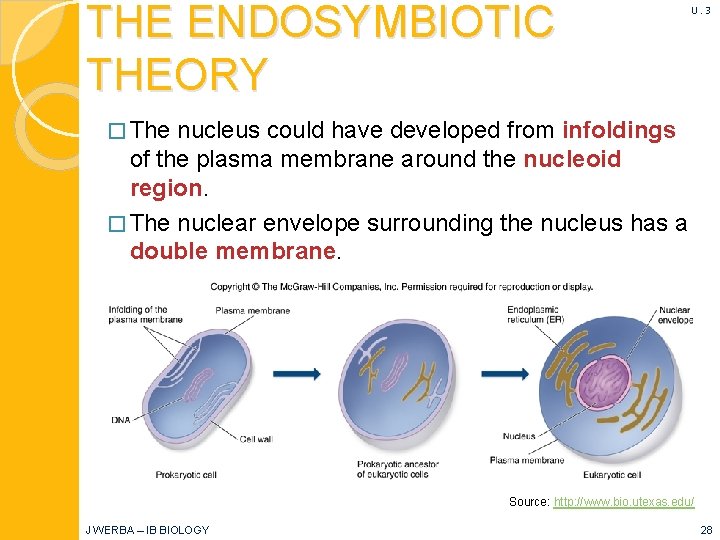
THE ENDOSYMBIOTIC THEORY U. 3 � The nucleus could have developed from infoldings of the plasma membrane around the nucleoid region. � The nuclear envelope surrounding the nucleus has a double membrane. Source: http: //www. bio. utexas. edu/ J WERBA – IB BIOLOGY 28

THE ENDOSYMBIOTIC THEORY U. 3 � Evidence ◦ ◦ ◦ to support theory includes: Both mitochondria and chloroplasts contain their own DNA (naked and circular like bacterial DNA). They have a double membrane (own of their own and one from being engulfed). They have 70 S ribosomes. They are the same size as bacterial cells. They can replicate on their own in a process similar to binary fission. Chloroplasts are similar in structure to cyanobacteria. J WERBA – IB BIOLOGY 29

THE ENDOSYMBIOTIC THEORY �The ◦ ◦ U. 3 four eukaryotic kingdoms are: Protoctista Fungi Plantae Animalia �Eukaryotic cells have some advantages over prokaryotic cells so the early eukaryotes survived and proliferated �Hence the wide diversity of species we know today! J WERBA – IB BIOLOGY 30
THE ORIGIN OF CELLS Q 1 (6 min) The spontaneous origin of life on Earth is thought to have involved the non-living synthesis of simple organic molecules. a) List two other processes needed for the spontaneous origin of life. [2] b) Outline the role of prokaryotes in the development of an oxygen-rich atmosphere on the Earth. [2] J WERBA – IB BIOLOGY 31

THE ORIGIN OF CELLS Q 2 (9 min) Discuss the endosymbiotic theory for the origin of eukaryotes. [6] J WERBA – IB BIOLOGY 32
- Slides: 32