
The Organizational Environment Overview Organizations do not exist


- Slides: 34
The Organizational Environment
Overview � Organizations do not exist in a vacuum. They are constantly being affected by external forces which determine an organization’s effectiveness and performance. Therefore, it is imperative for the management of any organization to examine components of their firm’s external and internal environments to understand the dynamic and far-reaching changes that are occurring. This presentation focuses on the environmental factors that companies need to analyze for developing strategic options.
The External Environment (Macro environment)
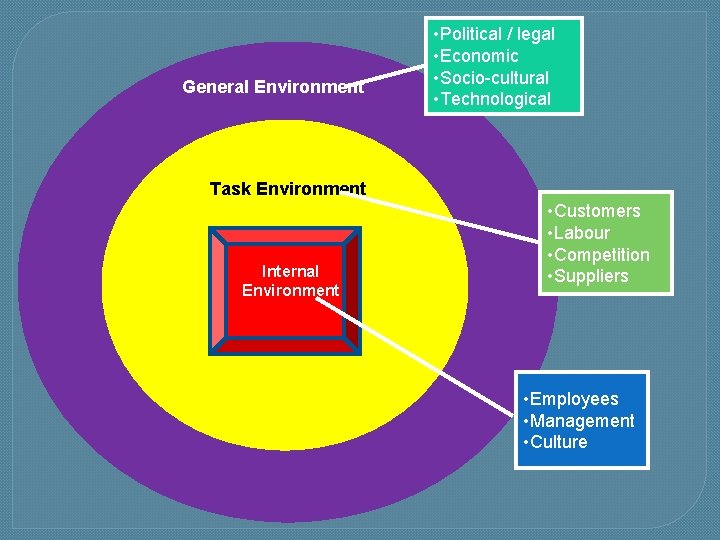
General Environment • Political / legal • Economic • Socio-cultural • Technological Task Environment Internal Environment • Customers • Labour • Competition • Suppliers • Employees • Management • Culture
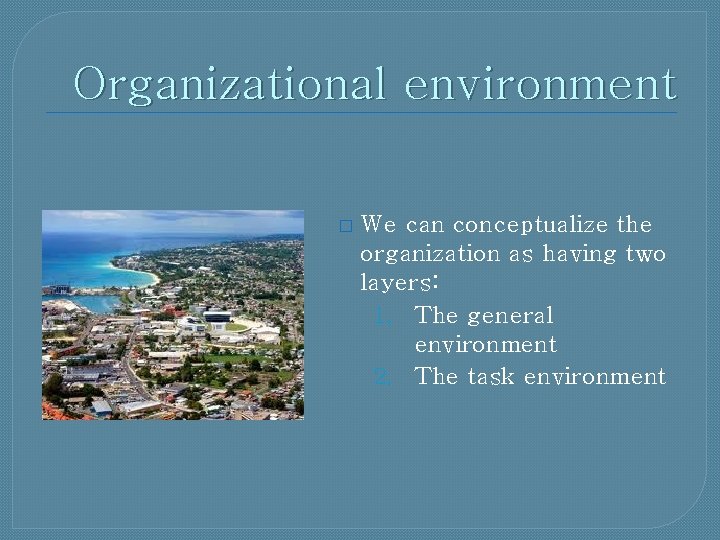
Organizational environment � We can conceptualize the organization as having two layers: 1. The general environment 2. The task environment
The general environment �The general environment or macroenvironment is all those forces affecting the organization indirectly. These external forces are: �Political / legal �Economic �Technological �Socio-cultural
Political / legal environment �The general environment is inclusive of government regulations, laws, policies and activities designed to influence organizational performance in an indirect way.
Technological forces �Technological environment includes changes in technology that affect the way organizations operate and service they provide.
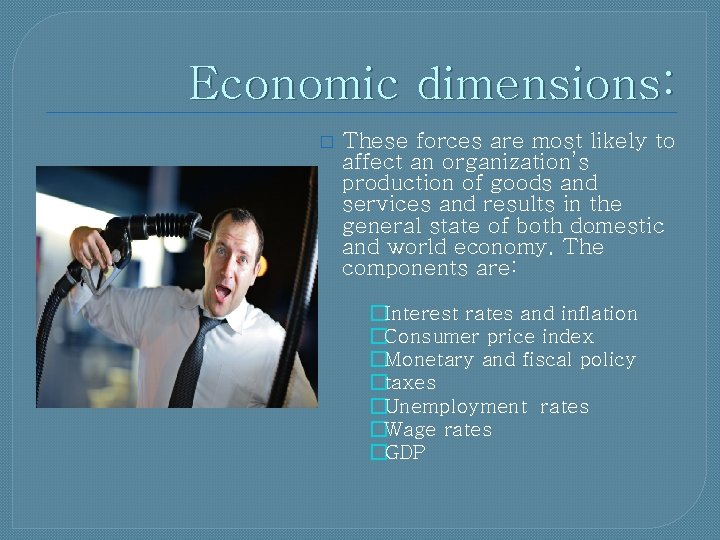
Economic dimensions: � These forces are most likely to affect an organization’s production of goods and services and results in the general state of both domestic and world economy. The components are: �Interest rates and inflation �Consumer price index �Monetary and fiscal policy �taxes �Unemployment rates �Wage rates �GDP
Socio cultural �The importance socio cultural factors that companies should analyze are: • • • Age Population density Educational levels Geographical distribution Culture Lifestyles
Task environment �The task environment is inclusive of those sectors that have a direct working relationship with the organization. Critical variables in the tasks environment are: • • Customers Suppliers Labour competition
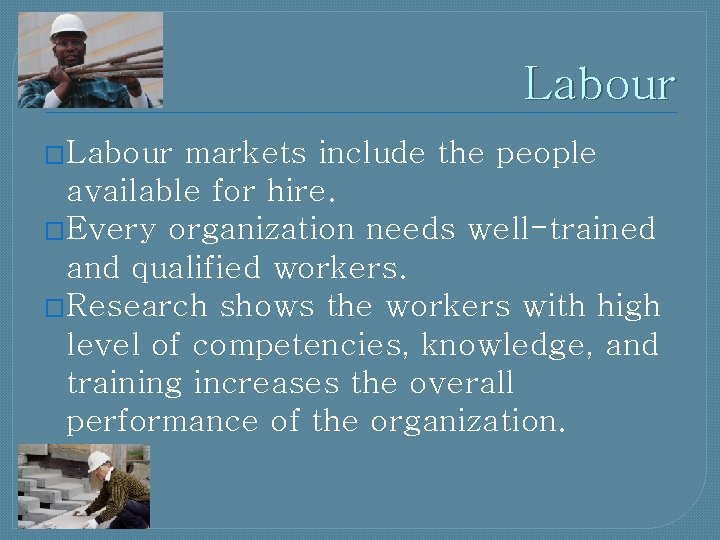
Labour �Labour markets include the people available for hire. �Every organization needs well-trained and qualified workers. �Research shows the workers with high level of competencies, knowledge, and training increases the overall performance of the organization.
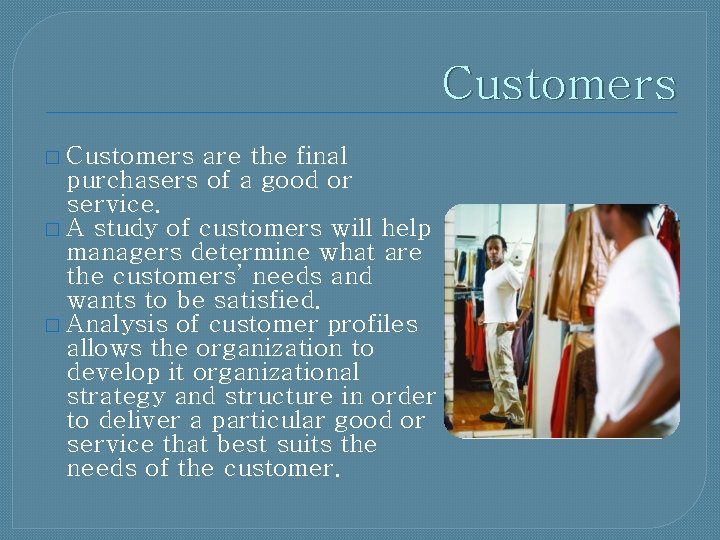
Customers � Customers are the final purchasers of a good or service. � A study of customers will help managers determine what are the customers’ needs and wants to be satisfied. � Analysis of customer profiles allows the organization to develop it organizational strategy and structure in order to deliver a particular good or service that best suits the needs of the customer.
Suppliers �Suppliers are peoples and organizations who provide raw materials the organization uses to produce its output. �A supplier’s pricing strategy does affect the organization’s level of revenue earned.
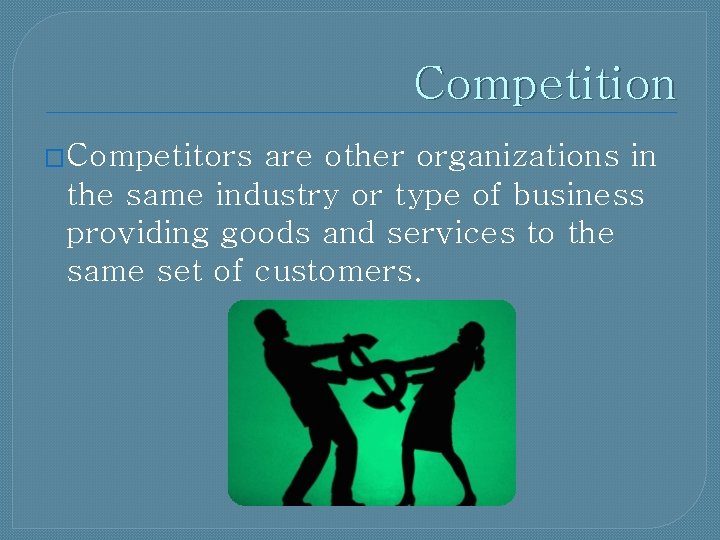
Competition �Competitors are other organizations in the same industry or type of business providing goods and services to the same set of customers.
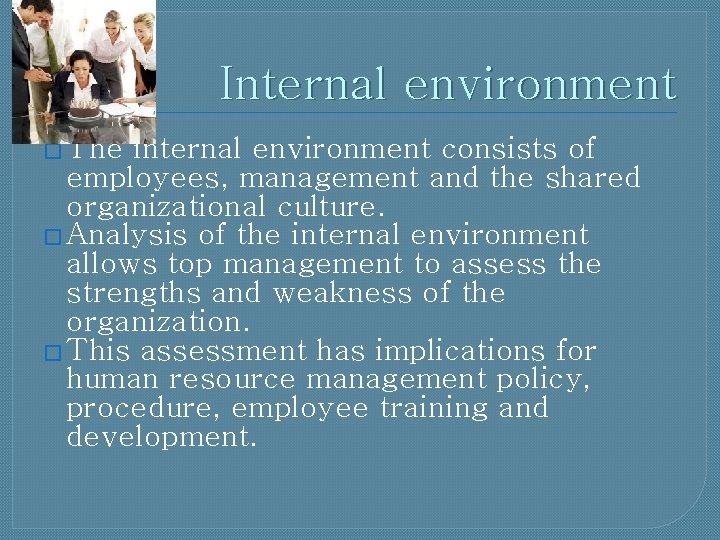
Internal environment � The internal environment consists of employees, management and the shared organizational culture. � Analysis of the internal environment allows top management to assess the strengths and weakness of the organization. � This assessment has implications for human resource management policy, procedure, employee training and development.
Importance of the organizational environment � The unpredictability of the external environment can render an organization ineffective and consequent demise. Careful environmental scanning by management is significant and has implications for planning. It is at this point that managers are able to set goals and design strategy and justify their decisions for taking what ever they see necessary. Not one can be certain; but it is better to be safe than sorry.
What forces in an organizational environment do you see influencing the hotel industry in your country?
Adapting to the Environment �Boundary Spanning Roles assumed by people and/or departments that link and coordinate the organization with key elements in the external world. �Forecasting & Planning.
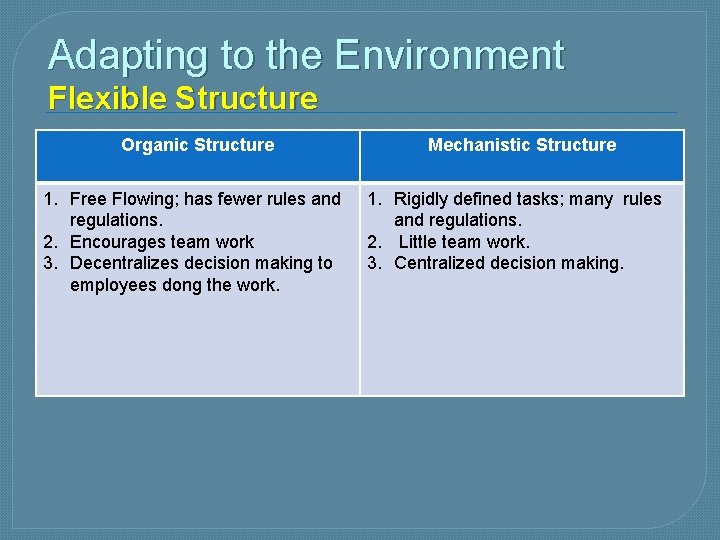
Adapting to the Environment Flexible Structure Organic Structure 1. Free Flowing; has fewer rules and regulations. 2. Encourages team work 3. Decentralizes decision making to employees dong the work. Mechanistic Structure 1. Rigidly defined tasks; many rules and regulations. 2. Little team work. 3. Centralized decision making.
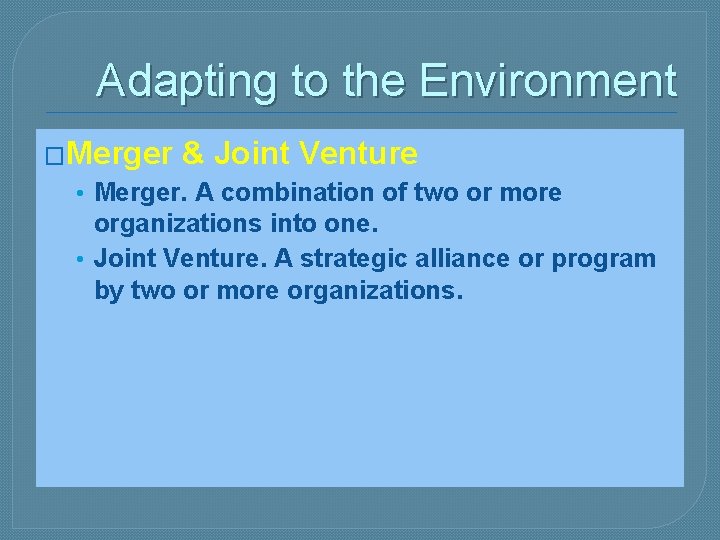
Adapting to the Environment �Merger & Joint Venture • Merger. A combination of two or more organizations into one. • Joint Venture. A strategic alliance or program by two or more organizations.
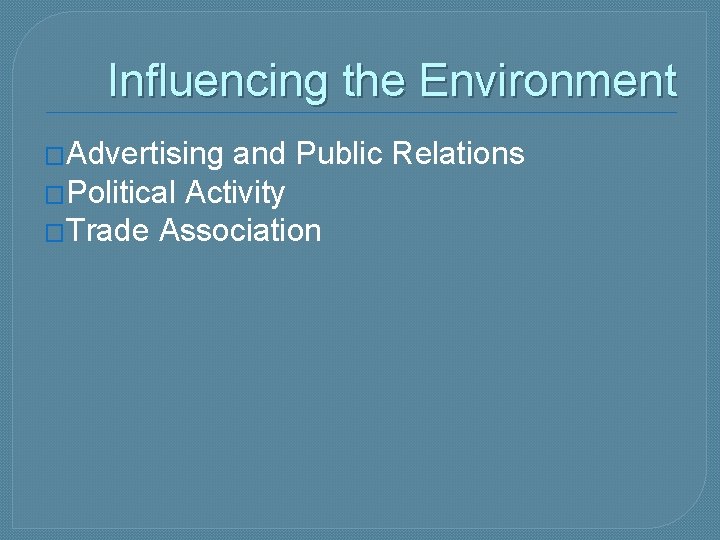
Influencing the Environment �Advertising and Public Relations �Political Activity �Trade Association
Managing in a Global Environment
A Borderless World �Domestic Stage �International Stage �Multinational Stage �The Global Stage
The International Business Environment
Economic Environment �International Financial Crisis �Chinese century �Rise of BRICS �Consumption Patterns �Exchange Rates �Global Warming Loses
Legal-Political �Political Risks �Clash of the Civilizations �GATT – WTO �New Economic Blocks • • EU BRICS Shanghai Five ASEAN
The Socio-cultural Environment �Hofstede’s • • • Research Power Distance Uncertainty avoidance Individualism and Collectivism Masculinity/femininity Future orientation
Getting Started Internationally �Outsourcing �Exporting �Licensing • Franchising �Direct Investment
Multinational Corporation �Advantages • • • Can sell more globally Can avoid transport costs Can take advantage of different wage levels Can achieve great economies of scale Have less chance of going bankrupt Can carry out a lot of R & D
Multinational Corporation �Disadvantages • • • MNCs move their factories to wherever it is profitable MNCs may switch their profits between countries They may force competing firms out of business Some MNCs may exploit workers Some MNCs may interfere in the government of a country