
The optical properties of ore minerals determinable in
The optical properties of ore minerals determinable in polarized reflected light fall naturally into two groups: A. • • PROPERTIES OBSERVED WITHOUT THE ANALYZER: Color of reflection Reflectance or Reflectivity (R) Bireflectance = Reflection pleochroism. Shape or Habit Zoning Cleavages Hardness: relative hardness (scratch or moving line hardness), kalb hardness (equivalent to Becke Line hardness of transparent minerals), Vickers Microhardness (VMH) B. • • • PROPERTIES OBSERVED BETWEEN CROSSED NICOLS: anisotropism vs. isotropism, polarization colors, internal reflections.

Color of Reflection Color of reflection: is the appearance of the mineral to the eye under polarized light. The colors of ore minerals, which range from pure white to gray, as well as other various colors are one of most characteristic and useful properties. 1. A difference in reflectivity can affect the eye, eye where two minerals have a similar color but different reflectivity, the one of higher reflectivity appears the clearer because of its greater brightness 2. The color of a mineral is strongly influenced by the color of neighboring crystals ('mutual color interference'). For example, chalcopyrite by itself has a characteristic and easily recognizable yellow color. Inside sphalerite, it appears a very clear yellow, but in contrast with native gold, it appears a dull greenish yellow. In these circumstances, it may help to close down the IFS, so that the field of view is essentially monomineralic. 3. Color is a function of the index of refraction of the immersion medium (the medium comprising the space between the objective and the surface of the mineral). Covellite in air (R. I. = 1. 00) is deep blue, in water (R. I. - 1. 333) violet blue, in cedar oil (1. 515) red violet, and in methelene iodide (R. I. = 1. 74) orange red. 4. It should be stressed that many minerals which occupy solid solution fields will exhibit color variations (for example ilmenite, sphalerite, pentlandite)
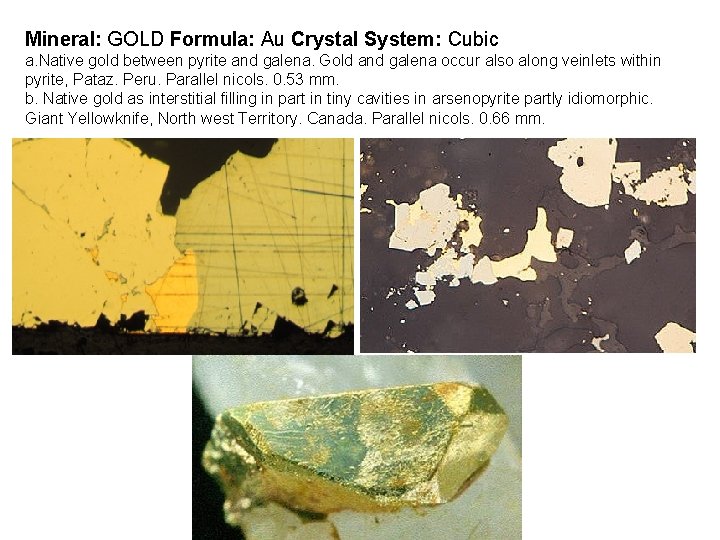
Mineral: GOLD Formula: Au Crystal System: Cubic a. Native gold between pyrite and galena. Gold and galena occur also along veinlets within pyrite, Pataz. Peru. Parallel nicols. 0. 53 mm. b. Native gold as interstitial filling in part in tiny cavities in arsenopyrite partly idiomorphic. Giant Yellowknife, North west Territory. Canada. Parallel nicols. 0. 66 mm.
- Slides: 3