
The Optical Materials Technology OMT group operates its
- Slides: 10
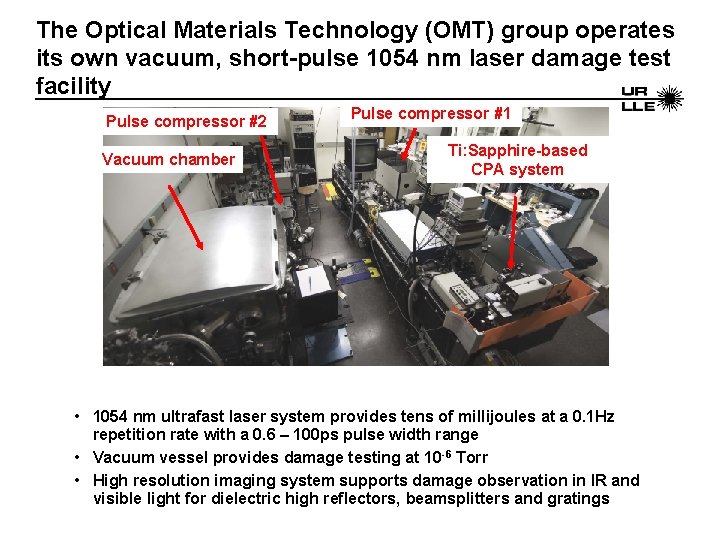
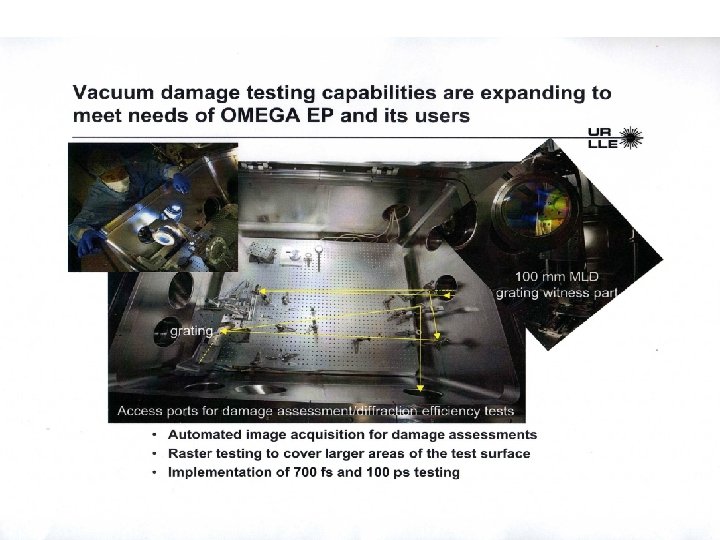
The Optical Materials Technology (OMT) group operates its own vacuum, short-pulse 1054 nm laser damage test facility Pulse compressor #2 Vacuum chamber Pulse compressor #1 Ti: Sapphire-based CPA system • 1054 nm ultrafast laser system provides tens of millijoules at a 0. 1 Hz repetition rate with a 0. 6 – 100 ps pulse width range • Vacuum vessel provides damage testing at 10 -6 Torr • High resolution imaging system supports damage observation in IR and visible light for dielectric high reflectors, beamsplitters and gratings
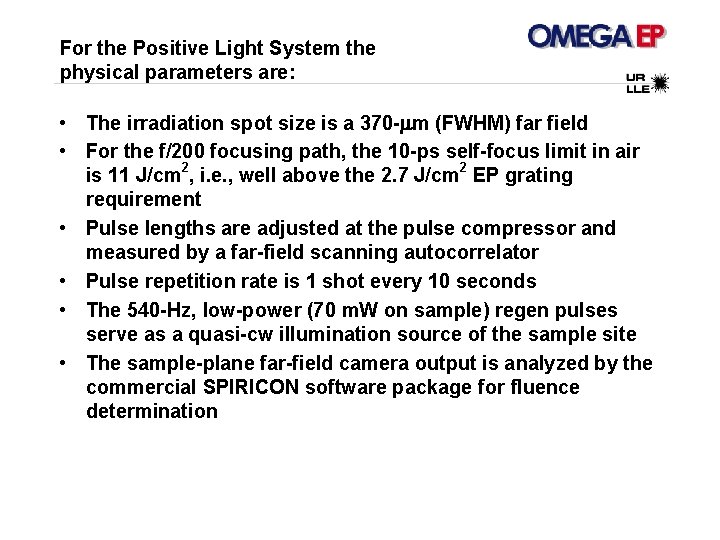
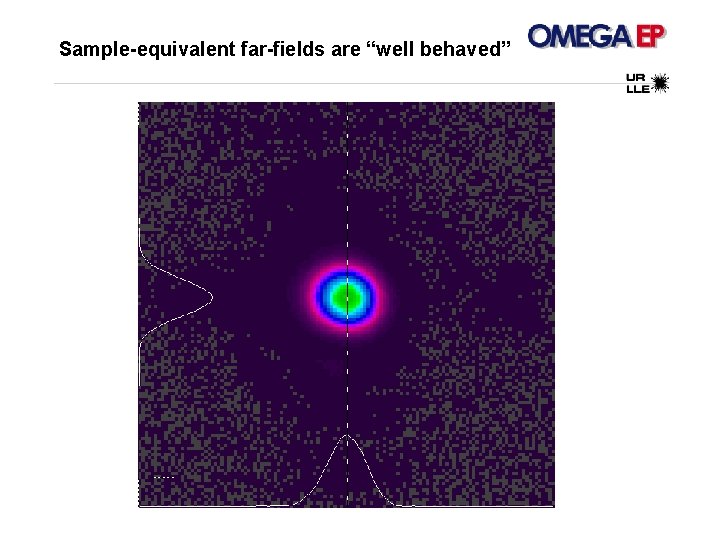
For the Positive Light System the physical parameters are: • The irradiation spot size is a 370 -mm (FWHM) far field • For the f/200 focusing path, the 10 -ps self-focus limit in air 2 2 is 11 J/cm , i. e. , well above the 2. 7 J/cm EP grating requirement • Pulse lengths are adjusted at the pulse compressor and measured by a far-field scanning autocorrelator • Pulse repetition rate is 1 shot every 10 seconds • The 540 -Hz, low-power (70 m. W on sample) regen pulses serve as a quasi-cw illumination source of the sample site • The sample-plane far-field camera output is analyzed by the commercial SPIRICON software package for fluence determination
Sample-equivalent far-fields are “well behaved”
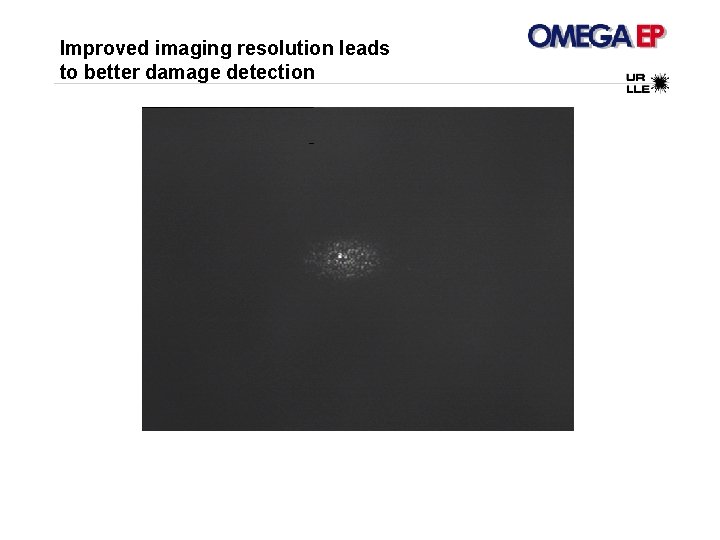
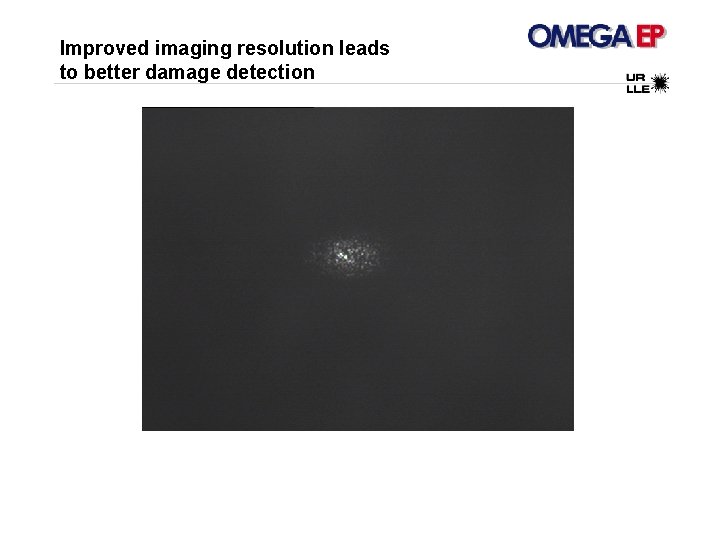
Improved imaging resolution leads to better damage detection
Improved imaging resolution leads to better damage detection
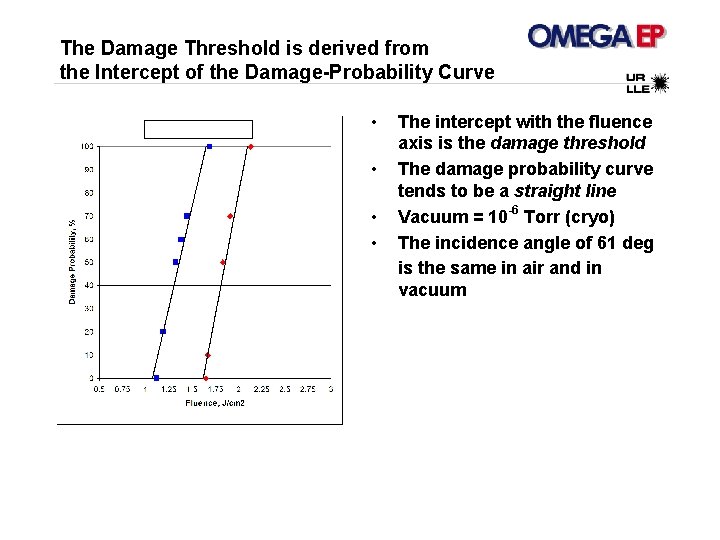
The Damage Threshold is derived from the Intercept of the Damage-Probability Curve • • The intercept with the fluence axis is the damage threshold The damage probability curve tends to be a straight line Vacuum = 10 -6 Torr (cryo) The incidence angle of 61 deg is the same in air and in vacuum
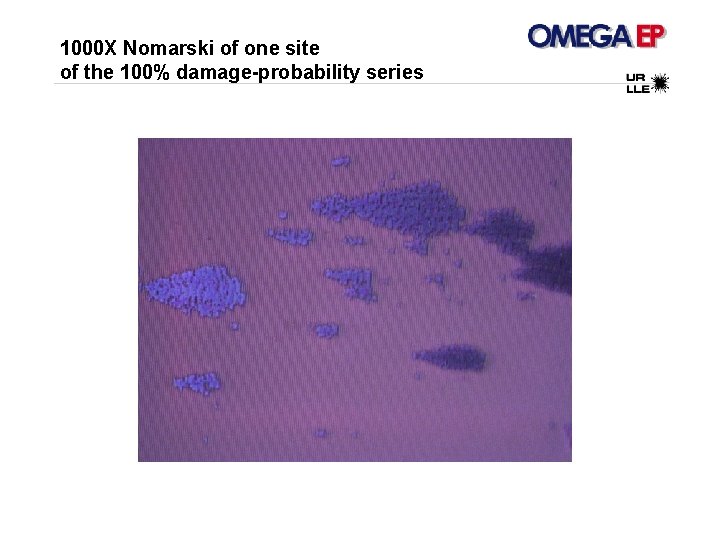
1000 X Nomarski of one site of the 100% damage-probability series
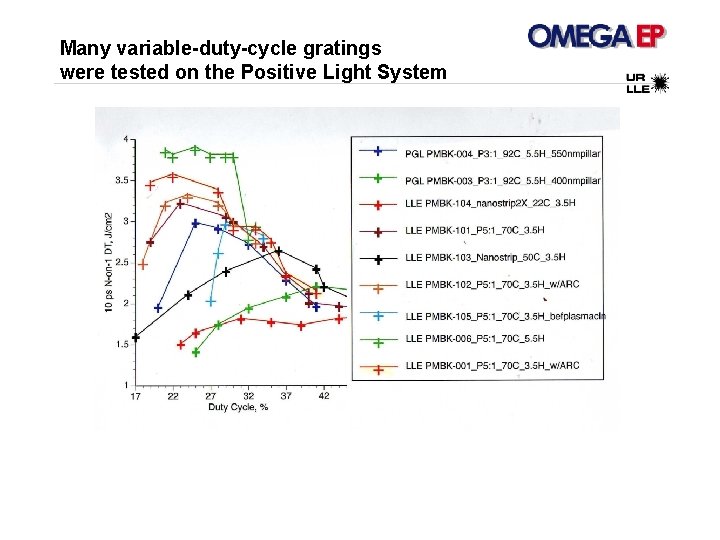
Many variable-duty-cycle gratings were tested on the Positive Light System
Summary • Current gratings fall short of the 2. 7 J/cm 2 @ 10 psec, 61 deg incidence EP requirement • In-vacuum thresholds are similar for samples from different vendors • In-vacuum thresholds cluster in the range of 2. 1 to 2. 5 J/cm 2 • “Good” grating duty cycles have been obtained on production witnesses • The unaided-eye determination of damage yields overoptimistic threshold values inconsistent with fluence observations on EP