
The Opportunities and Challenges for Rural Hospitals in
- Slides: 14
The Opportunities and Challenges for Rural Hospitals in an Era of Health Reform April, 2011 Research and analysis by Avalere Health
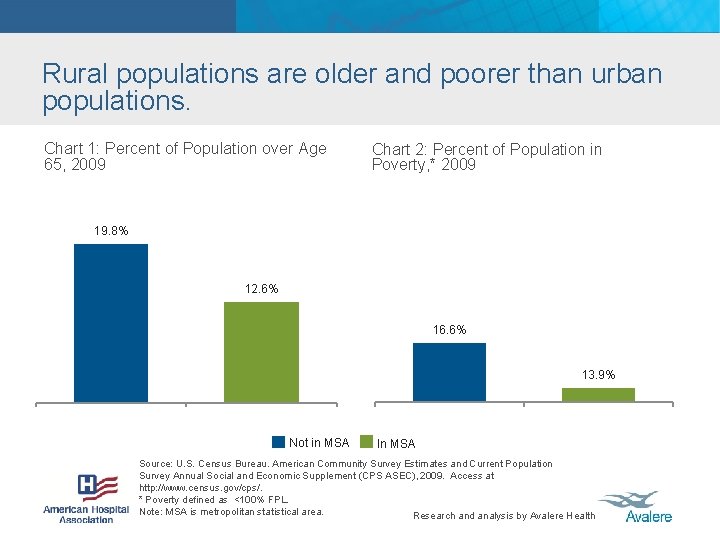
Rural populations are older and poorer than urban populations. Chart 1: Percent of Population over Age 65, 2009 Chart 2: Percent of Population in Poverty, * 2009 19. 8% 12. 6% 16. 6% 13. 9% Not in MSA In MSA Source: U. S. Census Bureau. American Community Survey Estimates and Current Population Survey Annual Social and Economic Supplement (CPS ASEC), 2009. Access at http: //www. census. gov/cps/. * Poverty defined as <100% FPL. Note: MSA is metropolitan statistical area. Research and analysis by Avalere Health
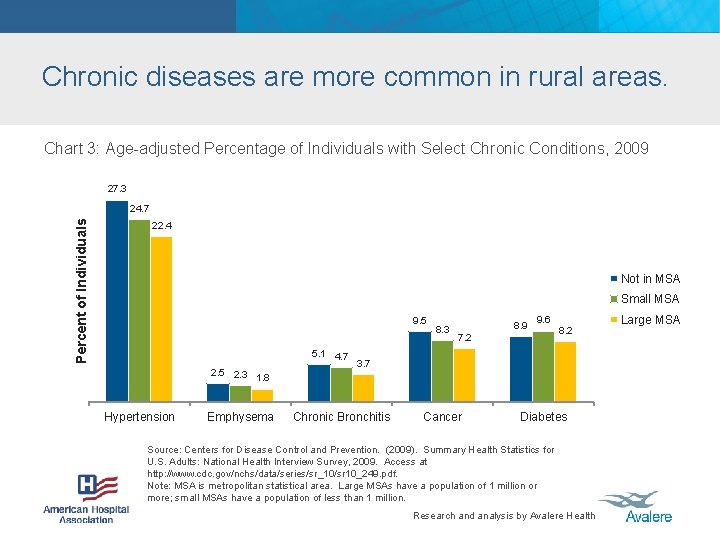
Chronic diseases are more common in rural areas. Chart 3: Age-adjusted Percentage of Individuals with Select Chronic Conditions, 2009 27. 3 Percent of Individuals 24. 7 22. 4 Not in MSA Small MSA 9. 5 5. 1 4. 7 2. 5 2. 3 1. 8 Hypertension Emphysema 8. 3 8. 9 9. 6 7. 2 8. 2 3. 7 Chronic Bronchitis Cancer Diabetes Source: Centers for Disease Control and Prevention. (2009). Summary Health Statistics for U. S. Adults: National Health Interview Survey, 2009. Access at http: //www. cdc. gov/nchs/data/series/sr_10/sr 10_249. pdf. Note: MSA is metropolitan statistical area. Large MSAs have a population of 1 million or more; small MSAs have a population of less than 1 million. Research and analysis by Avalere Health Large MSA
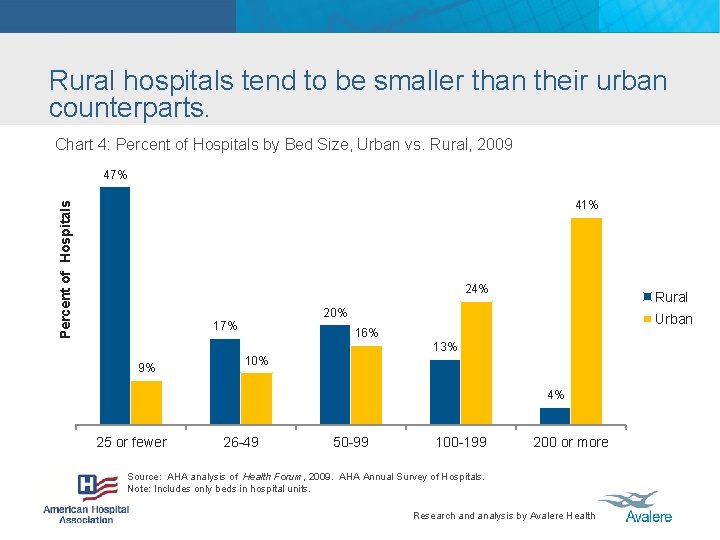
Rural hospitals tend to be smaller than their urban counterparts. Chart 4: Percent of Hospitals by Bed Size, Urban vs. Rural, 2009 47% Percent of Hospitals 41% 24% Rural 20% 17% 9% Urban 16% 13% 10% 4% 25 or fewer 26 -49 50 -99 100 -199 200 or more Source: AHA analysis of Health Forum, 2009. AHA Annual Survey of Hospitals. Note: Includes only beds in hospital units. Research and analysis by Avalere Health
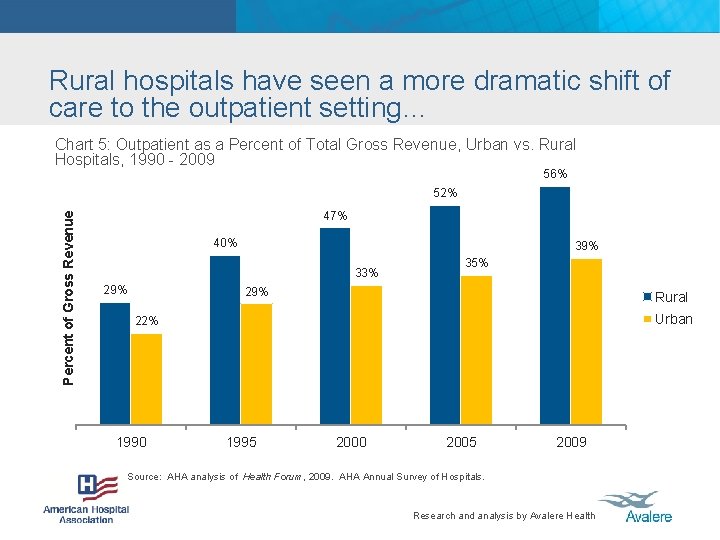
Rural hospitals have seen a more dramatic shift of care to the outpatient setting… Chart 5: Outpatient as a Percent of Total Gross Revenue, Urban vs. Rural Hospitals, 1990 - 2009 56% Percent of Gross Revenue 52% 47% 40% 39% 33% 29% 35% 29% Rural Urban 22% 1990 1995 2000 2005 2009 Source: AHA analysis of Health Forum, 2009. AHA Annual Survey of Hospitals. Research and analysis by Avalere Health
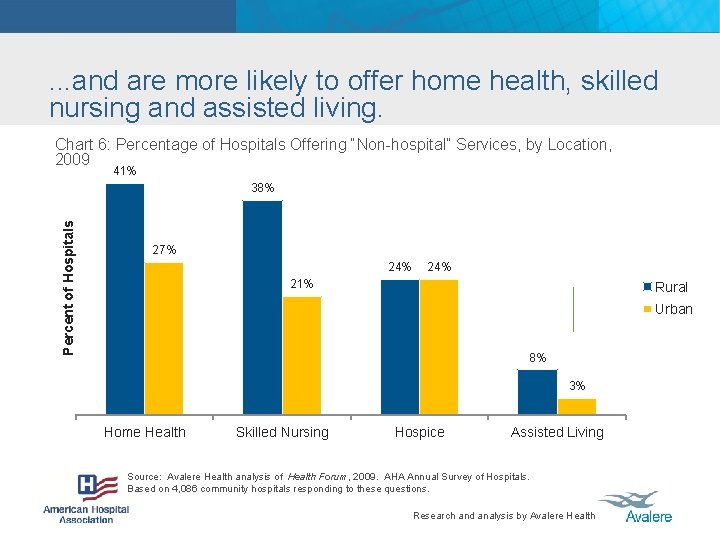
. . . and are more likely to offer home health, skilled nursing and assisted living. Chart 6: Percentage of Hospitals Offering “Non-hospital” Services, by Location, 2009 41% Percent of Hospitals 38% 27% 24% 21% Rural Urban 8% 3% Home Health Skilled Nursing Hospice Assisted Living Source: Avalere Health analysis of Health Forum, 2009. AHA Annual Survey of Hospitals. Based on 4, 086 community hospitals responding to these questions. Research and analysis by Avalere Health
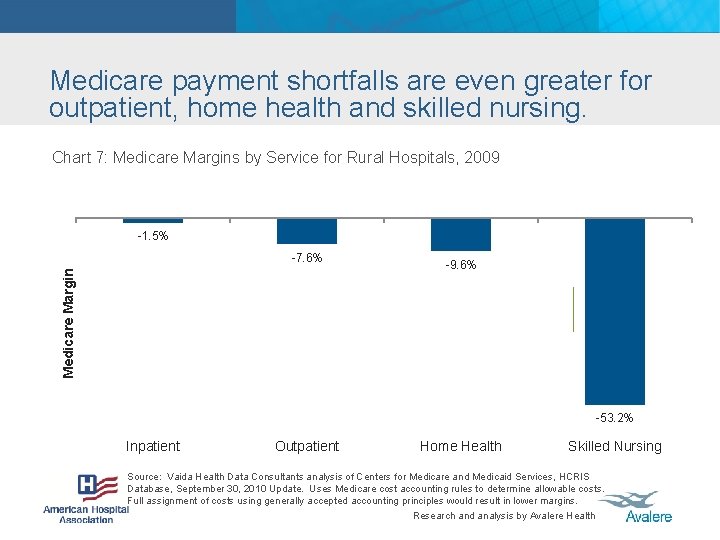
Medicare payment shortfalls are even greater for outpatient, home health and skilled nursing. Chart 7: Medicare Margins by Service for Rural Hospitals, 2009 -1. 5% Medicare Margin -7. 6% -9. 6% -53. 2% Inpatient Outpatient Home Health Skilled Nursing Source: Vaida Health Data Consultants analysis of Centers for Medicare and Medicaid Services, HCRIS Database, September 30, 2010 Update. Uses Medicare cost accounting rules to determine allowable costs. Full assignment of costs using generally accepted accounting principles would result in lower margins. Research and analysis by Avalere Health
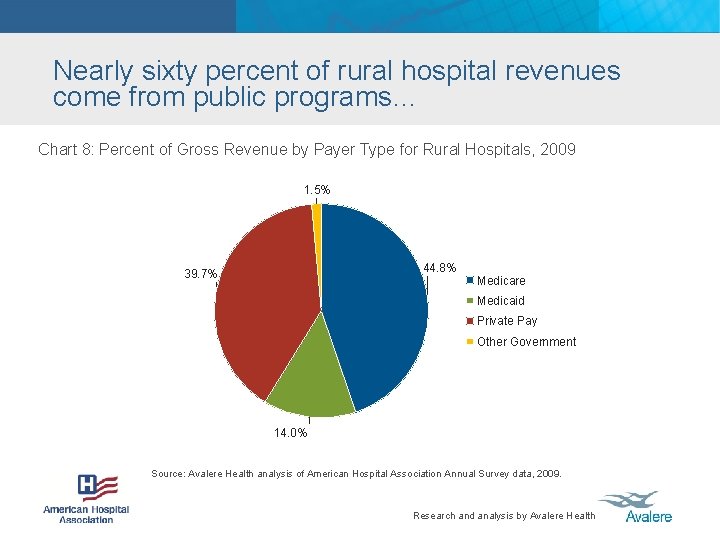
Nearly sixty percent of rural hospital revenues come from public programs… Chart 8: Percent of Gross Revenue by Payer Type for Rural Hospitals, 2009 1. 5% 44. 8% 39. 7% Medicare Medicaid Private Pay Other Government 14. 0% Source: Avalere Health analysis of American Hospital Association Annual Survey data, 2009. Research and analysis by Avalere Health
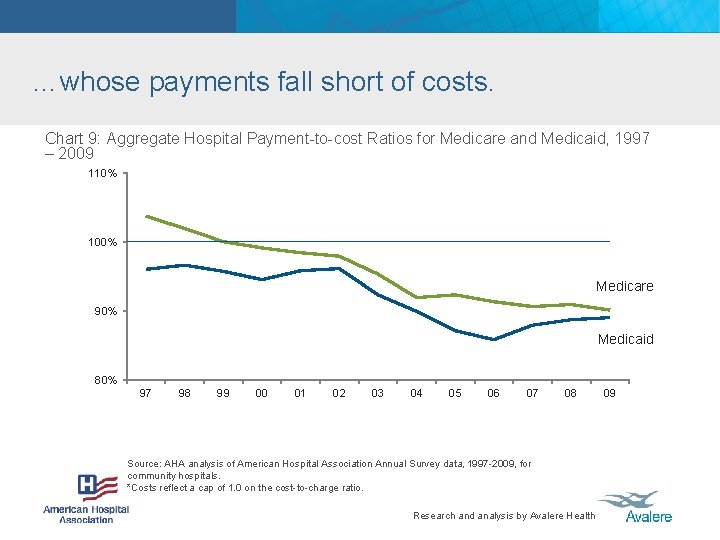
…whose payments fall short of costs. Chart 9: Aggregate Hospital Payment-to-cost Ratios for Medicare and Medicaid, 1997 – 2009 110% 100% Medicare 90% Medicaid 80% 97 98 99 00 01 02 03 04 05 06 07 08 Source: AHA analysis of American Hospital Association Annual Survey data, 1997 -2009, for community hospitals. *Costs reflect a cap of 1. 0 on the cost-to-charge ratio. Research and analysis by Avalere Health 09
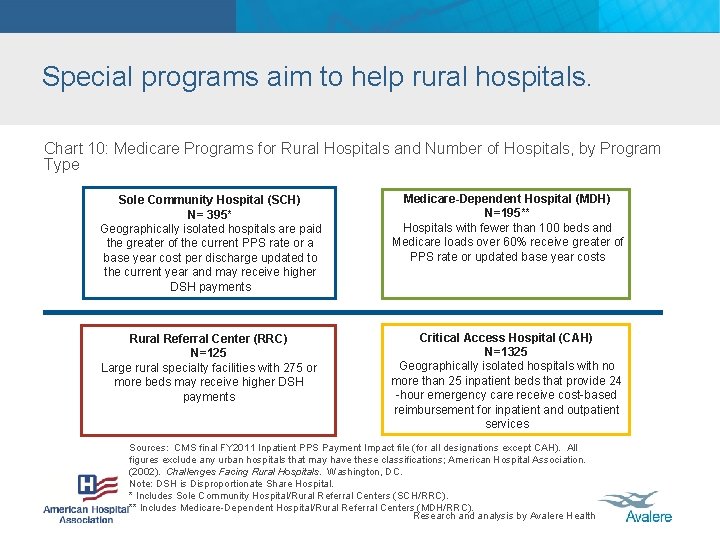
Special programs aim to help rural hospitals. Chart 10: Medicare Programs for Rural Hospitals and Number of Hospitals, by Program Type Sole Community Hospital (SCH) N= 395* Geographically isolated hospitals are paid the greater of the current PPS rate or a base year cost per discharge updated to the current year and may receive higher DSH payments Medicare-Dependent Hospital (MDH) N=195** Hospitals with fewer than 100 beds and Medicare loads over 60% receive greater of PPS rate or updated base year costs Rural Referral Center (RRC) N=125 Large rural specialty facilities with 275 or more beds may receive higher DSH payments Critical Access Hospital (CAH) N=1325 Geographically isolated hospitals with no more than 25 inpatient beds that provide 24 -hour emergency care receive cost-based reimbursement for inpatient and outpatient services Sources: CMS final FY 2011 Inpatient PPS Payment Impact file (for all designations except CAH). All figures exclude any urban hospitals that may have these classifications; American Hospital Association. (2002). Challenges Facing Rural Hospitals. Washington, DC. Note: DSH is Disproportionate Share Hospital. * Includes Sole Community Hospital/Rural Referral Centers (SCH/RRC). ** Includes Medicare-Dependent Hospital/Rural Referral Centers (MDH/RRC). Research and analysis by Avalere Health
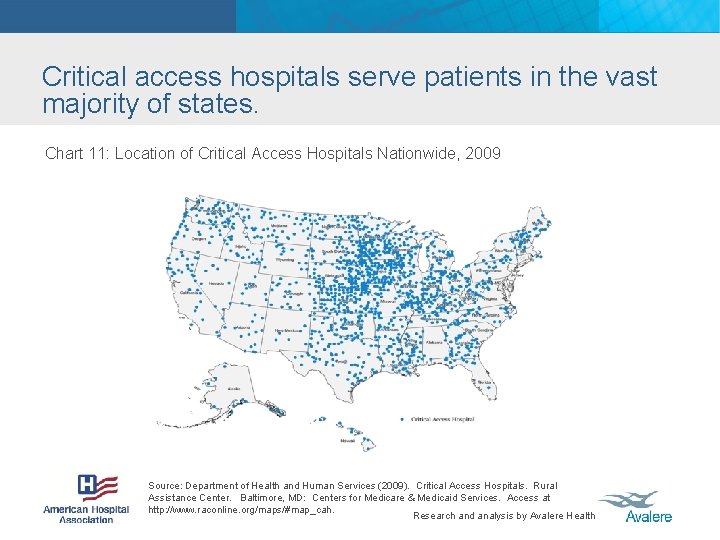
Critical access hospitals serve patients in the vast majority of states. Chart 11: Location of Critical Access Hospitals Nationwide, 2009 Source: Department of Health and Human Services (2009). Critical Access Hospitals. Rural Assistance Center. Baltimore, MD: Centers for Medicare & Medicaid Services. Access at http: //www. raconline. org/maps/#map_cah. Research and analysis by Avalere Health
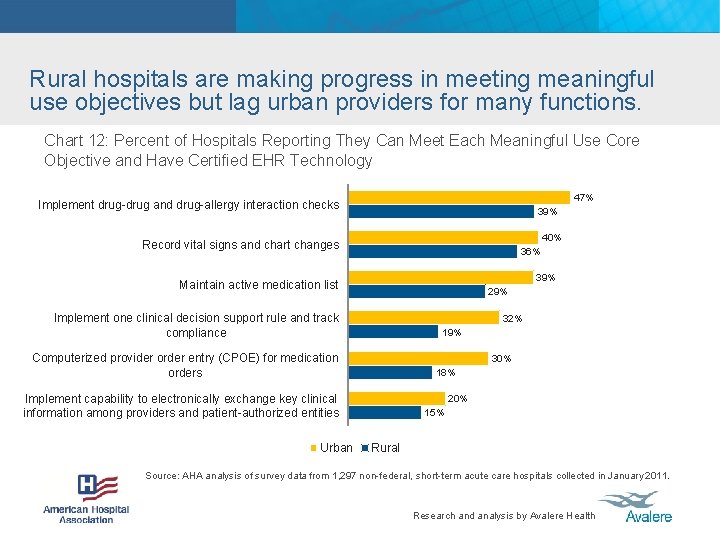
Rural hospitals are making progress in meeting meaningful use objectives but lag urban providers for many functions. Chart 12: Percent of Hospitals Reporting They Can Meet Each Meaningful Use Core Objective and Have Certified EHR Technology 47% Implement drug-drug and drug-allergy interaction checks 39% 40% Record vital signs and chart changes 36% 39% Maintain active medication list 29% Implement one clinical decision support rule and track compliance 32% 19% Computerized provider order entry (CPOE) for medication orders 30% 18% Implement capability to electronically exchange key clinical information among providers and patient-authorized entities Urban 20% 15% Rural Source: AHA analysis of survey data from 1, 297 non-federal, short-term acute care hospitals collected in January 2011. Research and analysis by Avalere Health
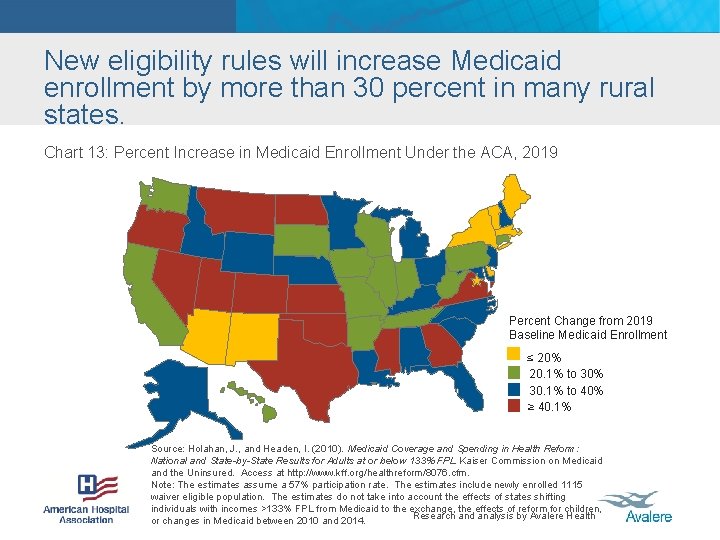
New eligibility rules will increase Medicaid enrollment by more than 30 percent in many rural states. Chart 13: Percent Increase in Medicaid Enrollment Under the ACA, 2019 Percent Change from 2019 Baseline Medicaid Enrollment ≤ 20% 20. 1% to 30% 30. 1% to 40% ≥ 40. 1% Source: Holahan, J. , and Headen, I. (2010). Medicaid Coverage and Spending in Health Reform: National and State-by-State Results for Adults at or below 133% FPL. Kaiser Commission on Medicaid and the Uninsured. Access at http: //www. kff. org/healthreform/8076. cfm. Note: The estimates assume a 57% participation rate. The estimates include newly enrolled 1115 waiver eligible population. The estimates do not take into account the effects of states shifting individuals with incomes >133% FPL from Medicaid to the exchange, the effects of reform for children, Research and analysis by Avalere Health or changes in Medicaid between 2010 and 2014.
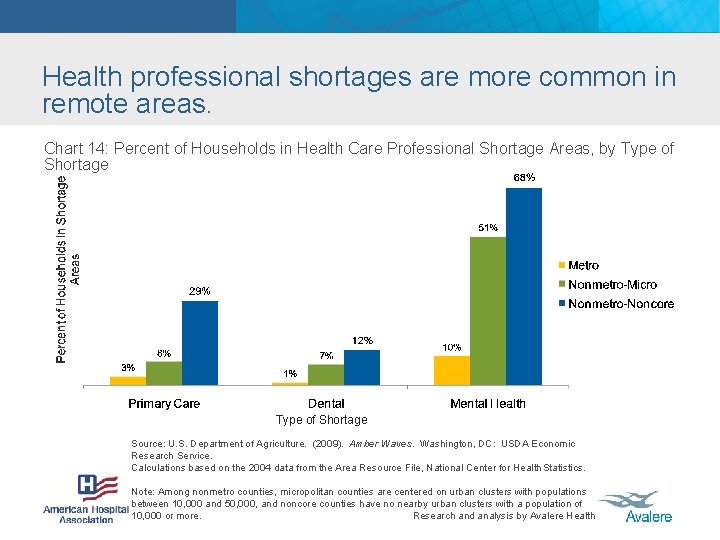
Health professional shortages are more common in remote areas. Chart 14: Percent of Households in Health Care Professional Shortage Areas, by Type of Shortage Source: U. S. Department of Agriculture. (2009). Amber Waves. Washington, DC: USDA Economic Research Service. Calculations based on the 2004 data from the Area Resource File, National Center for Health Statistics. Note: Among nonmetro counties, micropolitan counties are centered on urban clusters with populations between 10, 000 and 50, 000, and noncore counties have no nearby urban clusters with a population of 10, 000 or more. Research and analysis by Avalere Health