
The Open University Maths Dept Promoting Mathematical Thinking
![Preparing the Ground v Construct a function F : [a, b] --> R o](https://slidetodoc.com/presentation_image/466d5c421b7116f4fa28821f344f2b1a/image-26.jpg "Preparing the Ground v Construct a function F : [a, b] --> R o")
- Slides: 37
The Open University Maths Dept Promoting Mathematical Thinking University of Oxford Dept of Education What Makes Examples Exemplary for Students of Mathematics? John Mason Dundee Feb 2018
Outline v v v Phenomena: Familiar Student Behaviour Headlines for what is possible today Mathematical & Pedagogical Theme o Invariance in the midst of change v 22 Pedagogical Constructs as Strategies
Conjectures v v v Everything said here today is to be treated as a conjecture …. . . to be tested in your experience I normally take a phenomenological stance. . . I start from and try to connect to, experience BUT – Your time is precious and mine today is short. . . 33
Some Phenomena v v Students often ignore conditions when applying theorems Students often ask for more examples. . . o But do they know what to do with the examples they have? v v Students often over generalise, or fail to generalise at all Students often have a very limited notion of mathematical concepts. . . o What is it about some examples that makes them useful for students? o What do students need to do with the examples they are given? o Do students know how to study mathematics (for an exam)? o Do you indicate useful study strategies? 44
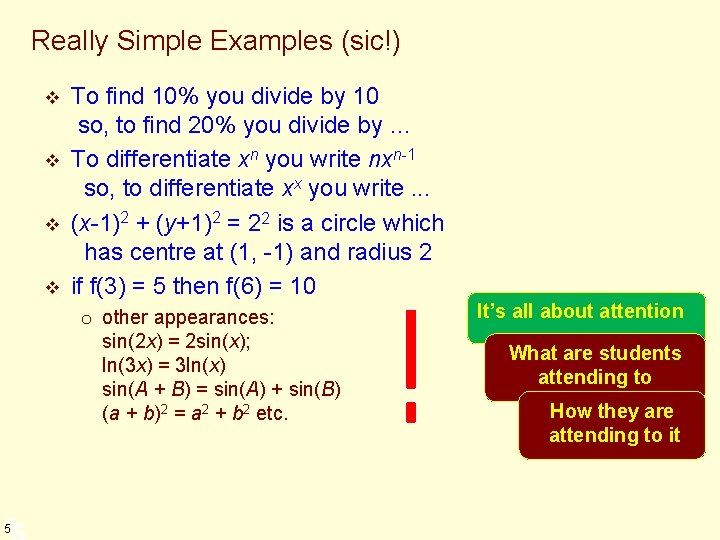
Really Simple Examples (sic!) v v To find 10% you divide by 10 so, to find 20% you divide by … To differentiate xn you write nxn-1 so, to differentiate xx you write. . . (x-1)2 + (y+1)2 = 22 is a circle which has centre at (1, -1) and radius 2 if f(3) = 5 then f(6) = 10 o other appearances: sin(2 x) = 2 sin(x); ln(3 x) = 3 ln(x) sin(A + B) = sin(A) + sin(B) (a + b)2 = a 2 + b 2 etc. 55 It’s all about attention What are students attending to How they are attending to it
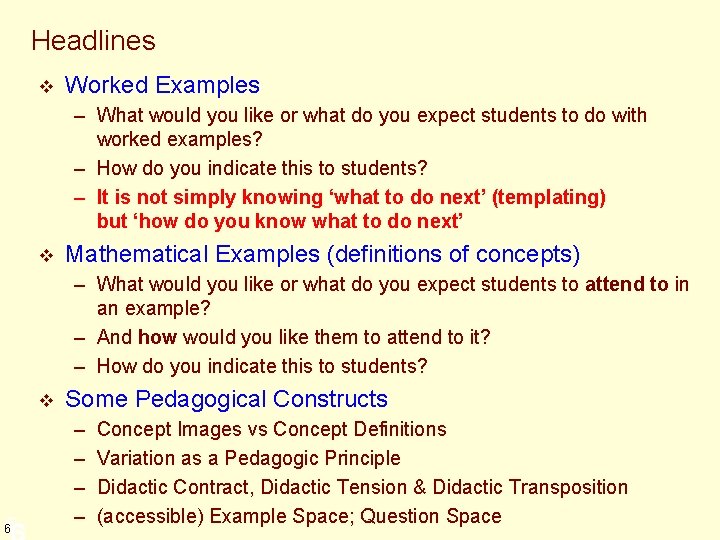
Headlines v Worked Examples – What would you like or what do you expect students to do with worked examples? – How do you indicate this to students? – It is not simply knowing ‘what to do next’ (templating) but ‘how do you know what to do next’ v Mathematical Examples (definitions of concepts) – What would you like or what do you expect students to attend to in an example? – And how would you like them to attend to it? – How do you indicate this to students? v 66 Some Pedagogical Constructs – – Concept Images vs Concept Definitions Variation as a Pedagogic Principle Didactic Contract, Didactic Tension & Didactic Transposition (accessible) Example Space; Question Space
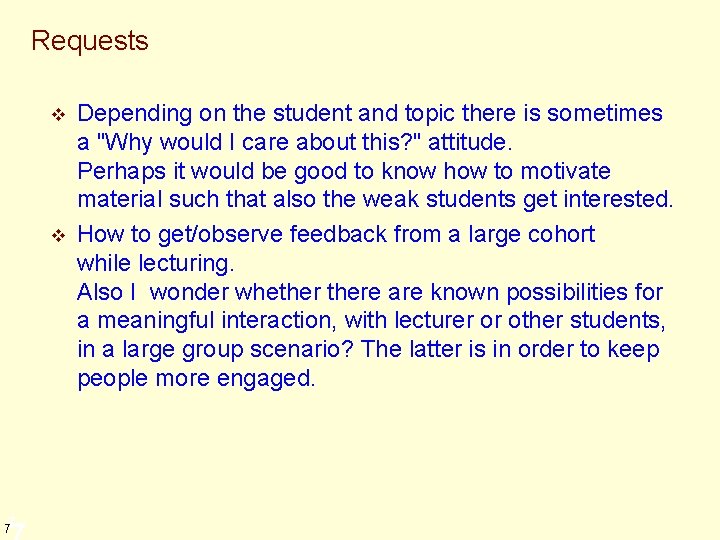
Requests v v 77 Depending on the student and topic there is sometimes a "Why would I care about this? " attitude. Perhaps it would be good to know how to motivate material such that also the weak students get interested. How to get/observe feedback from a large cohort while lecturing. Also I wonder whethere are known possibilities for a meaningful interaction, with lecturer or other students, in a large group scenario? The latter is in order to keep people more engaged.
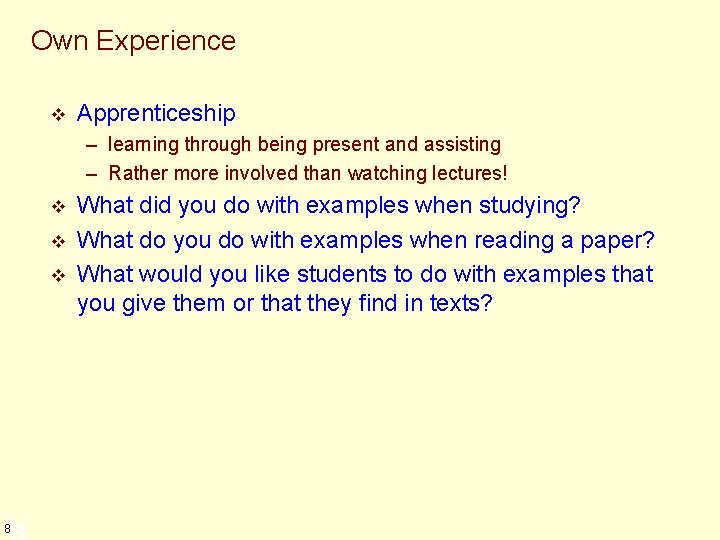
Own Experience v Apprenticeship – learning through being present and assisting – Rather more involved than watching lectures! v v v 88 What did you do with examples when studying? What do you do with examples when reading a paper? What would you like students to do with examples that you give them or that they find in texts?
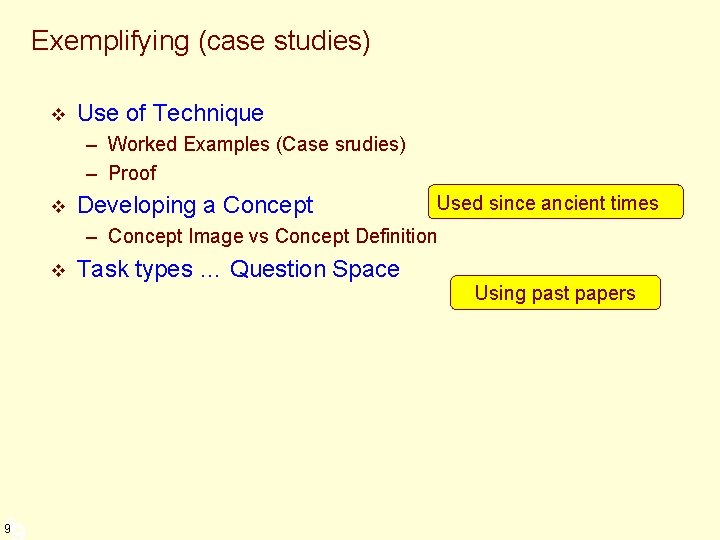
Exemplifying (case studies) v Use of Technique – Worked Examples (Case srudies) – Proof v Developing a Concept Used since ancient times – Concept Image vs Concept Definition v Task types … Question Space Using past papers 99
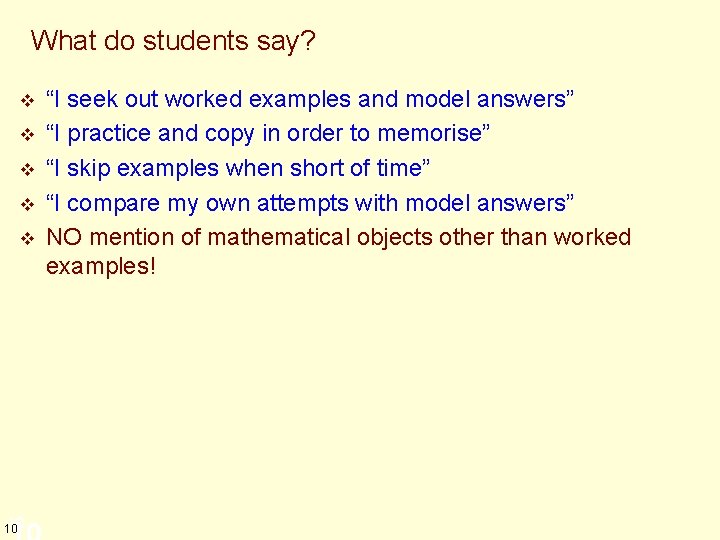
What do students say? v v v 10 10 “I seek out worked examples and model answers” “I practice and copy in order to memorise” “I skip examples when short of time” “I compare my own attempts with model answers” NO mention of mathematical objects other than worked examples!
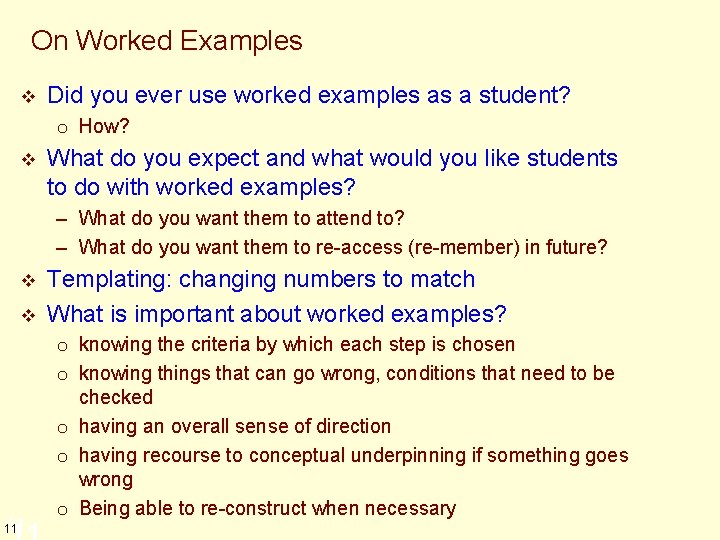
On Worked Examples v Did you ever use worked examples as a student? o How? v What do you expect and what would you like students to do with worked examples? – What do you want them to attend to? – What do you want them to re-access (re-member) in future? v v 11 11 Templating: changing numbers to match What is important about worked examples? o knowing the criteria by which each step is chosen o knowing things that can go wrong, conditions that need to be checked o having an overall sense of direction o having recourse to conceptual underpinning if something goes wrong o Being able to re-construct when necessary
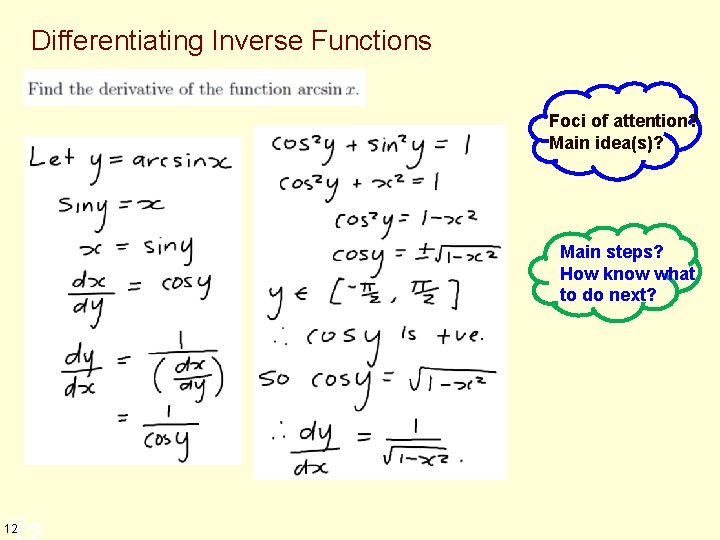
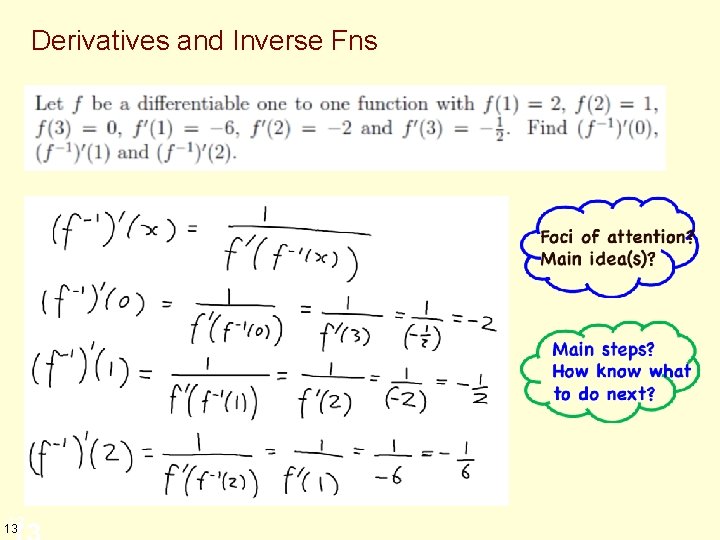
Differentiating Inverse Functions Foci of attention? Main idea(s)? Main steps? How know what to do next? 12 12
Derivatives and Inverse Fns 13 13
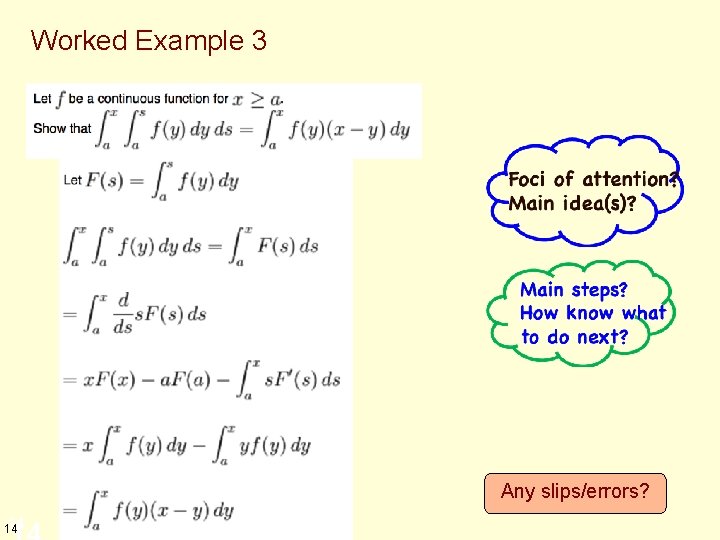
Worked Example 3 Any slips/errors? 14 14
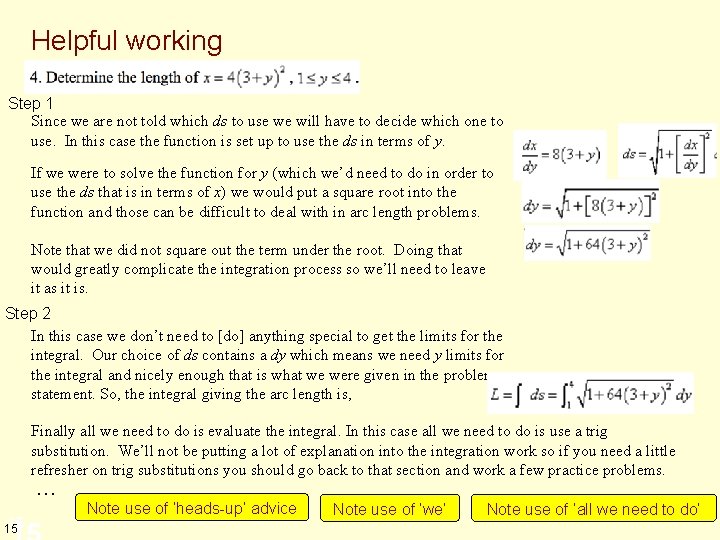
Helpful working Step 1 Since we are not told which ds to use we will have to decide which one to use. In this case the function is set up to use the ds in terms of y. If we were to solve the function for y (which we’d need to do in order to use the ds that is in terms of x) we would put a square root into the function and those can be difficult to deal with in arc length problems. Note that we did not square out the term under the root. Doing that would greatly complicate the integration process so we’ll need to leave it as it is. Step 2 In this case we don’t need to [do] anything special to get the limits for the integral. Our choice of ds contains a dy which means we need y limits for the integral and nicely enough that is what we were given in the problem statement. So, the integral giving the arc length is, Finally all we need to do is evaluate the integral. In this case all we need to do is use a trig substitution. We’ll not be putting a lot of explanation into the integration work so if you need a little refresher on trig substitutions you should go back to that section and work a few practice problems. … 15 15 Note use of ‘heads-up’ advice Note use of ‘we’ Note use of ‘all we need to do’
Using a Worked Example v v What needs to be attended to particularly? (What is being exemplified? ) How do you know what to do next? – What images or awarenesses invoked? v v v 16 16 What can be changed in the ‘problem’ and still the technique can be used? What choices might arise? What wrinkles might occur?
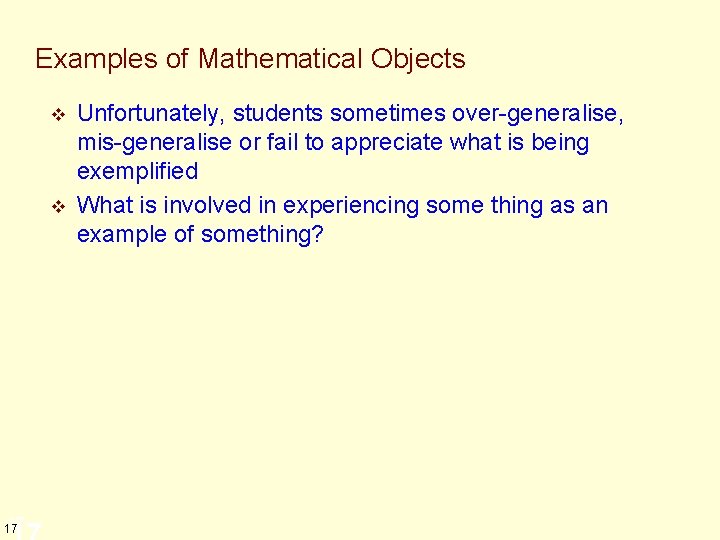
Examples of Mathematical Objects v v 17 17 Unfortunately, students sometimes over-generalise, mis-generalise or fail to appreciate what is being exemplified What is involved in experiencing some thing as an example of something?
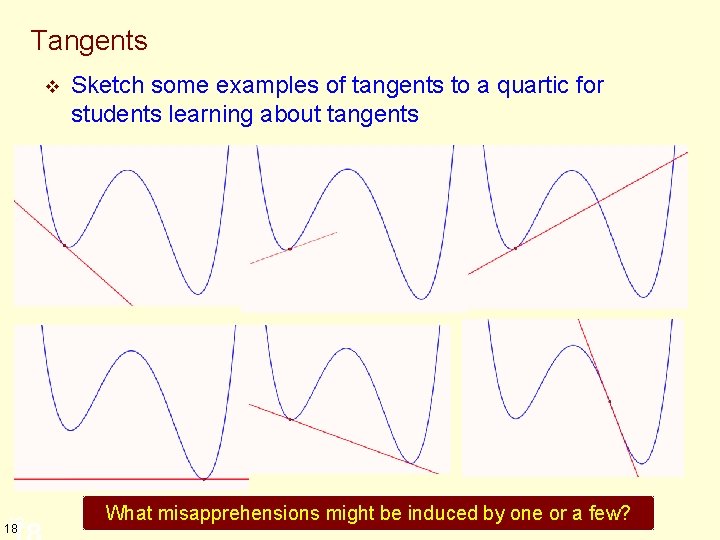
Tangents v 18 18 Sketch some examples of tangents to a quartic for students learning about tangents What misapprehensions might be induced by one or a few?
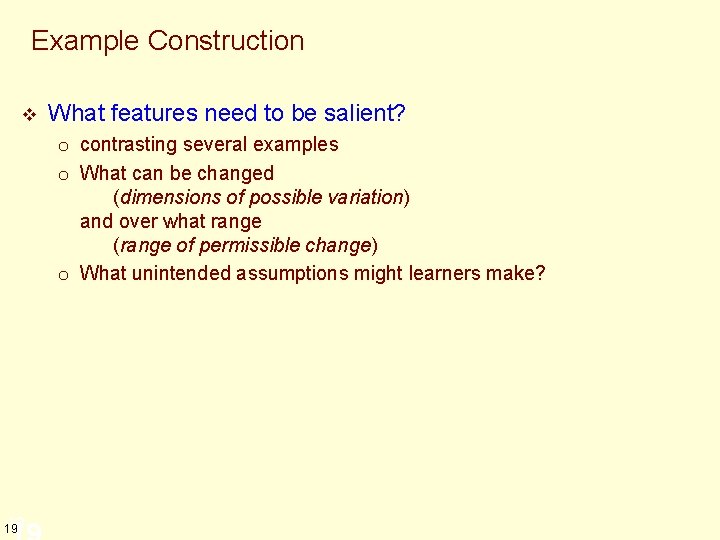
Example Construction v What features need to be salient? o contrasting several examples o What can be changed (dimensions of possible variation) and over what range (range of permissible change) o What unintended assumptions might learners make? 19 19
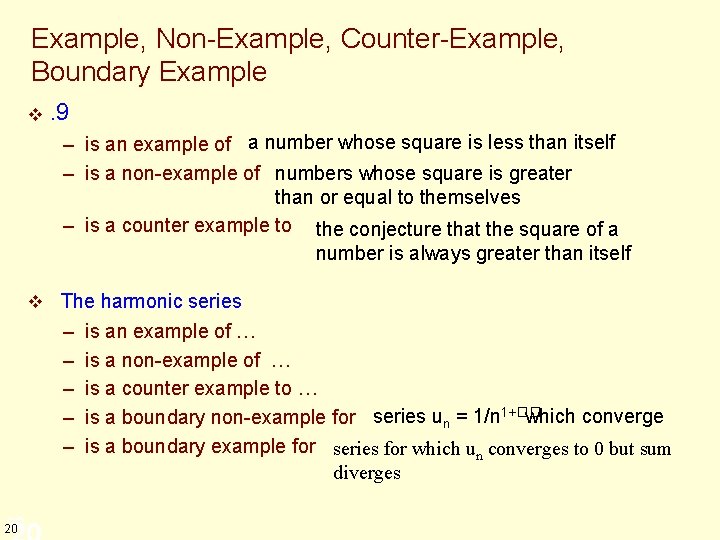
Example, Non-Example, Counter-Example, Boundary Example v . 9 – is an example of a number whose square is less than itself – is a non-example of numbers whose square is greater than or equal to themselves – is a counter example to the conjecture that the square of a number is always greater than itself v The harmonic series – – – 20 20 is an example of … is a non-example of … is a counter example to … which converge is a boundary non-example for series un = 1/n 1+�� is a boundary example for series for which un converges to 0 but sum diverges
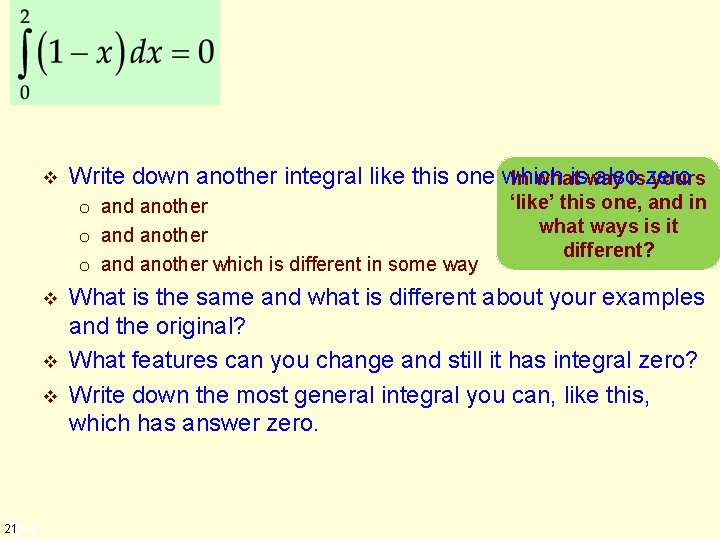
v Write down another integral like this one which is also zero In what way is yours o and another which is different in some way v v v 21 21 ‘like’ this one, and in what ways is it different? What is the same and what is different about your examples and the original? What features can you change and still it has integral zero? Write down the most general integral you can, like this, which has answer zero.
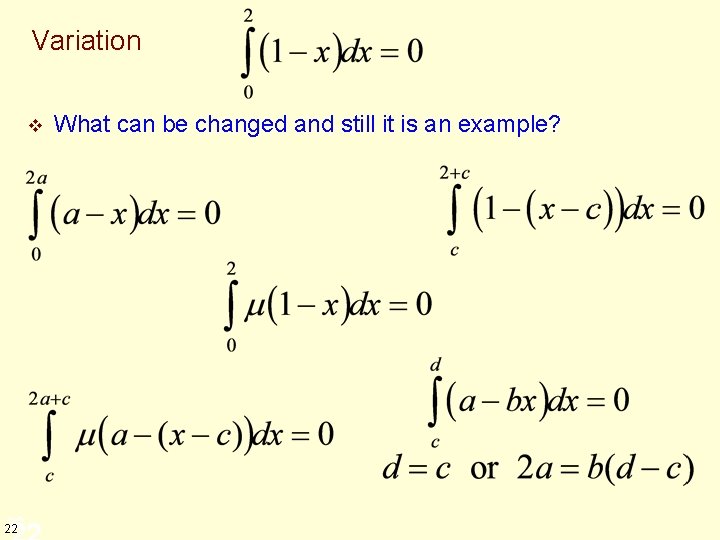
Variation v 22 22 What can be changed and still it is an example?
Mathematical Objects v Who produces examples? – Lecturer? – Students? v 23 23 What do they do with them?
Conjecture v When learners construct their own examples of mathematical objects they: – Extend and enrich their accessible example spaces – Become more engaged with and confident about their studies – Make use of their own mathematical powers – Experience. mathematics as a constructive and reative enterprise 24 24
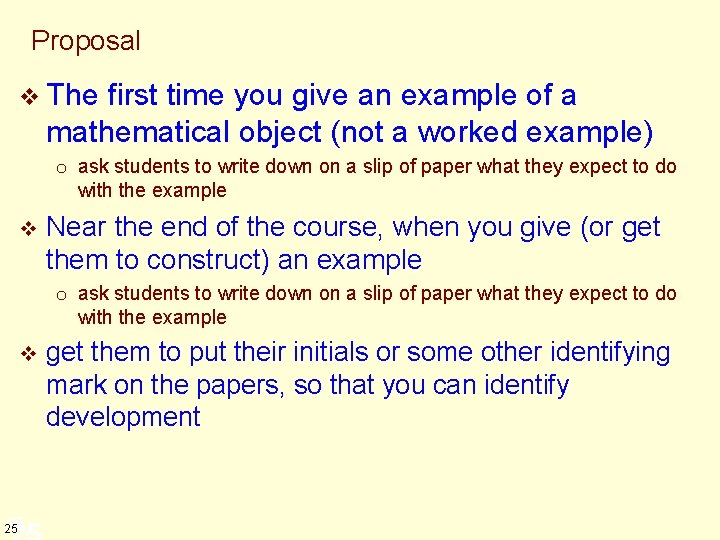
Proposal v The first time you give an example of a mathematical object (not a worked example) o ask students to write down on a slip of paper what they expect to do with the example v Near the end of the course, when you give (or get them to construct) an example o ask students to write down on a slip of paper what they expect to do with the example v 25 25 get them to put their initials or some other identifying mark on the papers, so that you can identify development
Preparing the Ground v Construct a function F : [a, b] --> R o which is continuous and differentiable on (a, b) o for which f(a) = f(b) o but nowhere on (a, b) is f’(x) = 0 v 26 26 Having attempted this, students are likely to appreciate the proof that it is impossible
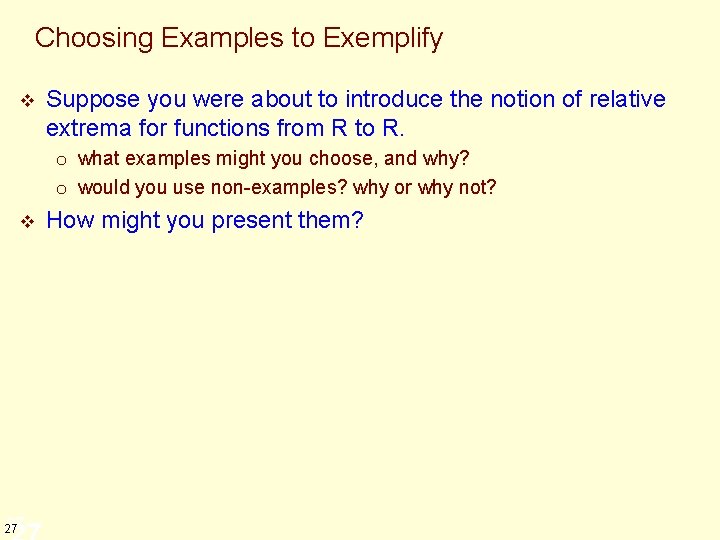
Choosing Examples to Exemplify v Suppose you were about to introduce the notion of relative extrema for functions from R to R. o what examples might you choose, and why? o would you use non-examples? why or why not? v 27 27 How might you present them?
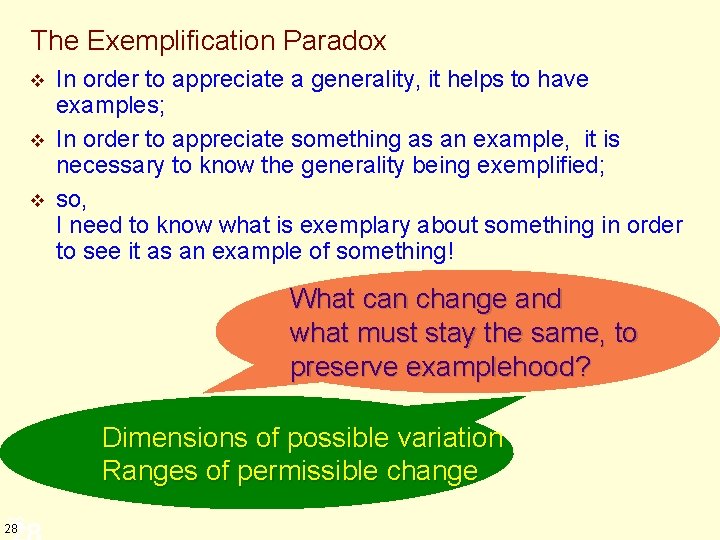
The Exemplification Paradox v v v In order to appreciate a generality, it helps to have examples; In order to appreciate something as an example, it is necessary to know the generality being exemplified; so, I need to know what is exemplary about something in order to see it as an example of something! What can change and what must stay the same, to preserve examplehood? Dimensions of possible variation Ranges of permissible change 28 28
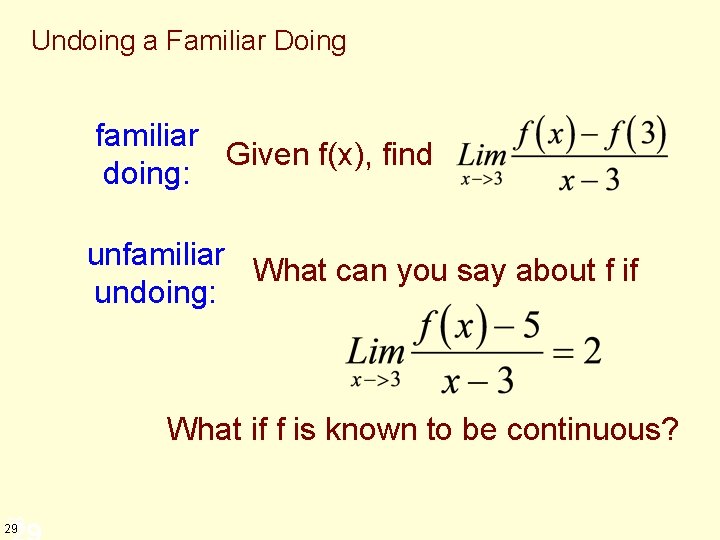
Undoing a Familiar Doing familiar Given f(x), find doing: unfamiliar What can you say about f if undoing: What if f is known to be continuous? 29 29
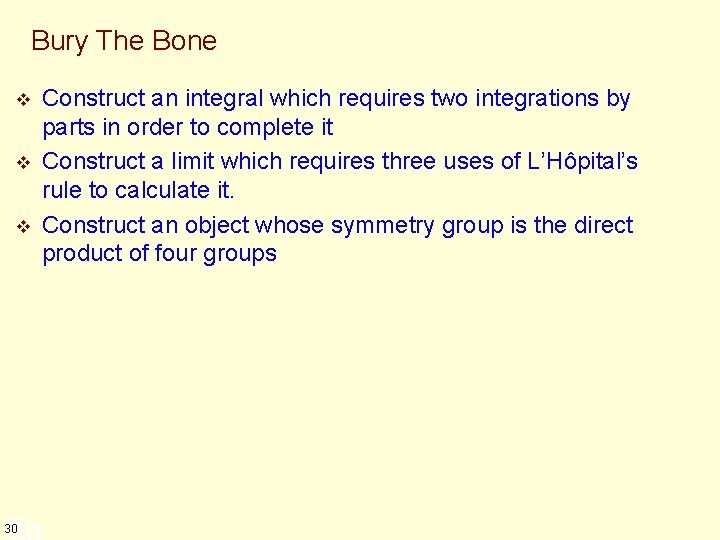
Bury The Bone v v v 30 30 Construct an integral which requires two integrations by parts in order to complete it Construct a limit which requires three uses of L’Hôpital’s rule to calculate it. Construct an object whose symmetry group is the direct product of four groups
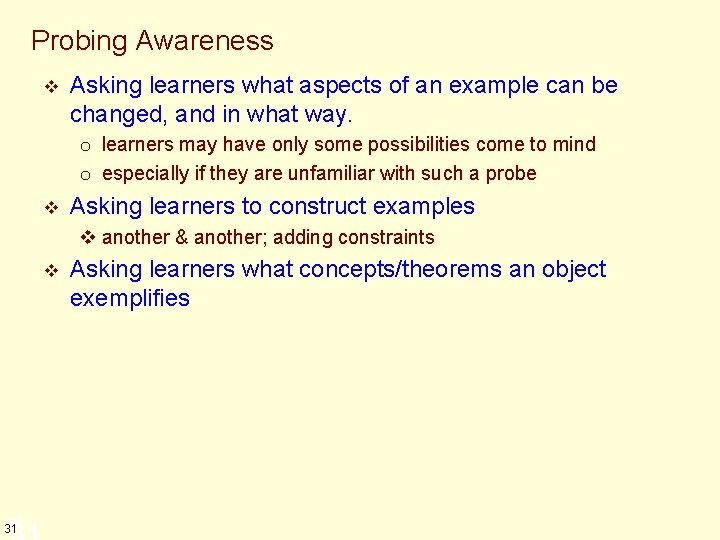
Probing Awareness v Asking learners what aspects of an example can be changed, and in what way. o learners may have only some possibilities come to mind o especially if they are unfamiliar with such a probe v Asking learners to construct examples v another & another; adding constraints v 31 31 Asking learners what concepts/theorems an object exemplifies
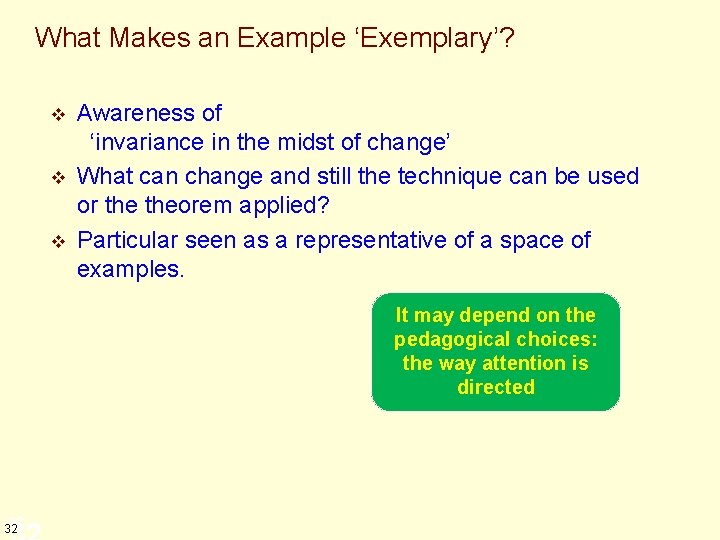
What Makes an Example ‘Exemplary’? v v v Awareness of ‘invariance in the midst of change’ What can change and still the technique can be used or theorem applied? Particular seen as a representative of a space of examples. It may depend on the pedagogical choices: the way attention is directed 32 32
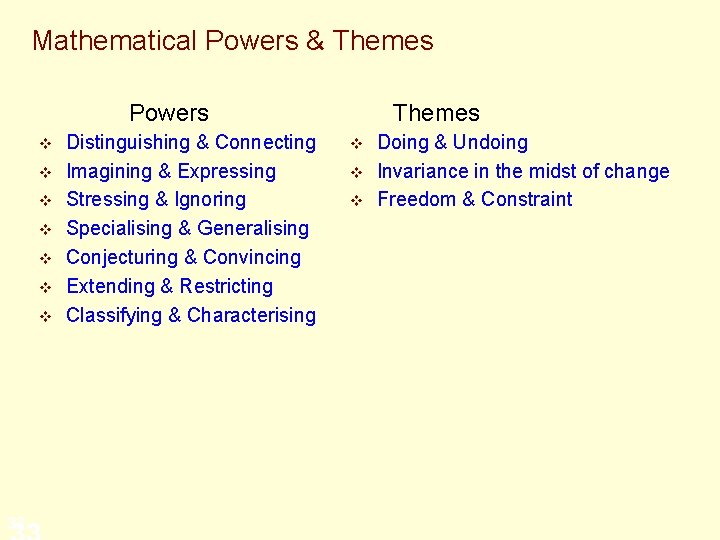
Mathematical Powers & Themes Powers v v v v 33 Distinguishing & Connecting Imagining & Expressing Stressing & Ignoring Specialising & Generalising Conjecturing & Convincing Extending & Restricting Classifying & Characterising v v v Doing & Undoing Invariance in the midst of change Freedom & Constraint
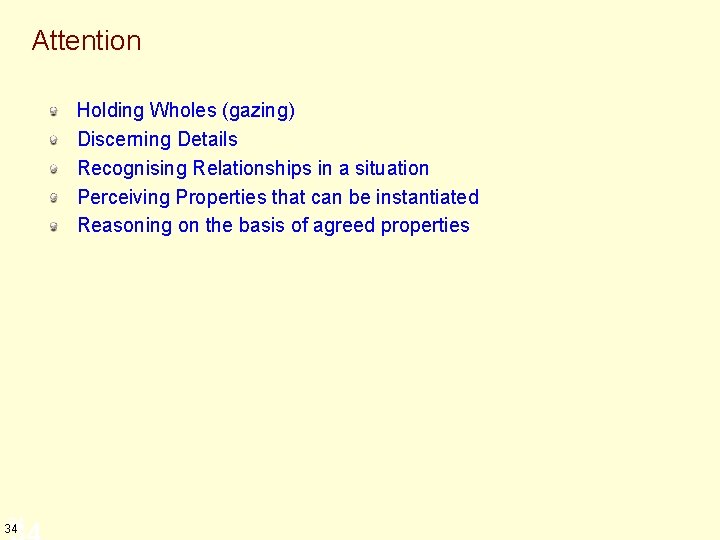
Attention Holding Wholes (gazing) Discerning Details Recognising Relationships in a situation Perceiving Properties that can be instantiated Reasoning on the basis of agreed properties 34 34
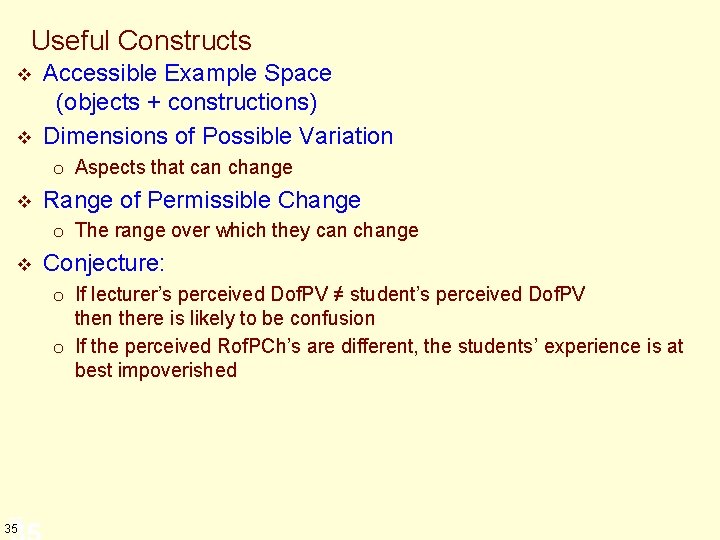
Useful Constructs v v Accessible Example Space (objects + constructions) Dimensions of Possible Variation o Aspects that can change v Range of Permissible Change o The range over which they can change v Conjecture: o If lecturer’s perceived Dof. PV ≠ student’s perceived Dof. PV then there is likely to be confusion o If the perceived Rof. PCh’s are different, the students’ experience is at best impoverished 35 35
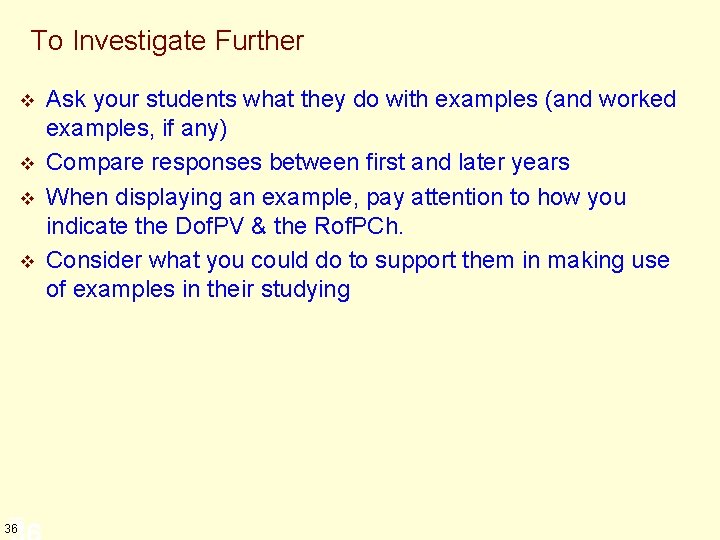
To Investigate Further v v 36 36 Ask your students what they do with examples (and worked examples, if any) Compare responses between first and later years When displaying an example, pay attention to how you indicate the Dof. PV & the Rof. PCh. Consider what you could do to support them in making use of examples in their studying
For MANY more tactics: ✤ Mathematics Teaching Practice: a guide for university and college lecturers, Horwood Publishing, Chichester, 2002. ✤ Mathematics as a Constructive Activity: learners constructing examples. Erlbaum 2005. ✤ Using Counter-Examples in Calculus College Press 2009. ✤ John. Mason @ open. ac. uk v www. PMTheta. com/jhm-Presentations. html [for these slides & Applets … for contributions to appreciating functions, derivatives, linear transformations] 37 37